


Introduction
In inertial confinement fusion (ICF) and laser-driven ion accelerator, high power laser interacts with a solid target (Snavely et al., Reference Snavely, Key, Hatchett, Cowan, Roth, Phillips, Stoyer, Henry, Sangster, Singh, Wilks, MacKinnon, Offenberger, Pennington, Yasuike, Langdon, Lasinski, Johnson, Perry and Campbell2000; Lindl et al., Reference Lindl, Landen, Edwards and Moses2014). When the laser beam comes into contact with the outer surface of this target, plasma is created due to ionization of target atoms by the electric field of the laser. This plasma expands outward from the surface. The density of this laser produced plasma is spatially inhomogeneous. Laser plasma instabilities (LPI) occur at different density region in this inhomogeneous plasma (Rosenbluth, Reference Rosenbluth1972; Weaver et al., Reference Weaver, Oh, Afeyan, Phillips, Seely, Feldman, Brown, Karasik, Serlin, Aglitskiy, Mostovych, Holland, Obenschain, Chan, Kehne, Lehmberg, Schmitt, Colombant and Velikovich2007), for example, parametric decay instability (PDI) occurs at the region where laser frequency (ω0) is greater than local plasma frequency (ωpe), while oscillating two-stream instability (OTSI) occurs in the denser region where ω0 is ≤ωpe (Chen, Reference Chen1985; Liu and Tripathi, Reference Liu and Tripathi1995).
In direct drive experiments (Craxton et al., Reference Craxton, Anderson, Boehly, Goncharov, Harding, Knauer, McCrory, McKenty, Meyerhofer, Myatt, Schmitt, Sethian, Short, Skupsky, Theobald, Kruer, Tanaka, Betti, Collins, Delettrez, Hu, Marozas, Maximov, Michel, Radha, Regan, Sangster, Seka, Solodov, Soures, Stoeckl and Zuegel2015), this interaction occurs in the outer corona which is made of carbon and hydrogen ions. While in indirect drive experiments (Lindl et al., Reference Lindl, Amendt, Berger, Glendinning, Glenzer, Haan, Kauffman, Landen and Suter2004), these instabilities occur in the low Z H/He plasma and high Z Au blow-off plasma in the vicinity of hohlraum wall. In the blow-off plasma near the Au hohlraum wall, the ion species is mostly due to high Z Au ions. The typical density of these ions is in the range n i ≤ 1021 cm−3 (n cr ≈ 1022 cm−3 for λlaser ≈ 351 nm, n cr is the critical density), the ion temperature T i is typically in the range 5–50 eV and Z ≈ 10 − 20 (for Au ions). Under these conditions, Sharma et al. (Reference Sharma, Avinash and Gupta2016) have shown the ratio of typical electrostatic potential energy to typical kinetic energy of Au ions is >1, that is,  ${{\rm \Gamma} _i = \lpar {Z^{\rm 2}e^{\rm 2}/a_iT_i} \rpar \gt {\rm 1}}$; where Γi is the ion coupling parameter and a i ( = (3/4πn i)1/3) is the mean distance between ions. Thus the high Z Au ions may become strongly coupled. These instabilities can also occur in plasma relevant to laser-driven ion accelerator near the target surface (Wilks et al., Reference Wilks, Langdon, Cowan, Roth, Singh, Hatchett, Key, Pennington, MacKinnon and Snavely2001; Esirkepov et al., Reference Esirkepov, Koga, Sunahara, Morita, Nishikino, Kageyama, Nagatomo, Nishihara, Sagisaka, Kotaki, Nakamura, Fukuda, Okada, Pirozhkov, Yogo, Nishiuchi, Kiriyama, Kondo, Kando and Bulanov2014). In this process, a thin target foil (hydrogen, carbon or aluminum) is irradiated by an intense laser pulse. The laser prepulse creates a preplasma on the target's front side, where the density of plasma is near critical density (Esirkepov et al., Reference Esirkepov, Koga, Sunahara, Morita, Nishikino, Kageyama, Nagatomo, Nishihara, Sagisaka, Kotaki, Nakamura, Fukuda, Okada, Pirozhkov, Yogo, Nishiuchi, Kiriyama, Kondo, Kando and Bulanov2014). The main pulse interacts with the plasma and accelerates a part of target electrons, mainly in the forward direction. The electrons so accelerated create charge separation. The charge separation provides a strong electric field by which the target ions are accelerated. This ion acceleration mechanism is called as target normal sheath acceleration (Wilks et al., Reference Wilks, Langdon, Cowan, Roth, Singh, Hatchett, Key, Pennington, MacKinnon and Snavely2001). The typical target ions can be hydrogen, carbon, oxygen or aluminum. In this case, the plasma density is close to the critical density n cr, Z is ≈ 5–10 (for Al ion) and the temperature of the ions is in the range 10–100 eV, hence the ions may become strongly coupled in the preplasma. For example, with ion density in the range n i ≈ 1021 cm−3, the mean particle distance a i is ≈ 6 × 10⁻⁸ cm. Then for Al ions with temperature T i ≈ 30 eV and Z = 9, the ion coupling parameter,
 ${{\rm \Gamma} _i = \lpar {Z^{\rm 2}e^{\rm 2}/a_iT_i} \rpar}$ ≈ 7. The electrons are still weakly coupled due to smaller charge and higher temperature, as for T e ≈ 50 − 500 eV and Z = 1, Γe <1.
Extensive studies related to LPI have been done by various authors in the weakly coupled plasma. Kirkwood et al. (Reference Kirkwood, Macgowan, Montgomery, Afeyan, Kruer, Moody, Estabrook, Back, Glenzer, Blain, Williams, Berger and Lasinski1996) have reported experimental results on stimulated Raman scattering (SRS) and stimulated Brillouin Scattering (SBS) from Xe plasma embedded with C 5H 12impurities. Fernandez et al. (Reference Fernandez, Cobble, Failor, Dubois, Montgomery, Rose, Vu, Wilde, Wilke and Chrien1996) have observed the dependence of SRS on ion acoustic damping in hohlraum plasmas. Yadav et al. (Reference Yadav, Tripathi and Gupta2003) have studied SBS of a laser in a high-Z plasma channel embedded with light ions. Satya et al. (Reference Satya, Jain, Guha and Bose1985) obtained the analytical reductions of the low-frequency dispersion relation of the field- plasma system, including results on the OTSI. Kumar and Malik (Reference Kumar and Malik2006) studied the effect of negative ions on OTSI of laser-driven plasma beat wave in homogeneous plasma. All the above-mentioned studies of plasma instabilities containing high Z ions have been done in the weakly coupled plasma, that is, Γi,e <1. In addition, other types of instabilities have been studied in different types of plasma models (Malik and Singh, Reference Malik and Singh2011; Singh et al., Reference Singh, Malik and Nishida2013; Malik et al., Reference Malik, Singh, Malik and Kumar2015a; Reference Malik, Singh, Malik and Kumar2015b; Tyagi et al., Reference Tyagi, Singh and Malik2018).
In recent years, a great deal of attention has been focused on different plasma instabilities in strongly coupled plasma also. Janaki et al. (Reference Janaki, Chakrabarti and Banerjee2011) studied Jeans instability in a viscoelastic gravitational fluid. Das and Kaw (Reference Das and Kaw2014) have studied the suppression of Rayleigh Taylor instability in strongly coupled plasmas. Sharma et al. (Reference Sharma, Avinash and Gupta2016) studied the parametric instabilities (stimulated Brillouin scattering, PDI, and Langmuir decay instability) in laser plasmas with strongly correlated/coupled ions. In this paper, we study the OTSI of a high power laser in plasma where ions are strongly coupled. OTSI is an important non-linear process in a high power laser–plasma interaction near the critical layer (Fried et al., Reference Fried, Kemura, Nishikawa and Schmidt1976; Nicholson, Reference Nicholson1981; Mulser et al., Reference Mulser, Giulietti and Vaselli1984). In this process, a laser or a long wavelength plasma wave decays into a low-frequency mode and two Langmuir wave sidebands. In uniform plasma, the low-frequency mode turns out to be purely growing with time and the growth rate is less than or comparable with the ion plasma frequency. OTSI of a laser in two ion species plasma was shown by Yadav et al. (Reference Yadav, Gupta, Tripathi and Gupta2004). Malik (Reference Malik2007) investigated OTSI in a negative ion containing plasma with hot and cold positive ions and found that the effects of charge number and mass of the ions are significant on the instability. But OTSI in strongly coupled plasma has not been studied yet.
In the strongly coupled regime, the ion fluid behaves like a strongly coupled visco-elastic fluid (Frenkel, Reference Frenkel1946; Boon and Yip, Reference Boon and Yip1980). In our paper, we take into account these strong coupling effects via generalized hydrodynamic (GHD) equation for ions (Berkovsky, Reference Berkovsky1992; Kaw and Sen, Reference Kaw and Sen1998; Murillo, Reference Murillo1998). In this equation, the strong coupling effects are parameterized by a typical relaxation time τm(Γi). For τm = 0 there are no memory effects and the GHD equation reduces to the standard Navier Stokes equation for viscous medium. On the other hand in the limit τm → ∞ memory effects persist and the medium acquires solid like elastic properties. In the range 0 < τm < ∞, the medium has viscous as well solid like elastic properties that is, viscoelastic fluid. Electrons are still weakly correlated. It should also be noted that in this parameter regime, the electrons and the ions, both are well within the non-degenerate regime. This phenomenon is of relevance to studies of plasma heating, ICF and laser-driven ion accelerator.
The paper is organized as follows in the section Governing equations the governing equations for strongly coupled ions and weakly coupled electrons are discussed. In the section Oscillating two-stream instability the effects of the strong correlation of ions on OTSI has been studied. The last section summarizes the conclusion.
Governing equations
In our model, we consider strongly coupled ions. These ions could be either the high Z Au ions in the blow-off plasma near the vicinity of hohlraum or the Al ions in the preplasma of the target front in laser-driven ion accelerator. The dynamics of the strongly coupled ions is described by GHD equation given by
 $$\matrix{\displaystyle{{d\,{\vec{v}}_i\lpar {\vec{r},t} \rpar } \over {dt}} + \displaystyle{{\nabla P_i(\vec{r},t)} \over {n_im_i}} + \displaystyle{{Ze\nabla {\rm \varphi} (\vec{r},t)} \over {m_i}} = \hfill \cr \quad \int_{-\infty} ^t {d{t}^{\prime}} \int {d{r}^{\prime}{\rm \eta} _i\lpar {\vec{r}-{\vec{r}}^{\,\,\prime},t-{t}^{\prime}} \rpar } {\vec{v}}_i\lpar {{\vec{r}}^{\,\,\prime},{t}^{\prime}} \rpar \hfill}, $$
where  ${d/dt = \lpar {\partial /\partial t + {\vec{v}}_i\cdot \nabla} \rpar }$,
 $\vec{v}_i$ is the ion fluid velocity, P i is the ion pressure, m i is mass of the ion, n i is ion density, φ is the electrostatic potential, Z = q i/e, q i is the charge on multiple charged Au or Al ion, e is the electronic charge and ηi is a non-local ion viscoelastic operator (as defined in the section Oscillating two-stream instability). The continuity equation for ions is given by
 $${\displaystyle{{\partial n_i} \over {\partial t}} + \nabla \cdot \lpar {n_i{\vec{v}}_i} \rpar = {\rm 0}}.$$
Eqs. (1) and (2) will be used to calculate the ion susceptibility with strong correlation effects. The electron fluid is weakly coupled which is governed by following a set of equations
 $${\displaystyle{{\partial n_e} \over {\partial t}} + \nabla \cdot \lpar {n_e{\vec{v}}_e} \rpar = 0},$$
 $${n_em_e\displaystyle{{d{\vec{v}}_e} \over {dt}} = en_e\nabla {\rm \varphi} -en_e\displaystyle{{{\vec{v}}_e \times \vec{B}} \over c}-\nabla P_e},$$
where  ${d/dt = \lpar {\partial /\partial t + {\vec{v}}_e\cdot \nabla} \rpar }$,
 $\vec{B}$ is magnetic field, m e is mass of electron, P eis the electron pressure and
 ${n_e,{\vec{v}}_e}$ are electron number density and velocity, respectively. These equations are supplemented with the set of Maxwell's equations.
 $$\eqalign{ \nabla \cdot \vec{E} &= 4{\rm \pi} e\lpar {Zn_i-n_e} \rpar ,\nabla \times \vec{E} = \cr & \quad -\displaystyle{1 \over c}\displaystyle{{\partial \vec{B}} \over {\partial t}},\nabla \times \vec{B} = \displaystyle{{4{\rm \pi}} \over c}\vec{J} + \displaystyle{1 \over c}\displaystyle{{\partial \vec{E}} \over {\partial t}},\nabla \cdot \vec{B} = 0,} $$
where  $\vec{J} = e\lpar {Zn_i{\vec{v}}_i-n_e{\vec{v}}_e} \rpar $ is the net plasma current density.
Oscillating two-stream instability
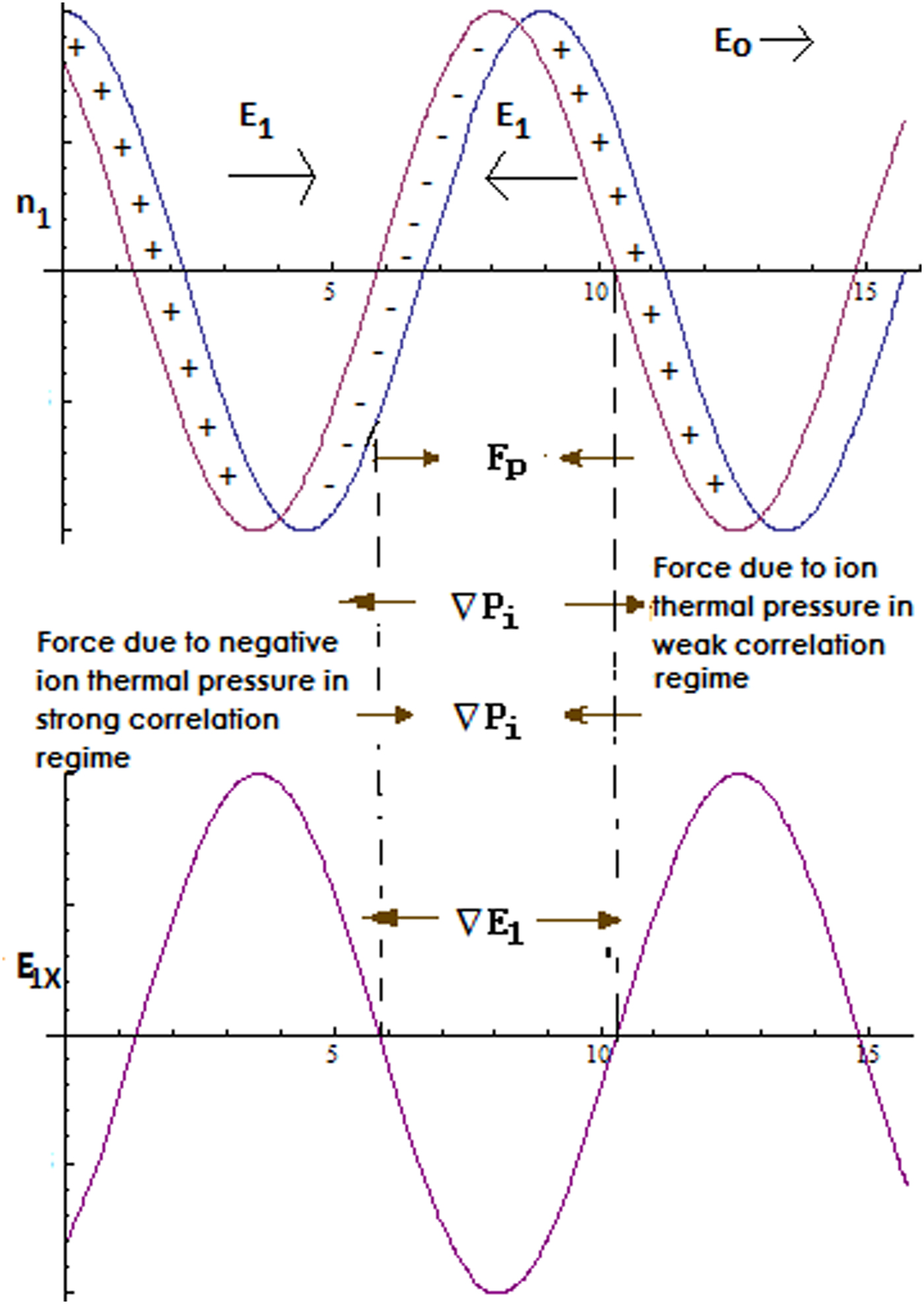
In OTSI a long wavelength laser pump wave excites short wavelength electrostatic waves and a low-frequency mode which is a purely growing density perturbation. The physics of this instability is as follows (Chen, Reference Chen1985). Consider a quasi-neutral density perturbation in plasma as shown in Figure 1. In case when pump frequency ω0 is less than ωpe, which is the resonant frequency of cold electron fluid, electrons move opposite to the direction of laser electric field. Since ions do not respond on the high-frequency time scale, an electric field is created due to the charge separation. The ponderomotive force ( $\mathop {F_p}\limits^\to $) due to this electric field creates a bunching of ions which causes OTSI. The pressure gradient of electrons and ions oppose the tendency of bunching which results in the threshold of OTSI. We will show later, that the ion pressure gets modified due to the strong coupling effects. It decreases with Γi and in certain parameter regime (Γi >4) it becomes negative. Ion bunch collapse under this negative pressure as shown in Figure 1 thereby leading to significant enhancement of ion bunching and destabilization OTSI.
Physical mechanism of OTSI in weakly and strongly coupled plasma.
Consider a laser pump  $({\rm \omega} _0,\,\vec{k}_0)$ decays into two sideband waves (
 ${\rm \omega} _{a,b},\vec{k}$) and one low frequency (
 ${\rm \omega}, \,\vec{k}$) mode density perturbation where
 ${\rm \omega} _{a,b} = {\rm \omega} \mp {\rm \omega} _0$ and
 $\vec{k}_0\approx 0$. Here (
 ${\rm \omega}, \,\vec{k}$) may not be an eigenmode of the system; it could be a driven mode. However, the sidebands are the Langmuir eigenmodes within a slight frequency mismatch due to nonlinear coupling. The dipole laser pump field is taken to be coherent given by
 $\vec{E}_0 = \hat{z}A_0e^{-i{\rm \omega} _0t}$ with ω0 ≈ ωpe. The electrostatic potentials are
 $${\rm \varphi} _l = Ae^{-i({\rm \omega} t-\vec{k}\cdot \vec{r})},$$
 $${\rm \varphi} _{a,b} = A_{a,b}e^{-i({\rm \omega} _{a,b}t-\vec{k}\cdot \vec{r})}.$$
The perturbed equation of motion for electron fluid is
 $$n_{e0}m_e\left( {\displaystyle{{\partial {\vec{v}}_{e1}} \over {\partial t}} + {\vec{v}}_{e1}\cdot \nabla {\vec{v}}_{e1}} \right) = -en_{e0}(\vec{E}_0-\nabla {\rm \varphi} )-\nabla P_{e1}.$$
The perturbed electron continuity equation is
 $$\displaystyle{{\partial n_{e1}} \over {\partial t}} + n_{e0}\nabla \cdot \vec{v}_{e1} + \nabla \cdot \left( {\displaystyle{1 \over 2}n_{e1}{\vec{v}}_{e1}} \right) = 0,$$
where  $\vec{v}_{e1},P_{e1},n_{e1,}{\rm \varphi} $ are the perturbed electron velocity, pressure, density, and the electric potential, respectively, and n e0 is the equilibrium electron density. Here the electrons will contribute to both, the high-frequency part and the low-frequency part. The high-frequency part corresponds to the laser (ω0) and sidebands (ωa, ωb) where electrons move independently of ions and the low-frequency part corresponds to the low-frequency mode (ω)where the electrons move along with ions in quasi-neutral manner. Hence for the electrons the quantities
 $\vec{v}_{e1},\,P_{e1},\,n_{e1},$ and φ each contains a high-frequency part (
 $\vec{v}_{e0}$,
 $\vec{v}_{ea,b},\,P_{ea,b},\,{\rm \varphi} _{a,b}$, and n ea,b) and a low-frequency part (
 $\vec{v}_{el},\,P_{el},\,{\rm \varphi} _l$, and n el).
To the lowest order of Eq. (8), the motion in response to high-frequency laser electric field E 0 is
 $$\displaystyle{{\partial {\vec{v}}_{e0}} \over {\partial t}} = -\displaystyle{{e{\vec{E}}_0} \over {m_e}}$$
This gives the electron oscillatory velocity 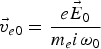 $\vec{v}_{e0} = \displaystyle{{e{\vec{E}}_0} \over {m_ei{\rm \omega} _0}}$.
For the high-frequency sidebands, the equation of motion for electron fluid is-
 $${m_e\displaystyle{{\partial {\vec{v}}_{ea,b}} \over {\partial t}} = e\nabla {\rm \varphi} _{a,b}-\displaystyle{{\nabla P_{ea,b}} \over {n_{e0}}}},$$
where  $\vec{v}_{ea,b}$, n ea,b, φa,b, and P ea,b correspond to the high-frequency part at
 ${\rm \omega} _{a,b},\vec{k}$. The oscillatory velocities of electrons correspond to sideband waves (neglecting the pressure term) will be
 $$\vec{v}_{ea,b} = -\displaystyle{{e\vec{k}} \over {m_e{\rm \omega} _{a,b}}}{\rm \varphi} _{a.b}.$$
In the low-frequency part, the sidebands, and the pump wave beat and produce a low-frequency ponderomotive force  $\vec{F}_p$ on electrons as ω = ωa,b ± ω0. Hence the equation of motion for low-frequency electrons along with the ponderomotive force is given by
 $$m_e\left( {\displaystyle{{\partial {\vec{v}}_{el}} \over {\partial t}} + {\vec{v}}_{e0}\cdot i\vec{k}{\vec{v}}_{ea} + \vec{v}_{e0}^{^\ast} \cdot i\vec{k}{\vec{v}}_{eb}} \right) = e\nabla {\rm \varphi} _l-\displaystyle{{i\vec{k}n_{el}T_e} \over {n_{e0}}},$$
where  $\vec{v}_{el}$, n el, and φl correspond to low-frequency part and T e is the electron temperature. The ponderomotive force
 $\vec{F}_p$ can be defined as
 $$\vec{F}_p = e\nabla {\rm \varphi} _p = -({{m_e} / 2})\nabla (\vec{v}_{e0}\cdot \vec{v}_{ea} + \vec{v}^{^\ast}_{e0} \cdot \vec{v}_{eb}).$$
This gives the ponderomotive potential
 $${\rm \varphi} _p = \displaystyle{{\vec{k}\cdot {\vec{v}}_{e0}} \over {2{\rm \omega} _a}}{\rm \varphi} _a + \displaystyle{{\vec{k}\cdot {\vec{v}}^{^\ast}_{e0}} \over {2{\rm \omega} _b}}{\rm \varphi} _b.$$
Using Eqs. (14) and (15) in Eq. (13) we get
 $$m_e\displaystyle{{\partial {\vec{v}}_{el}} \over {\partial t}} = e\nabla \lpar {{\rm \varphi}_l + {\rm \varphi}_p} \rpar -\displaystyle{{i\vec{k}n_{el}T_e} \over {n_{e0}}}.$$
The low-frequency part of Eq. (9) gives
 $$\displaystyle{{\partial n_{el}} \over {\partial t}} + n_{e0}i\vec{k}\cdot \vec{v}_{el} = 0.$$
Using Eqs. (16) and (17) we can find the low-frequency electron density perturbation which is due to the ponderomotive and self-consistent potential φp and φl
 $$n_{el} = \displaystyle{{k^2} \over {4{\rm \pi} e}}{\rm \chi} _e({\rm \varphi} _l + {\rm \varphi} _p),$$
where χ e is the low-frequency electron susceptibility at ω, k. For ω ≪ kv th (v th = (2T e/m e)1/2 is electron thermal speed),  ${\rm \chi} _e\approx {{2{\rm \omega} _{pe}^2} / {k^2v_{th}^2}} = {{{\rm \omega} _{pi}^2} / {k^2C_{s0}^2}} $ (where ωpi = ((4πn i0Z 2e 2)/m i)1/2is ion plasma frequency and C S0 = (ZT e/m i)1/2). The equation of motion of strongly coupled ion fluid is obtained by linearizing Eq. (1) as
 $$\matrix{\displaystyle{{\partial {\vec{v}}_{i1}\lpar {\vec{r},t} \rpar } \over {\partial t}} + \displaystyle{{\nabla P_{i1}(\vec{r},t)} \over {n_{i0}m_i}} + \displaystyle{{Ze\nabla {\rm \varphi} _l(\vec{r},t)} \over {m_i}} = \hfill \cr \quad \int_{-\infty} ^t {d{t}^{\prime}} \int {d{r}^{\prime}{\rm \eta} _i\lpar {\vec{r}-\vec{{r}^{\prime}},t-{t}^{\prime}} \rpar } {\vec{v}}_{i1}\lpar {\vec{{r}^{\prime}},{t}^{\prime}} \rpar \hfill}, $$
where  $\vec{v}_{i1},P_{i1},{\rm \varphi} _l$ are the perturbed ion velocity, pressure and the electric potential, respectively, and n i0 equilibrium ion density. The quantity ηi may be identified as a nonlocal viscoelastic operator (Berkovsky, Reference Berkovsky1992; Kaw and Sen, Reference Kaw and Sen1998) which accounts for memory effects and for the short-range order that begins to develop in the plasma as a result of the growing correlation between the ions with increasing values of Γi. If the memory function is regarded as a simple exponential function with τm as the relaxation time, then the Fourier transform of ηi can be expressed as (Kaw and Sen, Reference Kaw and Sen1998)
 $${\rm \eta} _i\lpar {{\rm \omega}, k} \rpar = \displaystyle{{{\rm \eta} k^2 + \left( {\displaystyle{{\rm \eta} \over 3} + {\rm \zeta}} \right)\vec{k}(\vec{k}\cdot )} \over {m_in_{i0}\lpar {1-i{\rm \omega} {\rm \tau}_m} \rpar }},$$
where ω and k are the frequency and the wave number of the low-frequency mode, η, ζ are shear and bulk viscosities. Combining Eqs. (19) and (20) we can express the GHD equation as
 $$\matrix{\left[ {{\rm 1} + {\rm \tau}_m\displaystyle{\partial \over {\partial t}}} \right]\left[ {m_{i}n_{i0}\displaystyle{{\partial {\vec{v}}_{i1}} \over {dt}} + Zen_{i0}\nabla {\rm \varphi}_l + \nabla P_{i1}} \right] \hfill \cr \quad = {\rm \eta} \nabla \cdot \nabla {\vec{v}}_{i1} + \left( {{\rm \zeta} + \displaystyle{{\rm \eta} \over 3}} \right)\nabla \lpar {\nabla \cdot {\vec{v}}_{i1}} \rpar. \hfill} $$
Linearizing the ion continuity equation given by Eq. (2)
 $$\displaystyle{{\partial n_{i1}} \over {\partial t}} + n_{i0}i\vec{k}\cdot \vec{v}_{i1} = 0.$$
The ion density perturbation n i1 can be obtained by using Eq. (22) to eliminate the perturbed velocity in Eq. (21) which gives
 $$n_{i1} = -\displaystyle{{k^2} \over {4{\rm \pi} Ze}}{\rm \chi} _i{\rm \varphi} _l,$$
where χ i is the ion susceptibility such that
 $${\rm \chi} _i = -\displaystyle{{{\rm \omega} _{\,pi}^2} \over {\left[ {{\rm \omega}^{\rm 2}-{\rm \gamma}_i{\rm \mu}_ik^{\rm 2}v_{thi}^2 + \displaystyle{{i{\rm \omega} {\rm \eta}^{^\ast}k^2a_i^2 {\rm \omega}_{\,pi}} \over {(1-i{\rm \omega} {\rm \tau}_m)}}} \right]}},$$
where γ i = C pi/C vi is an adiabatic index, v thi = (2T i/m i)1/2 is the ion thermal velocity,  ${\rm \mu} _i\lpar {{\rm \Gamma}_i} \rpar = \lpar {1/T_i} \rpar \lpar {\partial P_i/\partial n_i} \rpar _{T_i} = 1 + u({\rm \Gamma} _i)/3 \;+ \lpar {{\rm \Gamma}_i/9} \rpar \partial u({\rm \Gamma} _i)/\partial {\rm \Gamma} _i$ is compressibility (Ichimaru et al., Reference Ichimaru, Iyetomi and Tanaka1987) and u(Γi) is the normalized excess internal energy. For weakly coupled plasma (Γi <1),
 $u({\rm \Gamma} _i)\approx -\sqrt 3 /2\,\,{\rm \Gamma} _i^{3/2} $ and for 1 ≤ Γi ≤ 200, Slattery et al. (Reference Slattery, Doolen and DeWitt1980; Reference Slattery, Doolen and DeWitt1982) have given the empirical relation
 $u({\rm \Gamma} _i) = -0.89{\rm \Gamma} _i + 0.95{\rm \Gamma} _i^{1/4} + 0.19{\rm \Gamma} _i^{-1/4} -0.81$. For weak coupling (Γi ≈ 0) the value of μ i = 1. As we increase Γi the value of μ i decreases, goes to 0 for Γcr ≈ 3 and becomes negative for Γi >Γcr. Here τm and η* are given by
 $${\rm \tau} _m = \displaystyle{{{\rm \eta} ^{^\ast}} \over {{\rm \omega} _{\,pi}{\rm \lambda} _i^2}} \displaystyle{{a_i^2} \over {1-{\rm \gamma} _i{\rm \mu} _i + \displaystyle{4 \over {15}}u({\rm \Gamma} _i)}}$$
 $${\rm \eta} {^\ast} = \displaystyle{{\left( {\displaystyle{{4{\rm \eta}} \over 3} + {\rm \zeta}} \right)} \over {m_in_{i0}{\rm \omega} _{\,pi}a_i^2}} $$
where λi and a i are the Debye length and mean interparticle distance for ions, respectively. The dependence of η* on Γi is more complicated and cannot be expressed in a simple closed form. Numerically calculated values using codes (Ichimaru et al., Reference Ichimaru, Iyetomi and Tanaka1987) show that it is of order unity (≈1.12) for values of Γi close to 1, goes to a minimum value (≈0.06) for Γi ≈ 10 and then monotonically increases for higher values of Γi.
Poisson's equation for the low-frequency part is given by
 $$k^2{\rm \varphi} _l = 4{\rm \pi} e\lpar {Zn_{i1}-n_{el}} \rpar .$$
Substituting the value of n el and n i1 from Eqs. (18) and (23) in Eq. (26) we get
 $${\rm \varepsilon} {\rm \varphi} _l = -{\rm \chi} _e{\rm \varphi} _p,$$
where ε = 1 + χ i + χ e.
Using Eq. (9), the continuity equation for sidebands is given by
 $$\displaystyle{{\partial n_{ea}} \over {\partial t}} + n_{e0}i\vec{k}\cdot \vec{v}_{ea} + i\vec{k}\cdot \left( {\displaystyle{1 \over 2}n_{el}{\vec{v}}^{^\ast}_{e0}} \right) = 0,$$
 $$\displaystyle{{\partial n_{eb}} \over {\partial t}} + n_{e0}i\vec{k}\cdot \vec{v}_{eb} + i\vec{k}\cdot \left( {\displaystyle{1 \over 2}n_{el}{\vec{v}}_{e0}} \right) = 0.$$
Using Eqs. (11), (28) and  $({\rm \omega} _j,\vec{k})$ (29), the linear density perturbations at the sidebands are given by
 $$n_{ej}^L = \displaystyle{{k_{}^2} \over {4{\rm \pi} e}}{\rm \chi} _{ej}{\rm \varphi} _j,\quad j = a,b,$$
where χ ej is the electron susceptibility at sideband. One may write  ${\rm \chi} _{ej} = -({\rm \omega} _{pe}^2 + (3/2)k_{}^2 v_{th}^2 )/{\rm \omega} _j^2 $. The non-linear density perturbations at (
 ${\rm \omega} _{a,b},\vec{k}$) due to the conjunction of density perturbation n el with oscillatory velocity v e0 from Eqs. (28) and (29) are
 $$n_{ea}^{NL} = \displaystyle{{\vec{k}\cdot {\vec{v}}^{^\ast}_{e0}} \over {2{\rm \omega} _a}}n_{el} = \displaystyle{{\vec{k}\cdot {\vec{v}}^{^\ast}_{e0}} \over {2{\rm \omega} _a}}\displaystyle{{k^2(1 + {\rm \chi} _i){\rm \chi} _e{\rm \varphi} _p} \over {4{\rm \pi} e{\rm \varepsilon}}}, $$
 $$n_{eb}^{NL} = \displaystyle{{\vec{k}\cdot {\vec{v}}_{e0}} \over {2{\rm \omega} _b}}n_{el} = \displaystyle{{\vec{k}\cdot {\vec{v}}_{e0}} \over {2{\rm \omega} _b}}\displaystyle{{k^2(1 + {\rm \chi} _i){\rm \chi} _e{\rm \varphi} _p} \over {4{\rm \pi} e{\rm \varepsilon}}}. $$
The Poisson's equation for high-frequency sidebands is
 $$k^2{\rm \varphi} _{a,b} = -4{\rm \pi} e\lpar {n_{ea,b}^L + n_{ea,b}^{NL}} \rpar .$$
Using Eqs. (30)–(32) in Eq. (33), we obtain
 $${\rm \varepsilon} _j{\rm \varphi} _j = {{-4{\rm \pi} en_{ej}^{NL}} / {k_{}^2}}, \quad j = a,b,$$
where  ${\rm \varepsilon} _j = 1 + {\rm \chi} _{ej} = 1-({\rm \omega} _{pe}^2 + (3/2)k_{}^2 v_{th}^2 )/{\rm \omega} _j^2 $. Using Eqs. (27), (31) and (32) in Eq. (34) we get
 $${\rm \varphi} _a = \displaystyle{{\vec{k}\cdot {\vec{v}}^{^\ast}_{e0}} \over {2{\rm \omega} _a{\rm \varepsilon} _a}}\lpar {1 + {\rm \chi}_i} \rpar {\rm \varphi} _l,$$
 $${\rm \varphi} _b = \displaystyle{{\vec{k}\cdot {\vec{v}}_{e0}} \over {2{\rm \omega} _b{\rm \varepsilon} _b}}\lpar {1 + {\rm \chi}_i} \rpar {\rm \varphi} _l.$$
Using Eqs. (15), (35) and (36) in Eq. (27), we finally obtain the dispersion relation for OTSI as
 $${\rm \varepsilon} = -{\rm \chi} _e\lpar {1 + {\rm \chi}_i} \rpar \displaystyle{{{\vert {\vec{k}\cdot {\vec{v}}_{e0}} \vert } ^2} \over 4}\left( {\displaystyle{1 \over {{\rm \omega}_a^2 {\rm \varepsilon}_a}} + \displaystyle{1 \over {{\rm \omega}_b^2 {\rm \varepsilon}_b}}} \right).$$
Define a frequency mismatch  ${\rm \Delta} = {\rm \omega} _0-\lpar {{\rm \omega}_{pe}^2 + (3/2)k^2v_{th}^2} \rpar ^{{1 / 2}}$ and substituting the value εa,b and ωa,b in Eq. (37), we can write the dispersion relation as
 $${\rm \varepsilon} = -{\rm \chi} _e\lpar {1 + {\rm \chi}_i} \rpar \displaystyle{{{\vert {\vec{k}\cdot {\vec{v}}_{e0}} \vert } ^2} \over 4}\displaystyle{{\rm \Delta} \over {{\rm \omega} _0\lpar {{\rm \Delta}^2-{\rm \omega}^2} \rpar }}.$$
Now using Eq. (38) we will study OTSI in two limits that is, kinetic limit where ωτ m > 1 and the hydrodynamic limit where ωτ m < 1. Here ω represents the frequency of the ion or the low-frequency mode. We first consider the kinetic regime.
Kinetic regime
In this regime ωτ m > 1, we can write χ e and χ i from Eq. (24) as follows
 $${{\rm \chi} _e} = {{\rm \omega} _{\,pi}^2 /k^2C_{s0}^2}, \,\,{{\rm \chi} _i = -\displaystyle{{{\rm \omega} _{\,pi}^2} \over {\left[ {{\rm \omega}^{\rm 2}-{\rm \gamma}_i{\rm \mu}_ik^{\rm 2}v_{thi}^2 -\displaystyle{{{\rm \eta}^{^\ast}{\rm \omega}_{\,pi}k^2a_i^2} \over {{\rm \tau}_m}}} \right]}}}$$
Using Eq. (25a) we can write Eq. (39) -
 $${\rm \chi} _i = -\displaystyle{{{\rm \omega} _{\,pi}^2} \over {\left[ {{\rm \omega}^{\rm 2}-(1 + \displaystyle{4 \over {15}}u({\rm \Gamma}_i))k^2v_{thi}^2} \right]}}$$
On substituting these values in Eq. (38) we get a biquadratic equation of ω
 $$\eqalign{& \lpar {{\rm \omega}^2-{\rm \Delta}^2} \rpar \left( {{\rm \omega}^2-\left( {1 + \displaystyle{4 \over {15}}u({\rm \Gamma}_i)} \right)k^2v_{thi}^2 -\displaystyle{{{\rm \omega}_{\,pi}^2} \over {\left( {1 + \displaystyle{{{\rm \omega}_{\,pi}^2} \over {k^2C_{s0}^2}}} \right)}}} \right) \cr & \quad = L\left( {{\rm \omega}^2-\left( {1 + \displaystyle{4 \over {15}}u({\rm \Gamma}_i)} \right)k^2v_{thi}^2 -{\rm \omega}_{\,pi}^2} \right){\rm \Delta},} $$
which can be simplified as
 $$\eqalign{& {\rm \omega} ^4-{\rm \omega} ^2\lpar {{\rm \omega}_{ac}^2 + {\rm \Delta}^2 + L{\rm \Delta}} \rpar + L{\rm \Delta} \left( {{\rm \omega}_{\,pi}^2 + \left( {1 + \displaystyle{4 \over {15}}u({\rm \Gamma}_i)} \right)k^2v_{thi}^2} \right) \cr & \quad + {\rm \Delta} ^2{\rm \omega} _{ac}^2 = 0,} $$
where
 $$\eqalign{& \cr L = \displaystyle{{{\vert {v_{e0}} \vert } ^2} \over {4C_{s0}^2}} \displaystyle{{{{{\rm \omega} _{\,pi}^2} / {{\rm \omega} _0}}} \over {\left( {1 + \displaystyle{{{\rm \omega}_{\,pi}^2} \over {k^2C_{s0}^2}}} \right)}}\quad {\rm and} \cr \quad {\rm \omega} _{ac}^2 = \left( {1 + \displaystyle{4 \over {15}}u({\rm \Gamma}_i)} \right)k^2v_{thi}^2 + \displaystyle{{{\rm \omega} _{\,pi}^2} \over {\left( {1 + \displaystyle{{{\rm \omega}_{\,pi}^2} \over {k^2C_{s0}^2}}} \right)}},} $$
if we normalized ω by ωpi Eq. (42) will be
 $$\eqalign{& {{{\rm \omega}} ^{\prime 4}}-{\rm \omega} ^{\prime 2}\lpar {{{\rm \omega}}_{ac}^{\prime 2} + {{{\rm \Delta}}^{\prime 2}} + {L}^{\prime}{{\rm \Delta}}^{\prime}} \rpar \cr & \quad + {L}^{\prime}{{\rm \Delta}} ^{\prime} \left( {1 + \left( {1 + \displaystyle{4 \over {15}}u({\rm \Gamma}_i)} \right)\displaystyle{{T_i} \over {ZT_e}}k^2{\rm \lambda}_e^2} \right) + {{{\rm \Delta}} ^{\prime 2}}{{\rm \omega}}_{ac}^{\prime 2} = 0,} $$
where
 $${{\rm \omega}} ^{\prime} = \displaystyle{{\rm \omega} \over {{\rm \omega} _{\,pi}}},$$
 $${\rm \omega} _{ac}^{\prime 2} = \left( {1 + \displaystyle{4 \over {15}}u({\rm \Gamma}_i)} \right)\displaystyle{{T_i} \over {ZT_e}}k^2{\rm \lambda} _e^2 + \displaystyle{1 \over {\left( {1 + \displaystyle{1 \over {k^2{\rm \lambda}_e^2}}} \right)}},$$
 $${L}^{\prime} = \displaystyle{{{\vert {v_{e0}} \vert } ^2} \over {4C_{s0}^2}} \displaystyle{{{{{\rm \omega} _{\,pi}} / {{\rm \omega} _0}}} \over {\left( {1 + \displaystyle{1 \over {k^2{\rm \lambda}_e^2}}} \right)}},$$
 $${{\rm \Delta}} ^{\prime} = \displaystyle{{\rm \Delta} \over {{\rm \omega} _{\,pi}}} = \displaystyle{{{\rm \omega} _0} \over {{\rm \omega} _{\,pi}^{}}} -\left( {\displaystyle{{{\rm \omega}_{\,pe}^2} \over {{\rm \omega}_{\,pi}^2}} + \displaystyle{{m_i} \over {Zm_e}}\displaystyle{3 \over 2}k^2{\rm \lambda}_e^2} \right)^{{1 / 2}}.$$
The two roots of Equation (43) are
 $$\eqalign{& \omega ^{{\prime 2}} = \displaystyle{1 \over 2} \bigg[ (\omega _{ac}^{{\prime 2}} + \Delta ^{{\prime 2}} + L^{\prime}\Delta ^{\prime}) - \sqrt{\lpar \omega _{ac}^{{\prime 2}} + \Delta^{{\prime 2}} + L^{\prime}\Delta ^{\prime} \rpar^{2} -4 {\left( {L^{\prime}\Delta ^{\prime}\left( {1 + \left( {1 + \displaystyle{4 \over {15}}u(\Gamma _i)} \right)\displaystyle{{T_i} \over {ZT_e}}k^2\lambda _e^2 } \right) + \Delta ^{{\prime 2}}\omega _{ac}^{{\prime 2}} } \right)}} \bigg]}.$$
Instability occurs when Δ′ <0 and
 $$\vert {{{\rm \Delta}}^{\prime}} \vert \lt \displaystyle{{{L}^{\prime}\left( {1 + \left( {1 + \displaystyle{4 \over {15}}u({\rm \Gamma}_i)} \right)\displaystyle{{T_i} \over {ZT_e}}k^2{\rm \lambda}_e^2} \right)} \over {{{\rm \omega}}_{ac}^{\prime 2}}}. $$
If the two conditions given above are satisfied then the value of ω′2 will be negative which gives two imaginary roots, out of which one grows with time. This root corresponds to OTSI. Thus the growth rate of OTSI in the kinetic regime is
 $$\displaystyle{{\rm \gamma} \over {{\rm \omega} _{\,pi}}} = \left[ {\displaystyle{1 \over 2}\left\{ \matrix{({{\rm \omega}}_{ac}^{\prime 2} + {{{\rm \Delta}}^{\prime 2}} + {L}^{\prime}{{\rm \Delta}}^{\prime})- \sqrt {{\lpar {{{\rm \omega}}_{ac}^{\prime 2} + {{{\rm \Delta}}^{\prime 2}} + {L}^{\prime}{{\rm \Delta}}^{\prime}} \rpar }^2- 4\left( {{L}^{\prime}{{\rm \Delta}}^{\prime}(1 + \left( {1 + \displaystyle{4 \over {15}}u({\rm \Gamma}_i)} \right)\displaystyle{{T_i} \over {ZT_e}}k^2{\rm \lambda}_e^2 ) + {{{\rm \Delta}}^{\prime 2}}{{\rm \omega}}_{ac}^{\prime 2}} \right) }} \right\}} \right]^{1/2}.$$
In the limit Γi → 0 the growth rate in Eq. (45) reduces to the standard growth rate of OTSI (Ramachandran and Tripathi, Reference Ramachandran and Tripathi1997). In Figure 2, we have plotted the growth rate (γ) as a function of k for Γi ≈ 0 (for the weak coupling limit) and for Γi = 2.5 and 5. The parameters which we have used in Figure 2 are as follows. Since OTSI takes place near the critical density (n cr) region where ω0 ≈ ωpe, we take n i ≈1021 cm−3 (n e ≈ n cr ≈ 1022 cm−3 for laser 351 nm), T e ≈ 100 − 150 eV, T i ≈ 45 − 100 eV, laser intensity(I) is1014W/cm2 and Z = 5 − 10 for Al ion plasma.
Variation in growth rate (γ) as a function of k for Γi = 2.5 and Γi = 5 in the kinetic regime. The case of Γi ≈ 0 is included for comparison with weak coupling limit (Γi <1).
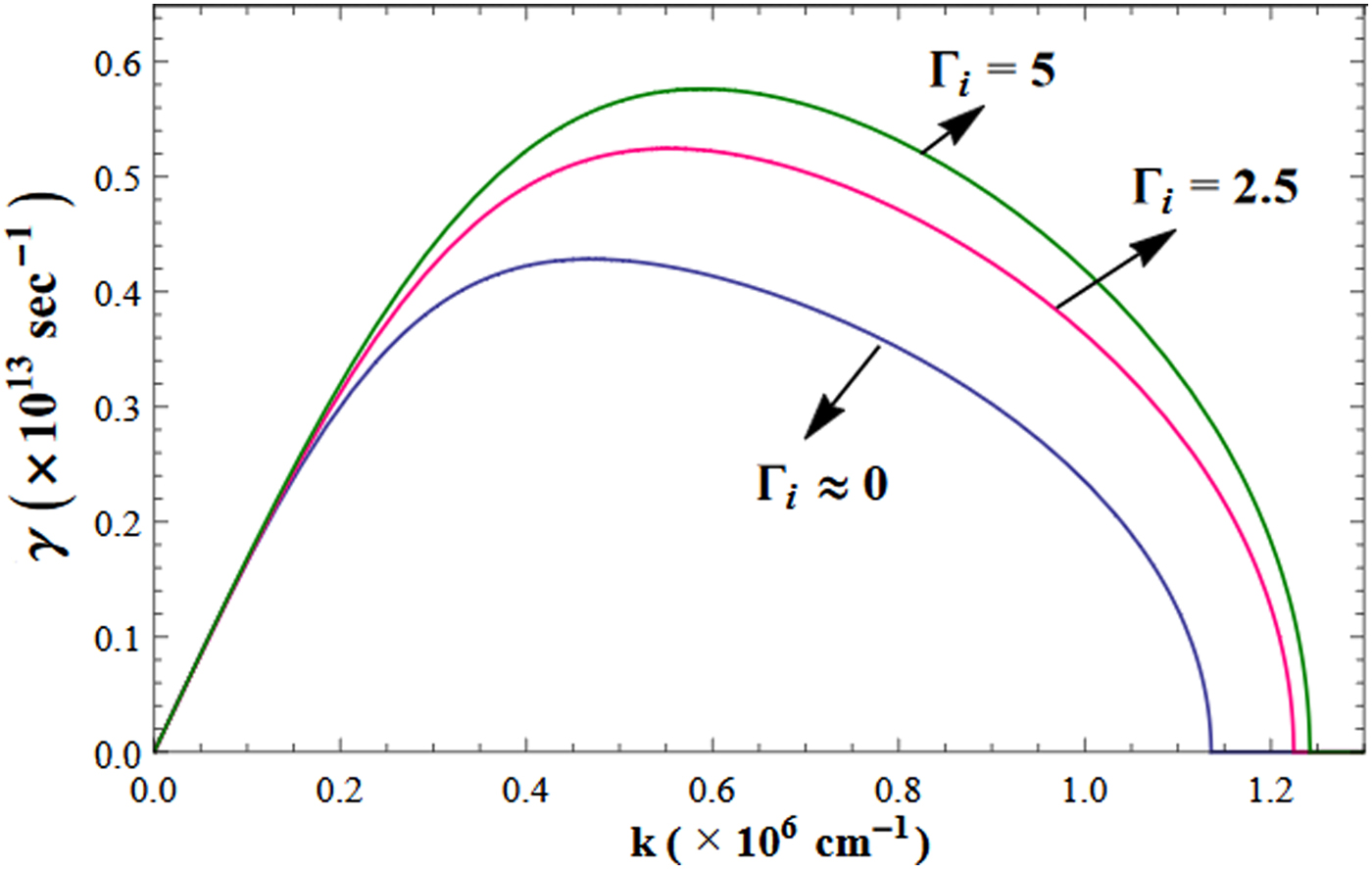
In the plot, we can see the growth rate increases with Γi. For example at k ≈ 0.6 × 106 cm−1, the enhancement in the growth rate for Γi = 2.5 is about 25% and for Γi = 5 is about 40%. In Figure 3, we plot the growth rate (γ) as a function of normalized pump frequency (ω0/ωpe) for k = 0.5 × 106 cm−1 with different Γi ≈ 0, 2.5 and 5. OTSI will occur only when ω0 ≈ ωpe. For higher values of ω0, at which Δ′ becomes positive, OTSI will vanish. Next, we give a posterior justification for the kinetic regime condition γτ m >1. For particular values of plasma parameters ωpi, λi and ion coupling parameter Γi, τm can be obtained from Eq. (25a). So in Fig. 2 for Γi = 2.5, τm ≈ 1.8 × 10⁻¹¹ s while the typical growth rate γ ≈ 0.45 × 10¹³ s−1 and hence γτ m ≈ 80. Similarly for Γi = 5, τm ≈ 2.7 × 10⁻¹² s and γτ m ≈ 15. Thus in Figure 2 and Figure 3, OTSI is indeed in the kinetic regime for Γi = 2.5 as well as for Γi = 5. It should be noted that since γ → 0 as k → 0, the growth rate must be chosen sufficiently away from zero for the kinetic regime to be valid.
Variation in growth rate (γ) as a function of ω0/ωpe for k = 0.5 × 106 cm−1 with different values of Γi in the kinetic regime. The case of Γi ≈ 0 is included for comparison with weak coupling limit (Γi <1).

Hydrodynamic regime
In this regime where ωτ m <1, χ e and χ i from Eq. (24) will be as follows
 $${{\rm \chi} _e} = {{\rm \omega} _{\,pi}^2 /k^2C_{s0}^2}, \ldots {\rm \chi} _i = -\displaystyle{{{\rm \omega} _{\,pi}^2} \over {\lsqb {{\rm \omega}^{\rm 2}-{\rm \gamma}_i{\rm \mu}_ik^{\rm 2}v_{thi}^2} \rsqb }}.$$
On substituting these values in Eq. (38), the biquadratic equation which we obtain is
 $$\eqalign{& {{{\rm \omega}} ^{\prime 4}}-{{{\rm \omega}} ^{\prime 2}}\lpar {{{\rm \omega}}_{ac}^{\prime 2} + {{{\rm \Delta}}^{\prime 2}} + {L}^{\prime}{{\rm \Delta}}^{\prime}} \rpar + {L}^{\prime}{{\rm \Delta}} ^{\prime} \cr & \quad \left( {1 + {\rm \gamma}_i{\rm \mu}_i\displaystyle{{T_i} \over {ZT_e}}k^2{\rm \lambda}_e^2} \right) + {{{\rm \Delta}} ^{\prime 2}}{{\rm \omega}} _{ac}^{\prime 2} = 0,} $$
where
 $${{\rm \omega}} ^{\prime} = \displaystyle{{\rm \omega} \over {{\rm \omega} _{\,pi}}},$$
 $${{\rm \omega}} _{ac}^{\prime 2} = {\rm \gamma} _i{\rm \mu} _i\displaystyle{{T_i} \over {ZT_e}}k^2{\rm \lambda} _e^2 + \displaystyle{1 \over {\left( {1 + \displaystyle{1 \over {k^2{\rm \lambda}_e^2}}} \right)}},$$
 $${L}^{\prime} = \displaystyle{{{\vert {v_{e0}} \vert } ^2} \over {4C_{s0}^2}} \displaystyle{{{{{\rm \omega} _{\,pi}} / {{\rm \omega} _0}}} \over {\left( {1 + \displaystyle{1 \over {k^2{\rm \lambda}_e^2}}} \right)}},$$
 $${{\rm \Delta}} ^{\prime} = \displaystyle{{\rm \Delta} \over {{\rm \omega} _{\,pi}}} = \displaystyle{{{\rm \omega} _0} \over {{\rm \omega} _{\,pi}^{}}} -\left( {\displaystyle{{{\rm \omega}_{\,pe}^2} \over {{\rm \omega}_{\,pi}^2}} + \displaystyle{{m_i} \over {Zm_e}}\displaystyle{3 \over 2}k^2{\rm \lambda}_e^2} \right)^{{1 / 2}}.$$
Two roots of Eq. (47) are-
 $$\eqalign{&{\omega }^{\prime 2} = \displaystyle{1 \over 2}\Bigg[ ({\omega }^{\prime 2}_{ac} + {{\Delta }^{\prime 2}} + {L}^{\prime}{\Delta }^{\prime}) -\sqrt {\matrix{\left( {\omega }^{\prime 2}_{ac} + {\Delta }^{\prime 2} + {L}^{\prime}{\Delta }^{\prime} \right)^2 -4\left( {L}^{\prime}{\Delta }^{\prime}\left( 1 + \gamma _i\mu _i\displaystyle{{T_i} \over {ZT_e}}k^2\lambda _e^2 \right) + {\Delta }^{\prime 2}{\omega }^{\prime 2}_{ac} \right)}} \Bigg].}$$
For instability Δ′ must be negative and
 $$\vert {{{\rm \Delta}}^{\prime}} \vert \lt \displaystyle{{{L}^{\prime}\left( {1 + {\rm \gamma}_i{\rm \mu}_i\displaystyle{{T_i} \over {ZT_e}}k^2{\rm \lambda}_e^2} \right)} \over {{{\rm \omega}} _{ac}^{\prime 2}}}. $$
For the above two conditions, the value of ω′2 will be negative which further gives two imaginary roots and hence one of the roots of Eq. (48) gives the growth rate of OTSI in the hydrodynamic regime such that
 $$\displaystyle{\gamma \over {\omega _{\,pi}}} = \left[ {\displaystyle{1 \over 2} \left\{(\omega _{ac}^{{\prime}2} + \Delta ^{{\prime}2} + L^{\prime}\Delta ^{\prime})- \sqrt{ \matrix{\left( {\omega _{ac}^{{\prime}2} + \Delta ^{{\prime}2} + L^{\prime}\Delta ^{\prime}} \right)^2- 4\left( {L^{\prime}\Delta ^{\prime}(1 + \left( {1 + \gamma _i\mu _i\displaystyle{{T_i} \over {ZT_e}}k^2\lambda _e^2 } \right) + \Delta ^{{\prime}2}\omega _{ac}^{{\prime}2} } \right) \hfill} \hfill} } \right\} \right]^{1/2}.$$
The growth rate in Eq. (49) reduces to the standard growth rate of OTSI in the limit Γi → 0. In Figure 4 we have plotted the growth rate (γ) as a function of k for Γi = 9 and Γi = 14, where the laser intensity (I) is 1014W/cm2, n e ≈ 1022 cm−3, T e ≈ 75 eV, T i = 20 − 25 eV, Z = 10–11 (for Al ion) and ω0 ≈ ωpe. The curve Γi ≈ 0 shows the growth rate in weakly coupled plasma.
Variation in growth rate (γ) as a function of k for Γi = 9 and Γi = 14 in the hydrodynamic regime. The case of Γi ≈ 0 is included for comparison with weak coupling limit (Γi <1).

The plot shows a large increment in the growth rate of OTSI (by almost 200%) for k = 1 × 106cm−1 and Γi = 14. For Γi = 9 the enhancement in the growth rate at k = 1 × 106 cm−1 is about 160%. Thus the destabilization effect of strongly coupled ions is much severe in the hydrodynamic limit than in the kinetic limit. To give a posterior justification for the hydrodynamic regime condition γτ m <1, we find for Γi = 9, τm ≈ 0.3 × 10⁻¹³ s while the typical growth rate γ ≈ 0.6 × 10¹³ s−1 and hence γτ m ≈ 0.1, similarly for Γi = 14, τm ≈ 0.9 × 10⁻¹⁴ s and γτ m ≈ 0.06. Hence in Figure 4, OTSI is in the hydrodynamic regime for Γi = 9 as well as for Γi = 14.
Summary and discussions
In this paper, we have studied the OTSI in the presence of strongly coupled ions. The situation involving strongly coupled ions is likely to arise in a number of cases. For example in the case of Au blow of plasma near the hohlraum wall in the indirect drive experiments in ICF scheme, the gold ions may become strongly coupled due to large electronic charge. In case of the direct drive approach, the carbon ions of the ablator material in the coronal plasma may become strongly coupled. Similarly, in the case of laser-driven ion accelerator, a pre-plasma of C or Al ions is formed on the target's front side, where the density of plasma is near critical density. In this region, C or Al ions may become strongly coupled. Typically in these situations, the ion correlation factor Γi can be as high as 2–15. In this regime, the ion behaves as strongly coupled viscoelastic fluid. The strong coupling effects are included here via GHD equation. It is shown that in a typical parameter regime of OTSI, these strong correlation effects modify the compressibility μ i(Γi). This can be integrated once to give the ion pressure P i as a function of Γi given by the expression  $P_i = (0.73-0.3{\rm \Gamma} _i + 0.31{\rm \Gamma} _i^{1/4} + 0.07{\rm \Gamma} _i^{-1/4} )n_iT_i.$ As can be seen from this expression with increasing Γi ion pressure decreases and for Γi >4 it becomes negative. We have examined the effects of strong correlation in the two regimes that is, the kinetic regime (valid for ωτ m >1) and the hydrodynamic regime (valid for ωτ m <1). Our results show that these strong correlation effects lead to significant enhancement of the growth rate of OTSI. This destabilization is caused by enhancing bunching of ions due to its negative pressure as shown in Figure 1.
It should be noted that extreme compression also leads to plasma electrons and ions correlation. Strong correlations generated due to high compression cannot be described by GHD theory (Avinash, Reference Avinash2015). These effects may also become significant in laser fusion targets and ion acceleration which will be the subject of future publication.
Acknowledgement
This research was supported by the Board of Research in Nuclear Sciences (BRNS), Department of Atomic Energy, Government of India (Grant No. 39/14/24/2016-BRNS/34177). One of the authors (P.S.) acknowledges the financial support from the University Grants Commission (UGC), India, under the SRF scheme.



