





Introduction
Faecal egg counts (FECs) are often used as indicators of parasite infections to guide diagnosis and treatment in domestic as well as wild mammals. In ecological studies aiming to investigate the transmission dynamics and interactions between parasites and their hosts, FECs could be a useful, non-invasive tool for the collection of comprehensive datasets, as they can be obtained from life animals, are relatively quick to perform when compared to post-mortem helminth collections and circumvent many of the logistic and ethical challenges associated with lethal sampling, such as restricted host spectrum, sample size and/or limited geographic range (Seivwright et al., Reference Seivwright, Redpath, Mougeot, Watt and Hudson2004; Budischak et al., Reference Budischak, Hoberg, Abrams, Jolles and Ezenwa2015; Byrne et al., Reference Byrne, Fogarty, Mooney, Marples and Holland2018). However, while the relationships between FECs, expressed as eggs per gram of faeces, and adult nematode burdens have been investigated in a number of domestic species, especially in small ruminants, the reliability of FECs as predictor of actual worm burdens in wild mammals remains largely unexplored (Gordon and Whitlock, Reference Mcl and Whitlock1939; Bryan and Kerr, Reference Bryan and Kerr1989; Seivwright et al., Reference Seivwright, Redpath, Mougeot, Watt and Hudson2004; Rinaldi et al., Reference Rinaldi, Veneziano, Morgoglione, Pennacchio, Santaniello, Schioppi, Musella, Fedele and Cringoli2009; Gassó et al., Reference Gassó, Feliu, Ferrer, Mentaberre, Casas-Díaz, Velarde, Fernández-Aguilar, Colom-Cadena, Navarro-Gonzalez, López-Olvera, Lavín, Fenández-llario, Segalés and Serrano2015; Kuzmina et al., Reference Kuzmina, Dzeverin and Kharchenko2016; Byrne et al., Reference Byrne, Fogarty, Mooney, Marples and Holland2018). Previous studies have shown that the FEC-to-adult relationships may be influenced by the species richness and composition of the helminth communities, as the number of eggs produced per female varies between species (Thienpont et al., Reference Thienpont, Rochette and Vanparijs1986; Shaw and Moss, Reference Shaw and Moss1989). In addition, the intensity of infection of adult nematodes (Cabaret et al., Reference Cabaret, Gasnier and Jacquiet1998; Medica and Sukhdeo, Reference Medica and Sukhdeo2001; Kuzmina et al., Reference Kuzmina, Lyons, Tolliver, Dzeverin and Kharchenko2012), the age of the host, its immune and nutritional status, as well as seasonality can affect worm fecundity (Smeal et al., Reference Smeal, Hotson, Mylrea, Jackson, Campbell and Kirton1977; McKenna, Reference McKenna1981; Shaw and Moss, Reference Shaw and Moss1989; Malczewski et al., Reference Malczewski, Jolley and Woodard1996; Byrne et al., Reference Byrne, Fogarty, Mooney, Marples and Holland2018). Further factors that may restrict the accuracy of FECs as indicators of nematode infection are the fact that eggs will be absent in hosts where only males or females are present or during the prepatent period (Thienpont et al., Reference Thienpont, Rochette and Vanparijs1986). Moreover, the eggs of many nematodes are morphologically similar, rendering identification to even genus level difficult or impossible (Ezenwa, Reference Ezenwa2004; Budischak et al., Reference Budischak, Hoberg, Abrams, Jolles and Ezenwa2015).
In recent years, coprological analysis has been used to study host–parasite relationships in a number of ruminants in Africa (e.g. Ezenwa, Reference Ezenwa2004; Turner and Gez, Reference Turner and Getz2010; Nalubamba et al., Reference Nalubamba, Mudenda and Malamo2012; VanderWaal et al., Reference VanderWaal, Omondi and Obanda2014; Obanda et al., Reference Obanda, Maingi, Muchemi, Ng’ang’a, Angelone, Archie and Serrano2019), based on the assumption that FECs do provide an indication of the relative infection rates across groups of hosts. Nevertheless, there is limited information on the relationship between FEC and adult nematode burdens in African ungulates, and the factors that could affect these relationships. Horak (Reference Horak1978) reported the adult nematode burdens and the mean monthly FEC in impalas, Aepyceros melampus, in the Nylsvley Nature Reserve in South Africa. He found a marked seasonal pattern in the FEC, with large numbers in the summer, November to March, and low numbers in the winter, May to October. However, in a re-analysis of the data (Horak et al., Reference Horak, Junker and Gallivan2023), there was no seasonal pattern in the numbers of adult nematodes. Boomker et al. (Reference Boomker, Horak and De Vos1989) found a low correlation (r = 0.07) between the FEC and worm burden in kudus, Tragelaphus strepsiceros, examined from April 1981 to March 1983 in the Kruger National Park, South Africa. Budischak et al. (Reference Budischak, Hoberg, Abrams, Jolles and Ezenwa2015) tested whether nematode communities in African buffaloes, Syncerus caffer, could be accurately described using a combination of faecal analysis, larval culture and molecular barcoding, comparing their results to worm counts and identifications derived from the same host individuals via lethal sampling. They concluded that their combined approach offered a reliable non-invasive method to obtain quantitative data about nematode communities in wildlife. To our knowledge, no further data comparing FECs with actual worm burdens in wild African ungulates have been published.
African wildlife faces escalating pressures from climate change, human-driven habitat encroachment and an expanding wildlife–livestock–human interface. Consequently, understanding host–parasite relationships and transmission dynamics is more critical than ever. While the conservation status of many hosts precludes complete parasite recovery from sufficient sample sizes, faecal sampling offers a viable alternative – provided FECs are reliable predictors of actual worm burdens. Because existing knowledge of this relationship relies primarily on data from wild and domesticated ungulates in the Northern Hemisphere, we analysed available archival data collected from 1977 to 1981 across 3 African ungulate host species (see Horak et al., Reference Horak, De Vos and Brown1983, Reference Horak, Boomker, De Vos and Potgieter1988, Reference Horak, Junker and Gallivan2023) to represent an ecologically different and distinct system. When comparing European and African ecosystems, for example, the high original megafaunal species diversity associated with natural savannas that evolved in southern Africa millions of years ago much exceeds that found in cultural grasslands in Europe (Zeller et al., Reference Zeller, Starik and Göttert2017). This variation in host diversity across ecosystems is also reflected in parasite diversity. While certain helminth genera and even species are shared between wild Northern Hemisphere and African ungulates – particularly those introduced through contact with livestock – the overall helminth faunas of hosts in these distinct geographic regions are notably different and helminth diversity in sub-Saharan Africa is especially high (see Pester and Laurence, Reference Pester and Laurence1974; Hoberg et al., Reference Hoberg, Kocan, Rickard, Samuel, Pybus and Kocan2001; Figueiredo et al., Reference Figueiredo, Valente, Fonseca, De Carvalho and Torres2020; Halvarsson et al., Reference Halvarsson, Baltrušis, Kjellander and Höglund2022; Loginova et al., Reference Loginova, Rozenfeld, Sipko, Mizin, Panchenko, Laishev, Bondar, Kolpashchikov, Gruzdev, Kulemeev and Litovka2023; Junker and Krasnov, Reference Junker and Krasnov2026). Seasonal variation in resource availability is a challenge faced by both African and European/North American ungulates. However, while host condition in African habitats is severely impacted by the poor quality and scarcity of grass forage during the dry season, Northern Hemisphere ungulates face similar bottlenecks primarily due to the harsh cold of winter (Parker et al., Reference Parker, Barboza and Gillingham2009; Bhattacharjee et al., Reference Bhattacharjee, Flay, Mumby and McElligott2026).
Within the African savanna, blue wildebeest, impalas and warthogs differ significantly in their social structures, habitat preferences and digestive systems. Blue wildebeest are gregarious short-grass grazers that prefer areas of short, green grassland or grass that is less than 10–15 cm in height, while impalas are gregarious intermediate mixed feeders that both browse and graze, depending on the season and availability of forage (Skinner and Chimimba, Reference Skinner and Chimimba2005). Both are foregut fermenters, and the majority of the gastrointestinal (GI) nematodes are found in the stomach and small intestine (Horak et al., Reference Horak, Boomker, Junker and Gallivan2021). Warthogs live in small groups or are solitary (typically adult males). They prefer to feed on short grasses and their rhizomes, but will also feed on sedges, herbs and wild fruit (Skinner and Chimimba, Reference Skinner and Chimimba2005). They are hindgut fermenters, and the majority of GI nematodes are found in the large intestine (Horak et al., Reference Horak, Boomker, De Vos and Potgieter1988; Junker et al., Reference Junker, Spickett, Swanepoel, Krasnov, Boomker and Hoffman2019).
First, we compared the effects of season, host sex and host age on nematode prevalence and abundance calculated based on either FECs or adult counts to assess if both methods would yield the same trends. Second, we modelled the relationships between FEC and worm burden in individual hosts, controlling for host sex, age and season of sampling. The aim of these models was to answer the question of whether FECs can be used as reliable indicators of nematode infection.
Materials and methods
Hosts, parasite collection and faecal sampling
The localities and timing of the collections of the 3 host species are detailed in Table 1. All hosts were collected as part of previous surveys on their endo- and ectoparasites conducted in the Kruger National Park from 1977 to 1981 (see Horak et al., Reference Horak, De Vos and Brown1983, Reference Horak, Boomker, De Vos and Potgieter1988, Reference Horak, Boomker, Junker and Gallivan2021, Reference Horak, Junker and Gallivan2023). Hosts were shot in the neck with a high-powered rifle in the morning and transported to the post-mortem facility where they were skinned and eviscerated. The procedures for the recovery of adult nematodes are described in the publications on blue wildebeest (Horak et al., Reference Horak, De Vos and Brown1983), warthogs (as Phacochoerus aethiopicus; Horak et al., Reference Horak, Boomker, De Vos and Potgieter1988) and impalas (Horak et al., Reference Horak, Junker and Gallivan2023). For FECs, the caecum and colon were separated from the rest of the intestine by a ligature. Faeces were collected from the distal rectum of each animal within 3 h of death and stored separately in a refrigerator at 5 °C until the eggs were counted later the same day. Although up to 3 h passed between the death of the hosts and the collection of the rectal faecal samples, we do not believe that this would have influenced the number of eggs counted in these samples. While autolysis commences immediately upon death, including the mucous membranes of the rectum, enzyme activity in the rectum is comparatively low as its function is primarily to absorb remaining water and to store and expel waste. Furthermore, nematode eggshells are specifically designed to provide physical and chemical resilience (Bond and Huffman, Reference Bond and Huffman2023).
Grid references, altitudes, vegetation types (Gertenbach, Reference Gertenbach1983), annual rainfall, time periods and numbers of the 3 species of hosts examined at the various localities in the Kruger National Park

Table 1 Long description
Rows list localities with grid reference and altitude, vegetation type, annual rainfall in millimeters, collection period, and number of hosts with age and sex composition for blue wildebeest, impalas, and warthogs. Blue wildebeest were sampled between Satara and Onder Sabie, at 24 degrees 24 minutes south 31 degrees 47 minutes east altitude 275 meters to 25 degrees 07 minutes south 31 degrees 55 minutes east altitude 180 meters, in Marula and Knobthorn savanna, rainfall 500 to 550 at Satara to about 600 at Onder Sabie, collected November 1977 to November 1978, with 49 hosts: 14 young females, 11 young males, 13 adult females, 11 adult males. Impalas were sampled at Skukuza, 24 degrees 58 minutes south 31 degrees 36 minutes east altitude 262 meters, thickets of the Sabie and Crocodile Rivers, rainfall about 600, January 1980 to December 1980, 3 to 7 per month total 49: 4 young females, 8 young males, 12 adult females, 25 adult males. Impalas at Biyamiti, 25 degrees 06 minutes to 25 degrees 28 minutes south 31 degrees 25 minutes to 31 degrees 39 minutes east altitude 200 to 350 meters, Mixed Bushwillow woodlands, rainfall 600 to 700, January 1980 to December 1980, 3 to 6 per month total 46: 2 young females, 10 young males, 10 adult females, 24 adult males. Impalas at Crocodile Bridge, 25 degrees 22 minutes south 31 degrees 54 minutes east altitude 217 meters, Marula and Knobthorn savanna, rainfall about 600, January 1980 to December 1980, 11 hosts, adult males only; and at Pafuri in Kruger National Park, 23 degrees 27 minutes south 31 degrees 19 minutes east altitude 305 meters, Mopani veld on Limpopo and Levubu floodplains, rainfall 420, July 1980, 4 hosts: 1 young male, 1 adult female, 2 adult males. Warthogs were sampled at Skukuza, thickets of the Sabie and Crocodile Rivers, rainfall about 600, January 1980 to January 1981, 26 hosts: 4 young females, 7 young males, 6 adult females, 9 adult males. Warthogs at Crocodile Bridge, Marula and Knobthorn savanna, rainfall about 600, September 1979 to January 1981, 26 hosts: 1 young female, 10 adult females, 15 adult males; at Onder Sabie, Marula and Knobthorn savanna, rainfall about 600, July 1980, 2 hosts: 1 young female, 1 adult female; and at Pafuri, Mopani veld on Limpopo and Levubu floodplains, rainfall 420, July 1980, 5 hosts: 2 young males, 3 adult males.
FECs were performed in the veterinary laboratory at Skukuza according to Reinecke’s (Reference Reinecke1961) modification of the McMaster technique of Gordon and Whitlock (Reference Mcl and Whitlock1939). Two grams of faeces were weighed and emulsified in 58 mL of a 40% solution of sugar (specific gravity = 1.14). The liquid was poured into a small bottle, a few drops of amyl alcohol were added to prevent air bubbles, the bottle was shaken and a small amount was pipetted into a 1 cm square on a McMaster slide. The number of eggs was counted (3 squares on 2 slides per host individual) under a microscope and converted to the FEC, i.e. number of eggs per gram of faeces (EPG). FECs were performed by a single collaborator (I.G.H.) for all samples across all host species. Although the flotation medium had not been specifically validated for the 3 wildlife species in question, its efficacy is supported by the pronounced morphological similarities between these eggs and those found in domestic livestock. Given that several of the target helminths are congeneric or conspecific with livestock parasites, established flotation protocols for domestic hosts are anticipated to be equally suitable for processing samples from these wildlife species.
Nineteen species of adult GI nematodes were collected from impalas (Horak et al., Reference Horak, Junker and Gallivan2023), 13 from wildebeest (Horak et al., Reference Horak, De Vos and Brown1983) and 12 from warthogs (Horak et al., Reference Horak, Boomker, De Vos and Potgieter1988). The eggs of Strongyloides papillosus, which are elliptical and contain a larva, were counted separately in the 3 host species, and the eggs of Gaigeria pachyscelis, which are parallel-sided with rounded ends, were counted separately in impalas. The eggs of the remaining GI nematodes, predominantly trichostrongyloids, were elliptical and contained a few blastomeres. They were grouped as ‘other GI nematodes’ because of the difficulties in morphologically distinguishing among genera. In wildebeest, the eggs of G. pachyscelis and the other hookworm, Agriostomum gorgonis, were included with other GI nematodes because the eggs of the 2 hookworm species are similar. No hookworm eggs were collected from the 2 impalas infected with adult A. gorgonis.
Helminth prevalence and abundance were determined according to Bush et al. (Reference Bush, Lafferty, Lotz and Aw1997).
Statistical analysis
The relationships between the number of adult nematodes in a host’s gastrointestinal tract (GIT) (response variable) and the FEC, sex, age and season of sampling of a host (explanatory variables) were analysed using generalized linear mixed effects models (GLMMs) as implemented in the R package ‘glmmTMB’ (Brooks et al., Reference Brooks, Kristensen, Van Benthem, Magnusson, Berg, Nielsen, Skaug, Mächler and Bolker2017; McGillycuddy et al., Reference McGillycuddy, Warton, Popovic and Bolker2025). We used locality, i.e. where a host was sampled, as a random factor. Because the collections were not balanced with respect to host age and the months collected in, we grouped time of collection into seasons (winter, i.e. May to September, and summer, i.e. October to April) and age into young animals (up to 11 months) and adults (12 months and more). Age thresholds were chosen for statistical convenience due to sample size constraints. We ran 5 models, namely 4 models for impalas (for S. papillosus only, for G. pachyscelis only, for all nematodes excluding these 2 species, and for all nematodes including these 2 species), 1 model for wildebeest (for all nematodes) and 1 model for warthogs (for all nematodes). Only a few individuals of the 2 latter hosts yielded nematode eggs that could be differentiated. The number of adult nematodes is a count variable, so we first fitted a GLMM for each host separately using a Poisson distribution. Model assumptions were then evaluated using simulated residuals implemented in the R package ‘DHARMa’ (Hartig, Reference Hartig2022). Residual diagnostics included tests for dispersion, outliers and excess zeroes. Residual diagnostics revealed significant overdispersion (DHARMa dispersion tests: dispersion ratio = 4.40–45.93, P < 0.001 for all models). Consequently, we applied GLMMs with a negative binomial distribution and then again ran residual diagnostics using ‘DHARMa’. Diagnostics indicated that residual dispersion did not differ significantly from expectations under the fitted model (DHARMa dispersion tests: dispersion ratio = 0.59–2.36, P > 0.10 for all models). DHARMa’s bootstrapped outlier test detected no outlying residuals (expected frequencies = 0.001–0.003, P = 1.0 for all models), indicating no evidence of an excess of extreme observations relative to model expectations. DHARMa’s zero-inflation tests detected no evidence of excess zeros in the data (observed/simulated zero ratios = 0 and P = 1.0 for all models).
After running the models, we carried out reliability and predictive accuracy analyses to test whether FEC can be used as a dependable indicator of actual adult worm burden. This was done for 4 models for impalas (see above) and a model for wildebeest, but not for the warthog model (see Results). The diagnostic performance of FEC was estimated using (a) absolute marginal effect (= absolute effect size) calculated using the function ‘avg_comparisons’ of the R package ‘marginaleffects’ (Arel-Bundock et al., Reference Arel-Bundock, Greifer and Heiss2024); (b) the Incidence Rate Ratio that evaluates how consistently the underlying adult nematode population accelerates per 100-unit change in egg count (Hilbe, Reference Hilbe2011); (c) marginal R 2 using Nakagawa et al.’s (Reference Nakagawa, Johnson and Schielzeth2017) framework; and (d) the Root Mean Squared Error reflecting predictive accuracy. The 2 latter metrics were calculated using the R package ‘performance’ (Lüdecke et al., Reference Lüdecke, Ben-Shachar, Patil, Waggoner and Makowski2021).
We specifically did not apply an adjustment of the alpha-level for multiple comparisons (e.g. Bonferroni corrections). This procedure has been strongly criticized by both statisticians and ecologists because it likely inflates the rate of Type II errors (e.g. Rothman, Reference Rothman1990; Moran, Reference Moran2003; Nakagawa, Reference Nakagawa2004).
Results
The prevalence of all groups of nematodes considered in our study was higher when estimated based on adult counts compared to FECs (Table 2). In impalas, the GIT prevalence of S. papillosus, G. pachyscelis and that of other nematodes was 87.3%, 77.3% and 98.2%, respectively. Their prevalence in the faeces, on the other hand, was 38.2%, 12.7% and 85.5%, respectively. In both blue wildebeest and warthogs, the prevalence of S. papillosus was higher in the GI tract (24.5% and 5.1%, respectively) compared to its prevalence in the faeces (10.2% and 1.7%, respectively). Similarly, the prevalence of the other nematodes was 93.9% and 96.6%, respectively, in the GIT of these hosts vs 79.6% and 79.7% in the faeces. Generally speaking, a large number of hosts harbouring adult worms would have been recorded as not infected when examined via faecal sampling only. None of the impalas, blue wildebeest or warthogs that were positive for eggs, were negative for worms, and this was true for G. pachyscelis, S. papillosus and other GIT nematodes. Two impalas harboured A. gorgonis, but no eggs of this hookworm were found in their faecal samples.
Prevalence and abundance of Stronyloides papillosus, Gaigeria pachyscelis and other gastrointestinal (GI) nematodes based on adult worm collections and corresponding faecal egg counts per gram of faeces (FECs)

Table 2 Long description
Prevalence and abundance are reported for adult worms and faecal egg counts per gram of faeces for impalas with N 110 examined, blue wildebeest with N 49 examined, and warthogs with N 59 examined. For impalas, Strongyloides papillosus prevalence is 87.3 percent with n 96 infected for adult worms and 38.2 percent with n 42 infected for faecal egg counts, with adult worms mean 335.9 plus or minus 29.2 and range 0 to 1585, and EPG mean 198.2 plus or minus 41.8 and range 0 to 2200. For impalas, Gaigeria pachyscelis prevalence is 77.3 percent with n 85 infected for adult worms and 12.7 percent with n 14 infected for faecal egg counts, with adult worms mean 6.3 plus or minus 0.8 and range 0 to 42, and EPG mean 22.7 plus or minus 7.2 and range 0 to 500. For impalas, other GI nematodes prevalence is 98.2 percent with n 108 infected for adult worms and 85.5 percent with n 94 infected for faecal egg counts, with adult worms mean 4059.8 plus or minus 481.8 and range 0 to 35225, and EPG mean 998.2 plus or minus 113.6 and range 0 to 7400. For blue wildebeest, Strongyloides papillosus prevalence is 24.5 percent with n 12 infected for adult worms and 10.2 percent with n 5 infected for faecal egg counts, with adult worms mean 130.2 plus or minus 51.7 and range 0 to 1675, and EPG mean 266.0 plus or minus 215.5 and range 0 to 10400; other GI nematodes prevalence is 93.9 percent with n 46 infected for adult worms and 79.6 percent with n 39 infected for faecal egg counts, with adult worms mean 1153.9 plus or minus 157.4 and range 0 to 4294, and EPG mean 383.9 plus or minus 65.8 and range 0 to 2250. For warthogs, Strongyloides papillosus prevalence is 5.1 percent with n 3 infected for adult worms and 1.7 percent with n 1 infected for faecal egg counts, with adult worms mean 2.0 plus or minus 1.5 and range 0 to 75, and EPG mean 1.7 plus or minus 1.9 and range 0 to 100; other GI nematodes prevalence is 96.6 percent with n 57 infected for adult worms and 79.7 percent with n 47 infected for faecal egg counts, with adult worms mean 3194.4 plus or minus 1054.4 and range 0 to 52575, and EPG mean 935.6 plus or minus 170.1 and range 0 to 5200.
N, number of hosts examined; n, number of infected hosts.
The relative mean abundance of S. papillosus, G. pachyscelis and other GIT nematodes based on FECs reflected that of adult worms, i.e. the most abundant taxon in a given host species when looking at adult worms was also the most abundant one when evaluating FECs (Table 2). We further aimed to assess whether the effect of season, host age and host sex on nematode prevalence and abundance when calculated based on FECs would follow the same trend as that based on adult worm counts. Since the sampling was highly imbalanced, we combined data collected for all groups of nematodes for a given host and locality, and we only compared prevalence and abundance data of hosts at localities where more than 20 hosts were examined. Regardless, a formal analysis was not possible, and we merely compared prevalence and abundance as given in Supplementary Table S1. In impalas at Skukuza, FECs and adult counts produced the same result for sex and season, i.e. prevalence was higher in males than females and higher in winter than in summer. In contrast, while nematodes were more prevalent in young than adult hosts based on FECs, the opposite was true when evaluating adult counts. However, the differences in prevalence for all comparisons were marginal. When looking at abundance, opposite trends were found regarding host sex and age between the 2 methods, but FECs and adult counts revealed the same tendency for season, i.e. counts being lower in winter than in summer. While prevalence based on adult counts revealed no differences between season, host sex and age in impalas at Biyamiti (all at 100%), prevalence based on FECs was higher in males than females, higher in young animals than in adults and lower in winter than in summer. Abundance based on FECs was higher in males than females and higher in young animals than adults, but the reverse picture emerged based on adult counts.
In wildebeest at Satara, FECs and adult counts produced the same trends regarding prevalence, with prevalence being higher in males, young animals and in winter. However, as seen in impalas, the differences in prevalence for all comparisons were low. FECs and adult worm counts produced opposing results when looking at the effect of host sex and season on abundance but yielded the same outcome for host age.
Prevalence based on adult counts in warthogs at Skukuza was 100%, irrespective of season, host age or sex. In contrast, FECs suggested a lower nematode prevalence in males, young animals and summer. Generally, the prevalence determined via FECs was distinctly lower (46.7–72.7%) than that based on adult counts. FECs and adult worm counts produced opposing results for abundance with respect to season as well as host age and sex. Interestingly, in warthogs at Crocodile Bridge, FECs indicated the same effect of season, host age and sex on prevalence as well as abundance as did adult worm counts.
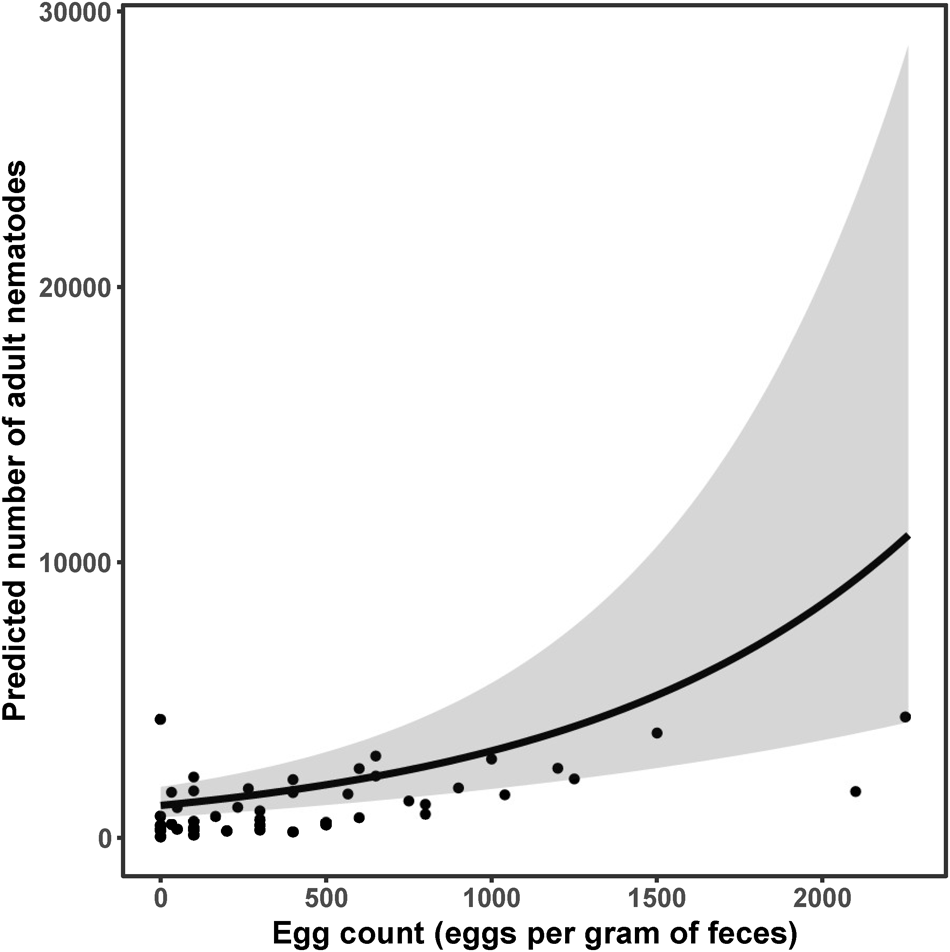
In both impalas and blue wildebeest, the FEC correlated significantly positively, albeit not especially strongly, with the number of adult nematodes (Table 3; Figures 1 and 2). In warthogs, no relationship between these 2 variables was detected (Table 3). Furthermore, negative coefficients of age in GLMMs for 3 of 4 models for impalas and 1 model for warthogs indicated that adult nematode counts were significantly higher in adults (reference level) than in young animals (Table 3). In addition, nematode burden in wildebeest was higher in summer than in winter (Table 3).
Relationship between the burden of (A) adult Strongyloides papillosus, (B) adult Gaigeria pacyscelis, (C) other gastrointestinal nematodes, excluding S. papillosus and G. pachyscelis and (D) all adult gastrointestinal nematodes and the corresponding faecal egg count in impalas (N = 110).

Figure 1 Long description
The image A showing a scatter plot with a fitted curve and a shaded band. The horizontal axis label is, Egg count, eggs per gram of feces, with tick labels 0, 500, 1000, 1500, 2000. The vertical axis label is, Predicted number of adult nematodes, with tick labels 0, 1000, 2000, 3000, 4000. The plotted points include multiple points at egg count 0 with predicted values between 0 and about 1000 and additional points spread across egg counts up to about 2000. The fitted curve rises from a few hundred at egg count 0 to around 1800 at egg count 2000. The image B showing a scatter plot with a fitted curve and a shaded band. The horizontal axis label is, Egg count, eggs per gram of feces, with tick labels 0, 100, 200, 300, 400, 500. The vertical axis label is, Predicted number of adult nematodes, with tick labels 0, 50, 100, 150, 200. The plotted points cluster near egg counts between 0 and 100 with predicted values mostly below 50, with a few points at higher egg counts up to about 500. The fitted curve rises from near 0 at egg count 0 to around 70 at egg count 500. The image C showing a scatter plot with a fitted curve and a shaded band. The horizontal axis label is, Egg count, eggs per gram of feces, with tick labels 0, 2000, 4000, 6000. The vertical axis label is, Predicted number of adult nematodes, with tick labels 0, 50000, 100000, 150000, 200000. The plotted points are concentrated at lower egg counts, with several points between 0 and 2000 and predicted values mostly below about 30000 and fewer points at higher egg counts up to about 6500. The fitted curve rises from near 0 at egg count 0 to around 50000 at egg count 6500. The image D showing a scatter plot with a fitted curve and a shaded band. The horizontal axis label is, Egg count, eggs per gram of feces, with tick labels 0, 2000, 4000, 6000, 8000. The vertical axis label is, Predicted number of adult nematodes, with tick labels 0, 50000, 100000, 150000, 200000. The plotted points are concentrated at lower egg counts, with several points between 0 and 2000 and predicted values mostly below about 30000 and additional points extending to about 8000. The fitted curve rises from near 0 at egg count 0 to around 80000 at egg count 8000.
Relationship between the burden of all adult gastrointestinal nematodes and the corresponding faecal egg count in blue wildebeest (N = 49).

Summary of the results of generalized linear mixed effects models of the relationships between the number of adult nematodes in the gastrointestinal tract (GIT, response variable) and the number of nematode eggs per gram of faeces (FEC), sex (S), age (A) and season of sampling (SS) of a host (explanatory variables). Locality of sampling was used as a random factor. Only significant coefficients (P < 0.05) are shown. Superscripts above coefficients – standard errors; z-values are related to coefficients in the same order as in the equation; and R 2 is the coefficient of determination of the conditional model (both fixed and random effects). Reference levels for nominal predictor variables are female for sex, adult for age and summer for season

Table 3 Long description
Generalized linear mixed effects model results relate adult nematode counts in the gastrointestinal tract to eggs per gram of faeces, plus host sex, age, and season of sampling, with locality as a random factor. Columns list host species, parasite species or group, significant model coefficients with their superscript standard errors, z-values, and conditional R2. For impalas with Strongyloides papillosus, the coefficient for eggs per gram of faeces is 0.0006 and the coefficient for age is minus 0.48, with z-values 28.21, 4.38, and minus 2.53, and R2 0.16. For impalas with Gaigeria pachyscelis, the eggs per gram of faeces coefficient is 0.005, z-values are 8.65 and 4.18, and R2 is 0.28. For impalas with all nematodes excluding Gaigeria pachyscelis and Strongyloides papillosus, the eggs per gram of faeces coefficient is 0.0004 and age is minus 1.37, with z-values 25.79, 4.54, and minus 6.86, and R2 0.52; including those two groups, the eggs per gram of faeces coefficient is 0.0003 and age is minus 1.37, with z-values 27.41, 3.89, and minus 6.82, and R2 0.51. For blue wildebeest with all nematodes, the eggs per gram of faeces coefficient is 0.001 and season of sampling is minus 0.55, with z-values 30.31, 4.97, and minus 2.48, and R2 0.38. For warthogs with all nematodes, age is minus 1.25, with z-values 16.15 and minus 3.46, and R2 0.50.
Summary of the results of the reliability and predictive accuracy analyses testing whether FEC can be used as an indicator of adult worm burden is presented in Supplementary Table S2. The diagnostic utility of FEC appeared to be highly species-specific, demonstrating a major contrast between massive count increases and sharp, fast-acting responses. In impalas, FEC was a highly reliable predictor for individual nematode species, acting as a proportional predictor for S. papillosus (+24.70 worms, P = 0.0001) and a highly responsive rate marker for G. pachyscelis (+4.92 worms, 59% rate jump, P = 0.001), yet it completely failed when counts are pooled for all nematodes (P = 0.07). Conversely, in wildebeest (Model 5), FEC served as a highly reliable indicator of heavy worm burdens, where a 100-unit increase in egg counts predicted an absolute gain of 139.00 adult worms (P = 0.01).
Comparing the results of the GLMMs with those of the FECs and adult worm counts, we found the following. In both impalas at Skukuza and at Biyamiti, adult worm counts that indicated a higher abundance in adults than in young animals (contrary to FECs being higher in young animals) were borne out by the results of the GLMMs, revealing significantly higher burdens in adult impala. The same was true for warthogs at Skukuza. Notably, at Crocodile Bridge, both FEC and adult counts were higher in adult warthogs. In wildebeest, the significantly higher abundance of nematodes in summer revealed in the GLMM coincided with higher FECs in summer; in contrast, mean abundance based on adult counts was lower in summer than in winter (Supplementary Table S1).
Discussion
We investigated the relationship between adult nematode infections and FECs across 3 African ungulate species from the families Bovidae and Suidae. By incorporating species with distinct differences in habitat preference and GI nematode assemblages, we expanded the ecological and taxonomic scope of these investigations. Studies such as Cabaret et al. (Reference Cabaret, Gasnier and Jacquiet1998), Seivwright et al. (Reference Seivwright, Redpath, Mougeot, Watt and Hudson2004) and Gassó et al. (Reference Gassó, Feliu, Ferrer, Mentaberre, Casas-Díaz, Velarde, Fernández-Aguilar, Colom-Cadena, Navarro-Gonzalez, López-Olvera, Lavín, Fenández-llario, Segalés and Serrano2015) have shown that FEC utility is strongly species- and system-specific and, consequently, these host-associated differences should be borne in mind when assessing the results of our analyses. Briefly, impalas had the highest nematode species richness and blue wildebeest had the lowest burdens. Even though the most common genera, Cooperia, Haemonchus and Trichostrongylus, were similar in impalas and wildebeest, the species differed between the 2 hosts (Horak et al., Reference Horak, Boomker, Junker and Gallivan2021). Warthogs had the most divergent community, with Murshidia and Daubneyia the dominant genera (Horak et al., Reference Horak, Boomker, De Vos and Potgieter1988; Junker et al., Reference Junker, Horak, Boomker and Krasnov2023). The eggs of G. pachyscelis were identifiable in impalas and the eggs of S. papillosus were identifiable in the 3 hosts, but the majority of eggs were indistinguishable. These other GI nematodes accounted for ≥90% of the adult nematode burden in the 3 host species.
Our results revealed that in all 3 host species, the prevalence of nematode infections would have been underreported when relying on FECs only. This was true for S. papillosus, G. pachyscelis and other GI nematodes. In S. papillosus, FECs detected less than half of the infected hosts, irrespective of the host species, whereas only one-sixth of the impala individuals infected with G. pachyscelis were positive on FEC. In other GI nematodes, which, representing several taxa of the order Strongylida, had the highest prevalence in all 3 hosts, the difference between prevalence based on adult counts and FECs was less drastic and ranged from 12.7% to 16.9%. These findings of a weaker detection capacity of positive hosts based on egg counts compared to adult counts coincide with those of Gassó et al. (Reference Gassó, Feliu, Ferrer, Mentaberre, Casas-Díaz, Velarde, Fernández-Aguilar, Colom-Cadena, Navarro-Gonzalez, López-Olvera, Lavín, Fenández-llario, Segalés and Serrano2015), who studied helminth infections in wild boars, Sus scrofa, in Spain and those of Byrne et al. (Reference Byrne, Fogarty, Mooney, Marples and Holland2018), who investigated hookworm (Uncinaria criniformis) and lungworm (Aelurostrongylus falciformis) prevalence in European badgers, Meles meles, in the Republic of Ireland. Similarly, ascarid infection was underreported in horses when comparing FECs with adult counts (Nielsen et al., Reference Nielsen, Baptiste, Tolliver, Collins and Lyons2010). Gassó et al. (Reference Gassó, Feliu, Ferrer, Mentaberre, Casas-Díaz, Velarde, Fernández-Aguilar, Colom-Cadena, Navarro-Gonzalez, López-Olvera, Lavín, Fenández-llario, Segalés and Serrano2015) concluded that the reliability of faecal analysis as an indicator of helminth infections depended on the helminth species studied. Although a slightly lower prevalence by FEC is to be expected given the detection threshold of the McMaster technique, the prevalence of prepatent infections in natural wildlife populations and the intermittent shedding of eggs by some species, these discrepancies were especially pronounced in S. papillosus and G. pachyscelis (Table 2). Eggs of G. pachyscelis and S. papillosus are very characteristic and easily recognized during coprological examination (Ortlepp, Reference Ortlepp1937; Reinecke, Reference Reinecke1984; Sabatini et al., Reference Sabatini, De Almeida Borges, Claerebout, Gianechini, Höglund, Kaplan, Lopes, Mitchell, Rinaldi, Von Samson-Himmelstjerna, Steffan and Woodgate2023). It is thus unlikely that they would have been overlooked or, in the case of G. pachyscelis, included in the counts of the remaining Strongylida. Gaigeria pachyscelis females are considered moderately fecund (Reinecke, Reference Reinecke1984), while S. papillosus is seen as moderately to highly prolific (Sabatini et al., Reference Sabatini, De Almeida Borges, Claerebout, Gianechini, Höglund, Kaplan, Lopes, Mitchell, Rinaldi, Von Samson-Himmelstjerna, Steffan and Woodgate2023), again raising the expectation that eggs should be picked up in faecal samples. However, in the case of some Strongylida, for example Nematodirus, a low egg producer, eggs are present for a few weeks only in suckling lambs, are seldom found in weaned sheep and rarely, if ever, in older animals (Reinecke, Reference Reinecke1984). As mentioned, intermittent shedding of eggs has been described in some nematodes and could be a reason for the difference between coprological and post-mortem detection of G. pachyscelis and S. papillosus in the present study (Lalošević et al., Reference Lalošević, Lalošević, Čapo, Simin, Galfi and Traversa2013; Polotzek et al., Reference Polotzek, Van der Neut, Keiser, Lindhorst, Kühling, Hering-Hagenbeck, Fuehrer and Ebmer2025).
No hookworm eggs were detected in 2 impalas confirmed to harbour adult A. gorgonis. This observation demonstrates that confirmed adult infection can produce zero detectable eggs, one of the well-known factors that limit the accuracy of FECs as an estimation of actual worm burdens. Possible reasons for this might be the absence of males, females being in the prepatent phase or egg density being below the detection level of the applied McMaster method (Thienpont et al., Reference Thienpont, Rochette and Vanparijs1986). Furthermore, based on FECs only, the presence of this species would have been overlooked in a helminth diversity study.
FECs correctly reflected the relative abundance of the various helminth groupings in 2 of the 3 host species we examined. In addition, there was a significant, albeit weak, positive correlation between FECs and adult nematode counts in impalas and blue wildebeest for each of the groupings tested. A positive relationship between worm burdens and FECs has been reported by previous authors for specific host–parasite associations, for example, Trichostrongylus tenuis in red grouse, Lagopus lagopus scoticus (Seiwright et al., Reference Seivwright, Redpath, Mougeot, Watt and Hudson2004), U. criniformis in badgers (Byrne et al., Reference Byrne, Fogarty, Mooney, Marples and Holland2018), and Trichostrongylus colubriformis and Haemonchus contortus in sheep (Gibson and Parfitt, Reference Gibson and Parfitt1973; Coadwell and Ward, Reference Coadwell and Ward1982). While a correlation between FECs and worm burdens in Ostertagia species, another genus of GI helminths in cattle, was absent in some studies (see Seivwright et al., Reference Seivwright, Redpath, Mougeot, Watt and Hudson2004), Sabatini et al. (Reference Sabatini, De Almeida Borges, Claerebout, Gianechini, Höglund, Kaplan, Lopes, Mitchell, Rinaldi, Von Samson-Himmelstjerna, Steffan and Woodgate2023) reported density-dependent fecundity in Ostertagia females in cattle, with egg production per female declining as the worm burden in the abomasum increased. Similarly, sheep with higher burdens of Teladorsagia shed fewer eggs per female than sheep with lower infection intensity (Sabatini et al., Reference Sabatini, De Almeida Borges, Claerebout, Gianechini, Höglund, Kaplan, Lopes, Mitchell, Rinaldi, Von Samson-Himmelstjerna, Steffan and Woodgate2023). As mentioned above, several factors causing variability in the relationships between FECs and worm burdens in domesticated ruminants have been determined. Amongst these are host age and host species, host size (concentration of eggs in smaller hosts that excrete smaller amounts of faeces), host breeding status and/or season sampled (e.g. periparturient rise in egg output), host immune response and susceptibility to helminth infection and their effect on worm fecundity, consistency of host faeces (e.g. dilution of eggs in watery faeces or diarrhoea) as well as the composition and intensity of the worm community (Cabaret et al., Reference Cabaret, Gasnier and Jacquiet1998; Höglund et al., Reference Höglund, Carlsson and Gustafsson2021; Sabatini et al., Reference Sabatini, De Almeida Borges, Claerebout, Gianechini, Höglund, Kaplan, Lopes, Mitchell, Rinaldi, Von Samson-Himmelstjerna, Steffan and Woodgate2023).
Variability in the relationship between FECs and adult counts in the same host species has been found in some wild ungulates as well. Morgan et al. (Reference Morgan, Shaikenov, Torgerson, Medley and Milner-Gulland2005) examined the FEC-to-adult nematode relationships in Saiga antelope, Saiga tatarica, and found faecal egg density was directly proportional to adult worm intensity in all age classes for Marshallagia spp., but only in young antelope for Nematodirus spp. Morgan et al. (Reference Morgan, Shaikenov, Torgerson, Medley and Milner-Gulland2005) speculated that, because Nematodirus spp. penetrate deeper into the intestinal mucosa than other Strongylida, they might elicit a stronger immune response, which in turn could lead to a reduction in Nematodirus fertility in older antelopes. Davidson et al. (Reference Davidson, Ličina, Gorini and Milner2015) obtained higher mean abomasal nematode counts in female than male Norwegian moose, Alces alces, especially in adults, but FECs were higher in males. The authors ascribed this to a reduction in faecal volume in males during rut, which would have led to a concentration of eggs in the faeces.
No correlation was seen between FECs and adult counts of all nematodes in warthogs in the present study. This variation between the helminth populations of impalas and wildebeest on the one hand and warthogs on the other hand might reflect the above-mentioned differences in their foraging and digestive strategies, resulting in distinctly different helminth communities. It is well documented that fecundity of females varies between helminth species (Thienpont et al., Reference Thienpont, Rochette and Vanparijs1986; Shaw and Moss, Reference Shaw and Moss1989; Coyne et al., Reference Coyne, Smith and Johnstone1991) and that egg production and shedding rates vary seasonally in some helminths and some wildlife hosts (Ocaido et al., Reference Ocaido, Siefert and Baranga1999; Ortiz et al., Reference Ortiz, De Ybáñez, Abaigar, Goyena, Garijo, Espeso and Cano2006; Nalubamba et al., Reference Nalubamba, Mudenda and Malamo2012; VanderWaal et al., Reference VanderWaal, Omondi and Obanda2014). Horak (Reference Horak1978) reported a decrease in the FEC in impalas at Nylsvley in the dry season from May to August, and Ocaido et al. (Reference Ocaido, Siefert and Baranga1999) reported a similar pattern in Uganda in the dry season. Horak (Reference Horak1978) suggested that the decreased egg production in the winter months reflected an inhibition of larval development as seen in the increased L4:adult nematode ratio. However, on re-examination of his data (Horak et al., Reference Horak, Junker and Gallivan2023), there was an increase in the number of L4 larvae, but no change in the number of adult nematodes. This would suggest that the decrease in the FEC resulted from reduced egg production by the adult female nematodes rather than a decrease in the adult nematode burden. In the context of the warthogs, however, a more likely explanation for the negative correlation between FECs and adult worm burden could be a suppression of egg production caused by the host’s immune reaction (Stear et al., Reference Stear, Bishop, Doligalska, Duncan, Holmes, Irvine, McCririe, McKellar, Sinski and Murray1995; Paterson and Viney, Reference Paterson and Viney2002; Seivwright et al., Reference Seivwright, Redpath, Mougeot, Watt and Hudson2004). Shaw and Moss (Reference Shaw and Moss1989) speculated that the difference in female worm fecundity as established by in utero counts between captive and wild grouse could have been due to higher levels of physiological stress in captive birds causing lowered resistance. Colditz et al. (Reference Colditz, Watson, Gray and Eady1996) found egg output to be higher in young ruminants with an as-yet-naïve immune system when compared to older animals.
A density-dependent reduction in helminth fecundity has been shown for some helminths (Anderson and Schad, Reference Anderson and Schad1985; Keymer and Slater, Reference Keymer and Slater1987; Shostak and Scott, Reference Shostak and Scott1993; Romeo et al., Reference Romeo, Wauters, Cauchie, Martinoli, Matthysen, Saino and Ferrari2014). According to Shostak and Scott (Reference Shostak and Scott1993), this can result from direct effects on egg production per female or indirectly from reduced growth, delayed maturation or a shortened life span. These effects may be facilitated through the host’s immune response, competition between worms for resources, such as space, or may stem from direct interactions either intra- or interspecific (Shostak and Scott, Reference Shostak and Scott1993; Seivwright et al., Reference Seivwright, Redpath, Mougeot, Watt and Hudson2004; Scott, Reference Scott2023 and references cited therein). In warthogs, the 2 dominant genera, Daubneyia and Murshidia, each represented by 2 species, are found in the large intestine where they reach high infection intensities (Junker et al., Reference Junker, Horak, Boomker and Krasnov2023), which might create favourable conditions for intra- and/or interspecific competition.
The comparison between the effects of season, host sex and age on helminth prevalence and abundance obtained via FEC vs adult counts revealed vast discrepancies between the results in all 3 hosts. We conclude that, given the high variability of our dataset and the relatively limited number of hosts in a given category per locality, faecal analysis was not a suitable means to investigate the impact of these 3 factors on the helminth communities of impalas, wildebeest or warthogs.
Generally, the results of our study indicate that there is variability in the FEC-to-adult nematode count relationships among and within the 3 host species, in addition to differences in the GI nematodes. With respect to future research on wildlife parasite burdens and FECs, researchers will have to assess the available information and decide if faecal analysis will be an appropriate method for their study. Any surrogate marker, such as the FEC, should be properly validated and extrapolations from FECs should be made judiciously.
In conclusion, FEC appeared to work well as a diagnostic tool for helminth burden in some but not other setups, with its usefulness heavily dependent on the specific host and parasite. It spots heavy worm infections in dense populations and acts as a sharp warning signal for low-level infections, provided each helminth species is tracked individually rather than grouping multiple helminth species into a single total count. However, FEC may reflect nematode burden in some hosts (e.g. wildebeest) but not other hosts even when the data on individual nematode species are unavailable. These between-host differences warrant further investigation. In other words, FEC could be a highly effective diagnostic indicator of adult worm burden, but diagnostic rules cannot be applied uniformly across wildlife systems. Although we have not been able to confirm the absolute validity of using FECs to estimate helminth infection in the studied host species, this is not to say that faecal analysis is not a useful tool in assessing helminth transmission dynamics in populations of wild hosts, where information on worm burdens based on adult counts may be difficult or impossible to obtain. This is especially true since the faecal egg output is linked directly to the number of infective stages in the environment that can subsequently be encountered by a susceptible host. Because helminth infections in wildlife are typically composed of several species and egg output between species is highly variable, obtaining the best possible taxonomic resolution from faecal samples is important. Recent studies that combine faecal analysis with larval culture and molecular identification of larvae have achieved a more detailed taxonomic picture of helminth infections in a given host population despite the absence of adult worms (e.g. Budischak et al., Reference Budischak, Hoberg, Abrams, Jolles and Ezenwa2015; Obanda et al., Reference Obanda, Maingi, Muchemi, Ng’ang’a, Angelone, Archie and Serrano2019).
Supplementary material
The supplementary materials for this article can be found at https://doi.org/10.1017/S0031182026102595.
Data availability statement
All data generated or analysed during this study are included in this published article. The datasets used and/or analyses are available from the corresponding author upon reasonable request.
Author contributions
I.G.H., K.J. and B.R.K. conceived the study. I.G.H. compiled the dataset based on previous studies, including sample collection, FECs and helminth identifications. K.J. and B.R.K. analysed the data. K.J. and B.R.K. wrote the first draft of the manuscript; all authors reviewed and approved the final version.
Financial support
K.J. received funding from the Department of Agriculture, South Africa (project number A150).
Competing interests
The authors declare there are no conflicts of interest.
Ethical standards
All applicable institutional, national and international guidelines for the care and use of animals were followed.




 Open access

