I. INTRODUCTION
Silver (Ag) powder has been extensively applied in the electronic industry over the last three decades, particularly in the preparation of conducting inks and paste for thin/thick films. Conductive Ag paste forms the basis for electronic components such as hybrid microcircuits and the internal electrodes of multi-layer ceramic capacitors. A specific morphological feature of Ag powder is needed for such applications. The powders should be composed of crystalline non-agglomerated micron/submicron particles with a narrow size distribution (Sinha and Sharma, Reference Sinha and Sharma2005). To date, the preparation of Ag powder has involved many routes, such as chemical reduction of Ag ions on aqueous solution with or without stabilizing agents (Chou and Ren, Reference Chou and Ren2000 ; Nersisyan et al., Reference Nersisyan, Lee, Son, Won and Meang2003; Sondi et al., Reference Sondi, Goia and Matijevic2003), radiation chemical reduction (Wu et al., Reference Wu, Xu, Ge and Zhang1997), polyol method, physical and electrochemical processes, and each of these processes generates Ag powder with unique morphological properties. Among these methods, the mechanochemical (MC) process because of the low cost and simplicity is highly regarded (Keskinen et al., Reference Keskinen, Ruuskanen, Karttunen and Hannula2001; Lee et al., Reference Lee, Ahn, Tung, Kim, Kim, Chung and Kim2006). The main purpose of this investigation is to make a comparative study of the morphological characteristics of fine Ag powder prepared by MC reactions in the presence and absence of an additive, i.e. stearic acid.
II. EXPERIMENTAL PROCEDURE
All the experiments were carried out by taking analytical grade AgCl (purity, >99%, <100 µm) (Fluka Chemical Co.) and Cu (purity: >99.9%, <100 µm) (Merck Chemical Co.) as starting materials. To prevent agglomeration, 1 wt.% stearic acid was added to the initial powders. The two starting materials were mixed at equivalent molar ratio, and the mixture was kept in a desiccator. A high-energy ball milling Fritsch P-5 planetary mill (Fritsch, IdarOberstein, Germany) using stainless steel containers and balls of different diameters was used for grinding the mixture. The mixture was subjected to grinding in argon atmosphere at rotation speed of 400 rpm and ball-to-powder ratio (BPR) of 20 for different times: 9, 12, 15, and 18 h. Leaching treatment of the ground samples was carried out with NH3 (aq). One gram of the ground sample was dispersed in 100 ml of 1.0 M NH3 (aq) and the slurry was stirred by a magnetic bar to extract Ag from CuCl in the ground mixture. After leaching, it was filtered to separate solid phase from slurry by using membrane filter (cellulose acetate, pore size 0.2 mm, Advance MFS Inc., Japan). The solid phase was analyzed by a Philips diffractometer (30 kV and 25 mA) with CuKα 1 radiation (λ = 1.5404 Å). All X-ray diffraction (XRD) experiments were performed with a step size of 0.05° and a time per step of 1 s. The recorded XRD patterns were used for the calculation of crystallite size. Prior to calculations from the XRD peaks, the background was automatically removed and the Kα 2 radiation was stripped from the scans using the computer software Xpert High Score developed by PANalytical B.V. Company. The morphology of Ag powder prepared in this investigation was observed by scanning electron microscopy (SEM).
III. RESULTS AND DISCUSSION
A. Characterization of time effects on the MC reaction
The XRD patterns of the mixture of AgCl and Cu, for different milling times in the absence of additive (stearic acid) are shown in Figure 1. The displacement reaction during the synthesis can be written as:
 $$\hbox{AgCl} + \hbox{Cu} \rightarrow \hbox{CuCl} + \hbox{Ag}.$$
XRD patterns of AgCl + Cu mixture ground for different milling times.

According to Figure 1, it is observed that the appearance of Ag and CuCl in the final ground mixture after 9 h of milling reveals that the displacement reaction has partially taken place during the MC process. With the increase of milling time to 18 h, the diffraction peaks of remaining AgCl and Cu are completely disappeared, and only the diffraction peaks of crystalline Ag and CuCl exist in the pattern.
B. Effect of additive on the MC reaction
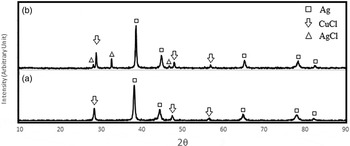
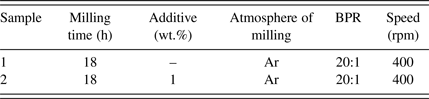
To determine the effect of additive, two samples were prepared with similar milling conditions. Table I summarizes the milling conditions. As seen in Figure 2, when stearic acid added as an additive in the starting materials, after 18 h of milling, AgCl in the final ground mixture [Figure 2(b)] was observed. This represents the role of stearic acid in controlling MC reaction. The stearic acid that is absorbed on the surface of the particles helps the cold-welding and agglomeration processes. Because the cold-welding process is an essential requirement to the progress of MC reaction, through decreasing cold welding, the reaction rate is slowed. Accordingly, the reaction in the presence of stearic acid needs more time to be completed (Lü and Lai, Reference Lü and Lai1998).
XRD patterns of AgCl + Cu mixture ground for 18 h (a) without additive, (b) stearic acid additive.

Milling conditions of the samples.
C. Characterization of powder sample after leaching
Leaching process formed a single phase of Ag in the residue. The process can be explained by the following reaction (Prakash et al., Reference Prakash, Tuli, Basu and Madan2000):
 $$\hbox{CuCl} + 2\hbox{NH}_3 + 2\hbox{H}_2\hbox{O} \rightarrow \left[\hbox{Cu} \left(\hbox{NH}_3 \right)_2 \right] \hbox{Cl} (\hbox{soluble}) + 2\hbox{H}_2\hbox{O}.$$
In the presence of additive, the small remnant of AgCl presents in the mixture reacted with NH3 (aq) during the leaching process and formed the following complex (Prakash et al., Reference Prakash, Tuli, Basu and Madan2000):
 $$\eqalign{\hbox{AgCl} + 2\hbox{NH}_3 + 2\hbox{H}_2\hbox{O} \rightarrow & \left[\hbox{Ag} \left(\hbox{NH}_3 \right)_2 \right] \hbox{Cl} (\hbox{soluble}) \cr & + 2\hbox{H}_2\hbox{O}.}$$
Figure 3 shows the XRD pattern of the separated Ag powder from liquid during the leaching process. The diffraction peaks correspond to the (111), (200), (220), (311), and (222) planes, respectively. All reflections on the XRD pattern can be indexed to a face centered cubic (fcc) structure according to the literature pattern (JCPDS, file no. 04-0783). The peaks in Figure 3 show the existence of Ag only.
XRD patterns of AgCl + Cu mixture ground for 18 h after leaching by NH3 (aq) solution.

Thus, it confirmed that the material synthesized during the leaching process is pure Ag powder. The broadening of the pattern peaks correlates to the fineness of the Ag crystallite. The crystallite size of the powder was calculated by line broadening of (111) peak of the XRD pattern using Scherrer's formula:
 $$\hbox{Crystallite size} = {0.9 \lambda \over \beta. \cos \theta}.$$
The width β is usually measured in radians, at intensity equal to half the maximum intensity. The crystallite size of Ag particles in samples 1 and 2 are presented in Table II. As seen in the table, the crystallite size is decreased by addition of stearic acid. The larger crystallite size of sample 1 could be because of the relatively higher temperature existed during milling in the absence of stearic acid. Enhanced lubrication is believed to reduce the local temperature during collisions.
Crystallite size of Ag particles in samples 1 and 2.

The SEM photomicrographs of the Ag powder are shown in Figure 4. It is observed that the morphology of the powder processed in the presence of stearic acid differed considerably from that of processed without stearic acid. Figures 4(a)–4(c) show the photomicrographs of the powder prepared without additive in the different magnifications. This reveals that the particles have densely agglomerated and it is difficult to distinguish between them clearly. The formation of large particles may be attributed to Ag and its fcc crystal structure in which particles are easily deformed and cold welded to each other to form large agglomerates (Shaw et al., Reference Shaw, Zawrah, Villegas, Luo and Miracle2003). Figures 4(d)–4(f) show the photomicrographs of the Ag powder prepared using stearic acid additive in different magnifications. The powder is more dispersive than the sample without additive and the size of particles remain in the range of 30–300 nm. It seems that by addition of stearic acid, the cold-welding process is suppressed.
SEM images of Ag powders formed (a)–(c) without additive and (d)–(f) stearic acid additive.

SEM images in Figure 4 suggest that addition of stearic acid plays an important role during Ag nanoparticle synthesis. This additive behaves as a dispersant in the MC process because of the possibility of the formation of an outer-sphere or a surrounding layer of stearic acid that covers the dispersed Ag particles in the mixture. This helps to prevent the agglomeration of the Ag particles.
Figure 5 shows results of particle size analysis (PSA) for Ag powder in the presence of stearic acid as additive. It can be observed that the size of particles remains in the range of 30–300 nm and verifies the SEM photomicrographs, also according to the diagram the average size of particles is 85.4 nm.
(Color online) PSA diagram for Ag powder in the presence of stearic acid as additive.

IV. CONCLUSIONS
Silver nanoparticles were synthesized by the MC process with AgCl and Cu as starting materials and the reaction was carried out in the absence and presence of stearic acid as additive. It was found by the XRD analysis that the addition of stearic acid alters the behavior of reactants significantly during the mechanical milling and delays the displacement reaction also. The SEM photomicrographs and PSA data reveal the effective nature of stearic acid in formation of silver nanoparticles during the MC process. Using stearic acid efficiently reduced the particle size of Ag by the suppression of excessive cold welding and led to formation of more dispersed Ag nanoparticles with the range of 30–300 nm. In the absence of stearic acid, the particles densely agglomerated, as the size of particles was roughly more than 1000 nm.