Introduction
Delusions, one of the key symptoms of schizophrenia, are defined as fixed false beliefs that (i) are maintained despite counter-evidence and rational counter-argument, (ii) would be dismissed by members of the same social and cultural environment, and (iii) are held with great conviction (APA, 2000). Maintenance of delusions despite counter-evidence and rational counter-argument involves explaining away disconfirming evidence by integrating it into the delusional framework, and this process has been described as safety behaviours (e.g. ‘the only reason they did not shoot me yesterday was because I took another route to work’) and incorporation (e.g. ‘the only reason they did not shoot me yesterday was because they want me to suffer another day’; Garety et al. Reference Garety, Kuipers, Fowler, Freeman and Bebbington2001; Freeman et al. Reference Freeman, Garety, Kuipers, Fowler and Bebbington2002). There is also evidence that people with delusions have greater belief inflexibility relative to healthy controls (Colbert et al. Reference Colbert, Peters and Garety2010; So et al. Reference So, Garety, Peters and Kapur2010). Past work has shown that a cognitive bias against disconfirmatory evidence (BADE) exists in schizophrenia that is observable on delusion-neutral material, tapping into a cognitive process that may underlie the fixed aspect of delusions (i.e. maintained despite counter-evidence and rational counter-argument), possibly resulting in safety behaviours and incorporation. This bias is present in schizophrenia (Moritz & Woodward, Reference Moritz and Woodward2006a ; Woodward et al. Reference Woodward, Moritz, Menon and Klinge2008) and is particularly enhanced in delusional patients (Moritz & Woodward, Reference Moritz and Woodward2006b ; Woodward et al. Reference Woodward, Moritz, Cuttler and Whitman2006; Riccaboni et al. Reference Riccaboni, Fresi, Bosia, Buonocore, Leiba, Smeraldi and Cavallaro2012). Moreover, a previous factor analysis by Woodward et al. (Reference Woodward, Buchy, Moritz and Liotti2007) that incorporated BADE and traditional neuropsychological measures demonstrated that BADE measures were independent from other cognitive domains, including executive function as measured on the Wisconsin Card Sorting Test (WCST; Loong, Reference Loong1991) and the Trail Making Test (TMT; Reitan & Wolfson, Reference Reitan and Wolfson1985).
The most comprehensive form of the BADE task involves a set of scenarios that are accompanied by four possible interpretations, individually rated after each of three successively presented statements (illustrated in Fig. 1): one absurd interpretation, which seems implausible from the first statement and remains so throughout the trial; two lure interpretations (one neutral and one emotional), which seem plausible initially but are disconfirmed after the second or third statement; and one true interpretation, which does not seem to be the most plausible from the start but is confirmed by the final statement. For example, the statement ‘Jenny can't fall asleep’ may be interpreted in several ways (e.g. ‘Jenny is worried about her exam the next day’ or ‘Jenny is excited about Christmas morning’); as more statements are presented (e.g. ‘Jenny can't wait until it is finally morning’), it becomes increasingly clear as to which interpretations are lures, which are true, and which are absurd. The BADE has been characterized as an unwillingness to down-rate initially plausible interpretations (‘lures’) as they are revealed to be implausible (Moritz & Woodward, Reference Moritz and Woodward2006a , Reference Moritz and Woodward b ; Woodward et al. Reference Woodward, Moritz, Cuttler and Whitman2006, Reference Woodward, Moritz, Menon and Klinge2008; Buchy et al. Reference Buchy, Woodward and Liotti2007).
A typical bias against disconfirmatory evidence (BADE) trial after all three statements have been presented.

Previous analyses of the BADE task have typically focused on lure interpretation ratings (Woodward et al. Reference Woodward, Buchy, Moritz and Liotti2007) and/or have used rating adjustment scores as an index of BADE (Moritz & Woodward, Reference Moritz and Woodward2006b ; Woodward et al. Reference Woodward, Moritz, Cuttler and Whitman2006, Reference Woodward, Moritz, Menon and Klinge2008; Veckenstedt et al. Reference Veckenstedt, Randjbar, Vitzthum, Hottenrott, Woodward and Moritz2011). However, these methods do not take into account potential relationships between all BADE items. A more recent multivariate analysis of the BADE task (Speechley et al. Reference Speechley, Ngan, Moritz and Woodward2012) that used all plausibility ratings in a factor analysis suggested that two cognitive operations underlie the BADE task, termed: (1) ‘evidence integration’, which showed that participants providing high ratings for ‘lure’ interpretations following the second and third statements rated low for ‘true’ interpretations on statement three, and vice versa, indexing the degree to which they integrated disambiguating evidence, and (2) ‘response conservatism’, dominated by ratings for lure interpretations after the first two sentences, in addition to all ratings for true interpretations; this component was labelled ‘conservatism’ because it seemed to arise from some participants being reluctant to provide high ratings when justified. Of note, severely delusional schizophrenia patients showed higher evidence integration scores than psychiatric and non-psychiatric controls, reflecting higher ratings for disconfirmed interpretations and lower ratings for confirmed interpretations.
Small sample sizes can be problematic in studies where a group of psychiatric subjects is divided into symptom-related subgroups. Although the analysis by Speechley et al. (Reference Speechley, Ngan, Moritz and Woodward2012) provided important insights into the cognitive operations underlying the BADE task, their study was limited by a small sample size for the delusional group (n = 10). One aim of the present study was to replicate this analysis in a larger group of schizophrenia patients that could be divided into adequately sized subgroups. In addition, the Speechley et al. (Reference Speechley, Ngan, Moritz and Woodward2012) study compared delusional and non-delusional schizophrenia patients with non-delusional bipolar patients to control for impairment in cognitive function, genetic and environmental susceptibility factors, and stigmatization associated with mental illness (Barrett et al. Reference Barrett, Mulholland, Cooper and Rushe2009). A potentially more interesting psychiatric control may be obsessive–compulsive disorder (OCD) patients, who generally have little symptom overlap with schizophrenia but do typically experience intrusive thoughts and obsessive beliefs from which they find it difficult to disengage. OCD is not a psychotic disorder, but there are similarities between delusions in psychosis and obsessions in OCD in the sense that, unlike the worries present in anxiety disorders (which are typically excessive concerns about realistic situations), obsessions in OCD are considered to be egodystonic and more bizarre in nature (Barlow, Reference Barlow2002). The inclusion of an OCD psychiatric control group should help to determine whether BADE is a cognitive bias specific to psychosis and delusions in particular, or can be observed in other individuals with obsessive and generally unrealistic and possibly bizarre beliefs.
In the current study, to negate concerns around sample size insufficiencies and other methodological idiosyncrasies in our past work as described above, we entered all interpretation ratings (absurd, neutral lure, emotional lure, and true) into a principal component analysis (PCA) to explore the cognitive underpinnings of the BADE paradigm and how they differ across patient groups and healthy individuals. Based on our previous analyses of schizotypy (Woodward et al. Reference Woodward, Buchy, Moritz and Liotti2007) and schizophrenia data on small samples (Speechley et al. Reference Speechley, Ngan, Moritz and Woodward2012), we anticipated that two factors would emerge from all BADE items, and that highly delusional schizophrenia patients would show the most impairment in evidence integration relative to healthy controls, OCD patients and schizophrenia patients with mild/no delusions.
Method
Participants
The present analysis was drawn from a consolidation of two datasets (total n = 214): (1) previously published data (see Veckenstedt et al. Reference Veckenstedt, Randjbar, Vitzthum, Hottenrott, Woodward and Moritz2011 for recruitment details) for 30 healthy controls with no psychiatric history, 54 patients fulfilling DSM-IV criteria for schizophrenia or schizo-affective disorder, and 20 OCD patients, and (2) unpublished data for 110 patients with schizophrenia or schizo-affective disorder. Thus, a total of 164 schizophrenia patients were included in the analysis. Schizophrenia patients were mainly recruited from an acute psychosis ward at the University Medical Centre, Department of Psychiatry and Psychotherapy in Hamburg, Germany. All diagnoses, including screening for the healthy control group, were determined by an experienced psychologist using the Mini International Neuropsychiatric Interview (MINI; Sheehan et al. Reference Sheehan, Lecrubier, Sheehan, Amorim, Janavs, Weiller, Hergueta, Baker and Dunbar1998). None of the participants had previously completed a BADE task. All participants provided written informed consent after a complete description of the study, which was approved by the local ethics committee.
General exclusion criteria for all psychiatric participants were: (1) history of stroke, brain trauma, epilepsy, or other major neurological disorders, (2) severe substance dependence, and (3) an additional Axis I diagnosis (although an exception was made for major depression). An additional exclusion criterion for healthy individuals was the presence of any Axis I disorder, as determined using the MINI. Finally, OCD patients showing psychotic symptoms were excluded from participation. In the schizophrenia sample, current psychopathology was assessed with the Positive and Negative Syndrome Scale (PANSS; Kay et al. Reference Kay, Opler and Lindenmayer1989). Patients with schizophrenia who reached a score of 4 or higher on delusions (item 1 on the positive subscale of the PANSS) were classified as high-delusional (n = 43).
BADE task
Full details of the German-language BADE task administration are described elsewhere (Veckenstedt et al. Reference Veckenstedt, Randjbar, Vitzthum, Hottenrott, Woodward and Moritz2011). A screen shot of a typical BADE trial is presented in Fig. 1. In brief, the task consisted of 24 scenarios, eight of which were control trials (i.e. the ‘true’ interpretation was evident from the start of the trial rather than increasing in plausibility with accumulating evidence). Eight of the experimental trials and four control trials included only two possible interpretations (i.e. one lure and one true). All stimuli were presented on a computer screen. According to the plausibility evaluations of the participant, the instructor moved a slider along a scale of 0 (‘implausible’) to 10 (‘very plausible’) for each possible interpretation by using the computer mouse. The participants could use the entire range of scale in 0.1 steps to make their ratings. A small box to the right of each scale showed the current rating. Participants completed one practice trial at the start of the experiment.
Ethical standards
All procedures contributing to this work complied with the ethical standards of the relevant national and institutional committees on human experimentation and with the Declaration of Helsinki of 1975, as revised in 2008.
Results
Sample characteristics
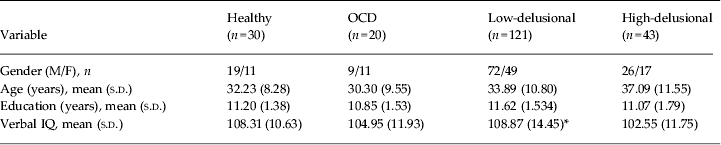
Table 1 presents a list of group means for sample characteristics. The four groups did not differ in gender distribution [χ2(3) = 1.90, p > 0.5]. There were trend-level group effects for age (F 3,210 = 2.34, p = 0.074), verbal intelligence, assessed by the Multiple Choice Vocabulary Test (F 3,208 = 2.62, p = 0.052), and years of education (F 3,208 = 2.39, p = 0.070). Post-hoc comparisons using the Tukey honestly significant difference (HSD) test showed a significant difference in verbal IQ between the delusional [mean = 102.55, s.d. = 11.75, 95% confidence interval (CI) 98.89–106.21] and non-delusional groups (mean = 108.87, s.d. = 14.45, 95% CI 106.27–111.47; p = 0.042), but otherwise no significant differences were found on age, IQ or education for any group comparisons (all p's > 0.08).
Sociodemographic characteristics of each participant group

OCD, Obsessive–compulsive disorder; M, male; F, female; s.d., standard deviation.
* p < 0.05 for post-hoc comparison with high-delusional group.
PCA
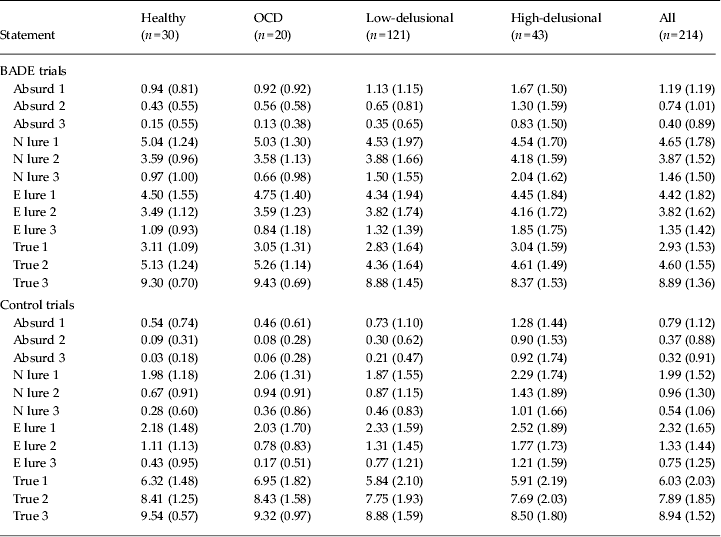
Control trials and trials that included only two possible interpretations were not included in the present analysis, resulting in 12 BADE variables: mean absurd, neutral lure, emotional lure and true interpretation ratings following each of the three evidence-providing statements (mean plausibility ratings for each group of participants are listed in Table 2). As in our previous study with a smaller sample size (Speechley et al. Reference Speechley, Ngan, Moritz and Woodward2012), PCA was used for data reduction, with one difference: the PCA was run on the schizophrenia sample only, and component scores were subsequently constructed for the groups not included, using the coefficients obtained from this PCA. The reason for this was that, if group differences are present on the BADE and all participants are analysed simultaneously, this could lead to components that are specific to these group differences and would not emerge within any of the individual groups. Therefore, these ratings were entered into a PCA with varimax (orthogonal) rotation, in the schizophrenia group only (i.e. the main population of interest; n = 164, no missing data). The overall Kaiser–Meyer–Olkin (K-M-O) measure of sampling adequacy was 0.776, with individual measures of sampling adequacy for each variable ranging from 0.693 to 0.897. Bartlett's Test of Sphericity yielded χ2(66) = 1637.05 (p < 0.001), verifying that the correlation matrix was not an identity matrix. The determinant of the correlation matrix was greater than zero (3.20 × 10⁻⁵), supporting an absence of multicollinearity.
Mean (s.d.) plausibility ratings following each piece of evidence

OCD, Obsessive–compulsive disorder; BADE, bias against disconfirmatory evidence; N, neutral; E, emotional; s.d., standard deviation.
Control trials differed from BADE trials in that the ‘true’ interpretation was evident from the start of the trial rather than increasing in plausibility.
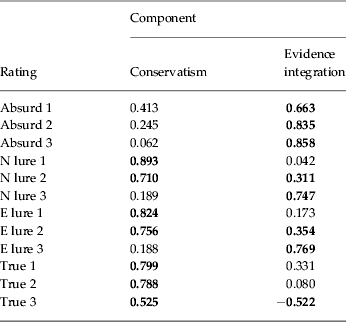
An examination of the eigenvalues (5.61, 2.45, 1.18, 0.73, 0.62, 0.45, 0.29, 0.20, 0.17, 0.16, 0.08, 0.08) suggested a two-component solution, which accounted for 67.14% of the total variance. Components with eigenvalues greater than but close to 1.0 were not retained because the eigenvalues > 1.0 rule is thought to lead to overextraction (Cliff, Reference Cliff1988; Jackson, Reference Jackson1993; Bandalos & Boehm-Kaufman, Reference Bandalos, Boehm-Kaufman, Lance and Vandenberg2008), and this was supported by a parallel analysis of eigenvalues obtained from analogous matrices of random values generated over 100 repetitions (see Hayton et al. Reference Hayton, Allen and Scarpello2004 for an in-depth description of this method). Component loadings are listed in Table 3, with component 1 labelled ‘conservatism’ and component 2 labelled ‘evidence integration’, in line with our previous factor analysis of the BADE task (Speechley et al. Reference Speechley, Ngan, Moritz and Woodward2012). The rotation sums of squared loadings showed that the rotated component 1 (‘conservatism’) accounted for 36.59% of the total variance and the rotated component 2 (‘evidence integration’) accounted for approximately 30.55% of the total variance.
Varimax-rotated component loadings for BADE indicators (schizophrenia patients only, n = 164)

N, Neutral; E, emotional.
All loadings corresponding to those > 0.40 in Speechley et al. (Reference Speechley, Ngan, Moritz and Woodward2012) are set in bold font to show similarities in component patterns.
The highest-loading variables on the response conservatism component were the first two ratings for neutral and emotional lure interpretations in addition to all ratings for true interpretations (see Table 3). Given the set-up of the BADE task (i.e. lure interpretations seem to be the most plausible initially and true interpretations seem somewhat less plausible initially but gradually become the most plausible), we would expect most participants to provide relatively high initial lure ratings and progressively higher true ratings. However, the existence of intercorrelations among these variables, reflected by the response conservatism component, suggests that a portion of the subjects generally rate low even though high ratings would be justified; that is, they are ‘conservative’ in their ratings (i.e. using caution or moderation). In comparison, evidence integration did not seem to be driven simply by an unwillingness to rate low when justified, as the negative loading of the third true rating suggests that this pattern arises from subjects continuing to rate high for initial beliefs following disconfirmatory evidence and continuing to rate low for the true interpretation following confirmatory evidence (see Table 3). This suggests that all BADE task ratings can generally be interpreted within the context of the two cognitive operations, response conservatism and evidence integration.
Group by component analysis
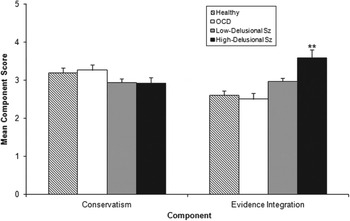
Component scores for the OCD and healthy control groups were computed by applying the component score coefficients obtained from running PCA on the schizophrenia group. The computed component scores for response conservatism and evidence integration were entered as dependent variables into a one-way multivariate analysis of variance (MANOVA), with the four participant groups entered as a fixed factor, to determine whether conservatism and/or evidence integration were able to discriminate the high-delusional schizophrenia group (n = 43; mean delusions = 4.51, s.d. = 0.74) from the three control groups [(1) low-delusional schizophrenia, n = 121; mean delusions = 1.59, s.d. = 0.80, (2) OCD, n = 20, and (3) healthy controls, n = 30]. This analysis revealed a significant main effect of group (ΛWilks = 0.875, F 6,418 = 4.821, p < 0.001). Follow-up univariate ANOVAs revealed a significant between-groups effect for evidence integration (F 3,210 = 9.008, p < 0.001) but not conservatism (F 3,210 = 1.082, p = 0.358). Post-hoc comparisons using the Tukey HSD test revealed that the highly delusional group had significantly higher evidence integration scores (mean = 0.581, s.d. = 1.462, 95% CI 0.296–0.866) than all other groups [(1) low-delusional: mean =−0.025, s.d. = 0.808, 95% CI −0.195 to 0.144, (2) OCD: mean =−0.493, s.d. = 0.659, 95% CI −0.911 to −0.075, and (3) healthy controls: mean =−0.401, s.d. = 0.654, 95% CI −0.743 to −0.060); all p's < 0.005]. Comparisons between low-delusional, OCD and healthy control groups were not significant (all p's > 0.15). These relationships are presented in Fig. 2.
Mean component scores plotted as a function of group [healthy controls, n = 30; obsessive–compulsive disorder (OCD), n = 20; low-delusional, n = 121; high-delusional, n = 43]. The mean of the component scores was rescaled to 3 for display purposes. ** p < 0.005 for comparisons between high-delusional subjects and all other groups.

Given the significant group effect observed for verbal IQ (driven by high-delusional subjects having a lower mean IQ than low-delusional subjects), there was a concern that IQ may be contributing to the group differences observed for evidence integration. However, a reanalysis using MANCOVA with IQ entered as a covariate showed that the significant main effect of group remained (ΛWilks = 0.877, F 6,412 = 4.672, p < 0.001), and a follow-up ANCOVA showed that the between-groups effect for evidence integration remained significant when IQ was entered as a covariate (F 3,212 = 8.706, p < 0.001).
Given the overlap commonly observed between the presence of delusions and hallucinations (Liddle, Reference Liddle1987; Woodward et al. Reference Woodward, Ruff, Thornton, Moritz and Liddle2003, Reference Woodward, Thornton, Ruff, Moritz and Liddle2004, Reference Woodward, Jung, Smith, Hwang, Barr, Procyshyn, Flynn, van der Gaag and Honer2013, in press; van der Gaag et al. Reference van der Gaag, Hoffman, Remijsen, Hijman, de Haan, van Meijel, van Harten, Valmaggia, de Hert, Cuijpers and Wiersma2006), the specificity of the evidence integration effect to delusions was examined by performing independent t tests between high- and low-hallucinating schizophrenia patients, using the same cut-off as was used to classify the highly delusional schizophrenia group (PANSS score ⩾4). Neither evidence integration nor conservatism differed between high-hallucinating (n = 36; delusional = 23, non-delusional = 13) and low-hallucinating (n = 127; delusional = 20, non-delusional = 107) subgroups for hallucinations (both p's > 0.09).
Discussion
Previous analyses using the BADE task have demonstrated that delusional schizophrenia patients show a relative unwillingness to down-rate disconfirmed interpretations of a given scenario, illustrating a defining characteristic of delusions in that they are maintained with conviction despite contradictory information (APA, 2000). The present study aimed to verify these previously identified cognitive processes in a large sample and to compare people with schizophrenia to those with OCD patients on these measures. This was achieved using a component analysis of all interpretation ratings. Two components accounted for approximately 67% of the variance in the BADE task: evidence integration (plausibility ratings reflecting the degree to which disambiguating information has been integrated) and response conservatism (plausibility ratings indexing an unwillingness to provide high ratings when justified). Only the evidence integration component distinguished between severely delusional schizophrenia patients and non-delusional subjects, with delusional subjects giving relatively high plausibility ratings for disconfirmed interpretations and low ratings for confirmed (true) interpretations. The absence of a difference in evidence integration between high- and low-hallucinating patients suggests that this effect is specific to delusions. Conservatism scores did not differ between groups, arguing against a generalized performance bias.
Comparisons with previous studies
In the previous study from which some of the present data were derived (Veckenstedt et al. Reference Veckenstedt, Randjbar, Vitzthum, Hottenrott, Woodward and Moritz2011), a BADE was measured by lure rating adjustments, and this was not enhanced in delusional patients compared with non-delusional patients. This univariate method of analysis as an index of BADE may sacrifice reliability; for example, the use of raw difference scores is limited because this measure prevents the consideration of participants' initial ratings, and how willing participants are to adjust lure interpretation ratings relative to their adjustments for true/absurd ratings. Moreover, difference scores are less reliable than either of the individual scores from which they are derived because any common variance in the two scores cancels out, and as a result, the error variance constitutes a larger proportion of the total variance. By contrast, aggregates of variables (e.g. component scores, which are variable aggregates weighted by coefficients derived from PCA) are more reliable than any of the individual scores because error variance in the two scores cancels out, and the common variance constitutes a larger proportion of the total variance (Anastasi & Urbina, Reference Anastasi and Urbina1997). The current study demonstrates how a multivariate approach can be a more informative evaluation of cognitive processes underlying the BADE task. For comparisons across studies, future studies using the BADE task could compute evidence integration and conservatism scores as sums of their respective indicators. Specifically, we recommend that evidence integration be computed as the sum of absurd 1, absurd 2, absurd 3, neutral lure 3, emotional lure 3, and (true 3 × −1), and that conservatism be computed as the sum of neutral lure 1, neutral lure 2, emotional lure 1, emotional lure 2, true 1, and true 2.
The results from this study do not point to a specific cognitive mechanism affecting evidence integration, although our previously proposed concepts of liberal acceptance (LA; Moritz & Woodward, Reference Moritz and Woodward2004; Moritz et al. Reference Moritz, Woodward and Lambert2007, Reference Moritz, Woodward, Jelinek and Klinge2008) and/or hypersalience of evidence–hypothesis (EVH) matches (Speechley et al. Reference Speechley, Whitman and Woodward2010; Balzan et al. Reference Balzan, Delfabbro, Galletly and Woodward2012, Reference Balzan, Delfabbro, Galletly and Woodward2013) may underlie impairment in evidence integration on the BADE task. For example, the LA account would suggest that, in highly delusional patients, all BADE interpretations are considered somewhat plausible initially, and so the true interpretation is not fully accepted and the absurd/lure interpretations are not fully dismissed, and a definitive decision is delayed. Another possibility is that EVH matches between the initial evidence and the lure interpretations (i.e. hypotheses) result in delusional patients continuing to find these matches hypersalient after the second and third sentences, resulting in a relative reduction in weighting of new evidence. Future BADE experiments including a manipulation of the initial plausibilities of each interpretation, and/or the strength of evidence, would be useful for testing the involvements of LA and EVH matches.
Limitations
It is important to note that the present study used a cross-sectional design, which is not optimal for studying associations of cognitive biases with psychotic symptoms. Given that symptoms cycle through active states and remissions in schizophrenia, longitudinal studies investigating correlations between change in delusions and change in BADE measures would be a more rigorous way to investigate whether this is a state-dependent cognitive process that changes with fluctuations in symptom severity, or is a trait characteristic of patients prone to severe pathology. This link between changes in cognition and changes in symptom severity has been demonstrated with the jumping-to-conclusions (JTC) bias (Woodward et al. Reference Woodward, Munz, Leclerc and Lecomte2009; Sanford et al. Reference Sanford, Lecomte, Leclerc, Wykes and Woodward2013), a distinct but related cognitive process thought to be associated with delusions (Garety et al. Reference Garety, Hemsley and Wessely1991; Fine et al. Reference Fine, Gardner, Craigie and Gold2007; Freeman et al. Reference Freeman, Pugh and Garety2008; Speechley et al. Reference Speechley, Whitman and Woodward2010; Menon et al. Reference Menon, Quilty, Zawadzki, Woodward, Sokolowski, Boon and Wong2013).
Conclusions
The components derived from the present analysis agree with those previously reported (Speechley et al. Reference Speechley, Ngan, Moritz and Woodward2012) and provide further support for a deficit in evidence integration that is enhanced in currently delusional patients. Importantly, the present study not only replicates this finding in a larger sample of schizophrenia patients but also suggests that BADE is specific to psychosis; that is, the absence of a deficit in evidence integration in OCD patients, who generally display obsessive beliefs and rigidity in cognition but were not experiencing psychosis-like delusions, provides support for the idea that BADE may underlie psychotic delusions in particular rather than some general tendency to persist in dysfunctional thinking.
Implications
The development of cognitive measures connecting the clinical symptoms of psychosis to the daily experiences of schizophrenia patients may provide significant advances in mental health; for example, symptom-based cognitive measures can be adapted to a clinical setting such as metacognitive training, a treatment that aims to reduce the impact of delusional ideation by helping patients recognize and counter the cognitive processes characterizing their illness without discussing personal delusions (Moritz et al. Reference Moritz, Veckenstedt, Randjbar, Vitzthum and Woodward2011). Such cognitive-focused interventions are crucial because of the limited effectiveness of pharmacological treatments (Elkis, Reference Elkis2007; Leucht et al. Reference Leucht, Arbter, Engel, Kissling and Davis2009) and low medication compliance in psychosis (Byerly et al. Reference Byerly, Nakonezny and Lescouflair2007). Thus, the BADE represents a promising area of focus for cognitive-based interventions and assessing treatment responsiveness in psychosis.
Acknowledgements
This work was supported by a grant from the German Research Foundation (Mo 969/6–1) and a National Alliance for Research on Schizophrenia and Depression (NARSAD) grant from the Brain and Behavior Research Foundation.
Declaration of Interest
None.