Introduction
Bangladesh is predominantly an agricultural country with a high population density. Small-scale poultry farming, as a sub-sector of agriculture, plays an important role in improving rural livelihood, food security and poverty reduction in rural and semi-urban communities in the country. Commercial broiler farming, nowadays, has become a promising and dynamic industry with enormous potential and serves as a tool for poverty reduction through self-employment and income generation of unemployed family members (Raha, Reference RAHA2007). Due to short life cycle, low capital investment and quick return it may be a good source of income to rural farmers throughout the year (Bhende, Reference BHENDE2006). It plays a significant role in improving the livelihood of the farmers that is reflected in improved socio-economic conditions and increased empowerment of women among rural people of Bangladesh (Rahaman et al., Reference RAHAMAN, SAYEED, SARKAR and ALAM2006).
Approximately 70% of people are suffering from malnutrition and about 81% of families do not have their caloric requirements met in Bangladesh. In addition, about 60% of families in Bangladesh are not able to meet their protein requirements from their diets. Consumption of protein of animal origin is much lower in the country than in some other countries of the world. This was also echoed recently by Das et al. (Reference DAS, CHOWDHURY, KHATUN, NISHIBORI, LOSBE and YOSHIMURA2008). According to a recent report, the average per capita availability of meat is 23.6 g/head/day compared against the standard human requirement of 120 g/head/day (BBS, Reference BBS2010). Consequently, there is a huge gap between requirements and the availability of meat.
In view of the above scenario in Bangladesh, broilers can play a vital role in meeting the nutritional deficiency to an appreciable extent. They can efficiently and rapidly provide a source of protein, as production requires less time and small investment.
Broiler meat contains high quality protein and micronutrients which have tremendous impact on health and nutrition for the people in rural areas (Neumann et al., Reference NEUMANN, HARRIS and ROGERS2002; Barroeta, Reference BARROETA2007). From an economic point of view, broiler farming has been playing a key role in providing meat to overcome the malnutrition for the rural people particularly for small farmers and landless labourers. Due to the increasing demand of poultry meat, and quick return on investment, small farmers prefer to rear broilers. Profitability of broiler farming is affected by a number of factors. Sometimes, rural farmers fail to manage their farms efficiently because of their limited resources, lack of knowledge and very low investment. As a result their production is not in a static condition. Sometimes, they earn profit but at other times they incur losses. A sharp rise in the price of chicks and feed and failure to obtain a fair price for their produce further aggravate the situation. The small farmer seldom performs financial analysis of their production units, although expansion of poultry farming in particular locations should be based on the cost-benefits ratio of performance of small-scale poultry production units.
Research on the severity of constraints and factors influencing the performance of fast growing, small-scale broiler farms under private management in rural areas is scant. In addition, the farmers’ attitude and behaviour towards expansion of farm size based on the household income of small-scale broiler farming is yet to be investigated. In this context, farm size is a very crucial factor for increasing broiler meat production. There are a limited number of studies (Islam, Reference ISLAM1995; Karim, Reference KARIM2000, Nair and Ghadoliya, Reference NAIR and GHADOLIYA2000; Jaim and Islam, Reference JAIM and ISLAM2008; Mohsin, et al., Reference MOHSIN, RIAZ, ASAD and MUSHTUK2008 and Ali and Hossain, Reference ALI and HOSSAIN2010) dealing with production and economic aspects of this type of poultry production. Among those, Jaim and Islam (Reference JAIM and ISLAM2008) dealt with village based small farms who concluded that technical intervention could make a significant contribution in alleviating rural poverty by enhancing profitability. But the study did not consider all related factors that affect the profitability.
Therefore, in this paper, an attempt has been made to identify the relative weight of the factors influencing profitability of small-scale broiler farming and constraints faced by the farmers during production.
Study area and sample
Broiler producing areas of the Mymensingh, Sherpur and Kishoreganj districts of Bangladesh were considered as study areas. Data were collected from a total of 77 broiler farmers, of which 40 were in Mymensingh, 22 in Sherpur and 15 in Kishoreganj. A semi-structured questionnaire was prepared, pre-tested and finalised before interviewing the farmers. Before the collection of data, the objectives of the study were clearly explained to each of the participants. All possible care was taken to obtain accurate and reliable data. The collected data were then edited and categorised into farm sizes (100, 200, 300, 400, 500 and 600 flock sizes). Among 77, three had 100 birds, 12 had 200 birds, four had 300 birds, 17 had 400 birds, 30 had 500 birds and 11 had 600 birds, which were treated as small-scale broiler farms. The data were collected during November 2009 to February 2010 on a regular basis.
Broiler productive performance
Broiler performance was determined on the basis of benefit-cost ratio (BCR). It was measured with the following formula: BCR = {Benefit \over cost}
Benefits = total earnings from broiler farming per bird / batch during recent past year,
Costs = total costs incurred in broiler farming per bird/ per batch.
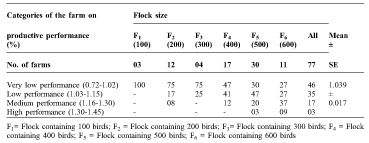
The observed performance ranged from 0.72 to 1.45 with the mean and standard error (SE) of 1.039 and 0.017 respectively. The broiler farms were classified into four categories on the basis of their performance in broiler production as shown in Table 1.
Distribution of the broiler producing farmers on the basis of their performance in broiler production.
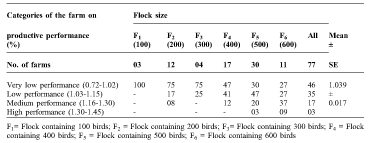
F1= Flock containing 100 birds; F2 = Flock containing 200 birds; F3= Flock containing 300 birds; F4 = Flock containing 400 birds; F5 = Flock containing 500 birds; F6 = Flock containing 600 birds
Findings revealed that an overwhelming majority of the farms (81%) had very low to low performance, 17% showed medium and only 3% had high performance and these performances increased with the size of the farm. Obviously, various factors related to production performance and constraints might have influenced these results.
Selected factors of the broiler-producing farmers
Eleven characteristics of broiler-producing farmers were considered for this study: age, education, occupation, land possessions, family size, marital status, family income, training on farming, farming experience, farm size and feed conversion ratio (FCR).
Education of the broiler farmers was measured in terms of formal years of schooling. Land possession was determined by the area of land on which the farmer carried the agricultural operations including homesteads, and was expressed in acres. The number of family members determined the working units of the farm. Annual family income was measured by the total yearly earnings from different sources by the members of a broiler farmer's family. Broiler farming experience was measured by the actual years of involvement. Farm size was determined by the number of birds reared in a unit. Extension contact scores for broiler farmer was computed and communicated.
FCR of different farm sizes was determined from average feed intake and average live body weight of the broilers in each farm. Bangladeshi farmers usually sell their broilers between 28 and 35 days of age at around 1.5 kg body weights depending on market price. For this reason, in most cases it was only possible to record feed intake of birds up to 30 days of age. Average live weight of broilers was recorded at 30 days of recording. This combination with feed intake was used to calculate the FCR for each farm.
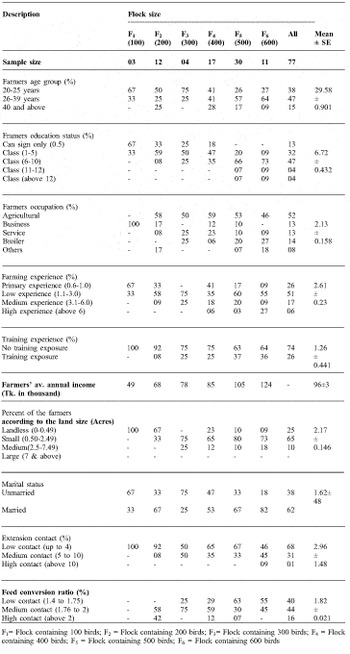
Salient features, including possible and observed ranges, numbers and percentage, distribution, mean standard error (SE) and categories of the 11 selected factors of the broiler-producing farmers are presented in Table 2.
Salient features of the selected factors of the small-scale broiler-producing farmers.

F1= Flock containing 100 birds; F2 = Flock containing 200 birds; F3= Flock containing 300 birds; F4 = Flock containing 400 birds; F5 = Flock containing 500 birds; F6 = Flock containing 600 birds
Table 2 shows that out of 77 sample farms, flocks of 100, 200, 300, 400, 500 and 600 accounted for 4, 16, 5, 22, 39, and 14% of the farms, respectively. All poultry farm owners were educated, but 13% could only sign their names and the sizes of the flock increased in step with level of education. About 32% of all poultry farm owners had primary education, 47% secondary level education, and only 4% had higher secondary level education and/or were college graduates. The result of a previously conducted survey showed that 52% of the small-scale broiler farmers who reared flocks of 100, 200 & 300 birds had only a primary level of education (Chowdhury et al., Reference CHOWDHURY, ISLAM, RAHA, HAQUE and KAWSAR2010). Such a low level of educational background causes difficulty in understanding and applying scientific knowledge in practice, even though they have access to training. Therefore, productivity and profitability suffer, causing serious dissatisfactions to the farmers. The exceptions to this were those farmers who had at least a secondary level of education and who received training on poultry raising. Chowdhury et al. (Reference CHOWDHURY, LATIF and DEBNATH1993) clearly indicated secondary level (Class VI to Class X passed) as being the appropriate level of education for trainees who were backyard poultry raisers. Chowdhury (Reference CHOWDHURY2011) suggested that small and medium enterprise (SME) farmers must have at least Junior School Certificate (JSC) and they should be trained on poultry science and technology before allowing/registering for commercial poultry farming. Owners of the small-scale broiler farms were relatively young, as reported in an earlier study of Akteruzzaman et al. (Reference AKTERUZZAMAN, MIAH, HOSSAIN, JEBUNAHAR and FATTAH2009). In this study, the age composition of owners of the broiler farms indicated that none of the owners were below 20 years old. The highest number of owners (47%) was in the age group of 26-39 years, 38% fell in the age group of 20-25 years and only 15% were in the age group of 40 years and above.
It was observed that the broiler farmers had a few sources of income. The average annual income of small-scale broiler farmers of 100, 200, 300, 400, 500 and 600 flock sizes amounted to be Tk. 49,166, Tk. 68,550, Tk. 77,675, Tk. 85,166, Tk. 1,05,276 and Tk. 1,24,647 respectively in 2010 (BDT 81= US$ 1.00). In rural Bangladesh, farm size has still been used as one of the important measuring indices of rich and poor. The farmers of the study area were categorised either as landless (0-0.49 acres), small (0.5-2.49 acres), medium (2.5-7.49 acres) or large (7.5 acres above) on the basis of total land holdings (BBS, Reference BBS2011). Most of the broiler producers (65%) were small farmers. Landless and medium farmers constituted 25% and 10% respectively. Among broiler farmers, nobody was found to possess sizeable land area.
Family size of small-scale broiler farmers in selected areas ranged from four to 10 members with an average of 5.7, which was higher than national average of 4.53 in the rural area of Bangladesh (BBS, Reference BBS2010). On the basis of family size, the broiler farmers were classified into three categories: small (up to 4), medium (5-6) and large (7 and above). About 55% of the farmers belonged to a medium sized family, 30% to a small sized family and the remaining 15% had a large sized family. Small-scale broiler farmers are poor communicators with other extension media, but this communicative approach increased the size of the farm. In addition, training had an impact on the increased farm size. Similar results were reported by Akteruzzaman et al. (Reference AKTERUZZAMAN, MIAH, HOSSAIN, JEBUNAHAR and FATTAH2009) who concluded that farmers with training increased flock size and land area to a greater extent as compared to the farmers who had no training. The training received by the farmers improved knowledge on feeding, management and health care of poultry that had an ultimate reflection on productive performance. Most of the small-scale broiler farmers (74%) were not trained on the basic principles of broiler farming. Technical knowledge of farmers on broiler rearing was not satisfactory and in some cases, it was poor as reported earlier by Bandara and Dassanayake (Reference BANDARA and DASSANAYAKE2006). FCR decreased with the increasing size of farm. It is evident that small-scale broiler flocks are low performers than those of comparatively larger farm size. A similar result was observed by Kawsar et al. (Reference KAWSAR, CHOWDHURY, ISLAM, RAHA, HOSSAIN and HAQUE2011) and Jaim and Islam (Reference JAIM and ISLAM2008) who concluded that the cost of raising broiler/bird had a negative relationship with size of farm and therefore the larger the flock size, the lower the cost of production. BCR also widened with an increase in the size of the flocks as shown by Islam et al. (Reference ISLAM, TAKASHI and CHABBI2010) and this was so in this study. Chand et al. (Reference CHAND, CHOWDHURY, SAHA and HOSSAIN2009) suggested that profitability is enhanced if farmers are properly trained to improve FCR, thereby reducing production cost and if biosecurity is strengthened as well, this will reduce mortality under field conditions. Those results are also in agreement with the result of Badubi et al. (Reference BADUBI, RAVINDRAN and REID2004) who reported that a better-trained class of farmers, who can effectively seek out and process new information and keep accurate financial records, earned higher profit.
Relationship between the selected factors of the farmers and their performance in broiler production
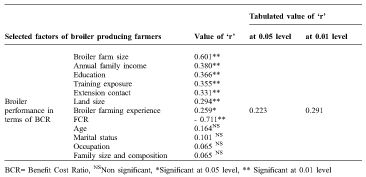
To determine the relationship between the performances of broilers with their selected factors, a Pearson product moment correlation analysis was conducted. The results revealed that out of 11 selected factors, education, land possessions, family income, training exposure, broiler farm size and extension contact had significant positive relationships with broiler performance (Table 3).
Correlation (r) between the selected factors of the farmers and their performance in broiler production.
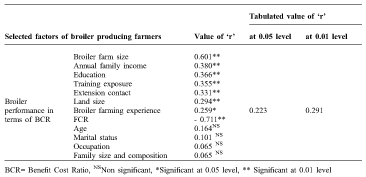
BCR= Benefit Cost Ratio, NSNon significant, *Significant at 0.05 level, ** Significant at 0.01 level
It is logical that larger training exposure with higher education and higher experience makes a farmer better able to do this job properly. Larger land holdings per individual may help increase annual family incomes which could in turn help enable farmers for higher investment in broiler enterprise. This study clearly indicated that comparatively larger broiler farm size could improve overall performance, ultimately profitability would be increased. On the other hand, more contact with different extension media by an individual could help the farmer to collect updated information on broiler farming which could help minimize certain problems in broiler farming and increase production.
FCR had a significant negative relationship with broiler performance as well as profitability (BCR) of broiler production. It was found to be a factor which had the highest impact on the profitability showing the co-efficient -0.711. This is in close agreement with the earlier observation of Ali and Hossain (Reference ALI and HOSSAIN2010) who reported a co-efficient value of -0.687. High FCR is an important factor leading to lower productive performance. The remaining four variables, namely age and family size, marital status and their occupation had no significant relationship with broiler performance.
Problems faced by the farmers in broiler production
To determine the severity of the problems faced by the farmers in broiler production, a problem faces index (PFI) and rank order was used. PFI of each problem was determined by using the following formula (as used by Ali, Reference ALI2008):
PFI =3 ×fs +2× fm +1 fl + 0 ×fn
Where,
fs = Number of broiler producing farmers faced severe problem
fm =Number of broiler producing farmers faced moderate problem
fl = Number of broiler producing farmers faced little problem
fn = Number of broiler producing farmers faced no problem
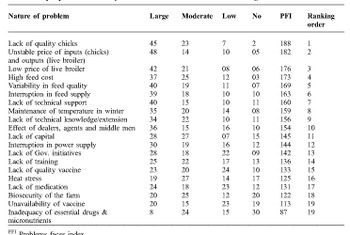
PFI was made with the 19 selected problems. PFI problems could range from 0 to 188, where 188 indicated severe problems and 0 indicated no problem. Rank order was made by the descending order of PFI of all the problems in order to compare the severity of problems. Some of the major constraints of small-scale broiler farmers are reported in Table 4.
Major problems faced by small-scale broiler farmers ranked through index method.

PFI Problems faces index
Among the constraints shown in the Table 4, lack of quality chicks ranked highest and this constraint appeared to be a common complaint of the farmers. The finding of the present study agreed with the result of a previous survey of Chand et al. (Reference CHAND, CHOWDHURY, SAHA and HOSSAIN2009) who concluded that chick quality occupied highest scoring among sixteen constraints of the farmers. Price instability of both chicks and live broiler was annoying to the farmers which ranked second among the constraints. However in comparison Tohura (Reference TOHURA2004) described unstable and undeveloped broiler market as the top of listed constraints for broiler farming. Fluctuation in market price of broilers affecting the profitability was previously reported by other researchers (Islam and Howlider, Reference ISLAM and HOWLIDER1990; Roy, Reference ROY2000; Raha, Reference RAHA2007; Begum and Alam, Reference BEGUM and ALAM2009). This might be because the market is mostly controlled by the middlemen involved with the business. Low prices of finished broiler, high feed cost and an interruption in feed supply ranked by turns third, fourth and fifth respectively. High feed cost and failure to obtain a fair price for broilers affected profitability while interruption in feed supply affected productivity and eventually profitability. The other constraints reported by the farmers were lack of technical knowledge, biosecurity on farm, variation in feed quality, lack of access to credit, influence of middlemen in the marketing channel, power failure and lack of technical support. All these constraints should be addressed by policy makers to ensure sustainability in the production system.
Conclusions and recommendations
The profitability of small-scale broiler farming depends on several factors, of which FCR had the highest impact (-0.711) and profitability increased with the size of the farm. A majority of the broiler farmers (81%) reported lower performance due to a lack of quality chicks and low price of live broiler. The effect of feed price and variable quality according to brand has a great impact on profitability when farmers had to buy feed at several times per production cycle, because the price varied according to brand, which had a further impact on FCR. With regard to qualitative findings of the study, certain areas can be highlighted. Technical knowledge regarding broiler rearing was not satisfactory amongst farmers, and, in some cases, it was poor. This was quite noticeable among the farmers who handled small flocks and who had a very low level of education. Broiler farmers should have technical knowledge to run a poultry farm profitably, but most of them were not properly trained (74%). From these findings the following recommendations can be made:
Education, training, extension contact and broiler farming experience had a significant positive relationship with their performance in broiler farming. Therefore, it is recommended that the illiterate farmers should not be registered for farming. Farmers should be trained periodically on various aspects of husbandry and disease control so that they can apply their knowledge successfully. Advisory and monitoring services on management, vaccination, biosecurity etc. would be helpful to enhance productivity and maximize profitability of small-scale broiler farmers. Department of Livestock Services (DLS) of Bangladesh should be strengthened and small farmers should be provided with technical supports either free of charge or at a minimum fee.
Higher quality feed and day-old chicks should be more readily available. To make this possible, there is no alternative except development of quality control systems. For the greater interest of poultry business and uphold the interest of the farmers, formation of a regulatory body such as a National Poultry Development Board, may help with quality control of chicks and feeds and ensure fair pricing of inputs and outputs in order to make broiler production profitable and consequently sustainable.
Commercial poultry farming systems in Bangladesh face many constraints of which lack of quality chicks ranked highest and this constraint appeared as a common complaint of the farmers. The poor sales price of finished broilers, high feed cost and interruptions in feed supply, failure to obtain fair price of broiler, lack of technical knowledge, lack of biosecurity in farm management, variation in feed quality, influence of middlemen in the marketing channel, power failure and lack of technical support for farming were severe constraints affecting productivity and profitability. All these constraints should be addressed by the policy makers to ensure sustainability in the production system.
Acknowledgement
The research was conducted with the financial support of Bangladesh Livestock Research Institute (BLRI), Savar, Dhaka. The Chief Scientific Officer of the Poultry Production Research Division deserves special thanks for administrative help.