1. Introduction
More people than ever are crossing borders to settle in new countries (Global Commission on International Migration 2005). Immigration is driven by diverse factors such as economic improvement, job opportunities, educational opportunities, family reunion, political persecution, natural disaster, and war. However, the majority of immigrants will encounter challenges, among which learning the language and culture of the host country may be the most radical. For young immigrant children, in particular, failure to meet these challenges risks devastating consequences: in too many cases, immigrant children are found to be at greater risk of academic failure in school, early school dropout, and, eventually, lower-paid employment or unemployment.
Mastering literacy in the dominant language of the immigrants’ society is one key to academic success. Even though literacy development of second-language (L2) learners has received academic attention, most research so far has examined the relationships between different components of reading (e.g., decoding words, phonological awareness, comprehension), and how systematic instruction can strengthen such relationships (August & Shanahan Reference August and Shanahan2006). Far less research has examined the influences of home language and literacy practices on L2 learners’ literacy development.
In the United States, it has been accepted that families are the first source of literacy development for children, with federal programs such as Even Start and Head Start incorporating components that promote parents’ engagement in home language and literacy practices with their children (Harper, Platt & Pelletier Reference Harper, Platt and Pelletier2011). Some of these practices, such as parents’ use of extended discourse and rare words with their children (Tabors, Roach & Snow Reference Tabors, Roach, Snow, Dickinson and Tabors2001) and book reading with their children (see Bus, van IJzendoorn & Pellegrini Reference Bus, van IJzendoorn and Pellegrini1995 for a meta-analysis of this topic), have been shown to predict later literacy success among monolingual children better than socioeconomic status (SES) alone. That is, although higher-income families tend to engage in more of these literacy-promoting activities than low-income families, low-income parents who do engage in these activities reap similar rewards for their children's literacy development.
We would expect children from families with strong language and literacy engagement to develop stronger oral language and pre-literacy skills before starting school. These children, then, not only start with an advantage over children from other families but also build on that advantage through continued practices at home that support further development of the children's literacy skills. However, it is unclear whether home practices within immigrant families promote their children's literacy development in the new societal language; they may instead do so in their first language (L1), which may or may not be useful in helping them develop literacy in their L2. Immigrant parents with limited L2 proficiency might try to engage in L2 language and literacy practices with their children, but these efforts might be undermined by their own low L2 proficiency.
Though the positive effects of home language and literacy practices on children's literacy development has been supported by research on monolingual children (Dickinson & Tabors Reference Dickinson and Tabors2001), there is still no consensus about the strength of this relationship in bilingual or L2 learning populations. Studies of the role of home language and literacy practices in immigrant children's literacy development have shown mixed results (Goldenberg, Rueda & August Reference Goldenberg, Rueda, August, August and Shanahan2006). In this paper, we review how home literacy practices and interaction between home and school help or hinder L2 literacy development among immigrant children in different countries. In particular, the following research questions will be addressed:
1. What home literacy practices have been documented in immigrant families?
2. What factors seem to influence the occurrence of such practices?
3. How do different home literacy practices in immigrant families influence children's development of literacy in the societal language?
4. What factors seem to moderate or mediate the effects of home literacy activities on literacy in the societal language?
Although in this review we focus on the home language and literacy practices of immigrant families, it is important to keep in mind that these practices exist within a broader societal and policy context which may influence both the home practices themselves and immigrant children's success in L2 literacy development. We find Bronfenbrenner's ecological theory (Bronfenbrenner & Evans Reference Bronfenbrenner and Evans2000) helpful in conceptualizing the many systems which impact immigrant children's overall development. In Bronfenbrenner's terms, the microsystems of the home and school have a direct impact on the child, as does the mesosystem created by the interaction of home and school (Bronfenbrenner & Evans Reference Bronfenbrenner and Evans2000; Guhn & Goelman Reference Guhn and Goelman2011). More indirectly, the macrosystem, including societal attitudes and policies toward immigrants, influences a child's development and how his or her home resources and practices are regarded, as well as how they might interact with societal practices to impact the child's L2 literacy development. In this paper, we focus on the microsystem of the home, with some investigation of the microsystem of the heritage language school and the mesosystem between home and both heritage and general societal school.
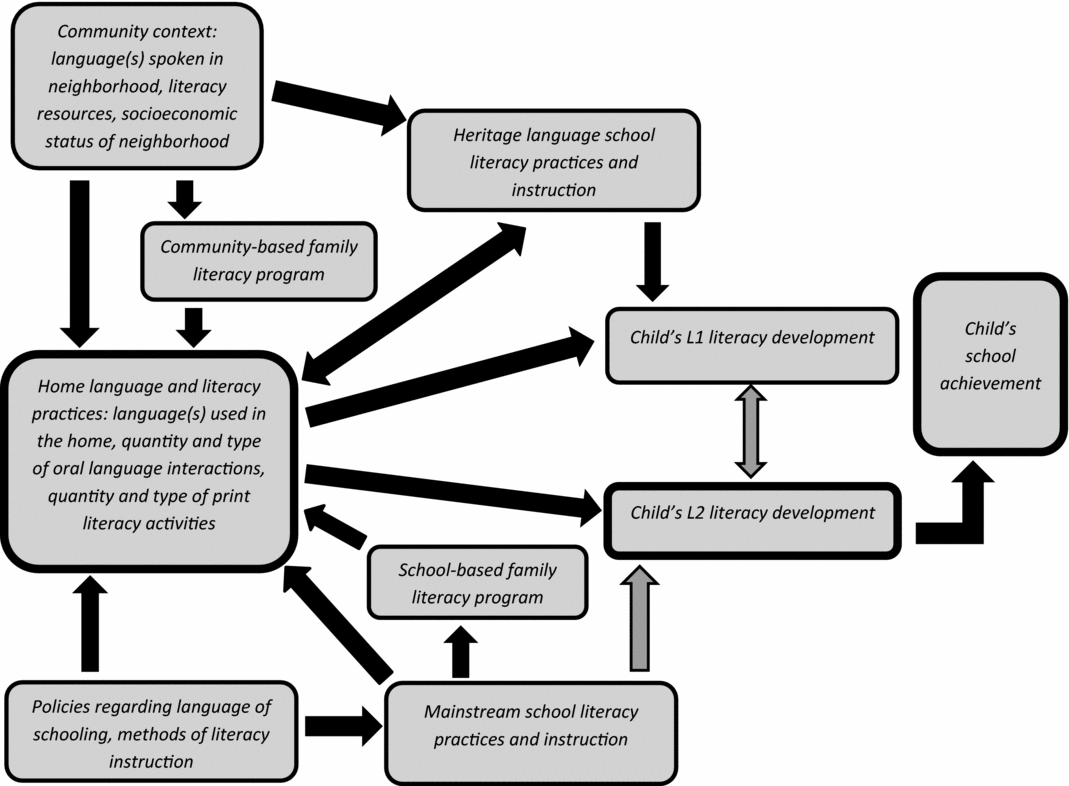
Our conceptual model of how home language and literacy practices influence and are influenced by the other factors we are investigating in this paper is shown in Figure 1. We are interested in how home literacy practices (broadly defined) influence, directly and indirectly, immigrant children's L2 literacy development, which in turn is believed to affect their school achievement and life success. A direct path occurs when home literacy practices in the L2, such as book reading, promote the child's L2 literacy development. An indirect path may occur when home literacy practices in the L1, such as writing letters to relatives in the country of origin, contribute to the child's L1 literacy development and in turn transfer to the child's L2. Expanding on our example, learning about the genre of writing a friendly letter in the L1 may help the child develop the skills to write a similar letter in the L2. Another indirect route is through a heritage (or community) school program: these hold classes for immigrant children in their family's L1, often focused on developing literacy in the L1. In this model, heritage language school practices are seen as a way to extend home literacy practices in the L1. The bidirectional arrow suggests that the heritage school may both reflect home literacy practices and influence them (through homework, for example). The heritage school practices then strengthen the child's L1 literacy skills, which in turn may help promote his or her L2 literacy development. The figure expresses the hypothesis that the relationship between L1 and L2 literacy skills is bidirectional: literacy skills developed in one language help to promote similar skills in the other, but this link is not directly examined in this paper (hence the gray color of the arrow).
A conceptual map of the relationships among home literacy practices, factors that influence home literacy, and L2 literacy development

Figure 1 also captures the hypothesis that many factors influence home literacy practices. Starting with the upper left corner, the community context may influence home literacy practices through the richness or scarcity of literacy resources (such as libraries or bookstores) in the community, as well as the prevalence of the languages spoken in the neighborhood and its SES. For example, even if there is a well-stocked library a few blocks away, if the neighborhood feels dangerous because of high levels of crime, families may not make use of this resource (and therefore may not read books much at home). The community context may also determine whether a heritage language school is available: this is more likely in communities with a high concentration of immigrants from the same L1 background. Additionally, the community may offer a community-based family literacy program, which would seek to encourage certain home literacy practices.
Turning to the bottom left corner of Figure 1, policies may also influence families’ home literacy practices. For example, when the language of schooling is exclusively the family's L2, families may feel pressure to use the L2 more at home to prepare their children for L2 schooling. These policies also have an indirect effect on home literacy practices by determining how literacy is taught in school. School practices may, in turn, affect home practices directly, such as through the provision of homework, and indirectly, through a school-based family literacy program should the school offer one. Of course, the mainstream school literacy practices and instruction should also have a direct effect on the child's L2 literacy development, but we are not examining that link in this paper (hence the gray color of the arrow).
2. Method
Drawing on the expertise of the co-authors and expert colleagues, 21 articles from leaders in the field formed the basis of the initial pool of studies. To ensure that no relevant studies unknown to the co-authors were inadvertently excluded, a systematic search was conducted in four databases: ERIC, PsycInfo, LLBA, and Education Full Text (EBSCO). Two groups of terms were combined in search of the articles: one group emphasized literacy activities: home literacy, family literacy, class, classroom, oral language, talk, storytelling, media use, and policy; the other focused on language status: bilingual, L2, second language, English as a Second Language (ESL), English Language Learning (ELL), English Language Development (ELD), and immigrant. The articles displayed were then screened for empirical studies that met the following criteria: (1) conducted since 2000; (2) published in a peer-reviewed journal; (3) analyses conducted on either a single sample in which three out of four were immigrant children or children of immigrant parents, or a mixed sample with immigrant or L2 status as a variable; (4) involving children aged 18 or below; and (5) concerning language or literacy practices in L1, L2, or both.
We decided to exclude studies conducted before 2000 and focus on relatively recent research that would reflect the experiences of the current wave of immigrants. A review including earlier literature can be found in August & Shanahan (Reference August and Shanahan2006). In addition, the methods used in the studies were screened for a minimum level of quality: in the case of quantitative studies we looked for reliability and validity, with samples no smaller than 30, and in the case of qualitative studies, for indications of trustworthiness, such as the use of triangulation. As these are minimal criteria for quality screening, some studies were clearly methodologically stronger than others. Our searches found 70 articles to add to those previously identified, producing a total of 91 for the review.
We define immigrants as citizens of one country who move to another country to live and work there indefinitely. Throughout this article, we will use the term immigrant children/adolescents/learners/students to refer both to children who are themselves immigrants and to those who are the children of immigrant parents. It is also assumed that these immigrant children are L2 learners of the societal language unless otherwise specified. Because the focus of this article is immigrant children, we also may simply refer to children, adolescents, learners, or students, meaning immigrant L2 learners; we will make it clear when we are discussing studies that compare non-immigrant with immigrant students or L2 learners with L1 learners of the same language. Another important term is home literacy activities/practices, which in our review refers to any activities that take place at home involving reading, writing, speaking, or listening in either the home language or the societal language. Although some might view literacy narrowly as comprising only reading and writing activities, we take an inclusive view of literacy that includes oral language, because oral language contributes to literacy development (Dickinson & Tabors Reference Dickinson and Tabors2001). Throughout the review, ‘home literacy activities’ and ‘home literacy practices’ are used interchangeably.
3. Results
We begin by noting methodological issues with the studies reviewed. The findings of our literature review are grouped around the four research questions. In this section, documented home literacy practices in immigrant families are described. Factors that may influence the occurrence of home literacy practices are then discussed, followed by findings regarding the differential impact of home literacy practices on children's literacy development in the societal language. Finally, possible moderators and mediators involved in the effects of home literacy activities are discussed.
3.1 Quality of research studies
First, a note on the quality of the studies included in the review. Although we excluded work of low quality, many studies were not of optimal quality. Several common methodological limitations were noted in all the studies. For both qualitative and quantitative studies, sample size was an issue. Qualitative studies mostly showed sample sizes of one to six, while quantitative studies used samples in the 30–40 range. Many of the qualitative studies did not employ a second coder or interpreter to add trustworthiness to the author's analyses and interpretations of the data. Many quantitative studies did not employ fully equivalent comparison groups, raising problems with how comparison groups were recruited or assigned. In addition, the quantitative studies mostly examined correlations or predictive relationships between literacy activities and the acquisition of literacy skills. The reported effects of family literacy programs were often documented through parent self-report, rather than through direct observation or assessment.
Mixed methods were rarely seen, even though such methods could shed more light in many studies. For example, quantitative data might be used to select cases for a qualitative study, to locate cases that either match or differ on characteristics of interest (such as SES, L1 and/or L2 proficiency, and age of children). Also, quantitative data can add to the qualitative data collected. When exploring children's literacy development, for example, knowing their scores on certain widely used measures and/or school literacy assessments can add to the rich qualitative description of their literacy activities. In fact, including quantitative data can help answer an important question: do the children studied demonstrate literacy competence in home activities which is not reflected in the standardized measures or school assessments? Primarily quantitative studies can also be enhanced by qualitative methods, including open-ended questions on surveys or in focus groups that may help answer why certain literacy practices are or are not used and case studies that can provide richer detail on families that typify certain subgroups identified in the quantitative analyses.
The qualitative studies included in the review provide rich descriptions of the home literacy practices in which case-study immigrant families engage; these therefore offer a starting point to help educators and other service providers better understand the families they serve. This information can help them to design better programs and services to build on the families’ strengths and draw on their cultural resources. Quantitative studies, too, often identify variables that might be promising for inclusion in intervention programs, describing relationships between specific practices and concurrent or later literacy development. However, very few studies documented the next step: designing and implementing culturally appropriate school- or community-based programs for immigrant children or their families. And even fewer attempted to assess the effectiveness of such programs, an assessment that is urgently needed in order to move from description to positive change. More research utilizing random assignment to program and control groups is required to establish the effectiveness of these programs with different immigrant populations. In addition, both descriptive and intervention studies on this topic would benefit from a longitudinal design, documenting relationships between home literacy, any special programs, and children's literacy development over a longer period of time.
3.2 Documented home literacy practices
The most-studied home literacy activity was book reading (Boyce et al. Reference Boyce, Cook, Roggman, Innocenti, Jump and Akers2004; Kenner Reference Kenner2005; Raikes et al. Reference Raikes, Pan, Luze, Tamis-Lemonda, Brooks-Gunn, Tarullo, Tarullo, Raikes and Rodriguez2006; Duursma, Pan & Raikes Reference Duursma, Pan and Raikes2008; Ro & Cheatham Reference Ro and Cheatham2009; Scheele, Leseman & Mayo Reference Scheele, Leseman and Mayo2010; Leyendeckera et al. Reference Leyendeckera, Jäkel, Kademoǧlu and Yagmurlu2011; Markose, Symes & Hellstén Reference Markose, Symes and Hellstén2011; Farver et al. Reference Farver, Xu, Lonigan and Eppe2013). Mothers are the most-studied reading partners for children, and mothers typically read with their children several times a week to several times a month (Boyce et al. Reference Boyce, Cook, Roggman, Innocenti, Jump and Akers2004; Gonzalez & Uhing Reference Gonzalez and Uhing2008; Farver et al. Reference Farver, Xu, Lonigan and Eppe2013). Regarding fathers, Duursma et al. (Reference Duursma, Pan and Raikes2008) found that over half of Spanish–English bilingual fathers in their sample regularly read to their children, and other studies showed that other extended family members and siblings sometimes also acted as reading partners for younger children in the family (Kenner Reference Kenner2005; Hirst, Hannon & Nutbrown Reference Hirst, Hannon and Nutbrown2010; Markose et al. Reference Markose, Symes and Hellstén2011; Farver et al. Reference Farver, Xu, Lonigan and Eppe2013), particularly when their command of the L2 was considered stronger than that of their parents (Stavans, Olshtain & Goldzweig Reference Stavans, Olshtain and Goldzweig2009). Siblings in several studies were found to teach younger children school literacies, while maintaining traditional home literacy practices (Kelly, Gregory & Williams Reference Kelly, Gregory and Williams2001; Williams & Gregory Reference Williams and Gregory2001; Markose et al. Reference Markose, Symes and Hellstén2011).
Many other studies found that immigrant parents overall read less often to their children than parents from the mainstream of the host society; this has been observed with Spanish-speaking parents in the United States (Boyce et al. Reference Boyce, Cook, Roggman, Innocenti, Jump and Akers2004; Raikes et al. Reference Raikes, Pan, Luze, Tamis-Lemonda, Brooks-Gunn, Tarullo, Tarullo, Raikes and Rodriguez2006), Turkish parents in Germany (Leyendeckera et al. Reference Leyendeckera, Jäkel, Kademoǧlu and Yagmurlu2011), and Moroccan and Turkish families in the Netherlands (Scheele et al. Reference Scheele, Leseman and Mayo2010). One study found that the characteristics of children who were most at risk for less reading and literacy stimulation in the home included the immigrant status of their parents, Spanish L1 background, and English spoken as L2, among a sample of culturally diverse, low-income families in the US (Diener et al. Reference Diener, Wright, Julian and Byington2003).
In addition to the classic home literacy activity of book reading, a wide range of home activities in immigrant families have been documented in the literature. For children of preschool and elementary-school age, home literacy activities with their parents are usually highly interactive. In some cases, such interaction turned out to be beneficial to both parent and child. Schoolwork is one of the common domains in which parents provide time and space or actively help their children (Menard-Warwick Reference Menard-Warwick2007; Reyes & Azuara Reference Reyes and Azuara2008; Early Reference Early2010). Beyond schoolwork, immigrant families may read for fun or for religious purposes (Sneddon Reference Sneddon2000; Menard-Warwick Reference Menard-Warwick2007; Joo Reference Joo2009; de la Piedra Reference de la Piedra2010) and write for observance of a festival or family communication (Sneddon Reference Sneddon2000; Pahl Reference Pahl2002; Reyes & Azuara Reference Reyes and Azuara2008). Library use was also identified as a way that immigrant parents help with their children's literacy (Menard-Warwick Reference Menard-Warwick2007; James & Martin Reference James and Martin2009). In addition, some immigrant families explicitly taught their children L1 or L2 literacy skills, generally following their own culture's traditional methods of teaching (Sneddon Reference Sneddon2000; Markose et al. Reference Markose, Symes and Hellstén2011).
Some immigrant parents also include their children in the literacy tasks required to run a family business, such as keeping records, paying invoices, and writing restaurant specials (G. Li Reference Li2001; Wason-Ellam Reference Wason-Ellam2001; G. Li Reference Li2003). Some children whose parents were still struggling with the new societal language acted as translators or linguistic brokers to help their parents read literacy materials such as letters from school, bills, and other official notices (Sneddon Reference Sneddon2000; G. Li Reference Li2003; Y. Li Reference Li2005; Miano Reference Miano2011). Translating and interpreting those unfamiliar texts at home increased these emergent bilingual children's opportunities to develop their knowledge in vocabulary, syntax, culture, and genre (Perry Reference Perry2009).
Adolescents typically choose literacy activities independent of their parents, but often dependent on new technology and media. The main purposes of their literacy activities included socializing with peers (Lam Reference Lam2000; de la Piedra Reference de la Piedra2010), pursuing personal interests (Cruickshank Reference Cruickshank2004), and maintaining ethnic and cultural identity (Joo Reference Joo2009). Driven by these purposes, immigrant adolescents showed their preferences for online community posting (Yi Reference Yi2007, Reference Yi2008), texting/messaging and personal writing (such as diary or poetry writing), and internet surfing (Y. Li Reference Li2005). One study documented four Korean immigrant teens’ literacy activities in each language in the US; these adolescent girls enjoyed reading (in English) teen magazines, comic books, the Bible, books assigned at school, novels, poems, short stories (both online and hard copy), and nonfiction texts such as history books and encyclopedia articles, and (in Korean) comic books, short stories, biographies, folk tales, the Bible, and worship service programs (Joo Reference Joo2009). The teens also used mystery novels, cooking recipes, horoscopes, calendars, nutritional information, and friends’ webpages (Y. Li Reference Li2005). Cruickshank (Reference Cruickshank2004) found that teenagers who were labeled ‘non-readers’ by their teacher still engaged in diverse out-of-school literacy activities, including reading and writing shopping lists, keeping a diary, reading magazines, completing homework for both English and heritage language (Arabic) schools, following instructions for computer games, reading home-language subtitles on videos, reading mail, helping with bills, writing letters to relatives, and reading ‘young adult’ novels for fun. Among families with little access to written materials in their L1, oral storytelling (Sneddon Reference Sneddon2000; Scheele et al. Reference Scheele, Leseman and Mayo2010) and discussions on various topics (Scheele et al. Reference Scheele, Leseman and Mayo2010) were more common than print literacy activities.
Although regarded by some as the antithesis of literacy, television (TV) or video viewing was also identified by some immigrant families as an important tool for maintaining connections with the family's heritage, learning new vocabulary and cultural concepts, and spurring children to read books and write stories using TV characters (Perry & Moss Reference Perry and Moss2011). We include discussion of TV viewing in this review because our definition of literacy includes both oral language, which TV provides, and print literacy, which is explicitly promoted by some educational TV programs.
All the studies mentioned above used qualitative methodologies, relying on interviews, questionnaires, and observations. They document a variety of literacy practices among immigrant families, but often do not examine their contributions to children's literacy growth.
3.3 Factors impacting the occurrence of home literacy practices
In all the relevant studies, four factors were identified as influencing the choice of language or types of literacy activities in which parents engage their children: government policy, community environment, the parents’ language proficiency and cultural beliefs, and their SES and education. The studies discussed below are mostly qualitative, so findings should be considered suggestive rather than definitive.
3.3.1 Government policy
Policies only have an indirect effect on immigrant families’ home language and literacy practices, as they generally do not specify what families can do in their own homes. However, policies can encourage or discourage the use of the family's L1 in the home, as well as the development of literacy skills in the L1. This area is severely under-researched: we found only two studies that touched on the effects of government language policy on home language or literacy choices. In a case study of one Korean family in the US, Ro & Cheatham (Reference Ro and Cheatham2009) found that the parents decided to use more English at home with their first child when he entered an English-only preschool. The child subsequently became English-dominant, and the family said they were trying to use more Korean with their younger children in order to increase their skills in the language. In a qualitative study of three Chinese–Canadian children, G. Li (Reference Li2006) suggested that the English-only policy in the mainstream school influenced the children's language preference and use, ultimately preventing them from acquiring high L1 proficiency. Clearly, more research is needed on the effects of language and education policies on immigrant families’ home language use and literacy development. In addition, investigation is needed of how policies may vary in their effects on immigrant families with different home literacy practices. For example, some policies may have a positive effect for children of parents who frequently engage them in rich conversations, but a neutral or even negative effect for children of parents who speak to them less often, mostly about the here-and-now.
3.3.2 Community environment
The impact of the community environment or language and literacy resources on developing children offers another interesting avenue of research. Reese & Goldenberg (Reference Reese and Goldenberg2008) documented differences in community literacy resources across 35 communities with high concentrations of L2 learners but found they did not determine whether immigrant parents were actively engaged in home literacy practices. In Reese & Goldenberg's Reference Reese and Goldenberg2008 study, 1,418 students were randomly recruited from 35 schools in California and Texas in which at least 50% of the L2 learners spoke Spanish as their L1. The study showed that home literacy practices in immigrant families had no correlation with richness of community literacy resources: some immigrant parents were still able to strongly support their children's literacy learning despite limited community literacy resources, while some families in print-rich communities did not take advantage of these resources. However, as this study only used bivariate correlations, the combined contribution of community literacy resources and other variables to the L2 learners’ literacy development was not investigated, so the true nature of the impact of community literacy resources may not have been revealed. For example, in a qualitative study of a Sudanese, a Vietnamese and a White American family in one US inner-city immigrant neighborhood (G. Li Reference Li2010), the deteriorating school and community environment – closure of the public library, reduction in numbers of bilingual teachers, and concentration of low SES families – widened the gap between what the parents aspired to do and what they could actually do with regard to home literacy practices. Perhaps because of these unfavorable conditions, all the focus families had some children who were struggling at school but, despite the conditions, others who were not. Although one boy apparently had a learning disability, this study otherwise failed to explain the mixed literacy outcomes of the children in the two immigrant families.
Other community elements such as language environment may also influence home literacy practices. For example, Gujerati-speaking immigrant families in the United Kingdom with access to a Gujerati community center maintained their L1 more than those without (Sneddon Reference Sneddon2000). The community center provided more opportunities to use and learn Gujerati; the children who attended community center events regularly were found to tell more creative stories in both Gujerati and English. On the other hand, one fourth-grade child's Korean literacy development slowed due to his all-English schooling and neighborhood environment in the US, despite his highly educated parents, a Korean tutor, and regular attendance at a weekend school that promoted Korean development (Ro & Cheatham Reference Ro and Cheatham2009). As Reese & Goldenberg (Reference Reese and Goldenberg2008) summarized, community influence on children's literacy outcomes could be best interpreted as the extent to which the children were exposed to the predominant language of literacy in the community.
The results of several other studies resonated with those of Reese & Goldenberg (Reference Reese and Goldenberg2008) and showed that parental effort could offset negative community impact on home literacy practices (G. Li Reference Li2003; Early Reference Early2010; G. Li Reference Li2010). In the face of the poverty-related neighborhood problems such as crime, violence, and racial tensions, immigrant parents in two studies chose to keep their children indoors. Though all were restrained by lack of literacy support from outside the home, some families managed to provide diverse materials and resources to develop their children's writing (Early Reference Early2010), while one family put their young boy in front of the television all the time for non-literacy purposes (G. Li Reference Li2003).
What, then, might be the causes of varying involvement in, and choices of, home literacy activities? Studies have identified several characteristics of parents that influence their participation or non-participation, as well as parental preferences for certain home literacy activities: parents’ language proficiency, cultural beliefs, SES and educational background, and some engagement factors.
3.3.3 Parents’ language proficiency and cultural beliefs
Some immigrant parents’ passive role in home literacy activities may be due to their low proficiency in the new language and/or their assumption that there is less need to learn the L1 in the new country. In an ethnographic study of a Filipino family's home literacy activities in Canada, G. Li (Reference Li2000) found that though the parents both valued education, neither of them had much direct involvement in their children's home literacy activities in either language. One notable reason for their non-involvement was that the parents attached more importance to L2 (English) proficiency than their L1 (Tagalog) proficiency in Canada, yet at the same time recognized their inability to help their children acquire high English proficiency.
Sometimes, combined with their perception of L2's dominant role, it is parents’ cultural beliefs concerning formal education that may lead to more or less parental participation in home literacy activities. For example, for 68 Ethiopian Amharic-speaking mothers in Israel (Stavans et al. Reference Stavans, Olshtain and Goldzweig2009), the nature of the home literacy activities tended to change from bilingual or multilingual to L2 (Hebrew)-only as their children reached school age. The mothers also became less involved in children's literacy activities; this could be partly explained by their cultural belief that the teacher was entirely responsible for the child's formal schooling. Amharic-speaking Ethiopian Jews emigrated mainly from small farming communities to Israel during the civil war and famine; most of them have low levels of education and were not literate in Amharic; subsequently, they have had a difficult time finding employment in Israel and most remain in a low SES position (Shany, Geva & Melech-Feder Reference Shany, Geva and Melech-Feder2010). By contrast, two comparative studies in Canada – one quantitative study (Riches & Curdt-Christiansen Reference Riches and Curdt-Christiansen2010) and one qualitative (Simmons & Johnston Reference Simmons and Johnston2007) – suggested that Asian Indian and Chinese parents held cultural beliefs that required parental involvement in school-like literacy activities. In contrast to Euro-Canadians who typically engaged in storybook reading, Asian Indian mothers preferred adult-led language teaching and literacy activities (Simmons & Johnston Reference Simmons and Johnston2007), and Chinese parents resorted to self-created homework and tutored learning to supplement ‘unchallenging’ school work (Riches & Curdt-Christiansen Reference Riches and Curdt-Christiansen2010).
In sum, all the studies described above were conducted in the US and Canada (except for one in Israel). Due to the cultural focus of this type of study, qualitative methods were used more than quantitative. In addition, all the studies involved small sample sizes, often single case studies (with the notable exception of Reese & Goldenberg Reference Reese and Goldenberg2008). Therefore, more studies are needed to investigate whether there is any recognizable pattern within a specific culture, across different families. In addition, as most of the studies described immigrants of one culture only, it would be interesting to look into similarities and differences across cultures regarding cultural beliefs and their impact on patterns of home literacy activities. As different cultures may harbor different interpretations of how to define literacy learning and what activities (such as play) may promote it (Stavans et al. Reference Stavans, Olshtain and Goldzweig2009), long-term participant observation should therefore yield more reliable findings.
3.3.4 Parents’ SES and educational background
The parents’ SES and educational levels may be more significant than culture in explaining the differences in literacy activities between families. Regardless of their ethnicity, well-educated immigrant parents tend to engage in more home literacy activities with their children and seem to adapt more easily to mainstream literacy instruction (Menard-Warwick Reference Menard-Warwick2007; Duursma et al. Reference Duursma, Pan and Raikes2008; Markose & Hellsten Reference Markose and Hellstén2009; Ro & Cheatham Reference Ro and Cheatham2009). Duursma et al. (Reference Duursma, Pan and Raikes2008) found that in the US, Spanish–English bilingual fathers with a high school education were much more likely than those without to read regularly to their young children. In California, a Nicaraguan mother with more schooling was found to adopt literacy activities, such as shared book reading and library visits, that were much closer to mainstream activities than those of her less educated sister-in-law (Menard-Warwick Reference Menard-Warwick2007). Markose & Hellsten's (Reference Markose and Hellstén2009) cross-ethnic comparison in Australia showed that highly-educated Chinese parents were more successful than the poorly-educated Lebanese parents in helping their children's English development with school-approved literacy activities. Similarly, in the case of Chinese parents in Canada of differing education levels, highly-educated parents created their own homework (Riches & Curdt-Christiansen Reference Riches and Curdt-Christiansen2010), whereas less-educated Chinese parents, although also dissatisfied with their children's schooling, felt unable to help with school homework, much less create their own (G. Li Reference Li2003). Several other studies have investigated how SES and parental educational levels may influence children's language and literacy development through differences in specific home language and literacy practices, which will be discussed in more detail below (Reese et al. Reference Reese, Garnier, Gallimore and Goldenberg2000; Driessen, van der Slik & De Bot Reference Driessen, Van der Slik and De Bot2002; Farver et al. Reference Farver, Xu, Eppe and Lonigan2006; Duursma et al. Reference Duursma, Pan and Raikes2008; Scheele et al. Reference Scheele, Leseman and Mayo2010).
Family SES and parental education can also influence home literacy activities indirectly, by limiting or increasing the choice of language(s) used at home; in turn, this might affect the children's chance of developing biliteracy. A central question for this chain effect is whether L1 home literacy activities can contribute to L2, or bilingual, literacy development.
3.3.5 Engagement-related factors
In addition to the more intensely studied factors described above, two studies involving young Spanish-speaking children in the US took the lead in exploring engagement-related factors to account for home literacy activities: parent–child relationships (Oades-Sese & Li Reference Oades-Sese and Li2011) and children's interest (Farver et al. Reference Farver, Xu, Eppe and Lonigan2006). For younger children, close parent–child relationships and parents’ high degree of acculturation were found to be positively related to Hispanic preschool children's L2 English proficiency, controlling for teacher–child relationship (Oades-Sese & Li Reference Oades-Sese and Li2011). In light of Bronfenbrenner's emphasis on the importance of warm relationships for optimal learning opportunities (Bronfenbrenner Reference Bronfenbrenner, Smelser and Baltes2001), this is a much-neglected but promising area for additional research, particularly with young children, who may be more influenced than older students by the tenor of their relationships with their parents, caregivers, and teachers. Moreover, after controlling for parents’ education and other variables, 3–4-year-old L1 Spanish children's interest in literacy activities mediated the literacy outcomes of home literacy interactions (Farver et al. Reference Farver, Xu, Eppe and Lonigan2006). More studies, with more diverse ethnic and age groups, are needed for a fuller account of the role of the parent–child relationship and the child's interest in home literacy activities.
This group of studies suggests that the choice of home literacy activities may be determined by the children's immediate family environment and shaped by SES, parents’ education, language proficiency and culture, as well as more distant factors such as community resources and environment, and even language policy. However, these findings must be tempered by the limitations of all the studies. The quantitative studies generally used parental questionnaires to collect information about family background, language use, and parents’ language proficiency and, despite their efficiency, these measures may not be reliable. Furthermore, almost all the studies failed to recruit a representative sample of their target population. The qualitative studies, on the other hand, though rich in observational data, were limited by a focus on specific families in specific settings. Their findings can be enlightening, but are limited to the particular families observed.
3.4 The impact of home literacy activities on children's literacy development
Research suggests that the details of family literacy practices (such as reading frequency, parental involvement and guidance) influence immigrant children's literacy development more than simple measures of SES, immigrant status, or parent education. Strong evidence for this was found in two projects targeting Spanish-speaking kindergarten pupils or preschoolers in the US (Reese et al. Reference Reese, Garnier, Gallimore and Goldenberg2000; López et al. Reference López, Gallimore, Garnier and Reese2007; Farver et al. Reference Farver, Xu, Lonigan and Eppe2013), and one involving Turkish–German children in Germany (Leyendeckera et al. Reference Leyendeckera, Jäkel, Kademoǧlu and Yagmurlu2011). By examining 392 Latino families in the US, 85% of whom were immigrants, Farver et al. (Reference Farver, Xu, Lonigan and Eppe2013) found that parents’ literacy activities in English, including reading to the child and playing rhyming games, contributed to their preschool children's English vocabulary, and that their home print resources in English predicted the children's English print knowledge. However, the parents’ literacy activities in Spanish were negatively related to English vocabulary. The longitudinal impact of family literacy practices was also investigated by López, Reese and colleagues and reported in Reese et al. (Reference Reese, Garnier, Gallimore and Goldenberg2000) and López et al. (Reference López, Gallimore, Garnier and Reese2007). They found that parental involvement in literacy activities, including reading to the child and parents’ personal and work use of literacy, predicted the children's early Spanish literacy and English oral proficiency in kindergarten, which in turn predicted their English reading in Grade 7 (Reese et al. Reference Reese, Garnier, Gallimore and Goldenberg2000). In Germany, Leyendeckera et al. (Reference Leyendeckera, Jäkel, Kademoǧlu and Yagmurlu2011) found that more parent–child oral interaction, but not reading habits, predicted cognitive development, including basic vocabulary, of the Turkish–German preschoolers.
A couple of studies also reported positive effects of participation in home literacy activities on adolescents’ literacy development. For example, Yi (Reference Yi2007, Reference Yi2008) documented three immigrant teenagers’ L1 and L2 literacy activities and concluded that their voluntary involvement, especially in online literacy activities, enabled them to develop and maintain advanced proficiency in both Korean and English. Lam (Reference Lam2000) found online writing with peers helped an immigrant adolescent improve his English writing skills.
However, in one study in Israel (Shany et al. Reference Shany, Geva and Melech-Feder2010), kindergarten pupils from Ethiopian-background low-SES families, who engaged in very few home oral-language or literacy activities, still scored just as well as non-Ethiopian children from the same neighborhood on letter knowledge and basic spelling in Hebrew (their L2). Careful scrutiny of the studies reveals that these findings may not be as contradictory as they seem. Immigrant children may be able to learn the basics of literacy from school with minimum help from their parents at home (Shany et al. Reference Shany, Geva and Melech-Feder2010). As they move on to more complex literacy knowledge and skills, more exposure, practice, and guided help at home are likely to give them an edge (Reese et al. Reference Reese, Garnier, Gallimore and Goldenberg2000; López et al. Reference López, Gallimore, Garnier and Reese2007; Farver et al. Reference Farver, Xu, Lonigan and Eppe2013).
Of all the activities mentioned in the studies, book reading is by far the most studied and is therefore discussed below. A few studies also investigated the effects of two other specific literacy practices, television viewing and library use, which are also discussed below.
3.4.1 Book reading
Many studies provide good evidence that collaborative book reading between the child and an adult or older sibling at home enhances immigrant children's literacy growth. A longitudinal study demonstrated the positive impact of frequent mother–child reading by low-income Spanish-speaking mothers on their children's language and cognitive development (Raikes et al. Reference Raikes, Pan, Luze, Tamis-Lemonda, Brooks-Gunn, Tarullo, Tarullo, Raikes and Rodriguez2006). In addition, Duursma et al. (Reference Duursma, Pan and Raikes2008) found that Spanish–English bilingual fathers who regularly read to their children and also spoke Spanish at home promoted their children's cognitive development better than those who spoke English at home. If the father also had an education level of high school or above, his child's language outcomes were improved even further. In addition, Farver et al. (Reference Farver, Xu, Lonigan and Eppe2013) found that sibling reading was related to the child's L2 English oral skills and print knowledge, and Quiroz, Snow & Zhao (Reference Quiroz, Snow and Zhao2010) found that the amount of reading to the child by adults other than the parents was a significant predictor of the children's Spanish and English vocabulary.
Apart from the quantity of book reading, the type of interaction between caregivers and children during book reading may be key to furthering children's literacy development. Among Spanish-speaking mothers, the mother's use of reading strategies such as encouraging interaction and elaborative reading predicted the children's total conceptual vocabulary size (concepts known in Spanish or English) in addition to the predictive value of the mother's own vocabulary (Boyce et al. Reference Boyce, Cook, Roggman, Innocenti, Jump and Akers2004). Mothers’ use of labeling questions in Spanish during shared reading activities with their preschool-aged children yielded positive results in their children's English and Spanish vocabulary (Quiroz et al. Reference Quiroz, Snow and Zhao2010).
3.4.2 Television viewing
Two studies of the effect of TV viewing on literacy (Patterson Reference Patterson2002; Uchikoshi Reference Uchikoshi2006) yielded contradictory results. Both these authors studied the impact of TV viewing on Spanish-speaking children's expressive vocabulary in the US. However, while Uchikoshi (Reference Uchikoshi2006) found that home viewing of literacy-focused educational television boosted the children's English vocabulary, Patterson (Reference Patterson2002) found that frequency of being read to rather than amount of TV watching in a language was associated with the size of children's expressive vocabulary in that language. These contradictory results may be attributable to differences in participant age and study focus. Uchikoshi (Reference Uchikoshi2006) studied bilingual kindergarten pupils who watched literacy-focused TV programs, while Patterson (Reference Patterson2002) collected information about two-year-old toddlers’ amount of TV viewing, regardless of program types. Together, these findings suggest that educational TV viewing may be more beneficial to vocabulary growth than general programming and that very young children may not be able to acquire vocabulary through video input. In addition, Uchikoshi (Reference Uchikoshi2006) found that only home viewing, not the experimental school viewing, was related to the Spanish–English children's increase in vocabulary scores, suggesting that the absence of reinforcement during/after viewing might account for the lack of school impact. She also remarked that the contextualized vocabulary found in educational TV programs might initiate more questions and answers between parent and child, which in turn would boost children's expressive vocabulary. On the other hand, explicit vocabulary teaching may direct parents’ attention to key vocabulary, and they could then reinforce the children's learning of both expressive and receptive vocabulary.
These contradictory results actually point to new directions for future studies. First, the impact of age and TV program type on immigrant students’ literacy gains merits further investigation. Second, judging from the fact that neither study included any observational data recording actual behavior during TV viewing, future studies should be encouraged to fill this gap by looking at the role of parent–child interaction and parental guidance in TV viewing. Third, more international studies would be beneficial to compare the impact of TV culture in different settings on children's literacy development.
3.4.3 Library use and books at home
The relationship of library use to oral language proficiency was investigated in two studies, which showed contradictory results. Uchikoshi (Reference Uchikoshi2006) found no effect of library use on low-income Spanish-speaking kindergarten pupils’ English vocabulary scores, using a single yes/no question. By contrast, Gonzalez & Uhing (Reference Gonzalez and Uhing2008), using a more reliable measure of several questions combined from a standardized instrument, showed that the frequency of library use was the strongest predictor of Spanish-speaking preschool children's English oral language proficiency among low-income migrant families, compared to other aspects of the home literacy environment. Moreover, the samples in these two studies also differed in the number of books available in the home. Uchikoshi found the number of books in the home (in Spanish and English) to be predictive of English vocabulary, whereas Gonzalez & Uhing (with a much lower range of books at home in their sample) found no effect of quantity of books at home. Migrant families, with fewer books, may need to rely more on libraries for books than more settled immigrant families, which might help explain the bigger impact of library use for these families.
3.5 Mediators and moderators involved in the effects of home literacy activities
3.5.1 Home language use
We found strong evidence from studies of different language groups in different countries to support the exposure hypothesis: the more a child is exposed to one language, the greater proficiency in that language he/she is likely to develop and the less the exposure, the lower the proficiency. Studies supporting this hypothesis relate to Hispanic (Quiroz et al. Reference Quiroz, Snow and Zhao2010) and Chinese-speaking children (Zhang & Koda Reference Zhang and Koda2011) in the US, Moroccan-Dutch and Turkish-Dutch children in the Netherlands (Scheele et al. Reference Scheele, Leseman and Mayo2010), and Finnish–Russian bilingual children in Finland (Silvén & Rubinov Reference Silvén and Rubinov2010). In terms of sample size and sampling method, the strongest evidence came from Scheele et al. (Reference Scheele, Leseman and Mayo2010), who studied the home language and literacy practices of 162 Moroccan-Dutch and Turkish-Dutch three-year-old children and their families, stratified by SES. In the Netherlands, Moroccan- and Turkish-background immigrants tend to be of lower SES, and their children do not perform as well at school, on average, as their native Dutch-speaking peers; Moroccan Berber immigrants, in particular, tend to be of very low SES and women members of that group have high rates of illiteracy (Mayo & Leseman Reference Mayo and Leseman2008). Scheele and colleagues examined specific practices, such as singing, storytelling, conversations, and book reading in the L1 (Tarifit-Berber or Turkish) and L2 (Dutch) and found that language input was moderately predictive of vocabulary in that language, and that L1 and L2 input were negatively correlated. In this study, though, SES did not affect the families’ L1 input to their children; Moroccan-background (but not Turkish) families of higher SES were more likely to use Dutch in the home and their children developed larger Dutch vocabularies than Moroccan-Dutch children of lower SES. The researchers attributed this difference to the fact that more plentiful language resources are available for Turkish, including TV, books, and newspapers, in the Netherlands, than for the Moroccan families’ L1. Another reason was that the higher SES Moroccan parents in the study tended to have been educated through Dutch and therefore employed only Dutch print resources in the home.
The exposure hypothesis, however, seems to be challenged by Driessen et al. (Reference Driessen, Van der Slik and De Bot2002), who studied a nationally representative sample of 4,419 seven-year-old students in the Netherlands, including immigrant Moroccan and Turkish children, over two years. They found that immigrant Moroccan and Turkish children used the most Dutch at home yet had the lowest Dutch proficiency compared to non-immigrant Frisian, Limburgish, and Dutch dialect speakers. Interestingly, non-immigrant Limburgish children used Dutch the least at home but their proficiency in Dutch was greater than even the Dutch monolingual children, suggesting that home use of a language is not the main factor for proficiency in that language.
The contradictions between the findings of these two studies can be explained by some major differences in their samples and measures. First, Scheele at al. (Reference Scheele, Leseman and Mayo2010) focused on three-year-old children, stratified by SES, whereas Driessen et al. (Reference Driessen, Van der Slik and De Bot2002) drew on a nationally representative sample of seven-year-old primary students. Because these children were going to school in the L2, their exposure to it in school may be more important than their exposure to it at home. Second, Scheele et al. (Reference Scheele, Leseman and Mayo2010) measured receptive vocabulary in the L1 and L2, knowledge that three-year-olds generally acquire through exposure to their immediate home environment. Driessen et al. (Reference Driessen, Van der Slik and De Bot2002), however, related morphological, syntactic, and semantic skills with children's Dutch language use to father, mother, siblings, and peers, rather than to their exposure to Dutch in the home and elsewhere. Morphological and syntactic skills are less likely to develop to an advanced degree among L2 learners without some explicit instruction. We might also suppose that a child who is not highly proficient in L2 Dutch may not gain in proficiency by using the L2 with other, probably also non-proficient, family members. However, Driessen et al. (Reference Driessen, Van der Slik and De Bot2002) examined parents’ self-reported Dutch proficiency, education levels, employment status, and length of stay in Netherlands, but could not explain these group differences. Third, although neither study observed or assessed actual language interactions, Scheele et al. (Reference Scheele, Leseman and Mayo2010) emphasized the impact of different forms of language input on young children's vocabulary, an aspect that Driessen et al. (Reference Driessen, Van der Slik and De Bot2002) failed to address. Driessen et al. could therefore not explore whether specific home oral language or literacy practices or the quality of language input could help account for the Limburgish children's linguistic success.
Though it is still inconclusive whether home use of the dominant societal language (L2) promotes children's proficiency in that language (Driessen et al. Reference Driessen, Van der Slik and De Bot2002; Scheele et al. Reference Scheele, Leseman and Mayo2010), the literature seems to converge on the conclusion that when schooling is entirely through L2, the use of L1 at home does not seem to affect the child's L2 proficiency, but more exposure to L2 at home might be negatively associated with L1 development. For example, following 72 Spanish–English bilingual children over three years of English instruction in preschool and kindergarten, Hammer et al. (Reference Hammer, Davison, Lawrence and Miccio2009) found that mothers’ sustained use of Spanish led to a larger Spanish vocabulary with no loss to their children's English vocabulary. In contrast, mothers’ increased use of English was related to their children's slower growth in Spanish. This finding was also replicated in Duursma et al.'s (Reference Duursma, Pan and Raikes2007) study of fifth-grade Spanish–English bilingual children: more use of Spanish at home led to a larger Spanish vocabulary but had no impact on English-instructed children's English vocabulary. Studies of language learning in other L2s also showed a similar tendency, for Russian-Israeli children attending Hebrew-medium schools (Schwartz, Kozminsky & Leikin Reference Schwartz, Kozminsky and Leikin2009), for four-year-old Russian-Finnish children attending mostly Finnish-medium daycare (Silvén & Rubinov Reference Silvén and Rubinov2010), and for Chinese-American children attending English-medium schools (Lü & Koda Reference Lü and Koda2011).
Many researchers have suggested that parents’ lack of L2 proficiency may account for the lack of a relationship between home use of the L2 and children's proficiency in L2; however, the evidence is mixed. Due to a lack of standardized assessment of parents’ L2 proficiency and different focuses on different ethnic groups in different settings, it is hard to interpret the findings. First, three out of four studies that looked at this question used self-report to record parents’ L2 proficiency. Some studies did not find a relationship between parental proficiency and child proficiency (Driessen et al. Reference Driessen, Van der Slik and De Bot2002; Schwartz et al. Reference Schwartz, Kozminsky and Leikin2009), whereas others (e.g. Shany et al. Reference Shany, Geva and Melech-Feder2010) did find that parents’ L2 proficiency positively influenced the children's L2 literacy skills. The only study in which the mothers’ L2 vocabulary was measured directly identified a positive relationship between immigrant mothers’ overall L2 English skills and their children's English vocabulary (Quiroz et al. Reference Quiroz, Snow and Zhao2010). Second, the four studies were conducted with children at different ages of different ethnic groups in different countries: primary students in the Netherlands (Driessen et al. Reference Driessen, Van der Slik and De Bot2002), seven-year old Russian children in Israel (Schwartz et al. Reference Schwartz, Kozminsky and Leikin2009), Ethiopian kindergarten pupils in Israel (Shany et al. Reference Shany, Geva and Melech-Feder2010), and Spanish-speaking preschoolers in the US (Quiroz et al. Reference Quiroz, Snow and Zhao2010). Moreover, although the majority of the participants were of low- or medium-to-low SES (except for those studied by Driessen et al. Reference Driessen, Van der Slik and De Bot2002), the criteria for SES classifications might be different, making it hard to compare participants across studies. Russian immigrants in Israel, for example, are characterized by high educational levels but low SES; the parents’ educational qualifications from Russia have not, for the most part, translated into professional positions in Israel (Shany et al. Reference Shany, Geva and Melech-Feder2010). In addition, varying language distances between these L1s and L2s might also impact the relationship between parents’ and children's L2 proficiency.
As Schwartz et al. (Reference Schwartz, Kozminsky and Leikin2009) found, Russian parents’ educational experience in Israel and their length of residence in Israel, both of which might be better proxies for Hebrew proficiency than self-report, did significantly predict their children's L2 Hebrew vocabulary. This suggests opportunities for future research on the relationship between parents’ and children's L2 proficiency, to identify more reliable indictors of immigrant parents’ L1 and L2 proficiency where direct assessment is not practical.
3.5.2 School and home connection
BenefitsBronfenbrenner's bioecological model suggests constant interaction between each element of a child's immediate environment. Moreover, such interaction is expected to exert influence that could be not accounted for by any single element. For L2 learners, sufficient literacy support both at home and school (Ryan Reference Ryan2005; Mayo & Leseman Reference Mayo and Leseman2008) would lead to greater progress in their literacy development. Mayo & Leseman (Reference Mayo and Leseman2008) is a strong study conducted in the Netherlands that exemplifies the positive results of the home–school connection. The authors examined the effects of both home literacy activities and classroom language environment on the Dutch vocabulary of 102 immigrant and non-immigrant children in kindergarten. The home literacy activities measured included oral storytelling and mealtime conversations, as well as reading print materials. The frequency of home literacy activities and amount of L2 Dutch used at home were found to contribute to children's L2 vocabulary at the start of school, controlling for SES and ethnic background. Comparing the effects of both home factors (literacy activities and amount of Dutch spoken at home) and school factors (teachers’ knowledge of L2 development, teachers’ language strategies and percentage of classmates who were L2 learners), home factors were found to be the better predictor of children's vocabulary growth from two months before until two months after the start of school. However, teachers’ knowledge of language development also predicted children's vocabulary growth to a statistically significant degree, over and above home factors and controlling for SES and ethnic background. This study highlighted how both home and school environments can influence children's L2 literacy development; the next step would be to examine whether school factors come to dominate vocabulary growth at later stages. Although similar studies are scarce in the literature, this approach to examining home literacy activities in relation to factors at different levels in different contexts suggests a new direction for home literacy studies.
School and home disconnectionsDespite these indications of connections, there is an abundance of studies documenting the discontinuities between school and home in different countries: different literacy activities are deemed appropriate at home and school. From a case-study of one family, G. Li (Reference Li2003) identified three relevant sources of discontinuities between home and school: different interpretations of being literate, different interpretations of the role of schooling, and different understandings of how special-needs children should be taught. As home literacy activities are generally guided by parents’ cultural heritage and their own schooling experience (Reese & Gallimore Reference Reese and Gallimore2000), it is common for immigrant parents to engage their children in literacy practices quite different from those of the dominant school. For example, Bangladeshi children in London were prepared for serious language learning in formal settings, rather than a child-centered class environment (Kelly et al. Reference Kelly, Gregory and Williams2001; Williams & Gregory Reference Williams and Gregory2001; Brooker Reference Brooker2003). To promote their children's learning at home, a Lebanese-Muslim mother and a Chinese mother in Australia employed a rote learning strategy, a strategy of which the school teacher strongly disapproved (Markose et al. Reference Markose, Symes and Hellstén2011). Although college educated and extensively involved in school-based literacy activities, Chinese, Sudanese, and Vietnamese parents in Canada and the US demonstrated dissatisfaction with school homework (G. Li Reference Li2004a, Reference Lib, Reference Li2007), unfamiliarity with school instruction (G. Li Reference Li2004b, Reference Li2007), and resistance to some school practices (G. Li Reference Li2010).
Even when the same activities could be found both in school and at home, they tended to have different orientations (Orellana & Reynolds Reference Orellana and Reynolds2008), or to be characterized by different functions and genres (Sze, Chapman & Shi Reference Sze, Chapman and Shi2009). Orellana & Reynolds’ years of observation and interviews showed that Spanish-speaking 10- to 12-year-olds had different experience with paraphrasing at home and school. In class, their paraphrasing repetitively involved redefining single words and forming sentences, the purpose of which was to ensure their comprehension and mastery of subject knowledge. The teachers therefore had a standard against which the students’ responses were checked. On the contrary, the focus child in their study took more control of her paraphrasing activities: in order to help her parents know what an official English letter was all about, she used a dictionary and negotiated possible meanings with her parents in Spanish. Characterized by clear purpose, a visible and interactive audience, and much participant freedom, contextualized paraphrasing at home enabled the child to simultaneously deal with two languages at the same time, in great contrast to the rather bland and decontextualized school paraphrasing. Similarly, in Canada, with Cantonese-speaking second-graders, Sze et al. (Reference Sze, Chapman and Shi2009) found that writing at school, mainly consisting of writing a story or a journal, or making a list, was strictly driven by the need to acquire and practice literacy skills. However, at home, these same children were exposed to a much richer variety of literary genres, such as poems, cards, notes, and non-fiction texts, and even actively engaged in writing these types of texts for the purpose of interacting.
However, mainstream schools failed to recognize the importance of these diverse home literacy activities, thus showing little support for them, or even strong opposition. For example, the Chinese mother's whole-word-recognition reading instruction was branded as ‘wrong’ by the teacher, who did not, however, provide additional curricular materials, despite the mother's request (Markose et al. Reference Markose, Symes and Hellstén2011). Some of adolescents’ favorite home literacy activities as recorded in the US studies, such as playing video games, watching TV, and chatting online (Sarroub, Pernicek & Sweeney Reference Sarroub, Pernicek and Sweeney2007), or translating/paraphrasing (Rubinstein-Avila Reference Rubinstein-Avila2003; Orellana & Reynolds Reference Orellana and Reynolds2008) were not acknowledged, much less included, in school lessons. In some cases, teachers may ignore such activities as letter writing, Bible reading, and sibling tutoring, as, in their judgment, these activities did not facilitate school preparation for state literacy exams (de la Piedra Reference de la Piedra2010).
Disconnections between school and home literacy activities put L2 students at risk of school difficulties because many teachers are unaware that such discontinuities exist (G. Li Reference Li2003). Consequently, teachers were prone to mislabeling L2 students’ language proficiency (Godina Reference Godina2004), or failing to tap into their L1 skills for L2 literacy development (Parke et al. Reference Parke, Drury, Kenner and Robertson2002). For example, in exploring the home literacy practices of Mexican-background high school students, Godina (Reference Godina2004) revealed how students with what the school termed ‘limited’ English proficiency demonstrated sophisticated translation abilities when helping their parents at home.
However, not all studies documented discontinuities between home and school. In one study in the UK, the immigrant parents adopted the school-approved practice of reading with their children in English, although the children were also attending daily religious literacy training using traditional rote methodologies (Sneddon Reference Sneddon2000). Another study recorded that a London school with 100% Bangladeshi-background enrollment adopted a more structured, formal approach to literacy instruction that formed a better match to the local community's expectations and practices (Williams & Gregory Reference Williams and Gregory2001).
These studies documenting the discontinuities and their impact are helpful in identifying the gap that needs to be bridged. Nearly all used qualitative methodology and, taken as a whole, shed light on the differences in literacy activities between home and school, and explored the underlying reasons for those differences. Few, however, have connected home–school discontinuities with actual literacy outcomes. Moreover, due to their qualitative nature, the findings cannot be generalized. Now that qualitative researchers have identified more authentic home language and literacy practices and discontinuities between home and school, quantitative researchers can create a tool for assessing these practices, measuring the frequency of each one in each language, and use this with a larger sample to establish their prevalence. Most important is the next step: to create solutions to bridge the gap, devising programs, based on the research, which recognize and incorporate students’ home literacy practices into what they do in school and actively seek to make connections between school and home. Not only should parents and teachers be brought together in programs to broaden their cultural horizons and sharpen their awareness of the diversity of effective literacy activities, but qualitative and quantitative researchers should also work together to evaluate these programs.
3.5.3 Programs aiming to promote collaboration between home and school
Lotherington & Eamer (Reference Lotherington and Eamer2008) have documented the experiences of five gifted immigrant students in Canada who have managed to excel in school. Based on their qualitative investigation, the authors found productive interaction between different layers of the children's environment: their active personality, extensive bilingual or multilingual literacy practices inside and outside class, their parents’ high SES and support for the formal study of languages other than the dominant societal language.
Other studies have reported that parents and teachers can bridge the discontinuities (Reese & Gallimore Reference Reese and Gallimore2000; Rubinstein-Avila Reference Rubinstein-Avila2003). In a strong mixed-method study, Reese & Gallimore (Reference Reese and Gallimore2000) captured noticeable changes over time: despite their cultural and individual preferences for certain home activities, the immigrant parents became more frequently involved in literacy activities, and had increasing contact with school. Rubinstein-Avila's (Reference Rubinstein-Avila2003) case study documented one caring teacher's success in motivating a struggling adolescent L2 learner to improve his L2 English literacy skills by encouraging independent reading choice and offering access to L1 books to take home.
School-initiated literacy programs featuring an inclusive approach seem to be gaining in popularity. These programs seek to include parents by emphasizing a home component in the school literacy activities in the hope of getting everyone – parents, teacher, and students – involved in literacy learning. For example, assignments drawing on parents’ L1 knowledge and skills are taken home; activities requiring parent–child interaction, such as joint reading first in class, then at home, are designed as natural extensions of class activities (Koskinen et al. Reference Koskinen, Blum, Bisson, Phillips, Creamer and Baker2000; Hindin & Paratore Reference Hindin and Paratore2007; Roberts Reference Roberts2008; Kim & Guryan Reference Kim and Guryan2010). Despite the generally positive results reported in these studies, the effectiveness of some programs for particular student populations must still be considered. Specific programs will be discussed in more detail below.
ReadingReading jointly at home and in school was the most commonly discussed program, but the overall effectiveness of joint reading is difficult to determine because of limitations of the research in these studies (Koskinen et al. Reference Koskinen, Blum, Bisson, Phillips, Creamer and Baker2000; Hindin & Paratore Reference Hindin and Paratore2007; Roberts Reference Roberts2008; Kim & Guryan Reference Kim and Guryan2010). Two programs with young L2-learning children in the US yielded positive literacy outcomes on oral reading (Hindin & Paratore Reference Hindin and Paratore2007), listening comprehension (Koskinen et al. Reference Koskinen, Blum, Bisson, Phillips, Creamer and Baker2000), and reading comprehension (Hindin & Paratore Reference Hindin and Paratore2007). Both these programs emphasized the importance of integrating home reading and class instruction; in addition, Koskinen et al. (Reference Koskinen, Blum, Bisson, Phillips, Creamer and Baker2000) included a book-rich class environment. Koskinen et al.'s quasi-experimental design was stronger, with treatment randomly assigned at the classroom level, but the authors found no statistically significant differences in literacy achievement between (a) students who had books read to them by the teacher in a book-rich environment where the students could re-read the book themselves at other times and (b) students who took the books home to re-read, with or without audiotapes. All three shared-book treatment groups did perform significantly better on oral story retelling than the non-shared reading, non-book-rich environment control group students. Koskinen et al. also found that L2 learners who took audiotapes of books home with them practiced reading the books more than those in the group who took the books home without audiotapes. Hindin & Paratore's (Reference Hindin and Paratore2007) small-scale school–home reading program involving both L2 learning and monolingual second graders focused on the overall impact of the program rather than the specific impact on L2 learning students.
One study examined whether the language of the books sent home made a difference; Roberts (Reference Roberts2008) found that L2 learners improved their vocabulary equally whether the books read in class in English were taken home in English or in the child's L1 (Spanish or Hmong). Unlike Koskinen (Reference Koskinen, Blum, Bisson, Phillips, Creamer and Baker2000) and Hindin & Paratore (Reference Hindin and Paratore2007), Roberts (Reference Roberts2008) included training for parents in reading books to their children.
Interestingly, the only non-positive result came from a well-designed study with Latino fourth-graders in the US, most of whom were struggling readers (Kim & Guryan Reference Kim and Guryan2010). The authors’ home summer reading intervention with little prior teacher instruction turned out to be ineffective in improving reading comprehension and vocabulary. This may have been because the books were selected by the children, and may have been beyond their reading levels; in addition, the lack of teacher or parent training may have contributed to the ineffectiveness of the program.
Taken as a whole, the studies shared some limitations. All were conducted in the US, examining L2 learners in preschool or elementary school. Except for Koskinen et al.'s (2007) seven months’ program, the interventions generally lasted around two months. At the end of the interventions, assessments were administered to examine their effects, but no longer-term follow-up assessments were conducted. Though a lack of teacher instruction may have been one of the reasons for an intervention proving ineffective (Kim & Guryan Reference Kim and Guryan2010), none of the studies tried to measure how teacher training might help strengthen program effectiveness. Future studies may contribute to the literature by including larger numbers of different ethnic groups across different age groups, extending the length of interventions, examining the role of teacher training in program effectiveness, and investigating the long-term effects of home–school reading programs on patterns of home literacy activities and children's later literacy achievement.
Text productionChildren's literacy gains were found to be influenced by their parents’ involvement in take-home writing and translating assignments. In combination with teacher instruction before children's writing about school activities, parents’ daily written replies to the children's writing were found to help children in the US demonstrate, in writing, their increasing genre knowledge (Wollman-Bonilla Reference Wollman-Bonilla2001). In London, with increasing exposure to bilingual literacy practices fueled by parents’ contribution of L1 literacy materials to the class, a four-year-old Gujarati-speaking girl also showed her growing awareness of salient features of written languages, as well as cross-linguistic differences (Parke et al. Reference Parke, Drury, Kenner and Robertson2002). In Toronto, two Cantonese-English and Urdu-English kindergarten pupils also received help from their parents, who played a crucial role in helping them translate the class materials into their L1s at home (Taylor et al. Reference Taylor, Bernhard, Garg and Cummins2008).
However, in Wollman-Bonilla's study (Reference Wollman-Bonilla2001), all the parents involved came from the middle/upper class; Taylor et al. (Reference Taylor, Bernhard, Garg and Cummins2008) gave vague information about the family SES in their study and Parke et al. (Reference Parke, Drury, Kenner and Robertson2002) did not even mention the child's family SES. It is therefore hard to tell whether such literacy engagement would be equally beneficial for L2 learners of different SES backgrounds. Taylor et al.'s (Reference Taylor, Bernhard, Garg and Cummins2008) study also suffered from an additional limitation: no qualitative or quantitative assessment of children's literacy gains was conducted. Their study therefore offers descriptions of types of parental involvement, but no real evidence for the effectiveness of parental involvement in children's writing. Considering these limitations, researchers interested in examining the impact of parents’ help with home-written assignments may need to consider the impact of family SES for a better understanding of the interplay between parental involvement and children's literacy development. Furthermore, it would be worthwhile exploring how parental writing support might facilitate other aspects of children's literacy growth.
3.5.4 Heritage or community school
When mainstream schooling is conducted entirely through the societal language, immigrants may turn to a heritage school to strengthen their L1. A heritage or community school is an educational program organized by the community of immigrants, with the goal of cultivating the immigrants’ home language, culture, and, often, religion; heritage schools operate after mainstream school and/or on weekends, providing supplementary education for the children of a particular L1 background. Although heritage schools are outside of the home, we include them in this review because immigrant parents create and support these heritage schools as a way of extending their L1 language and literacy practices beyond what they feel they can do on their own at home. In addition, children enrolled in heritage schools may bring language- or literacy-related homework and other practices into the home from these schools.
First, we found this to be a seriously under-researched area. Although there are a multitude of studies of immigrant children's literacy development and overall achievement within mainstream schools, we found only ten studies examining immigrant families’ involvement in heritage schools. Overall, the studies on such schools found that they supported children's L1 culture (Chow Reference Chow2001; Kelly et al. Reference Kelly, Gregory and Williams2001; Sneddon & Martin Reference Sneddon and Martin2012) and L1 oral language and literacy (Sneddon Reference Sneddon2000; Kelly et al. Reference Kelly, Gregory and Williams2001; Robertson Reference Robertson2006; Ek Reference Ek2008; Ro & Cheatham Reference Ro and Cheatham2009; Sneddon & Martin Reference Sneddon and Martin2012). A Bengali heritage language school in London seems to have been the most successful in promoting advanced L1 skills (Sneddon & Martin Reference Sneddon and Martin2012). The local education authority helped to fund preparation classes for the national secondary school examination subject of Bengali, and the local mainstream school worked together with the heritage school to promote L1 and L2 achievement (Sneddon & Martin Reference Sneddon and Martin2012). Because Bengali is offered as a subject for the UK's principal secondary school examinations, Bengali students had external validation and motivation to study their heritage language to an advanced level. However, a different Bengali and an Albanian heritage language school, also in London, did not enjoy any financial or other support from the local mainstream schools; students in the Albanian school did not seem to achieve the same level of L1 proficiency as the Bengali students (Sneddon & Martin Reference Sneddon and Martin2012).
Some studies contrasted heritage schools with mainstream schools, finding that the former incorporated the students’ home culture more and aided students in attaining higher levels of language and literacy skills (Robertson Reference Robertson2006; Ek Reference Ek2008). For example, young Pakistani children in the UK who learned Urdu literacy in a heritage school and classical Arabic at their mosque developed analytical skills relating to the different forms of literacy and their socio-cultural appropriateness to different contexts; the mainstream school only recognized English literacy and focused on high scores for the school evaluation (Robertson Reference Robertson2006). A case study of one Mexican-background teenager in the US contrasted the positive, encouraging environment of the Spanish-language church Sunday school with the cold, even hostile, environment of the public schools (Ek Reference Ek2008). In addition, the church school built higher-level oral language and literacy skills in Spanish, including analyzing, evaluating, and interpreting text, than the public school, which focused on the study of vocabulary and grammar in isolation.
A few studies examined the factors affecting students’ experience with heritage schools and the challenges or issues facing them (Chow Reference Chow2001; G. Li Reference Li2006; J. Li Reference Li2009; Sneddon & Martin Reference Sneddon and Martin2012). In the only study with a relatively large sample size, 510 Chinese-Canadians were surveyed about their experiences attending three different Chinese heritage schools (Chow Reference Chow2001). Chow found that, overall, the students did not like completing their Chinese homework; younger students and those who had arrived in Canada at a younger age tended to be less positive about their heritage school experience. The students’ use of Chinese media, attitudes toward multiculturalism, sense of ethnic identity, continuation of Chinese customs, and their self-reported Chinese proficiency were all positively and statistically significantly correlated with their enjoyment of the heritage school. G. Li's (Reference Li2006) qualitative study also found two out of three participants disliked their heritage school, perhaps because of the rigid instructional methods used. Interestingly, J. Li (Reference Li2009) found that children in two student-centered heritage classrooms in the US in which more cooperative work, parent involvement, writing practice and emphasis on contextual meaning was used had more difficulty reading Chinese characters than children in the same school who experienced a teacher-centered approach to Chinese literacy, including drilling, copying, and individual work.
In addition to issues relating to instructional methods, other challenges faced by heritage schools include financing, multi-age and multi-level classes, obtaining appropriate instructional materials, the children's lack of L1 cultural knowledge, and the need to maintain motivation and progress at a reasonable pace for children born away from the L1 homeland (Sneddon & Martin Reference Sneddon and Martin2012). Also, children do not necessarily like their heritage school (Chow Reference Chow2001; Williams & Gregory Reference Williams and Gregory2001). Although this can contribute to motivation issues, it also may reflect a difference in how literacy is viewed by the culture: Bangladeshi-background families in the UK viewed literacy as a serious endeavor, and, in the case of Arabic literacy, a sacred one, not meant to be fun or entertaining (Williams & Gregory Reference Williams and Gregory2001).
3.5.5 Parent literacy program
When parents and teachers pool together their expertise in two languages, immigrant children should stand a better chance of progressing in their literacy acquisition in both. For young emergent bilingual children in London, it was the opportunity of being exposed to two languages rather than quantity of input that helped deepen their understanding of different writing systems (Kenner et al. Reference Kenner, Kress, Al-Khatib, Kam and Tsai2004). Through interviews and analysis of fifth-graders’ writings, Hernández (Reference Hernández2001) also found that bilingual children could learn how to write in Spanish when receiving parents’ informal instruction in Spanish and teachers’ formal instruction in English.
To make best use of parental involvement in children's literacy development, parent literacy programs have been developed to increase families’ access to books and/or reading. In many programs, books are offered as the basic means, and the parents’ L1 is adopted as the instructional language to facilitate the interventions (Harper et al. Reference Harper, Platt and Pelletier2011; Whaley et al. Reference Whaley, Jiang, Gomez and Jenks2011). Although the parents are often invited to attend a program at school, others establish programs at other sites that parents visit regularly, such as their child's pediatrician's office (Diener et al. Reference Diener, Wright, Julian and Byington2003) or the office of a government nutrition assistance program for women with children (Whaley et al. Reference Whaley, Jiang, Gomez and Jenks2011). Such contexts seem the most promising for serving larger numbers of families, particularly those with children below school age.
Overall, parent or family literacy programs offering books and/or training in reading strategies showed positive results (Jiménez, Filippini & Gerber Reference Jiménez, Filippini and Gerber2006; Hirst et al. Reference Hirst, Hannon and Nutbrown2010; Harper et al. Reference Harper, Platt and Pelletier2011; Whaley et al. Reference Whaley, Jiang, Gomez and Jenks2011). Two interventions, both of which included book distribution and parent training, showed moderate evidence of effectiveness in well-designed studies (Harper et al. Reference Harper, Platt and Pelletier2011; Whaley et al. Reference Whaley, Jiang, Gomez and Jenks2011). Whaley et al. (Reference Whaley, Jiang, Gomez and Jenks2011) studied 405 families enrolled in the US federal government's nutrition program for pregnant women and mothers of children through age five, half of whom were Spanish-speaking immigrants from Mexico and elsewhere in Central America. The Spanish-speaking children in both two-year and four-year intervention groups showed considerable, statistically significant, gains over their peers in the control group in school readiness, including knowledge of letters, due to enhanced literacy resources and activities at home; however, the control group was a historical comparison group. Harper et al. (Reference Harper, Platt and Pelletier2011) studied a nine-week intervention with much more training of Canadian parents, both English language learners (ELL) and native English speakers (NES), than Whaley et al., consisting of weekly 90-minute sessions modeling different literacy-building activities and allowing time for parents and their kindergarten children to interact. The program included many different aspects of literacy engagement, including playing with oral language and interactive reading. The ELL children in the intervention group did better in inferring meaning and alphabet knowledge than the ELLs in the control group, consisting of parents who were interested in the program but unable to attend. The ELL intervention children also did better in inferring meaning than the NES children with and without the treatment. However, as the ELL parents were more educated than the NES parents, the different effects may have been due to the parents’ educational levels rather than the intervention itself.
Hirst et al. (Reference Hirst, Hannon and Nutbrown2010) investigated a home-visit program focused on language and literacy development for Pakistani-background families in the UK, which included older siblings of the three-year-old focal children and other family members. Although hampered by a small sample size, Hirst et al. found significant literacy gains over a matched control group and very positive attitudes toward the program on the part of the mothers and other participants. As for the fourth study (Jiménez et al. Reference Jiménez, Filippini and Gerber2006), small size, lack of a comparison group, and lack of standardized assessment undermined the generalizability of their findings to the population examined.
Other programs, also with small sample sizes, showed mixed results. Zhang, Pelletier & Doyle (Reference Zhang, Pelletier and Doyle2010) assessed the effects of a parental literacy program created for Chinese parents in Canada, including separate training for parents in Chinese and for their children in Chinese and English. Although the children showed immediate gains in expressive vocabulary on standardized measures, in both Chinese and English, there were no further statistically significant gains six months later, and children of more highly educated mothers showed more gains than children of less educated mothers. Two programs in which doctors gave low-income families literacy advice and a free book at their child's checkups showed anecdotal success (Diener et al. Reference Diener, Wright, Julian and Byington2003) or mixed results (Billings Reference Billings2009), perhaps because of the short amount of time the doctors devoted to literacy advice (1–3 minutes), the small sample size or the lack of equivalency between the program and non-program groups.
Two programs studied did not send books home with children or parents, focusing instead on traditional knowledge or oral discussion of past events. One program engaged immigrant Latino parents in discussing a story related to traditional Mexican herbal medicine (Huerta & Riojas-Cortez Reference Huerta and Riojas-Cortez2011). While writing with their children about these herbs, these low-income parents incorporated teaching of vocabulary and phonemic awareness, though children's literacy growth from the program was not documented. Another program found success teaching elaborative reminiscing to parents to enable them to talk more interactively with their children about past events, but the small sample size and even smaller bilingual sample weakens its conclusions (Reese et al. Reference Reese, Leyva, Sparks and Grolnick2010). These seem to be exciting, innovative programs, but their effectiveness needs to be examined with adequate samples of parents from different backgrounds. Future studies of parent literacy programs may try to strengthen their findings by recruiting larger numbers of participants, and evaluating the effectiveness of parent literacy programs in terms of children's literacy gains.
In addition, one other study (Perry, Kay & Brown Reference Perry, Kay and Brown2008) showed that access to school literacy practices and participation in the school reading program helped parents to fully understand the mechanisms of English schooling and integrate school literacy practices with their traditional home literacy activities.
4. Discussion
4.1 Major findings
4.1.1 Common home literacy practices
Our review has shown that immigrant parents are capable of providing home language and literacy support by a variety of means. Some parents in English-speaking countries learned to adapt to popular home literacy activities such as book reading and library visits (Raikes et al. Reference Raikes, Pan, Luze, Tamis-Lemonda, Brooks-Gunn, Tarullo, Tarullo, Raikes and Rodriguez2006; Duursma et al. Reference Duursma, Pan and Raikes2008), while others preserved their unique home literacy activities shaped by their culture and personal experiences: they involved their children in family reading and writing activities for fun, religious practice, or some other practical purposes, as well as helping with homework (G. Li Reference Li2003; Menard-Warwick Reference Menard-Warwick2007; Reyes & Azuara Reference Reyes and Azuara2008).
Types of home literacy activities also varied with immigrant students’ age. Younger children generally participated in interactive activities, through which they learned literacy skills and knowledge, and sometimes even helped the parents deal with L2 reading or writing tasks (G. Li Reference Li2003; Menard-Warwick Reference Menard-Warwick2007; Reyes & Azuara Reference Reyes and Azuara2008). Young adolescents, on the other hand, showed more independence from their parents. They usually read and write for socializing among their peers, pursuing their personal interests, or constructing their bicultural identity (Lam Reference Lam2000; Cruickshank Reference Cruickshank2004; Joo Reference Joo2009). In many cases, these adolescents were actively involved in an array of digital literacy activities (Yi Reference Yi2007, Reference Yi2008).
However, these home literacy activities may not always be in consonance with school literacy activities. The discrepancy between home and school resulted in teachers’ ignorance and neglect of some home activities (Parke et al. Reference Parke, Drury, Kenner and Robertson2002), parents’ dissatisfaction with teachers’ teaching practice (G. Li Reference Li2004a, Reference Lib, Reference Li2007), and even parents’ withdrawal from the arena of children's literacy education (Stavans et al. Reference Stavans, Olshtain and Goldzweig2009).
4.1.2 Factors affecting occurrence of home literacy activities
The occurrence of home literacy activities might be reduced by parents’ perception of L2 dominance, their language proficiency, and their cultural beliefs. The clear dominance of the L2 in the host country may increase parents’ determination to motivate their children to catch up with their peers in terms of L2 proficiency. However, many of these parents with limited L2 proficiency concluded that non-involvement was the best strategy because they could not help much with L2 development. In some cases, different cultural perceptions of schooling might also come into play: when parents viewed literacy instruction as the sole province of the teacher, they did not value their own strong presence in their children's L2 literacy development.
Another major finding was that SES and parents’ educational background affects immigrant families’ home literacy practices, probably more than culture, and that variation exists within the same cultural group even of the same SES. More educated parents involved their children in more literacy activities and more creative literacy activities, and seemed to be more flexible in adopting new literacy practices (G. Li Reference Li2003; Riches & Curdt-Christiansen Reference Riches and Curdt-Christiansen2010). When it comes to the effectiveness of home literacy activities, the research indicates that both the quantity of such activities (such as book reading) and the specific features of literacy practices have the greatest effect on children's literacy development (Reese et al. Reference Reese, Garnier, Gallimore and Goldenberg2000; López et al. Reference López, Gallimore, Garnier and Reese2007; Farver et al. Reference Farver, Xu, Lonigan and Eppe2013). For example, more interactive activities in immigrant families, such as interactive reading and elaborative reminiscing, benefit the children (Boyce et al. Reference Boyce, Cook, Roggman, Innocenti, Jump and Akers2004; Quiroz et al. Reference Quiroz, Snow and Zhao2010; Reese et al. Reference Reese, Leyva, Sparks and Grolnick2010). Some programs that train parents to read in a more interactive fashion have been shown to be effective in improving children's literacy development (Harper et al. Reference Harper, Platt and Pelletier2011), as have others that increase access to books with minimal parent training (Koskinen et al. Reference Koskinen, Blum, Bisson, Phillips, Creamer and Baker2000). However, it must be noted that book reading has been by far the most-studied home literacy practice. More research is needed to determine whether other home literacy practices have similarly beneficial effects.
4.1.3 Impact of L1 home literacy practice on L2 literacy achievement
It has been shown that more input in one language will enhance the learning of that language but detract from the acquisition of another (Scheele et al. Reference Scheele, Leseman and Mayo2010), but the extent to which this is true depends on the microsystems in which the child is living. For very young children, home language use seems to determine their development in both languages, but once a child starts school, the language of schooling often comes to dominate his or her repertoire. Thus, the immigrant family's choice of language used in the home does not seem to affect the child's development of the societal language once schooling through that language has commenced (Duursma et al. Reference Duursma, Romero-Contreras, Szuber, Proctor, Snow, August and Calderón2007; Hammer et al. Reference Hammer, Davison, Lawrence and Miccio2009). Furthermore, a literacy program that sent home books read in school in either L1 or L2 for home reading found no differences in effects according to the language of the books (Roberts Reference Roberts2008). Although it has been hypothesized that the parents’ proficiency in the societal language might be a major factor in this phenomenon, research findings are mixed (Driessen et al. Reference Driessen, Van der Slik and De Bot2002; Quiroz et al. Reference Quiroz, Snow and Zhao2010). More studies that directly measure parents’ proficiency (rather than relying on self-report) and children's proficiency, in conjunction with the language of schooling and other relevant practices, are needed in order to settle this point.
4.1.4 The bigger picture of L2 literacy development
With Bronfenbrenner's ecological hypothesis, a more complete picture of how immigrant students develop their L2 literacy begins to emerge. Direct support for children's L2 literacy development comes from family and school (Raikes et al. Reference Raikes, Pan, Luze, Tamis-Lemonda, Brooks-Gunn, Tarullo, Tarullo, Raikes and Rodriguez2006; Lotherington & Eamer Reference Lotherington and Eamer2008). Yet government policies, community resources, and general economic and social conditions may also indirectly affect a child's development (G. Li Reference Li2006). For example, government policies regarding the language of education and schooling of immigrant children determine how the L2 is taught to immigrant children in schools and can interact with families’ home practices in a variety of ways. Little research has been conducted on the indirect impacts of policy and communities, but there is more evidence of the discontinuities between home and school literacy practices, as well as the destructive consequences of such discontinuities (Parke et al. Reference Parke, Drury, Kenner and Robertson2002; Godina Reference Godina2004).
Among researchers, the inclusive approach is gaining momentum, channeling diverse home literacy practices in either language into supporting the students’ L2 literacy development (Reese & Gallimore Reference Reese and Gallimore2000). Some programs were tested to help connect home and school: the most frequently tried intervention was sending books read at school to be read at home, sometimes in the family's L1. The results looked promising, but were mixed (Koskinen et al. Reference Koskinen, Blum, Bisson, Phillips, Creamer and Baker2000; Kim & Guryan Reference Kim and Guryan2010). More and better-designed research must be conducted to identify the impact of such programs on children's literacy development.
4.2 Recommendations for researchers
4.2.1 Theoretical paradigm
As Bronfenbrenner's bioecological model suggested, a child's language learning is inevitably under the influence of the home environment, school instruction, home–school connection, community resources, and language and education policies. Therefore, in Bronfenbrenner's terms, the microsystem of the home cannot be examined in isolation from the microsystem of the school, the mesosystem created when home and school interact, and the general macrosystem of community environment and government policies that shape the climate within which the child develops. For example, government policies on the language of education and schooling of immigrant children determine how the L2 is taught to immigrant children in schools and can interact with families’ home practices in a variety of ways. However, we found that current studies tend to focus on the child's immediate environments: home and school. Beyond that, few studies have looked at the interplay between home literacy activities and other layers of influence (G. Li Reference Li2003, Reference Li2006; Reese & Goldenberg Reference Reese and Goldenberg2008; Early Reference Early2010; G. Li Reference Li2010). Our first recommendation is therefore that researchers should recognize the connectedness of all layers of influence, and try to design studies that examine more than one level of factors that may influence immigrant children's literacy development at home and in school and to develop parent, family, or child programs that address children's literacy from all directions.
4.2.2 Researchers’ perspectives
Most of the qualitative researchers view L2 learners’ home practices favorably, focusing on revealing the literacy skills and knowledge they cultivate through non-traditional literacy activities, often in their L1. These researchers are critical of other studies’ apparent focus on the defects of L2 learners’ home practices (Orellana & Reynolds Reference Orellana and Reynolds2008) and often criticize schools and teachers for ignoring or dismissing them (Parke et al. Reference Parke, Drury, Kenner and Robertson2002; Godina Reference Godina2004). However, as Orellana & Reynolds (Reference Orellana and Reynolds2008) note, the next step is rarely investigated: if schools do change their curricula and/or teaching strategies to recognize students’ home uses of literacy, does the students’ school achievement improve? On the face of it, it seems important that educators should recognize their students’ current literacy practices, but these practices may not be sufficient to help students achieve their goals in terms of school and life success. Schools should therefore devise programs that recognize students’ current practices as strengths and build upon them, but also scaffold students’ development of additional school- and work-based literacy practices. For example, many researchers (e.g. Ek Reference Ek2008) noted that the immigrant students they studied were able to read and discuss religious texts at a high level of comprehension. Teachers can help students to transfer these skills to the secular texts assigned in school. However, reading in a religious context may not encourage development of the type of critical thinking skills that schools seek to develop in students, so teachers must use students’ ability to read, comprehend, and interpret, adding the ability to question and even disagree outright with a secular text.
Family literacy programs might be seen as reflecting a view that something is wrong with immigrant families’ home practices that needs to be ‘fixed’. However, Hirst et al. (Reference Hirst, Hannon and Nutbrown2010) addressed this concern directly by asking parent participants in a literacy program what they thought of the program. These parents were overwhelmingly positive, seeing the program as helping them learn to support their children's school learning better, feel validated in their role in promoting L1 literacy, and understand school literacy practices, which differed substantially from the school practices of their countries of origin. Although school programs may need to change to accommodate immigrant students’ home language and literacy practices, parent programs can also be established to empower immigrant families to expand their repertoire of literacy practices and therefore support their children's literacy development further.
4.2.3 Populations studied
This field of research should be extended to a wider range of populations and contexts. Although we wanted to take a worldwide perspective, the studies we found focused on the Spanish-speaking population in the US (Gonzalez & Uhing Reference Gonzalez and Uhing2008; Quiroz et al. Reference Quiroz, Snow and Zhao2010), along with some studies of Chinese- and Korean-speaking populations in the US (Ro & Cheatham Reference Ro and Cheatham2009; Zhang & Koda Reference Zhang and Koda2011), the Chinese-speaking population in Canada (G. Li Reference Li2006; Riches & Curdt-Christiansen Reference Riches and Curdt-Christiansen2010), and Moroccan-Dutch and Turkish-Dutch children in the Netherlands (Scheele et al. Reference Scheele, Leseman and Mayo2010). A small number of studies examined other contexts or immigrant groups, but much more research is needed to fill out the picture of immigrant home literacy practices and how they relate to school and life achievement. It is only with further research on a variety of immigrant populations in a diversity of contexts that researchers and educators may be able to more clearly disentangle which issues are common to the experience of immigration, which are common to L2 acquisition, which are primarily socioeconomic, which are a result of specific policies or school contexts, and which are culture-specific. Such a systematic program of research could help greatly in identifying the underlying principles which need to be in place for successful education programs for immigrant children and which will help in the design of customized programs for specific host and immigrant cultures.
In addition, the major focus on bilingual children's literacy practices and literacy achievement in the literature also implies the need to include multilingual learners in home literacy studies. The primary question is: with more than two languages interacting with each other, what new factors or mediators might impact home literacy practices and ultimate literacy achievement?
4.2.4 Participants
Nearly all of the studies focused on mother–child literacy practices (Raikes et al. Reference Raikes, Pan, Luze, Tamis-Lemonda, Brooks-Gunn, Tarullo, Tarullo, Raikes and Rodriguez2006; Hammer et al. Reference Hammer, Davison, Lawrence and Miccio2009; Quiroz et al. Reference Quiroz, Snow and Zhao2010), which is understandable because mothers are usually the children's primary caretakers and generally report engaging in reading and other literacy practices with their children more often than fathers or other adults. However, although few in number, the studies examining how other family members contributed to young children's literacy develop also revealed positive results (Duursma et al. Reference Duursma, Pan and Raikes2008; Markose et al. Reference Markose, Symes and Hellstén2011; Farver et al. Reference Farver, Xu, Lonigan and Eppe2013). More studies should therefore be conducted to explore the roles of fathers, siblings, and other relatives in children's literacy development. These additional participants in home literacy studies may help us design more inclusive home literacy programs.
4.2.5 Promising programs
Although many of the programs we have described did not present adequate evidence of their effectiveness, several showed innovative designs that seem worth replicating in a well-designed effectiveness study. One consideration is the setting of the program. Participants in Hirst et al.'s (Reference Hirst, Hannon and Nutbrown2010) home-visit program commented that they had been hesitant to go to the school to participate in meetings there, but the home visits made them feel more confident and comfortable doing so. These comments suggest that a home-visit program may be an effective way of easing parents into participating in programs and meetings at school. Other interesting settings included a doctor's office (Diener et al. Reference Diener, Wright, Julian and Byington2003) and a government nutrition program office (Whaley et al. Reference Whaley, Jiang, Gomez and Jenks2011). Diener et al. documented the establishment of a library at a medical clinic, with librarians who helped model effective literacy interactions for waiting parents and their children. This model seems very promising for the transformation of what could be low-quality waiting time into high-quality parent–child literacy time. In addition, programs that build on parents’ traditional knowledge seem promising, such as that integrating parents’ knowledge of the properties of herbs with literacy activities with their children (Huerta & Riojas-Cortez Reference Huerta and Riojas-Cortez2011).
4.3 Recommendations for educators
All these studies, documenting a diverse array of home literacy practices among immigrant families, suggest that educators need to explore the literacy practices used by their own students (Cruickshank Reference Cruickshank2004; Menard-Warwick Reference Menard-Warwick2007). Teachers can ask parents, or older students themselves, to keep a literacy diary for a few days or a week, to help their teachers understand more fully how children and adolescents currently use reading and writing in their daily lives. Most importantly, teachers can recognize and acknowledge these home or out-of-school literacy practices, building on them and adding to them; after all, a major aim of education should be to expand students’ repertoire of skills and expose them to novel ideas rather than simply reinforcing their existing practices and beliefs. For example, if reading is assigned as homework, teachers can allow the use within the assignment of religious or other texts already read by their students. With the popularity of online chatting, instant messaging, and blogging, particularly with adolescents, teachers could assign students to blog or chat about the meaning of a text read in or for school, or even transform a portion of a school text into a blog or chat.
In addition, parent or family programs can be created to help immigrant families bridge the gap between home and school. These programs should not attempt to discourage any home language or literacy practices; rather, the focus should be on families maintaining those practices that are meaningful and/or functional for them, while increasing the use of effective home practices and adding to parents’ repertoire new practices that research has shown can help their children succeed at school. For example, research suggests that book reading at home, particularly in a more interactive style, can be beneficial to immigrant children (Raikes et al. Reference Raikes, Pan, Luze, Tamis-Lemonda, Brooks-Gunn, Tarullo, Tarullo, Raikes and Rodriguez2006). Research also indicates that many immigrant families engage in these practices at least occasionally (Duursma et al. Reference Duursma, Pan and Raikes2008; Quiroz et al. Reference Quiroz, Snow and Zhao2010). Programs can therefore build on book reading already engaged in and ask parents to do more of it and/or adopt a more interactive approach to sharing books with their children. In addition, programs can recognize that older siblings and other family members can also contribute to children's literacy development, and invite them to the family programs so they also can learn about effective literacy practices (Hirst et al. Reference Hirst, Hannon and Nutbrown2010).
Currently, educators often seem concerned that the societal language is not used much at home in immigrant families, and seek to encourage its use. However, research does not support this; the one study that examined families who changed their home language use found no benefit to abandoning the L1 for the L2, and a loss to the child's L1 (Hammer et al. Reference Hammer, Davison, Lawrence and Miccio2009). Although building strong skills in L2 is essential for immigrant success in the new society, educators need to be aware that discouraging use of the L1 may lead to communication difficulties at home, as immigrant children typically outpace their parents in L2 proficiency. We recommend that educators encourage the development of the L1 in rich ways at home, explaining to parents that, in addition to maintaining a common language and culture for parents and children, such practices may help provide a base from which their children can build success in the L2.
Furthermore, educators in mainstream schools can directly support their students’ L1 literacy development, even if they do not speak the children's L1. For example, teachers can encourage their students to create bilingual books, allow creative writing and display the students’ literacy artifacts in both languages. Mainstream teachers can also reach out to their counterparts at their students’ heritage school to create collaborations or partnerships. Educators in both institutions can, for example, focus on common themes across the two settings and/or borrow literacy practices or instructional strategies from each other.
5. Conclusion
Much remains to be learned about the relationship between immigrant children's home literacy practices and their L2 literacy development, especially in contexts beyond the US and Canada. Book reading at home appears to be a beneficial practice, but additional research is necessary to examine whether other home language and literacy practices may also promote children's L2 literacy. In particular, the interplay of different levels of influence (policies, community resources, language environment, and home practices) should be systematically examined. Innovative family literacy programs have been developed, but should also be replicated on a larger scale and their effectiveness evaluated.
Acknowledgments
The authors would like to thank Paul Leseman and Blanca Quiroz for their help in conceptualizing this paper. We would also like to thank the anonymous reviewers and Graeme Porte for their invaluable suggestions for improvement of the paper.
L. Quentin Dixon is Associate Professor of English as a Second Language at Texas A&M University. Her research interests focus on the language and early literacy development of young English language learners, on creating effective early literacy programs for English language learners, on effectively preparing pre-service teachers to instruct English language learners and in using rigorous quantitative research methods to evaluate literacy programs for English language learners. Dr Dixon has published articles in peer-reviewed journals such as Review of Educational Research, Journal of Applied Developmental Psychology, Journal of Research in Reading, Applied Psycholinguistics, Journal of Early Childhood Literacy, and Learning Disability Quarterly.
Shuang Wu is a doctoral student in English as a Second Language at Texas A&M University. Her research interests focus on biliteracy and on the writing development of English language learners both in the US and in foreign language contexts. She has published articles in peer-reviewed journals such as Review of Educational Research and Early Childhood Education.