Introduction
An important factor influencing the establishment of parasites in a host population is the presence of other parasite species or genotypes (Read, Reference Read2001; Pedersen and Fenton, Reference Pedersen and Fenton2007). In some cases, interactions between parasites can be positive, such that the presence of one species can facilitate the establishment of another (Cox, Reference Cox2001; Lello et al. Reference Lello2004; Graham, Reference Graham2008; Telfer et al. Reference Telfer2010; Shrestha et al. Reference Shrestha2013; Ramiro et al. Reference Ramiro2016). However, in many cases, particularly between-genotypes (Read, Reference Read2001; Brown et al. Reference Brown, Hochberg and Grenfell2002; Buckling and Brockhurst, Reference Buckling and Brockhurst2008), parasites display competitive interactions, such that a resident parasite population is likely to reduce the likelihood of a focal parasite becoming established (Onderdonk et al. Reference Onderdonk1981; Dittmar et al. Reference Dittmar, Castro and Haines1982; Hart and Cloyd, Reference Hart and Cloyd1990; Cox, Reference Cox2001; Lello et al. Reference Lello2004; Mideo, Reference Mideo2009; Telfer et al. Reference Telfer2010).
Assuming differences in infection order of the host, competitive interactions between parasites can result in priority effects (Sutherland, Reference Sutherland1974; Connell and Slatyer, Reference Connell and Slatyer1977), such that parasites that infect a host first can have a relative advantage (Eswarappa et al. Reference Eswarappa, Estrela and Brown2012; Hoverman et al. Reference Hoverman, Hoye and Johnson2013). Mechanistically, such priority effects might arise for a number of reasons, including ecological monopolization of host resources (Sutherland, Reference Sutherland1974), rapid adaptation to the specific host environments in the case of microparasites (Gómez et al. Reference Gómez2016), and because anti-competitor toxins will increase in concentration with parasite density (Inglis et al. Reference Inglis2009). Here, we develop a simple model and carry out experiments using a bacterium-virus system to investigate the potential for another type of a priority effect: one that occurs at the level of the host population rather than the individual host. Specifically, we consider if such population level priority effects might arise even when they do not occur at the level of the individual host.
Why might a rare parasite be unable to invade a host population in the presence of an endemic parasite, yet is able to outcompete the resident parasite within individual hosts? A simple reason is that mixed infections often result in lower levels of transmission than would be expected from single genotype/species infection based on host resource partitioning, as a result of parasite anti-competitor mechanisms or host immunity (Sugita, Reference Sugita1981; Dobson, Reference Dobson1985; Gupta et al. Reference Gupta, Swinton and Anderson1994; Roberts and Dobson, Reference Roberts and Dobson1995; Cox, Reference Cox2001; Read, Reference Read2001; Lello et al. Reference Lello2004; Fenton, Reference Fenton2008; Buckling and Brockhurst, Reference Buckling and Brockhurst2008; Balmer et al. Reference Balmer2009; Telfer et al. Reference Telfer2010). Assuming a resident parasite has infected a high frequency of hosts, a rare invading parasite is more likely to find itself in a mixed infection compared with the resident, and hence is more likely to pay the cost of lower transmission to new hosts (Fenton, Reference Fenton2008).
The basic building block of most micro-parasitic epidemiological models is the compartmental SI model (Keeling and Rohani, Reference Keeling and Rohani2008), and we use its classic framework to assess the conditions when a parasite of a different type (genotype or species) can invade from rare when there is lower total transmission from a mixed infection. We then test the qualitative predictions with an experimental case study using the bacterium Pseudomonas fluorescens SBW25 and its lytic virus, bacteriophage ϕ2 (Buckling and Rainey, Reference Buckling and Rainey2002). In a previous study (Leggett et al. Reference Leggett2013a), viruses that were propagated over tens of generations under a high multiplicity of infection (MOI; the ratio of virus to bacteria) evolved greater within-host competiveness than those propagated under a low MOI. This increased competitiveness was caused by a shorter latent period: competing viruses were unable to fully assemble before host lysis occurred. This shorter lysis time however came at the cost of a reduction in the total number of virions produced from a lysed cell. Lysis time was phenotypically plastic, and was not shortened when high MOI-evolved phages were propagated under low MOI; as consequence, transmission was lower from mixed clone infections than single clone infections. We therefore determined if the high and low MOI-evolved viruses could both be prevented from invading each other from rare under high but not low MOI, despite the high MOI-evolved viruses having a clear within-host advantage.
Materials and methods
Theory methods
We begin with a classic SI model at an endemic equilibrium (Keeling and Rohani, Reference Keeling and Rohani2008). We then augment the system by introducing a rare mutant, and explore the conditions under which it can invade.
Classic SI model
Consider a population subdivided into individuals susceptible to a particular disease (S) and individuals infected with that same disease (I). Assuming a freely mixing population, susceptible individuals (S) that encounter an infected individual (I), them-selves become infected. The rate at which this happens is described by the force of infection of the wild-type parasite λw (=βI w, where β represents parasite transmission rate). S refers to numbers of susceptible hosts and I w refers to number of hosts infected with a wild-type pathogen.
The dynamics can be described by the following set of differential equations:
 $$\eqalign{& \displaystyle{{dS} \over {dt}} = b(S + I_w) - S(\lambda _w + \mu ) + cI_w \cr & \displaystyle{{dI_w} \over {dt}} = S\lambda _w - (\mu + v + c)I_w}$$
Where b = host birth rate, μ = host death rate, v = extra mortality of host caused by parasite infection and c = rate of parasite clearance from the host. A stable coexistence equilibrium containing both susceptible (S) and infected (Iw) hosts will be established when:
 $$\eqalign{& S{^\ast} = \displaystyle{{\mu + v + c} \over \beta} \cr & I_w^{^\ast} = \displaystyle{{(b - \mu )(\mu + v + c)} \over {\beta (\mu + v - b)}}} $$
These conditions are locally asymptotically stable when condition A is satisfied (see SI for working):
 $$\mu \lt b \lt \mu + v$$
To these stable conditions, we now add a rare mutant parasite and assess whether or not it can invade.
Introducing rare mutant
If a mutant is introduced to the population, then a multiply-infected host can occur, i.e. a host can be simultaneously infected with both a wild-type and mutant parasite. This creates two new classes of individuals – hosts infected with the mutant, I m and hosts infected with both the mutant and the wild-type, I wm. Note that infection is a symmetrical process, i.e. a host that is infected with a wild-type parasite can then be infected with a mutant parasite (and vice versa), creating a multiply-infected host. Multiply-infected hosts are likely to represent a reduced transmission opportunity for co-infecting parasites. The reduction in transmission is because of some sort of competitive interaction that reduces transmission of each individual strain from a single host to less than 50%, i.e. transmission is lower than expected from simply passively partitioning host resources.
This effect can be captured by having a separate transmission term for multiply-infected hosts (β wm). The force of infection of the wild type (λ w) and mutant (λ m) now becomes:
 $$\eqalign{& \lambda _w = \beta I_w + \beta _{wm}I_{wm} \cr & \lambda _m = \beta I_m + \beta _{wm}I_{wm}} $$
With the full system represented by the following set of differential equations:
 $$\eqalign{& \displaystyle{{dS} \over {dt}} = bS - S(\lambda _w + \lambda _m + \mu ) + c(I_w + I_m) \cr & \displaystyle{{dI_w} \over {dt}} = S\lambda _w - I_w(\mu + v + c + \lambda _m) + CI_{wm} \cr & \displaystyle{{dI_m} \over {dt}} = S\lambda _w - I_w(\mu + v + c + \lambda _m) + CI_{wm} \cr & \displaystyle{{dI_{wm}} \over {dt}} = I_w\lambda _m + I_m\lambda _w - I_{wm}(2c + \mu + v)} $$
Further variations and justifications on the model are explored in the Supplementary information.
Given the classic SI endemic equilibrium conditions (see condition A), we are able to assess the stability of the augmented system on the introduction of a rare mutant, which transmits as well as the resident; i.e. we ask the question: under what conditions can the rare mutant invade? See SI for working and the section Results for the mutant invasion condition.
Experimental materials and methods
We tested our predictions using two different bacteriophage clones derived from the lytic dsDNA phage SBW25Φ2and the susceptible bacterium Pseudomonas fluorescens SBW25 (Buckling and Rainey, Reference Buckling and Rainey2002). The phage clones were isolated from populations of SBW25Φ2 that had previously been evolved under conditions of High MOI (the ratio of phage to bacteria) and Low MOI (subsequently termed H and L clones, respectively) (Leggett et al. Reference Leggett2013a, Reference Leggettb). Both clones grew equally well under conditions of low MOI, however when H and L are found together in a mixed infection, the output of both strains is reduced and the H clone has a competitive advantage (Leggett et al. Reference Leggett2013a, Reference Leggettb). In order to distinguish between the two phage clones, the H clone was selected to grow on a mutant of Pseudomonas fluorescens SBW25 that was resistant to ancestral SBW25Φ2 (Scanlan et al. Reference Scanlan2011) and the L clone. The final densities of the H clone was determined by the plaque forming units (PFUs) on lawns of resistant host, whilst the final densities of the L clone was determined by the PFUs on wild-type host lawns minus the number of PFUs on resistant host lawns.
To determine whether a rare bacteriophage was prevented from invading, we mixed H and L strains at different starting ratios (H:L) 1000:1, 1:1 and 1:1000 under high (5 × 10⁷ colony forming units (CFUs)/ml) and low (1 × 10⁴ CFUs/ml) bacterial densities, whilst fixing the total density of phage at 1 × 10⁵ PFUs/ml. This enabled conditions where the MOI was low (high bacterial densities) and high (low bacterial densities). High MOI treatments were used to test whether within-host competition was the mechanism preventing the invasion of rare parasites, with the low MOI treatment acting as a control where we would not expect to see frequency dependence.
After inoculating the bacteria with the starting ratios of phage, they were grown in wells containing 2 ml of King's media B (KB), incubated at 28 °C, static, for 8 h. Phage were then extracted from each replicate population by taking samples and adding 10% v:v chloroform, vortexing and centrifuging at 13 000 g for 3 min. The final densities of H and L clones were determined by serial plating onto bacterial lawns of both susceptible and resistant hosts. Ten microlitres of supernatant containing phage was spot plated onto growing lawns of each bacterial host (that had been reconditioned from stock by growing for 24 h in liquid KB at 28 °C) using KB soft agar overlay plates. Plates were placed in a 28 °C incubator and checked for phage plaques (zones of lysis that indicate parasite infectivity) after 8, 12, 24, 48 and 72 h of incubation. Fitness of the phage was calculated using the estimated Malthusian parameters (m), where m = ln(N f/N0) where N0 is the starting density and Nf is the final density (Lenski et al. Reference Lenski1991). We then determined the selection of coefficient of L strains in competition with H strains, (mL−mH)/mH, where mL and mH are the Malthusian parameters of L and H strains respectively (Lenski et al. Reference Lenski1991).
Results
Theoretical results
We were able to derive a simple analytical condition for the invasion of a rare mutant parasite (see the section Theoretical Methods), primarily as a function of the cost of transmission associated with being in a mixed infection:
 $$\displaystyle{{\beta _{wm}} \over \beta} \gt \displaystyle{{{(v + \mu )}^2} \over {(c + \mu + v)(b + 2v + \mu )}}$$
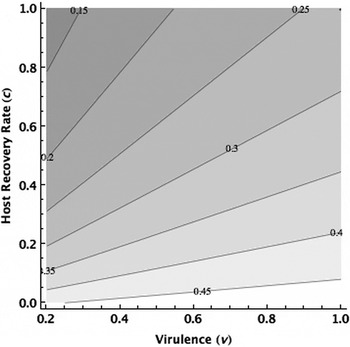
When condition B is satisfied, the mutant can invade. When condition B is not satisfied, the population remains at the classic SI equilibrium conditions described in the section Theory Methods, above. The β wm/β term in condition B represents the relative transmission rate from multiply-infected hosts. Under pure resource competition, there is no reduction in total transmission of parasites from mixed versus single infections, i.e. β wm = β/2 and the rare mutant can invade. As the relative transmission rate of multiply-infected hosts is reduced, the likelihood of a rare mutant invading the population decreases. We show the invasion conditions for different ratios of β wm/β as a function of parasite-imposed host mortality (virulence; v) and rate of parasite clearance from the host (c) in Fig. 1. Note that this qualitative result is robust to a range of model variations, including assuming that: all individuals give birth to susceptible hosts (not just susceptible parents); it is harder for host to clear mixed infections; and there is density dependent growth of hosts (see SI).
Plotting Condition B – Rare parasite less likely to invade as relative transmission rate of multiply-infected host (β wm/β) is reduced. Phase plane diagram showing the value of β wm/β required for the rare parasite to invade, as a function of virulence (v) and host recovery rate (c). For sensible values of β (<1), the mechanism preventing invasion of the rare parasite is a form of interference competition i.e. β wm/β < β/2. Parameters; b = 0·3, μ = 0·2.

Experimental results
We then tested our theoretical prediction that parasites are unable to invade from rare when there are mixed infections by competing different starting ratios (1:1000, 1:1 and 1000:1) of two bacteriophage strains (H and L) under low and high MOI, on bacterial hosts of Pseudomonas fluorescens SBW25. We have previously shown that the presence of H clones under conditions of high MOI reduces phage population growth rate, indicating that H clones reduce absolute between host transmission (Leggett et al. Reference Leggett2013a, Reference Leggettb, Reference Leggett2017), as assumed in our model.
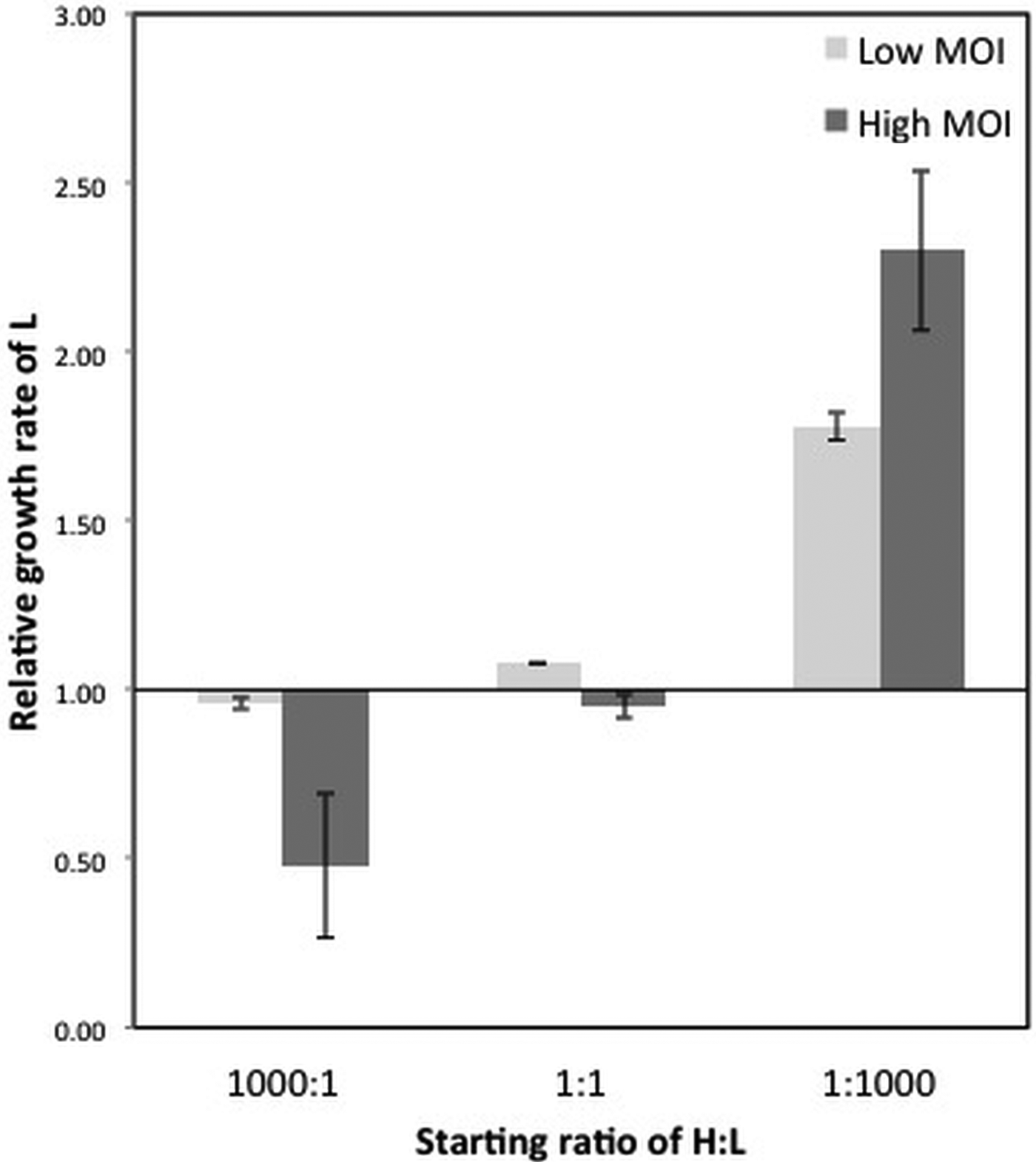
Crucially, we found a significant interaction between MOI and starting frequency (Fig. 2; F2,30 = 4·030, P = 0·028): while the relative growth rates of the two clones was largely independent of starting frequency under conditions of low MOI, under higher MOI the rare clone always had a fitness disadvantage. Note that at 1:1 ratios, the L clones was fitter under low MOI, presumably as a result of the host range phenotype that is costly in this system (Poullain et al. Reference Poullain2008; Scanlan et al. Reference Scanlan2011) whilst the H clone was fitter under high MOI, as reported in previous studies (Leggett et al. Reference Leggett2013a, Reference Leggettb) (1 sample t-tests: P < 0·01 in both cases). Note that we found that there was no main effect of starting frequency (Fig. 2; F2,30 = 0·417, P = 0·663) on the relative growth rate of the H and L strains, nor a main effect of whether phages were cultured at high or low MOI (Fig. 2; F1,30 = 1·586, P = 0·218).
Positive frequency dependence prevents rare phage from invading. The relative growth rate (selection coefficient) of L phage strains, compared with H strains, is plotted for different starting ratios of H:L, under high and low MOI. Error bars are ±1 standard error of the mean. MOI, multiplicity of infection.

Discussion
Here we investigated whether parasites that display strong anti-competitor behaviours in coinfected hosts suffer a fitness cost when rare, thus limiting the conditions under which parasites can become established in new host populations. Our simple epidemiological model confirmed findings implicit in previous models (e.g. Fenton, Reference Fenton2008) that interference between coinfecting strains reduces total parasite transmission from hosts, the likelihood of a rare parasite invading an endemic parasite population is reduced. We subsequently find evidence for this reciprocal invasion inhibition in competing bacteriophage genotypes (infecting bacteria) that experience growth inhibition with coinfection. Crucially, this reciprocal invasion inhibition was not observed when there was little coinfection, but instead one phage genotype consistently outcompeted the other, demonstrating that coinfection was the driver of the observed growth cost of being rare.
How important might this effect be? While we are not aware of any data from natural populations that could provide direct evidence for its operation, the assumptions required for this type of priority effect will frequently be met. Specifically, mixed genotypes and species infections are common in nature (Read, Reference Read2001; Pedersen and Fenton, Reference Pedersen and Fenton2007) and many interactions between parasites are directly or indirectly, via the host immune system, inhibitory (Sugita, Reference Sugita1981; Cox, Reference Cox2001; Read, Reference Read2001; Lello et al. Reference Lello2004; Buckling and Brockhurst, Reference Buckling and Brockhurst2008; Balmer et al. Reference Balmer2009; Mideo, Reference Mideo2009; Telfer et al. Reference Telfer2010).
In addition to the clear epidemiological implications of the work, the population level priority effects reported here might have important evolutionary and coevolutionary implications. First, it is likely to limit the evolution of generalist parasites. On the one hand, if parasites are limited in their interaction with novel host populations this will limit selection for generalism (Kawecki, Reference Kawecki1998). On the other, generalist parasites may find themselves in mixed infections more frequently than specialist parasites, hence exposing them to this transmission cost (Leggett et al. Reference Leggett2013a, Reference Leggettb); although not in circumstances where generalists have unique access to certain hosts (Gandon et al. Reference Gandon, van Baalen and Jansen2002). This may represent a novel cost of generalism over and above genetic tradeoffs and costs of using less productive hosts (Futuyma and Moreno, Reference Futuyma and Moreno1988; Heineman et al. Reference Heineman, Springman and Bull2008; Benmayor et al. Reference Benmayor2009), helping to explain host specialization of parasite species and genotypes. Second, limiting the invasion of new parasite genotypes can have important implications for coevolutionary dynamics. Specifically, high parasite diversity and density can increase parasite adaptation to their local hosts and lead to more rapid and arms-race-like coevolution (Morgan et al. Reference Morgan, Gandon and Buckling2005; Gomez et al. Reference Gomez, Ashby and Buckling2015).
More generally, our results highlight the importance of considering priority effects (i.e. an advantage of early colonization) at different scales. Priority effects are typically investigated within ecological patches (or hosts), but here we show a meta- population (or community) – level priority effect, which may also be an important consideration in a range of ecological systems. Precisely how priority effects at different scales interact requires further exploration.
Supplementary material
The supplementary material for this article can be found at https://doi.org/10.1017/S003118201700052X.
Acknowledgements
We are grateful to two anonymous referees and the editors for valuable comments on the manuscript, and especially thank Diana Outlaw for the invitation to contribute to this special issue.
Financial support
This work was funded by NERC, BBSRC and AXA Research Fund. AB acknowledges support from the Royal Society. HCL is funded by The Royal Commission for the Exhibition of 1851. PDS is funded by a Royal Society-Science Foundation Ireland University Research Fellowship.