The very high prevalence of aggressive acts in Nigerian educational institutions and the societies at large (Onyeizugbo, Reference Onyeizugbo2009; Reference Onyeizugbo2010) especially among adolescents call for urgent research to broaden the understanding of the possible factors that may be implicated in aggressive behaviors. Over the past one and half decades, Nigeria has witnessed continual increase in various forms of aggressive acts, ranging from militant youth violence and kidnapping of foreign oil workers in the Niger delta in the south-south and south eastern Nigeria, killing, bullying and school cultism (gangster) in most of the educational institutions, and terrorism with consequent destruction of life and properties in north eastern Nigeria (Ajayi, Ekundayo, & Osalusi, Reference Ajayi, Ekundayo and Osalusi2010; Aluede, Reference Aluede2011; Arijesujo & Olusanya, Reference Arijesujo and Olusanya2011; Egbue, Reference Egbue2006; Ibeanu, Reference Ibeanu2008; International crisis group, 2006; Omoteso, Reference Omoteso2010; Onyeizugbo, Reference Onyeizugbo2009; Oxford Research Group, 2012).
Most of these acts of aggression and violence are perpetrated by youths, including adolescents. Evidence of these aggressive acts are further seen in the high rate of bullying in Nigeria secondary schools (Egbochukwu, Reference Egbochuku2007), school cultism (gangster) which involve fighting and killing among rival cult or gangster members (Ajayi et al., Reference Ajayi, Ekundayo and Osalusi2010), and increasing rate of juvenile delinquency and other anti-social behaviors. Abasiubong, Abiola, and Udofia (Reference Abasiubong, Abiola and Udofia2011) found that 32.8% of the 515 undergraduates who participated in their study reported that they were involved in aggressive acts. Similarly Onukwufor (Reference Onukwufor2013) reported that an average of 20.8% of the 360 secondary school adolescents who participated in his study reported that they were involved in aggressive acts. In an earlier collaborative nation-wide survey of school violence and aggression in Nigeria conducted in 2007 by Federal Ministry of Education (FME) and UNICEF, physical violence accounted for 85% of violence against school children, this is more than any other type of violence studied; psychological, sexual, gender-based and health-related violence. The result of the survey further showed that physical violence was more prevalent in the rural (90%) than in the urban areas (80%). According to the result, physical violence in schools is higher in the southern Nigeria (90%) than in the northern Nigeria (79%).
Aggression may take different forms including social, psychological, verbal and physical aggression. Physical aggression in particular includes behaviors that threaten or cause physical harm, such as physical fighting, and bullying, violent crimes such as robbery, rape and homicide (Loeber & Hay, Reference Loeber and Hay1997; Yonas, O’campo, Burke, Peak, & Gielen, Reference Yonas, O´campo, Burke, Peak and Giden2005). Physical aggression has different risk factors for perpetrators and victims. Perpetrators may have serious adjustment difficulties (e.g., they were significantly more rejected by their peers) while the victims reported significantly higher levels of loneliness, depression, and isolation (Crick & GrotPeter, Reference Crick and GrotPeter1995). Some negative consequences of physical aggression according to different studies (Gest, Graham-Bermann, & Harrup, Reference Gest, Graham-Bermann and Hartup2001; Hodges & Perry, Reference Hodges and Perry1996; Onyeizugbo, Reference Onyeizugbo2009; Perry, Hodges, & Egan, Reference Perry, Hogdes, Egan, Juvonen and Graham2001) include mental health problems, low academic performance, social problem, and difficulty concentrating on school work, absenteeism, dropping out from school, low self esteem, internalizing and externalizing problems.
Anderson and Bushman (Reference Anderson and Bushman2002) had affirmed in their General Aggression Model (GAM) that traits factors are predictors of aggression and acknowledged that certain traits predispose individuals to high levels of aggression. This fact was further illustrated by Frick, Conell, Barry, Bodin, and Dane (Reference Frick, Conell, Barry, Bodin and Dane2003) who reported that children with callous-unemotional (CU) traits were also at risk of showing higher levels of aggression, especially proactive aggression, and self-reported delinquency. Callous-unemotional traits refer to specific deficits in affect (e.g. absence of guilt, poverty in emotional expression) and deficits in interpersonal relationship (e.g. failure to show empathy, use of others for one’s own gain) which are relatively stable across childhood into adolescence, at least compared to other measures of childhood personality and psychopathology (Frick, Kimonis, Dandreaunx, & Farrell, Reference Frick, Conell, Barry, Bodin and Dane2003). Paul Frick and many other researchers have done extensive work on the importance of callous-unemotional traits for developmental models of aggressive and antisocial behavior.
Some studies involving CU traits showed that the scores obtained from the instrument for measuring CU traits could be treated as a unidimensional scale (summation of the sub-scales to obtain a single score) and/or as a multi-dimensional scale comprising of callousness subscale, uncaring subscale and unemotional subscale which are summed separately and analyzed to see their independent contributions (see: Ciucci, Baroncelli, Franchi, Golmaryami, & Frick, Reference Ciucci, Baroncelli, Franchi, Golmaryami and Frick2014; Essau, Sasagawa, & Frick, Reference Essau, Sasagawa and Frick2006; Fanti, Frick, & Georgiou, Reference Fanti, Frick and Georgiou2009; Kimonis et al., Reference Kimonis, Frick, Skeem, Marsee, Cruise, Munoz and Morris2008). This is evidenced from the results of exploratory factor analysis, confirmatory factor analysis, measures of internal consistency and the high correlations found between the total CU and the subscales, modest correlations found between the subscales and different correlation values obtained when the CU and subscales are correlated independently with other psychological variables (see Ciucci et al., Reference Ciucci, Baroncelli, Franchi, Golmaryami and Frick2014; Essau et al., Reference Essau, Sasagawa and Frick2006; Fanti et al., Reference Fanti, Frick and Georgiou2009). Conceptually, the callousness subscale taps into absent of guilty, remorsefulness, or not apologizing for wrong doing to self or others, the uncaring subscale taps into not being concern about the welfare or feeling of others and the unemotional subscale taps into not showing or expressing or letting out one’s emotion. The present study considered the contributions of the total CU and each of the subscales separately during analysis, but only the subscales that reached an acceptable Cronbach’s alpha according to Schmitt (Reference Schmitt1996) were included.
Frick and White (Reference Frick and White2008) in a reviewed research work showed that callous-unemotional traits are stable over time in children and adolescents, and are associated with severity of conduct problems, aggression and delinquency. Ciucci et al. (Reference Ciucci, Baroncelli, Franchi, Golmaryami and Frick2014), Frick (Reference Frick2006), Frick and Dickens (Reference Frick and Dickens2006) found evidences from research and review of published studies that there are substantial evidences that Callous-unemotional traits predict antisocial, conduct and aggressive behavior. According to Frick and White (Reference Frick and White2008) a number of distinct cognitive, emotional and personality characteristics of individuals with callous-unemotional traits can possibly lead to aggressive behavior. Individuals with callous – unemotional traits show a temperament that is characterized by deficits in emotional arousal to fear and abnormalities in their response to cues of punishment. Most studies on callous – unemotional traits were focused on its’ role in psychopathology (Frick, Reference Frick2006; Frick & Dickens, Reference Frick and Dickens2006; Viding, Simmonds, Petrides, & Frederickson, Reference Viding, Simmonds, Petrides and Frederickson2009) and only a few studies have considered gender difference in callous –unemotional traits or the interaction of callous –unemotional traits and gender in determining or predicting other outcomes. Essau et al. (Reference Essau, Sasagawa and Frick2006) showed that there is significant gender difference in total callous-unemotional traits whereby girls scored lower than boys in both the total callous-unemotional traits and the subscales. Similarly, Viding et al. (Reference Viding, Simmonds, Petrides and Frederickson2009) found that girls reported significantly low callous-unemotional traits than boys. Also, Fanti et al. (Reference Fanti, Frick and Georgiou2009) found that on the average, boys reported being more callous, unemotional and uncaring than girls. Similarly, Ciucci et al. (Reference Ciucci, Baroncelli, Franchi, Golmaryami and Frick2014) found that boy reported higher in CU and the subscales of CU. Although traits are enduring individual characteristics that consistently influence individual’s behavior manifestation, studies (Hawes & Dadds, Reference Hawes and Dadds2007; Hawes, Dadds, Frost, & Hasking, Reference Hawes, Dadds, Frost and Hasking2011; Head, Reference Head2008; Onyeizugbo, Reference Onyeizugbo2010) have shown that other social and psychological characteristics or factors (such as gender role expectation, parental childrearing practices, socialization and cultural orientation of individual) could moderate the impact and manifestation of traits.
A few published works have focused on gender and physical aggression in Nigeria. According to FME & UNICEF (2007) aggression is evenly distributed among boys and girls in Nigeria schools 85% vs. 83.8%. However, Onukwufor (Reference Onukwufor2013) reported in his study that boys showed more physical aggression 26.7% than girls 15%. Contrarily, Ogwo (Reference Ogwo2013) found that there was no significant gender difference in aggression among the internally displaced children in two communities she studied in Nasarawa state northern Nigeria. It is good to note that Ogwo’s study was on general aggression and not on physical aggression. Elsewhere in African, Butovskaya, Burkova, and Mabulla (Reference Butovskaya, Burkova and Mabulla2010) in their study with Tanzanian samples, showed that gender differences in aggression may depend on culture; their study showed that for Iraqi children there were no gender differences, whereas for Hadza children, boys exhibited higher rates of aggressive behavior than girls.
In Anambra, a south eastern state of Nigeria where the present study was conducted, there is patriarchal tradition whereby boys are expected to be tough and warriors and girls are expected to be weak and soft (Onyeizugbo, Reference Onyeizugbo2003; Reference Onyeizugbo2006; Reference Onyeizugbo2010). The Igbo culture emphasizes the weakness of feminity and the benefits of masculine behaviors and through gender stratification of their culture they ensure continuation of patriarchy (Onyeizugbo, Reference Onyeizugbo2006; Reference Onyeizugbo2010). This orientation favored differential socialization practice in childrearing of male or female child.
A further meta-analytical review of 148 worldwide studies on child and adolescent direct and indirect aggression based on gender differences by Card, Stucky, Sawalani, and Little (Reference Card, Stucky, Sawalani and Little2008) also indicated that boys are more involved in direct aggression or physical aggression than girls, but girls are involved more in indirect aggression or relational aggression. Figure 1 showed the conceptual diagram for the present study.
Conceptual Diagram of the interaction effects of callous-unemotional traits and gender on physical aggression.
X1 = total callous-unemotional trait, X2 = callousness, X3 = uncaring, M = gender, Y = physical aggression

This study hypothesized that CU traits, callousness subscale and uncaring subscale will predict physical aggression among the Nigerian adolescents. This is because behavior attributes such as absence of guilt and emotional insensitivity that CU traits measure correlate with conduct disorder – a behavior highly correlated with antisocial behaviors, including aggression and violence (Charlebois, Leblanc, Gagnon, Larivee, & Tremblay, Reference Charlebois, Leblanc, Gagnon, Larivée and Tremblay1993; Eppright, Kashani, Robison, & Reid, Reference Eppright, Kashani, Robison and Reid1993; Loeber, Reference Loeber1982; Lynam, Reference Lynam1996).
It also hypothesized that gender will correlate with CU traits, callousness and uncaring and will predict physical aggression whereby boys are expected to report higher CU, callousness, uncaring and physical aggressive behavior than girls given the double standards of gender socialization operating in most societies, Nigeria included (Carlo, Raffaelli, Laible, & Meyer, Reference Carlo, Raffaelli, Laible and Meyer1999; Onyeizugbo, Reference Onyeizugbo2003; Reference Onyeizugbo2006; Reference Onyeizugbo2010).
Finally, it was hypothesized that gender will significantly moderate the relationship between CU, callousness, uncaring traits and physical aggression given the fact that CU traits are associated with negative outcomes such aggressive behavior irrespective of the individual’s gender (Frick Reference Frick2006; Frick & Dickens, Reference Frick and Dickens2006).
Method
Participants
Two hundred and ninety five (295) students participated in the study. These participants were selected from a public Senior Secondary School Two Students (SS11) in Anambra State, South Eastern Nigeria (all participants were of Igbo ethnic groups). The Igbos have patriarchal traditions whereby weakness is associated to feminity and male children are encourage to be tough. The study used simple random sampling technique described by Bordens and Abbot (Reference Bordens and Abbott2008) to select the participants utilizing the class registers. These participants include boys 51.5% (152) and girls 48.5% (143). The ages of the participants were between 14 to 16 years and the average age of the participants was 15.24 (SD = .76). The age distributions of the participants were 14 years = 19.7% (n = 58), 15 years = 36.1% (n = 109), 16 years = 43.4% (n = 128). All participants were day students who were residence at Onitsha commercial city of Anambra state.
Instruments
Two measures were used to collect data: The Inventory of Callous-unemotional Traits (ICU), and the Aggression Scale (AS).
The Inventory of Callous-unemotional Traits (ICU)
The inventory of callous-unemotional traits (ICU) was originally developed by Frick (Reference Frick2004), however evidence for the inventory’s reliability was shown in the study by Essau et al. (Reference Essau, Sasagawa and Frick2006) who found a total Cronbach’s alpha of .77 for the scale and Cronbach’s alphas of .70, .73, .64 for the callousness, uncaring and unemotional subscales respectively in a sample of 1,443 adolescents in Germany. Also, Kimonis et al. (Reference Kimonis, Frick, Skeem, Marsee, Cruise, Munoz and Morris2008) found a total Cronbach alpha of .81 and for the three subscales, the alphas include .81, .80 and .53 for uncaring, callousness and unemotional respectively. The results of their confirmatory factor analysis (CFA) showed the Root Mean Square Error of Approximation (RMSEA) = .06 and the Comparative Fit Index (CFI) = .87. The scale contains 22 items which were rated on a four point scale ranging from 0 = (Not at all true) to 3 = (Definitely true); 12 items are reversed during scoring. The inventory has three subscales: uncaring 8 items (e.g., “I try not to hurt others’ feelings; reversed during scoring”), callousness 8 items (e.g., “I do not care if I get into trouble”) and unemotional 5 items (e.g., “I am very expressive and emotional; reversed during scoring”). The reliability and validity of the inventory for the present study are for the full scale a Cronbach’s alpha of .75 and alphas of .71, .71, and .56 for the uncaring, callous and unemotional sub scales respectively. CFA of the inventory showed RMSEA = .03, CF1 = .96 and x 2 = 260, p < .05. A split-half reliability of r = .60 was also obtained. In the present study the unemotional subscale was include to obtain the total CU, but was excluded in the subscales analyses due to its’ poor Cronbach’s alpha.
Aggression scale (AS)
The aggression scale was developed by Orpinas and Frankowski (Reference Orpinas and Frankowski2001) as a self-report measure physical aggression among youths. It contains 11 items arranged in a 7 points scale from 0 times to 6 times (e.g., I pushed or shoved other students, I slapped or kicked someone). Orpinas and Frankowski (Reference Orpinas and Frankowski2001) reported an internal consistency Cronbach’s alpha of α = .88 and the CFA showed a goodness to fit index of .96. The internal consistency of the scale for the present study was Cronbach’s alpha α = .78.
Procedure
The researchers obtained written permission and consent from the school authority after explaining the nature of the research to them and assuring them of the confidentiality of the information gathered from the pupils. Only those pupils whose parents signed the consent form participated in the study. They were gathered in the school hall and were instructed about the task. For the selected 300 students with signed consent form, five declined to participate in the study and were allowed to go, remaining only 295. They were administered the two questionnaire forms together and it took about 20 minutes for them to finish responding to the questions. Each questionnaire form contains questions about the gender and the age of the participants. The questionnaire forms were collected from the participants and these participants were debriefed. The raw data were scored and used for further analysis.
Design/Statistics
Cross sectional survey and correlation designs were adopted for study; this is because it does not involve manipulating variables, allows researchers to look at numerous things at once (gender, callous-unemotional traits and physical aggression) and allows researchers to obtain information from the participants about what is going on at only one point in time.
The moderation analyses were conducted with SPSS 19 and Conditional Process Analysis model 1 (Hayes, Reference Hayes2013). This statistical procedure calculates the interaction effect of two predictor variables (CU * gender) in a multiple regression analysis using the principles of moderation analysis where by one variable (gender) is regarded as the moderating variable and the following parameters were also obtained: conditional effect coefficient, conditional interaction effect coefficient, adjusted R square, class interval values and F –value. The analyses were computed independently for each anticipated interactions in models 1 to 3 and the coefficient values are conditional coefficients (see Hayes, Reference Hayes2013, pp. 214–218). Gender was coded as girls (0) and boys (1) throughout the analysis.
Results
The descriptive result (see table 1) showed that the mean score of the male participants for uncaring, M = 7.19, SD = 4.51 and for physical aggression M = 12.71, SD = 6.63 were higher than that of the female participants uncaring, M = 5.57, SD = 3.81 and physical aggression M = 9.07, SD = 6.18.
Descriptive statistics of study variables by gender

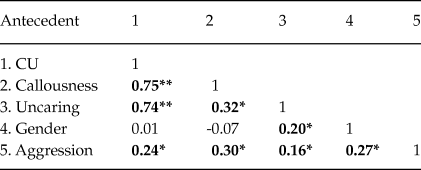
The result of the correlations (see table 2) between CU and callousness (r = .75, p ≤ .01), CU and uncaring (r = .74, p ≤ .01), CU and aggression (r = .24, p ≤ .05) were significant but that of CU and gender was not significant (r = .01, n.s.). Correlation between callousness and uncaring (r = .32, p ≤ .05), callousness and aggression (r = .30, p ≤ .05), and uncaring and aggression (r = .16, p ≤ .05) were significant but, that of callousness and gender was not significant (r = -.07, n.s.). Also the correlation between gender and uncaring (r = .20, p ≤ .05), gender and aggression (r = .27, p ≤ .05) were significant.
Pearson r correlation between the variables (CU, callousness, uncaring, gender and physical aggression)

Note: * = p < .05; ** p < .01.
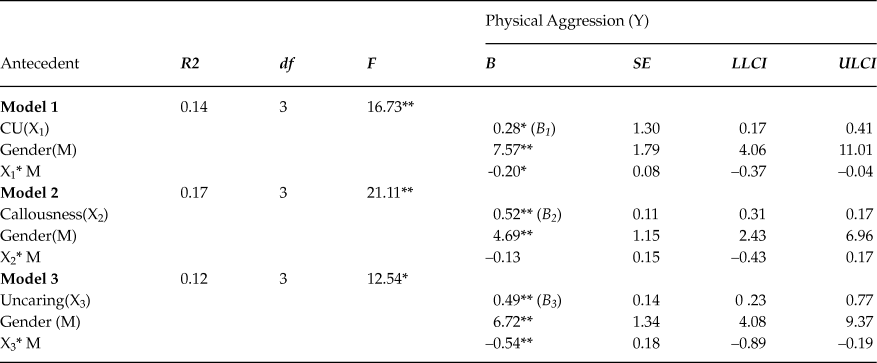
Furthermore, the results of the conditional process analysis which tested the interaction or moderating effects of CU traits and gender on physical aggression (see Figure 2 to 4, and Table 3 models 1, 2, & 3) showed that gender moderated the relationship between CU traits and physical aggression, X1 * M = –.20, p = .01, uncaring on physical aggression, X3 * M = –.54, p = .01, but gender did not moderate the relationship between callousness and physical aggression, X2 * M = –.13, p = .40.
Statistical diagram of the interaction effects of callous-unemotional traits and gender on physical aggression.
B1 1,2,3 = conditional coefficient values for X1,2,3 on Y, B2 = conditional coefficient for M on Y, B3 1,2,3 = conditional coefficient values of the interaction of X1,2,3 and M on Y respectively.
X1 = callous-unemotional trait(CU), X2 = callousness, X3 = uncaring, M = gender, Y = physical aggression. 1,2,3 = models 1,2 & 3.

Interaction of gender and ICU traits on physical aggression.

Interaction of gender and Uncaring trait on physical aggression.

The conditional effect coefficients (B), standard errors, and model summary results for the interaction effects of callous-unemotional traits and gender on physical aggression

Note: *p < .05, **p = .01, Lower Limit Class Interval (LLCI), Upper Limit Class Interval (ULCI).
Discussion
This study was set up to investigate whether gender moderate the relationship between CU traits and physical aggression. The result revealed that there were no significant correlations between CU traits and gender, callousness subscale and gender. However, there were significant correlations between uncaring subscale and gender, physical aggression and gender. Also the correlations between CU traits and physical aggression, callousness and physical aggression, uncaring and physical aggression were significant. The no significant correlations found between CU, callousness and gender did not concur with the previous findings obtained by Ciucci et al. Reference Ciucci, Baroncelli, Franchi, Golmaryami and Frick2014; Essau et al., Reference Essau, Sasagawa and Frick2006; Fanti et al., Reference Fanti, Frick and Georgiou2009; Viding et al., Reference Viding, Simmonds, Petrides and Frederickson2009 who found in their studies that boys on the average shows more CU traits than girls. The lack of significant correlations between gender and some CU traits may be attributed to the fact that the population sampled in the present study were from a co-educational school where boys and girls receive approximately the same treatment and training in school. However, the significant correlation found between uncaring trait and gender was in concordance with the previous studies mentioned above. The study further found that CU traits and gender significantly predicted physical aggression (see table 3 models 1 to 3) and these finding were in agreement with the previous studies (Card et al., Reference Card, Stucky, Sawalani and Little2008 ; Frick, Reference Frick2006, Frick & Dickens, Reference Frick and Dickens2006; Frick et al., Reference Frick, Conell, Barry, Bodin and Dane2003; Onukwufor, Reference Onukwufor2013).
The result of the conditional process analysis revealed that gender has conditional influence on the relationship between CU traits and physical aggression, and uncaring subscale and physical aggression, but not on callousness and physical aggression. During the analysis, gender was coded thus: girls = 0 and boys = 1 by implication, the negative conditional beta in the models 1 & 3 for the interaction effect indicated that when girls have higher CU traits or uncaring trait respectively; they reported being more aggressive than boys.
Several theorists (Anderson & Bushman, Reference Anderson and Bushman2002; Bettencourt, Talley, Benjamin, & Valentine, Reference Bettencourt, Talley, Benjamin and Valentine2006; Huesmann, Reference Huesmann, Geen and Donnerstein1998) proposed that traits can influence or trigger a set of underlying variables (e.g. cognitive processing system, negative affection, self-regulation and social information processing system) which are the likely mechanisms through which traits influence behavioral outcomes such as physical aggression. Bettencourt et al. (Reference Bettencourt, Talley, Benjamin and Valentine2006) argued favorably in a meta-analytical review that the level of traits in an individual could interfere with the normal functioning of some underlying variables which will then potentiate aggressive behavior. The evidence from the present study and other studies mentioned earlier suggested that on the average boys are more prone to physical aggression than girls. Several theorists (Carlo et al., Reference Carlo, Raffaelli, Laible and Meyer1999; Gilligan, Reference Gilligan1982; Maccoby & Martin, Reference Maccoby, Martin, Mussen and Hetherington1983) explained this trend with the fact that most societies have differential socialization practices which appear to foster physical aggression to a greater extent in males than females. For instance, in the patriarchal tradition common in Nigeria boys are expected to be tough and warriors and consequently various traditional rite of passage are organized regularly to prepare the males for patriarchal roles and some of these rites encourage physical aggression (e.g. initiation into the masquerade cult). However, the present study suggested that irrespective of an individual gender, the level of CU traits in an individual will increase or decrease the chances of being more aggressive.
One of the limitations of the present study is that the participants were selected from one public secondary school in an urban settlement. Also, the present study utilized only self- report measures for both physical aggression and Callous-unemotional traits; these may not correspond with behavior. Additionally, the study is cross sectional and correlational and therefore causality cannot be inferred. The effect size is small and caution should be taken in interpretation of the results. Therefore, future studies could select samples from the private schools, non co-educational schools and schools in rural areas and may consider other mediating factors such as cognitive processing system, negative affection, self-regulation and social information processing system. Also Nigeria has many ethnic groups and samples could as well be selected from them so that the result can have more external validity.
The findings of this study are implicated in planning and designing programs for youths’ orientation and education. It calls for parents and other caregivers in schools (school counselors) to carryout proper assessment of their clients who have problem of physical aggression and include the assessment for callous-unemotional traits in their plans. This may help in designing appropriate treatment plans. For instance several studies (e.g., Fontaine, Rijsdijk, McCrory, & Viding, Reference Fontaine, Rijsdijk, McCrory and Viding2010; Hawes & Dadds, Reference Hawes and Dadds2007; Hawes et al., Reference Hawes, Dadds, Frost and Hasking2011; Head, Reference Head2008) indicated that several aspects of parenting (frequency and consistency of discipline, monitoring/supervision, involvement with children, positive parenting, and parental empathy) were associated with change in the level of reported callous-unemotional traits in the post study groups. Also early dictation of these traits in an earlier age may prove more fruitful since the individual may still be under the parents and can be nurtured with good parental practices. Nigeria government recently introduced a special amnesty program for Niger- Delta militants in the oil rich south-south geo-political zone. The program included reorientation of the militants through “mind-set change” program and other skill acquisition training (Oluduro & Oluduro, Reference Oluduro and Oluduro2012). The decrease in the report of violence in that area shows that when situational factors that predispose individual to physical aggression are changed it seems to control the strength of traits in predicting physical aggression (Hawes et al., Reference Hawes, Dadds, Frost and Hasking2011; Head, Reference Head2008). Therefore, such special training could be extended to other parts of the country where there are increasing reports of physical aggression and violence. The finding also calls for a change from absolute patriarchal tradition in domestic and cultural training of the youths especially the males. This is important since research suggests that androgynous gender role orientation is associated with better outcomes such as general adjustment (Bem, Reference Bem1975; Reference Bem1983; Spence, Reference Spence1983) and cognitive flexibility (Carter, Reference Carter1985; Keller, Lavish, & Brown Reference Keller, Lavish and Brown2007).
Finally, though the stability of the callous-unemotional traits have been favorably argued (Frick et al., Reference Frick, Conell, Barry, Bodin and Dane2003) recent research has shown that early intervention on some situational factors can weaken the strength of the CU traits in controlling behavior (Hawes et al., Reference Hawes, Dadds, Frost and Hasking2011). This provides hope for some individuals who are high in these traits for possible adjustment in life. The present research showed that CU and gender are independently and inter dependently implicated in physical aggression thus calls for more research on possible ways of reducing physical aggression giving the cue from the present study.