1. Introduction
In the developing world, the use of improved infrastructure, including electricity, has the potential to accelerate economic development and improve livelihoods (Khandker et al., Reference Khandker, Barnes and Samad2012, Reference Khandker, Barnes and Samad2013). Electricity can have substantial impacts on productivity and incomes as well as education, health and gender outcomes (Cabraal et al., Reference Cabraal, Barnes and Agarwal2005; Dinkelman, Reference Dinkelman2011). The World Bank (2015) reports that 1.6 billion people, mostly in Africa and Southeast Asia, do not have access to electricity. Therefore, there exists an opportunity to stimulate economic development through electrification, especially in rural areas. While recent technological innovations have decreased the cost of electricity provision, in order to expand access efficiently investors and governments must consider how the benefits derived from electricity infrastructure depend on whether there are any constraints placed on household consumption of electricity. The purpose of this paper is twofold. First, we quantify the willingness to pay (WTP) for electricity consumption in remote rural villages in Rwanda under two different allocation options. Secondly, we propose a method to jointly estimate the responses from multiple stated preference questions that can improve the efficiency of econometric estimates.
In remote regions of Sub-Saharan Africa, many households do not have access to electricity within their villages, and instead must walk long distances to access it (Bensch et al., Reference Bensch, Kluve and Peters2011). As a result, even if a WTP for electricity services within a village exists, it is difficult to quantify using data on revealed demand. In some cases it may be feasible to transfer demand estimates from one region to another, but this may not be appropriate for the most remote regions because demand is likely to differ from electrified areas. This means that stated preference methods (Champ et al., Reference Champ, Boyle and Brown2012) can provide important information about household WTP for consumption of public services in contexts where they are not currently provided. In this paper, we take advantage of a unique data set in which rural Rwandan households were asked both a payment card contingent valuation (CVM) question (Mitchell and Carson, Reference Mitchell and Carson2013) to elicit household WTP for a fixed quantity of electricity, and a contingent quantity behavior (CB) question (Grijalva et al., Reference Grijalva, Berrens, Bohara and Shaw2002) that asked for a quantity of electricity they would choose to consume at alternative fixed prices. The two types of stated preference questions allow for a valuation of electricity consumption provided as a public good where all households consume the same quantity at the same time, as well as a private good where households can choose quantities and when to consume, but must pay a fixed marginal price.
In the rural Rwandan setting of this study, different electricity options discussed with communities resemble different types of economic goods. Under each option, households gain access to electricity but the quantity available for consumption and the timing vary. For example, without a system of measurement (i.e., meters), electricity consumption can resemble a public good for all connected households during the hours in which electricity is generated. During times when generation occurs, a household with a connection can consume as much electricity as desired, limiting the excludability of the electricity good. If the system has the appropriate size to provide electricity quantities that meet demand, the consumption behavior of one household does not diminish the quantity of electricity available for others to use. On the other hand, if the system is heavily used, it may become rival, leading it to have the properties of a common property resource. We refer to this situation as quasi-public electricity consumption, and consider the case where a household can access electricity at a zero marginal price for a fixed number of hours in the evening (see Broadbent, Reference Broadbent2014 or Elbakidze et al., Reference Elbakidze, Nayga, Li and McIntosh2014 for a discussion of the distinction regarding quasi-public goods).
On the other hand, if households have meters and pay for electricity on a per-unit basis, electricity consumption resembles a private good. In this paper we explore WTP differences across these ways of administering infrastructure. Others have explored the distinction between public and private goods and how the features of such goods influence the WTP for them. In particular, Shah (Reference Shah1992) tests for the effect of ‘publicness’ versus ‘privateness’ on the productivity of public infrastructure (e.g., transportation and electricity) in Mexico.
There may be supply/cost conditions that make one of these two options more cost effective than the other. If, after starting up a power station, it is technically difficult or extremely expensive to vary the generation, then a fixed number of hours of electricity per day at the same time could be more cost effective. If the generation capacity can be ramped up and down quickly, then allowing consumers to choose when and how much electricity to consume may be feasible. Also, in remote villages, electricity storage (e.g., batteries) may be necessary to allow solar power to provide a continuous supply of electricity to be purchased when needed.
Many researchers have combined revealed and stated preference data to estimate demand for non-market goods (Adamowicz et al., Reference Adamowicz, Louviere and Williams1994; Cameron et al., Reference Cameron, Shaw, Ragland, Callaway and Keefe1996; Alberini et al., Reference Alberini, Zanatta and Rosato2007). Here, we jointly estimate CVM payment card WTP and CB models to measure the WTP for electricity consumption under two different types of supply arrangements in rural Rwanda. Results suggest much higher values for flexibility in the timing and quantity of electricity use, much like a private good. In addition, joint estimation of multiple stated preference models could have wide applicability in other valuation contexts, including public infrastructure, environmental quality and habitat protection.
In the following section we discuss the Rwandan context and provide background on the use of stated preference data. We then describe our survey and the CVM and CB questions. An econometric model is developed to estimate the two models in a joint framework. Finally, results are discussed and hypotheses are offered for why demand estimates differ across the two stated preference techniques.
2. Background on valuation of electricity consumption in developing countries
The scarcity of financial resources in many developing countries means that investment in electrification can have a high opportunity cost. While high costs have prevented the electrification of remote, rural areas throughout Sub-Saharan Africa, governments and private investors have an interest in finding economically viable solutions to increase electrification (Banerjee et al., Reference Banerjee, Baringanire and Malik2014). In practice, central grid expansion often faces prohibitively high costs that prevent expansion to remote rural areas (Reiche et al., Reference Reiche, Covarrubias and Martinot2000). As a result, off-grid solutions have been proposed that include household solar units (Miller and Hope, Reference Miller and Hope2000), biogas (Kanase-Patil et al., Reference Kanase-Patil, Saini and Sharma2010) and village-level microgrids (MGs; Brent and Rogers, Reference Brent and Rogers2010). Projecting the intensity of use of electricity in rural areas can inform the design and deployment of this type of solution.
While a WTP for electricity consumption likely exists throughout rural areas of the developing world, few studies have estimated the quantities demanded. Stated preference methods have been used in the developing world to value public environmental goods (Whittington, Reference Whittington1998) as well as infrastructure. Despite the use of stated preference tools that focus on the valuation of public goods, infrastructure use often has many characteristics of private goods. Abdullah and Mariel (Reference Abdullah and Mariel2010) measure a WTP for electricity service improvements through decreased outages, and Abdullah and Markandya (Reference Abdullah and Markandya2012) and Kalisa (Reference Kalisa2014) measure a WTP for access to electricity services. Yet little research attempts to capture the quantity of a service that households would demand given that they face a marginal cost for the service. Since the consumption of electricity often requires a marginal payment for its use, stated preference methods that measure only the WTP for access to electricity may not adequately capture the quantity demanded for electricity as a private good.
In this study we use stated preference methods to compare the WTP for a fixed quantity of electricity at a given time, with the WTP implied by the amount of electricity households would choose to consume at different prices. The first method provides a fixed quantity of electricity to a village as a public good. During a fixed time window (e.g., the evening), all households in the village consume electricity without additional payment. The rest of the time, power is not generated (or is stored). This setup has been discussed in focus groups with rural village households in Rwanda, where the population is familiar with cooperative business structures and has expressed a preference for egalitarian electricity access.
The second strategy allows for continual electricity consumption within a village but with a fixed price per unit used. This arrangement more closely resembles the way in which central grid electricity is allocated in Rwanda.Footnote 1 Under this method, electricity consumption resembles a private good that households can purchase. Importantly, households face no constraint on when they use electricity or how much they use.
We estimate a WTP for both forms of electricity consumption using survey data from rural Rwanda. We use a method to estimate WTP from a payment card (Champ et al., Reference Champ, Boyle and Brown2012) using interval regression (Cameron et al., Reference Cameron, Shaw, Ragland, Callaway and Keefe1996) and compare it to a CB question using a random effects model. Our joint estimation method has broad applications for stated preference methods. If individuals respond to two stated preference questions, it is possible to jointly estimate models that use the respondents’ series of survey responses.
2.1. Electricity demand
While households in rural areas of Sub-Saharan Africa are often cash poor (Ali and Thorbecke, Reference Ali and Thorbecke2000), they are likely to have a WTP for electricity. This WTP is driven by several key beneficial uses of electricity in rural areas. First, households currently use candles and lanterns for light (Bensch et al., Reference Bensch, Kluve and Peters2011). Electricity could displace some of this expenditure while improving indoor air quality. Next, most (>85 per cent in our study villages) households in rural Rwanda own mobile phones and batteries for other devices that they pay someone in other villages to charge. Given high per-kWh prices and long travel distances to access energy, providing electricity in the residence can bring significant time and money savings. Finally, electricity has many productive uses in rural areas. In some cases, water can be pumped to more central locations or used for irrigation. In our study villages, households expressed interest in using electricity to process crops to sell throughout the year and to start non-agricultural businesses.
Other studies have used central grid expansion to assess the impacts of rural electrification. For example, Khandker et al. (Reference Khandker, Barnes and Samad2012) find an increase in income of about 20 per cent for electrified households in Bangladesh. Consistent with this, Khandker et al. (Reference Khandker, Barnes and Samad2013) find an increase in income that exceeds 20 per cent in Vietnam, and also highlight that richer households are more likely to consume electricity for productive uses. They point out that electrification impacts can spill over to non-electrified households in electrified villages as well. Lipscomb et al. (Reference Lipscomb, Mobarak and Barham2013) find evidence that electrification in Brazil led to reduced poverty, increased employment and higher home values. Dinkelman (Reference Dinkelman2011) demonstrates that electrification in rural South Africa increased female employment (outside the home) by 13.5 per cent.
Caution must be used when extrapolating results from historical grid expansions to remote rural village electrification. Remote villages may differ in ways including access to markets, initial incomes and wealth, and even education levels. Nevertheless, we use the results of these studies to inform our empirical specifications and use a stated preference approach to value electricity consumption in remote areas. In constructing our stated preference survey questions, we attempt to minimize the biases associated with these methods. For example, hypothetical bias can affect estimates produced using stated preference methods (Murphy et al., Reference Murphy, Allen, Stevens and Weatherhead2005). Because the questions being asked in the survey do not require respondents to make actual tradeoffs, they may lack an incentive to answer truthfully. To avoid this bias, we frame survey questions in ways to make responses more consequential (details in section 3).
In addition to this concern, households without electricity may not know the potential uses for it. However, rural Rwandan consumers are familiar with electricity because they travel frequently to electrified towns for market activities and to charge mobile phones and other batteries (e.g., for flashlights or radios).
Based on the evidence from studies of central grid electricity, we hypothesize that the WTP for electricity should be driven by several household characteristics. First, because electricity is likely a normal good that requires cash to purchase, households with higher cash incomes should demand more. Next, because electricity can displace current energy expenses, household WTP should increase with current energy expenditure. Electricity can also save travel time so those households that currently travel further to get electricity may have a higher WTP for in-home electricity. Because of concerns about exposing children to pollution from conventional lighting, we also hypothesize that a household with more children may have a higher demand. Finally, households that want to use electricity for production and other activities may also have a higher electricity demand. Because households currently do not have access to electricity, they do not currently own the capital to use the electricity. Therefore, we test if the stated intention to use electricity for these purposes influences electricity demand. Finally, we control for factors such as the age and gender of respondents. These hypotheses are tested in the electricity demand models developed in the empirical section of this paper.
3. Survey and data description
Our study takes place in rural Rwanda, where electrification rates remain low (7.7 per cent in 2012, according to the World Bank World Development Indicators Database (WDI)). At the federal level in Rwanda, officials have set ambitious targets for electrification, including increasing overall electrification rates from approximately 20 per cent of the population to 70 per cent by 2018 (Government of Rwanda, 2015). According to Rwandan planning documents (Government of Rwanda, 2015), 22 per cent of the electrified population will not receive the benefit of central grid electricity. Instead, off-grid solutions such as MGs and solar units will provide electricity to this part of the population. Making progress towards these ambitious goals will rely on both private and public sector investment. An understanding of the demand for different types of electricity consumption can help inform the appropriate administration of both publicly and privately administered remote electricity infrastructure in Rwanda.
With the goal of measuring the potential benefits of rural electrification in Rwanda, a survey was carried out in two villages during the summer of 2014 (see Manning et al., Reference Manning, Means, Zimmerle, Galvin, Loomis and Paustian2015, for details).Footnote 2 Before the survey was implemented, it was tested with rural households in other villages, as well as with community leaders in the selected villages.Footnote 3 The survey consisted of questions about household socio-economics, demography, current energy use and priority uses of electricity. Finally, two stated preference questions elicited respondent WTP for electricity quantities delivered in two different ways.
The Rwandan Ministry of Infrastructure has mapped central grid plans for the current expansion. Using this map, a region was identified that will not receive central grid electricity for the next 5–10 years. The villages for this study were randomly selected from this region in the Muhanga District. Therefore, despite the small sample of villages, they are representative of the remote villages least likely to receive central grid electrification. The villages will receive MG electricity as part of a pilot project testing an energy-based development program.
Currently, neither village has access to electricity in homes. Mountainous terrain and poor roads make access to the villages challenging. The nearest village electrified by the central grid is about 8 km and 20 km away, and the nearest paved road is approximately 14 km and 41 km away from Village A and Village B, respectively. Travel to the villages from the paved road by car takes approximately 45 minutes and 2 hours, respectively (with the last few kilometers requiring a vehicle with substantial clearance). When village members need electricity, they travel to the nearest electrified village to rent access to it. The most common use of electricity is charging mobile phones, but households also pay to process agricultural output.
Village A has 112 households while Village B has 212. Individuals from each village attended a meeting in the village center where individuals from 100 households were asked to fill out a survey. In Village A the survey is nearly a census, while in Village B the first 100 individuals to arrive at the village meeting received a survey, resulting in a quasi-random sample. Survey administrators were available to assist if individuals had trouble answering questions, and individuals were asked to respond on behalf of their entire households. We limit our analysis to respondents that completed both the CVM and CB quantity questions. Therefore, our sample consists of 31 observations from Village A and 22 from Village B, for a total of 53 observations used in the statistical analysis (and response rates of 31 and 22 per cent, respectively). In Village A, 65 people responded to the CB question while 89 answered the CVM question. In Village B, 43 individuals filled out the CB question and 91 answered the CVM question. Therefore, it is apparent that the CVM question had much higher response rates in both villages, with around 90 per cent response rates, compared to 54 per cent for the CB question. Several explanations exist for why the response rates differed by such large amounts. First, the CVM question appeared before the CB question in the survey. There is also some evidence that the CB question was not as well understood, as some households responded for less than all the prices presented, perhaps interpreting the question as a ‘choose one’ rather than responding to every price. Despite this, the majority of respondents who completed the CB question indicated (weakly) downward-sloping demand curves, suggesting that tradeoffs were made as the question was answered.
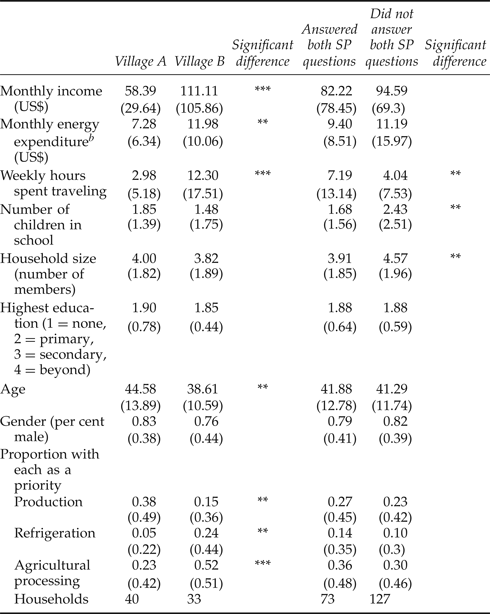
While the sample sizes and response rates were lower than desired, the averages of most socio-economic and demographic variables for those who responded to both stated preference questions do not differ significantly from the overall sample averages. Respondents that answered both questions did, however, come from smaller households with fewer children and more traveling time (see table 1). A summary of the explanatory variables used in this analysis appears in table 1. A comparison of household averages from the two villages reveals important heterogeneity across villages. Households in Village B have higher cash incomes and almost double the expenditure on energy. Energy expenditures include purchases of candles, fuel (kerosene and diesel), mobile phone charges and other battery charging. Other battery charging includes batteries used for flashlights, radios and small lights used in the home.
Summary of household responses for RHS variables a

Notes: ***p<0.01, **p<0.05.
a RWF is Rwandan Francs: 675 RWF=US$1.
b Includes expenditure on candles, fuel and battery charging, including cell phones.
Energy expenditure is found to be approximately 14 per cent of total cash income, higher than the expenditure shares of 1–3 per cent reported in Bacon et al. (Reference Bacon, Bhattacharya and Kojima2010) for rural households across the developing world, including Uganda and Kenya in Sub-Saharan Africa. This discrepancy can partly be explained because we only measure cash income. We elicited cash earnings so Monthly Income is a measure of revenue earned from selling output on the market as well as any wages earned (there were no remittances reported). It is not a net income measure, and is likely to understate full household income because it does not count the value of home consumption of agricultural production. As expected, our average income estimates are much lower than the World Bank WDI measurements for consumption per capita in Rwanda (our estimates imply an annual per capita income of approximately US$194 compared with the WDI estimate of US$343 in 2014, both expressed in 2005 US$). Higher income could increase the demand for electricity because cash is required for purchases.
Currently, households travel to electrified towns where they can purchase electricity through battery charging. While household members travel to nearby villages for reasons other than charging (e.g., to buy and sell agricultural produce on a market day), electricity in the home could displace charging expenditure as well as reduce the number of trips to town. This could save valuable time to be used in agricultural production or other activities, including leisure. Village B spends significantly more time traveling per week than Village A (consistent with longer distances to electrified towns). The number of children enrolled in school did not differ significantly across the villages.
The intended use of electricity may also influence a respondent's WTP for electricity. In both villages, lighting and mobile phone charging were consistently the top priorities for electricity use. As seen in table 1, other high priority uses differed across the villages. Village A had a higher proportion of respondents who responded that household production was a priority use of electricity. In Village B, a higher proportion responded that refrigeration and agricultural processing were a priority. Each of these activities would be likely to increase the demand for continuous access to electricity relative to a household who plans to use electricity only for light.
The survey included two stated preference questions regarding electricity use and WTP. While households in the area are very familiar with electricity and its potential uses, the exact quantity of electricity consumed for different uses remains unknown. To overcome this challenge, we asked respondents about a WTP for one electric plug in the household, with a warning that plugging in multiple devices could cause the system to fail. This means that estimates apply to the benefits from one plug. Quantity consumed is measured in the number of hours of use. While imperfect, this provides a way to capture the quantity of electricity in a stated preference framework. This solution could pose a problem if household uses for electricity vary widely. For example, if one household uses electricity for a television while another uses it for one light bulb, we are valuing different quantities of electricity, even if it is used for the same amount of time.
In addition to questions regarding the WTP for electricity, respondents were asked to indicate the top five priority uses of electricity if they were to gain access. Lighting and mobile phone charging are by far the most common priority uses. When asked to choose the top priority, 90 per cent of individuals chose lighting.
To minimize hypothetical bias in the stated preference questions, we take advantage of the surveyed villages’ participation in a rural electrification program through MG electricity. Before the survey, villagers were made aware of the MG program that would be implemented in the village. By stating that responses would influence the design and delivery of MG electricity, respondents have some incentive to answer accurately.
To minimize any strategic bias that would cause respondents to understate WTP, it was stated that if village WTP was too low, electrification might not be feasible. The hypothetical bias towards overstating WTP is minimized because households knew that responses could be used to set the price of electricity in the village.
3.1. Contingent valuation for valuing four hours of electricity
The CVM question asked respondents to select the range of their maximum WTP per month for electricity every day between 6 pm and 10 pm (question can be made available upon request). This is a payment card CVM approach (Champ et al., Reference Champ, Boyle and Brown2012). The main drawback to this approach is the potential for hypothetical bias. As mentioned above, the question was framed in the context of a real electrification project in order to minimize this bias. The advantage of this method is its simplicity in implementation as compared to the dichotomous choice method, which would have required varying the dollar amount households were asked to pay across villages. Given our budget, we could only sample households from two villages, and with small sample sizes the dichotomous choice approach is relatively statistically inefficient in terms of eliciting WTP compared to the payment card method. In addition, in a small village, telling different villagers that the program would cost them different amounts could have caused friction in the community. Given these issues with applying a dichotomous choice CVM in small remote rural villages, we chose the payment card method over a method less prone to hypothetical bias which would have required multiple survey versions.
In this setup, all households would have access to the same quantity of electricity (in terms of hours and time of day). Each respondent indicated the range within which their maximum WTP falls. The response to this question is used to estimate household WTP for a fixed quantity and timing of electricity for each household in a village. Consistent with electricity as a normal good, a higher proportion of Village B, which has higher average income, responded in ranges above 300 Rwandan Francs (RWF), or US$0.44 per month.
3.2. Contingent behavior quantities
To reflect an alternative electricity allocation mechanism, households were also asked the quantity (hours per day) of electricity they would consume at a fixed hourly price. Each respondent chose a quantity for five prices ranging from RWF10 to 100 (US$0.015–0.15) per hour. Incomplete responses were dropped from the sample. For reference, a 60-watt light bulb consumes 0.06 kWh of electricity per hour. The price for this light would range between US$0.25 and US$2.47 per kWh at the hourly prices provided. Given that grid electricity costs >US$0.25 per kWh in Rwanda, this is a realistic range for electricity prices in remote regions. It is assumed that households would have access to electricity for 30 days per month. If individuals anticipate outages or days away from home, then this method may overstate or understate the benefits. The estimate of the WTP for a given hour could be biased down if there is uncertainty associated with the reliability of the electricity (due to outages). On the other hand, we generate monthly WTP assuming that the household successfully uses electricity for the daily electricity demand*30 days. If not all this demand is actually used because of outages, this method overstates the quantity consumed as well as the WTP. Again, the stated demand for electricity is much higher in Village B than Village A. Responses to this question can be used to estimate household electricity demand curves and WTP for given amounts of electricity use.
To investigate the presence of protest responses to stated preference questions, we explore the frequency of a respondent answering zero demand for electricity. All respondents that answered both stated preference questions indicated that they would purchase some electricity at least at a low price. The five households who responded zero to the CVM question indicated poverty as the reason for zero WTP. This is not considered a protest response because it reflects their economic behavior, accounting for a budget constraint. None of the respondents who indicated zero WTP on the CVM question fully completed the CB question. Therefore, our analysis is conditional on having positive demand for electricity.
4. Econometric model
In order to estimate the WTP for each type of electricity service or use option, we construct a model that explains an individual's response to the two stated preference questions. The goal is to obtain the total WTP that corresponds to four hours of daily consumption using both stated preference methods. In practice, this represents the gross benefit of electricity. To find net household benefits, electricity payments would be subtracted from this quantity.
We first describe the two model specifications. While the two models can be estimated separately, we propose a method for joint estimation of the models that exploits the correlation in responses across questions because the same individual responds to both questions. This method requires construction of a joint likelihood function and could apply in other contexts where a survey elicits WTP in multiple ways. Using this seemingly unrelated regressions (SUR) approach can result in an efficiency gain because the inclusion of price in the CB question means the independent variables vary across the models.
4.1. Econometric model for payment card CVM for fixed quantity and time available
The payment card question asks households to provide a maximum WTP interval. Following Cameron et al. (Reference Cameron, Shaw, Ragland, Callaway and Keefe1996), we assume that household i’s latent WTP,
 $y_{ij}^{\ast}$
, can be expressed as:
 $$y_{ij}^{\ast} = X_i^{\prime} \beta + u_{ij}$$
where
 $y_{ij}^{\ast}$
is the log of WTP for individual i, and X
i
is a vector of household characteristics that includes household income, electricity expenditure, age, gender, household size, the number of children, and a village dummy equal to 1 if a household resides in Village A. It also includes a series of dummy variables that indicate if a household prioritizes different uses of electricity. The index j refers to the price offered in the CB question, but for the CVM question there is no variation within an individual across different prices. This introduces (perfect) correlation between responses within an individual, which we account for by clustering standard errors to be robust to this correlation.
We want to model the probability that y
ij
falls between the given cut-points
 $\underline{c}_{k}$
and
 $\overline{c_{k}}$
for interval k;
 $\underline{c}_{k}$
is the lower bound of each interval in the payment card, while
 $\overline{c_{k}}$
is the upper bound. Assuming that u
ij
is distributed normally with mean zero, then:
 $$\hbox{Pr} \lpar y_{ij} \in [\underline{c}_{k}, \bar{\rm c}_{k} \rpar = \hbox{Pr} \lpar \underline{c}_{k} - X_i^{\prime} \beta \lt y_{ij}^{\ast} \lt \bar{c}_k - X_i^{\prime} \beta \rpar $$
We will model this probability jointly with the CB model to obtain estimates for β, accounting for correlation across models. After estimating the parameters of this model, household WTP can be obtained for each household by exponentiating the model predicted LHS variable. Village median and average WTP estimates are compared with those from the CB model described below.
4.2. Econometric model for contingent quantities of electricity at variable prices
Each respondent was also asked the daily quantity, q ij , of electricity the household would use for a given price j. This question allows for the calculation of the area under a demand curve but for a slightly different electricity good. It represents a different good because instead of a fixed quantity and time of electricity consumption, households can choose consumption levels and timing but must pay per unit for the privately purchased electricity. We express the daily quantity demanded as:
 $$q_{ij} = \alpha_i + \beta_0 p_j + X_i^{\prime} \beta_1 + \epsilon_{ij}$$
where X
i
is a vector of household characteristics (the same as the CVM model), and p
j
is the hourly price of electricity. Each household responded for five prices. If α
i
is a household random effect, this model can be estimated using feasible generalized least squares (Cameron and Trivedi, Reference Cameron and Trivedi2005). If the transformed data is written
 $\tilde{q}_{ij}, \tilde{X}_{i}$
, with error term,
 $\tilde{\epsilon}_{ij}$
, we can jointly estimate this model with the CVM model by assuming that
 $\tilde{\epsilon}_{ij}$
and u
ij
are distributed bivariate normal.
Once parameter estimates are obtained, equation (3) can be solved for p j to obtain a predicted inverse demand function for household i:
 $$p = {1 \over \widehat{\beta_0}} q_i - {\widehat{\beta_1} \over \widehat{\beta_0 }} X_i$$
where hats indicate an estimated parameter and X i includes the constant. This function can be integrated from zero to four and multiplied by 30 days to get a WTP estimate for a comparable quantity of electricity as in the CVM question (four hours per day, 30 days per month). Note that the slope is constant across all households in equation (4). In order to allow for flexibility in this slope, price interactions with village and household-producer indicators are also included. The total benefit of electricity is represented by the integral over the estimated inverse demand function:
 $$TB_i = 30 \int_0^4 \left({1 \over \widehat{\beta_0}} q_i - {\widehat{\beta_1} \over \widehat{\beta_0}} X_i \right) dq_i.$$
The total benefit calculated in equation (5) can be compared to the total WTP predicted by the model in equation (1). This comparison values the same quantity of electricity access (four hours of electricity use per day) delivered in two distinct ways: a fixed four hours each day from 6–10 pm, or four hours a day at the user's choosing throughout the day and evening.
4.3. Joint estimation
Because the same individual is represented in both models, there is the potential for efficiency gains from modeling u
ij
and
 $\tilde{\epsilon}_{ij}$
jointly (Petrolia et al., Reference Petrolia, Joonghyun, Landry and Coble2015). Specifically, the use of price and price interactions in the CB model means that independent variables differ across the two models, introducing an efficiency gain from a SUR approach. We therefore propose a method to jointly estimate the responses of the two stated preference questions. We define the joint distribution of the model error terms as:
 $$\left(\matrix{u_{ij}\cr \tilde{\varepsilon}_{ij}} \vert X_i, p_j \right) \sim N \left[\matrix{0 \cr 0}, \left(\matrix{\sigma_1^2 &\sigma_{12}\cr \sigma_{21} &\sigma_{22}^2} \right) \right] = N [0, \Sigma]$$
where u
ij
and
 $\tilde{\epsilon}_{ij}$
are the error terms from each model, and σ12 captures the covariance between the error terms in the two models. Let ρ be the correlation coefficient between the error terms. If ρ differs significantly from zero, there is an efficiency gain from estimating the two equations jointly.
To construct the joint likelihood function, we follow Roodman (Reference Roodman2009). Under the assumption of independence across observations (later relaxed), the joint likelihood of an observation for individual i and price j with a realization in interval k can be expressed as:
 $$L_{ij} \lpar \beta_I, \beta_{RE}, \Sigma; q_{ij}, X_i, p_j \rpar = \int\limits_{\underline{c}_k - X_{ij}^{\prime} \beta}^{\bar{c}_k - X_{ij}^{\prime} \beta} \Phi (\tilde{q}_{ij} - \tilde{X}_i^{\prime} \beta_{RE}, u_{ij}; \Sigma) d u_{ij}$$
with Φ representing the bivariate normal probability distribution function. For a given observation,
 $$L_{ij} \lpar \beta_I, \beta_{RE}, \Sigma; q_{ij}, X_i, p_j \rpar = \int_{h^{ - 1}} \lpar \hat{y}_{ij} \rpar \Phi (\tilde{\epsilon}_{ij}, u_{ij})\, du_{ij}$$
h −1 is derived from the function relating the observed outcome for the interval regression to the underlying, latent WTP. Specifically, if O k is a given outcome, let:
 $$y_{ij} = g \lpar y_{ij}^{\ast} \rpar = \left\{\matrix{\hbox{O}_1 & if \underline{c}_0 \le y_{ij}^{\ast} \le \bar{c}_0 \cr & \ldots \cr \hbox{O}_K & if \underline{c}_K \le y_{ij}^{\ast} \le \bar{c}_K} \right.$$
where y
ij
is the observed outcome when the true dependent variable is
 $y_{ij}^{\ast}$
. Define
 $h\lpar u_{ij} \rpar \equiv g\lpar \tilde{X}_{i}^{\prime} \beta + u_{ij} \rpar $
so that
 $h^{ - 1} \lpar y_{ij} \rpar = \lpar \underline{c}_{k} - \tilde{X}_{ij}^{\prime} \beta, \bar{c}_{k} - \tilde{X}_{ij}^{\prime} \beta \rsqb $
. Taking the product of (8) across observations produces the likelihood function:
 $$L \lpar \beta_I, \beta_{RE}, \Sigma; q_{ij}, X_i, p_j \rpar = \prod_i \prod_j L_{ij} \lpar \beta_I, \beta_{RE}, \Sigma; q_{ij}, x_{ij} \rpar $$
Maximizing the log of this joint likelihood function by choosing the parameters for both models produces the jointly estimated model coefficients.
Note that observations within an individual are not independent in this context. In the interval regression, each observation is repeated for every price j. Therefore, we construct standard errors that allow for correlation across j, but assume independence across i. To do this, let
 $l\lpar \beta_{I}, \beta_{RE}, \Sigma; q_{ij}, X_{i}, p_{j} \rpar = \ln \lpar L \lpar \beta_{I}, \beta_{RE}, \Sigma; q_{ij}, X_{i}, p_{j} \rpar \rpar $
. In this case, the maximum likelihood variance estimate becomes
 $\hat{V} = \lpar - A^{ - 1} \rpar B \lpar - A^{ - 1} \rpar $
where
 $A = l^{\prime \prime} \lpar \beta_{I}, \beta_{RE}, \Sigma; q_{ij}, x_{ij} \rpar $
.
Defining
 $l^{\prime} \lpar \beta_{I}, \beta_{RE}, \Sigma; q_{ij}, x_{ij} \rpar \equiv \sum_{i} \sum_{j} r_{ij} \lpar \beta_{I}, \beta_{RE}, \Sigma; q_{ij}, x_{ij} \rpar $
, then
 $B = \sum_{i} \sum_{j} r_{ij} \lpar \beta_{I}, \beta_{RE}, \Sigma; q_{ij}, x_{ij} \rpar ^{\prime} r_{ij} \lpar \beta_{I}, \beta_{RE}, \Sigma; q_{ij}, x_{ij} \rpar $
. With a correctly specified model and independent observations, −A
−1=B and the variance matrix
 $\hat{V}$
collapses to equal −A
−1=B. In our case, −A
−1≠B because of dependence across prices for an individual. To construct errors that are robust to this correlation, standard errors are clustered within individuals and B is estimated as:
 $$B = \sum_i \left[\sum_{j\epsilon f} r_{ij} \lpar \beta_I, \beta_{RE}, \Sigma; q_{ij}, x_{ij} \rpar \right]^{\prime} \left[\sum_{j\epsilon f} r_{ij} \lpar \beta_I, \beta_{RE}, \Sigma; q_{ij}, x_{ij} \rpar \right]$$
where the internal summations sum over each price level contained in cluster f. Clustering at the individual level allows for each individual to belong to a unique cluster.
To estimate the joint likelihood function, we use the user-written Stata command CMP (conditional mixed process; Roodman, Reference Roodman2009) to estimate the joint likelihood model presented above. The cross-sectional interval regression data are stacked by individual to create N×5 observations for both models, and standard errors are clustered at the individual level to allow for dependence across individual error terms for a given model. To allow for comparison and to examine if there exist efficiency gains from joint estimation, the models are estimated both jointly and separately. Results are presented in the following section.
5. Results
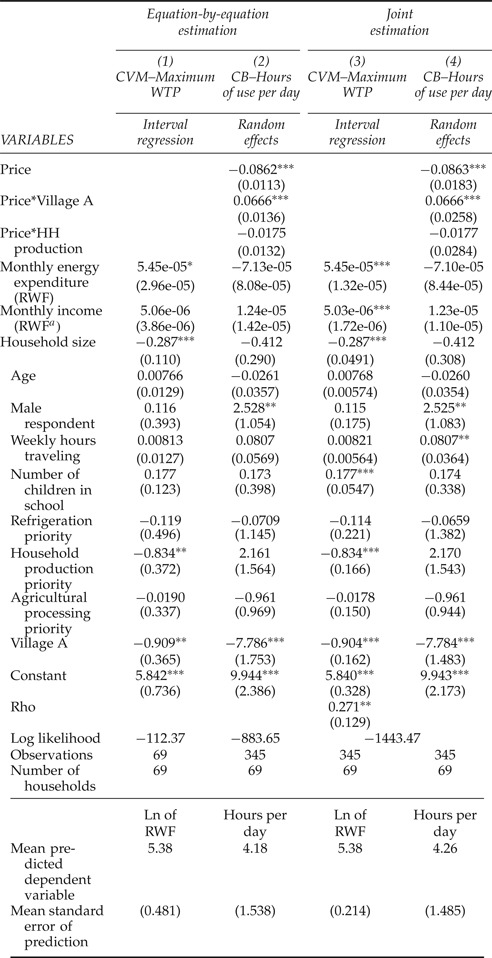
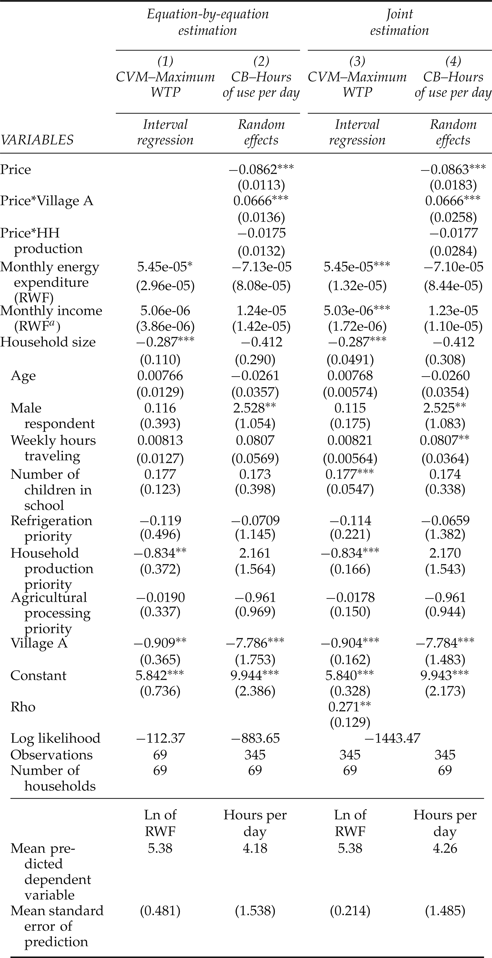
The separate (equation-by-equation) and joint estimation results of both models are presented in table 2. A few outcomes become apparent. First, the correlation between error terms in the two models, ρ, indicates that efficiency gains exist from joint estimation. A positive ρ means that if a respondent has higher than predicted WTP in the interval regression, s/he is likely to also respond with a higher than expected number of hours of electricity use at a given price. If demand for electricity of both types is correlated for the same individual, we would expect this positive correlation. Nevertheless, the correlation is not perfect because the type of electricity offered differs across the two models. A respondent who wants to use electricity for production, for example, may have a high WTP for continuous electricity during the day, but not for the four hours per night. This implies imperfect correlation across the error terms.
Joint estimation of CVM and contigent behavior models
Notes: Standard errors in parentheses. ***p<0.01, **p<0.05, *p<0.1.
a RWF is Rwandan Franc; 675 RWF=US$1.
Notable increases in precision are found for coefficients on monthly income and the number of children in the household. They become significant in the interval regression when estimated jointly. Monthly energy expenditure also becomes significant at the 1 per cent level when estimated jointly. The coefficient on hours spent traveling per week becomes significant in the CB regression. This increase in efficiency means the average standard error of the predicted dependent variables decreases in both models. The mean predicted dependent variable, along with the mean standard error, are reported at the bottom of table 2. The standard error of the predicted WTP (in log of Rwandan Francs) decreases to around half through the joint estimation. The standard error of predicted number of hours of use per day also decreases when estimating the equations jointly. These results translate into more precisely estimated benefits of electrification in Rwanda. Importantly, the magnitude of WTP estimates is not sensitive to the exact combination of explanatory variables included.
When comparing results across the two models, it becomes apparent that different factors drive the WTP for electricity as a public or a private good. First, income and energy expenditure significantly increase the WTP for electricity as a public good that could only be used in the evening for activities such as lighting and mobile phone charging. On the other hand, the current level of these variables does not significantly influence the number of stated hours of use. This makes sense if business plans do not correlate with current income. If households can use electricity for productive activities that require more continuous power, current income may not determine the amount that could be afforded in the future. This is consistent with the difference in sign of the coefficient on the indicator for production as a priority. If a household wants to start a production business (e.g., saw mill) that requires daytime electricity and sees electricity delivery as an either/or decision, the WTP for four hours at night could decrease. On the other hand, households with a lot of children are likely to value the light in the evening that would allow students to study with better light and cleaner indoor air. Consistent with this hypothesis, the number of children in school significantly increases the WTP for four hours of electricity in the evening (i.e., electricity as the public good). Across both models, it becomes apparent that Village A has a lower WTP on average than Village B.
In the CB model, most coefficients have the expected sign, with gender and the number of hours traveling per week significantly affecting the intercept of the inverse demand curve. The coefficient on price is negative and significant, and there is evidence that the slope differs by village but not for those who want to use electricity for production. The point estimate on the price interaction with the production household indicator suggests more inelastic demand for households with production as a priority, as well as an increase in the estimated inverse demand curve y-intercept. Surprisingly, monthly energy expenditure has a negative coefficient estimate but it is not significantly different from zero in the CB regression. If the quantity demanded in this model is driven by expected future uses of electricity, this may not displace current expenditure on energy.
Interestingly, the sign of the coefficient on household size is negative in both models and significant in the CVM model. Theoretically, the impact of this variable on electricity demand is ambiguous. As more people live in a household, this could increase the demand for electricity, similarly to how more children in school increase the demand for light. On the other hand, a bigger household with working-age members in a setting with imperfect labor markets leads to a lower shadow value of time. If electricity saves labor in household and productive activities, this benefit will be smaller for larger households. The negative impact of household size on WTP here indicates that this labor effect dominates the increase in demand for electricity as a household becomes larger.
Note that the number of children enrolled in school is highly correlated with the size of the household, with a correlation coefficient of 0.56. Also, children under 12 years of age make up the largest age group across all households. Therefore, we estimate the same models presented in table 2 but excluding the variable measuring the number of children enrolled in school. The marginal effects of other variables do not qualitatively change.Footnote 4
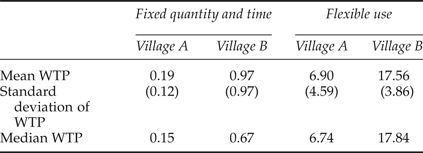
Finally, the daily household inverse demand is integrated from zero to four hours and multiplied by 30 days to obtain the WTP for 120 hours of electricity from the CB model. We assume a household would stop consuming when the marginal benefit of electricity reaches zero, so the utility from 120 hours is either the utility from four hours per day or 30 times the WTP for the quantity that sets the marginal benefit equal to zero. This occurs for many households in Village A where stated quantities are much lower than in Village B. These households only receive the total benefit from four hours of flexibly provided electricity at a price of zero. Table 3 presents WTP estimates from both models and it is apparent that the WTP differs substantially across villages and types of electricity. Village B has a higher average WTP and, for both villages, the average estimated WTP differs by a large factor (Village A (B) mean WTP for flexible use is 37 (18) times higher when electricity is valued as a private (CB) good). Clearly, the estimated WTP using CB greatly exceeds the CVM WTP.
Average monthly willingness to pay for four hours of electricity, US Dollars*
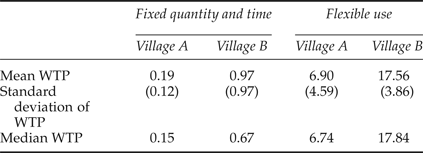
Notes: WTP estimates are from the jointly estimated model.*675 RWF=US$1.
The results presented here demonstrate an efficiency gain to joint estimation and a clear difference in estimated WTP across the two types of electricity delivery, and we now explore possible explanations for this discrepancy.
6. Discussion
Our results suggest a strong WTP premium for flexibility in the use of electricity in rural Rwanda. This means that when investors or policy makers are designing electricity provision, flexibility and consistency in electricity delivery could be economically preferred even at a higher cost. With only four hours of electricity per day at a given time of day, households are highly constrained. They can use electricity for light and battery charging but not for productive activities during the day. On the other hand, with more flexible use, households can use electricity when they choose. Mobile phones can be charged and machinery can be used during the day while lighting can be used at night. Also, several households indicated a desire to purchase a refrigerator, which requires a constant supply of electricity.
Survey responses suggest that, with a continual supply of electricity, some households would open small businesses such as hair salons, agricultural crop processing (e.g., drying), milling (timber or grain) and construction work. These business opportunities would not be possible without continuous access to electricity during the day. Therefore, while lighting and battery charging are high priorities for many households, they do not appear to drive the high WTP for a continuous supply of electricity.
Our results are broadly in line with the positive impacts that have been found in other studies. For example, Kalisa (Reference Kalisa2014) finds a WTP for electricity access in Rwanda of US$55 per year. Our CB results imply a higher annual WTP, between US$80 (Village A) and US$210 (Village B). Yet these benefits are 11 and 16 per cent of reported average income in each village, respectively. Comparing these percentage impacts with observed income benefits is not directly comparable because stated preference methods capture both income and non-market benefits of electricity. Nevertheless, these benefits are consistent with income impacts found in Vietnam (Khandker et al., Reference Khandker, Barnes and Samad2013) and Bangladesh (Khandker et al., Reference Khandker, Barnes and Samad2012) of around 20 per cent.
Of course the WTP results only provide estimates of the gross benefit of electrification through each method. Policy makers must consider the net benefits that account for the cost of electricity provision under each scenario. Currently, surveyed households have near-zero electricity access within the village. Several options exist to electrify rural households. The first includes central grid expansion. The Rwandan Ministry of Infrastructure uses a cost estimate for grid expansion of US$1,000 per household, not including the required increase in generation or transmission infrastructure (OAG, 2015). As villages are located farther from paved roads, this cost estimate is likely to rise, but it conservatively implies a cost of US$100,000–200,000 per village. Given WTP estimates in the range of US$100 per household per year, it is unlikely to be economically viable to electrify villages of 100–200 households using central grid expansion.
Village electrification could also occur through the use of village-wide isolated microgrids (MGs). Due to a lack of installed MGs, the costs of such units in remote parts of Rwanda are unknown but our results suggest that systems should allow for continual electricity access unless doing so would greatly increase costs. This may occur if continuous access requires significantly larger amounts of storage. Future research should investigate the relationship between MG capacity, operating times and cost. Without this information, our results do not indicate the optimal MG size. Nevertheless, they suggest a significant gross benefit from continuous supplies of electricity that can be purchased when needed.
Besides a difference in the type of good delivered, there are several other possible explanations for the difference in WTP estimated here. First, responses to the CVM question may be subject to strategic bias for understatement of WTP if households suspect that their valuation responses would be used to price the electricity system they would receive (Loomis et al., Reference Loomis, Pierce and Manfredo2000). While Carson and Groves (Reference Carson and Groves2007) point out that a dichotomous choice experiment would have minimized this bias, practical considerations prevented the use of multiple survey versions, leading us to use the payment card method which may be more susceptible to hypothetical bias.
Also, the divergent estimates of WTP may be driven by the difference in time frame for the CVM and CB question. While the CVM question asked for a monthly WTP, the CB question focused on daily electricity use. Seeing a monthly amount may provide users with a type of ‘sticker shock’. As people answered the daily-use question, they may not have accurately considered the monthly bill that would result. It is also possible that people responded for their maximum use per day instead of average, or that individuals did not anticipate using electricity for four hours each and every day for 30 days a month. Both of these would cause the CB demand to be overestimated. In general, this possibility should be accounted for when composing such questions, especially in developing country settings. Calculating implied monthly bills from responses and then presenting them back to respondents as a check would help mitigate this concern. These concerns mean that the exact magnitude of the differences found here should be interpreted with caution.
Despite the possibility that the question framing may contain biases, the joint estimation procedure proposed here could have broader applications for stated preference methods. Frequently, one individual responds to multiple questions in a survey and joint estimation can lead to more efficient parameter estimation.
7. Conclusion
We have explored the household WTP for alternative ways to supply electricity in remote rural villages in Rwanda. We find a difference in WTP for electricity delivered as a village public good versus a household private good. Households expressed a higher WTP for four hours of electricity per day given that they face no restriction on when the electricity is used. Many respondents expressed an interest in using electricity for business activities in addition to household uses such as lighting and mobile phone charging. With electricity as a public good available in the same quantity and at the same time to all households, the average WTP is much lower, in part because the ability to use electricity for production activities is greatly diminished. This suggests that, even if delivering a continuous supply of electricity has a higher cost, higher benefits may justify the additional cost.
We also found that our joint estimation of the payment card CVM WTP and the contingent quantities model was econometrically justified because of significant correlation between the two models’ error terms.
Because of the small sample size in the study, we exercise caution when generalizing the results to all of rural Rwanda and to other regions. If our results are replicated by others in future studies with larger sample sizes, the results of this analysis would have several important policy implications. First, we find a positive WTP for electricity in rural Rwanda. This implies a gross benefit to electrification and justifies further exploration to quantify both the costs and benefits of electrification, and to identify circumstances under which electrification brings a net benefit to rural communities.
Next, the benefits of constantly available electricity are likely to be large relative to only having electricity a portion of the day (in our case, evening hours). This is consistent with findings that outages can decrease the positive impacts of electricity (Chakravorty et al., Reference Chakravorty, Pelli and Marchand2014). While the timing of outages can be anticipated in our study, there are still significantly smaller benefits compared with continual access. Therefore, as governments set and measure progress towards electrification targets, our results suggest that much larger benefits are likely to occur from continuous electricity access.
Finally, when considering electricity system capacities, a larger system that can provide continuous electricity may be preferred to a cheaper system that cannot provide continuous electricity. For example, while individual solar units may be cheaper in the short run, they do not provide the continuous supply of electricity that could lead to higher electricity value. Future work should explore the relationship between system capacity and cost to identify the optimal electrification strategy.
Future electricity demand analyses should combine revealed preference approaches using electrification experiments with stated preference data to more precisely estimate the WTP for electricity and how this depends on price, household characteristics and village-level factors. By applying household WTP estimates to rural electrification, generation and distribution systems can be efficiently designed and administered to maximize the net benefits of scarce available resources for rural village infrastructure.