Dementia is a common disease associated with adverse outcomes.Reference Livingston, Huntley and Liu1 Studies on the incidence and prevalence of dementia have had variable results depending upon the population studied,Reference Fiest, Jetté and Roberts2 the time frame of the analysis, the decades consideredReference Wu, Beiser and Breteler3 and how dementia was diagnosed.Reference Fiest, Jetté and Roberts2 In most studies, the point prevalence of dementia is about 50 cases per 1000 persons over 60.Reference Fiest, Jetté and Roberts2 Most studies report an incidence of about 17 cases per 1000 person-years,Reference Fiest, Jetté and Roberts2 which varies from 0.5 to 5.0 per 1000 person-years in people aged 60–64 years with increases to 50–140 per 1000 person-years in people older than 95 years.Reference Olfson, Stroup, Huang, Wall and Gerhard4 Calculating the incidence of dementia is difficult because of selection bias, competing risk from death, loss to follow-up, interval censoring between survey waves, inaccuracy in the diagnosis of dementia and uncertainty in the date of dementia onset. There are very few large cohort studies that follow a population over the adult life course that have a low loss to follow-up and continuous data collection. The Manitoba Follow-Up Study (MFUS) is a cohort study of men who qualified for air crew training in the Second World War and who have been followed to the present day with continuous data collection. It therefore offers the opportunity to describe the risk of dementia over a 76-year period. Specifically, the objectives of these analyses are to report:
-
1. The age-specific incidence of dementia in a cohort study of aging men;
-
2. The age-specific prevalence of dementia; and
-
3. The life course cumulative risk of dementia considering the competing risk of mortality.
The methods of MFUS have previously been reported.Reference Tate, Cuddy and Mathewson5 Briefly, this is a prospective cohort study of 3983 men who qualified for air crew training in the Royal Canadian Air Force (RCAF) in the Second World War. The cohort was sealed on July 1, 1948, and continues to the present day. At entry, the mean age of the men was 31 years, with three-quarters between 25 and 34 years of age. The men were fit for service in the RCAF and free of heart disease. We considered the time from July 1948 to July 2024. At the time of these analyses, 3960 men had died. Seven participants have been lost to follow-up – defined as no contact with the MFUS study for three years and not known to have died. The study receives annual approval from the Health Research Ethics Board (Bannatyne Campus) of the University of Manitoba.
Between 1948 and 1996, there were regular health assessments including a history and physical, electrocardiogram and measurement of weight and blood pressure – initially every five years and subsequently every three years. This was requested from the participants’ primary care provider. Since 1978, there has been an annual health survey sent to the participants, which inquires about health and healthcare contacts. The questionnaire also notes a proxy respondent and includes written consent to obtain health records. If there are healthcare contacts, then these healthcare records are retrieved. These records include primary care notes, consultant notes, hospitalizations, long-term care records and death reports.Reference Tate, Cuddy and Mathewson5 The report of death is usually derived from health records and/or death certificates. In some instances, such as an out-of-hospital death, decedent interviews are conducted with the identified proxy. These records are reviewed by a study physician using a standard coding process and coding manual for chronic diseases. Thus, there is a continuous record of the participant’s health throughout the course of the study. If a diagnosis of dementia is noted in any of these records, then the diagnosis and date of diagnosis are coded by study physicians. For these analyses, we do not consider the specific subtype of dementia but consider all subtypes combined.
The date of the first diagnosis of dementia defined an incident case. We report the overall incidence of dementia and the age-specific incidence in five-year intervals. The time frame of the analyses was from 1948 to 2024. Those who were free of dementia were censored at the time of last contact with the study or the end of the observation time. Those who died and those who were diagnosed with dementia were removed from the risk pool at the time of diagnosis or death. The incidence rate of dementia per 1000 person-years of observation time was then calculated. Prevalence at each age was calculated as a proportion of surviving members who had a diagnosis of dementia. Finally, we graphically present the proportion of the study members who had died without dementia, who had died after a diagnosis of dementia, who were alive with a diagnosis of dementia and who were alive without dementia.
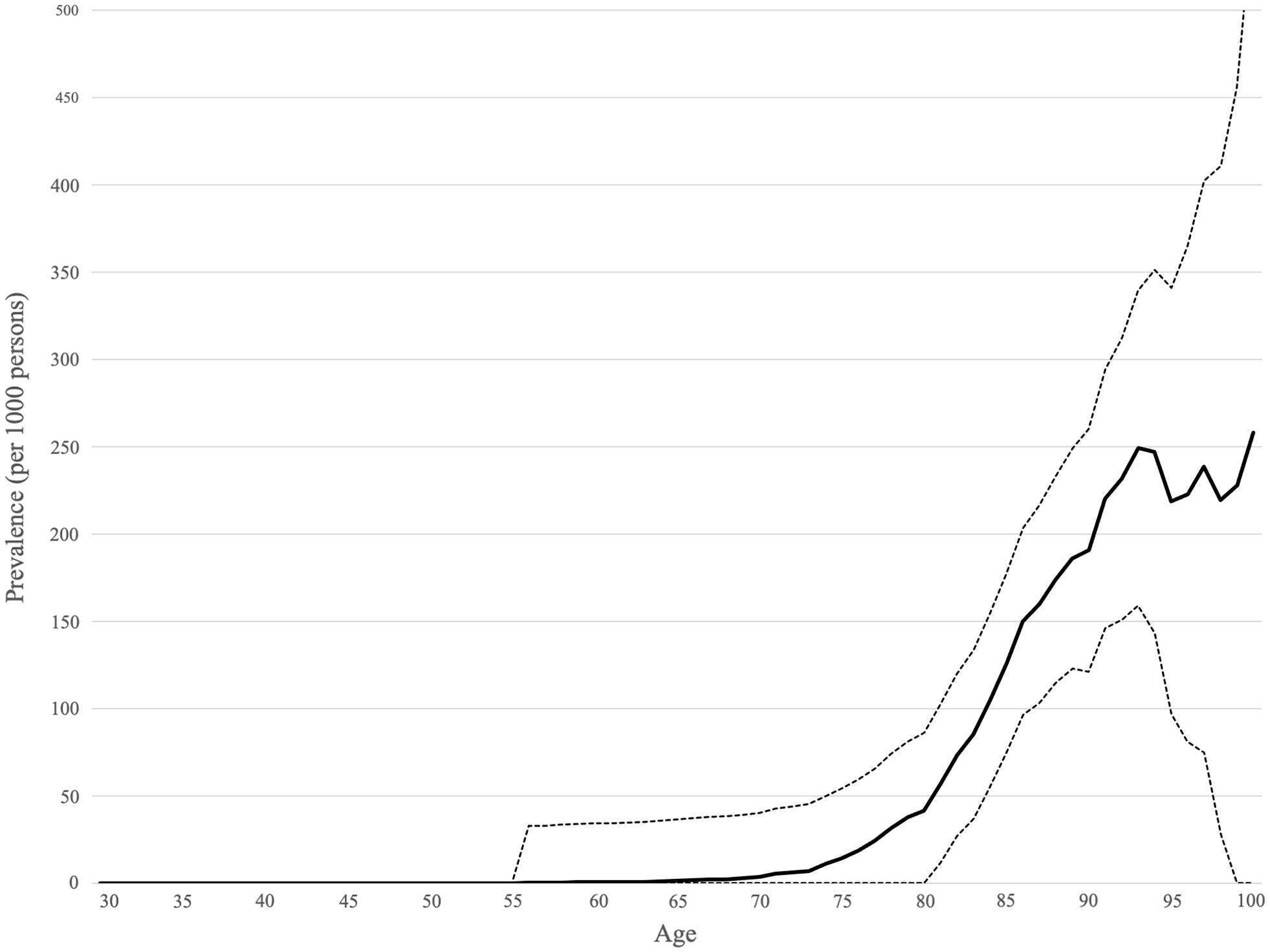
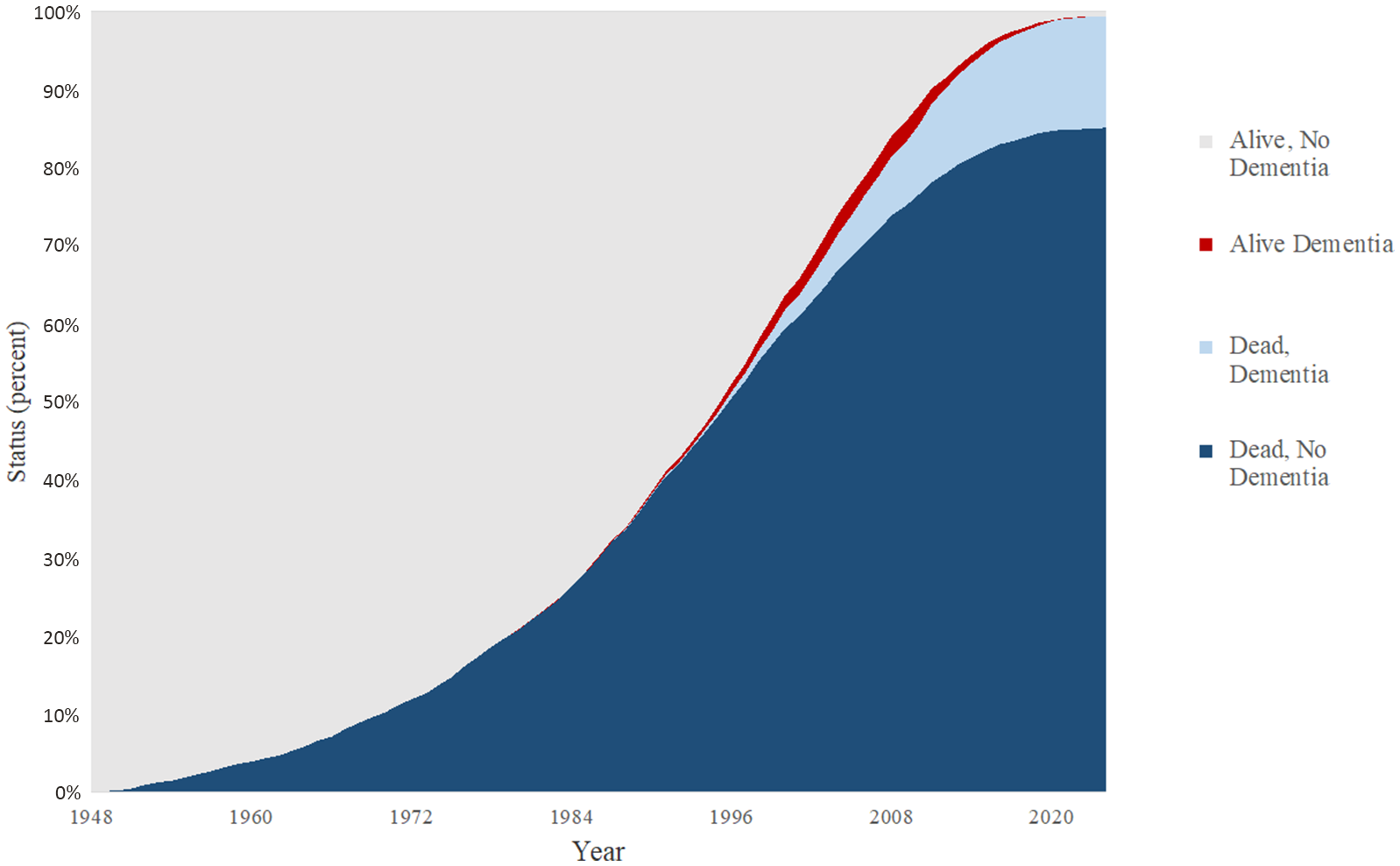
Between 1948 and 2024, the members contributed 181,334 person-years of observation; 570 participants were diagnosed with dementia. The mean age at diagnosis was 86 years old (range 56–102 years old). Figure 1 shows the age-specific incidence of dementia. The incidence of dementia was very closely related to age: low prior to the age of 80 but increasing markedly thereafter. At all ages, the incidence of death was considerably higher than the incidence of dementia. Figure 2 shows the prevalence of dementia, which also shows a very strong nonlinear relationship with age. Our estimates for both incidence and prevalence after the age of 95 should be viewed with great caution, since the number of participants was small – leading to imprecision. Moreover, there are still participants alive – all of whom are over the age of 95 and still at risk of dementia. We expect that future analyses of this cohort may show an ongoing increase in dementia risk at very old ages. Figure 3 shows the cumulative risk of dementia and the competing risk from death. The cumulative risk of dementia is very low at younger ages but increases considerably after the age of 80. However, the risk of death is higher than the risk of dementia throughout the study.
Incidence (95% confidence interval) of dementia per five-year age group in a prospective cohort study of men. The incidence of dementia increases with age.

Prevalence (95% confidence interval) of dementia in a prospective cohort study of men. The prevalence of dementia increases with age.

Lifetime risk of dementia and death. The risk of dementia increases with age, and there is considerable competing risk due to death. Note that this is by calendar year and not by age.

We have analyzed a prospective cohort study of aging men and found that dementia has a high incidence and prevalence, which are both strongly related to age. However, the competing risk from death is higher. The incidence and prevalence we note are within the range of other reports – albeit at the lower end of estimates.6,Reference Helmer, Pérès and Letenneur7 This may be due to the nature of the study – men may have a lower risk of dementia than women,Reference Letenneur, Gilleron, Commenges, Helmer, Orgogozo and Dartigues8 and MFUS members may have better general health than other studies. There are strengths and limitations to this study. It is a study of men, and the results should not be extrapolated to women. The participants also have had unique life experiences, which also limit the generalizability of our findings. MFUS did not conduct cognitive assessments on the participants but relied on their clinical records and/or clinical examinations of their physicians. Thus, there may be some misclassification of dementia, particularly mild dementia.Reference Wilkinson, Ly and Schnier9 Similarly, the date of diagnosis may be later than the actual onset of dementia. This inaccuracy may vary across the course of the study, with changes in clinical recognition of dementia in more recent decades. The resulting misclassification may result in an underestimation of the true incidence of dementia, particularly mild dementia and particularly earlier in the study. We also consider all cause dementia rather than specific dementia subtypes. Strengths include the long study duration with constant ongoing data collection over decades and a very low loss to follow-up. To our knowledge, there is no other cohort study over a 76-year time frame.
Our findings are important for several reasons. Dementia poses a considerable challenge for older adults and healthcare systems. The risk is highly concentrated in those over the age of 80. While not surprising, the association between age and dementia is extremely strong and has implications for prevention,Reference Brayne10 since the effect of age may overwhelm the effect of potentially modifiable risk factors. Finally, the risk of dementia is highly dependent upon the competing risk of death. Changes in the risk of death may have large effects on the risk of dementia, and this competing risk should be considered in clinical practice and research.
Acknowledgments
We would like to thank the previous investigators, collaborators, volunteers and staff of MFUS over many years. We would also like to thank the study members for many years of dedication to the study.
Author contributions
RT has been involved in the design and conduct of MFUS since 1975 and conceived and conducted the analyses and commented upon the manuscript. PStJ has been involved in the design and conduct of MFUS since 2012 and conceived these analyses, prepared the graphs and drafted the manuscript. CS conceived these analyses and commented upon the manuscript.
Funding statement
These analyses were unfunded. Funding has been received from charitable donations from study members and their families. Funding for other projects has been received from the Canadian Institute for Health Research (CIHR). The funding sources had no role in these analyses or manuscript preparation.
Competing interests
Dr St John and Dr Tate have received funding from CIHR for other analyses and projects. Dr St John is an unremunerated Board Member of Age and Opportunity and has received speaking honorarium from McMaster University and the Regional Geriatric Program of Eastern Ontario, as well as management consulting fees from the University Health Network (Toronto).