Electoral commitmentsFootnote 1 are at the heart of multiparty competition. In the run-up to elections, political parties lay out their policy positions and promises in an attempt to win votes and, ultimately, claim office (Austen-Smith and Banks Reference Austen-Smith and Banks1988; Baron Reference Baron1993). Pledges that dominate newspaper headlines—such as “Lib Dems would end austerity in three years” (Wintour and Watt Reference Wintour and Watt2015)—and policy commitments found in electoral manifestos—such as “Under Labour, the NHS will remain a universal health service” (Labour 2010)—provide crucial information to voters regarding the specifics of parties’ policy positions and the importance they assign to them. However, strong electoral commitments potentially “tie the hands” of political parties once in government, to the extent that failing to act upon them could result in voter disapproval (Hillebrand and Irwin Reference Hillebrand and Irwin1999; Armingeon and Giger Reference Armingeon and Giger2008; Thomson Reference Thomson2011).Footnote 2
Yet, when and how strong electoral commitments affect policy outcomes in multiparty cabinets is, as yet, poorly understood. Some scholars find that the control of ministerial portfolios and coalition agreements are critical for effectively influencing policy in multiparty cabinets (Laver and Shepsle Reference Laver and Shepsle1996; Mansergh and Thomson Reference Mansergh and Thomson2007; Thomson et al. Reference Thomson, Royed, Naurin, Artes, Costello, Ennser-Jedenastik, Ferguson, Kostadinova, Moury, Petry and Schermann2014; Back, Debus and Tosun Reference Back, Debus and Tosun2015; Schermann and Ennser-Jedenastik Reference Schermann and Ennser-Jedenastik2015). Others instead, find that policy is decided by cabinets collectively and reflects parties’ ideology weighted by their size, independently of the distribution of portfolios (Austen-Smith and Banks Reference Austen-Smith and Banks1988; Martin and Vanberg Reference Martin and Vanberg2014).
Focusing on social welfare policy, this article asks: “once a political party enters a coalition government, do its electoral commitments constrain or enable it to formulate policy?” Do electoral promises matter for policy or are they “cheap talk”? Under what conditions? We develop a theory of policymaking in multiparty cabinets that provides the conditions under which electoral promises strengthen parties’ negotiating position. Drawing from models of bargaining with pre-negotiation commitment (Leventoglu and Tarar Reference Leventoglu and Tarar2005), we argue that the party with the highest audience costsFootnote 3 attached to the policy in question has the greatest leverage. We identify three necessary conditions that increase parties’ audience costs while in government: they have agenda setting power through the control of portfolios, and they have made a strong electoral commitment on a salient policy for party voters.
We test our theoretical expectations on social welfare policy. This is an area about which voters care deeply (Pierson Reference Pierson1996; European Commission 2009), particularly in rich European countries where the costs and benefits of welfare are highly visible (Gingrich Reference Gingrich2014). Nonetheless, even in the United Kingdom, known for its “minimal welfare state” (Esping-Andersen Reference Esping-Andersen1990), social welfare policy has been found to be the second most important electoral issue after the economy (Bara Reference Bara2005). The political significance of social welfare policy in western European countries is also explained by the fact that tax and social welfare policies constitute the majority of legislative bills (Martin and Vanberg Reference Martin and Vanberg2014). The recent financial crisis has revived the heated debates of the 80’s and the 90’s over austerity, making it all the more important to understand the political conditions under which the welfare state can be protected. Unsurprisingly, the politics of welfare state reform have been central in the literature of comparative political economy and have been hotly debated (Pierson Reference Pierson1996; Korpi and Palme Reference Korpi and Palme2003; Allan and Scruggs Reference Allan and Scruggs2004; Giger and Nelson Reference Giger and Nelson2011; Horn and Jensen Reference Horn and Jensen2017).Footnote 4
Utilizing three new data sets across eight multiparty parliamentary democracies over 40 years, we find strong support for our expectations. Controlling the portfolio of social affairs is a necessary condition for social democratic parties to defend welfare generosity, but only when they made strong pro-welfare commitments. Their impact on policy further increases when they control the portfolio of finance, which directly disperses funds to individual spending departments, and independently of the total number of seats the party controls. Importantly, in the absence of such commitments, portfolio control alone has no policy effect. Taken together, then, these findings suggest a revised understanding of the conditions that lead to welfare policy reform in multiparty cabinets.
We make three important contributions. First, counter to most existing work on welfare state reform (Esping-Andersen Reference Esping-Andersen1990; Korpi and Palme Reference Korpi and Palme2003; Allan and Scruggs Reference Allan and Scruggs2004; Iversen and Stephens Reference Iversen and Stephens2008),Footnote 5 we explicitly account for parties’ pro-welfare promises on changes in welfare generosity in multiparty cabinets. We maintain that strong pro-welfare platform commitments do not necessarily translate into more generous welfare benefits but neither are they cheap talk. Strong pro-welfare commitments can be effective when made by a traditionally pro-welfare party, namely by social democrats and when that party is in charge of the social affairs portfolio, irrespective of the number of seats they control in the cabinet.
Second, we contribute to the important debate in the literature of policymaking in multiparty cabinets. Understanding how electoral promises affect social welfare policy lies at the heart of scholarly inquiry regarding governance and representation, and contributes to long-standing debates regarding the policy-making process in multiparty cabinets (Budge and Hofferbert Reference Budge and Hofferbert1990; Hofferbert and Budge Reference Hofferbert and Budge1992; Laver and Shepsle Reference Laver and Shepsle1996; Franzese Reference Franzese2002; Tsebelis Reference Tsebelis2002; Clark Reference Clark2003; Allan and Scruggs Reference Allan and Scruggs2004; Goodhart Reference Goodhart2013; Martin and Vanberg Reference Martin and Vanberg2014; Back, Debus and Tosun Reference Back, Debus and Tosun2015).
Third, we provide scope conditions for competing models of policymaking. We go beyond adjudicating on models of policymaking by providing the conditions under which alternative models of policymaking are more likely to prevail. We do that by explicitly taking into account the role of legislative complexity in party competition with the aid of a new data set (Laver and Benoit Reference Laver and Benoit2015). We show that portfolio control enhances the agenda-setting role of social democratic parties primarily in more complex and decentralized legislative systems. In contrast, in triangular legislative systems, changes in welfare generosity are best explained by the cabinet’s weighted average commitments as predicted by “coalition compromise theories” (Austen-Smith and Banks Reference Austen-Smith and Banks1988; Baron Reference Baron1993; Martin and Vanberg Reference Martin and Vanberg2014).
WELFARE STATE REFORM AND MODELS OF POLICYMAKING
It is often assumed that parties are held accountable by voters, and fearing electoral punishment, they seek to fulfill their electoral promises (Hofferbert and Budge Reference Hofferbert and Budge1992; Baron Reference Baron1993). Yet, many theoretical and empirical analyses of welfare state reform fail to include parties’ expected political costs or parties’ agenda-setting power in the policy-making process.
With few notable exceptions (Schumacher Reference Schumacher2011; Horn and Jensen Reference Horn and Jensen2017), scholars of welfare states have mostly employed measures of parties’ left-right ideology (as determined by party families or by experts’ assessments) weighted by the proportion of party seats in the cabinet to predict policy (Franzese Reference Franzese2002; Korpi and Palme Reference Korpi and Palme2003; Allan and Scruggs Reference Allan and Scruggs2004). While this expectation is both theoretically and empirically informed (Korpi and Palme Reference Korpi and Palme2003), it ignores the potential electoral costs for failing to follow through with specific electoral promises (Giger and Nelson Reference Giger and Nelson2011). Unlike measures of party ideology, which are rather stable over time, electoral platforms vary across elections, revealing the saliency of specific issues and signaling different levels of commitment to policies (Budge and Hofferbert Reference Budge and Hofferbert1990; Hofferbert and Budge Reference Hofferbert and Budge1992; Benoit and Laver Reference Benoit and Laver2006; Schumacher Reference Schumacher2011).Footnote 6
Furthermore, the dominant approaches within the comparative study of welfare states mostly ignore the agenda-setting power of parties through the control of ministerial portfolios, despite otherwise assumptions often made by scholars of government formation (Carroll and Cox Reference Carroll and Cox2007; Huber and Martinez-Gallardo Reference Huber and Martinez-Gallardo2008). Laver and Shepsle (Reference Laver and Shepsle1996), in particular, argue that parties dictate policy by being in charge of ministerial portfolios. Yet, research on the role of cabinet ministers in welfare state reform is still limited (Becher Reference Becher2010; Goodhart Reference Goodhart2013; Martin and Vanberg Reference Martin and Vanberg2014; Alexiadou Reference Alexiadou2015). In what follows we provide a theory and the conditions for ministerial agenda-setting power in multiparty cabinets.
THEORY
Audience Costs and Policy Negotiation in Minimal-Winning Coalitions
How does accounting for parties’ audience costs alter our understanding of the process of social welfare reform in coalition cabinets? After the government has formed and portfolios have been agreed on, when should we expect parties to stand firmer on their policy positions? Footnote 7
Let us assume that parties (and by extension their ministers) have three goals. First, they want to minimize the distance between the policy outcome and their party’s ideal point, which is a function of its ideology, broadly defined by its party family. Second, parties fear future electoral and broader political costs for proposing or accepting a policy that clearly contradicts their electoral promises, particularly so when their promises are on issues their voters feel strongly about. Third, parties value office so they generally prefer compromise to walking away when a policy dispute in the coalition arises. However, some parties are more office-seeking than others (Adams et al. Reference Adams, Clark, Ezrow and Glasgow2006; Schumacher, Vries and Vis Reference Schumacher, Vries and Vis2013).
With the aid of a formal bargaining model provided in Section A of the Appendix, we identify the conditions that lead to policy stability and change. We predict that in a situation where a social affairs minister is presented with a proposal to cut social welfare benefits, she is able to block the proposal only when her party has made a sufficiently strong policy commitment to defend welfare benefits, social welfare policy is a salient policyFootnote 8 for the party’s core voters, and all parties in the coalition are moderately office-seeking. If, on the other hand, her party made only a weak pledge while the party of the finance minister made a strong commitment to cut spending, then the social affairs minister cannot block finance’s proposed cuts. In the absence of pledges from both parties, there is no policy change.
The intuition here is that the higher the expected electoral penalty from diverging from the party’s promised policy is, the closer the final policy outcome will be to the ideal point of the two agenda-setter ministers. This is because voters assign responsibility to the ministers with agenda setting power (Duch and Stevenson Reference Duch and Stevenson2013; Angelova, König and Proksch Reference Angelova, König and Proksch2016). The ministers of finance and social affairs are both significant agenda setters with respect to social welfare policy, because it is an electorally salient policy and it accounts for a large percentage of the government’s budget. Thus, the model predicts the direction of policy change on the basis of the expected audience costs of these ministers’ respective parties, which in turn is a function of party ideology and their pro- or anti- welfare commitments.
A direct implication of the model is that the partisan control of cabinet seats and even of the portfolio of social affairs cannot alone predict policy change. If social democrats control the portfolio of social affairs but have made no commitments to increase welfare benefits, we do not expect positive changes in benefits. Similarly, if finance is controlled by a right of center party, she/he will not be able to cut benefits unless her party has made a strong pledge to cut benefits while the party of the social affairs minister has made a weak pledge to defend welfare benefits.
Thus we expect changes in welfare generosity to be best predicted by the partisan control of the portfolios of social affairs and finance, conditional on their specific pro and anti-welfare commitments. This prediction differs significantly from the compromise coalition theories (Austen-Smith and Banks Reference Austen-Smith and Banks1988) for which changes in welfare generosity reflect parties’ welfare commitments conditional on their size. Our predictions also differ from the predictions of ministerial government theories (Laver and Shepsle Reference Laver and Shepsle1996) under which ministers are policy dictators unconditionally.
These predictions rest on two central assumptions; that voters punish parties for reneging on their promises, especially when these promises are on a salient issue for party core voters and that voters attribute policy responsibility to the party that formally sets the policy agenda. There is growing evidence that informed voters and party core voters, alike, are attentive of parties’ electoral promises and policy shifts (Thomson Reference Thomson2011; Adams, Ezrow and Somer-Topcu Reference Adams, Ezrow and Somer-Topcu2014).
Even though our predictions are in line with historical cases,Footnote 9 there is no large-n empirical evidence that voters punish the party that controls the portfolio of social affairs for welfare cuts. We fill this gap with our own preliminary analysis provided in Section B in the Appendix. We combined our data with comparative electoral data to directly test whether voters are attentive of social democrat’s social welfare effort when they control the portfolio of social affairs.Footnote 10 The results, presented in Table 2 in the Online Appendix are clear: voters are more likely to vote for social democratic parties when the social democrats raise welfare generosity, having promised to do so. Importantly, voters who casted their ballot for social democrats in the previous election, are a lot more likely to vote for social democrats again if they raised welfare generosity while being in charge of the portfolio of social affairs.
Electoral Commitments, Party Ideology and the Welfare State
There is an extensive literature on the historical roots and the political determinants of reforming the welfare state (for an extensive review of the literature see Kersbergen and Vis Reference Kersbergen and Vis2014). Generally, scholars agree that liberal and conservative parties favor a slimmer welfare state while social democrats and Christian democrats have supported a more generous welfare state (Korpi Reference Korpi1983; Esping-Andersen Reference Esping-Andersen1990; Baldwin Reference Baldwin1992; Huber, Ragin and Stephens Reference Huber, Ragin and Stephens1993; Korpi and Palme Reference Korpi and Palme2003; Manow and Kersberger Reference Manow and Kersberger2009). At the same time, Christian democrats have historically appealed to religious and more affluent voters (Lipset and Rokkan Reference Lipset and Rokkan1967; Dalton Reference Dalton2008). As a result, social welfare policy has been more salient for social democratic parties and their voters than for Christian democrats, even though both parties have been instrumental in the development of welfare states in Europe.
Also, social democrats tend to “own” the issue of welfare state policy compared to Christian democrats (Blomquist and Green-Pedersen Reference Blomquist and Green-Pedersen2004). Thus, when it comes to social welfare policy, social democrats should have a hard time justifying cuts in welfare benefits to their core voters and party activists, particularly when they promised to defend and uphold them in the campaign trail. This is more so when they are in charge of the portfolio of social affairs. No social democrat minister would want to present legislation that negates the party’s electoral promises on a policy that defines the party’s, and its core voters’ policy priorities.Footnote 11
These important differences among parties’ support bases allow us to derive testable hypotheses. We expect “social democrats to best defend welfare benefits generosity when they control the portfolio of social affairs and have committed electorally to do so” (Hypothesis 1a). “This conditional pro-welfare effect should be stronger when social democrats also control the portfolio of finance” (Hypothesis 1b) or, “when the party of the finance minister has not pledged to cut benefits” (Hypothesis 1c).Footnote 12
EMPIRICS
Dependent Variable (DV) and Empirical Strategy
Our data cover eight European parliamentary democracies that are overwhelmingly governed by multiparty governments and where both social and Christian democrats have held the portfolio of social affairs.Footnote 13 We restrict the analysis to the period between 1972 and 2010 due to data availability for the DV. We include only minimum winning, minority multiparty and oversized cabinets that would lose their majority if the social democratic party left the coalition. We do not include oversized coalitions due to the central assumption in our theoretical model that ministers’ negotiating power rests on their ability to walk out and threaten the life of the coalition. In oversized cabinets, any individual party has less negotiating power if there are alternative majorities (Volden and Carrubba Reference Volden and Carrubba2004).Footnote 14
The DV is Total Welfare State Generosity, constructed by Scruggs, Detlef and Kuitto (2013). It codes welfare generosity accounting for benefit replacement rates, qualifying conditions and coverage rates for public pensions, unemployment and sickness insurance. It is the most comprehensive and updated measure for welfare state generosity, which does not rely on actual spending. Aggregate spending measures are problematic because they vary with gross domestic product and they fail to capture the generosity of benefits in terms of the actual replacements rates, the qualifying conditions and the coverage rates (Korpi and Palme Reference Korpi and Palme2003; Mares Reference Mares2006; Scruggs Reference Scruggs2006).
Our empirical strategy involves the estimation of an Autoregressive Distributed Lag model (ADL) that excludes the contemporaneous regressors. ADL models are appropriate when the time series are strongly autoregressive and near integrated (Grant and Lebo Reference Grant and Lebo2016; Keele, Linn and Webb Reference Keele, Linn and Webb2016).Footnote 15 All the regressors are lagged by one year, which is a common practice for these types of empirical models, as political decisions take time before they become policy (Franzese Reference Franzese2002). All policy models include country fixed effects to remove unobserved country heterogeneity:
 $$Y_{t} \,{\equals}\,a_{i} {\plus}a_{1} Y_{{t{\minus}1}} {\plus}b_{1} X_{{t{\minus}1}} {\plus}{\varepsilon}_{t} .$$
Independent variables: Pro-Welfare Pledges and Partisan Portfolios
To measure pro-welfare pledge, we employ data on social welfare platform statements from the Comparative Manifesto Project (CMP). While measures of party ideology are more or less fixed over time, parties’ electoral platforms vary across elections, revealing the saliency of specific issues and signaling different levels of commitment to specific policies (Budge and Hofferbert Reference Budge and Hofferbert1990; Hofferbert and Budge Reference Hofferbert and Budge1992; Benoit and Laver Reference Benoit and Laver2006; Schumacher Reference Schumacher2011).
We use two indicators to measure the strength of the pledge. To test Hypothesis 1a we employ the indicator left welfare commitments, which is coded as social democratic favorable mentions minus negative mentions of the need to introduce, maintain or expand public social service or social security, and includes healthcare, child-care, pensions and housing.Footnote 16 This variable is constructed by subtracting the code 505 from the code 504 in the Manifesto Data Project (Budge et al. Reference Budge, Klingemann, Volkens, Bara and Tanenbaum2001; Klingemann et al. Reference Klingemann, Volkens, Bara, Budge and McDonald2006).Footnote 17 However, this measure is somewhat “naïve” in that it does not take into account the negative pledges made by the party of the finance minister. According to the predictions of the model and Hypothesis 1c, we must account for the commitments of both cabinet ministers involved in the policy-making process. Thus, we also code net welfare commitments. To construct this alternative indicator we set to 0 left welfare commitments every time a right of center party controls finance and has made a commitment in its manifesto to cut benefits. The reason we do that instead of subtracting finance’s negative pledges from the pledges the social affairs minister is that parties rarely make pledges to cut benefits. Typically when they intend to cut benefits they avoid raising the issue altogether. This explains why the mean value of finance’s anti-welfare commitments is only 0.3, while the mean value of left pro-welfare commitments is 7.8, when they control social affairs.Footnote 18
To create the indicator left and right welfare pledges, we identify the major center-left and center-right political parties in the countries in our sample. We used the largest party (in terms of vote share) from party families that are located in the left and the center-right of the ideological scale. The largest social democratic party in each country is coded as left. Under center-right we coded either the largest conservative or the largest Christian democratic party in the country.Footnote 19
Our second main predictor is social democratic social affairs portfolio. All the countries in the sample have had a ministry of social affairs for over half a century. In some cases the ministry is independent of other ministries while in other cases it is merged with the ministry of labor or health. We have constructed a unique data set that codes the party that is in charge of social affairs, both at the start but also during the government’s life. Our data set first identifies the ministerial department responsible for social welfare policy,Footnote 20 second tracks changes in ministerial jurisdictions over time and across space, and third codes cabinet and ministerial reshuffles. It codes all ministerial reshuffles, as long as a minister remained in his or her post for at least two calendar months. In addition, we use the average social democratic control of the social affairs and finance portfolios to test Hypothesis 1b. Given the important role of the minister of finance in social welfare policy, it is possible that we are overestimating the policy effect of social affairs ministers when we do not account for the partisan control of the portfolio of finance. Furthermore, utilizing this additional indicator we can compare whether the partisan control of finance (Hypothesis 1b) or finance’s anti-welfare pledges matter the most for blocking the minister of social affairs (Hypothesis 1c).
We test our hypotheses against two alternative models of policymaking. One that predicts policy to be an outcome of the policy preferences of inner cabinets (Thiebault Reference Thiebault1993), here coded as the average control of the portfolios of the prime minister, finance, social affairs and employment by social democrats, and a second that predicts that policy reflects the cabinet’s weighted average net welfare commitment (Austen-Smith and Banks Reference Austen-Smith and Banks1988).
All the empirical models include the following control variables: left cabinet seats and economic growth.Footnote 21 We include left cabinet seats to control for party size. and economic growth to address the possibility that social democrats make strong pro-growth pledges and control the portfolio of social affairs when the economy is strong.
The data have been modified from government level to country/year observations. Portfolios are assigned a party family and a pro-welfare commitment score. If a ministry changed hands during a calendar year or if there were multiple elections in a year, the value assigned in that year is the value of the last election. We assume that if there is more than one election in one year, the government(s) that form and lead the country to new elections within a calendar year would have no time to initiate and implement new policies within the brief period of holding office.
Findings
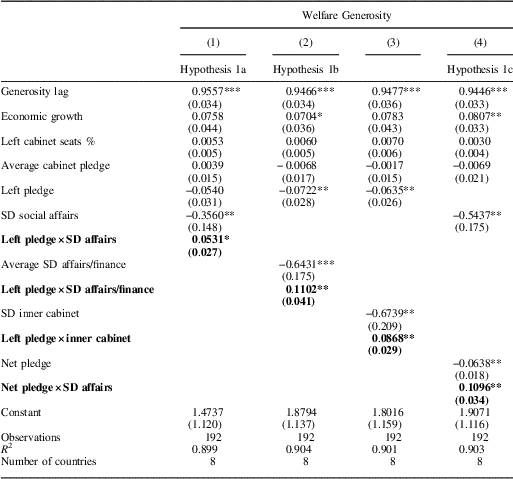
Equations 1–6 of Table 1 strongly support our theoretical expectations as derived from the bargaining model. Neither a strong pro-welfare pledge nor the control of the relevant portfolios alone is associated with higher welfare benefit generosity. Social democrats cannot increase welfare generosity when they control the department of social affairs but have made no commitment to expand social welfare. Similarly, when social democrats are in government but do not control the department of social affairs, their commitment to expand social welfare has a small negative effect on welfare state generosity. Perhaps even more surprising is that larger representation of left parties in the cabinet does not increase welfare generosity. Instead and in line with our expectations, the left is associated with higher welfare generosity only when it has made a strong electoral commitment to defend benefits and controls the portfolio of social affairs (Hypothesis 1a), particularly if the party of the finance minister has not pledged to cut benefits (Hypothesis 1c).
Welfare Generosity, Pro-Welfare Electoral Commitments and Social Democrats

Note: All models include country fixed effects.
Robust standard errors in parentheses.
***p<0.01, **p<0.05, *p<0.1.
In Equation 1 of Table 1, we see that the interactive term Social democratic welfare pledge×Social democratic ministry of social affairs is positive and statistically significant, even after controlling for the left’s electoral strength and for the cabinet’s weighted average pro-welfare pledge. This effect is stronger when the left also controls the portfolio of finance as predicted by Hypothesis 1b and shown in Equation 2. However, controlling more portfolios on top of social affairs and finance does not deliver any further benefits, according to Equation 3.
The conditional positive effect of controlling social affairs is considerably stronger when we account for the negative pledges made by finance’s party (Hypothesis 1c). These results are reported in Equation 4. Overall, the largest conditional effects are observed either when the left controls both social affairs and finance, assuming strong pro-welfare commitment, or when the minister of finance has not made a pledge to cut benefits. In fact, the additive effects are stronger when the social affairs minister deals with a “friendly” right of center finance minister than when she deals with a social democrat finance minister. Controlling the portfolio of finance per se is not required or even helpful for increasing welfare benefits, as long as the party that controls finance has not pledged to cut benefits.
We should further note that the added benefit of controlling the portfolio of finance is not as important as it might at first appear. In our sample, the left has controlled the department of social affairs more than three quarters of the time and the portfolio of finance half the time, when in government. Crucially, only half of the time the left has controlled social affairs it has also controlled finance, but when it has controlled finance it almost always has controlled social affairs (89 percent of the time).Footnote 22 Thus, even though being in charge of both the social affairs and finance portfolios increases the left’s policy impact, the effect of controlling the social affairs portfolio alone has significant policy effects, given strong pro-welfare commitments.
One might ask how far away from the cabinet average policy position can the social affairs minister’s party push policy? To answer this question we need to investigate the policy effects of the social democrat minister when her party’s pledge is higher than the average cabinet pledge. Indeed, this is the case in more than 50 percent of all cases in our sample. Our empirical model informs us that if the social democrat minister acts as a perfect agent of the cabinet with an average welfare score of about 6.5, she would increase social welfare benefits by about 0.2 units in the short-run and by 3 units in the long-run, which is equivalent to just under 13 percent increase. If, on the other hand, the social affairs minister follows her party’s pro-welfare commitment (after modifying for finance’s negative commitment) at the average level of 9, she would increase welfare generosity by 0.44 units in the short-run and by 7.3 units in the long-run which is equivalent to about 30 percent increase in welfare generosity.Footnote 23
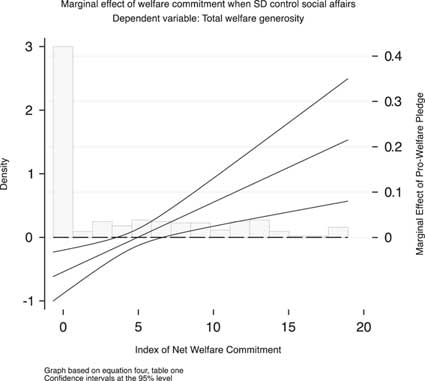
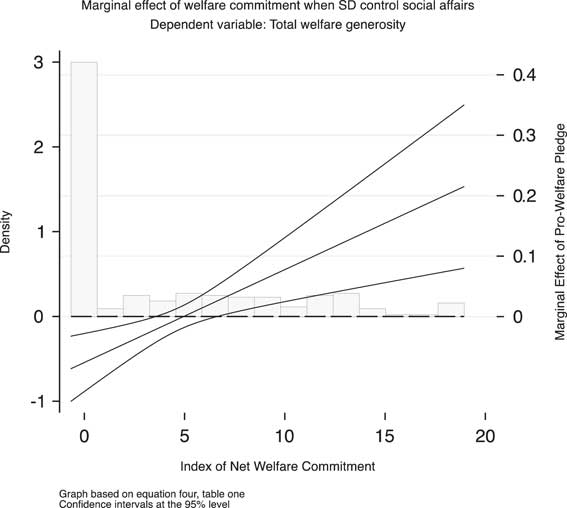
Figure 1 makes clear that controlling the portfolio of social affairs bears no positive changes in welfare generosity unless the net pro-welfare pledge is at average or higher values. Importantly for making inferences, half of the time social democrats controlled social affairs in multiparty cabinets they made strong pro-welfare commitments (on average a value of about 9), while the other half of the time their pro-welfare commitments were on average 3.Footnote 24 To conclude, when the social democrats make a pledge stronger than that of the cabinet and they are not confronted with a hostile finance minister (Hypothesis 1c),Footnote 25 they moved policy away from what it would be under the cabinet’s weighted pledge, independently of party size or the partisan control of the portfolio of finance.Footnote 26
Marginal effects of partisan portfolio control as welfare commitment varies Note: Graph based on Equation 4, Table 1. Confidence intervals at the 95 percent level.
Party ideology, platform commitments and portfolio control are all necessary conditions for policy influence in multiparty cabinets. These effects hold despite controlling for the cabinet’s weighted average pro-welfare commitments. In fact the cabinet’s average pro-welfare commitment has a negative coefficient.Footnote 27 Moreover, these results do not hold for Christian democratic parties, as shown in Section D in the Online Appendix. We believe that this finding further supports our expectation that electoral promises are binding only for highly salient policy issues, when controlling the policy agenda.
Identifying Scope Conditions
How generalizable are the findings of Table 1? To what extent are pledges endogenous to parties’ expectations of fulfilling them, and thus not an outcome of intra-ministerial bargaining?
Our central predictions and findings, that parties’ policy influence is a function of them having agenda control and having made strong electoral commitments have direct implications for parties’ incentives to form strong pro-welfare commitments and control the portfolio of social affairs. Chronologically, parties make electoral commitments, then negotiate over policy and portfolios and finally renegotiate over policy during the life of government. If parties had perfect foresight regarding the government formation process and the state of the economy, they would only make strong pro-welfare commitments and wish to control the portfolio of social affairs when they expect to be in government and, once in government, to follow through with their commitments.
Indeed, the assumptions of perfect foresight are made by Austen-Smith and Banks (Reference Austen-Smith and Banks1988) and Baron (Reference Baron1993) in their seminal works of government formation and policy outcomes in multiparty governments. Yet, voters’ and parties’ perfect foresight is justified by the fact that only three parties compete and any two parties can form a majority coalition. The government that forms consists of the parties with the most and the least votes, hence the final policy outcome is either center-left or center-right. In these models, the final policy outcome is a compromise among the coalition partners, with the largest party having the most policy influence (Austen-Smith and Banks Reference Austen-Smith and Banks1988). Empirically, this means that policy outcomes reflect the cabinet’s weighted average commitments.
Germany met these criteria during the 70’s whereby the three main parties, the Christian democrats (CDU), the social democrats (SPD) and the smaller liberals (FDP) could form two-party majority coalitions. Under these conditions parties should be able to predict fairly accurately their “ideal” pledge given the pledges of the other two parties. Moreover, in such stable coalitional environments parties should predict reasonably accurately their policy leverage as well as the ministerial portfolio allocation, especially in the presence of strong norms on portfolio allocation. Laver and Benoit (Reference Laver and Benoit2015) call these triangular legislative systems, Top-Three Party System legislatures.
Nonetheless only a subset of parliamentary legislatures are triangular (Laver and Benoit Reference Laver and Benoit2015). Pledge formation is less predictable outside well-defined coalitional environments (Laver and Benoit Reference Laver and Benoit2015). In most legislative systems, parties’ chances of entering a coalition might be too hard to predict due to high levels of legislative fragmentation and complexity or due to the presence of a dominant party (Laver and Benoit Reference Laver and Benoit2015). Thus, outside triangular systems, the assumptions that parties have perfect foresight and can freely choose their post-electoral coalition partners have to be relaxed. If parties are less able to predict the post-electoral government formation process, then they might be less likely to tailor their electoral pledges to their expectations. In these situations parties’ optimal strategy is to formulate electoral pledges that are primarily vote maximizing instead of office or policy maximizing.Footnote 28 Therefore, outside triangular systems we can reasonably assume that parties’ pro-welfare pledges are at least partly orthogonal to their ability to influence policy in the future.
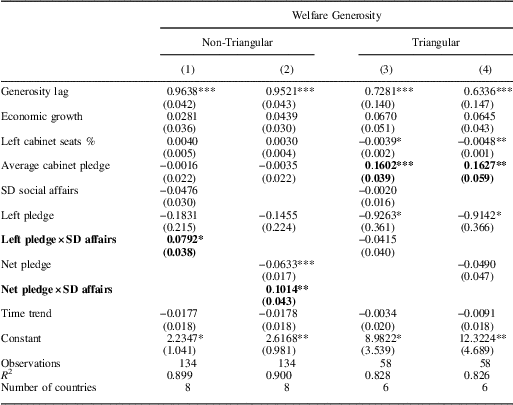
If the legislative environment matters for policy-making processes, then we should find that coalition compromise theories are more prevalent in triangular systems whereas our theory is more prevalent outside triangular systems. We test this expectation in Table 2, where we split our sample to triangular and non-triangular legislative systems. According to Table 2 our findings are replicated outside triangular systems. This is clearly shown in Equations 1 and 2 of Table 2, where we re-estimate estimate Equations 1 and 4 of Table 1. However, and in line with the coalition compromise theories, in triangular systems, the cabinet’s weighted average pledge best explains changes in welfare generosity.
Cabinet Commitments and Portfolio Control Across Legislative Systems

Note: All models include country fixed effects.
Robust standard errors in parentheses.
***p<0.01, **p<0.05, *p<0.1.
DISCUSSION
In this paper, we argue and illustrate that electoral commitments potentially have important policy implications. Specifically, we predict that in a situation where two parties bargain over social welfare policy through their cabinet ministers, the party with the highest audience costs will have the largest policy influence. In turn, parties’ electoral costs are determined by the level of their public commitment made on welfare policy, the saliency of welfare policy to their voters, and whether the party controls the portfolio of social affairs. We test our predictions in eight parliamentary democracies over 40 years and find strong support for our argument. Social democratic parties have been more successful in increasing welfare generosity when they have made a strong pro-social welfare electoral commitment and they controlled the portfolios of social affairs and/or finance. In contrast, party size, portfolio control or strong electoral pledges alone fail to predict policy.
The findings of this paper make a number of important contributions. First, they provide evidence in support of the argument that words matter. Some argue that electoral promises are cheap talk (Schattschneider Reference Schattschneider1942). Yet others have shown that parties in fact follow through with many of their electoral promises (Mansergh and Thomson Reference Mansergh and Thomson2007; Petry and Collete Reference Petry and Collete2009). Our theory identifies the conditions under which parties’ electoral platforms are more likely to matter for policy outcomes in multiparty cabinets. By doing that, we address a cornerstone question of democratic governance, whether electoral commitments matter for policy outcomes and when.
Second, we provide the necessary theoretical tools to understand how and why parties can affect policy. Specifically, existing literature does not provide satisfactory answers as to whether and why the control of specific portfolios enables parties to successfully redeem electoral pledges (Thomson Reference Thomson2001; Mansergh and Thomson Reference Mansergh and Thomson2007; Thomson et al. Reference Thomson, Royed, Naurin, Artes, Costello, Ennser-Jedenastik, Ferguson, Kostadinova, Moury, Petry and Schermann2014). We offer an explanation for the lack of consensus in the existing literature about the policy effects of partisan ministerial portfolios (Laver and Shepsle Reference Laver and Shepsle1996; Becher Reference Becher2010; Goodhart Reference Goodhart2013; Martin and Vanberg Reference Martin and Vanberg2014). We show that controlling the social affairs portfolio is a necessary but by no means a sufficient condition for implementing preferred reforms. Third, by providing a model of policymaking in multiparty cabinets and by putting it to test against existing models of policymaking, we contribute to current research, which, as Strom, Muller and Bergman (Reference Strom, Muller and Bergman2008) point out, has “barely scratched the surface of the issue of coalition governance.”
Our findings suggest that parties are accountable to voters in multiparty cabinets but under certain conditions. Accountability increases when parties control portfolios that deal with salient policies for their core voters. Consequently, parties’ electoral costs also increase when party core voters perceive parties as being responsible for adopting policies that go against their electoral promises on salient issues. Thus, diffusion of responsibility and blame sharing (Powell and Whitten Reference Powell and Whitten1993) does not have to be as successful as often thought in multiparty cabinets.
Importantly, we reconcile the conflicting findings in the literature regarding the best model of policymaking in multiparty cabinets. We show that coalition compromise theories are the best model of policymaking in triangular party systems but not in the more complex decentralized legislative systems or in systems strongly dominated by one party. Thus, our findings complement recent findings by Martin and Vanberg (Reference Martin and Vanberg2014). Finally, our results have important implications for the study of strategic portfolio allocation (Fernandes, Meinfelder and Moury Reference Fernandes, Meinfelder and Moury2016) as well as the strategic delegation of cabinet ministers in multiparty cabinets (Alexiadou Reference Alexiadou2016).