The definitions of Indigenous people are many and at times difficult to conceptualize due to their distinctive cultures relative to the dominant epistemic civilization prior to colonization having distinctive cultural traditions and even tribal languages and dialects (Battiste & Henderson, Reference Battiste and Henderson2009; Gravelle, Reference Gravelle2000; Mehta, Alter, Semali, & Maretzki, Reference Mehta, Alter, Semali and Maretzki2013). Subsequently, they are referred to as the natives of a region prior to colonization having special registers of births to record those accordingly as Indigenous people. In Fiji, the register is known as The Register of Births or Vola Ni KawaBula in accordance with the Government regulations (Ministry of iTaukei Affairs, 2011). As such, the Indigenous people in Fiji are known as the iTaukei, whereas the decedents of the Indians who were brought in Fiji from India by the British are commonly known as Fijians (Indo-Fijians or non-iTaukei) as all citizens of Fiji are known as Fijians.
Background and Context
Fiji lies in the centre of the Pacific Ocean midway between the equator and the South Pole. Fiji is formally known as the Republic of Fiji. There are over 300 islands and has a total land area of 18333 square kilometres and spread over about 1.3 million square kilometres of the South Pacific Ocean. Fiji became independent in 1970, after nearly a century as a British colony. Democratic rule was interrupted by two military coups in 1987, and a new constitution was promulgated that favoured Indigenous Fijians having political supremacy in Fiji, which led to an exodus of Indians to other countries (Ministry of Information, 2006/7). However, the political upheavals did not cease and another coup took place in 2000, but life could not normalize when another coup took place in 2006. The Military under the advice of a military council ruled Fiji until the elections were held on 17th September 2014. Fiji now has a new constitution that is crafted to put Fiji on track to become a modern and advanced nation in the South Pacific (Sayed-Khaiyum, Reference Sayed-Khaiyum2014).
Setting and Location
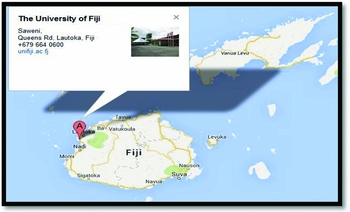
The University of Fiji is located about 16 kilometres from Nadi International Airport and about 8 kilometres from Lautoka City on the main island known as Viti Levu (Figure 1). The University of Fiji was established in December 2004 by the Arya Pratinidhi Sabha of Fiji and opened its doors to students in March 2005 (The University of Fiji, 2014).
Map of Fiji showing the location of the University of Fiji (https://maps.google.com/maps).

The University of Fiji is in its tenth year of operation and is one of the main providers of tertiary education in Fiji. The workplace is becoming more and more competitive, and tertiary qualifications are now a basic requirement for securing good jobs. More so, tertiary education leads to the expansion of knowledge and the development of industry-related skills (Doval & Doval, Reference Doval and Doval2009). Currently, the University of Fiji offers a multitude of courses and programmes in different disciplines and is proud to have a Centre for Indigenous Studies or commonly known as the Centre for iTaukei Studies (CIS). The Centre's programmes aim at examining topics and activities that will encourage cultural integration, interaction and a sense of inclusiveness among the different ethnic communities in Fiji.
Aim and Significance of the Study
The conundrums faced in promoting research and developments in Indigenous studies are manifold. Given that, the assumption is that Indigenous studies are vital to gain better perspective and understanding of the feelings and aspirations of the iTaukei people. As a result, the aim of this study is to explore the role of the CIS in promoting and preserving the Indigenous cultural and traditions norms and practices. The study also investigates how and why the CIS has taken an Indigenous academic perspective towards the dissemination of iTaukei language and culture. Finally, the study tries to examine the fine threads of commonalities that exist between Indo-Fijians and them in co-existing together for over a century despite the previous political upheavals in the country.
The prime significance of this study is its contribution towards local literature in regards to activities promoting and enhancing iTaukei language and traditions. iTaukei people have an implicit belief that the accumulated and constantly refined wisdom of their ancestors and the elders in their communities has enabled their cultures to survive for millennia. The findings will also be of value to the Ministry of iTaukei Affairs and the Ministry of Education in Fiji. They may realize the importance of the programmes and services provided by the CIS and provide appropriate funding and grants for the establishment of a separate building reflecting Indigenous architectural structure and design. The study will also assist the curriculum planners at the Curriculum Advisory Section (CAS) of Fiji to better understand the role of CIS in preparation of curriculum materials that could be used in the school system.
Findings will also provide valuable information to the Fiji Higher Education Commission in recognizing the important role CIS plays in providing quality education to the iTaukei students while maintaining their rich cultural identity at the University of Fiji. Findings will no doubt contribute towards reviewing of the role of the CIS so that its course offerings are more pertinent to the objectives of its establishment. Literature on Indigenous knowledge also concurs that the best approach to learning and Indigenous knowledge is in the linguistic foundations of Indigenous frameworks and paradigms (Battiste & Henderson, Reference Battiste and Henderson2009; Doxtater, Reference Doxtater2004; Mehta et al., Reference Mehta, Alter, Semali and Maretzki2013). This study will highlight the infusion of the cultures of the iTaukei people and that of the Indo-Fijians, who have co-existed together for over 100 years and how they have shaped the unique multicultural landscape in Fiji.
Relevant Literature
The article 14 of the United Nations Declaration on the Rights of Indigenous Peoples (United Nations, 2008) affirms that:
Indigenous peoples have the right to establish and control their educational systems and institutions providing education in their own languages, in a manner appropriate to their cultural methods of teaching and learning (p. 7).
Based on the above premise, this section presents some pertinent literature in regards to issues relating to Indigenous people and their knowledge, cultures and traditional practices.
While Indigenous people have the right to their lands, territories and resources, often literature mentions their gradual elimination and eviction by governments (Greenwood & Leeuw, Reference Greenwood and Leeuw2007; McGregor, Reference McGregor2003). Land is a pressing issue for many Indigenous communities in the world. Literature discloses that in Malaysia the introduction of legislation concerning land has ignored the customary rights of the Indigenous communities, while the Kavet in Cambodia are affected by the devious political circumstances (Gamage, Reference Gamage2001). It must be established that Fijian indigeneity and associated issues may be different from Maori or Hawaiian indigeneity as they all experienced colonialism and cultural transformation in rather different fashion from those who retained authority over their lands. This paper neither tries to ascertain nor refute this belief as further comparative study can be done in this regard. This study basically explores the role of an Indigenous institution in promoting and preserving the Indigenous cultural and traditions norms and practices.
Subsequently, in Fiji the Ministry of iTaukei Affairs ensures that the Government develops, maintains and promotes policies that provide for the continued good governance and welfare of the iTaukei now and in the future (Ministry of iTaukei Affairs, 2011). The Ministry of iTaukei affairs has embarked on a number of initiatives to preserve and promote language and culture. The iTaukei Institute of Language and Culture based within the Ministry promotes the iTaukei language and culture and has produced and published the first ever iTaukei monolingual dictionary to be used in schools and by the general public (Ministry of iTaukei Affairs, 2011). According to Sillitoe (Reference Sillitoe1998), these types of provisions enable researchers to better understand the ethical dilemmas when conducting research in Indigenous studies.
It has been extensively documented that research in Indigenous studies is growing especially in areas of Indigenous languages, world views and experiences (Aseron, Wilde, Miller, & Kelly, Reference Aseron, Wilde, Miller and Kelly2013; Bandias, Fuller, & Larkin, Reference Bandias, Fuller and Larkin2014; Battiste & Henderson, Reference Battiste and Henderson2009). Indigenous knowledge is an emerging field of inquiry globally mainly for those interested in educational innovation and change. Indigenous science, arts, trading and exchange reflect the ecologically centred way of living and a sustainable humanity (Battiste & Henderson, Reference Battiste and Henderson2009). The University of Fiji through the CIS advocates collaborative learning practices through storytelling and creative arts. It is able to use ‘talanoa’ sessions quite effectively as it means solving issues through discussions and dialogues.
Talanoa is an Indigenous word and is referred as a conversation, a talk or an exchange of ideas usually without formal settings in the Pacific (Halapua, Reference Halapua2002; Otunuku, Reference Otunuku2011; Vaioleti, Reference Vaioleti2006). Talanoa sessions have been successfully used as data-gathering tools in form of in-depth interviews as many Pacific customs and rituals are transmitted verbally (Ali, Reference Ali2004; Sharma, Reference Sharma2000; Vaioleti, Reference Vaioleti2006). In this case, it was impossible to use talanoa as the respondents were scattered all over remote and rural places and it was not possible to get all the respondents at one place at a given time. Moreover, Farrelly and Nabobo-Baba (Reference Farrelly and Nabobo-Baba2014) further propose that talanoa could be used as a tool for decolonizing pedagogy and practice. Hence, talanoa can also be used as an effective teaching pedagogy as it is similar to cooperative learning and fosters respect and friendship even among diverse groups of students.
Indigenous academic perspective acknowledges the importance of Indigenous pedagogies in their diverse forms and manifestations. These different forms include oral traditions, community responsibilities and the creation of respect and reciprocity. Similar to that of the iTaukei Centre at the University of Fiji, the Faculty of Education at the University of Victoria (UOV) has programmes that honours Indigenous peoples, their cultures and ways of transmitting them from one generation to another (De France, Reference De France2013). Objective 19 of the Faculty of Education's Strategic Plan according to DeFrance (Reference De France2013) is ‘to strengthen the faculty's capacity to create an environment welcoming of Indigenous peoples and their ways of knowing and being’ (p. 87). Based on this premise, the Faculty offers various courses and programmes in Indigenous studies.
Following a successful launching of a number of programmes, the Faculty of Education at the UOV approved a new Bachelor of Education programme (BEd) on Indigenous language revitalization. This programme provides opportunities for students to strengthen and support the development of Indigenous knowledge, languages and cultures. According to DeFrance (Reference De France2013), the BEd is a laddered programme delivered with a strong focus on building of fluency and analytical skills in linguistics and curriculum development. However, DeFrance (Reference De France2013) agrees with Wilson (Reference Wilson2008) that there are challenges in teaching Indigenous students due to the ‘western paradigms of expectations and obligations within academic life’ (p. 92). As such, lecturers and teaching staff need to have an understanding of the cultural obligations and awareness and appreciation of their cultural responsibilities.
Consequently, a better understanding of these responsibilities in turn can inform the educational pedagogies from an Indigenous perspective. There is ample evidence that Indigenous perspectives enable students to uncover and reflect upon their cultural narratives through assignments and group activities (DeFrance, Reference De France2013; Greenwood & Leeuw, Reference Greenwood and Leeuw2007; Hill & Arlene Holland, Reference Hill and Arlene Holland2002; Mehta et al., Reference Mehta, Alter, Semali and Maretzki2013; Otunuku, Reference Otunuku2011; Sillitoe, Reference Sillitoe1998). Discourse on the challenges and perceived solutions in regards to Indigenous education have been many and have brought together educators, historians, social scientists and academic researchers (Aseron et al., Reference Aseron, Wilde, Miller and Kelly2013). Notwithstanding these efforts, the United Nations (2008) advocated a position whereby Indigenous peoples have been given the right to establish and control their educational processes, making use of their own language in a manner appropriate to their cultural methods of teaching and learning.
Considering the importance of language and cultural obligations, the Indigenous community in Australia achieved a milestone towards the beginning of this millennium when they opened doors to the first Indigenous university in the Northern Territory. The foundations of Batchelor Institute of Indigenous Tertiary Education was laid down in late 1960s as a small part of Kormilda College, providing programmes for Aboriginal teacher aides and assistants in community schools. Although most Australian universities have special centres for Indigenous studies programmes, Maslen (Reference Maslen1999) is optimistic that having an institution fully managed by the Indigenous people will no doubt enhance Indigenous inspirations, cultural ceremonies and languages. Having discussed pertinent literature regarding Indigenous studies, the following sections present the methodology implemented in this study.
Research Methodology
Consistent with contemporary social and educational research, this study was conducted in an interpretive paradigm. The interpretive paradigm is characterized by an ontology of realism, and suggests that human behaviour is essentially rule-governed and can be investigated by the methods of natural science (Lincoln & Guba, Reference Lincoln and Guba1985). Subsequently, a mixed method was adopted for this research to build on the strengths of both quantitative as well as qualitative methods (Creswell & Clark, Reference Creswell and Clark2007). In the context of this research, methodological triangulation was achieved by combining input from qualitative data obtained from interviews with quantitative data from student enrolment and graduation statistics for the period 2010–2014 inclusive. The study adopts a case study design using mixed method approach.
Interviews and Textual Data
Semistructured interviews were used, as this allowed flexibility in asking follow-up questions and seeking clarifications whenever responses were not clear. Appropriate prompts were provided to elucidate answers when deemed necessary. Reinharz (Reference Reinharz1992), for example, notes that the use of semistructured interviews provides better access to informants’ ideas, thoughts and memories. This understanding led to the selection of semistructured interviews to be conducted in this study together with the analysis of textual data. According to Rose and Webb (Reference Rose and Webb1998), public records, personal documents and physical materials are three major types of documents available to researchers for analysis. As stated earlier, it was not possible to use talanoa as a data-gathering tool due to administrative reasons, and there is ample evidence of literature where researchers have used mainstream social science methods and analysis to a context while attempting to explore Indigenous knowledge and approaches (Aseron et al., Reference Aseron, Wilde, Miller and Kelly2013; Bandias et al., Reference Bandias, Fuller and Larkin2014; Battiste & Henderson, Reference Battiste and Henderson2009).
Sampling Strategy
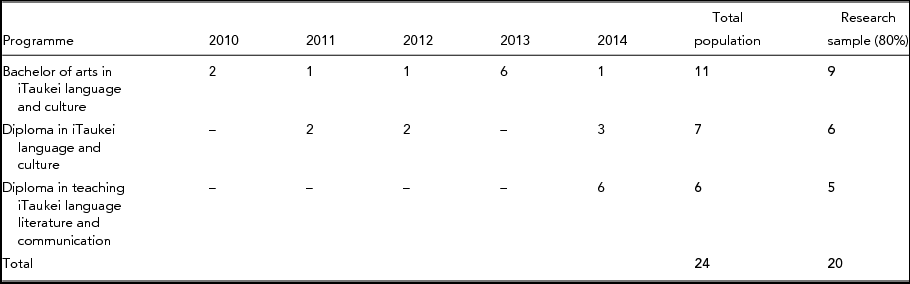
Selecting a research sample is a pressing issue frequently raised by researchers. According to Fraenkel & Wallen (Reference Fraenkel and Wallen2006), researchers are always concerned with what can be labelled as an adequate size for a sample especially in qualitative research. Due to work and time constraints, it was impracticable to interview all the students as some of them were school teachers teaching in schools that are scattered and situated in rural and remote areas. Literature supports that it is ‘very difficult for a single researcher to be involved in more than 100 long and complex social interactions’ (Minichiello, Aroni, & Hays, Reference Minichiello, Aroni and Hays2008, p. 174). Thus all four of the staff members and a manageable sample of 20 students (80% of the total population) were purposefully selected because interviewing is time-extensive research (See Table 1).
Student Population and Interview Research Sample

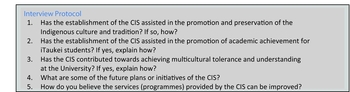
Sample selection method is an aspect of the interpretive paradigm which ‘relies upon purposeful rather than representative sampling’ (Lincoln & Guba, Reference Lincoln and Guba1985, p. 102). Moreover, purposive sampling is ‘very different from conventional sampling. It is based on information, not statistical considerations. Its purpose is to maximise information, not facilitate generalizations’ (Lincoln & Guba, Reference Lincoln and Guba1985, p. 202). Teddlie and Tashakkori, (Reference Teddlie and Tashakkori2009) agree with the views expressed by Lincoln and Guba (Reference Lincoln and Guba1985) and further state that purposive sampling is typically associated with ‘selecting a relatively small number of units because they can provide particularly valuable information related to the research questions’ (p. 25). Nonetheless, 80% is a good representative of the total population. Subsequently, a set of interview protocols were developed for the staff and the students. Figure 2 shows the questions that were asked during the interviews:
Interview questions.

Similarly, ethical issues were taken into consideration throughout the course of this study. The participants have not been identified in order to maintain confidentially and anonymity of the participants. To further maintain the ethical practices, relevant information such as the aim and the purpose of the study were communicated well in advance to the participants of the present study while the pictorials used have been duly acknowledged.
Findings and Discussion
The statistical information was systematically analysed while the qualitative data was analysed using thematic approach using coding after transcribing in its entirety resulting in emerging themes. Coding, categorizing and concept identification made the reporting of the data more meaningful and comprehensive. Seemingly, as suggested by Yin (Reference Yin2003) all care was taken to ensure that appropriate interpretation of the information and techniques used in data analysis process were of the highest quality.
Demographic Overview
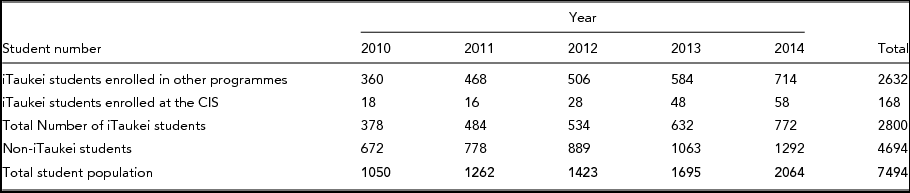
The trend in the iTaukei student population at the University shows a gradual increase over the years. A lot of iTaukei students are enrolled in other programmes offered by the University. Although the numbers of students enrolled in the programmes offered by the CIS are quite low as shown in Table 2, it does show a subtle increase from 2011.
Number of iTaukei Students Enrolled in at the University of Fiji

The data provides valuable conventional information for the CIS as it needs to be more marketable and maybe offer more attractive programmes and also be prepared to meet an influx of students in time to come. Programmes and courses offered by the CIS would be discussed in detail in the forthcoming sections.
Programme Structure for CIS
An important precursor to this current study is the recognition that not much of the existing research conducted to date perpetuates a recurring theme towards a deficit view of the ITaukei students in tertiary institutions in Fiji (Sillitoe, Reference Sillitoe1998). Although this study does not in any way supports or refutes a deficit view to this participation, a lingering sense of the drivers for research in this area is needed. The CIS offers three distinct programmes of study. Apart from preparing teachers, CIS graduates enjoy careers akin to iTaukei administrators, interpreters in courts, tour guides, translators of books and legal documents, reporters and journalists. The Prime Minister, Commodore Voreqe Bainimarama, while opening the Umanand Prasad School of Medicine (UPSM) on 24 October 2009 at the University of Fiji acknowledged that:
With two campuses, five academic schools, and Centres of Excellence such as the Centre for International and Regional Affairs, and the Centre for iTaukei Studies, the University has truly come of age. I am particularly pleased with the pioneering work done by the staff of the Centre for Indigenous Studies in the promotion of written resources and literature in vosa vakaviti. The objectives of the Centre are admirable and worthy of our support. (Uluinakauvadra, Reference Uluinakauvadra2011)
The above comments made by the Prime Minister of Fiji speak volumes about the CIS as a major stakeholder in the study of iTaukei language, culture, society, economy and leadership. The following sections discuss programmes and perceptions of students and lecturers in regards to the three programmes offered by the CIS.
Diploma in iTaukei Language and Culture
This is a basic programme in the study of iTaukei Language and Culture. One of the interviewees stated during the interviews the ‘courses provided in the Diploma in iTaukei Language and Culture were very helpful and assisted me in my work as tourist guide’ (P3, 2014). The letter ‘P’ represents the participant and the number denotes the third participant followed by the year of research whereas ‘L’ represents a lecturer. Students responded as follows in regards to programmes and how they could be improved:
In this program there is a whole course on promoting cultural practices, like cooking and preserving of food. This course teaches us the importance of preserving our culture so that the information can be passed on to the new generations. Having practical sessions will be better in future (P14, 2014).
While another participant who works as a tour guide recounts his experiences as follows:
The best aspect of this program is on ceremonies and iTaukei protocols. As a tour guide, it has enabled me to perform my duties well. The tourists are very happy with my explanations and often I am given a lot of tips but inclusion of some conversational Hindi would be better (P15, 2014)
The Diploma in iTaukei Language and Culture equips students with knowledge and skills required for a better understanding of the iTaukei culture and tradition. This creates a better understanding and an appreciation of the various customs and traditions of the iTaukei people.
Diploma in Teaching iTaukei Language, Literature and Culture
This is a teaching programme that prepares students to a life of teaching in secondary schools in Fiji. One of the interviewees, who is teaching in a village school considered it to be:
A good program with good content making future teachers know about the teaching methods. As a teacher now, I can reflect and say the teaching experience sessions I had was great. Maybe the practical sessions could be increased so that we could get more experience (P9, 2014).
The courses discuss what is generally understood as the three main teaching styles in educational pedagogy: direct instruction, inquiry-based learning and cooperative learning. Through these three teaching methods, teachers can gain a better understanding of how to govern their classroom, implement instruction and connect with their students.
Bachelor of Arts (with a major in iTaukei Language and Culture)
The Bachelor's degree is the highest level of academic qualification offered by the iTaukei Centre. Students complete a set of prescribed courses together with certain compulsory courses to get double majors in iTaukei and English language and literature. While responding to the question regarding how the programmes could be improved one of the interviewees contemplated that:
It is time the CIS should be offering double majors which a special course in Fiji Hindi. This will help us in teaching both iTaukei and non-iTaukei students in our classes. This will be good for our promotions (P11, 2014).
It is overwhelming to note that the CIS is intending to offer a double major programme from 2017. The Director of the CIS stated that the double major will explore a range of contemporary issues affecting iTaukei peoples' life experiences and aspirations.
Research in iTaukei Language and Culture
The CIS is involved in researching into the iTaukei way of life. Analytical analysis shows that research has been done in a nearby village. Findings further reveal that the research undertook the collecting and documenting oral iTaukei histories, including relationship ties, social structures and those between people and the physical and spiritual environment. There is ample literature to support the views that Indigenous knowledge in its diverse forms and manifestations can inform academic perspectives and practices through different forms (Battiste & Henderson, Reference Battiste and Henderson2009; De France, Reference De France2013; Mehta et al., Reference Mehta, Alter, Semali and Maretzki2013). The CIS intends to become a leader in providing quality education in Indigenous knowledge and practice within traditional and contemporary contexts.
Written iTaukei Resources
Recognizing the need to have written materials in iTaukei for use in tertiary studies, CIS has embarked on translating relevant books in iTaukei language. Subsequently, they have also identified topics on which short stories can be written that can be used as texts by iTaukei students in primary and secondary schools. The CIS intends to venture into writing but is affected by lack of financial as well as qualified iTaukei staff members. One of the lecturers lamented the lack of resources and staff to fully implement the writing process. It is not that qualified personnel are not available, but the University's financial position inhibits recruiting more staff members to undertake writing iTaukei texts and prepare other teaching and learning resources. Adding up to the setbacks, one of the lecturers raised her concerns as follows:
There are fourteen confederacies in Fiji with different dialects, cultural practices and art and craft. Courses need to be redefined so that more areas in indigenous culture and tradition can be studied. It is a rich and complex culture that needs more written records with comprehensive research (L2, 2014)
Written texts play a very important role in the lives of the iTaukei people, and this view is strongly endorsed by Hill and Arlene (Reference Hill and Arlene Holland2002) who argue that language provides inroads into peoples’ feelings and cultural ethos that are best conveyed in one's own language. Understanding cultural attitudes, tribal protocol, and sensitivity to native issues takes years and they need to be captured in textbooks and educational videos that could be used as educational resources in Fijian schools.
Promotion and Preservation of iTaukei Culture and Tradition
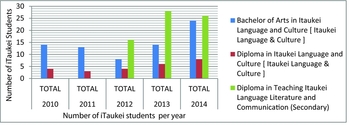
One of the most exciting aspects of historic preservation today is the way in which native peoples are seeking to protect their culture and tradition. Figure 3 shows the number of students enrolled in the different programmes offered by the CIS over a period of five years.
Student enrolments as per the different programmes.

The data reveals that although CIS is a small unit at the University, it is slowly making its impact in regards to the promotion and preservation of the iTaukei culture and tradition. The number of students enrolled in all the three academic programmes shows a gradual increase, while Diploma in teaching iTaukei Language, Literature and Culture seems to be well taken by the students. According to one of the staff members:
The mission of CIS is to promote intrinsic values through lectures, research and workshops on indigenous culture and tradition. Engaging and involving students to take part in cross cultural programs and activities promotes better understanding amongst all students (L2, 2014)
While one of the graduates who seemed pleased with the programme affirmed that:
The courses offered by CIS require students to do assignments that need us to go into villages and do surveys and study protocols during traditional ceremonies. We are given group works where we are required to plan and imitate official protocols like the yaqona ceremony (P17, 2014).
The drinking of yaqona has integrated into the many functions of the non-iTaukei people in Fiji and abroad wherever people of Fiji have settled in. This has enabled a better understanding and tolerance amongst all people and now it is common in non-iTaukei weddings to watch non-iTaukei performers doing meke and fire dances. There is substantial research evidence that support the view that culture and traditions of the Indigenous people are essential to the renewal and revitalization of the Indigenous knowledge that can be transmitted through ceremonies, songs, stories and dramatic representations (Aseron et al., Reference Aseron, Wilde, Miller and Kelly2013; Bandias et al., Reference Bandias, Fuller and Larkin2014; Battiste & Henderson, Reference Battiste and Henderson2009; Greenwood & Leeuw, Reference Greenwood and Leeuw2007; Maslen, Reference Maslen1999; Ward, Reference Ward2011). Quantified data derived from interviews show that most of the students (90%) strongly agree that CIS has been able to actively promote and preserve the iTaukei culture and traditions and create a better relationship with all others.
Promotion of Academic Performance
Improving academic performance is an important means by which individuals can realize their full potential and make positive, informed choices about their lives. Research shows that unless Indigenous students learn about the forces that shaped their history, their values, customs and language, they will never be able to know their self-potential and CAS tries to honour these through its programmes (De France, Reference De France2013). One of the lecturers made the following comment in this regard:
All our graduates are employed in primary and secondary schools in Fiji. Many of the graduates have indicated their wish to further their studies to postgraduate level while the Diploma graduates are eager to complete their degree programs. Diploma graduates from other tertiary institutions are pursuing the UniFiji iTaukei program for better recognition in the employment sector (L1, 2014).
On a similar note, one of the graduates made the following observations that are in alignment with the comments that follow:
All my colleagues who graduated have been absorbed in the civil service. They have better grades in iTaukei courses as compared with the grades they achieved in other subject majors. (P5, 2014)
As stated above, analytical findings reveal that iTaukei students enrolled at CIS are more academic oriented and complete their studies with good grades. Analytical data further reveals that there are fewer iTaukei at risk students at CIS as compared to those enrolled in other programmes of studies. It can be unequivocally stated that CIS has played a positive role in establishing a high standard for the students who are enrolled in its programmes.
Promotion of Multicultural tolerance and Understanding
Raising tolerance for people of different ethnic and racial groups is one of the goals of the CIS. Literature on multiculturalism reverberates that effective intercultural communication is critical to the establishment of favourable intergroup relations (Tien & David, Reference Tien and David2011). Subsequently, the CIS offers a number of crosscultural activities that involves iTaukei students as well as Fijian students. However, the CIS does not offer any conversational courses in Hindi language, and this has been raised by majority of the students during the interviews. Following are two comments that establish the position of CIS in relation to the promotion of multicultural tolerance and understanding in the midst of the university community:
The CIS has involved the students and staff in organizing multicultural activities for the University and in this manner we have created an atmosphere of multicultural tolerance and understanding that collaboratively breeds a multicultural harmonious society (P4, 2014).
Similar sentiments were shared by one of the staff members:
Most of the cultural functions at the University are organized by the CIS. The CIS has always encouraged other cultural groups to participate in functions that in turn contributes to understanding of others cultures and builds tolerance and better communications (L4, 2014).
Tien and David (Reference Tien and David2011) further assert that communication is the heart of all human relationships and sincere intercultural communication, people regardless of group or cultural orientation, can work together to achieve great things. Activities like celebrating Diwali, which is an Indian festival of lights, has helped in shaping the multicultural landscape in Fiji creating tolerance and better understanding amongst all people. This suggests a possible relationship between tolerance and intercultural communication, which can be furthered explored by expanded study, and analysis by academics is recommended.
Future Initiatives of CIS
The rich cultural practices, knowledge systems and cultural expressions of the iTaukei people are a source of great strength, resilience and pride. Strong cultural identity is fundamental to Indigenous health and social and emotional wellbeing. Initiatives that strengthen Indigenous culture are therefore important to the CIS and as such, it also has a few future plans:
Special Building for CIS
The CIS is currently based in a small room that houses two staff members. The CIS operates from this office, while two other staff members are located in an adjacent office. Lectures and preparation of cultural items are held in normal lecture rooms. The CIS is looking for funds to establish a building of its own where it can fully offer all the courses and set it up depicting a truly iTaukei environment. One of the staff members claimed that:
Having a special building with indigenous architectural design will look better and entice more students to enrol in our courses. It will be more spacious and we will be able to display our arts and crafts (L2, 2014).
While one of the students had the following to say:
As a student, I think there should be a building in shape of a bure where we can have all our classes. Also here we can be taught meke and weaving of mats. We also need a kitchen where we can learn how to prepare vakaloo (puddings). In doing so we can know what we learn in our iTaukei classes (P18, 2014).
Universities that offer Indigenous studies globally have special centres well equipped with amenities required to host and deliver relevant programmes (Bandias et al., Reference Bandias, Fuller and Larkin2014). For example, The University of New England has the Oorala Aboriginal Centre, which is a teaching, research and study support centre for internal and external Aboriginal and Torres Strait Islander students. They offer academic advice, tutorial assistance, have a computer room, a resource library, tutorial rooms and a student common room for relaxation and study. The CIS at the University of Fiji looks forward to having a similar centre where all the services can be located in one building. In doing so, CIS will value and respect the Indigenous knowledge systems as a vital part of the knowledge capital of Fiji.
Dance and Cultural Group
The CIS further intends to set up a unit or a dance group that would be well trained and could perform at many of the tourist hotels and resorts in the western division. According to one of the lecturers (L3, 2014) ‘this could be an income generating exercise for the CIS at the same time they would market the CIS and the university.’ There is plethora of literature supporting the views that Indigenous culture and tradition needs to be preserved and protected not only for the sake of identity but also these attributes can contribute towards self-employment and a decrease in abuse, neglect, and undue indulgence in criminal activities (Aseron et al., Reference Aseron, Wilde, Miller and Kelly2013; Bandias et al., Reference Bandias, Fuller and Larkin2014; Battiste & Henderson, Reference Battiste and Henderson2009; De France, Reference De France2013; Greenwood & Leeuw, Reference Greenwood and Leeuw2007; Maslen, Reference Maslen1999; Sillitoe, Reference Sillitoe1998; United Nations, 2008).
Handicraft Centre
The iTaukei people have a rich heritage in crafts and skill. The CIS believes that there are many wood carvers and mat weavers in nearby villagers who can be temporarily employed to teach these skills to our students. Similar to the Fijian context, subsequent literature purports that although Aboriginal community art centres are not conventional businesses they fulfil important socio-cultural and training functions in addition to their commercial activities (Wright, Reference Wright2000). One of the lecturers declared his intentions as follows:
We aim to create a creative arts course where apart from just learning the culture and traditional protocols, students are able to get hands on training in things like weaving and wood carvings. This will be a great initiative as students will be able to progress academically and also gain skills where their traditions and cultures are being brought back to life (L1, 2014)
Subsequently, CIS intends to venture into commercial paintings, weaving and flower arrangements in an attempt to empower even village people with entrepreneurial skills. Options would be provided to students and prospective adults (schools leavers), so that they could work according to their knowledge and ability to learn appropriate skills. The iTaukei people have preserved many of their traditional stories and legends through paintings (Ministry of iTaukei Affairs, 2011).
Building Capacity of Indigenous Staff
The CIS staff members unanimously agreed that they all needed capacity strengthening in the areas of iTaukei studies. They believe they all need professional development in specific areas of Indigenous knowledge and culture. Findings fully support the argument by Maslen (Reference Maslen1999) that well-qualified indigenous staff will be able to better support the students and will no doubt enhance Indigenous inspirations, cultural ceremonies and languages. According to empirical data, capacity building in Indigenous people also improves the governance which, in a cyclical process of improvement, is the precursor to capacity strengthening for further sustainable development (Tsey, McCalman, Bainbridge, & Brown, Reference Tsey, McCalman, Bainbridge and Brown2012). Providing staff with opportunities to improve and strengthen their abilities and knowledge will be an investment for the University at large.
Reviewing of Services and Programmes
Most of the students (85%) were happy with the programmes offered by the CIS, while a few suggested that conversational Hindi should also be offered. Some of the students raised concern in regards to the lack of crosscultural activities organized by the CIS. One of the students (P6, 2014) stated that ‘we only have cross cultural activities when we have some functions, like the creative circle at the University but we need to have more.’ Creative Circle is one such event that allows students to celebrate the richness in diversity through a variety of crosscultural activities. It provides opportunities for students to display their talents and take part in crosscultural activities such as art and craft, dance and music.
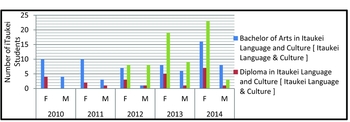
In sum, it appears that most of the students enrolled in various programmes are mostly Indigenous females (See Figure 4). While this disparity does not in any way affect the scope of this study, it does leave room for assumptions and further interpretations.
Student enrolments as per gender and year.

The disparity in gender may be attributed to the current offering of the programmes and courses. While this research neither intends to claim nor refute this proposition, it believes offering programmes requiring more hands on tasks may be more appealing and engaging for the male students. Similar views are shared by Battiste and Henderson (Reference Battiste and Henderson2009) who strongly consider that promising practices in Indigenous knowledge will succeed when aspirations of the students are taken into consideration. Subsequently, CIS anticipates reviewing its programmes and course offerings in time to come.
The single greatest remedy to the issues discussed so far involves unbiased recognition of the CIS as the premier centre for not only preserving and promoting iTaukei culture and traditions but also for encouraging excellence in education by stakeholders, Ministry of iTaukei Affairs, Ministry of Education Culture and Heritage and other social service organizations in Fiji and abroad. In a subtle way, the CIS has contributed a lot towards developing an inclusive and united Fiji but has the scope to offer a lot more. It requires a productive learning environment for its students and adequate resources to fully showcase its capabilities and products. It is high time the true value of CIS is recognized and assisted so that it becomes a full-fledged centre with well-equipped facilities to fully deliver the initiatives as discussed earlier.
Conclusion
Due to the relatively small nature of the CIS at the University of Fiji and a manageable research sample, one should proceed with caution when seeking to extrapolate findings from this research across other such institutions. The degree of fit between a sample and the target population about which generalizations can be made is a common challenge in many studies (Minichiello et al., Reference Minichiello, Aroni and Hays2008; Rhodes, Bowie, & Hergenrather, Reference Rhodes, Bowie and Hergenrather2003). However, this research provides a strong foundation for further research and could extend the scope of investigation in the domain of Indigenous education and research incorporating Indigenous knowledge and approaches in Fiji and abroad.
This paper attempts to offer an overview of the courses and programmes regarding iTaukei language and culture offered by the CIS. While the paper is more informative in nature about Indigenous pedagogies and practices, it has revealed a holistic interpretation of the various courses, programmes and activities offered by an Indigenous learning centre. It seems, then, that despite being small in nature the CIS has made its impact not only on the lives of the iTaukei students but also the community at large at the University of Fiji. With the many initiatives in the pipeline and with support from the university, well-wishers and external funders, I am confident that the CIS will become a centre of attraction and excel in years to come.
Acknowledgments
This research paper was made possible through the help and support from the staff and graduates from the Centre for iTaukei Studies and in essence, all sentient beings. Especially, please allow me to dedicate my acknowledgment of gratitude towards the following significant advisors and contributors: Joji Uluinakauvadra, the previous Director of CIS for providing the historical information; Shelly Reddy and Sanjai Singh for providing the analytical data. The product of this research paper would not have been possible without all of them. Finally, the views and opinions expressed in this article are those of the author and does not necessarily reflect the views of the University of Fiji.
About the Author
Associate Professor Wahab Ali is the Dean of the School of Humanities and Arts at the University of Fiji. He joined the University of Fiji in 2011 as a Senior Lecturer in Education, and prior to this appointment he served as a Lecturer at the Fiji National University formerly known as the Lautoka Teachers College for six years. He has research interests in educational leadership issues related to good governance and change. Presently, he is coordinating the doctoral programme at the University of Fiji and supervises research students.