

Individuals who have mild intellectual disabilities (MID) often experience social difficulties with regard to interpersonal skills, social responsibility, problem-solving, and adherence to rules (American Association on Intellectual and Developmental Disabilities [AAIDD], 2011; American Psychiatric Association, 2000; Schalock & Luckasson, Reference Schalock and Luckasson2004). There has been an abundance of research concerning social skill interventions with findings that have relevance for students who have MID (Gresham, Sugai, & Horner, Reference Gresham, Sugai and Horner2001; McConnell, Reference McConnell2002; Reynhout & Carter, Reference Reynhout and Carter2011; Vaughn et al., Reference Vaughn, Kim, Morris Sloan, Hughes, Elbaum and Sridhar2003; Wang & Spillane, Reference Wang and Spillane2009). However, there is a limited body of research concerning the specific use of strategies to develop the social skills of students who have MID, let alone their participation in the planning and co-construction of such strategies.
Reviews of social skill interventions that have been conducted with students who have special needs reveal that some intervention features are more effective than others. For example, Vaughn et al. (Reference Vaughn, Kim, Morris Sloan, Hughes, Elbaum and Sridhar2003) revealed in their synthesis of social skills intervention research that interventions that clearly target, prompt and allow for the rehearsal of specific behaviours are more likely to be associated with positive social outcomes for preschool children with disabilities. This finding is consistent with the outcome of Gresham et al.'s (Reference Gresham, Sugai and Horner2001) analysis of intervention strategies for students with high incidence disabilities, which showed that the most effective social skills interventions consist of ‘modeling, coaching and reinforcement procedures’ (p. 335). Similarly, McConnell (Reference McConnell2002) explained that modelling and prompting procedures increase the social interactions and positive social behaviours of students with autism spectrum disorder (ASD) in the classroom setting. Social skill development strategies that employ these features include Social Stories™ (Gray, Reference Gray2004) and video modelling.
Developing Social Skills
Social Stories
Social Stories are short narratives that ‘describe a situation, skill, or concept in terms of relevant social cues, perspectives, and common responses in a specifically defined style and format’ (Gray, Reference Gray2004, p. 2) that are meaningful for teaching social skills to students with developmental disorders. Social Stories are designed and constructed by a teacher for a student in various formats, including booklets, audiotapes and videos (Gray, Reference Gray2010). Reviews conducted by Reynhout and Carter (Reference Reynhout and Carter2007) and Test, Richter, Knight, and Spooner (Reference Test, Richter, Knight and Spooner2011) caution that although Social Stories are widely accepted as an intervention strategy, there is little empirical evidence to support their effectiveness. Despite Social Stories not meeting the criteria of an evidence-based practice, literature reports favourably on using Social Stories to teach social skills to students who have ASD. The extensive reviews of Ali and Frederickson (Reference Ali and Frederickson2006), Karkhaneh et al. (Reference Karkhaneh, Clark, Ospina, Seida, Smith and Hartling2010), and Reynhout and Carter (Reference Reynhout and Carter2011) suggest that using Social Stories in the field of special education is beneficial and valuable to students. Contemporary studies suggest that such benefits include enhanced favourable social behaviours (Chan & O’Reilly, Reference Chan and O’Reilly2008; Crozier & Tincani, Reference Crozier and Tincani2007; Quirmbach, Lincoln, Feinberg-Gizzo, Ingersoll, & Andrews, Reference Quirmbach, Lincoln, Feinberg-Gizzo, Ingersoll and Andrews2009) and reduced disruptive behaviours (Crozier & Tincani, Reference Crozier and Tincani2007; Ozdemir, Reference Ozdemir2008; Quilty, Reference Quilty2007; Reynhout & Carter, Reference Reynhout and Carter2007).
As Social Stories were originally developed for use with people who have ASD (Gray, Reference Gray2004, Reference Gray2010), there is an absence of research regarding their use with individuals who may not have ASD but who might have social skills difficulties, such as students with MID (Reynhout & Carter, Reference Reynhout and Carter2007). Acknowledging such a gap in the literature, Reynhout and Carter (Reference Reynhout and Carter2006) reason that ‘the efficacy of Social Stories™ in promoting behavior change in children with disabilities other than autism or Asperger's is yet to be substantively researched’ (p. 463).
Video Modelling
Video modelling and video self-modelling are also social skill development strategies that have been reported favourably in the literature (Ayres & Langone, Reference Ayres and Langone2005; Bellini & Akullian, Reference Bellini and Akullian2007; Delano, Reference Delano2007; Hitchcock, Dowrick, & Prater, Reference Hitchcock, Dowrick and Prater2003; Mechling & Swindle, Reference Mechling and Swindle2013). Unlike Social Stories, video modelling is considered to be an evidence-based practice (Wang & Spillane, Reference Wang and Spillane2009). In their extensive analysis of social skills interventions, Wang and Spillane (Reference Wang and Spillane2009) reveal that video modelling is the only evidence-based social skills intervention that has proved to be highly effective. Aligned with Bandura's social learning theory (Bandura, Reference Bandura1997), such interventions are described as enhancing positive behaviours and efficacy through visually cued instruction and modelling strategies for students with special needs (Bellini & Akullian, Reference Bellini and Akullian2007). Research suggests that viewing a video demonstration of positive behaviour, either modelled by the student viewer (video self-modelling) or another individual (video modelling), facilitates a student viewer's imitation of this modelled behaviour (Delano, Reference Delano2007).
Research suggests that there is promise for the implementation of social skill development strategies that integrate Social Story and video-modelling features, thus capitalising on the strengths of both strategies (Litras, Moore, & Anderson, Reference Litras, Moore and Anderson2010). A number of studies have reported positive effects of such strategies on the understandings and skills of students with special needs (Bernad-Ripoll, Reference Bernad-Ripoll2007; Litras et al., Reference Litras, Moore and Anderson2010; Sansosti & Powell-Smith, Reference Sansosti and Powell-Smith2008; Thiemann & Goldstein, Reference Thiemann and Goldstein2001). Thiemann and Goldstein's (Reference Thiemann and Goldstein2001) research revealed that combining Social Stories with written text, pictorial cues, and video feedback enhanced targeted social communication skills for students with ASD and social deficits. Bernad-Ripoll's (Reference Bernad-Ripoll2007) study reported that combining video self-modelling with Social Stories led to the enhanced recognition and understanding of emotions for a child with Asperger syndrome. The research of Litras et al. (Reference Litras, Moore and Anderson2010) further indicates that the use of a video self-modelled Social Story intervention with a child with ASD resulted in increased communicative behaviour and social engagement. Investigations concerning the use of computer-based formats to present interventions that integrate Social Story and video-modelling strategies, including the use of computer-based teaching aids (Sansosti & Powell-Smith, Reference Sansosti and Powell-Smith2008), PowerPoint® (Mancil, Haydon, & Whitby, Reference Mancil, Haydon and Whitby2009) and 2D animation software (Mandasari, Lu, & Theng, Reference Mandasari, Lu, Theng and Theng2011), have also indicated favourable outcomes for students with special needs.
Although the use of technology creates the possibility of combining different ways for developing social skills, all previous research involving Social Stories and video modelling strategies reported in the literature are teacher/expert-generated. It is possible that there could be additional value in enabling the students, who are the focus of the strategy, to be more involved in the strategy design and construction process. Such involvement would be consistent with aspects of self-regulated learning, which has increasing value in the field of special education (Kim & Park, Reference Kim and Park2012; Lane et al., Reference Lane, Graham, Harris, Little, Sandmel and Brindle2010; Mazzotti, Wood, Test, & Fowler, Reference Mazzotti, Wood, Test and Fowler2012). Moreover, in light of the rapid technological advancements of the past 20 years, perhaps a process could be developed that uses technology to integrate aspects of self-regulation, video modelling and Social Stories to help develop the social skills of primary school students with MID.
Student-Generated Animations
The present study explored the application of slowmation (an abbreviation of ‘slow animation’) to the field of special education. Traditionally used as a new way to promote student learning in science (Hoban, Reference Hoban2005, Reference Hoban2007; Hoban, Loughran, & Nielsen, Reference Hoban, Loughran and Nielsen2011; Hoban & Nielsen, Reference Hoban and Nielsen2010), slowmation is a simplified way to make a stop-motion animation, enabling students to engage with storyboarding, character manipulation, photography and narration in creating their own animation. Unlike traditional animation techniques that require expensive software and resources, and advanced computer skills, slowmation uses free movie-making software and can be made using everyday materials such as paper, clay, or 2D models. Unlike claymation, in which photographs transition quickly to convey movement, slowmation plays photographs at a much slower speed (e.g., two frames per second) with the aim of breaking down concepts and enabling students to add a narration to explain the slow-moving images (Hoban, Reference Hoban2005). Using such stop-motion animation skills enables students to design a sequenced progression of a variety of representations (e.g., storyboard, models, photographs, narration) that break concepts down into steps and motivate students to think in unique ways and with different modalities (Hoban & Nielsen, Reference Hoban and Nielsen2010). Meaning is cumulated as concepts are deconstructed and revisited through different representations, with the affordances of each representation shaping and connecting an individual's understandings in diverse ways (Hoban & Nielsen, Reference Hoban and Nielsen2010).
The present study explored the application of using slowmation in the new context of special education as a social skill development strategy for use with students who have MID. The process of breaking down concepts is a necessary teaching strategy for promoting optimal learning for students with MID (AAIDD, 2011; Gresham et al., Reference Gresham, Sugai and Horner2001). Unlike previous research, this study focused solely on addressing the social skills needs of students who have MID, and gave them the opportunity to participate in the identification of their own personalised social skills development strategy, thus incorporating aspects of self-regulation. The purpose of this study therefore was to explore the extent to which slowmation could be used to enable students with MID to co-construct animated social narratives to help them identify their own social skills. The research questions to address this purpose were:
(1) What stop-motion animation skills are students with MID able to use to co-construct an animated social narrative about their own social skills?
(2) In what ways does the co-construction of an animated social narrative support the students’ identification of social skills?
Method
Research Design
This study employed a multiple case study design using qualitative methods of inquiry to track the experiences of four students with MID (Creswell, Reference Creswell2007, Reference Creswell2009; Mertens, Reference Mertens2010) as they each worked individually with the researcher to co-construct their own animated social narrative. Yin (Reference Yin2003) explains that a case study ‘investigates a contemporary phenomenon within its real-life context, especially when the boundaries between the phenomenon and the context are not clearly evident’ (p. 13). Focusing on four individual student case studies as opposed to one case study consisting of four student participants was fundamental to providing a detailed investigation into the complexity and individuality of each student's experiences (Creswell, Reference Creswell2009; Kervin, Vialle, Herrington, & Okely, Reference Kervin, Vialle, Herrington and Okely2006; Yin, Reference Yin2003).
Participants
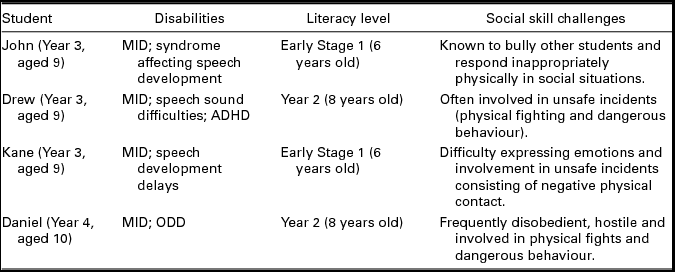
The participants in this study included three 9-year-old boys called John, Drew and Kane, and one 10-year-old boy named Daniel (pseudonyms have been used for all participant names) from an IM (Intellectually Mild) support class (a segregated class of only students who have MID) consisting of approximately 20 students within a regular Australian primary school. As can be seen in Table 1, each student had a history of unsafe behaviour with regards to keeping their hands and feet to themselves in social situations. It is for this reason that these students were purposefully selected (Patton, Reference Patton2002) by the classroom teacher to participate in this study, and that safe behaviour was the social skill of focus for this study's animated social narrative strategy.
Overview of Student Participant Profiles

Note. MID = mild intellectual disability; ADHD = attention-deficit/hyperactivity disorder; ODD = oppositional defiant disorder.
Setting
This study took place at Georgia-Blue Public School (pseudonym), a primary school in New South Wales, Australia. Participants were selected from one of two IM support classes that only consisted of students with MID. All other classes at this school were mainstream, consisting of students who do not have MID.
School and class selection was based on the expressed interest of an IM support class teacher in late 2010 during a meeting with the researcher regarding the potential of using slowmation with her students. It was revealed during this meeting that students in this class had difficulties with the social skills of keeping their hands and feet to themselves in the school playground, and thus adhering to Georgia-Blue Public School's ‘Be Safe’ rule. In particular, inappropriate physical contact such as punching and kicking in the playground was an issue for many students prior to this study. In light of this, the Be Safe school rule was selected by the teacher as the focus of this study's social skills development strategy.
The Social Skills Development Strategy
Students engaged with stop-motion animation skills across three 40-minute one-on-one lessons with the researcher to co-construct their own animated social narrative. Where possible, the researcher encouraged the students to be independent in their stop-motion animation skills and in the identification of their social skills. However, in some cases the researcher asked questions to prompt each student. The lessons took place across a period of approximately three weeks in a classroom adjoining the students’ regular classroom, which was supervised by a classroom teacher. No other classroom or home-based social skills programs or activities were undertaken by participants for the duration of the study. To participate in this study's social skills development strategy, students used a digital camera and were assisted to navigate movie-making software called Windows Movie Maker® for Windows 7® on a PC laptop. In the first lesson, students completed a template worksheet that posed four questions related to their safe behaviour at school. Students’ responses to these questions in the form of drawings and written sentences constituted the framework of a storyboard for their social narratives. In Lesson 2, students manipulated and photographed 2D paper characters (one bearing a photograph of their face) on a flat cardboard surface. Students moved characters in ways that re-enacted their storyboard and paused to take a photograph with a digital camera after every 1 cm movement. Finally, in Lesson 3, students’ photographs were uploaded to Windows Movie Maker on a PC laptop to play at approximately two frames per second. While viewing their photographs transition during this lesson on the computer, students’ audio-recorded a narration using Windows Movie Maker to explain their story of how to improve their social skills.
Data Collection Methods
Methods used to gather data for this study consisted of a combination of semistructured student interviews, lesson observations and student work samples. Data collection methods were designed to capture information addressing specific aspects of the study's research questions. To address Research Question 1, data collection was ongoing across lessons in the form of open-ended observations (Kervin et al., Reference Kervin, Vialle, Herrington and Okely2006; Mertens, Reference Mertens2010) until the completion of students’ animated social narratives so as to identify the extent of their animation skills. Lessons were video-recorded using a camera that rested on a tripod overlooking the desk at which the researcher and student worked. As such, the researcher took on the role of a ‘participant-as-observer’ (Mertens, Reference Mertens2010) and was able to experience what was being studied and become closely involved and familiar with the processes of students’ slowmation co-construction. Video-recorded lessons were later viewed by the researcher, and detailed observational notes were compiled on the stop-motion animation skills that each student was able or unable to use independently and/or with support from the researcher. To supplement the observations, samples of students’ work were collected and photographed across each lesson. Work samples included storyboards completed in Lesson 1, photographs of manipulated models taken during lesson two, and audio narrations and published slowmations completed in Lesson 3.
To address Research Question 2, semistructured interviews were conducted by the researcher with students concerning students’ identification of social skills for staying safe at school. Each student participated in two 10-minute interviews. The first interview took place prior to the study with the aim of ascertaining students’ initial identification of safe behaviour in relation to keeping hands and feet to self at school. The second interview occurred at the completion of the study and sought to identify students’ identification of these social skills since animated social narrative co-construction. Students’ work samples were also used to triangulate interviews concerning the ways in which animated social narrative co-construction supported students’ identification strategies for being safe at school.
It should be noted that this was an exploratory study, as the slowmation process had not previously been used in a special education context. Consequently, limitations of the study were that the teacher selected the four students and there was no control group. However, the purpose of this study was to ascertain if each of the selected students could actually use the stop-motion skills and whether they could identify their own social skills, requiring in-depth observations. Hence, to address this purpose there was a need to include four case studies and to monitor the students’ awareness of social skills at the beginning and end of this preliminary study.
Data Analysis and Trustworthiness
Thematic analysis was conducted across data collection to identify emerging similarities, differences and themes among the data (Braun & Clarke, Reference Braun and Clarke2006). The researcher read within and among all data numerous times from beginning to end to become familiar with certain themes and determine categorisation of data (Stake, Reference Stake2006). Such processes involved open and axial coding in which the researcher progressed from the identification of specific codes from within each dataset to the relation of categories among extensive data (Creswell, Reference Creswell2007). Transcripts of students’ initial and final interviews were coded for themes concerning their understanding of social skills for staying safe at school. Coded initial and final interviews then underwent comparative analysis. Video-recorded lessons were transcribed, and the observation notes that the researcher compiled upon viewing the recordings were coded for themes regarding the stop-motion animation skills that students could use in each lesson. Specifically, observation notes were categorised according to descriptions of the animation skills that students were able or unable to use independently and with support from the researcher. Transcribed student and researcher dialogue from during lessons (specifically concerning engagement with animation skills) was infused with descriptive observation notes to capture specific scenes from each lesson and enable a detailed narrative account of each case study's findings. Work samples were also analysed for what they demonstrated about students’ learning and participation in the co-construction of an animated social narrative in each lesson. Work samples were then triangulated with data collected from interviews and observations.
A variety of steps were taken by the researcher to promote trustworthiness of this study's findings. The researcher used triangulation, member checking, peer debriefing, and an audit trail to maximise research credibility and dependability (Creswell, Reference Creswell2007; Kervin et al., Reference Kervin, Vialle, Herrington and Okely2006). Further, the use of multiple sources of data helped to increase the validity of interpretations, and explicit detail is provided in the example case study on John to promote reliability. The researcher's use of detailed descriptions in reporting students’ experiences and understandings enables the reader to gain a broad understanding of the research context and promotes transferability of findings (Creswell, Reference Creswell2009).
Ethical Considerations
Ethical approval was granted for this study by the University of Wollongong's Human Research Ethics Committee and the NSW Department of Education and Training. Upon receiving ethics approval, the school principal of Georgia-Blue Public School was contacted by telephone and emailed a letter that sought to obtain permission to conduct research within the school. Consent was subsequently received by the school principal and classroom teacher to conduct research with students. Student participants and their parents/caregivers also consented to student involvement in the study. Participant information sheets clarified that participation in the study was voluntary and that participants could withdraw themselves and their data at any point during the project with no detrimental consequences. Further, the names of all participants involved in the study were changed to pseudonyms to ensure confidentiality.
Results
Due to the extensive qualitative data gathered and the limitation of space, this paper provides a focused account of the experiences of one case study, John, followed by a synthesis of overall findings pertaining to the other three cases of Drew, Kane and Daniel. Results are presented in two sections to address each research question. It should be noted that the same multiple sources of data collection were used for all students using the same depth of analysis to promote trustworthiness of interpretations.
Extent of Animation Skills
Findings related to Research Question 1 emerged as three individual lessons were implemented by the researcher with each student. Data gathered from observations, work samples and interviews revealed that students were able to use the following stop-motion animation skills to co-construct their own animated social narrative.
Storyboarding
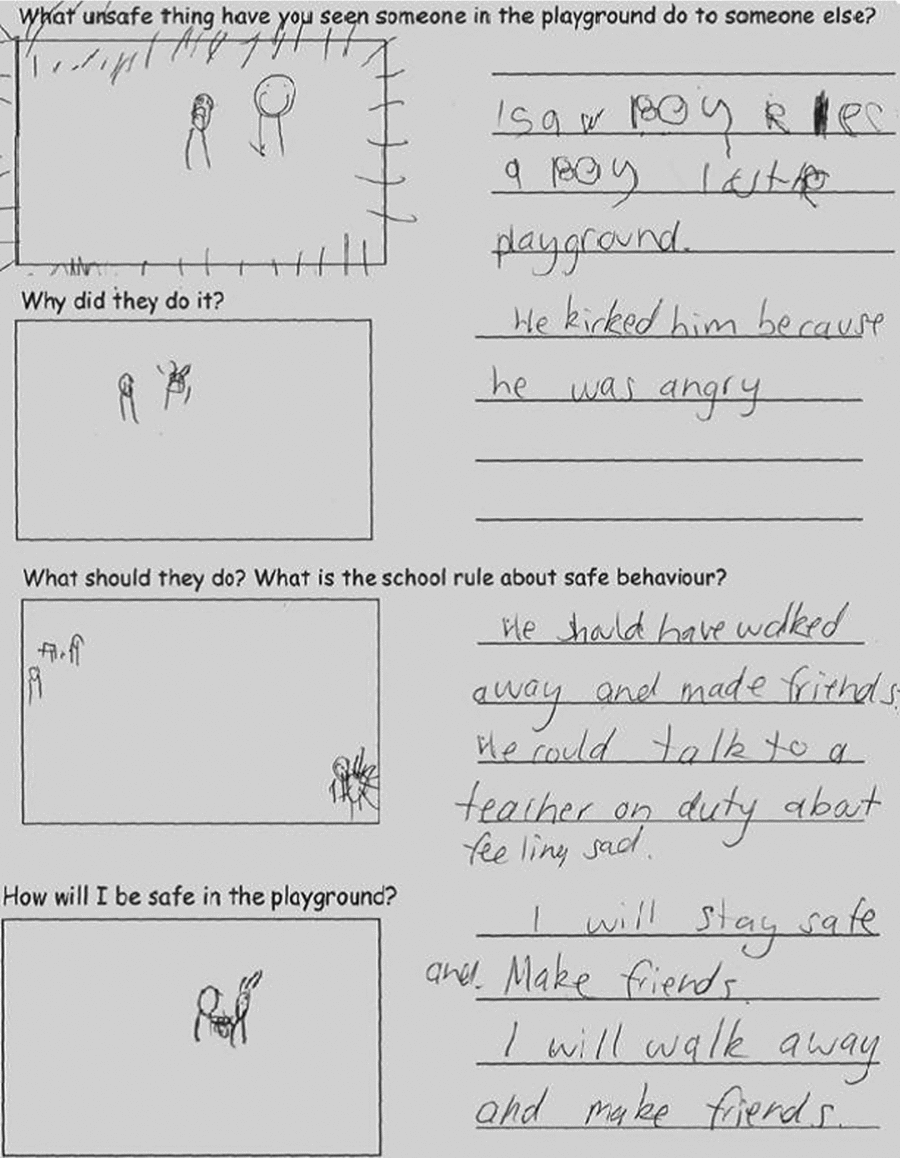
Results from Lesson 1 observations and storyboard work samples revealed that students required varying levels of researcher support to complete a template worksheet and thus construct their own storyboard. John's literacy skills were considered equivalent to a 6-year-old (as determined by teacher reports), and observations of him engaging with storyboarding revealed that he experienced difficulty when attempting to formulate written sentences and consequently sought the assistance of the researcher to write for him. After completing his first sentence, John expressed that he did not want to write anymore and requested support, stating, ‘I want to draw pictures here and you can draw there . . .’. From that moment onwards, John continued to draw pictures and the researcher used John's verbal responses to formulate appropriate storyboard sentences. John's storyboard is shown in Figure 1.
John's Storyboard.
Kane's literacy skills were also considered equivalent to a 6-year-old and he consequently needed the researcher to write sentences for him. In contrast, Drew and Daniel, who had the literacy abilities of 8-year-old students, were able to write independently and required little researcher assistance to complete their storyboard. Just as John's request to draw reflected his preference for visual learning supports, Lesson 1 observations revealed that drawing was the learning preference of Kane and Drew too. Daniel, however, expressed a preference for writing instead of drawing, perhaps reflecting his skills in being able to effectively communicate verbally. Consequently, although each student was able to draw pictures and verbally communicate ideas for their storyboard, not all students could read and write independently.
Character Movement and Photography
Lesson 2 observations identified that students required varying assistance to re-enact their storyboard by photographing 1 cm movements of 2D paper cut-out characters (one bearing a photograph of their face) on a flat cardboard background. Observations revealed that John required little support to take photographs as he demonstrated mastery of the digital camera and character movements. John also showed initiative in designing his characters, backdrop and props, and justifying his own decisions with regard to technique, and how his scenes should be animated. An example of this is when John expressed, ‘I want to take a close-up of the boy's happy face in scene 2’ to show that his character kicked a boy because ‘he is a bully and it made him feel happy’. John's observable confidence and joy throughout this lesson is reinforced by his interview response: ‘It was the best fun when I took the pictures’.
Drew, Kane and Daniel also initiated specific photographs and justified their reasons for capturing certain shots. Nevertheless, unlike John, these students experienced frequent challenges with camera navigation and therefore required ongoing researcher guidance with regard to keeping the camera and tripod still, holding down on the camera's capture button, and allowing enough time for the camera to take a photograph before moving characters in 1 cm intervals. Despite the camera difficulties that Drew, Kane and Daniel experienced, observations revealed that these students maintained engagement with the process of moving and photographing characters. Moreover, as was the case with John, Drew and Daniel indicated when interviewed that photographing characters was their favourite stop-motion animation skill.
Narration
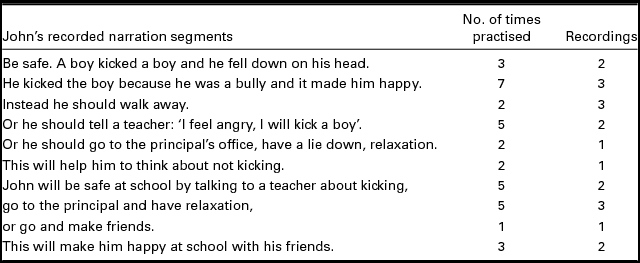
In preparation for narration, the researcher uploaded students’ photographs to Windows Movie Maker to play at two frames per second to provide slow-moving images to support a narration, as they were unable to transfer photos to the computer on their own. As revealed by Lesson 3 observations, students then verbally constructed and audio-recorded a narration sentence by sentence as they viewed their slow-moving images in Windows Movie Maker. The degree of difficulty students experienced and the level of support that they required to record a narration varied among cases. Observations of John indicated that he required significant scaffolding from the researcher for spoken sentence structure and use of grammar and tense. He also had to be prompted to practise and record his narration in small segments. As Table 2 demonstrates, the longer and more complex the sentence, the more time John spent practising it, and the more likely he was to make a mistake and need to re-record it.
John's Narration
Although John was unable to read and navigate Windows Movie Maker software, he offered suggestions to inform recording decisions. For example, John frequently advised the researcher where to drag the audio files on Windows Movie Maker: ‘You should put that one where he goes to walk away from him’. John also proposed slide-speed adjustment suggestions when he thought that the images moved too slowly or too quickly. An example of one of John's suggestions was to slow down the slide speed because ‘his leg should come up when I say that’. A snapshot of John's animated slowmation as he was proposing such editing ideas is shown in Figure 2.
John's Uploaded Photographs and Narration.
Observations of Kane's participation in Lesson 3 showed that he experienced similar difficulties to John concerning the use of narration skills. Because of his speech and literacy difficulties, Kane required ongoing support to formulate, practise, record, and re-record sentences. Similarly, Drew also experienced challenges that were likely associated with his speech difficulties and thus needed sentence delivery and pronunciation support. In contrast, Daniel, who was a confident and skilled speaker, and whose speech was not impaired, formulated and recorded his narration with little practice or researcher assistance. Further, when lesson observations were compared among case studies, findings revealed that Daniel was the most at ease and skilled at narrating his animated social narrative. Such a comparison of observations also showed that like John, Drew, Kane and Daniel were capable of proposing recommendations to inform file placement and slide speed.
Summary
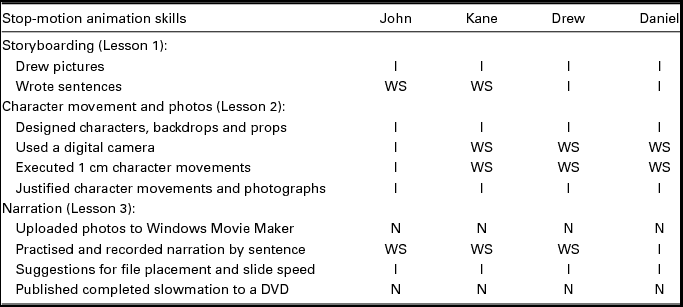
The stop-motion skills that all four students achieved included: (i) creating a storyboard to design their social narrative about being safe in Lesson 1; (ii) manipulating and photographing 2D paper characters in ways that communicated their story in Lesson 2; and (iii) audio-recording a narration to explain their animated social narrative in Lesson 3. The skills that they could not achieve included uploading their photographs and navigating Windows Movie Maker software. Table 3 provides a comparative summary of the extent of each case study's use of animation skills in their co-construction of an animated social narrative. In this table “I” indicates the skills that students could achieve independently, “WS” represents the skills that students could achieve with support from the researcher, and “N” reflects the skills used by the researcher that the students were not capable of using.
Comparison of Students’ Use of Stop-Motion Animation Skills
Note. I = individually achieved; WS = achieved with researcher support; N = not achieved.
Identification of Strategies for Staying Safe
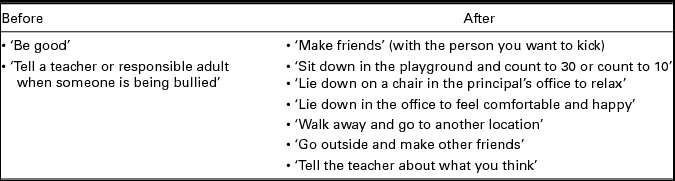
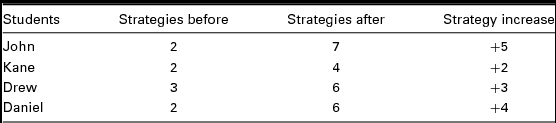
Results across each case study revealed that since using slowmation to co-construct an animation about their own safe behaviour, each student was able to identify in greater detail a larger number of specific strategies for staying safe at school. The student who demonstrated the greatest development in such social skills identification was John. Table 4 shows John's growth in its comparison of the strategies that he identified in interviews prior to and after the study took place. As displayed by Table 4, after having co-constructed his own animation, John identified seven and more detailed strategies than he proposed prior to the study.
Comparison of John's Understanding of Strategies for Being Safe
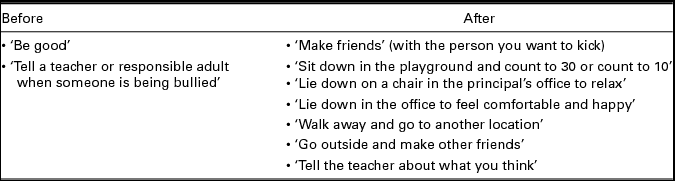
Evidence that this study supported John's identification of practical ways in which to be safe at school can be seen in that he made reference to animated social narrative content when describing strategies in his final interview. This can be seen when comparing the strategies from John's narration in Table 2 with those later expressed by John as shown in Table 4.
The notion of a person approaching a teacher before, and instead of hurting someone, was a new concept to John that was introduced by the researcher in Lesson 1. John's initial interview responses revealed that he had only ever viewed the teacher as a person for a victim to approach after an incident. The researcher explained that a student can go to a teacher to talk about their feelings of anger instead of bullying or physically hurting someone because they feel angry, and John agreed to add this strategy to his storyboard. It was evident that John better understood such a concept by Lesson 3, as when viewing the uploaded photos on Windows Movie Maker of his character walking toward the teacher, he said that the character could say ‘I feel very angry like kicking someone’. Such understanding was further evident in John's final interview when John expressed that from his slowmation he learned that to stay safe at school ‘you can tell the teacher about what you think’. Furthermore, John included in his narration that the boy should tell a teacher ‘I feel angry I will kick a boy’ and that ‘John will be safe at school by talking to a teacher about kicking’.
John's emerging identification of other strategies for keeping his hands and feet to himself was further revealed in Lesson 2: when reviewing his storyboard, John proposed that another strategy to stay safe at school is to ‘sit down and relax’. When asked to describe this, John elaborated that ‘to relax you can just close your eyes and count to 30 or 10 . . . that's sometimes how our class does it . . . that's our relax’. The researcher asked John where he could go at lunch or recess time to relax if he is feeling cranky. John responded that he could sit down in the principal's office. Such a strategy was then added to John's storyboard and during Lesson 2 John photographed paper cut-out characters (including the character bearing his photograph) going to the principal's office to ‘have a lie down and relaxation,’ as shown in Figure 3.
John's Strategy Photographs of Relaxation in the Principal's Office.
When interviewed prior to the study, Kane, Drew and Daniel also expressed limited identification of social skills for staying safe. Nevertheless, Table 5 shows that Drew and Kane were able to identify twice the number of strategies for keeping their hands and feet to themselves after their co-construction of an animated social narrative. Moreover, John and Daniel identified at least three times more strategies after animated social narrative co-construction.
Number of Strategies for Being Safe Proposed Before and After the Study
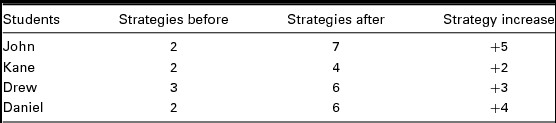
As was the case with John, the fact that the majority of the strategies that Drew, Kane, and Daniel proposed after the study were explored in their animations suggests that using slowmation to co-construct an animated social narrative supported students’ identification of strategies for being safe at school. In particular, the lesson observations of each case study revealed that the most salient strategy for being safe that students were able to identify since the study was the ‘talk to a teacher about feelings strategy’. Students’ final interviews revealed that like John, after the inclusion of this strategy in their animations, Drew, Kane and Daniel were able to explain the significance of approaching a teacher prior to an incident to discuss feelings with the aim of calming down and preventing unsafe practices.
Discussion
Social skills development for students with MID is still a major challenge in spite of many years of research and interventions. Previous studies have shown that social skills development strategies designed by teachers and professionals such as Social Stories and video modelling have improved social skills for students with special needs (Chan & O’Reilly, Reference Chan and O’Reilly2008; Crozier & Tincani, Reference Crozier and Tincani2007; Mechling & Swindle, Reference Mechling and Swindle2013; Quirmbach et al., Reference Quirmbach, Lincoln, Feinberg-Gizzo, Ingersoll and Andrews2009; Wang & Spillane, Reference Wang and Spillane2009). This study, however, provided insight into exploring the effects of a social skills development strategy involving students in the design of a co-constructed stop-motion animation about their social behaviour.
In regard to the first research question, findings revealed that each student required varying levels of researcher support to construct their own storyboard in Lesson 1. Results suggested that the degree of storyboarding support each student required was commensurate with their literacy capabilities. As is a commonly reported characteristic of students with MID, the literacy levels of participants in this study were below that of their same-aged peers who did not have an intellectual disability (AAIDD, 2011; American Psychiatric Association, 2000). In particular, John and Kane, whose literacy levels were considered equivalent to that of a 6-year-old, experienced significant difficulty writing storyboard sentences independently and relied on the researcher to write for them. The literature supports that many students who have MID may experience such writing difficulties (AAIDD, 2011). Nevertheless, the literature reveals that not all students with MID experience slower development of writing skills (Schalock & Luckasson, Reference Schalock and Luckasson2004). This is evidenced by the experiences of Drew and Daniel who had the literacy abilities of 8-year-old students. Although such a level is below that of their same-aged peers who do not have a MID, it did not affect their writing ability as much as John and Kane, whose literacy levels were much lower. As a result, Daniel and Drew were able to write their own sentences independently.
Results also revealed that drawing pictures to depict storyboard scenes was a preference to writing sentences for John, Drew and Kane. Such a finding is consistent with literature that suggests that visual supports are often the learning preference for students with developing writing skills (Ayres & Langone, Reference Ayres and Langone2005; Bellini & Akullian, Reference Bellini and Akullian2007; Bernad-Ripoll, Reference Bernad-Ripoll2007; Hitchcock et al., Reference Hitchcock, Dowrick and Prater2003; Thiemann & Goldstein, Reference Thiemann and Goldstein2001), and in particular, students who have MID (Fossett & Mirenda, Reference Fossett and Mirenda2006). Nevertheless, Daniel expressed a preference for writing. This is somewhat unusual in light of his limited literacy capabilities, but it may be reflective of his ability to skilfully communicate verbally.
Findings revealed that some students were more capable and thus required less researcher support than others to manipulate and photograph characters in Lesson 2. Research findings suggest that the camera navigation challenges that Drew, Kane and Daniel experienced likely reflected their lack of experience using a digital camera. Unlike John, who showed mastery of the digital camera and admitted having used one before, Daniel, who experienced difficulty taking photos, stated: ‘I’ve never had my own camera to do photos with before’. It is also possible that the greater support that these students required to use the digital camera may reflect that in addition to having a MID, Drew has attention-deficit/hyperactivity disorder and Daniel has oppositional defiant disorder, characteristics of which indicate concentration difficulties (Konza, Grainger, & Bradshaw, Reference Konza, Grainger and Bradshaw2001).
Observations of Lesson 2 revealed that each student was engaged with the process of manipulating and photographing characters. Moreover, when interviewed after having made their own animated social narrative, John, Drew and Daniel indicated that photographing characters was their favourite part of construction. Case study comments from this interview revealed that students’ opportunity to move and photograph a character that featured a photograph of their face enhanced their engagement. Such an observation is consistent with Bandura's (Reference Bandura1997) reasoning that seeing one's self perform ideal behaviours strengthens engagement and self-efficacy. It is likely that student excitement and eagerness to manipulate 2D characters led to reported larger movements and difficulties with regard to pausing between movements to take photographs.
Research findings revealed that the level of assistance that students needed to formulate, practise and record a verbal narration to explain their animation was also commensurate with their literacy capabilities. In support of this claim, John and Kane who had the most limited literacy capabilities required the most narration scaffolding in terms of spoken sentence structure, grammar, and tense. In contrast, Daniel and Drew who had higher literacy levels required little assistance with narration construction. The speech difficulties of some students may have also affected their ability to record a narration. In particular, the speech difficulties of John, Kane and Drew likely influenced their need to practise recording and re-recording sentences more frequently than Daniel whose speech was not impaired.
In regard to Research Question 2, results across each case study revealed that since co-constructing an animated social narrative about their own safe behaviour, the amount of strategies for staying safe that each student could identify increased by at least two or three-fold. There are a number of factors external to the study including students’ home and school experiences that may have contributed to students’ gained awareness of social skills strategies. Nevertheless, it is important to note that no other classroom or home-based programs or activities were implemented alongside this study to further promote the social skills development of students in terms of the focus of staying safe at school. It is therefore possible that using slowmation to co-construct animated social narratives facilitated strategy identification.
Research reports favourably on the use of visual supports for students with disabilities, including MID. Such studies would suggest that students’ visual representations of characters demonstrating strategies for staying safe may have enhanced their identification of safe practices (Ayres & Langone, Reference Ayres and Langone2005; Bellini & Akullian, Reference Bellini and Akullian2007; Bernad-Ripoll, Reference Bernad-Ripoll2007; Fossett & Mirenda, Reference Fossett and Mirenda2006; Hitchcock et al., Reference Hitchcock, Dowrick and Prater2003; Thiemann & Goldstein, Reference Thiemann and Goldstein2001). In addition, research regarding the use of self-modelling (a feature made possible by this study's inclusion of characters that bear photographs of student faces) would also support that observing oneself successfully performing a particular behaviour promotes self-efficacy, awareness and ultimate imitation of that behaviour (Ayres & Langone, Reference Ayres and Langone2005; Bandura, Reference Bandura1997; Bellini & Akullian, Reference Bellini and Akullian2007; Gresham et al., Reference Gresham, Sugai and Horner2001; Hitchcock et al., Reference Hitchcock, Dowrick and Prater2003; McConnell, Reference McConnell2002; Vaughn et al. Reference Vaughn, Kim, Morris Sloan, Hughes, Elbaum and Sridhar2003).
There is an emerging body of research that favourably reports on the implementation of computer-based social skills interventions that integrate Social Story and video modelling techniques (Mancil et al., Reference Mancil, Haydon and Whitby2009; Mandasari et al., Reference Mandasari, Lu, Theng and Theng2011; Sansosti & Powell-Smith, Reference Sansosti and Powell-Smith2008), but there is a lack of research regarding students’ acquisition of social skills through engagement with stop-motion animation skills. Research concerning the use of slowmation as a means of learning science concepts would support that students’ enhanced identification of strategies for staying safe at school could be attributed to the opportunity that slowmation provided for them to deconstruct and revisit concepts across various representations (e.g. storyboard, models, photographs, narration). Hoban and Nielsen (Reference Hoban and Nielsen2010) argue that thinking is facilitated by the opportunity that slowmation provides to discuss a product in smaller sections or ‘chunks’, thus breaking down concepts and arranging and rearranging models, images (taken one by one), text, and narration until comprehensive meaning is cumulated (Hoban, Reference Hoban2005, Reference Hoban2007; Hoban et al., Reference Hoban, Loughran and Nielsen2011; Hoban & Nielsen, Reference Hoban and Nielsen2010). Although this research has been conducted in science education, this study shows that it has applicability to special education. Such a process of constructing a stop-motion animation using a tactile activity, whereby a concept is broken down into steps or segments, is consistent with the learning preferences of students who have MID (Schalock & Luckasson, Reference Schalock and Luckasson2004).
Student-generated learning in the field of special education has gained focus over time in contemporary research (Kim & Park, Reference Kim and Park2012; Lane et al., Reference Lane, Graham, Harris, Little, Sandmel and Brindle2010; Mazzotti et al., Reference Mazzotti, Wood, Test and Fowler2012). Consistent with recent investigations into the potential of self-regulated learning, especially strategies that involve the use of technology, this exploratory study suggests that there may be considerable value in students with special needs participating in the planning and construction of their own social skills development strategy. However, the exploratory nature of this study implies that it has several limitations that necessitate caution when interpreting the data. As stated in the methodology, limitations of the study were that the students were selected by the teacher and there was no control group. To strengthen the trustworthiness of data interpretation, it would be worthwhile to repeat the study with a larger number of primary students with MID, and compare the effects of student co-constructed animated social narratives with teacher/expert-generated social skill development strategies using a quasi-experimental design. It would also be worthwhile to separate the role of facilitator and researcher so that there would be independent crosschecks of observer data, as well as establishing a control group to improve the validity of data interpretations.
Implications
Although this study revealed that students were successful in using slowmation to co-construct an animated social narrative and that this process supported their identification of social skills, it was just that: a ‘co-construction’. This means that some of the students required individualised instruction as they worked one on one with the researcher. Consequently, as a classroom teacher does not have the opportunity to spare three 40-minute lessons for each student, it would be unrealistic to expect teachers to implement this social skills development strategy in the school setting. However, it may be possible for teacher aides to administer the strategy independently with individual students outside of whole class interactions. Such school staff would need to be trained in preparation, as the researcher who implemented the animated social narrative lessons in this study was a skilled slowmation construction expert with 3 years of slowmation production experience. It may also be possible to use animated social narratives in a peer-tutoring context at school, in which an older and capable peer (with slowmation training and experience) could support a younger student who has MID with stop-motion animation skills.
It would be valuable to implement this study's social skills development strategy on a larger scale with older students who have MID in the secondary school setting to confirm the findings of the study. It would be anticipated that these older students would have more technology skills and additional cognitive functioning. Participants could include students who have MID from a range of IM support classes in special and mainstream schools, and students with MID who are integrated into regular mainstream classes. An examination of the potential of animated social narrative construction for students on the high end of the autism spectrum and those who have mild impairments or emotional, social or behavioural disorders, as opposed to MID, would also contribute to its value in special education.
Further research is needed to explore if the use of slowmation to generate animated social narratives has the capacity to influence behaviour and thus enhance the application of social skills for students with special needs. This would require studies that employ more regular and long-term observations and interviews over a longer period of time in a classroom to map students’ social skills and experiences. Hence, it would be worthwhile studying the retention of newly developed social skills over time. Slowmation as a student-generated process for social skills development could also be extended to target life skills, instructions or routines, in addition to social skills and behaviours for students with special needs.