Introduction
Antibiotics have revolutionized the practice of modern medicines, saved millions of lives each year, and enabled interventions such as surgeries and chemo-therapies to occur with a low risk of bacterial infection.1 However, failure to address growing antimicrobial resistance will impose significant health and economic burden on society.Reference O'Neil2 While there is an urgent need to develop new and useful antibiotics, over the last two decades the number of major companies investing in research and development (R&D) has been declining. The antibiotics market faces challenges that differ from other therapy areas, including: unpredictable future demand; the societal value of novel antibiotics is not fully captured in health technology assessments; and several characteristics of the current hospital reimbursement system that may restrict timely patient access.3 The solutions to restore investment in antibiotic R&D should include mechanisms and efforts to address these challenges. This article will focus on the treatment of serious infections in the hospital settings where novel antibiotics, that address multidrug resistant bacteria, are usually used. First, we discuss factors contributing to the barriers to timely patient access caused by the current hospital reimbursement system. We then propose a new value-based reimbursement mechanism to address these challenges.
The Challenge
Current treatment of hospitalized infections typically involves empiric therapy prior to the confirmation of diagnostic results, which usually takes 1-3 days (Figure 1). Because of the diagnostic uncertainty and the serious consequences of delayed treatment,Reference Raman, Avendano, Berger and Menon5 providing timely sufficient coverage against a wide range of disease-causing bacteria is crucial for patients with severe infections. On the other hand, the use of broad-spectrum antibiotics is associated with drawbacks such as treatment side effects and the emergence of bacterial resistance. The factors considered by physicians, when making treatment decisions, usually include: patients' risk factors for antimicrobial-resistant pathogens, local resistance epidemiology, evidence of earlier appropriate treatment leading to better patient outcomes for the specific infections, and seriousness of the infections. Novel broad-spectrum antibiotics, especially those covering resistant pathogens, are often reserved for patients with the greatest need for such therapies. Antibiotic de-escalation, in which the spectrum of the initial therapy is narrowed as soon as microbiological results are available, is recommended to optimize therapy and to reduce possible unintended consequences of antibiotic use, including toxicity and selection of pathogenic organisms.
Graphic from “Four Diagnostic Strategies for Better-Targeted Antibiotic Use” Wellcome Trust 20164

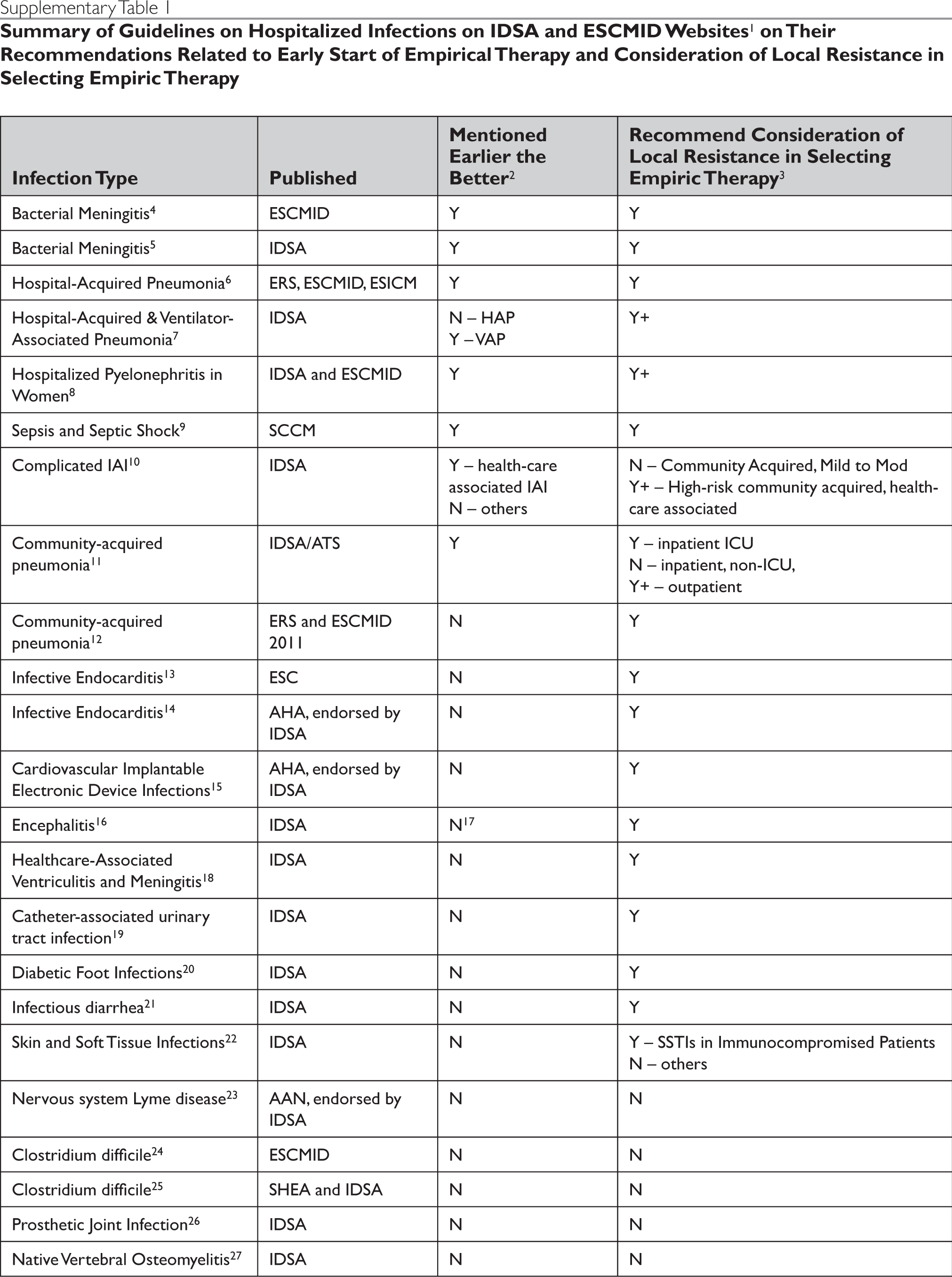
The benefits of earlier appropriate treatment are examined in many studies, especially for serious infections with high mortality and morbidity.6 While intuitively one expects that earlier appropriate treatment would lead to better outcomes, the evidence to support this is difficult to collect and expert opinion is often required to evaluate the limited data in view of the need for antibiotic stewardship in setting treatment guidelines. In a review of 23 national and international treatment guidelines for hospitalized infections (see Supplementary Table 1), eight acknowledged the benefits of earlier appropriate treatment and recommended considering local resistance pattern in selecting the empiric treatment. Of the fifteen guidelines that did not explicitly acknowledge the benefit of earlier appropriate treatment, ten recommended taking local resistance patterns into consideration when selecting the empiric treatment. The significant downside of failing therapy, especially in cases of serious infections, is often cited as the rationale. In fact, four of these guidelines recommend the threshold for local resistance, when deciding whether or not to cover resistant bacteria via empiric treatment, to be approximately 10-20% (see Supplementary Table 1). This means that for patients with serious infections, antibiotics that could cover the suspected resistant bacteria are recommended even though in 80-90% of the cases, they could turn out to be unnecessary. It highlights the importance of providing early appropriate therapy and facilitating antibiotic de-escalating strategies to minimize the development of drug resistance and maximizing the clinical benefits to the patients.Reference Garnacho-Montero, Escoresca-Ortega and Fernández-Delgado7 Review of literature suggests that de-escalation is accomplished in about 35-50% of patients with severe sepsis.8 A similar rate of de-escalation in ventilator-associated pneumonia has been reported, although the rate is around 10% when multidrug-resistant pathogens are implicated.9
In addition to clinical considerations, financial factors often play a role in selection of antibiotics within hospitals. Diagnosis-related group (DRG) is a hospital financing system that is used in the majority of the Organization for Economic Co-operation and Development (OECD) countries to reimburse inpatient hospital costs.Reference Koechlin, Konijn, Lorenzoni and Schreyer10 The DRG system aims to promote efficiency and cost control.Reference Scheller-Kreinsen, Quentin and Busse11 Under this system, each patient's charges are compiled and bundled into a DRG. Each DRG is supposed to be clinically meaningful and relatively homogenous in their resource consumption patterns. Hospitals are paid by a set reimbursement rate for each DRG, encompassing labor and non-labor costs including pharmaceuticals. The DRG system could pose financial disincentives that delay the adoption of new innovations.Reference Busse, Geissler, Quentin and Wiley12 To avoid compromising patient access to these innovations, many countries include short- and long-term alternative funding mechanisms.13 However, few antibiotics qualify for such funding mechanisms because they typically require demonstration of statistical superiority over an existing technology in randomized control studies,Reference Schaffer, West, Towse, Henshall, Mestre-Ferrandiz, Masterton and Fischer14 which is acknowledged to be not feasible for antibiotics which target rare drug-resistant infections.Reference Boucher, Ambrose, Chambers, Ebright, Jezek, Murray, Newland, Ostrowsky and Rex15
Hospitals typically manage their budgets through separate departments; this approach places tremendous pressure on a department to contain its own expenditure, even if the savings lead to greater costs elsewhere in the system. The cost of antibiotics is borne by the pharmacy department budget, which may steer use towards the lowest cost antibiotics, despite the potential broader benefit associated with the use of a novel antibiotic.Reference Goff and File16 It is widely acknowledged that inadequate payment to hospitals leads to limitation in use of new antibiotics as well as the inability to price them at a level commensurate with their value.Reference Outterson, Powers, Daniel and McClellan17
Methods
The DCM was first conceived by a multi-disciplinary team with members from research and development, commercial, market access, health policy, and diagnostics at Roche over the course of December 2014 to October 2015. The aim was to design an incentive model for severe infections treated in the hospital setting, where novel antibiotics for multidrug-resistant pathogens are typically used. Eleven potential incentive models were identified based on interviews and group discussions with internal experts and ranged from market-based models (involving modifications to existing reimbursement mechanism) to fully delinked models. Three models were prioritized by the multi-disciplinary team based on their potential to mitigate challenges in development, value demonstration, and reward innovation, while supporting antibiotic stew-ardship. The prioritized models were presented to 39 national, regional, and local payers from France, Germany, Italy, the United Kingdom, and the United States to collect feedback on their potential values, concerns, feasibility, areas of improvement and key criteria for evaluating innovative commercial models in May to July 2015. The models were refined and presented to two focus groups in Germany (n=4) and United Kingdom (n=5) to collect further feedback and insights in August to September 2015. Both focus groups were multi-disciplinary and included infectious disease specialists, chief pharmacists, members of local medicine management teams and drug & therapeutic committee, and an ex-CFO of a hospital system. The payer interviews and focus groups were conducted by a third-party consultancy to ensure that the stake-holders interviewed did not know which company was conducting the research so as not to bias their input. Responses from the interviews and focus groups were also consolidated by the third-party consultancy.
The Diagnosis Confirmation Model received the most favorable feedback among the three models that were tested. Subsequently, it was proposed to the DRIVE-AB project to be included in the list of innovation incentives to be assessed. Roche and Merck were partners in the DRIVE-AB project. DRIVE-AB's “Driving Reinvestment in R&D and Responsible Antibiotic Use” was an Innovative Medicine Initiative public-private consortium mandated by the EU commission to deliver costed implementable solutions that could incentivize R&D of new antibiotics, while supporting their sustainable use and access. DRIVE-AB was launched in October 2014 and ended in December 2017. DRIVE-AB further evolved the model into the current form based on input from DRIVE-AB members collected through one-on-one and group discussions. The DCM was presented to external stakeholders at a high-level stakeholder meeting in Amsterdam, the Netherlands which was organized by DRIVE-AB on June 3, 2016 and was also analyzed by the Trans-Atlantic Task Force on Antimicrobial Resistance (TATFAR).Reference Årdal, Røttingen, Opalska, Van Hengel and Larsen18
Results
The Model
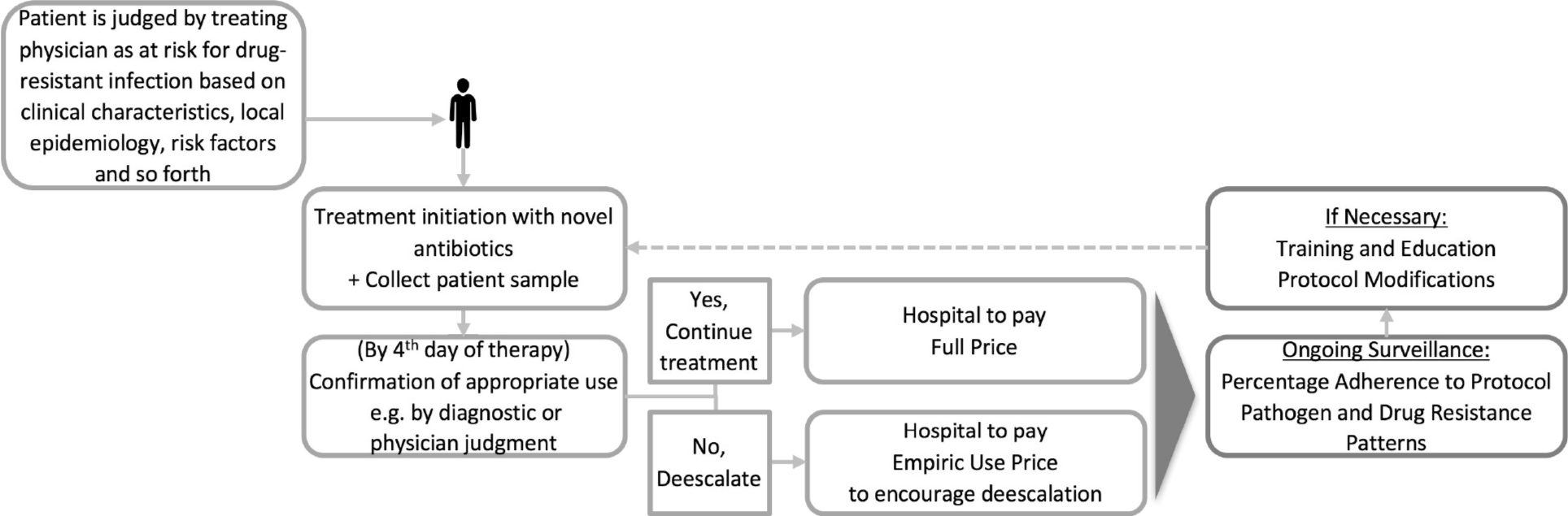
The Diagnosis Confirmation Model (Figure 2) was designed to support timely patient access to appropriate treatments through targeted modifications to existing reimbursement systems for inpatient antibiotics. The model includes a dual-pricing structure to reduce financial barriers to timely appropriate use of novel antibiotics and encourage de-escalation when possible. Collection of patient level data is integral to the model to enable payment calculations, as well as monitoring adherence to local clinical and steward-ship guidelines.
Diagnosis Confirmation Model

Effectively supporting adequate empiric therapy and facilitating de-escalation are key to minimizing the development of drug resistance and maximizing the clinical benefits to patients with serious infections likely to have been caused by drug-resistant pathogens. To this end, for novel inpatient antibiotics under the DCM, there would be two levels of reimbursed price based on the decision to continue or discontinue the novel therapy (Figure 2):
Empiric Use Price: If the decision is made to de-escalate the novel therapy on or before, for example, the 4th day of therapy when the microbiological results are usually available, the price for the first few days use would be set to an “empiric use” price that would be lower than the full price, but higher than other less-expensive — yet still effective — choices (i.e., generically available antibiotics). The difference between the empiric use price and the price of generically available antibiotics aims to discourage excessive use of the novel therapy and supports formulary-driven shifts to cheaper, effective drugs.
Full Price: If the novel therapy is continued for 4 or more days, for example, indicating it is deemed necessary for treating the infection based on diagnostic results or physician judgment, a price reflecting the full value of the antibiotic would be used for the full course. To ensure patient access and sustainability of the innovators and the health care systems, improved value assessment approaches that appropriately incorporate the broad value elements (e.g., ability to address resistance, societal value)19 will be essential to inform the pricing negotiation processes.
At the time of prescribing empiric therapy, there can be significant uncertainty on whether the new antibiotic is needed. By ensuring that the hospital only pays the empiric price if the patient is switched to an alternative non-inferior antibiotic, the DCM reduces the financial pressure to hospitals when the uncertainty of drug-resistant infection is high, and provides an incentive to de-escalate. By ensuring that the empiric price is higher than the price of generic antibiotics, the DCM provides a financial disincentive for selecting the novel antibiotics for patients at low risk of drug resistant infections.
The DCM could be adopted in health systems where infrastructure for diagnosis, data collection, and surveillance exists or could be developed. Payment requires tracking of patient level data, which provides the opportunity for the hospitals and other health-care bodies to validate use patterns to ensure alignment with local stewardship and clinical guidelines. In this way, the DCM can complement and reinforce hospital antimicrobial stewardship efforts, including the use of diagnostics, de-escalation, prescription monitoring, and surveillance/data collection on local epidemiology.
Stakeholders' Feedback
Responses from hospital payers and ID specialists collected from individual interviews and focus groups indicated that new commercial models were not widely used in their hospitals although they were open to evaluating and potentially implementing new models. Key criteria for new commercial models for antibiotics were: potential to improve patient outcomes of antibiotic treatment, simple design, ease of implementation, compatibility with local healthcare system and legislation, alignment with antibiotic stewardship policies, and flexibility to be adjusted as disease management needs change over time.
When presented with the DCM, the respondents saw potential benefits, which included alignment with stewardship, the potential to improve clinical outcomes, simple implementation in those hospitals with existing ID control teams and patient data collection systems, as well as economic benefits as a result of the dual-pricing structure. They suggested that the DCM was likely applicable only to serious infections at risk of MDR bacteria. Hospitals with protocols to screen for high risk patients would likely derive more benefit from the model compared to those that do not. Based on previous experience with screening, participants felt that screening for high risk patients could be implemented in hospitals, although additional screening/testing costs would likely be incurred. They acknowledged the fragmented data systems in certain hospitals as well as variation in ID expertise, especially in mid-sized to small hospitals, as potential barriers to implementation. They advised that pilot models to demonstrate the clinical and economic benefits through the real-world data would be required to convince other hospital stakeholders.
The DCM was presented at a DRIVE-AB conference in 2016. It was also analyzed by the Trans-Atlantic Task Force on Antimicrobial Resistance (TATFAR).20 Table 1 summarizes the analysis of the DCM by DRIVE-AB and TATFAR. The feedback recognized the potential benefits the model is designed to deliver which includes: alignment with stewardship by optimizing use of new antibiotics in patients at high risk of drug-resistant infections, encouraging de-escalation, promoting use of diagnostics, improving patient outcomes through earlier use of new antibiotics when considered appropriate, and improving quality of steward-ship through data collection. However, there was also concern that the DCM does not fully delink revenue from volume, and the decision to initiate and deesca-late therapy would be based on physicians' judgment and today's imperfect diagnostic tests. Some expressed concern that the premium price creates an incentive for industry to promote use of the novel agent beyond its appropriate use and questioned whether stewardship programs would be sufficient to ensure appropriate use. Due to the premium price and the level of administrative burden and data infrastructure required to support the DCM, the model was also criticized for being only applicable in developed health system and not having built-in equitable access features.
Summary of Analysis of the DCM by DRIVE-AB and TATFAR

Overall, the DCM was received favorably by both small and large pharmaceutical companies, as it offers a market-based mechanism that rewards competition and innovation. Academic and public health stake-holders were reserved about the model due to the concerns on the equitable availability and stewardship. As a result of these concerns, the DCM model was not selected by DRIVE-AB as one of the recommended innovation incentives.
Discussion
Different from today's single price paradigm, the DCM is an example of value-based pricing (VBP) arrangements that aims to improve the alignment between payment for medicines and the benefits they bring to patients and health systems. In the context of antibacterial treatment for a specific patient, the value of a novel inpatient antibiotic covering multidrug resistant bacteria is driven by the likelihood that a patient has a drug-resistant infection. When the pathogen causing the infection is likely to be susceptible to many antibiotics, the value of the new agent is low because there are several other older or less-expensive alternatives available. When the infection is confirmed to be caused by a multidrug-resistant pathogen, where there are limited safe and effective treatment options, the new agent that covers the resistant pathogen becomes significantly more valuable.
Overcoming additional burdens in administrative processes as well as the infrastructure needed to ensure effective data collection, are common challenges in setting up VBP arrangements. A review of previous experiences with VBP suggests that the costs to overcome these challenges are more likely to be justifiable in situations where there are high treatment costs, substantial uncertainty about effectiveness, concerns about inappropriate use, and a reasonably short time period for data collection.Reference Neumann, Chambers, Simon and Meckley21 Antibiotics targeting rare drug resistant infections with high mortality and morbidity satisfy these conditions. In addition, there is an increasing trend towards the collection of patient-level usage data to improve patient tracking and, as a result, stewardship practice. In its National Strategy Against Antibiotic Resistance 2015-2020,22 Norway states its government will introduce a requirement to include a diagnostic code on all antibiotic prescriptions for people to enable assessment of whether current prescribing practices are consistent with the recommendations. In the UK Start Smart then Focus: antimicrobial stewardship toolkit for English hospitals, auditing tools that record patient-prescription-level data were shared as best practice.23 In India's 2013 The Chennai declaration: A roadmap to tackle the challenge of antimicrobial resistance, patient monitoring for “higher-end” antibiotics such as third line antibiotics active against Gram-negative bacteria is included in its 5-year goals.Reference Team24 Better alignment with electronic health record systems and clinical decision support systems are also being explored to improve stewardship. Antibiotic manufacturers should work collaboratively with the national and local authorities that determine data requirements for stewardship programs to minimize the burden of additional data collection required to enable DCM.
To address concerns on the potential risk of over-promotion, measures to strengthen industry adherence to proper promotional activities for antibiotics could be implemented. These measures could be in the form of additional requirements imposed on the manufacturers (e.g., review of promotional materials), or on the local hospitals (e.g., additional approval process by the hospital ID teams for each prescription written). In setting these measures, policymakers must ensure balance since over-regulation could limit valuable medical education, or delay patient access. Since patient-level usage data is integral to the DCM, it provides an auditable and transparent dataset to measure the effectiveness of these measures, and to detect signals that call for systematic or local adjustment to improve appropriate use. With these measures, the DCM holds promise for reinforcing, rather than undermining, key components of patient-centered antimicrobial stewardship programs: enabling clinicians to provide early appropriate access to novel products when needed, requiring the use of diagnostics, incentivizing de-escalation of therapy, and data collection to inform appropriate decision making.
How Does the DCM Fit into Other Proposed Pull Incentives?
Reforms to value assessment and reimbursement processes will strengthen the DCM. A value assessment process that incorporates the unique challenges of conducting superiority trials and important societal value elements will provide crucial information to support sustainable value-based pricing via the DCM. Reimbursement reform that incorporates the resistance situation in the eligibility criteria for alternative funding outside of DRG will further mitigate the financial barriers that hospitals currently face while ensuring appropriate adoption of novel antibiotics.
DCM is a market-based model and can be complementary to delinked models. DCM is useful for novel antibiotics that address resistance that is rising but still below a threshold that would trigger a change in first line agents on the guideline level. The model is unlikely to be useful for antibiotics that target resistance that are extremely rare during the foreseeable future. These antibiotics are expected to be used only when there is confirmed diagnosis or as the last resort. These types of antibiotics would be best incentivized by novel delinked models, such as Market Entry Reward. Since resistance patterns are difficult to project, a Market Entry Reward may improve the predictability and potential financial return for companies who develop an antibiotic targeting an extremely rare infection. On the other hand, the DCM could be a more appropriate tool to expand appropriate access for antibiotics that, given resistance levels in some contexts, could be considered for earlier use when considered appropriate. This market-based mechanism provides an alternative revenue source for manufacturers, complementing other incentives and stewardship mechanisms.
Conclusion and Future Directions
The cause of failure in the antibiotics market is multi-factorial, but greater investment in antimicrobial R&D is needed. For novel antibiotics addressing in-patient drug-resistant infections in developed markets, new solutions are needed within current reimbursement systems to better support early appropriate access. The DCM is a value-based pricing approach developed to address these challenges. Policymakers who have expressed interest in enhancing access to novel antibiotics and incentivizing investment in antimicrobial R&D should consider tailoring the DCM to their reimbursement systems and incorporating it into the suite of incentives needed to drive the level of innovation needed to address AMR. A first step would be for industry, hospitals, payers, public health officials, and policymakers to identify opportunities to pilot the DCM, with the aim to test the model's feasibility and assess its intended and unintended impact to patient access and outcomes as well as stewardship in order to inform future design and implementation decisions.
Acknowledgments
The initial development of the model (including one-on-one interviews and focus group) was sponsored by Roche. The research leading to these results has also received support from the Innovative Medicines Initiative Joint Undertaking under grant agreement n°115618 [Driving re-investment in R&D and responsible antibiotic use — DRIVE-AB — www.drive-ab.eu], resources of which are composed of financial contribution from the European Union's Seventh Framework Programme (FP7/2007-2013) and EFPIA companies' in kind contribution. This work does not necessarily represent the view of all DRIVE-AB partners. Ka Lum, Taimur Bhatti, Stephanie Sassman, and Mark Guthrie would like to thank Professor Mark H. Wilcox, M.D., at University of Leeds, UK for his feedback on the model.
Summary of Guidelines on Hospitalized Infections on IDSA and ESCMID Websites1 on Their Recommendations Related to Early Start of Empirical Therapy and Consideration of Local Resistance in Selecting Empiric Therapy

Table References
1 Guidelines on hospitalized infections on IDSA and ESCMID websites, available at <http://integrate.idsociety.org/Organ_System/> and <https://www.escmid.org/escmid_publications/medical_guidelines/escmid_guidelines/> (both last visited March 23, 2018).
2 N: not mentioned, Y: mentioned
3 N: not recommended/no mention, Y: recommended, Y+: recommended with specified resistance threshold to switch
4 D. van de Beek, C. Cabellos, O. Dzupova, S. Esposito, M. Klein, A.T. Kloek, S. L. Leib, B. Mourvillier, C. Ostergaard, P. Pagliano, H. W. Pfister, R. C. Read, O. Resat Sipahi, and M. C. Brouwer, “ESCMID Guideline: Diagnosis and Treatment of Acute Bacterial Meningitis,” Clinical Microbiology and Infection 22 (2016): S37-S62.
5 A. R. Tunkel, B. J. Hartman, S. L. Kaplan, B. A. Kaufman, K. L. Roos, W. M. Scheld, and R. J. Whitley, “Practice Guidelines for the Management of Bacterial Meningitis,” Clinical Infectious Diseases 39, no. 9 (2004): 1267-1284.
6 A. Torres, S. Ewig, H. Lode, and J. Carlet, “Defining, Treating and Preventing Hospital Acquired Pneumonia: European Perspective,” Intensive Care Medicine 35 (2009): 9-29.
7 A. C. Kalil, M. L. Metersky, M. Klompas, J. Muscedere, D. A. Sweeney, L. B. Palmer, L. M. Napolitano, N. P. O'Grady, J. G. Bartlett, J. Carratalà, A. A. El Solh, S. Ewig, P. D. Fey, T. M. File, Jr, M. I. Restrepo, J. A. Roberts, G. W. Waterer, P. Cruse, S. L. Knight, and J. L. Brozek, “Management of Adults with Hospital-Acquired and Ventilator-Associated Pneumonia: 2016 Clinical Practice Guidelines by the Infectious Diseases Society of America and the American Thoracic Society,” Clinical Infectious Diseases 63, no. 5 (2016): e61-e111.
8 K. Gupta, T. M. Hooton, K. G. Naber, B. Wullt, R. Colgan, L. G. Miller, G. J. Moran, L. E. Nicolle, R. Raz, A. J. Schaeffer, and D. E. Soper, “International Clinical Practice Guidelines for the Treatment of Acute Uncomplicated Cystitis and Pyelonephritis in Women: A 2010 Update by the Infectious Diseases Society of America and the European Society for Microbiology and Infectious Diseases,” Clinical Infectious Diseases 52, no. 5 (2011): e103-e120.
9 A. Rhodes et al., “Surviving Sepsis Campaign: International Guidelines for Management of Sepsis and Septic Shock: 2016,” Intensive Care Medicine 43, no. 3 (2017): 304-377.
10 J. S. Solomkin, J. E. Mazuski, J. S. Bradley, K. A. Rodvold, E. J. C. Goldstein, E. J. Baron, P. J. O'Neill, A. W. Chow, E. P. Del-linger, S. R. Eachempati, S. Gorbach, M. Hilfiker, A. K. May, A. B. Nathens, R. G. Sawyer, and J. G. Bartlett, “Diagnosis and Management of Complicated Intra-abdominal Infection in Adults and Children: Guidelines by the Surgical Infection Society and the Infectious Diseases Society of America,” Clinical Infectious Diseases 50, no. 2 (2010): 133-164.
11 L. A. Mandell, R. G. Wunderink, A. Anzueto, J. G. Bartlett, G. D. Campbell, N. C. Dean, S. F. Dowell, T. M. File, Jr., D. M. Musher, M. S. Niederman, A. Torres, and C. G. Whitney, “Infectious Diseases Society of America/American Thoracic Society Consensus Guidelines on the Management of Community-Acquired Pneumonia in Adults,” Clinical Infectious Diseases 44, suppl. 2 (2007): S27-S72.
12 M. Woodhead, F. Blasi, S. Ewig, J. Garau, G. Huchon, M. Ieven, A. Ortqvist, T. Schaberg, A. Torres, G. van der Heijden, R. Read, and T. J. M. Verheij, “Guidelines for the Management of Adult Lower Respiratory Tract Infections — Full Version,” Clinical Microbiology and Infection 17, suppl. 6 (2011): E1-E59.
13 G. Habib, B. Hoen, P. Tornos, F. Thuny, B. Prendergast, I. Vila-costa, P. Moreillon, M. de Jesus Antunes, U. Thilen, J. Lekakis, M. Lengyel, L. Müller, C.K. Naber, P. Nihoyannopoulos, A. Moritz, and J. L. Zamorano, “Guidelines on the Prevention, Diagnosis, and Treatment of Infective Endocarditis (New Version 2009),” European Heart Journal 30 (2009): 2369-2413.
14 L. M. Baddour, W. R. Wilson, A. S. Bayer, V. G. Fowler, I. M. Tleyjeh, M. J. Rybak, B. Barsic, P. B. Lockhart, M. H. Gewitz, M. E. Levison, A. F. Bolger, J. M. Steckelberg, R. S. Baltimore, A. M. Fink, P. O'Gara, and K. A. Taubert, “Infective Endocarditis in Adults: Diagnosis, Antimicrobial Therapy, and Management of Complications,” Circulation 132 (2015): 1435-1486.
15 L. M. Baddour, A. E. Epstein, C. C. Erickson, B. P. Knight, M. E. Levison, P. B. Lockhart, F. A. Masoudi, E. J. Okum, W. R. Wilson, L. B. Beerman, A. F. Bolger, N. A. M. Estes, M. Gewitz, J. W. Newburger, E. B. Schron, and K. A. Taubert, “Update on Cardiovascular Implantable Electronic Device Infections and Their Management,” Circulation 121 (2010): 458-477.
16 A. R. Tunkel, C. A. Glaser, K. C. Bloch, J. J. Sejvar, C. M. Marra, K. L. Roos, B. J. Hartman, S. L. Kaplan, W. M. Scheld, and R. J. Whitley, “The Management of Encephalitis: Clinical Practice Guidelines by the Infectious Diseases Society of America,” Clinical Infectious Diseases 47, no. 3 (2008): 303-327.
17 Benefits of early treatment mentioned for herpes simplex encephalitis
18 A. R. Tunkel, R. Hasbun, A. Bhimraj, K. Byers, S. L. Kaplan, W. M. Scheld, D. van de Beek, T. P. Bleck, H. J. L. Garton, and J. R. Zunt, “2017 Infectious Diseases Society of America's Clinical Practice Guidelines for Healthcare-Associated Ventriculitis and Meningitis,” Clinical Infectious Diseases 64, no. 6 (2017): e34-e65.
19 T. M. Hooton, S. F. Bradley, D. D. Cardenas, R. Colgan, S. E. Geerlings, J. C. Rice, S. Saint, A. J. Schaeffer, P. A. Tambayh, P. Tenke, and L. E. Nicolle, “Diagnosis, Prevention, and Treatment of Catheter-Associated Urinary Tract Infection in Adults: 2009 International Clinical Practice Guidelines from the Infectious Diseases Society of America,” Clinical Infectious Diseases 50, no. 5 (2010): 625-663.
20 B. A. Lipsky, A. R. Berendt, P. B. Cornia, J. C. Pile, E. J. G. Peters, D. G. Armstrong, H. Gunner Deery, J. M. Embil, W. S. Joseph, A. W. Karchmer, M. S. Pinzur, and E. Senneville, “2012 Infectious Diseases Society of America Clinical Practice Guideline for the Diagnosis and Treatment of Diabetic Foot Infections,” Clinical Infectious Diseases 54, no. 12 (2012): e132-e173.
21 R. L. Guerrant, T. V. Gilder, T. S. Steiner, N. M. Thielman, L. Slutsker, R. V. Tauxe, T. Hennessy, P. M. Griffin, H. DuPont, R. B. Sack, P. Tarr, M. Neill, I. Nachamkin, L. B. Reller, M. T. Osterholm, M. L. Bennish, and L. K. Pickering, “Practice Guidelines for the Management of Infectious Diarrhea,” Clinical Infectious Diseases 32, no. 3 (2001): 331-351.
22 D. L. Stevens, A. L. Bisno, H. F. Chambers, E. P. Dellinger, E. J. C. Goldstein, S. L. Gorbach, J. V. Hirschmann, S. L. Kaplan, J. G. Montoya, and J. C. Wade, “Practice Guidelines for the Diagnosis and Management of Skin and Soft Tissue Infections: 2014 Update by the Infectious Diseases Society of America,” Clinical Infectious Diseases 59, no. 2 (2014): e10-e52.
23 J. J. Halperin, E. D. Shapiro, E. Logigian et al., “Practice Parameter: Treatment of Nervous System Lyme Disease (an Evidence-Based Review),” Neurology 69, no. 1 (2007): 91-102.
24 S. B. Debast, M. P. Bauer, and E. J. Kuijper, “European Society of Clinical Microbiology and Infectious Diseases: Update of the Treatment Guidance Document for Clostridium Difficile Infection,” Clinical Microbiology and Infection 20, suppl. 2 (2014): 1-26.
25 S. H. Cohen, D. N. Gerding, S. Johnson, C. P. Kelly, V. G. Loo, L. C. McDonald, J. Pepin, and M. H. Wilcox, “Clinical Practice Guidelines for Clostridium Difficile Infection in Adults: 2010 Update by the Society for Healthcare Epidemiology of America (SHEA) and the Infectious Diseases Society of America (IDSA),” Infection Control & Hospital Epidemiology 31, no. 5 (2010): 431-455.
26 D. R. Osmon, E. F. Berbari, A. R. Berendt, D. Lew, W. Zimmerli, J. M. Steckelberg, N. Rao, A. Hanssen, and W. R. Wilson, “Diagnosis and Management of Prosthetic Joint Infection: Clinical Practice Guidelines by the Infectious Diseases Society of America,” Clinical Infectious Diseases 56, no. 1 (2013): e1-e25.
27 E. F. Berbari, S. S. Kanj, T. J. Kowalski, R. O. Darouiche, A. F. Widmer, S. K. Schmitt, E. F. Hendershot, P. D. Holtom, P. M. Huddleston, III, G. W. Petermann, and D. R. Osmon, “2015 Infectious Diseases Society of America (IDSA) Clinical Practice Guidelines for the Diagnosis and Treatment of Native Vertebral Osteomyelitis in Adults,” Clinical Infectious Diseases 61, no. 6 (2015): e26-e46.