Introduction
Several Fusarium species are considered to be so-called ‘field fungi’ as they infect wheat and maize principally before harvest which results not only in a reduced crop yield by Fusarium head blight (commonly known as ‘scab’), but also in the production of secondary metabolites, such as mycotoxins. The toxins are commonly found world-wide on cereals such as wheat, barley, oats and maize.
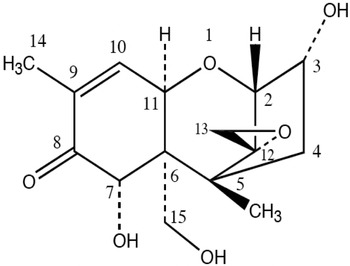
Deoxynivalenol (DON), a trichothecene, is produced by Fusarium graminearum and Fusarium culmorum. The pattern and amount of mycotoxins varies between fungal genera and even within strains of one distinct fungal species as well as from year-to-year (Gutleb et al., Reference GUTLEB, MORRISON and MURK2002). Since Fusarium species are ubiquitous, a total prevention of a Fusarium infection and the contamination with trichothecenes seems to be unlikely. It can be predicted that food and feed are always contaminated with toxins to a greater or lesser extent with the increasing accuracy of analysis (lower detection limits). Therefore, exposure to this toxin is a permanent health risk issue for both humans and farm animals. DON (Figure 1) is of outstanding importance among these contaminants due to its frequent occurrence in toxicologically relevant concentrations worldwide (Bottalico and Perrone, Reference BOTTALICO and PERRONE2002).
Chemical structure of deoxynivalenol (EFSA, Reference EFSA2004).

The majority of data on trichothecene contamination is derived from grains and grain products destined for human consumption. Therefore, it has been suggested that poorer quality grain is probably diverted to poultry feed which probably result in a higher incidence of DON exposure in chickens. Additionally, it has to be taken into account that DON was shown to be concentrated in by-products, such as bran, that are often used as animal feedstuffs (EFSA, Reference EFSA2004). Low to moderate doses of trichothecene can cause gastrointestinal irritation or necrosis, haematological disorders, diarrhoea, vomiting, feed refusal and decreased body weight gain. Higher doses cause severe damage to the haematopoietic systems in bone marrow, spleen, thymus and lymph nodes and immunological alterations (Ueno, Reference UENO1984).
Poultry are less sensitive to mycotoxins in terms of feed refusal than pigs (Huff et al., Reference HUFF, KUBENA, HARVEY, HALGER, SWANSON, PHILIPS and GREGER1986). Although acute mycotoxicoses are rare in poultry production, chronic exposure to low levels of mycotoxins is responsible for reduced productivity, altered immunity and increased susceptibility to infectious diseases (Swamy et al., Reference SWAMY, SMITH, KARROW and BOERMANS2004). Egg production and hatchability can be affected by this mycotoxin.
The value of the losses encountered due to mycotoxins depends on grain, animal and animal product prices, interest rates, degree of contamination and other economic variables. Even during favourable seasons it is likely that millions of dollars are lost as a result of the contamination of crops with mycotoxins (Charmley et al., Reference CHARMLEY, TRENHOLM, PRELUSKY and ROSENBERG1995). Many compounds and treatments have been tested in order to reduce mycotoxin levels in food and feed and to alleviate their adverse effects on animals. Some of these treatments show promising prospects for commercial application, while others have been used already to good effect. However, until reliable, cost-effective, commercially applicable methods are more widely available, problems associated with mycotoxin contamination and the economic losses resulting will continue to be seen in food and agriculture industries. The following review summarises the toxicity and mechanisms of action of DON with special reference to poultry and provides clear evidence of the effects of DON on the gut and immune function even in the absence of clinical signs or impaired growth. Such changes in the gut function and immune response should be viewed as an indication for adverse DON-effects on the health of the birds.
Toxicity of deoxynivalenol
effects on performance and feed intake
Prolonged dietary DON exposure of animals was described to cause anorexia, decreased live weight gain and altered nutritional efficiency (Pestka and Smolinski, Reference PESTKA and SMOLINSKI2005). Regarding livestock production these effects on performance resulted in great economic losses. Most experimental studies with poultry show a highly variable effect of DON on performance.
Direct effects of DON on haematology, clinical-chemical parameters and immunity are as yet poorly defined since most investigations could not separate the effect of feed intake from DON contamination (Rotter et al., 1996). Dänicke et al. (Reference DÄNICKE, GAREIS and BAUER2001) reviewed the literature regarding the effects of DON on the performance of broilers and came to the conclusion that dietary concentrations greater than 5 mg/kg are necessary to cause detrimental effects. Even higher concentrations did not consistently induce detrimental effects and in fact, even growth promoting effects were observed especially at moderately high concentrations of DON. The authors concluded that it was not possible to establish a simple dose-response relationship between growth depression and the dietary concentrations of DON for broilers compared to that of pigs.
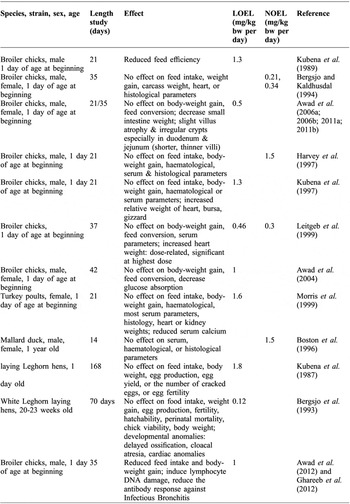
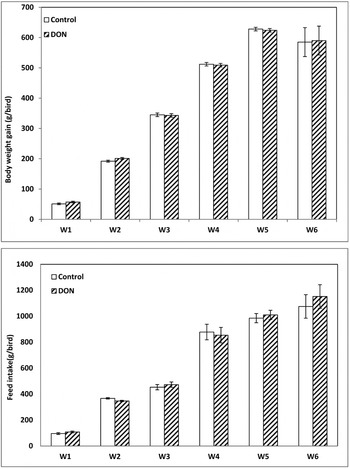
A review of the literature (Table 1) indicated that dietary concentrations of DON below 15 mg/kg had no adverse effect on body-weight gain, feed consumption or feed efficiency of broilers (Harvey et al., Reference HARVEY, KUBENA, ROTTINGHAUS, TURK, CASPER and BUCKLEY1997; Kubena et al., Reference KUBENA, EDRINGTON, HARVEY, PHILLIPS, SARR and ROTTINGHAUS1997; Leitgeb et al., Reference LEITGEB, LEW, WETSCHEREK, BÖHM and QUINZ1999; Swamy et al., Reference SWAMY, SMITH, COTTER, BOERMANS and SEFTONS2002; Li et al., Reference LI, VERSTEGEN and GERRITS2003; Awad et al., Reference AWAD, BÖHM, RAZZAZI-FAZELI, HULAN and ZENTEK2004; Reference AWAD, RAZZAZI-FAZELI, BÖHM, GHAREEB and ZENTEK2006a; Reference AWAD, BÖHM, RAZZAZI-FAZELI and ZENTEK2006b; Reference AWAD, HESS, TWARUŻEK, GRAJEWSKI, KOSICKI, BÖHM and ZENTEK2011a; Reference AWAD, VAHJEN, ASCHENBACH and ZENTEK2011b; Figure 2). Feed refusal and reduced weight gain were found when the dietary concentration of DON reached 16-20 mg/kg (Kubena et al., Reference KUBENA, HARVEY, CORRIER, HUFF and PHILLIPS1987; Reference KUBENA, HUFF, HARVEY, CORRIER, PHILLIPS and CREGER1988; Reference KUBENA, HUFF, HARVEY, PHILLIPS and ROTTINGHAUS1989; Kubena and Harvey, Reference KUBENA and HARVEY1988; Harvey et al., Reference HARVEY, KUBENA, HUFF, M.H. and PHILLIPS1991). Ghareeb et al. (Reference GHAREEB, AWAD and BÖHM2012) reported a significant decrease in feed intake and body weight in broiler chickens fed diet artificially contaminated with 10 mg DON/kg diets. In addition, Awad et al. (Reference AWAD, GHAREEB, DADAK, GILLE, STANIEK, HESS and BÖHM2012) indicated that deoxynivalenol has negative influences on the health and performance of chickens. Davis et al. (Reference DAVIS, ANDERSON, PARKHURST, RIVES D.V. and HAGLER1994) found that Pekin ducklings refused to eat feed naturally contaminated with DON in combination with other mycotoxins, which resulted in 100% mortality.
Dänicke et al. (Reference DÄNICKE, MATTHES, HALLE, UEBERSCHÄR, DOLL and VALENTA2003) found that an increase in dietary Fusarium mycotoxin concentrations (major toxin being DON) resulted in a linearly related decrease in feed intake, slight decrease in weight gain, increased FCR and linear decrease in serum antibody titres to Newcastle disease virus after vaccination in broilers. Dänicke et al. (Reference DÄNICKE, UEBERSCHAR, HALLE, MATTHES, VALENTA and FLACHOWSKY2002) concluded that layer performance, immune response and metabolism were adversely affected by chronic feeding of Fusarium mycotoxins. Growing chicks and laying hens are relatively insensitive to corn naturally contaminated with 2-3 mg/kg DON, whereas performance, egg production, fertility and hatchability, organ weights and presence of lesions in the mouth were not affected (Keshavarz, Reference KESHAVARZ1993).
Girish et al. (Reference GIRISH, SMITH, BOERMANS and KARROW2008) reported that turkey performance and some blood and immunological parameters were adversely affected by feedborne Fusarium mycotoxins. Feeding grains naturally contaminated with Fusarium mycotoxins, with a DON level up to 14 mg/kg, exerted only minor adverse effects on plasma chemistry and haematology of ducklings, and production parameters were unaffected in this avian species (Boston et al., Reference BOSTON, WOBESER and GILLESPIE1996; Cheng et al., Reference CHENG, CHANG, LIN, WU and CHEN2004; Dänicke et al., Reference DÄNICKE, UEBERSCHÄR, VALENTA, MATTHES, MATTHÄUS K. and HALLE2004; Chowdhury et al., Reference CHOWDHURY, SMITH, BOERMANS, SEFTON, DOWNEY and WOODWARD2005a). Feeding corn naturally contaminated with up to 18 or 10 mg/kg of DON (broiler or turkey, respectively) reduced bird BW gain at 21 d of age (Xu et al., Reference XU, EICHER and APPLEGATE2011).
Dänicke et al. (Reference DÄNICKE, VALENTA, UEBERSCHÄR and MATTHES2007) found that the weight gain of turkeys slightly decreased with increasing proportions of Fusarium toxin-contaminated wheat (0, 170, 340 and 510 g CW/kg) in the diet, whereas other performance parameters remained unaffected. However, other researchers have reported that feeding diets containing 20 mg DON/kg from 1 to 21 d of age had no effects on turkey poults performance (Morris et al., Reference MORRIS, LI, LEDOUX, BERMUDEZ and ROTTINGHAUS1999). Levels of up to 75 mg DON/kg diet did not produce toxic effects in turkey poults fed diets for up to three weeks post-hatch (McMillan and Moran, Reference MCMILLAN and MORAN1985; Manley et al., Reference MANLEY, HULET, MELDRUM and LARSEN1988). No adverse effects on performance were observed when tom turkeys were fed 15 mg DON/kg in the diet for 20 weeks, from hatch to slaughter (McMillan et al., Reference MCMILLAN, MORAN, REVINGTON and LUN1986).
The highly variable effect of DON on the performance of poultry indicates that zootechnical traits might not be a sensitive indicator of toxicity of this Fusarium toxin. However, feed refusal, reduced weight gain, reduced immune function, and changes in haematology and serum chemistry can be found when the dietary concentration of DON reached 16-20 ppm (Harvey et al., Reference HARVEY, KUBENA, HUFF, M.H. and PHILLIPS1991; Dänicke et al., Reference DÄNICKE, MATTHES, HALLE, UEBERSCHÄR, DOLL and VALENTA2003). The reason for this discrepancy may be because some studies used artificially contaminated grain or a single source of contaminated grain, where in general, artificially contaminated diets with purified DON is less toxic than naturally contaminated diets (Canady et al., Reference CANADY, COKER, EGAN, KRSKA, KUIPER-GOODMAN, OLSEN, PESTKA, RESNIK and SCHLATTER2002). While the use of a blend of naturally contaminated grains would increase the potential for toxicological synergies arising from interactions between multiple mycotoxins (Smith et al., Reference SMITH, MCMILLAN and CASTILLO1997).
Summary of the toxicity of deoxynivalenol in poultry.

Effects of feeding deoxynivalenol (DON) contaminated diets on broiler chickens’ performance (Awad et al., Reference AWAD, BÖHM, RAZZAZI-FAZELI, HULAN and ZENTEK2004).

effects on the gastrointestinal tract and other organs
In general, trichothecenes are well absorbed from the digestive tract after which they are widely distributed in many tissues and organs. The gastrointestinal tract is the first barrier against ingested chemicals, food contaminants and natural toxins. Following ingestion of mycotoxin-contaminated feed, intestinal epithelial cells may be exposed to high concentrations of toxins (Prelusky et al., Reference PRELUSKY, TRENHOLM, ROTTER, MILLER, SAVARD, YEUNG and SCOTT1996). Deoxynivalenol intoxication results in cytotoxicity and inhibition of protein synthesis, lesions of the gastrointestinal tract, bone marrow and lymphoid tissues as well as kidney and heart lesions.
Small erosions of the gizzard mucosa were observed in birds fed a diet containing 82.8 mg DON/kg for 27 days (Lun et al., Reference LUN, YOUNG, MORAN, HUNTER and RODRIGUEZ1986). Increased total and relative gizzard weights and lesions of the proventriculus were interpreted by these authors to be a consequence of an irritation of the upper gastrointestinal tract. Moreover, DON and several other toxins were found to decrease the trans-epithelial electrical resistance (TEER) of human epithelial cell lines (Maresca et al., Reference MARESCA, MAHFOUD, GARMY and FANTINI2002). These disaggregating effects of mycotoxins on epithelial intestinal cells may at least in part explain the intestinal lesions observed in humans and animals. In any case, alterations of the gastrointestinal tract, such as corrugation of the mucosa in the stomach, duodenitis, jejunitis, intestinal bleeding and necrosis, have been associated with the exposure to DON and other Fusarium toxins (Rotter et al., Reference ROTTER, THOMPOSON, LESSARD, TRENHOLM and TRYPHONAS1994; D´Mello et al., Reference D´MELLO, PLACINTA and MACDONALD1999). However, Moran et al. (Reference MORAN, HUNTER, FERKET, YOUNG and MCGIRR1982) and Huff et al. (Reference HUFF, DOERR, HAMILTON and VESONDER1981) did not observe any lesions in the upper gastrointestinal tract or haemorrhage when DON levels of less than 49 mg/kg of diet or when 140 mg/kg body weight were fed, respectively.
Harvey et al. (Reference HARVEY, KUBENA, ROTTINGHAUS, TURK, CASPER and BUCKLEY1997) found no histopathological lesions of kidneys of broiler chicks fed a diet containing 16 mg DON/kg for 21 days. Bergsjo and Kaldhusdal (Reference BERGSJO and KALDHUSDAL1994) observed that when DON was fed at a concentration of 3.4 mg/kg to broilers for 35 days, there were no effects on heart weight and furthermore, microscopical examination of organs did not reveal pathological changes. The weights of liver, kidney, spleen, and bursa Fabricius of broilers, expressed as a percentage of body weight, were not altered by dietary inclusion of Fusarium contaminated grains (Swamy et al., Reference SWAMY, SMITH, KARROW and BOERMANS2004). Dänicke et al. (Reference DÄNICKE, UEBERSCHAR, HALLE, MATTHES, VALENTA and FLACHOWSKY2002) found that liver, spleen, or heart weights of hens were not affected by dietary treatments with Fusarium contaminated maize. Feeding naturally contaminated grains did not alter the gross weight of lymphoid organs such as the bursa and spleen in turkeys (Chowdhury et al., Reference CHOWDHURY, SMITH, BOERMANS and WOODWARD2005b, Dänicke et al., Reference DÄNICKE, VALENTA, UEBERSCHÄR and MATTHES2007). In contrast, feeding DON resulted in a higher heart, liver and pancreas weight of ducks (Cheng et al., Reference CHENG, CHANG, LIN, WU and CHEN2004). However, the liver enzymes (aspartate aminotransferase, alanine aminotransferase, and γ-glutamyltransferase) determined in the plasma did not show any relationship with the inclusion of DON in diets for broiler chickens (Awad et al., Reference AWAD, GHAREEB, DADAK, GILLE, STANIEK, HESS and BÖHM2012).
The weight of the small intestine was slightly decreased in broilers fed the contaminated wheat (Awad et al., Reference AWAD, RAZZAZI-FAZELI, BÖHM, GHAREEB and ZENTEK2006a). Dänicke et al. (Reference DÄNICKE, UEBERSCHAR, HALLE, MATTHES, VALENTA and FLACHOWSKY2002) found that the weight of the small intestine was slightly decreased in hens fed Fusarium toxin-contaminated maize. The absolute and relative weights of liver were decreased in growing chicks fed DON-contaminated grain (Kubena et al., Reference KUBENA, SWANSON, HARVEY, FLETCHER, ROWE and PHILLIPS1985). Furthermore, Kubena et al. (Reference KUBENA, HUFF, HARVEY, CORRIER, PHILLIPS and CREGER1988) observed no changes in organ weights (liver, spleen, kidney, and bursa of Fabricius). In another study, Kubena et al. (Reference KUBENA, HUFF, HARVEY, PHILLIPS and ROTTINGHAUS1989; Reference KUBENA, EDRINGTON, HARVEY, PHILLIPS, SARR and ROTTINGHAUS1997) reported an increase in weights of gizzard, heart and bursa of Fabricius in their studies where chickens were fed 16 mg/kg DON from contaminated wheat for 21 days. The outcome of these studies was highly variable, indicating that organ weights might not be a relevant indicator of toxicity of some Fusarium mycotoxins. Conversely, time of toxin exposure may be a significant factor as the organ initially swells with toxin exposure followed by shrinkage (Swamy et al., Reference SWAMY, SMITH, KARROW and BOERMANS2004).
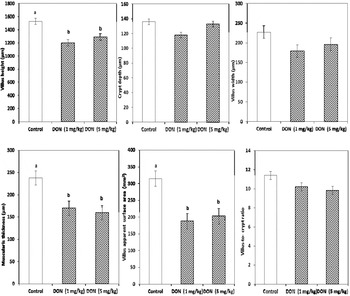
Other changes have been linked to DON exposure, including alterations in stomach condition and serum proteins, suggesting a specific effect of Fusarium toxins and particular DON (Prelusky et al., Reference PRELUSKY, GERDES, UNDERHILL, ROTTER, JUI and TRENHOLM1994). It was observed that DON may alter the stomach epithelial cell layer, as the fundic region of the stomach appeared thicker and the degree of folding higher (Rotter et al., Reference ROTTER, THOMPOSON, LESSARD, TRENHOLM and TRYPHONAS1994). Pathological lesions in visceral organ were observed in mule ducks in DON treatment groups (Cheng et al., Reference CHENG, CHANG, LIN, WU and CHEN2004). Awad et al. (Reference AWAD, RAZZAZI-FAZELI, BÖHM, GHAREEB and ZENTEK2006a; Reference AWAD, BÖHM, RAZZAZI-FAZELI and ZENTEK2006b; Reference AWAD, HESS, TWARUŻEK, GRAJEWSKI, KOSICKI, BÖHM and ZENTEK2011a; Reference AWAD, VAHJEN, ASCHENBACH and ZENTEK2011b) found mild intestinal changes such as slight villus atrophy and irregular crypts were observed by the dietary inclusion of naturally or artificially contaminated diets with DON. Furthermore, DON altered small intestinal morphology, especially in the duodenum and jejunum, as evidenced by shorter and thinner villi (Figure 3). Girish and Smith (Reference GIRISH and SMITH2008) reported that consumption of grains naturally contaminated with Fusarium mycotoxins resulted in adverse effects on intestinal morphology during early growth phases of turkeys. The decrease in enterocyte height is highly indicative that these mycotoxins alter digestive and absorptive functions. In contrast, no histological lesions were seen in turkey poults fed DON (Morris et al., Reference MORRIS, LI, LEDOUX, BERMUDEZ and ROTTINGHAUS1999; Dänicke et al., Reference DÄNICKE, VALENTA, UEBERSCHÄR and MATTHES2007) or ducks (Davis et al., Reference DAVIS, ANDERSON, PARKHURST, RIVES D.V. and HAGLER1994; Boston et al., Reference BOSTON, WOBESER and GILLESPIE1996).
Effects of DON contaminated diet on villus height, villus width, crypt depth, Muscularis thickness, villus surface area and villus to crypt in jejunum. Bars represent mean ± pooled standard error of the mean (PSEM). Different letters in each group of bars indicate significant differences (Awad et al., Reference AWAD, VAHJEN, ASCHENBACH and ZENTEK2011b).

effects on intestinal nutrient absorption
There is a little information available regarding the effects of DON on the electrical properties of the intestines of chickens. A study carried out by Grubb et al. (Reference GRUBB, DRISCOLL and BENTLEY1987) showed that the avian intestine has a regional electrical profile different from that of mammals. In the chicken, the region with the highest electrical resistance is the duodenum, whereas in the rat and the rabbit the region of highest resistance is the colon (Powell, Reference POWELL1987). The small and large intestines of birds are known to have high absorptive rates for water and electrolytes. The movement of ions responsible for the electrical current across the epithelium result from the absorption of Na+ and the secretion of Cl- (Skadhauge, Reference SKADHAUGE1981; Grubb, Reference GRUBB1991). The electrophysiological parameters of epithelia such as the transmural potential difference (PD), short-circuit current (Isc), and electrical tissue resistance (Rt) can be measured by using Ussing chambers. Transepithelial electrical potential (PD) constitutes an important electrophysiological parameter which reflects the functional state of a tissue. The current induced by ion transport is recorded as changes in PD (Boucher, Reference BOUCHER1994).
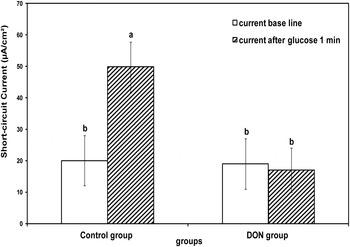
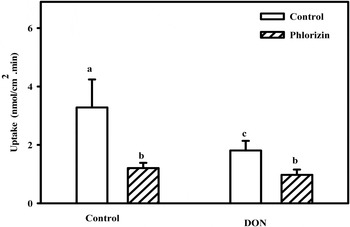
Levels of 10 mg/kg of DON reduced the intestinal absorption of D-glucose in broilers (Awad et al., Reference AWAD, BÖHM, RAZZAZI-FAZELI, HULAN and ZENTEK2004, Figure 4). Additionally, Awad et al. (2007; Figure 5) provided clear evidence that glucose uptake is inhibited by DON. The effect of DON was similar to the effect of phlorizin (SGLT1 inhibitor). Furthermore, a combined application of DON and phlorizin reduced D-glucose uptake to the same extent as an application of phlorizin alone. The similarity between the effects of phlorizin and DON on glucose uptake evidences their common ability to inhibit Na+-D-glucose co-transport. Furthermore, it was found that L-proline absorption was decreased by DON (Awad et al., Reference AWAD, REHMAN, BÖHM, RAZZAZI-FAZELI and ZENTEK2005). This finding indicates that the inhibition of Na+ co-transport systems is an important mechanism for DON toxicity in chickens. The principal mode of action of trichothecene mycotoxins is the inhibition of protein synthesis by blocking the peptidyl transferase activity in the 60S-ribosomal subunit (Feinberg and Mclaughlin, Reference FEINBERG and MCLAUGHLIN1989). In this case there may have been increased degradation of free amino acids for energy purposes as well as maintenance of blood glucose concentration.
The effects of deoxynivalenol (DON) on the short-circuit current after glucose addition. Means with different letters are significantly different (P < 0.05). The results are reported as means ± SEM (Awad et al., Reference AWAD, BÖHM, RAZZAZI-FAZELI, HULAN and ZENTEK2004).

Influence of deoxynivalenol (DON) on apical glucose uptake by chicken jejunal epithelia in the absence or presence of phlorizin. Means with different letters are significantly different (P < 0.05). The results are reported as means ± SEM (Awad et al., Reference AWAD, ASCHENBACH, SETYABUDI, RAZZAZI-FAZELI, BÖHM and ZENTEK2007).

Dose-efficacy studies on sugar and amino acid uptake in human intestinal epithelial cells with DON indicated that it inhibited the uptake of α-methyl-glucose resulting in 50% decrease at 10 µmol/l, and a maximal effect at 100 µmol/l (76 ± 1.6% of inhibition). DON selectively modulated the activities of intestinal transporters. The D-glucose/ D-galactose sodium-dependent transporter (SGLT1) was strongly inhibited by DON (50% inhibition at 10 µmol/l), followed by active and passive L-serine transporters. On the other hand, passive transporters of D-glucose (GLUT2) were only slightly inhibited by DON (15 % inhibition at 1 µmol/l) (Maresca et al., Reference MARESCA, MAHFOUD, GARMY and FANTINI2002).
The precise mechanism by which DON suppresses the activity of the hen intestinal SGLT1 is unknown at this time. Previous studies have often ascribed the functional consequences of mycotoxin action to their inhibitory action on RNA and protein synthesis (Rotter et al., 1996). Accordingly, the shortening and thinning of villi in the small intestine of chickens observed in previous investigations where chickens were fed DON (Awad et al., Reference AWAD, RAZZAZI-FAZELI, BÖHM, GHAREEB and ZENTEK2006a; Reference AWAD, BÖHM, RAZZAZI-FAZELI and ZENTEK2006b) suggest that the decrease in glucose absorption observed in this study may be a consequence of a general impairment of epithelial protein synthesis and function. However, Maresca et al. (Reference MARESCA, MAHFOUD, GARMY and FANTINI2002) reported that low concentrations (< 10 µmol/l) of DON applied to human intestinal epithelial cells selectively modulate the activities of specific intestinal transporters, including the D-glucose/D-galactose sodium-dependent transporter SGLT1. It has been also shown that the adverse effects on small intestine reduce the uptake of nutrients from the gut and hence decrease production performance of turkeys (Girish and Smith, Reference GIRISH and SMITH2008).
Based on this study and previous investigations, DON-sensitive transport systems in the avian intestine are based on the sodium-glucose cotransporter (SGLT1). It is not clear at present whether the interference with these specific intestinal transport pathways occurs mainly at the level of RNA transcription and/or protein synthesis. However, Awad et al. (Reference AWAD, VAHJEN, ASCHENBACH and ZENTEK2011b) found that DON contaminated diet suppresses the mRNA abundance and activity of intestinal glucose transporters (down-regulated of SGLT1 and GLUT2) of chicken intestine under practically relevant feeding conditions. This further suggests that DON has a specific inhibitory effect on glucose transport in addition to a concurrent decrease of intestinal surface area even at low to moderate dietary concentrations.
Given the profound effects of DON on nutrient absorption in the small intestine, it is interesting that poultry performance is often not or only moderately affected by DON content of feedstuffs (Dänicke et al., Reference DÄNICKE, UEBERSCHAR, HALLE, MATTHES, VALENTA and FLACHOWSKY2002; Sypecka et al., Reference SYPECKA, KELLY and BRERETON2004). One plausible explanation could be that, under normal circumstances, the majority of nutrient absorption occurs in the duodenum and proximal jejunum, and the small intestine apparently provides surplus absorptive capacity (Noy and Sklan, Reference NOY and SKLAN1996). Consuming DON decreases the absorption of some nutrients, such as D-glucose and amino acids, in the proximal small intestine (Awad et al., Reference AWAD, BÖHM, RAZZAZI-FAZELI, HULAN and ZENTEK2004, Reference AWAD, REHMAN, BÖHM, RAZZAZI-FAZELI and ZENTEK2005) and this may displace some of the uptake to more distal intestinal sites. Chickens are able to absorb D-glucose and amino acids efficiently even in the large intestine (Bindslev et al., Reference BINDSLEV, HIRAYAMA and WRIGHT1997). The absorptive functions in the large intestine may be better protected against the deleterious effects of DON, whereas it has been reported that DON is completely transformed to de-epoxy-DON after incubating for 96 h with the contents of the large intestine of hens (He et al., Reference HE, YOUNG and FORSBERG1992). Therefore, DON may alter the gut function but overall compensatory capacity is so high that this may not always impair performance.
modulation of immune function
Studies on DON immunotoxicity have focused primarily on the mouse model, with few investigations on possible effect in humans or domestic animals. These studies have shown that DON and other trichothecenes can suppress or stimulate immunity, sometimes even when present at identical dosages (Rotter et al., 1996). Most of the immunotoxic effects were short term, whereas prolonged consumption of purified DON resulted in the disappearance of adverse effects, which were mainly attributed to feed refusal rather than to systemic toxicity.
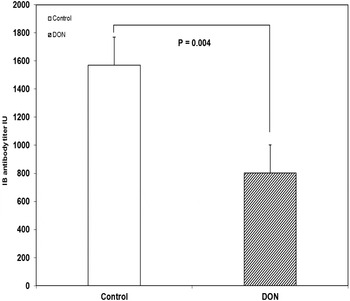
In chickens, humoral immunity can be either stimulated or impaired by DON and other trichothecenes. Chickens fed 50 ppm DON have shown reduced antibody responses to Newcastle disease vaccine (Harvey et al., Reference HARVEY, KUBENA, HUFF, M.H. and PHILLIPS1991). Dänicke et al. (Reference DÄNICKE, UEBERSCHAR, HALLE, MATTHES, VALENTA and FLACHOWSKY2002) found a decreased antibody titre against the ND virus in laying hens consuming a diet containing 17.6 mg of DON/kg. Additionally, Ghareeb et al. (2012; Figure 6) found a decreased antibody titre against the IB virus in broilers fed a diet containing 10 mg of DON per kg. Harvey et al. (Reference HARVEY, KUBENA, HUFF, ELISSALDE, HOLT, NAQI and PHILLIPS1988) reported decreased immune function in broiler and leghorn chicks that were fed DON-contaminated diets. The feeding of contaminated diets with Fusarium mycotoxins to chickens did not cause significant changes in serum or bile immunoglobulin concentrations (Swamy et al., Reference SWAMY, SMITH, KARROW and BOERMANS2004), however, Swamy et al. (Reference SWAMY, SMITH, COTTER, BOERMANS and SEFTONS2002) controversially observed that the feeding of contaminated grains with Fusarium mycotoxins caused significant linear and quadratic declines in the biliary IgA but not in serum IgG and IgM. Moreover, the immunological and haematological effects of long-term feeding of Fusarium mycotoxins have not been well characterised.
Effect of dietary Fusarium mycotoxin deoxynivalenol on Infectious Bronchitis (IB) antibody titres of broiler chickens.

Xu et al. (Reference XU, EICHER and APPLEGATE2011) found that the phagocytic capacity of caecal tonsil cells to engulf killed Staphylococcus aureus was significantly reduced (over 2.5-fold) when broilers were fed diets contaminated with DON (18 mg/kg). However, antibody-dependent phagocytosis (Staphylococcus aureus) was not affected in turkeys fed DON. Cheng et al. (Reference CHENG, CHANG, LIN, WU and CHEN2004) reported that DON contaminated feed decreased the number of circulating macrophages in duck.
Oral exposure to Fusarium mycotoxins may alter mucosal immunity because of local effects of mycotoxins in the gut. Serum IgA mediates the transport of antigens from blood circulation into the bile (Russell et al., Reference RUSSELL, BROWN and MESTECKY1981). It has been suggested that the hepatobiliary transport of IgA from blood serves to reinforce the intestinal supply of secretory IgA, which protects the mucosal surface against infection and prevents penetration of antigens from the gut lumen (Russell et al., Reference RUSSELL, BROWN and MESTECKY1981). Secretory IgA provides an important line of defence against bacteria, such as Salmonella, Vibrio cholerae, and Neisseria gonorrhoeae, and viruses such as polio, influenza and reovirus (Goldsby et al., Reference GOLDSBY, KINDT and OSBORNE2000). Trichothecenes bind to ribosomes and inhibit protein synthesis. Therefore, it is possible that Fusarium mycotoxins decrease biliary IgA concentrations, despite maintenance of serum IgA concentrations, by inhibiting the synthesis of secretory component proteins required for IgA transport into the bile. In addition, Chowdhury et al. (Reference CHOWDHURY, SMITH, BOERMANS and WOODWARD2005b) reported that the chronic feeding of Fusarium mycotoxins reduced biliary IgA concentration, however, IgG and IgM antibody titres to sheep red blood cells were not affected in turkeys.
Low doses or concentrations of trichothecenes can upregulate expression of inflammation-related genes in vivo and in vitro (Moon and Pestka, Reference MOON and PESTKA2002), pro-inflammatory cytokines (Wong et al., Reference WONG, ZHOU, MARIN-MARTINEZ, BROOKS and PESTKA1998), and numerous chemokines (Chung et al., Reference CHUNG, YANG, ISLAM and PESTKA2003). Human blood monocytes are susceptible to DON-induced cytokine and chemokine expression at concentrations as low as 25 ng/ml (Islam et al., Reference ISLAM, GRAY and PESTKA2005). Induction of these mediators might contribute to DON-induced anorexia, similar to that proposed for endotoxin.
The ability of DON to alter the expression of cytokines transiently is important because such effects can disrupt normal regulation of a wide variety of immune functions. Interestingly, interleukins (IL) IL-1, IL-6 and TNF-α have all been experimentally shown to cause anorexia and weight loss (Schobitz et al., Reference SCHOBITZ, DE KLOET and HOLSBOER1994). Thus, it might be speculated that cytokine elevation contributes to the lethal effects observed with DON, as well as the aforementioned chronic effects, feed refusal and reduced weight gain. Whereas DON inhibits intestinal cell proliferation and is absorbed through the intestinal epithelium by simple diffusion (Sergent et al., Reference SERGENT, PARY, GARSOU, PUSSEMIE, SCHNEIDER and LARONDELLE2006; Awad et al., Reference AWAD, ASCHENBACH, SETYABUDI, RAZZAZI-FAZELI, BÖHM and ZENTEK2007), at concentrations corresponding to those found naturally, DON induced p38 ERK and JNK phosphorylation as well as concomitantly disrupted intestinal permeability.
DON, nivelenol (NIV), T-2 toxin and fusarenon X toxins have been reported to exhibit a greater inhibitory effect on T-lymphocyte proliferation and antibody-dependent cytotoxicity than zearalenol (ZEA) (Berek et al., Reference BEREK, PETRI, MESTERHÁZY, Á., TÉREN and MOLNÁR2001). Dose-dependent inhibition of natural killer (NK) cell activity by DON, NIV and T-2 toxin has been found, and Froquet et al. (2003) reported that DON and T-2 toxin inhibited haematopoietic progenitor proliferation. Expression of dendritic cell maturation markers, endocytosis and IL production were inhibited by both DON and T-2 toxins (Hymery et al., Reference HYMERY, SIBIRIL and PARENT-MASSIN2006). Feeding DON contaminated diets resulted in reduction of the stimulation index of splenocytes from growing female chickens (Harvey et al., Reference HARVEY, KUBENA, HUFF, M.H. and PHILLIPS1991). Feeding naturally DON-contaminated diets to laying hens caused a decrease in the total number of circulating white blood cells, CD4+ and CD8+ T cell subsets and B cells (Chowdhury et al., Reference CHOWDHURY, SMITH, BOERMANS and WOODWARD2005c). Girish et al. (Reference GIRISH, SMITH, BOERMANS and KARROW2008) suggested that the cell-mediated immune response in turkeys involving CD4+ and CD8+ T cells is more sensitive to feedborne Fusarium mycotoxins. In addition, Awad et al. (Reference AWAD, GHAREEB, DADAK, GILLE, STANIEK, HESS and BÖHM2012) found that deoxynivalenol at dose of 10 mg/kg increased the amount of DNA damage in chicken lymphocytes.
Conclusions
Poultry are less sensitive to DON than other species, in part because of differences in its metabolism. This means that levels higher than 5 mg/kg feed are necessary to cause detrimental effects however feed refusal and reduced weight gain were only reported at levels higher than 10 mg/kg feed. However, birds consuming feed contaminated with DON at concentrations, which have no effect on performance, can still display major, deleterious changes in gut function. Through this altered gut function, decrease are seen in glucose and amino acid absorption, haematocrit values, total numbers of white blood cells, lymphocytes including both CD4+ and CD8+ T lymphocytes and B lymphocytes, and biliary IgA concentration. Although, it seems to be obvious that DON has negative effects on the active transport of some nutrients, until recently the biological mode of action of the inhibition of transport processes was not clear. It has been shown that the decrease in glucose absorption after exposure to DON is aggravated by a reduced expression of Na+/glucose cotransporter (SGLT1) and facilitative GLUT2. The capacity of DON to alter normal immune function has been of particular interest. There is extensive evidence that DON can be immunosuppressive or immunostimulatory, depending upon the dose and duration of exposure. While immunosuppression can be explained by the inhibition of translation, immunostimulation may be related to interference with normal regulatory mechanisms. In vivo, DON suppresses the normal immune response to pathogens. Other effects include superinduction of cytokine production by T helper cells (in vitro) and activation of macrophages and T cells to produce a pro-inflammatory cytokine was detected. To what extent the elevation of cytokines contributes to metabolic effects, such as decreased feed intake remains to be established. DON is mainly absorbed in the upper small intestine (duodenum and jejunum) in a dose dependent manner, indicating that the major part of DON transport across the intestinal epithelium is likely due to passive diffusion, probably via the paracellular route however, further studies are needed to confirm this hypothesis.