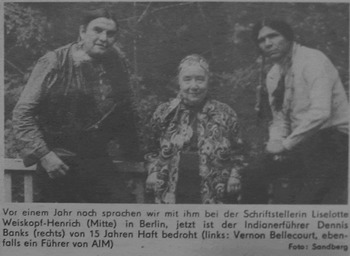
A curious photograph appeared in 1976 in the East-German newspaper Junge Welt (Fig. 1). Two well-known members of the American Indian Movement (AIM), Dennis Banks and Vernon Bellecourt, were shown together with an elderly German woman, Liselotte Welskopf-Henrich, at her home in East Berlin. This photo, like so many of the photos of Indians in unexpected places,Footnote 1 always seems to amuse people, leading them to ask with a snigger why the Indians were there. The Indians' presence in such places, however, is seldom a laughing matter, and in this case, scholars of the post-war era might find the answer to the simple question of the Indians' presence somewhat disconcerting.
Liselotte Welskopf-Henrich at her home in East Berlin in 1975 with two leaders of the American Indian Movement (AIM), Dennis Banks and Vernon Bellecourt. Junge Welt 81, April 3/4, 1976.

Welskopf-Henrich wrote novels about American Indians that were extremely popular in both East and West Germany, and by any estimation, she was an accomplished woman. By the time the picture was taken, she was a retired Professor of Ancient History at the Humboldt University and a member of the Berlin Academy of Science—the first woman to gain either of those distinctions. Born into a barrister's family in Munich in 1901, she received her Ph. D. in economics in 1925 at the University of Berlin (with history and philosophy as secondary fields). Because of financial problems brought on by the Depression, she was unable to continue her academic training in the 1920s.Footnote 2 Instead, she took a position as a Referent in the Statistisches Reichsamt in 1928, which she retained until 1945.Footnote 3
A confirmed opponent of National Socialism, she refused to return to the University in 1933 when a position became available. Instead, she became a resister, delivered clandestine food packages to Jews and French POWs, assisted prisoners from the Sachsenhausen concentration camp who were brought into Berlin as laborers in 1943, and helped one, the confirmed communist Rudolf Welskopf, who later became her husband, escape in 1944 after ten years in captivity.Footnote 4 Indeed, she hid him in what was left of her home for the better part of a year, and during the last months of the conflict she helped him produce and distribute flyers (some pasted onto tanks as well as buildings) calling for soldiers to lay down their weapons and embrace the Red Army.Footnote 5
After hostilities ended, she became the personal secretary of the Charlottenburg mayor and head of his statistics department and translation office until April 1946. At that time, she chose to move into the Soviet zone of the city, where she and her husband felt they were “most needed.”Footnote 6 She also became a member of the Communist Party (KPD) and soon after the Socialist Unity Party (SED). In 1949, during efforts to rebuild the faculty of the Humboldt University, she was able to return to academics as an Aspirantin (research assistant) (1949–1952) and then Dozentin (lecturer) (1952–1959) in ancient history until she became a professor in 1959. She also received a series of decorations from the East German state.Footnote 7
Because of that biography and the context of the historiography focused on the German Democratic Republic (GDR), it would be easy to regard her meeting with AIM activists as simply another example of radical American leftists, not unlike Angela Davis and Ben Chavis, invited to East Berlin by a member of the state.Footnote 8 Indeed, given the degree to which the history of the GDR remains “a political lightening rod,” as Catherine Epstein recently put it, such a connection to the state is what many scholars would expect to find, even insist on trying to locate.Footnote 9 As one critic told me directly when I began working on this project, “Welskopf-Henrich was a member of the Communist Party, a senior faculty member of the Humboldt University, and as such should be considered as part of East German official foreign policy”; to do otherwise would be naïve. And yet one searches in vain for clear connections between Welskopf-Henrich's interactions with American Indians and East German foreign policy.
There is no question that she was committed to socialism and the GDR, and that her loyalty together with her status as an old communist, an anti-Fascist, and a member of the Humboldt University Faculty and of the Academy of Science afforded her many privileges. According to her Stasi file, for example, the state had no concerns about letting her travel repeatedly to North America (or a series of other places in the east and west). Their records state unequivocally that “there is nothing to hold in consideration against [her] leaving the country.” Her return, they noted, “can be regarded as certain” because she was “strongly anchored politically and materially in the GDR” with firm family ties in Berlin. Moreover, as an operative wrote in her file, “her reputation is irreproachable [untadelig]” and she “counts as a highly respected person.”Footnote 10 For those reasons she traveled almost at will.
Absence is not an argument, but for those who would expect the state to try to make political hay out of Welskopf-Henrich's connections with American Indians or her travel abroad, for those who might be determined to locate her actions in official SED foreign policy, it is worth pointing out that Welskopf-Henrich's Stasi file, like those of many old communists, is rather thin.Footnote 11 The Stasi only became interested in her activities in 1972, after she had taken repeated trips to North America. That interest, however, was short-lived. After inspecting her mail and making their observations and inquiries, they concluded that “her focused work on writing, withdrawn lifestyle, and advanced age” made any contact to her senseless, and they closed the file the next year.Footnote 12
Moreover, when one begins investigating her official role at the Humboldt University, as Isolde Stark and others did for a recent conference volume, one finds the state hindering her work almost as often as supporting it, and Welskopf-Henrich forging her own path. Stark shows that Welskopf-Henrich often used her privileges to get around state policy. In one striking case, for example, she successfully published anthologies on ancient history that included contributions from authors in both the east and west, which reviewers, the press, and SED functionaries tried to hinder. Even more poignantly, Stark demonstrates that after the ideological leadership (Kommissarischen Leitung) of the Department of Ancient History fell to Welskopf-Henrich in 1961, she went out of her way, even in the years directly after the wall, to set up international connections and open the way for some of the younger people around her to travel abroad in the west. She also used that position to “fight for colleagues and students who were politically-ideologically suspicious and protect them from the repression apparatus of the SED.”Footnote 13 Without using the language of Eigen-Sinn, in other words, Stark details some of the complex ways in which this individual both withdrew from the state and sustained it, often at the same time.
The point of underscoring the absence of state interest in most of her efforts with American Indians and rehearsing Stark's arguments about Welskopf-Henrich's often ambivalent position to the state is not to whitewash her activities, or to try and deny that she was, essentially, a hard-boiled communist. Rather it is to call attention to the limitations inherent in assuming that people such as Welskopf-Henrich were always driven by the context of Cold-War politics simply by virtue of their affiliation with the GDR and the SED.
For example, because of our awareness of the importance of consumption in the Cold-War battle between east and west, we are used to thinking of material goods, and especially care packages moving across the geographic and political divide from west to east. Many East Germans looked to the west, to family members and others, for clothing, comforts, and even hard currency, generating a dual economy of sorts in the GDR, and demonstrating with each package the material superiority of the west over the east.Footnote 14
Because of our comfort with that vision, the recognition that many of Welskopf-Henrich's readers began sending care packages the other direction, from east to west, headed to American Indian Reservations and schools in the United States, seems an unlikely, even absurd proposition, one that many Cold Warriors might try to explain away as the work of naïve idealists, some sort of clever political ploy, or simply an extension of similar efforts to support so-called “third-world peoples” in places such as Vietnam or Angola. A closer analysis of the ways in which these packages were organized and delivered to the United States, however, demonstrates that the individuals involved in sending these packages regarded them as a new way to serve an old desire—connect to American Indians—rather than another way to support a political policy. The fact that their actions may have been completely consistent with GDR foreign policy, in other words, does not explain them. It might even obscure the motivations for those actions, if we assume that such actions are always already motivated by state policy.
Similarly, how do we evaluate the trade in illicit western literature on American Indians among the most dedicated American Indian enthusiasts in the GDR? Largely because of leading Nazis' enthusiasm for Karl May, the SED declared his work too bourgeois, imperialistic, kitschy, and too focused on “unrealistic” supermen to be published or sold in the GDR. While his books were not completely forbidden, the state had them removed from many libraries and the schools, discouraged any efforts to publish them, and forbade their entry into the GDR from either the east or the west.Footnote 15 That position led to outbursts from GDR citizens, repeated rallies in favor of Karl May, and a flood of requests for explanations sent to the Cultural Department of the Central Committee of the SED well through the 1960s and 1970s in which citizens berated the state for its position. Many also continued to obtain their copies of these books and other unapproved books on the American West illegally.Footnote 16
So how do we evaluate the actions of these dedicated fans, their protests, or their efforts illegally to distribute unapproved materials about American Indians and the American West? It was not Samizdat literature, and their actions were not openly revolutionary or counterrevolutionary. One could, perhaps, find a place for their actions in Hubertus Knabe's ten-point continuum of modes of resistance in the GDR,Footnote 17 but that would probably occlude what the people trading in these books were most focused on doing—pursuing their particular intellectual interests, indulging their childhood memories, and engaging in pleasures—all of which predated the GDR considerably.
And that is the potential inherent in Welskopf-Henrich's biography: it urges us to think through chronological and geographical borders and write German cultural history across the political ruptures that punctuate our narratives of the past. It compels us, in other words, to move beyond writing histories of the GDR and to begin writing German history through the GDR. It encourages us to move beyond characterizations of the state and even life under its auspices and toward integrating those lives into a broader German history that was, as James Sheehan once wrote about the entire post-war era, “a new chapter in a much older story.”Footnote 18
Thus what I have tried to do with this essay is to use the biography of one person as a vehicle for exposing a plurality of intersecting, overlapping, formal, and informal networks of communication and exchange that predated, persisted through, and extended beyond the GDR, and which proved important to many people living within and outside it. Welskopf-Henrich's biography is an effective tool, because, born in 1901 and occupied with American Indians at an early age, she thought intensely about them and then quite literally wrote about them across the Imperial, Weimar, Nazi, and Post-War eras until her death in 1979. As she did that, she revealed her dependence on rather old tropes about American Indians and Indianness that were widespread in German culture. She embraced these tropes, but she also altered them with her own notions of perfectibility, masculinity, community, individuality, and freedom. These notions, in turn, changed over time as her worldviews shifted and changed with her experiences of rejecting fascism, embracing communism, committing herself to a new German state, and traveling extensively in the United States and Canada.Footnote 19
Her work derives from the totality of these experiences. For example, she conceived of her first book, Die Söhne der großen Bärin before the 1930s, completed it in 1940, published it in the GDR in 1951, and then saw it go through more than three editions by 1952, as she wrote much to her delight, “even the West-Berlin youths scrape together their last pennies [Westgroschen] to buy the Bärensöhne rather than read the trashy novels generally sold there.”Footnote 20 That same book, awarded a prize for youth literature in the GDR, was reworked into the fifth and sixth volumes in her first series, Footnote 21 remained a blockbuster that has sold more than a million copies internationally, was the basis for the first DEFA Indianer film in the 1960s, was rated one of the best children's books in the world by UNESCO in 1963, received the Friederick-Gerstäcker prize for children's literature in West Germany in 1968, was translated into more than a half dozen languages,Footnote 22 and is still in print and highly recommended as a classic today. It is, in other words, much more than simply GDR literature, and its origins turned around a striking combination of creative forces.
Indeed, in order to understand why it would seem so natural to this woman, and to so many of her readers, to use American Indians as a means of exploring fundamental characteristics of human beings and their behavior in crisis situations, we have to situate her work in a set of broader contexts. American Indians have played similar roles in German societies and culture for at least two centuries. This was demonstrated by the fantastic success of James Fenimore Cooper's Leatherstocking Tales, the first volume of which was translated into German in 1826 and was ultimately condensed with the other four volumes into a single tome, released in abbreviated versions for children, and put through countless new editions in the following decades. It became, in short, a classic of German literature, recognized as such in the GDR, and familiar to the literate classes across the nineteenth and twentieth centuries.Footnote 23The Leatherstocking Tales were followed by a host of other translations and travel narratives focused on American Indians in German periodicals and as monographs, as well as a series of German novelists who became best-selling authors by writing about American Indians over the rest of the nineteenth century. The most prominent of these was Karl May. By the turn of the twentieth century, tales about American Indians were ubiquitous, and they were incorporated into the production of toys, theater, circus, high and low art, and the new cinema. Across Germany, children of all ages played Indian, emulating the characters in the stories. So, too, did adults, and not simply those individuals who joined the first hobby clubs devoted to studying and emulating American Indians, which began taking shape following Buffalo Bill's triumphant tours through Germany in 1890 and 1906. Artists such as Georg Grosz, Otto Dix, and Rudolf Schlichter, for example, turned to their childhood engagement with American Indians while dealing with their personal crises and the crises of modernity.Footnote 24 Art historian Aby Warburg traveled to the Zuni Pueblo for the same reason,Footnote 25 others such as artist Max Ernst followed, while Adolf Hitler simply continued to read Karl May's Winnetou for insights into crisis situations.Footnote 26 American Indians, in short, became deeply ingrained in German culture, their stories became ciphers for modern struggles, and that long cultural history is one critical context.Footnote 27
The other important context is her cumulative experience in war-torn Berlin. Welskopf-Henrich, who had also read Karl May as a child and played Indian with her friends, completed her first contribution to this broad component of German culture while living under National Socialism. During the last years of the war she came into contact with men she felt possessed those very characteristics and virtues she admired most among American Indians she had read about, and whom she felt Karl May had misunderstood.Footnote 28 Indeed, for the revisionist Welskopf-Henrich, the concept of “Red Power” as one that turned around committed notions of loyalty, conviction, resistance, and community, existed long before AIM members took up the phrase. She identified it first in her readings about their ancestors in the translated autobiographies of American Indian leaders from the late nineteenth and early twentieth century and then discovered it again among the communist prisoners from Sachsenhausen who were brought into her neighborhood as workers. In 1944 these heroic convictions seemed to her to be something the “red points” in the present shared with the “redskins” from the past,Footnote 29 and she felt certain that the young American Indian activists she later met in the 1960s shared them as well.Footnote 30
Recognizing the importance of these contexts changes everything. It not only helps us understand the focus of her interests across decades, but it also broadens the implications of the wide-spread popularity of her books and the transnational activist networks that developed around her in the 1960s and 1970s. It is my intention, then, during the rest of this essay, to sketch out those activist networks, underscore the ways in which they easily traversed the so-called Iron Curtain, and call attention to some of the interesting, and at times quite troubling, forms of reciprocal instrumentalization in which these activists engaged, as they harnessed each other for political purposes. In order to do that, I will begin by briefly discussing the reception of Welskopf-Henrich's novels among her readers and the ways in which networks developed around her, before turning to some of the more intriguing twists and broader implications.
Die Söhne der großen Bärin
Welskopf-Henrich's first novel Die Söhne der großen Bärin (and the series of six books by the same name) turns around the story of a group of Lakota in the northern plains of the United States who, facing pressure from white settlers and later starvation and poor treatment on a reservation, rise up in 1862 and begin an odyssey across the northern plains until they escape into Canada in 1878. The story is also focused on an individual, Tokei-ihto, the young war chief who leads his clan through a series of adventures and crises before they complete their odyssey north.Footnote 31
It is a classic setting for such novels, but when Welskopf-Henrich wrote it, she sought, as a revisionist, to move beyond the “kitschy gloss” produced by Karl May and other German authors, combining instead the adventure of a western with historical and ethnological instruction and a pointed exploration into the actions and character of people faced with crisis situations.Footnote 32 Her timing was perfect. The politics of publishing in the emerging GDR remained unclear in the late 1940s, and that made it difficult for her to find a publisher. Yet she managed, after a series of rejections, to convince the Altberliner Verlag to take the risk. As a result, her book appeared in 1951, just two years before an open discussion in the GDR about the suitability of adventure literature for children. And that timing, given the limited number of new titles available, the immediate popularity of her recently released book, and the official rejection of Karl May, placed her in the position of offering German youth the exemplary alternative. Indeed, both she and the press hoped that her book would “heave Karl May out of the saddle.”Footnote 33
It nearly did. It certainly paid the press great dividends for its risk. The initial run of 15,000 books disappeared in months, multiple editions followed, and by 1961 the eleventh edition included the two-hundred-thousandth copy. As early as the 1950s the book was licensed for printing in West Germany and Austria, and the letters she received from readers make it clear that their interest in getting new copies continued unabated. Indeed, it was the readers' incessant requests that led to the decision to rework the book into a series.Footnote 34
There are literally thousands of letters in her collected papers at the Archive of the Berlin-Brandenburg Academy of the Sciences from readers who spanned generations, classes, professions, and political boundaries in both the east and west. Many of these readers praised her efforts to provide them with a historically accurate portrait of what one called the “staggering fate of the Indians,” and just as many wrote to her about the importance these books had for their own lives. In her first letter to Welskopf-Henrich, for example, one woman began by writing about how eagerly she had read the first edition of Die Söhne der großen Bärin in her teens and twenties, before describing in a second letter the ways in which the hero of the subsequent series had changed her daughter's life:
I no longer need to urge her to do her morning calisthenics regularly. [My daughter] was often hot-tempered, now she understands how to control herself. Before she lacked self-confidence. Now she is no longer afraid to read a poem in front of her classmates or to give a fitting reply to sassy youths. The girls value her opinion, and often ask for it during disagreements. A girl in her school told me, [she] is totally different now, and we all like her a lot. … She often gave up too quickly when facing difficulties, but now she has a hero to whom she wants to measure up. Thus you have greatly helped me, dear Frau Dr. Welskopf, in raising my daughter; and for that I remain grateful from the bottom of my heart.Footnote 35
This was not a unique response. The characteristics embodied by Tokei-ihto, especially his unflinching willingness to endure extreme hardship while working to save his community from overwhelming forces, and the strength of his personal conviction, had tremendous appeal among her readers, and he quickly became a role model for many East and West German boys and girls. There are numerous letters in which young people told her similar tales directly. Some also sent pictures of themselves dressed as their hero, and more wrote about forming their own clubs devoted to studying the Lakota and asking questions about the history of the tribe and its fate.Footnote 36 Her work spurred them on to further inquiry, and a few even began trying to contact American Indians directly. That shift to the present, however, only became ubiquitous after Welskopf-Henrich began publishing her second series of novels, and encouraged her readers to become active in supporting the emerging American Indian Movement.
Das Blut des Adlers
And this is where it gets interesting. Focused on contemporary American Indians, Welskopf-Henrich's second series of novels, Das Blut des Adlers, was also set in the North American plains among the Lakota. It, too, turns around a strong individual, Joe King, who lives on and off the reservation, and at the beginning of the first volume, Nacht über der Prärie, has just returned with the hope of giving up a life of crime. Quickly married to an equally strong woman, their life together provides the red thread that guides readers through the five volumes, introducing them to the complexities of reservation life. These include the pair's violent confrontations with whites and other American Indians; Joe King's cleansing experience in the Sun Dance; the sacred birth of twins; encounters with peyote and the Native American Church; a group teen suicide on the reservation; the foundation of the American Indian Movement, which King joins; and the occupation of the island of Alcatraz in San Francisco Bay, which Welskopf-Henrich had witnessed. At the beginning of the fifth volume, the couple is murdered, removing these romantic characters from her narrative as she plunges into the many brutal events on the Pine Ridge reservation that took place around the 1973 uprising at Wounded Knee and during the protests and tensions that followed.
It was, in short, a pointed excursion into contemporary American Indian affairs, and her readers made that transition to the present with apparent ease.Footnote 37 Indeed, the reception of this new series of books remained much the same as the reception of the previous series. Young people continued to write that they were taking the characters as role models, and parents continued to write about the positive influence her characters had on their children.
The critical difference in this new wave of correspondence, however, was that in addition to asking about the history of the American Indians and the circumstances of her novels, they wrote that they had “learned through her books,” as one reader put it, “not to see the American Indians as something special, but as an oppressed group that, like many others, has the right to resistance.”Footnote 38 Within that group there were, as Welskopf-Henrich made clear in one of her responses, “intelligent people who are pushed in crisis situations from passive to active characters.”Footnote 39 These were not supermen—she reiterated this repeatedly in her correspondence—but among them emerged people “who, under exceptionally difficult conditions, remain courageous, honest, helpful, and honorable,” and who “fight with all their strength for their people's right to live.”Footnote 40
She tried to capture these commendable traits in her character Joe King, whom many of her readers independently linked to the leading AIM activist Russell Means, once news reports of Means's activities, arrests, and trials increased in East and West Germany during the late 1960s and early 1970s.Footnote 41 Welskopf-Henrich agreed with such comparisons, responding that Means and “other courageous Indians have much in common” with Joe King.Footnote 42 Means was “a man who in the middle of many difficulties and dangers has chosen a particular course in order to help his people,” and “much like Joe King, he had a turbulent life until he returned to his people.”Footnote 43 And just like the protagonist in her novels, the flesh and blood embodiment of his characteristics, Russell Means, soon became many of her readers' living “role model.”Footnote 44
Impressed as they were with the characteristics embodied in these fictitious and living heroes, many of her readers began shifting their queries from historical facts to political expediencies, asking for concrete advice about the ways in which they could help American Indians in their struggles, and how they could do the most good. Many in the west also began declaring their intentions to travel to the United States to help American Indians directly, followed often by statements such as, “Please don't take this letter as the silly enthusiasm of a young girl, I am almost 49 years old and deadly serious.”Footnote 45 For these people, Welskopf-Henrich had almost endless advice, and it is in this shift from an interest in a historical past embodied in German literary culture to a politically charged present that we see networks of correspondence transformed into activist networks.
Activist Networks
Although the GDR limited its citizens' mobility and curtailed the flow of publications and goods from west to east, Welskopf-Henrich was surprisingly well informed and well connected in the United States and Canada.Footnote 46 Her status in society and the party allowed her to receive American Indian newspapers and monographs, which she quickly consumed and illegally distributed.Footnote 47 She was also allowed to travel to North America for professional meetings, after which she visited most of the major American Indian reservations. After she returned, she acted. For example, she sought to have works of American Indian authors translated into German, collaborated with Lakota artist Authur Amiotte to bring art produced by some of his students on the Pine Ridge reservation to East Berlin for a show, and she went out of her way to assist a surprising number of American Indians who were trying to improve their material conditions.Footnote 48 After a visit to Akwesasne, New York, in 1975, for example, she sent books and blankets to their school.Footnote 49 She sent packages of clothing to groups and individuals she had met while abroad, and although East German currency was of little use to American Indians, Welskopf-Henrich drew on the western currency she received through royalties from books sold in the Bundesrepublik to send money to struggling individuals,Footnote 50 to AIM chapters, and to the International Indian Treaty Council.Footnote 51 She also wrote to lawyers and public officials about the plight of American Indians she had met in American prisons, offering on several occasions to help pay for their defense.Footnote 52
The travels that followed her initial venture also took her into the thick of American Indian activism. She brought water to activists during their occupation of Alcatraz in 1969.Footnote 53 She met with the people who published the leading activist newspaper, Akwesasne Notes. She attended the memorial of Pedro Bissonette, the civil-rights activist who had been killed in 1974 on Pine Ridge by the tribal chairman's hired guns, and she accompanied a group of mourners to Wounded Knee afterward to pray for the victims of the conflicts there. Because of her open support for AIM, she spent a night in the Pine Ridge Tribal Jail and she was detained and interrogated by the FBI.Footnote 54 Such adventures, however, only increased her legitimacy among American Indian activists, many of whom (including leading members such as Russell Means, Dennis Banks, Clyde Bellecourt, and Chris Spotted Eagle) visited her home in East Berlin and asked for her continued support during various campaigns.Footnote 55
She was always eager to comply. For example, when Dennis Banks asked her to collect signatures in Germany for a protest in 1974, she wrote to organizations that had sprung up in Rostock, Berlin, and other East German cities, asking them to go out and collect signatures on a petition she drafted,Footnote 56 and during this action alone, Welskopf-Henrich was able to collect thousands of signatures in support of AIM's cause.Footnote 57
She also took to the airwaves and went to the press in support of AIM, giving interviews and broadcasting statements about the conditions American Indians faced in the United States. In 1973, for instance, she gave a thirty-minute interview in which she not only sketched out the history of the reservations as well as their demographics and economic conditions, but also explained that many American Indians regard federal efforts at assimilation through the Bureau of Indian Affairs' schools as tantamount to “cultural genocide” (Völkermord) through “forced assimilation.” She termed the education at these schools “brainwashing” and argued, as did many of the AIM activists she supported, that this flew in the face of United Nations (UN) Charters. She stressed that American Indians had a right to their own language, schools, colleges, and support for developing their reservations, stressing that “anyone who will destroy and depopulate the reservations facilitates genocide, because they are the centers of resistance for the younger generation.” Moreover she spoke of AIM and its activists with great reverence, as leaders in “a new phase in the struggle” that turned around “much more than civil rights,” but rather “human rights in general” and the “rights of this minority to [live by the principles of the] UN Charter.”Footnote 58 Her rhetoric was powerful and, for many AIM members, it would have been quite familiar. So much of it came from their pamphlets.Footnote 59
Whether they heard this interview, read other press reports, or were inspired by Welskopf-Henrich's books, a staggering number of her readers wrote to her for tips about how to become involved in AIM's struggle.Footnote 60 She encouraged the better organized groups to set up information stands and print pamphlets to reeducate Germans about American Indians;Footnote 61 but she also provided them, and her more general readers, with contact names and addresses for American Indian schools and cultural centers,Footnote 62 suggesting that they send clothing, school supplies, or material for crafts, such as glass beads from eastern Europe or porcupine quills and eagle feathers collected from German zoos, all of which the schools could put to good use. When one group ran into difficulties with the East German postal service because they had exceeded the quantities of materials they were allowed to send in a package, she explained the regulations to them and then added that whatever they could not fit into their packet they could send to her. She would take care of it.Footnote 63 She also gave readers throughout Europe the addresses of people she had met at Pine Ridge who had participated in the occupation at Wounded Knee or supplied the defenders, and she instructed her readers to send them money and goods.Footnote 64 By early 1975, she was able to report that there were children in the GDR saving money to send to AIM, groups that organized monthly packages for schools, and reports from AIM members that “they have received more letters of sympathy and support from the GDR than the rest of Europe combined.”Footnote 65
Welskopf-Henrich considered such letters and petitions particularly important, and she urged readers in both the east and west to participate.Footnote 66 But in her correspondence with people in West Germany, she also encouraged them to travel to America to see the conditions for themselves and, if possible, to pitch in. A nurse from Göttingen was perhaps the most exceptional. After beginning a correspondence with Welskopf-Henrich, she traveled to Pine Ridge, took up a volunteer position at the reservation hospital, became a strong supporter of AIM and one of Welskopf-Henrich's most important sources of information as the violence on Pine Ridge started to escalate. Almost immediately, however, she had difficulties: with many Christians whom she found rather un-Christian in their dealings with American Indians, with employees at the hospital, with the tribal police, and with supporters of Tribal President Dick Wilson. Because of pressure from Wilson, she was forced to move off the reservation to Lincoln, Nebraska; but she continued to visit Pine Ridge and supply Welskopf-Henrich with insider's reports. Welskopf-Henrich, in turn, used the nurse as a critical example that direct engagement with American Indians was possible when advising other women from the west about what they could do.Footnote 67 Together they helped to deliver AIM's messages east.
On Reception and Reciprocal Instrumentalization
Messages about cultural identity and even political struggles, however, also went the other direction, from East and West Germany to Native America. Welskopf-Henrich felt that Germans and American Indians were drawn together because of certain shared characteristics that stemmed from parallels in their histories. Like many of her readers, she was fascinated with American Indians' purported connection to “mother earth,” and she often remarked that “earlier, the old Germans, also had this close connection with nature.”Footnote 68 Writing in English to Arthur Amiotte on Pine Ridge in 1969, she explained that “all the tribes of Europe and Asia were earth-born peoples.” When they lived as nomadic tribes, Germans, too, had gathered fruits and hunted, and “the German tribes—had a tribal constitution not so far away from the tribal constitutions of Indian tribes.” She stressed that one could “still see relics of it—as the common ownership of meadows and woods in South Bavaria and in Tyrol/Austria by the villagers in the Mountains [sic].”Footnote 69
In a rather striking use of the past by a professor of ancient history, she argued that much like American Indians, Germans' love of nature also had been undercut by their conquerors.Footnote 70 Writing to Ann Rourke at the Akwesasne Library in 1975, she explained that when the Romans arrived in Northern Europe, Germans “were living in tribal systems, pure, proud, brave, having big families, many children, living by agriculture, cattle—breeding and hunting inmidst [sic] of enormous woods and nice meadows, always in contact with nature; the oak was their holy tree,” and they “did not yet know anything of Christianism [sic].” In principle, she stated, “the Romans [with Tacitus acting as a kind of first-millennium Rousseau] admired their tribal customs and their courage,” but “in practice they tried to get our country, to suppress our ancestors.” And like the American Indians, “our German ancestors resisted,” they defeated a large Roman army and kept the Romans west of the Elbe. As a result, “the German tribes were divided, the one were submitted [sic], the others free.” But “the representatives of Greek and Roman civilization” persisted to combat the free tribes in other ways: “They sent their missionaries to our ancestors. Slowly the tribal system was abolished, the nature-religion became persecuted, the missionaries, the towns, the ‘civilization’ became victor.”Footnote 71 She described the oppression that followed from the Church, the ruling monarchs, and the resulting revolutions as her narrative dovetailed with a Marxist historiography, and then diverged from it rather radically. Now, she explained, East Germans had created a new republic, “but we have not yet again enough brotherhood and solidarity. We have to learn that again. Seeking our own traditions we have to control and analyze all the Greek and Roman traditions having invaded our way of life [Greek and Roman, not capitalist], our thinking, our feeling and we have to judge what is good and useful even now for us and what is bad and useless.”Footnote 72 East Germans and American Indians, in other words, faced very similar challenges.Footnote 73
Given this putatively shared history, Welskopf-Henrich was convinced that Germans had much to learn from their counterparts overseas about how to achieve a life worth living in a modern, technological, rational age.Footnote 74 Sounding much like Aby Warburg and a host of other German intellectuals around the turn of the century, she argued that in this “world-wide process” of self-reflection and rebuilding, “the fate and development of the small part of the American Indian people who live in the USA and Canada, that is, in those lands that are the most advanced in technology, organization, and perhaps in general,” are particularly important. These “small groups of Indians,” she explained, “must, in a few centuries and under the pressure of a terrible defeat, move from the stone age to the atomic age,” and that effort had given them a critical perspective and distance. They have, she explained, the ability to “see us,” in “the middle of our own development,” from “outside” that process. They have the ability, through their observations, to “identify the fractures” and the problems in that development, and thus, she argued “it would be very fruitful to speak to each other and listen to each other before it is too late.”Footnote 75 Moreover, because they came “out of a prehistory and prehistorical democracy in which they had already mastered the special connection between individuality and community,” American Indians were of particular importance for East Germany. People in the GDR, she wrote, were supposed to be engaged in “developing their own personalities without becoming egoists” and learning to “work with and for the whole” of society.Footnote 76 From her perspective, some American Indians still knew how to do that, and thus building up relations with them in order to learn from them was critical for this new state's future.
Those are striking statements, and just as striking are the ways in which they were accepted and extended, not just in the GDR, but also among political activists in West Germany who praised Welskopf-Henrich and her efforts, and among American Indian activists as well.Footnote 77 For example, in 1983, just four years after Welskopf-Henrich's death, a loose coalition of anti-nuclear and environmental activists teamed up with Petra Kelly and the Green Party to bring a delegation of American Indians to West Germany because, as one put it, “they have so much to teach us.”Footnote 78 They attended debates over Pershing II missiles in the West German Parliament, participated in an anti-nuclear rally, took part in an environmentalist protest near Frankfurt, and spent much of their time talking to German peace and environmental activists and to sold-out crowds of enthusiasts across the Federal Republic.
Those experiences led one of the visitors, Winnona La Duke, who would later become the American Green Party's candidate for vice president in the 2000 presidential election, to write a series of essays about the shared character, challenges, and goals of American Indian and German activists. Praising the seriousness of German activists she wrote, “in North America it seems that only the Indian, who has also trod the path along the edge of national extermination, holds a similar perception of the true urgency of the contemporary [political and environmental] situation. The Germans have to an amazing extent understood this: hence, their affinity with things Indian.” By the same token, she stressed that “Indians more and more are noting, ‘Of all other peoples today, the Germans have recognized the danger of our peril, and they've tried to stop it.’” That peril, she claimed, came from “two striking similarities between the situation of contemporary Native America and that of Germany. First, both are militarily occupied by the same nation (the United States). Second, both have been designated by the occupying power as an area/people to be consciously sacrificed in the interests of some mysterious ‘greater good.’” That sacrifice, she explained, came in part by exposing both American Indians and Germans to the effects of the uranium pulled out of American Indian lands and then placed near German cities in the form of missiles—an argument West-German activists eagerly embraced. Indeed, they helped her make those arguments about the Federal Republic of Germany much as AIM activists had helped Welskopf-Henrich make arguments about the United States. It is a stunning example of reciprocal instrumentalization as well as a rather strange illustration of transnational discourse.
The Rhetoric of Genocide
Harnessing the rhetoric of genocide while portraying American history and the conditions faced by American Indians was not limited to Welskopf-Henrich, her contacts, and a handful of West-German activists in the early 1980s. Neither was the emphasis that they placed on white Americans as perpetrators of violence, and Germans, together with their American Indian counterparts, as victims. Both had a history that began long before, and persisted through, East and West Germany.
Indeed, Michael Geyer has argued that even during the 1950s West Germans drew on older tropes of American savagery while portraying themselves as its victims. According to Geyer, the introduction of atomic weapons into West Germany “led to the fear of mass death and even extermination. In a classic act of displacement,” he claims, “a near majority of Germans … was convinced that they would be the ones exterminated in a nuclear war.” While Americans were “generally perceived to be peaceable and hence solid guarantors against a threat of war, German lore also held the opposing view that Americans had a way of smashing things and people they did not like.” He reminds us that “the stain of the ‘terror-bombing’ persisted throughout the 1950s,” but he also argues that “one did not even need to refer to Dresden, because there was a more traditional case that one ‘knew’: the Americans had exterminated the North American Indians. The only open side to the question was whether or not this was worse than what the Germans did (as Nazi propaganda asserted).” Thus it is “poignant,” he explains, that “in the late 1950s there was a revival of the cult of noble Indians (and their good German friends)” in West Germany just as those violent stereotypes about America were being revived. The negative stereotypes faded for a time, once America demonstrated that it could provide physical and material security, but they were revived again during the period of anti-nuclear, anti-war, and environmental protests encountered by Winnona LaDuke.Footnote 79
The “German lore” Geyer evokes stems from the nineteenth century. While the term “genocide” was coined in 1944, the rhetoric of genocide appeared frequently in nineteenth-century German periodicals that carried stories about the “winning” of America's West. It was not only common to read essays on “The slaughter [Abschlachtung] of Indians in North America” in middle-class journals such as Das Ausland and Globus but also articles in which authors argued that “the extermination [Ausrottung] of the redskins is being pursued in a completely systematic and business-like manner, so that one can hardly wonder about the extinction of individual tribes.”Footnote 80 Newspapers, too, often used words such as “annihilation” (Vernichtung), “extermination” (Ausrottung), and “destruction” (Zerstörung) when describing the conflicts between the red and white “races” in the United States. They blamed the “Indian wars” on “greedy and unscrupulous agents of the government” and the excesses on the “barbarism of the soldiers.”Footnote 81 Indeed, even the entry under “Indianer” in the 1876 edition of Meyers Konversations-Lexikon, perhaps the leading German encyclopedia of the age, details the sufferings of the 1838 “Trail of Tears,” explains the tragic conditions on reservations, and laments that for the Americans, the “solution” to their American Indian question seems to have been the “extermination of the red vermin” (Ausrottung des rothen Ungeziefers).Footnote 82
That rhetoric faded from prominence in German discourse with the putative vanishing of the American Indians after the last of the Indian wars in the 1890s. It is easy to understand, however, how the rhetoric could return again in the post-war period, particularly after American Indians themselves began adamantly harnessing it and popular portraits of American Indian-White conflicts changed in the United States.Footnote 83 Indeed, even in the American film industry, American Indians began appearing more often as victims than perpetrators after World War II, as the public became sensitive to the oppression of minorities in a post-Auschwitz world.Footnote 84 That began as early as the 1950s, and by the 1970s American books and films about American Indians often portrayed white civilization as corrupt rather than moral, with a clear discussion of the purposeful elimination of American Indians. Films such as Little Big Man and Soldier Blue, which ran in West Germany in 1969 under the title The Lullaby of Homicide (Das Wiegenlied vom Totschlag) and was billed as the “harshest film in the world,” undercut the romance of the American West and focused on the destruction of American Indians at the hands of corrupt officials, soldiers, and settlers. Both were a huge success, resonating with crowds in East and West Germany, as did the new books emerging from America, such as Dee Brown's Bury my Heart at Wounded Knee, which detailed the ongoing abuses faced by American Indians at the hands of the U.S. government and military from 1860–1890.Footnote 85
Indeed, Soldier Blue's portrait of the 1864 Sand Creek massacre of Cheyenne and Arapahoe shortly after revelations of the 1968 My Lai massacre in Vietnam opened up broad debate about the original victims of American imperialism in the United States.Footnote 86 That discourse was already prominent in GDR books and films,Footnote 87 but by the early 1970s it quickly reverberated through West Germany as well, leading to the publication of books such as Frederik Hetmann's Der Rote Tag, a volume for adolescents about the famous victory of a combined force of American Indians over the American Seventh Calvary at the Battle of Little Big Horn, which he dedicated to “the memory of the victims of Sand Creek (1864), Wounded Knee (1890), My Lai (1968), and Da Nang (1975), in anger and sorrow.”Footnote 88 Much like Welsopf-Henrich's first book, it went through four editions in the first three years, and it, too, received the Friedrich-Gerstäcker-Prize in 1976.
By the mid-1970s, in other words, West-German portraits of American Indian-White conflicts became increasingly similar to those promulgated much earlier in the east, where American Indians had consistently taken on the role of victims and resisters in both books and films, and where people such as Welskopf-Henrich and her husband, who counted as “victims of fascism,” had been less reluctant than their counterparts in the west to harness the rhetoric of genocide.Footnote 89 Indeed, in 1976, West-German political activist and journalist Claus Biegert, who would help to organize the 1983 tour that included Winnona La Duke, praised Welskopf-Henrich as one of the few Germans who understood American Indians' contemporary situation, a fact American Indians acknowledged: she was, he made clear, “spoken of with great respect in Native America.”Footnote 90 Basing his work on travels to some of the same American Indian reservations she had visited, Biegert responded to the American Bicentennial with his book Seit 200 Jahre ohne Verfassung. 1976: Indianer im Widerstand. Sounding much like Welskopf-Henrich in her radio broadcast just three years earlier, Biegert maintained that his book was an “engaged documentary” about “a variant of modern genocide [Völkermord] and resistance,” which had “taken shape through direct contact with surviving and, in the meantime, dead Indians such as Pedro Bissonette.”Footnote 91
Throughout the book, Biegert eagerly harnessed the rhetoric of genocide, terming earlier reservations “concentration camps” and arguing that with the creation of the Bureau of Indian Affairs, “genocide lay in the hands of the administration.”Footnote 92 That administration, he explained, was determined from the beginning to eliminate the last vestiges of Americans Indians by either destroying them physically or eradicating their culture through forced assimilation.Footnote 93 But in his story, much as in Welskopf-Henrich's books, the resistance he saw stretching over centuries was narrated from the American Indians' perspective, through a series of strong-willed and persistent individuals who refused to conform, culminating in the creation of AIM, which he likened to organizations of freedom fighters in Vietnam and elsewhere, including Germany.Footnote 94
Indeed, in the final section titled “Indians and Us: Wounded Knee is Everywhere,” Biegert begins with a 1967 citation from the student radical Rudi Dutschke talking about democracy as it should be: an amalgamation of individuals free from capitalistic or Stalinistic bureaucracy that was organized from the lowest levels by councils. Biegert argued that “what Dutschke was striving for was already being practiced by Indians” more than 400 year ago and was “still practiced in part” on some North American reservations.Footnote 95 That, he asserted, was simply one example of what American Indians had to teach Germans and other Europeans. For other examples he turned to American Indians themselves, ending his book with interviews of prominent activists who shared his vision.
Jimmie Durham, director of the International Treaty Council in New York City, who founded the solidarity committee Incomindos while living in Geneva in the early 1970s, made the most explicit statements about the shared histories of Europeans and American Indians and the lessons American Indians had to teach: “In my opinion, a neo-colonial situation” has existed in Europe for the last 2000 years, and “the mentality of Europeans is neo-colonized … it was not the inhabitants of North America who initiated and continue to pursue this unbelievable genocide against Indians. It was Europeans who started it. It is a European process, and not one that took place a hundred years ago, rather one that continues to be carried out.” Sounding much like Welskopf-Henrich, he argued that it was the repeated impact of Roman colonization and then Christianization that had transformed Europeans away from what they most shared with American Indians: their tribal heritage. “I don't want to sound arrogant,” he continued, “but I think that Europeans can learn from us what they were taught to forget. As I was in Europe I met many people in whom something of a tribal people remained.” But they, too, had been “subjugated by the same colonization process”: colonization by a “foreign system” that “served them just as poorly as it does us.”Footnote 96
Those Europeans, in other words, were both victims and agents of colonization, destruction, and genocide.Footnote 97 It should not surprise us that an author in East Germany harnessed the rhetoric of genocide and focused on American Indians as agents of resistance who shared an affiliation with Germans much earlier than her counterparts in the west. The East German state's official position on its relationship to the Nazi past, be it a foundational principle or foundational myth of anti-Fascism, combined with Welskopf-Henrich's personal background as an anti-Fascist, opened up space for this older discourse to reemerge much earlier in the GDR than in the west.Footnote 98 While it may have fit well into SED rhetoric about the United States as an imperialist and aggressive power, however, that was not its genesis; her conviction that American Indians were first and foremost modern agents of resistance as well as the rhetoric of an American genocide, antedated the East German state considerably, and it was ultimately embraced in the Federal Republic, and to a certain degree the United States, as well.Footnote 99 And that, of course, is the point. Welskopf-Henrich's efforts in the GDR were “a new chapter in a much older story.”
Implications
While it has become increasingly common to read stories of the quotidian that move beyond a focus on state oppression to explore the ways in which people created their own lives in the GDR, one encounters few stories of people who flourished; and yet Welskopf-Henrich certainly lived an incredibly rich and successful life there.Footnote 100 The challenge is to accommodate her success story in our narratives without attempting to force it to comply with our historiographic and political assumptions. It would, of course, be easy to criticize her actions, to undercut her achievements by painting her with a red brush in order to draw more attention to the limitations of the political system she chose to embrace rather than the implications of her actions and her successes. One could, for example, point out that there is something specious about a person in the GDR spending so much time talking about human rights abuses in the United States while doing relatively little to address such abuses in her own land or somewhere else in the Eastern Block. But one could hurl similar condemnations at many relief organizations in the United States meant to address hardships in the so-called Third World before addressing poverty at home. Such condemnations bring us little. People have the right to choose where they focus their energies, and dismissing their choices out of hand risks missing what careful analysis might reveal.
In this case, it is worthwhile thinking through the implications of her success. Her biography certainly supports Mary Fulbrook's contention that the actions and attitudes of many people in the GDR cannot be reduced “to compromise, acquiescence, retreat into private niches, and public conformity.”Footnote 101 Indeed, we can recognize in Welskopf-Henrich's biography many of the things scholars of the GDR have been looking for recently.Footnote 102 There is no question, for example, that she demonstrated a striking degree of Eigen-Sinn throughout her life, “demarcating a place of her own,” even as she joined the KPD, the SED, embraced the East German state, and then pursued her own notions of communism within it while supporting, ignoring, outmaneuvering, or engaging that state as each situation arose.Footnote 103 Yet, that is precisely what she did under National Socialism as well, and in that sense, her Eigen-Sinn, or simply her effort to live by her own principles, had nothing in particular to do with the GDR, but was simply another consistency, however small, that crossed over the political rupture of the war years, spurring us to ask what else may have accompanied it.
Indeed, her biography reveals a set of interconnections that transcend geographical and chronological borders, and which she drew on and extended as she wrote her novels and made sense of her world. There is a striking dialogical relationship between her thoughts on American history and her experiences under National Socialism. Repeatedly in her collected papers we find reminiscences of her efforts to write that first book, Die Söhne der großen Bärin, which she completed in several drafts during the 1930s and 1940s but never felt was truly finished until she was faced with an exceptional crisis, forcing her to make difficult decisions in war-torn Berlin, and introducing her to individuals who seemed to embody precisely those heroic characteristics she imagined were most necessary for the American Indians in her novel—as well as the people around her.
Her notion of the collective efforts American Indian tribes required to resist the overwhelming powers of American capitalism and imperialism in the prairies of the nineteenth century informed her evaluations of the kinds of solidarity and resistance she discovered among the Sachsenhausen communists; those experiences in turn helped her rethink how she cast the characters in her first book and the others that followed. She recalls in her correspondence during the decade after the war devising plans for getting food to camp inmates while reading the autobiography of a Blackfoot chieftain who describes his struggles to survive persecution.Footnote 104 Each experience informed the other, and the kind of integrity required in both crisis situations seemed to her, but also to others, to be embodied in the man she helped to escape and hide in the rubble, Rudolf Welskopf. The artist Hans Grundig, another inmate in Sachsenhausen, later described Welskopf in his memoir as “medium-sized, strong, with a face that, in its deliberateness and calm, always reminded me of an Indian chief. With his narrow, dark eyes, with the taut and almost colliding eyebrows, he resembled an Inca, whose word carried much weight with his tribe.”Footnote 105
Those characteristics, which both Welskopf-Henrich and Grundig had read about and imagined in their childhoods, which both believed to have witnessed in this man, and which she felt she should emulate during her illegal actions at the end of the war and in the rest of her life,Footnote 106 became embodied in her novels' protagonists, and later in the living American Indians she sought to assist. In turn, the incredible success of those novels and the striking appeal of these American Indian activists across both Germanies and over several decades demonstrate the widespread and lasting draw of the values and morals they represented. We know that not simply through the sheer number of editions of her books, but from the literally thousands of letters in her collected papers from a vast assortment of readers that articulate in clear text the joint reception, even consensus, across the political divide. The implication, of course, is that the meanings of these encounters in the 1960s were scripted decades earlier and drew on the revision of persistent tropes that retained their strength and salience across a broad span of years and stark political divisions.
Perhaps most suggestive, then, is the question her biography poses about how we as scholars narrate history, and the ways we might harness the reoccurring patterns, enduring characteristics, and consistencies that one finds in her biography to rethink the process of history. The transformation of her subject positions, that is, her own sense of self, during the crises of the final war years demonstrates the critical impact of experience both on her worldviews and her contributions to the century-old German discourse on the American Indian; but the war did not constitute a rupture for either. Rather, it was a moment of shifting contexts in which actions and ideas coalesced in new ways, quickly regrouping before clear social and political structures reemerged—as they always do. But her interests in American Indians, their common use as a vehicle for embodying optimal human characteristics, even many of those characteristics themselves, retained their salience through a kind of synthesis for which those moments of crisis offered little deterrence and historical analysis ignores at great peril.