Worldwide, Staphylococcus aureus is one of the most prevalent mastitis pathogens (Persson et al., Reference Persson, Nyman and Grönlund-Andersson2011). In Argentina, it is a frequent cause of intramammary infection (IMI) in lactating cows (Dieser et al., Reference Dieser, Vissio, Lasagno, Bogni, Larriestra and Odierno2014) and has also been detected in mammary secretions of periparturient dairy heifers (Calvinho et al., Reference Calvinho, Canavesio, Iguzquiza, Marioni, Puricelli, Neder, Tarabla and Aubagna2007). The prevalence of S. aureus IMI in pre partum heifers varied in different countries in relation to season, herd location and trimester of pregnancy (Fox, Reference Fox2009). Infected mammary glands are a main reservoir of S. aureus since transmission of this pathogen between lactating cows is considered to occur mainly during milking time (Zecconi et al., Reference Zecconi, Calvinho and Fox2006). However, because infection of pre partum heifers occurs before any milking, other potential sources of S. aureus have been examined. Milk from lactating cows and heifer extramammary body sites (skin, muzzle) was identified as the main potential sources of IMI in pre partum dairy heifers (Roberson et al., Reference Roberson, Fox, Hancock, Gay and Besser1998). Practices for rearing heifer calves, management of heifers from first breeding to parturition, stage of pregnancy, season and herd location have been identified as risk factors for acquiring IMI before the first calving (Oliver et al., Reference Oliver, Gillespie, Headrick, Lewis and Dowlen2005; Fox, Reference Fox2009). Production systems and management practices vary widely, therefore, some rearing systems may have a different impact on risk factors for acquiring an IMI (Fox et al., Reference Fox, Chester, Hallberg, Nickerson, Pankey and Weaver1995; De Vliegher et al., Reference De Vliegher, Fox, Piepers, McDougall and Barkema2012). These include feeding milk from mastitis cows to calves, contact between calves, contact with adult cows, inadequate milking practices and poor housing conditions (Oliver et al., Reference Oliver, Gillespie, Headrick, Lewis and Dowlen2005). Scant information is available about potential risk factors for S. aureus IMI in pre partum heifers in Argentina (Calvinho et al., Reference Calvinho, Canavesio, Iguzquiza, Marioni, Puricelli, Neder, Tarabla and Aubagna2007).
Management practices for prevention of IMI in pre partum dairy heifers aim to decrease the risk of infection and to increase immune competence against S. aureus (De Vliegher et al., Reference De Vliegher, Fox, Piepers, McDougall and Barkema2012). However, detecting management practices particularly associated with prevalence of S. aureus IMI are a pre-requisite of applying any management practices. Any relatedness between S. aureus in milk of lactating cows and from mammary secretion of pre partum heifers (Haveri et al., Reference Haveri, Hovinen, Roslöf and Pyörälä2008; Castelani et al., Reference Castelani, Silva Santos, dos Santos Miranda, Zafalon, Rodrigues Pozzi and Rodrigues Pozzi Arcaro2013) or primigravid heifer colostrum (Anderson et al., Reference Anderson, Lyman, Moury, Ray, Watson and Correa2012) is unclear, specially whether or not these strains are transmitted between heifers and lactating cows within a herd.
The objectives of this study were to identify potential risk factors associated with the presence of S. aureus IMI in pre partum dairy heifers in dairy farms from different dairy areas of Argentina and to evaluate genetic relationships between S. aureus isolates from pre partum heifers and lactating cows.
Materials and methods
Herd information
Seventeen dairy herds from the Santa Fe, Córdoba and Buenos Aires provinces of Argentina were studied. Herds were selected based on (1) recognition by the dairy farmer and veterinary advisor of mastitis problems within the lactating herd, (2) willingness to participate in the study and (3) availability of animal restraint facilities to allow sampling of pre partum heifers. Herd sizes ranged from 112 to 1207 lactating cows (median 180) and average milk production of 19.2 L/cow/day. Cows were Holstein–Friesian breed. In all herds heifers were grazed mainly on alfalfa with a new area of pasture offered daily and small amounts (1 to 2 kg of DM) of hay and pasture silage fed on the grazing area. Some herds used concentrates to complement the diet; corn, sorghum grain and a commercial balanced feed with 13% crude protein were the most frequently used. Water was available ad libitum.
Survey/risk factors
A survey of management practices of heifer calves in each herd was carried out on the first visit to each farm (online Supplementary File). Risk factors explored were: S. aureus prevalence in lactating cows, time the calf stayed with the dam after birth, time between birth and first milking, location of calves rearing (on or off farm), calves rearing system, type of calf feeding, time calves were fed milk, rearing post-weaning (on or off farm), contact with other animals, fly control, weight at first service, clinical mastitis percentage in first third of lactation in heifers, origin of replacements.
Sampling
Composite milk samples were obtained from all lactating cows of each herd before milking using an aseptic procedure rubbing teat ends with individual cotton buds moistened with 70% alcohol prior to sampling (Oliver et al., Reference Oliver, Gonzalez, Hogan, Jayarao and Owens2004). Sampling was performed the first time the farms were visited, except for one farm that had five dairy herds with one common facility for rearing heifer calves. In that case, these herds were sampled every month within a period of five months. Although culture of composite milk samples is less sensitive than quarter milk samples (Reyher and Dohoo, Reference Reyher and Dohoo2011), this procedure was selected due to the large number of animals included in the study.
Mammary gland secretion samples were collected from individual quarters of heifers approximately 20 d from the expected calving date. Heifers were immobilized in a chute, secretion samples were taken using the same aseptic procedure, after sampling the teats were dipped in a 0.5% iodophor solution. Any gross abnormality of heifers’ mammary glands or teats at sampling time was recorded.
All milk and mammary secretion samples were immediately refrigerated, transported to the laboratory and cultured within 24 h.
All procedures used in this study were consistent with the Guide for the Care and Use of Agricultural Animals in Agricultural Research and Teaching (Federation of Animal Science Societies, 2010) and approved by the Ethics and Security Committee of the Rafaela Experiment Station from the National Institute of Agricultural Technology.
Bacteriological examination
Intramammary infection was defined based on bacteriological analysis. Milk and mammary secretion samples were cultured for mastitis pathogens according to standard procedures (Oliver et al., Reference Oliver, Gonzalez, Hogan, Jayarao and Owens2004). Colony morphology, Gram staining, catalase and coagulase tests were performed. Coagulase-positive Staphylococci were presumptively identified as S. aureus and subjected to Multiplex polymerase chain reaction (PCR) for S. aureus identification, as previously described (Martineau et al., Reference Martineau, Picard, Roy, Ouellette and Bergeron1998).
Molecular characterization of isolates
Two herds were selected for further characterization of S. aureus isolates at the molecular level. Selection criteria for the herds were a high S. aureus prevalence in lactating cows, different S. aureus prevalence in pre-calved heifers between herds, and different geographical location (online Supplementary Table S1).
Clonality of S. aureus isolates was assessed by Pulse field gel electrophoresis (PFGE) of SmaI-digested (Invitrogen™, Thermo Fisher Scientific) chromosomal DNA fragments using a CHEF-DR II apparatus (BioRad Laboratories, CA, USA) (Barbagelata et al., Reference Barbagelata, Alvarez, Dotto, Lattar, Sordelli and Buzzola2012). Cluster similarity was set at 80%. Within a cluster, isolates with identical PFGE band patterns were considered to have indistinguishable genotypes (Anderson et al., Reference Anderson, Lyman, Moury, Ray, Watson and Correa2012). For within herd analysis, different clusters were identified with lower cases, and genotypes were identified with lower cases plus a numeric suffix, if needed. For between herds analysis, different clusters were identified with capital letters.
Genomic DNA was extracted for virulence gene amplification with a commercial Kit (Wizard® Genomic DNA Purification Kit, Promega) and quantified using a spectrophotometer (NanoDrop 2000, Thermo Fisher Scientific). The presence of cap5 and cap8 loci, genes for α-toxin (hla), β-toxin (hlb), Clumping factors A (clfA) and B (clfB), Fibronectin Binding Proteins A (fnbpA) and B (fnbpB), and genes from the intercellular adhesion locus, icaA and icaD, was evaluated by PCR using specific primers (online Supplementary Table 2).
Statistical analysis
The number of heifers with S. aureus IMI over the total number of heifers sampled within a herd at pre-calving was consider as an outcome variable. Analysis was performed in two stages: first, a univariate analysis was performed (a generalized linear model (GLM) using binomial distribution and logarithmic distribution as link function was applied). Among independent variables, for statistical purposes, S. aureus IMI prevalence in lactating cows was transformed into a dichotomous variable using the mean as cut-off point (>15%: high prevalence dairy farm, and <15%: low prevalence dairy farms). In a second stage, a multivariable analysis was performed including those independent variables having a P-value ≤0.15 in the earlier univariate analysis (Dohoo et al., Reference Dohoo, Ducrot, Fourichon, Donald and Hurnik1997). Only the explanatory variable with the lowest P-value was selected for the multivariate model when two of them might have explained similar results and were statistically associated (collinearity evaluation).
Multivariable logistic regression using GLM was performed to evaluate the effect of the selected independent variables on the outcome variable using binomial distribution and logarithmic distribution as link function. A manually conducted backward elimination strategy was followed by removing one variable at a time with the highest P-value. With each variable removed from the model, the coefficient of significant variables was checked and if resulted in >20% change in estimates; the variable was retained in the model to account for its confounding effect (Chowdhury et al., Reference Chowdhury, Sandberg, Themudo and Ersboll2012).
For molecular characterization of S. aureus isolates, the associations between origin of isolate (cow vs. heifer) and cluster for isolates from bovine milk/secretion were examined. The association between origin of isolate (cow vs. heifer) and presence of a given virulence factor was examined. Statistical significance of these associations was tested by Chi-square or two-sided Fisher's exact test. All statistical analyses were carried out using InfoStat software (Universidad Nacional de Córdoba, Argentina).
Detailed materials and methods are given in the online Supplementary File.
Results
Descriptive statistics
Dairy farms that participated in the study had a total of 4878 lactating cows, with a median of 180 milking cows per herd (range 112 to 1207 cows). The prevalence of Staphylococcus aureus IMI in the lactating cows was 14.65% (sd = 11.08%, range 0–40%). A total of 1474 heifers were sampled from those dairy farms, with a median of 57 heifers per farm (range from 31–314). Staphylococcus aureus IMI prevalence in heifers at animal level was 14.41% (sd = 11.69%, range 0–41%). A total of 5896 pre-calved heifer mammary quarters were sampled, with a S. aureus prevalence at quarter level of 4.82% (sd = 4.02%, range 0–14.19%) (online Supplementary Table S3). Approximately 3% of the total samples (325/10 774) were contaminated.
The calves stayed with their dams >24 h after birth in 12/17 of the surveyed dairy farms. Also, in most of the farms (12/17) the first milking after calving was carried out within 24 h. The most popular calf rearing system had calves tethered by a chain to a stake (stake system), on 15 of the 17 farms. Only two of the farms reared their calves off farm in collective facilities where 4 to 6 calves were kept in small pens. On 11 of 17 farms, the calves were fed with milk or milk replacer for approximately 60 d, on two for 30 to 45 d, and on the rest of the farms for 80 d. On half of the farms (8/17) calves were fed milk from the hospital herd, on two farms milk replacer or pasteurized milk, and on the other seven farms the calves were fed milk from healthy cows. Only 3 of the 17 of the farms applied some kind of fly control.
Univariate analysis
Variables associated with S. aureus IMI in heifers were: S. aureus IMI prevalence in cows of the lactating herd (OR = 1.72 95% CI 1.24–2.39; P = 0.001), time calves stayed with their dam after birth (OR = 1.73 95% CI 1.19–2.51; P = 0.004), calf rearing system (OR = 1.72 95% CI 1.11–2.64; P = 0.014), place of rearing (own farm or other dairy farm) (OR = 1.82 95% CI 1.18–2.81; P = 0.007), and fly control on the farm (OR = 1.84 95% CI 1.15–2.93; P = 0.011) (online Supplementary Table 4).
Heifers from high prevalence dairy farms had 1.72 times more probability of having an S. aureus IMI than heifers from low prevalence dairy farms. In those herds where newborn calves stayed >24 h with their dam, the heifers had 1.73 more probability of having an S. aureus IMI than those herds where calves stayed <24 h. Heifers reared in collective rearing systems had 1.72 more probability of having S. aureus IMI than heifers reared in the stake system. Also, heifers reared off farm had 1.82 more probability of having S. aureus IMI than those reared on farm. Dairy farms where fly control was applied had 1.84 more probability of having S. aureus IMI in heifers than dairy farms where no fly control was applied (online Supplementary Table S4). However, the number of farms that declared that they had implemented fly control was low (3/17).
Multivariate analysis
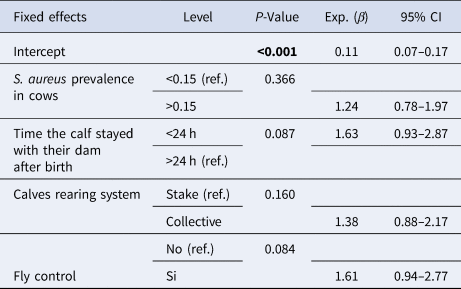
None of variables included in the multivariable analysis were associated with the presence of S. aureus IMI pre partum in heifers at a significance level of P < 0.05. However, two variables showed a tendency to be associated: time the calf spent with the dam after birth (OR = 1.63, 95% CI 0.94–2.87; P = 0.087) and fly control on farm (OR = 1.61; 95% CI 0.94–2.77; P = 0.084) (Table 1). Heifers from dairy farms where calves stayed >24 h with their dams after birth had 1.63 times more probability of having S. aureus IMI at pre-calving than those heifers from dairy farms where calves stayed less time. Heifers from farms that had a fly control system had 1.61 more probability to be positive to S. aureus in comparison with heifers whose farms did not implement fly control.
Final multivariable generalized lineal model (backward selection) for risk factors associated with presence of S. aureus in pre partum heifers

Bold numbers represent significant association.
Ref, reference category; CI, confidence interval.
Characterization of S. aureus isolates
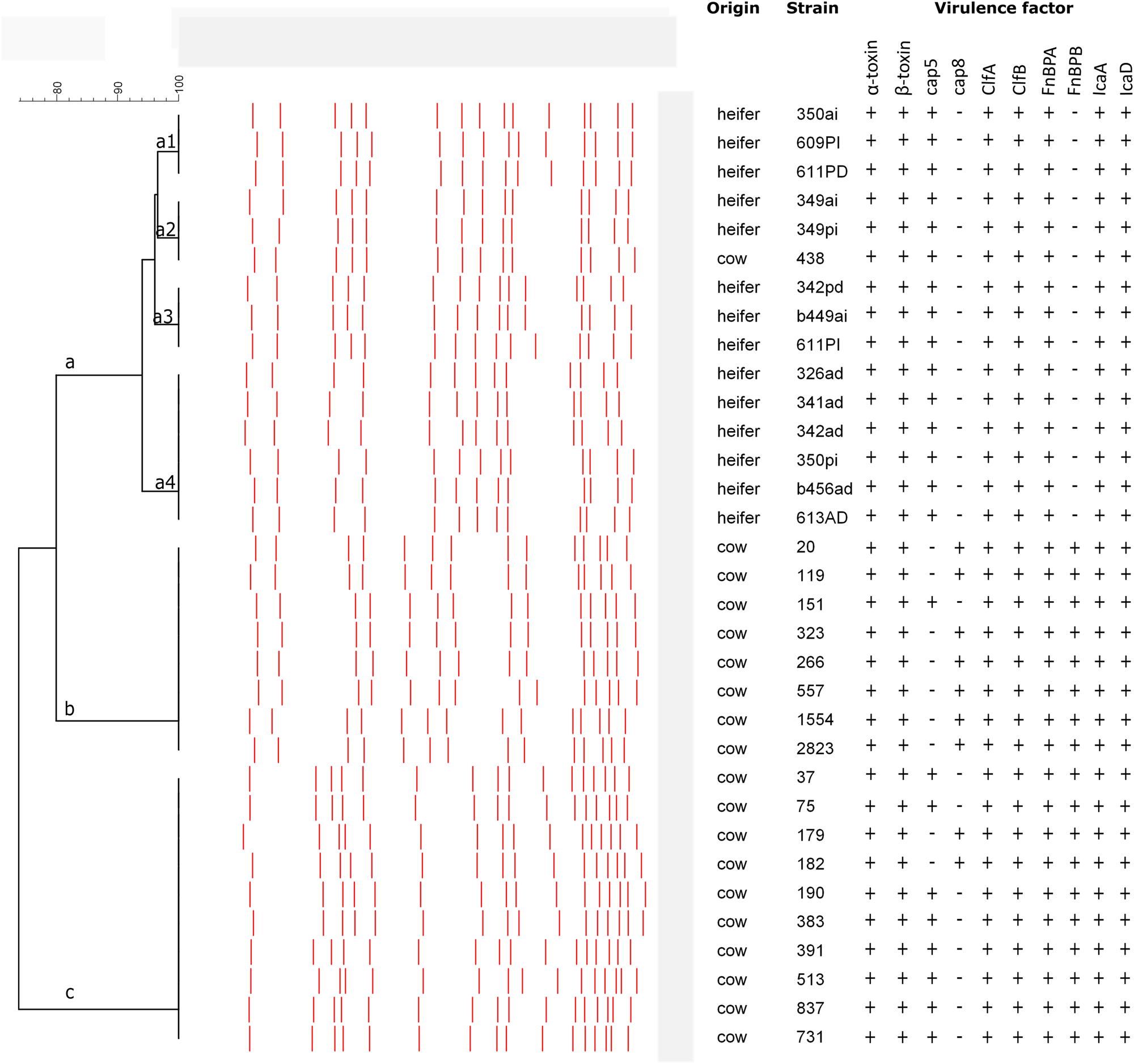
In H1 three PFGE clusters, a, b and c; and six genotypes were identified: a1 (3 isolates), a2 (3 isolates), a3 (3 isolates), a4 (6 isolates), b (8 isolates) and c (10 isolates) (Fig. 1). Isolates of cluster a were commoner in heifers (93.3%) than cows (6.7%) (P < 0.001); clusters b and c were only present in cows (100%).
Dendrogram of S. aureus SmaI PFGE profiles isolated from H1. Clusters were identified with lower cases (a, b and c) and genotypes were identified with lower cases plus a numeric suffix if needed. Isolates origin (cow/heifer), strain denomination, and presence (+) or absence (−) of selected S. aureus virulence factor genes are shown.

All S. aureus tested were positive for hla, hlb, clfA, clfB, fnbpA, icaA and icaD. All isolates in cluster a were cap5 positive. Seven from eight isolates included in genotype b were cap8 positive; while the remaining one was cap5 positive. Eight from 10 isolates in genotype c were cap5 positive, while the two remaining isolates were cap8 positive. The sample origin (cow vs. heifer) was associated with the presence of fnbpB, being more frequent in isolates from cows (94.7%) than from heifers (0%) (P < 0.001).
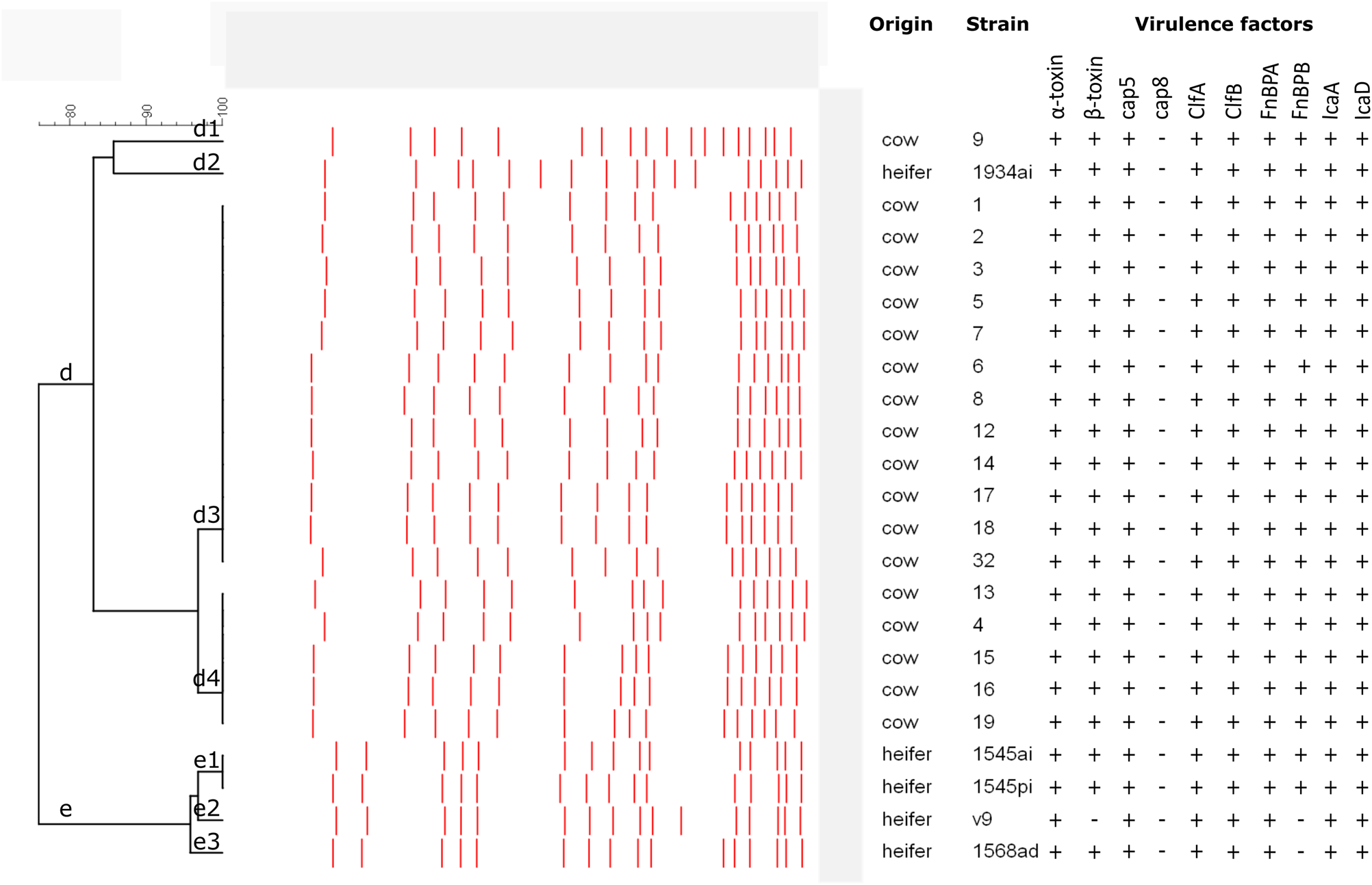
In H2, the analysis showed two clusters, d and e, and seven genotypes: d1 (1 isolate), d2 (1 isolate), d3 (12 isolates), d4 (5 isolates), e1 (2 isolates), e2 (1 isolate) and e3 (1 isolate) (Fig. 2). Cluster e was only present in heifers (P = 0.011), while cluster d was commoner in cows (94.7%) than heifers (5.3%) (P = 0.001).
Dendrogram of S. aureus SmaI PFGE profiles isolated from H2. Clusters were identified with lower cases (d and e) and genotypes were identified with lower cases plus a numeric suffix. Isolates origin (cow/heifer), strain denomination, and presence (+) or absence (−) of selected S. aureus virulence factor genes are shown.

All S. aureus tested were positive for cap5, hla, clfA, clfB, fnbpA, icaA and icaD. Only the isolate included in genotype e2 was negative for hlb. An association between the sample origin (cow vs. heifer) and presence of fnbpB was established, being more frequent in isolates from cows (100%) than from heifers (60%) (P = 0.04).
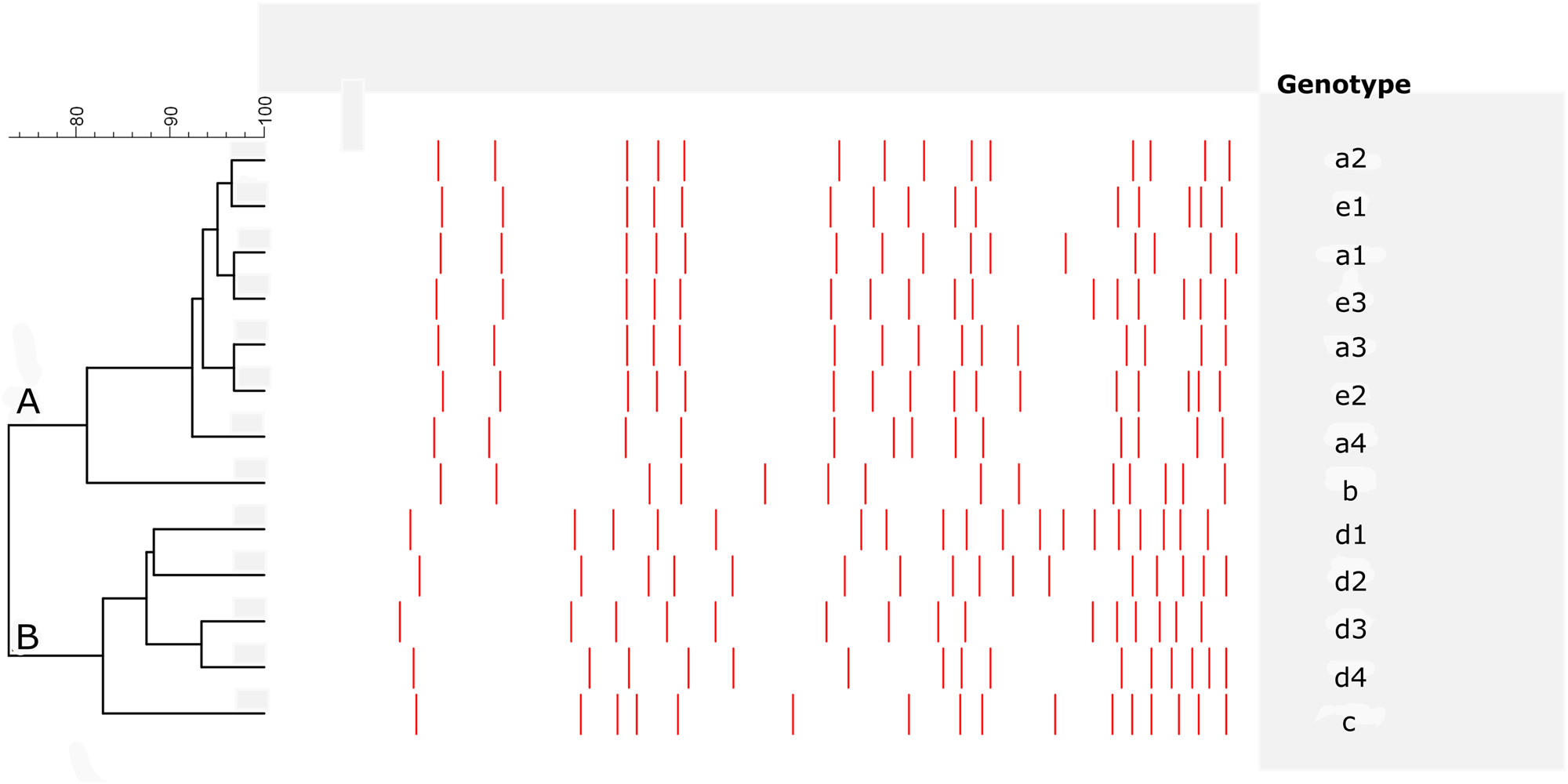
An isolate representative of each genotype identified in the analysis within herds (6 strains from H1 and 7 strains from H2) was selected (Fig. 3). No shared genotypes between herds were observed. Analysis produced thirteen individual genotypes, grouped in two clusters, A and B. Cluster A grouped eight genotypes, seven of them isolated from heifers. Genotypes a1, a2, a3, a4, e1, e2 and e3 (corresponded to pre partum heifer isolates) clustered with more than 90% of similarity, while genotype b (confirmed in lactating cow samples) was less related, clustering with 81% of similarity. Cluster B was more common in cows (80%) than heifers (20%) (P = 0.032). Genotypes c, d1, d3, and d4 (corresponded to lactating cows isolates) and d2 (corresponded to one pre-calved heifer isolate) were grouped with 83% of similarity.
Dendrogram of SmaI PFGE profiles of S. aureus isolates representative for each genotype defined in the analysis within herds. Clusters were identified with capital letters (A and B).

Discussion
Few previous studies have determined the prevalence of S. aureus IMI in primigravid heifers before parturition. Heifer and quarter S. aureus IMI found in the present study are lower than those found by Trinidad et al. (Reference Trinidad, Nickerson and Alley1990) in secretion samples from unbred and primigravid heifers in four Louisiana (USA) dairy herds (heifer IMI prevalence of 37.1% and quarter prevalence of 14.9%). However, they are similar to the S. aureus quarter IMI prevalence of 2.9% found by Fox et al. (Reference Fox, Chester, Hallberg, Nickerson, Pankey and Weaver1995) in unbred and primigravid heifers from 28 dairy herds in four states in USA and also to a previous survey in five dairy herds in Argentina with a prevalence of 4.1 of S. aureus quarter IMI in pre partum heifers (Calvinho et al., Reference Calvinho, Canavesio, Iguzquiza, Marioni, Puricelli, Neder, Tarabla and Aubagna2007). Conversely, Aarestrup and Jensen (Reference Aarestrup and Jensen1997) isolated S. aureus from only two mammary gland quarters of 180 pre partum dairy heifers in 20 dairy farms in Denmark and Compton et al. (Reference Compton, Heuer, Parker and McDougall2007) found a S. aureus quarter prevalence of 0.4% in pre partum pasture-grazed dairy heifers in New Zealand.
Several variables were associated with S. aureus IMI in pre-calved heifers but no one variable was significant in the multivariable analysis. This could be caused by the homogeneity in the management practices used in the farms. Only those variables with a P-value less than 0.10 in the multivariable analysis were considered further.
The prevalence of S. aureus IMI in pre partum heifers was higher on those dairy farms where calves stayed with their dam >24 h after birth, compared with those staying <24 h. The most obvious reason is the possibility of increased transmission of S. aureus from the dam to the calf, which would be most likely in herds with high level of S. aureus IMI. This implies colonization of extramammary sites in calves. The presence of S. aureus on different body sites has been detected in heifer calves from birth to less than two months of age in herds with a high prevalence of S. aureus IMI (Matos et al., Reference Matos, White, Harmon and Langlois1991; Capurro et al., Reference Capurro, Aspán, Ericsson Unnerstad, Persson Waller and Artursson2010; Anderson et al., Reference Anderson, Lyman, Moury, Ray, Watson and Correa2012). Similar S. aureus genotypes were found both at extramammary sites of heifer calves and in the milk of lactating cows, indicating that extramammary sites are a likely source of this organism and thus the origin of heifer IMI (Capurro et al., Reference Capurro, Aspán, Ericsson Unnerstad, Persson Waller and Artursson2010; Anderson et al., Reference Anderson, Lyman, Moury, Ray, Watson and Correa2012). However, even though S. aureus IMI has been detected in breeding age heifers (Fox et al., Reference Fox, Chester, Hallberg, Nickerson, Pankey and Weaver1995), there is no information on the persistence at pre partum of IMI acquired during the first days of life to parturition. Therefore, the importance of this association cannot be validated.
The role of horn flies (Haematobia irritans) as a vector in the transmission of S. aureus to heifers was demonstrated in experimental studies (Owens et al., Reference Owens, Oliver, Gillespie, Ray and Nickerson1998) and presence of S. aureus from the same genetic subtype was found in horn flies and mammary secretions from breeding age and bred heifers (Gillespie et al., Reference Gillespie, Owens, Nickerson and Oliver1999). Anderson et al. (Reference Anderson, Lyman, Moury, Ray, Watson and Correa2012) isolated S. aureus of the same pulsotype from horn flies, heifer colostrum and milk from lactating cows. Therefore, fly control is recommended as a practice for prevention of IMI in dairy heifers (Oliver et al., Reference Oliver, Gillespie, Headrick, Lewis and Dowlen2005; De Vliegher et al., Reference De Vliegher, Fox, Piepers, McDougall and Barkema2012). In the present study, the application of fly control was unexpectedly associated with an increased prevalence of S. aureus IMI. The justification for fly control in these two herds is unknown, thus the association found could be the result of cause-effect reversal, rather than a risk factor, as was observed by Nyman et al. (Reference Nyman, Emanuelson, Gustafsson and Persson Waller2009) for some preventive hygiene practices in herds with mastitis problems.
Heifers with S. aureus IMI at pre partum present a higher risk of mastitis at calving. Nearly 50% of all coagulase-positive Staphylococcus IMI in heifers at parturition appeared to persist into lactation for at least one month, posing a risk of transmission to uninfected herd mates (Roberson et al., Reference Roberson, Fox, Hancock, Gay and Besser1994). Previously we found that of 23 heifer quarters with a S. aureus IMI at pre partum, nine (39%) yielded this organism at post partum (Calvinho et al., Reference Calvinho, Canavesio, Iguzquiza, Marioni, Puricelli, Neder, Tarabla and Aubagna2007). However, these studies were performed using phenotypic methods. In the present study, S. aureus from both IMI in lactating cows and pre partum heifers were characterized at the molecular level. Similar to previous findings (Haveri et al., Reference Haveri, Hovinen, Roslöf and Pyörälä2008; Capurro et al., Reference Capurro, Aspán, Ericsson Unnerstad, Persson Waller and Artursson2010; Anderson et al., Reference Anderson, Lyman, Moury, Ray, Watson and Correa2012; Castelani et al., Reference Castelani, Silva Santos, dos Santos Miranda, Zafalon, Rodrigues Pozzi and Rodrigues Pozzi Arcaro2013), S. aureus isolates from the heifer herds were grouped into a few main clusters and several genotypes within some clusters. Isolates from the mammary secretion of the pre partum heifers and milk from lactating cows, in the two herds tested, grouped into different PFGE clusters in both herds, with only two exceptions. However, the time difference between when the pre partum heifers and the lactating cows were sampled does not allow drawing of any conclusions about diffusion or persistence of the S. aureus cluster found in heifers into the lactating herd. Our results agree with those of Castelani et al. (Reference Castelani, Silva Santos, dos Santos Miranda, Zafalon, Rodrigues Pozzi and Rodrigues Pozzi Arcaro2013) who found that a S. aureus isolated from a pre partum heifer carried a different pulsotype from that found in lactating cows in the same herd but differ from Haveri et al. (Reference Haveri, Hovinen, Roslöf and Pyörälä2008) who found the same pulsotype in milk from lactating cows and in two heifer colostrum samples obtained at pre partum in a dairy herd with a high prevalence of S. aureus IMI. Anderson et al. (Reference Anderson, Lyman, Moury, Ray, Watson and Correa2012) found that S. aureus isolates from primigravid heifer colostrum and lactating cows belonged mainly to two genotypes found in both groups. The results of the present study are not strictly comparable with those of Anderson et al. (Reference Anderson, Lyman, Moury, Ray, Watson and Correa2012), since in their study heifers were sampled within 3 to 4 d after calving and management practices of the newly calved heifer were not described. Our results suggest the existence of different sources of S. aureus infection for pre partum heifers and lactating cows, which could explain lack of statistical associations between IMI prevalence in heifers and management practices. Longitudinal analysis, including sequential sampling of heifers and lactating cows from pre-partum to the end of lactation in herds with high prevalence of S. aureus IMI both in pre-partum heifers and in lactating cows should be performed to provide further information about diffusion in the lactating herd of pulsotypes originated in IMI present in pre partum heifers.
All isolates carried the genes hla, clfA, clfB, fnbpA, icaA, icaD and either cap5 or cap8. All isolates, except one from a heifer in H2 carried the gene for hlb. In H1 all isolates from cluster a and two from heifers in H2 lacked fnbpB. Lack of this gene was significantly more frequent in heifer isolates than in cow isolates among herds. Haveri et al. (Reference Haveri, Hovinen, Roslöf and Pyörälä2008) also detected a lack of fnbpB in the less common pulsotypes in two dairy herds with high prevalence of S. aureus IMI, but they could not establish an association between the sample origin and virulence genes. However, their study was mainly focused in the comparison of isolates from IMI and extramammary sites. In in vitro internalization assays, FnBPs were overexpressed during S. aureus internalization into cells, in concert with other molecules that are involved in early host-pathogen interactions (Pereyra et al., Reference Pereyra, Picech, Renna, Baravalle, Andreotti, Calvinho, Diez and Dallard2016). Lack of fnbpB in heifer isolates can be associated with less internalization capacity in vivo, lower adaptation to colonize the mammary gland so resulting in a transient IMI. Conversely, presence of these genes in isolates from lactating cows can be associated with a better adaptation to colonize the mammary gland leading to a persisting IMI that could be a source of infection for other cows in the lactating herd. Further studies including a larger number of isolates and herds with high prevalence of S. aureus IMI are needed to confirm the trend observed in the present study and also to detect other genotypic characteristics linked to adaptation of this organism to the mammary gland (Bardiau et al., Reference Bardiau, Caplin, Detilleux, Graber, Moroni, Taminiau and Mainil2016).
In conclusion, none of the variables studied proved to be associated with the presence of S. aureus IMI in pre partum heifers according to multivariable analysis, probably due to the low variability among management practices used for rearing heifer calves, although the time calves stayed with their dam after birth and fly control on the farm showed a tendency for association. Staphylococcus aureus isolates from mammary secretions of pre partum heifers and milk of lactating cows were grouped in different PFGE clusters in both herds. The absence of the fnbpB gene was significantly more common in isolates from pre-calved heifer mammary secretion than in those of lactating cow milk among both herds studied. Altogether these results suggest that under the particular management conditions applied in Argentina isolates from mammary secretions of pre-calved heifer do not originate from the milk of lactating cows, but rather from other sources to which the heifer is exposed.
Supplementary material
The supplementary material for this article can be found at https://doi.org/10.1017/S0022029919001018
Acknowledgements
This work was supported by The National Institute of Agricultural Technology (Project INTA – AESA 52:203992) and Asociación Cooperadora INTA Rafaela. The authors express their appreciation to Dr Gerardo Leotta (Instituto de Genética Veterinaria (IGEVET-CONICET/UNLP) Facultad de Ciencias Veterinarias (UNLP) for the use of the Bionumerics software and to Mr M. Marín and O. Warnke for sample collection.