INTRODUCTION
The Class Homoscleromorpha Bergquist, Reference Bergquist1978 is the smallest class of sponges, with 103 species classified in a single order (Homosclerophorida Dendy, Reference Dendy1905) and two families (Oscarellidae von Lendenfeld, Reference von Lendenfeld1887 and Plakinidae Schulze, Reference Schulze1880; cf. van Soest et al., Reference van Soest, Boury-Esnault, Hooper, Rützler, de Voogd, Alvarez de Glasby, Hajdu, Pisera, Manconi, Schoenberg, Janussen, Tabachnick, Klautau, Picton, Kelly, Vacelet, Dohrmann, Díaz and Cárdenas2015). Only one genus is currently accepted in family Oscarellidae: Oscarella Vosmaer, Reference Vosmaer1884, without skeleton. Another aspiculate genus, Pseudocorticium Boury-Esnault et al., Reference Boury-Esnault, Muricy, Gallissian and Vacelet1995, was recently synonymized to Oscarella by Gazave et al. (Reference Gazave, Lavrov, Cabrol, Renard, Rocher, Vacelet, Adamska, Borchiellini and Ereskovsky2013). Six genera are valid in family Plakinidae: Plakortis Schulze, Reference Schulze1880, Plakinastrella Schulze, Reference Schulze1880, Plakina Schulze, Reference Schulze1880, Corticium Schmidt, Reference Schmidt1862, Placinolopha Topsent, Reference Topsent1897 and Tetralophophora Rützler et al., Reference Rützler, Piantoni, van Soest and Diaz2014, all with a skeleton composed of siliceous spicules (diods, triods, smooth calthrops, lophose calthrops, candelabra and microrhabds; Díaz & van Soest, Reference Díaz, van Soest, van Soest, van Kempen and Braekman1994; Muricy & Díaz, Reference Muricy, Díaz, Hooper and van Soest2002; Gazave et al., Reference Gazave, Lapébie, Renard, Vacelet, Rocher, Ereskovsky, Lavrov and Borchiellini2010, Reference Gazave, Lavrov, Cabrol, Renard, Rocher, Vacelet, Adamska, Borchiellini and Ereskovsky2013; Rützler et al., Reference Rützler, Piantoni, van Soest and Diaz2014).
In recent years, the Homoscleromorpha has gained special attention due to its relevant position at the basis of the metazoan phylogenetic tree. The presence of a basement membrane made of type IV collagen is considered a synapomorphy of the Eumetazoa and Homoscleromorpha that is not shared with other sponges (Boute et al., Reference Boute, Exposito, Boury-Esnault, Vacelet, Noro, Miyazaki, Yoshizato and Garrone1996). Their cinctoblastula larvae is similar to a presumed step on metazoan evolution (Nielsen, Reference Nielsen2008; Ereskovsky et al., Reference Ereskovsky, Borchiellini, Gazave, Ivanisevic, Lapébie, Perez, Renard and Vacelet2009a). Like all eumetazoans but unlike most other sponges, the spermatozoans of homosclerophorids have an acrosome; furthermore, and also in contrast to other sponges, the spermatogenesis is asynchronous inside spermatocysts (Ereskovsky et al., Reference Ereskovsky, Borchiellini, Gazave, Ivanisevic, Lapébie, Perez, Renard and Vacelet2009a). Recently, phylogenetic studies with different molecular markers suggested that the Homoscleromorpha should be separated from other sponges at class or even at phylum level (Borchiellini et al., Reference Borchiellini, Chombard, Manuel, Alivon, Vacelet and Boury-Esnault2004; Erpenbeck & Wörheide, Reference Erpenbeck and Wörheide2007; Phillippe et al., Reference Philippe, Derelle, Lopez, Pick, Borchiellini, Boury-Esnault, Vacelet, Renard, Houliston, Quéinnec, Silva, Wincker, Le Guyader, Leys, Jackson, Schreiber, Erpenbeck, Morgenstern, Worheide and Manuel2009; Gazave et al., Reference Gazave, Lapébie, Ereskovsky, Vacelet, Renard, Cárdenas and Borchiellini2012; Nielsen, Reference Nielsen2012).
The class Homoscleromorpha is cosmopolitan, occurring from the equator to the poles and from the intertidal to the deep sea. However, despite its importance, little is known about its diversity and distribution in most regions of the world. Only in the Mediterranean Sea has the group been recently revised, with 23 species currently accepted (Ereskovsky et al., Reference Ereskovsky, Ivanisevic and Perez2009b; Pérez et al., Reference Pérez, Ivanisevic, Dubois, Pedel, Thomas, Tokina and Ereskovsky2011; Pansini et al., Reference Pansini, Manconi and Pronzato2011). In this paper we investigate all records of Homoscleromorpha species from the Tropical Western Atlantic (TWA) and present an overview of their taxonomy, biodiversity and distribution to put in evidence taxonomic problems, distribution patterns and diversity hotspots of Homoscleromorpha in the TWA.
MATERIALS AND METHODS
The Tropical Western Atlantic was divided by Spalding et al. (Reference Spalding, Fox, Allen, Davidson, Ferdaña, Finlayson, Halpern, Jorge, Lombana, Lourie, Martin, McManus, Molnar, Recchia and Robertson2007) into 16 ecoregions and three provinces: Tropical North-western Atlantic, North Brazil Shelf, and Tropical South-western Atlantic. We followed this division and also included in our study area the Warm Temperate North-west Atlantic Province, with Carolinian and Northern Gulf of Mexico ecoregions (Figure 1). Based on a literature survey, the distribution of each species was mapped and compared with these ecoregions.
Study area, according to the division of the Western Atlantic Ocean in realms, provinces and ecoregions of Spalding et al. (Reference Spalding, Fox, Allen, Davidson, Ferdaña, Finlayson, Halpern, Jorge, Lombana, Lourie, Martin, McManus, Molnar, Recchia and Robertson2007).

RESULTS AND DISCUSSION
Biodiversity and taxonomy
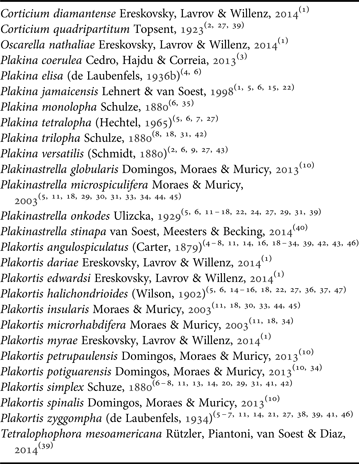
Twenty-seven species of Homoscleromorpha are currently recognized in the Tropical Western Atlantic, including one of the family Oscarellidae (Oscarella nathaliae) and 26 plakinids: two Corticium, seven Plakina, four Plakinastrella, 12 Plakortis and one Tetralophophora (Table 1). This number represents 26.2% of the total of 103 species currently known worldwide (van Soest et al., Reference van Soest, Boury-Esnault, Hooper, Rützler, de Voogd, Alvarez de Glasby, Hajdu, Pisera, Manconi, Schoenberg, Janussen, Tabachnick, Klautau, Picton, Kelly, Vacelet, Dohrmann, Díaz and Cárdenas2015), and is slightly higher than the 23 species listed from the Mediterranean (Ereskovsky et al., Reference Ereskovsky, Ivanisevic and Perez2009b; Pansini et al., Reference Pansini, Manconi and Pronzato2011; Pérez et al., Reference Pérez, Ivanisevic, Dubois, Pedel, Thomas, Tokina and Ereskovsky2011).
Checklist of currently accepted species of Homoscleromorpha from the Tropical Western Atlantic.
References of all articles reporting the species from the TWA are numbered within parentheses and listed below.
References: (1) Ereskovsky et al. (Reference Ereskovsky, Lavrov and Willenz2014); (2) Topsent (Reference Topsent1923); (3) Cedro et al. (Reference Cedro, Hajdu and Correia2013); (4) de Laubenfels (Reference de Laubenfels1936b); (5) Lehnert & van Soest (Reference Lehnert and van Soest1998); (6) Miloslavich et al. (Reference Miloslavich, Díaz, Klein, Alvarado, Díaz, Gobin, Escobar-Briones, Cruz-Motta, Weil, Cortés, Bastidas, Robertson, Zapata, Martín, Castillo, Kazandjian and Ortiz2010); (7) Hechtel (Reference Hechtel1965); (8) Boury-Esnault (Reference Boury-Esnault1973); (9) Schmidt (Reference Schmidt and Mauke1880); (10) Domingos et al. (Reference Domingos, Moraes and Muricy2013); (11) Moraes & Muricy (Reference Moraes and Muricy2003); (12) Uliczka (Reference Uliczka, Kükenthal and Hartmeyer1929); (13) Pulitzer-Finali (Reference Pulitzer-Finali1986); (14) Zea (Reference Zea1987); (15) Rützler et al. (Reference Rützler, Díaz, van Soest, Zea, Smith, Alvarez and Wulff2000); (16) Díaz (Reference Díaz2005); (17) Mothes et al. (Reference Mothes, Campos, Lerner and Silva2006); (18) Muricy et al. (Reference Muricy, Lopes, Hajdu, Carvalho, Moraes, Klautau, Menegola and Pinheiro2011); (19) Carter (Reference Carter1879); (20) Alcolado (Reference Alcolado1976); (21) Alcolado (Reference Alcolado2002); (22) Diaz & Rützler (Reference Diaz and Rützler2009); (23) van Soest (Reference van Soest1981); (24) Wintermann-Kilian & Kilian (Reference Wintermann-Kilian and Kilian1984); (25) Kobluk & van Soest (Reference Kobluk and van Soest1989); (26) Alvarez et al. (Reference Alvarez, Diaz, Laughlin and Rützler1990); (27) Díaz & van Soest (Reference Díaz, van Soest, van Soest, van Kempen and Braekman1994); (28) Kossuga et al. (Reference Kossuga, Nascimento, Reimão, Tempone, Taniwaki, Veloso, Ferreira, Cavalcanti, Pessoa, Moraes, Mayer, Hajdu and Berlinck2008); (29) Mothes & Bastian (Reference Mothes and Bastian1993); (30) Muricy & Moraes (Reference Muricy and Moraes1998); (31) Santos et al. (Reference Santos, Cantarelli, Tenório, Tabarelli and Silva2002); (32) Epifanio et al. (Reference Epifanio, Pinheiro and Alves2005); (33) Moraes et al. (Reference Moraes, Ventura, Klautau, Hajdu, Muricy, Alves and Castro2006); (34) Muricy et al. (Reference Muricy, Esteves, Moraes, Santos, Silva, Klautau and Lanna2008); (35) Arndt (Reference Arndt1927); (36) Wilson (Reference Wilson1902); (37) Collette & Rützler (Reference Collette and Rützler1977); (38) de Laubenfels (Reference de Laubenfels1934); (39) Rützler et al. (Reference Rützler, Piantoni, van Soest and Diaz2014); (40) van Soest et al. (Reference van Soest, Meesters and Becking2014); (41) de Laubenfels (Reference de Laubenfels1950a); (42) Hechtel (Reference Hechtel, Harrison and Cowden1976); (43) Rützler et al. (Reference Rützler, van Soest, Piantoni, Felder and Camp2009); (44) Moraes (Reference Moraes2011); (45) Moraes et al. (Reference Moraes, Vilanova and Muricy2003); (46) de Laubenfels (Reference de Laubenfels1936a); (47) Karlson & Osman (Reference Karlson and Osman2012).
The most specious genus of Homoscleromorpha in the TWA is Plakortis with 12 species, followed by Plakina (7 spp.) and Plakinastrella (4 spp.). This pattern contrasts with that of the Mediterranean, where Plakina and Oscarella dominate with 11 and seven species, respectively. Only one species of Plakortis, P. simplex Schulze, Reference Schulze1880, was reported so far from the Mediterranean (Ereskovsky et al., Reference Ereskovsky, Ivanisevic and Perez2009b), in strong contrast with its high species richness in the TWA. This may be related to a general preference of Plakortis spp. for coral reefs or rocky coast environments in tropical waters. The genus Plakortis is also very common and diverse in the tropical Indo-Australian region (Muricy, Reference Muricy2011).
Twelve new species and one new genus of Homoscleromorpha have been described from the TWA in the last two years, 2013–2014. Such recent descriptions illustrate well the growing interest in the diversity and biology of the class. These descriptions are quite detailed, usually including colour underwater photographs of living specimens, SEM pictures of spicules, and information on skeletal architecture in both the choanosome and the ectosome (Cedro et al., Reference Cedro, Hajdu and Correia2013; Domingos et al., Reference Domingos, Moraes and Muricy2013; Ereskovsky et al., Reference Ereskovsky, Lavrov and Willenz2014; Rützler et al., Reference Rützler, Piantoni, van Soest and Diaz2014; van Soest et al., Reference van Soest, Meesters and Becking2014). Older descriptions, however, are often much less complete and frequently raise doubts on the identity of several records of Homoscleromorpha in the region. It is thus difficult to recognize species such as Plakinastrella onkodes Uliczka, Reference Uliczka, Kükenthal and Hartmeyer1929, Plakortis angulospiculatus (Carter, Reference Carter1879), Plakortis halichondrioides (Wilson, Reference Wilson1902), Plakortis simplex, Plakortis zyggompha (de Laubenfels, Reference de Laubenfels1934), Corticium quadripartitum Topsent, Reference Topsent1923, Plakina elisa (de Laubenfels, Reference de Laubenfels1936) and Plakina versatilis (Schmidt, Reference Schmidt and Mauke1880). These species need taxonomic revision. This taxonomic uncertainty, especially in the genera Plakortis and Plakinastrella, is currently a major problem in the estimation of the biodiversity of Homoscleromorpha in the TWA.
Distribution patterns
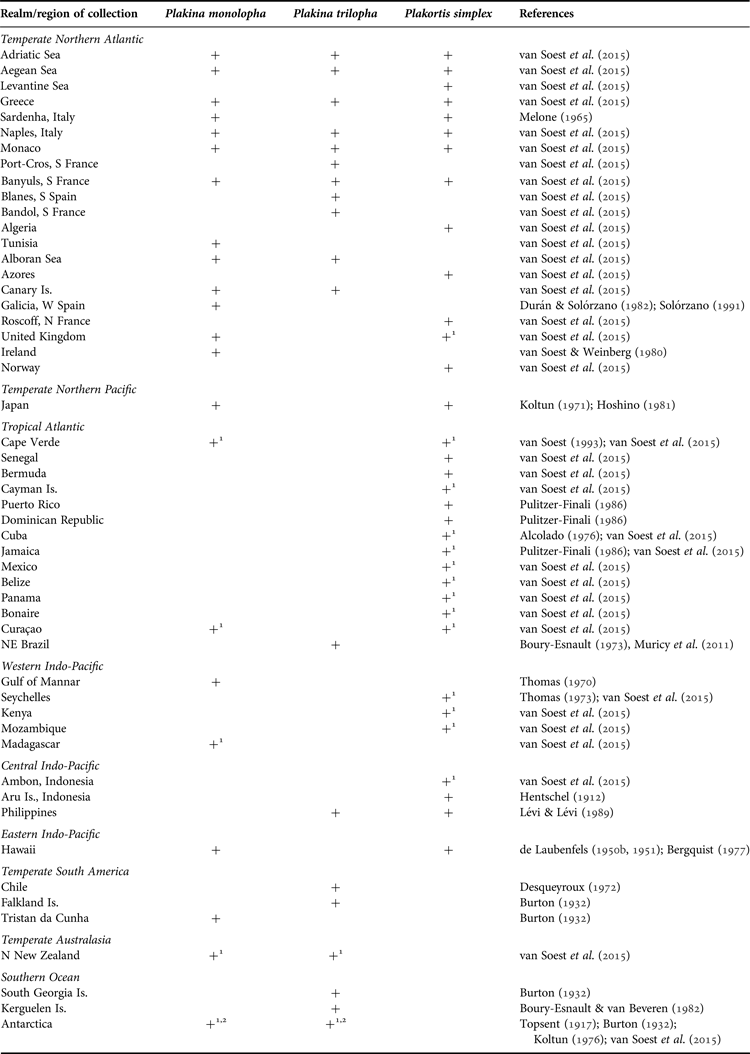
Three species of Homoscleromorpha reported from the TWA are allegedly cosmopolitan: Plakina monolopha Schulze, Reference Schulze1880, P. trilopha Schulze, Reference Schulze1880 and Plakortis simplex (Table 2, Figure 2), all originally described from the Mediterranean. They have been reported in the TWA with short or without descriptions (e.g. Boury-Esnault, Reference Boury-Esnault1973; Pulitzer-Finali, Reference Pulitzer-Finali1986; Miloslavich et al., Reference Miloslavich, Díaz, Klein, Alvarado, Díaz, Gobin, Escobar-Briones, Cruz-Motta, Weil, Cortés, Bastidas, Robertson, Zapata, Martín, Castillo, Kazandjian and Ortiz2010). These records represent complexes of cryptic species and the TWA populations probably deserve new species names. The distribution of Plakina monolopha and P. trilopha within the study area is much more restricted than that of the Plakortis simplex complex, which occurs in five ecoregions (Figure 2).
Worldwide records of the three allegedly cosmopolitan species of Homoscleromorpha reported from the Tropical Western Atlantic: Plakina monolopha, P. trilopha and Plakortis simplex.
Realms according to Spalding et al. (Reference Spalding, Fox, Allen, Davidson, Ferdaña, Finlayson, Halpern, Jorge, Lombana, Lourie, Martin, McManus, Molnar, Recchia and Robertson2007).
1 Record considered inaccurate by van Soest et al. (Reference van Soest, Boury-Esnault, Hooper, Rützler, de Voogd, Alvarez de Glasby, Hajdu, Pisera, Manconi, Schoenberg, Janussen, Tabachnick, Klautau, Picton, Kelly, Vacelet, Dohrmann, Díaz and Cárdenas2015).
2 Variety antarctica.
All other 24 species reported are TWA endemics. Within the TWA, only four species are widely distributed, occurring both in the Tropical North-western Atlantic and in the North Brazil Shelf or in the Tropical South-western Atlantic provinces: Plakinastrella onkodes, Plakinastrella microspiculifera Moraes & Muricy, Reference Moraes and Muricy2003, Plakortis angulospiculatus and Plakortis halichondrioides. These species also occurred in a large number of ecoregions, from 5–12 (Figure 3). As discussed above, however, this apparently wide distribution may be the result of misidentifications or different interpretations of each species’ concept, in general due to insufficient descriptions. One example is the concept of Plakinastrella onkodes, originally described as a light brown (in alcohol), massive sponge with small oscules (maximum 5 mm in diameter) on the sides of several small, irregular lobes (Uliczka, Reference Uliczka, Kükenthal and Hartmeyer1929). In more recent years, however, this species has been often described as light or dark brown, with a single or few tubes topped by a large apical oscule, or light grey and thick encrusting (Figure 4). Such taxonomic problems may have artificially increased by many thousands of kilometres and in three more provinces the estimated range of this (or these) species. Plakortis angulospiculatus and P. halichondrioides also have been described with wide morphological and ecological variations by different authors (e.g. Carter, Reference Carter1879; Wilson, Reference Wilson1902; Zea, Reference Zea1987; Díaz & van Soest, Reference Díaz1994; Lehnert & van Soest, Reference Lehnert and van Soest1998; Moraes & Muricy, Reference Moraes and Muricy2003; Figure 5), and their distribution could in fact be much more restricted than currently thought.
Distribution of Homoscleromorpha species that occur in two or more biogeographic provinces in the TWA: widely distributed species or complexes of cryptic species with more restricted distributions. Numbers within parentheses represent the total of ecoregions in which the species occurs. See Figure 1 for the names of provinces and ecoregions.
Morphological variation of Plakinastrella onkodes: (A) the holotype is irregularly lobate, bright light brown in alcohol, with small oscules (reproduced from Uliczka, Reference Uliczka, Kükenthal and Hartmeyer1929); (B–F) examples of the current concepts of P. onkodes: (B) greenish-brown, tubular specimen from the Bahamas (photo from Zea et al., Reference Zea, Henkel and Pawlik2014; http://www.spongeguide.org); (C) light brown, massively encrusting specimen from the Caribbean (photo Charles and Anne Sheppard; http://coralpedia.bio.warwick.ac.uk); (D) lobate, dark brown specimen from the Caribbean (photo Chris Freeman; http://porifera.lifedesks.org); (E) lobate, greyish brown specimen from Bocas del Toro, Panama (photo Renata Goodridge; http://biogeodb.stri.si.edu/bocas_database); (F) whitish specimen from Amapá State, N Brazil (reproduced from Mothes et al., Reference Mothes, Campos, Lerner and Silva2006).
In situ photographs of Plakortis spp. from the TWA showing morphological variation. (A–C) P. angulospiculatus: (A–B) specimens from the Bahamas (photographs from Zea et al., Reference Zea, Henkel and Pawlik2014; http://www.spongeguide.org); (C) specimen from Potiguar Basin, NE Brazil (photo Fernando Moraes; http://www.poriferabrasil.mn.ufrj.br); (D–F) P. halichondrioides: specimens from the Bahamas (photographs from Zea et al., Reference Zea, Henkel and Pawlik2014; http://www.spongeguide.org). High variation in external morphology suggests possible cryptic speciation.
Most species (20/27, or approximately 74%) have narrow distributions, being restricted to 1–3 ecoregions in a single biogeographic province: 13 in the Tropical North-western Atlantic (Corticium diamantense, C. quadripartitum, O. nathaliae, Plakina elisa, P. jamaicensis, P. tetralopha, P. versatilis, Plakortis dariae, P. edwardsi, P. myrae, P. zyggompha, Plakinastrella stinapa, Tetralophophora mesoamericana; Figure 6), and seven in the Tropical South-western Atlantic (Plakina coerulea, Plakinastrella globularis, Plakortis insularis, P. microrhabdifera, P. potiguarensis, P. spinalis, P. petrupaulensis; Figure 7). This pattern probably reflects a low dispersal ability of the cinctoblastula larvae, rather than an artifact due to insufficient collections.
Distribution of species restricted to the Tropical North-western Atlantic province (‘Caribbean endemics’). Numbers within parentheses represent the total of ecoregions in which the species occur. See Figure 1 for the names of provinces and ecoregions.
Distribution of species restricted to the Tropical Southwestern Atlantic province (‘Brazilian endemics’). Numbers within parentheses represent the total of ecorregions in which the species occur. See Figure 1 for the names of provinces and ecoregions.
Biodiversity hotspots
The areas with the highest number of species recorded are Jamaica (12 spp.), Belize (8 spp.) and Panama (6 spp.) in the Caribbean, and Fernando de Noronha Archipelago and Potiguar Basin in Brazil (4 spp. each; Figure 8). On the other hand, five other areas had only one or two records (South Carolina, Bermuda, off the mouth of the Amazon River, Abrolhos Reefs, Trindade Island), and only the Guiana ecoregion has no record of homoscleromorphs so far (Figure 8).
Species richness of Homoscleromorpha in different localities (numbers) and ecoregions (colour code) in the Tropical Western Atlantic. See Figure 1 for the names of provinces and ecoregions.
This pattern may be explained by the sum of several factors: (1) subjective taxonomic decisions leading to over-splitting of species and high apparent diversity (possibly the case of Jamaica); (2) subjective ‘lumping’ of populations that belong in fact to complexes of cryptic species, leading to a lower estimation of biodiversity (e.g. Plakortis simplex, P. angulospiculatus, Plakinastrella onkodes); (3) unequal sampling effort in different places (e.g. higher in Jamaica, Panama, Curaçao and Belize; lower in Abrolhos Reefs, Trindade Island and the Guianas); (4) real differences in species richness due to biogeographic, historical or ecological factors (this may be the case of the Guianas and Amazonian ecoregions, with high sediment input from the Amazonas and Orinoco rivers and relatively few hard substrates for sponge colonization). In the last hypothesis, the Guianas and Amazonian ecoregions could be effective barriers separating North-western and South-western Tropical Atlantic populations of Homoscleromorpha species and leading to allopatric speciation, increasing the diversity of the class in the Tropical Western Atlantic realm. More objective, integrative taxonomic approaches (e.g. Boury-Esnault et al., Reference Boury-Esnault, Lavrov, Ruiz and Perez2013; Cruz-Barraza et al., Reference Cruz-Barraza, Vega and Carballo2014; Ereskovsky et al., Reference Ereskovsky, Lavrov and Willenz2014; Ruiz et al., Reference Ruiz, Ivanisevic, Chevaldonné, Ereskovsky, Boury-Esnault, Vacelet, Thomas and Pérez2014), and increasing sampling efforts in poorly explored areas such as the Guianas and Abrolhos Reefs will help to make more precise estimations of the biodiversity and biogeography of Homoscleromorpha. The exploration of submarine caves and other sciaphilic habitats should also lead to a large number of species discovered, since most species of Oscarella, Plakina and Corticium are highly sciaphilic (Solé Cava et al., Reference Solé-Cava, Boury-Esnault, Vacelet and Thorpe1992; Muricy et al., Reference Muricy, Solé-Cava, Thorpe and Boury-Esnault1996, Reference Muricy, Boury-Esnault, Bézac and Vacelet1998; Ereskovsky et al., Reference Ereskovsky, Ivanisevic and Perez2009b; Gerovasileiou & Voultsiadou, Reference Gerovasileiou and Voultsiadou2012). Species of Plakinastrella and Plakortis, however, are often exposed to sunlight and wave action in reef environments (e.g. Zea, Reference Zea1987; Moraes & Muricy, Reference Moraes and Muricy2003), so these habitats should not be neglected as well.
Despite all the taxonomic problems and the need of more collections, several undescribed species of Oscarella, Plakina, Plakinastrella and Plakortis are known from Brazil and from the Caribbean (Figure 9; Muricy et al., Reference Muricy, Lopes, Hajdu, Carvalho, Moraes, Klautau, Menegola and Pinheiro2011). We therefore estimate that the true biodiversity of Homoscleromorpha in the TWA is at least twice as high as the 27 species currently known.
In situ photographs of undescribed species of Plakina and Oscarella from the Tropical Western Atlantic. (A–C) Plakina spp. from Cabo Frio, SE Brazil; (D–F) Oscarella spp. from: (D) Cabo Frio, SE Brazil; (E) Cuba and (F) Fernando de Noronha, NE Brazil.
FINANCIAL SUPPORT
The authors are grateful to Fundação Carlos Chagas de Apoio à Pesquisa do Rio de Janeiro (FAPERJ), Coordenação de Aperfeiçoamento de Pessoal de Nível Superior (CAPES) and Conselho Nacional de Desenvolvimento Científico e Tecnológico (CNPq) for grants or fellowships.