In his final work report to the delegates of the 2012 National People's Congress, Premier Wen Jiabao 温家宝 insisted that the government would “guide Chinese enterprises under various forms of ownership in making overseas investments … in an orderly manner.”Footnote 1 Yet, for most China scholars, Wen's promises are suspect. The field's long standing paradigm of fragmented authoritarianism emphasizes how central-level policymakers’ bargaining with local governments and bureaucratic agencies undermines policy coordination, coherence and implementation.Footnote 2 Foreign economic policy is widely seen as particularly fragmented across a diverse set of actors with diverging interests and unequal power.Footnote 3 In contrast, popular studies offer an image of a unified Party-state globally deploying overseas aid, investment and trade to strategic ends.Footnote 4 While some experts gloss over the problem of internal coordination,Footnote 5 others usefully highlight the Party tools used to shape enterprise behaviour, particularly the power of executive appointments, described by James McGregor as the “heart and soul of China's authoritarian capitalist system.”Footnote 6 These two approaches diverge sharply over issues such as whether government strategy or firms’ commercial incentives drive China's overseas energy investments.Footnote 7
One path for advancing this debate is to specify the conditions under which the central government is likely to shape local government and enterprise behaviour successfully. The principal-agent framework, developed to examine how managers delegate responsibilities to workers in modern firms, offers two useful insights in this regard. First, the framework highlights how principals rely upon a system of rewards and punishments to shape agents’ preferences and to encourage behaviour that advances the principals’ objectives. Second, this approach spotlights how agents’ diverging interests, privileged access to information, and autonomy of action impede principals’ effective monitoring and enforcement.Footnote 8 Both dynamics are prevalent in China's efforts to promote overseas trade and investment. Central officials deploy diplomacy, investment capital and supportive policies to encourage local governments and enterprises to expand overseas. However, firms’ pursuit of profits frequently leads them to act in ways that undermine diplomatic goals. Expansion in the number and diversity of enterprises, and in the bureaucratic agencies responsible for oversight, impedes effective enforcement. In short, while Chinese leaders are likely to be successful in encouraging firms to expand overseas, their ability to ensure that enterprises behave in an “orderly manner” will remain limited.
The principal-agent framework, Alden and Large suggest, is already “at the heart of the problem of developing sustainable Chinese ties” with developing countries.Footnote 9 This study extends the approach to China's economic engagement with the Democratic Peoples’ Republic of Korea (DPRK). North Korea represents a tough case for both aspects of this argument. As Freeman and Thompson point out, Beijing's strategy of promoting trade and investment “is tempered by limited interest by Chinese companies in taking on the risk involved in doing business in North Korea's business-unfriendly environment.”Footnote 10 Furthermore, the DPRK's tightly controlled society and relatively limited level of trade ease Beijing's efforts to monitor and curtail corporate malfeasance in North Korea.Footnote 11 If both dynamics emerge in this “crucial” case, then they are more likely to arise in China's ties across Asia.Footnote 12
This article begins by demonstrating that since 2005 Chinese leaders have provided a range of incentives to encourage greater economic engagement with North Korea. The second section details how local governments and commercial firms embraced this opportunity in ways that advanced their own interests, contributing to the rapid growth in bilateral trade and investment. The third part examines how Chinese firms benefited from state support as they expanded into North Korea. The final section shows how expanding trade ties with limited transparency and a proliferation of small private actors have intensified Beijing's principal-agent dilemma. Research for this study includes interviews with Chinese experts and businesspeople, and field visits in Liaoning and Jilin provinces throughout 2012. It is augmented by media reports, government publications, academic studies and economic data.
Beijing's Engagement Strategy: Cutting the Gordian Knot
Most experts describe China's North Korea policy as a failure. While agreeing that China's assistance helps to sustain the regime,Footnote 13 experts criticize Beijing's economic engagement for its failure to either deliver benefits to China's border regions,Footnote 14 restrain the DPRK's nuclear and missile programmes,Footnote 15 or stimulate economic reforms within the DPRK.Footnote 16 Chinese experts are among some of the harshest critics.Footnote 17 Historian Chen Jian captures this frustration:
Beijing's leaders are facing a major dilemma: if they do not apply the economic means, it is likely that their voice will go unheard by Pyongyang's ears; but if they do use economic means – such as cutting off China's aid to North Korea – this might backfire and, in the worst case scenario, might even cause North Korea's economic and societal collapse and thus result in a huge blow to China's own interests … It seems that Beijing is yet to develop a satisfactory strategy to cope with this dilemma.Footnote 18
In an effort to cut this Gordian knot, Chinese leaders have encouraged local governments and Chinese companies to expand their economic interactions with North Korea by providing diplomatic support, infrastructure projects, foreign aid and investment capital; a strategy encapsulated by the new framework announced in Pyongyang in 2005 by Chinese vice-premier, Wu Yi 吴仪: “government guidance with companies in the lead; market-based operations and mutual benefit” (zhengfu yindao, qiye weizhu, shichang yunzuo, huligongying 政府引导 企业为主 市场运作 互利共赢).Footnote 19 Ideally, this policy would nudge Pyongyang towards security moderation, facilitate gradual economic reforms and openness, spur economic growth in China's border regions, and bolster Beijing's influence within North Korea – a classic “win-win” approach.Footnote 20
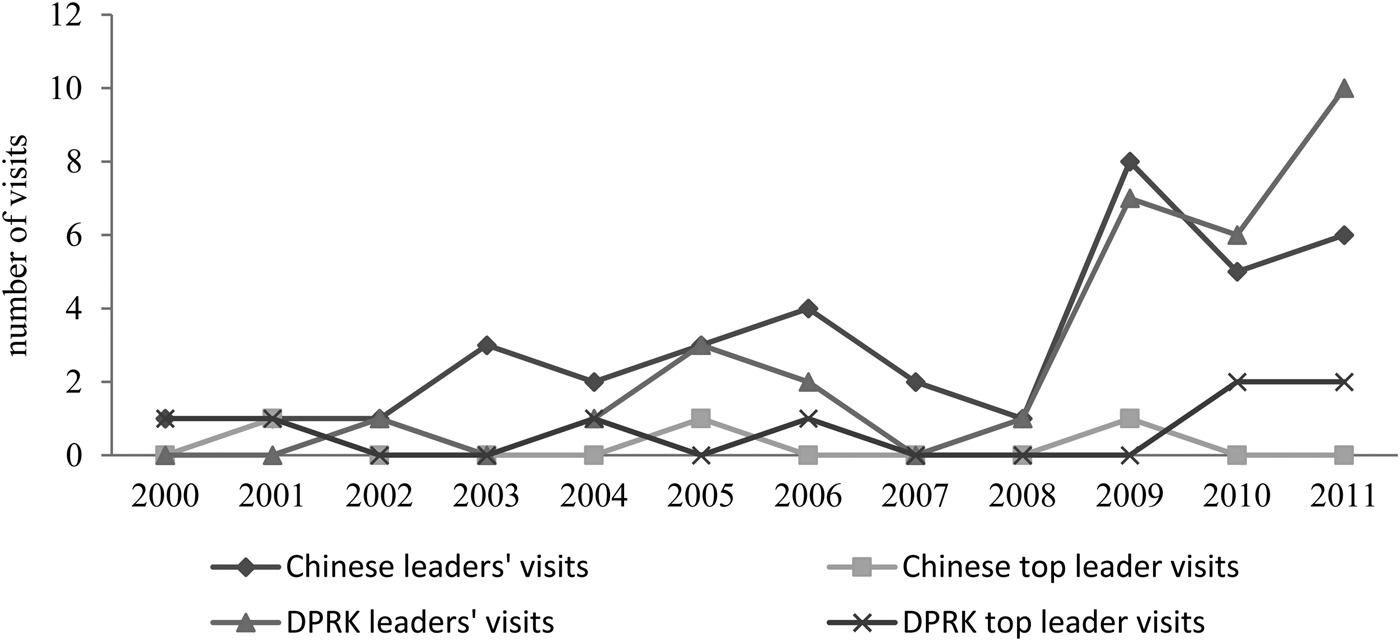
Expanding diplomatic engagement has been at the core of Beijing's strategy. In the 1980s, Chinese leaders made just nine visits to North Korea, with ten DPRK return trips. During the 1990s, nine Chinese visits were matched by only seven DPRK visits to China. In contrast, in the 2000s, there were 33 visits by Chinese leaders to the DPRK, with 27 DPRK return visits. From 2009 through 2011 alone, there were 20 visits by Chinese leaders to the DPRK, and 27 North Korean visits to China (see Figure 1).Footnote 21
Bilateral Leaders’ Visits, 2000–2011

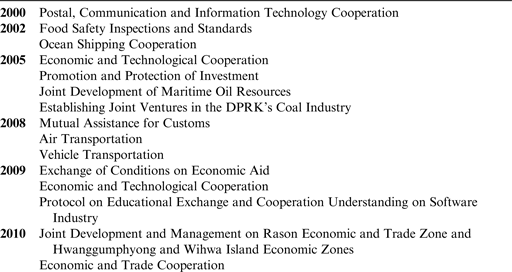
Beijing used frequent leadership visits to facilitate inter-ministerial coordination as well as reach diplomatic accords.Footnote 22 Premier Wen Jiabao's landmark visit to Pyongyang in October 2009 (the first by a Chinese premier in 18 years) included all key players in China's DPRK policy, notably the minister of commerce (MOFCOM), Chen Deming 陈德铭, and National Development and Reform Commission minister, Zhang Ping 张平.Footnote 23 Wen promised to build a new bridge across the Yalu River 鸭绿江 (at an estimated cost of US$150 million), signed a raft of diplomatic accords, designated 2010 as the “Year of Sino-Korean Friendship,” and agreed to establish two new joint economic development zones.Footnote 24 Emphasizing the importance of remaining “friendly neighbours while strengthening cooperation,” Wen carefully distinguished his promotion of economic ties from the tensions over the nuclear issue, trumpeted by the foreign minister, Yang Jiechi 杨洁篪, as Wen's “two great accomplishments.”Footnote 25 Having signed only seven major bilateral economic agreements between 1953 and 1999, Beijing's diplomatic push yielded an array of economic agreements (see Table 1).
Major China–DPRK Economic Agreements, 2000–2010
Source: International Economic Trade and Cooperation Research Institute 2011, 48.
To implement this policy, diplomats were mobilized to support Chinese corporations. On 20 May 2010, Ambassador Liu Hongcai 刘洪才 brought together major Chinese firms in Pyongyang to pledge his enhanced support for their efforts.Footnote 26 The embassy soon began hosting regular events to introduce Chinese firms to both DPRK officials and visiting Chinese officials.Footnote 27 China's consul in Chongjin publicized his regular trips to Rason port for “exchanges and communication on the problem of protecting the legal rights of Chinese citizens and organizations in North Korea.”Footnote 28 Emblematic of Beijing's efforts, the Chinese chamber of commerce in Pyongyang (Sinocham DPRK) was established on 14 February 2012. Sinocham pledges to deliver members’ “suggestions, opinions, and demands” to both the Chinese and DPRK governments, transmit government “guidance” back to its members, and to support members by “analysing and resolving trade and investment problems in North Korea.”Footnote 29
MOFCOM's 2011 investment report lauds the DPRK's “extremely abundant” mining resources as “among the largest in the world.” Praising recent reform measures while providing detailed (and hard to get) economic data, the report even suggests that requirements to hire at least 80 per cent North Korean workers on projects “might be negotiated downward through discussion with the DPRK Trade Ministry.”Footnote 30 Going a step further, on 14 August 2012, MOFCOM vice-minister, Chen Jian 陈健, published a People's Daily article pledging to “support Chinese enterprises … to advance the establishment of enhanced bilateral trade and investment structures [in the DPRK].”Footnote 31 A month later, the China Overseas Investment Federation announced a new 3 billion yuan (US$470 million) “Fund for Investment into North Korea.”Footnote 32 One billion yuan would be made available immediately for mining, real estate and infrastructure-related projects. In exchange, the DPRK Investment Office promised to “protect the interests of Chinese investors.”Footnote 33 MOFCOM then arranged for DPRK officials to hold investment promotion forums around China, beginning in Beijing on 26 September 2012.Footnote 34
Beijing further supported Chinese investors by funding new infrastructure. In addition to the new Yalu River bridge (scheduled for completion in October 2014), Beijing is expected to spend more than US$10 billion on road and rail links in China's border region by 2015, including new highways and railways linked to North Korea's largest iron ore and copper mines.Footnote 35 To generate electricity for major mining projects in northern DPRK, in June 2011 China's State Grid Corporation completed a 159 million yuan (US$25 million) project refurbishing North Korea's largest dam.Footnote 36 China also provided training for DPRK experts, including for 300 managers of the new joint economic development zones.Footnote 37 In aggregate, these measures reflect a relatively coherent and sustained effort by central leaders and bureaucratic agencies to encourage Chinese firms to “go out” into North Korea. The following section assesses how local governments responded to this initiative.
Local Liberalism
As Phillip Huang notes, governance in China is characterized by the “paradoxical coexistence” of powerful central authorities alongside “variegated local government initiatives for economic development.”Footnote 38 This divergence can result in “goal displacement,” as local officials responsible for implementing policies surreptitiously replace central objectives with local goals.Footnote 39 Yet, in this case, local governments seized upon central initiatives as an opportunity to bolster investment, build infrastructure and encourage economic growth. Competing among themselves, they promoted new projects that largely advanced national objectives, although with some re-direction in emphasis – a clear example of “local liberalism” in action.Footnote 40 The overlap between central and local officials’ preferences explains why, in this case, the centre's delegation of authority was largely successful.
Tourism provides a clear example. Following Wen Jiabao's October 2009 pledge in Pyongyang to expand tourism, in March 2010 China's National Tourism Administration designated North Korea as an approved destination for Chinese tour groups. An inaugural group of 400 tourists reached Pyongyang on 15 April.Footnote 41 In 2011, Jilin province officials reached an agreement with their DPRK counterparts offering Chinese tourists visa-free day trips into North Korea, including the right to drive their own cars to the DPRK's Rason port. The following year, Jilin officials secured approval for Chinese tourists to visit North Korea's famous Kumgang Mountain without visas.Footnote 42 Not to be outdone, Dandong 丹东 city officials also established visa-free day trips to the nearby city of Sinuiju. Following Dandong's 2012 signing of a tourism agreement with DPRK counterparts, a daily tourist train between Dandong and Pyongyang began on 1 January 2013.Footnote 43 A week later, on 8 January, Jilin province announced that it had approved eight new travel companies for cross-border tours and could now offer over ten approved tourist routes into North Korea.Footnote 44 While such measures advanced central objectives, local authorities also utilized policy openings to channel national resources towards their preferred projects.
Dandong: a bridgehead into North Korea
Sitting across from North Korea's north-western border on the Yalu River, Liaoning's Dandong city is the most vibrant channel for trade, investment and human flows in and out of North Korea: an estimated 70 per cent of bilateral trade goes through Dandong. To gain central-level support, local officials promoted Dandong as a “bridgehead” (qiaotoubao 桥头堡) for engaging North Korea.Footnote 45 The bridgehead phrase originated in a July 2009 speech given by President Hu Jintao 胡锦涛 in Yunnan province. Yunnan officials quickly embraced Hu's passing reference to bolster central support for their province's role in engaging South-East Asia.Footnote 46 Dandong officials similarly used the concept to lobby for new infrastructure, including the new highways from Dalian 大连, Shenyang, and Tumen 图们 that now feed into Dandong's new Yalu River bridge.Footnote 47
Dandong officials also channelled central support towards their preferred initiatives. For instance, during Wen Jiabao's 2009 Pyongyang trip, the two sides agreed to establish special economic zones (SEZ) on two North Korean islands in the Yalu River directly adjacent to Dandong, and in the DPRK port city of Rason, some 20 kilometres from Jilin's border town of Hunchun 珲春.Footnote 48 Dandong was tasked with supplying electricity and water to the island SEZ, and with implementing the zone's ambitious construction plans. Describing this as “both an important responsibility and an exciting opportunity,” Party secretary Dai Yulin 戴玉林 focused upon the challenge of “how to use this opportunity to develop Dandong.” He quickly spearheaded a broad effort to construct an entire new city on Dandong's outskirts, which was justified as a massive “supporting zone” for the island SEZ. While the island SEZ development has stagnated, Dandong's city government has already moved into the new “supporting zone,” and apartments for an expected 400,000 residents are being rapidly constructed.Footnote 49
Local officials focused upon developing the supporting zone, rather than the island SEZ itself. As Dai Yulin explains, “attracting investing enterprises into the supporting zone is the first step. More important for Dandong is the second step: bringing North Korean workers out to the supporting zone, since Dandong lacks adequate labour.”Footnote 50A growing number of North Koreans are already working in Dandong, generally receiving half the wages earned by local Chinese workers.Footnote 51According to local economists, Dandong could absorb another 100,000 to 200,000 DPRK workers.Footnote 52 News reports suggested that in June 2012, Dandong city had agreed to issue 20,000 work visas for North Koreans.Footnote 53 In October 2012, Dandong officials reached an agreement with their local DPRK counterparts to “promote labour exchanges on the basis of mutual needs.”Footnote 54 One element driving Dandong's pragmatism is its intensifying competition with neighbouring Jilin province.
Revitalizing Jilin
Jilin's local governments have adopted a similar strategy to Dandong: utilizing a central-level initiative to attract investment, build infrastructure and secure favourable policies. Jilin's opening emerged in 2002 with the national campaign to “Revitalize north-east China” (zhenxing dongbei 振兴东北) providing capital, policy autonomy and new infrastructure to stimulate economic growth, resuscitate large SOEs and stabilize the border region.Footnote 55Under this initiative, Beijing invested US$1 billion in the north-east's transportation infrastructure between 2003 and 2008.Footnote 56 To exploit this opportunity, Jilin officials designed and promoted the Changchun-Jilin-Tumen (Chang Ji Tu 长吉图) development plan. Approved by the State Council on 30 August 2009, this led to China's first “open development region” in a border zone. Centred in Jilin's Tumen River region, it was designed to promote the region's “openness, economic development, and strength.”Footnote 57 It offered new funding for transportation and infrastructure, including international rail and road links to the DPRK, and pledged to ease customs regulations and approvals for overseas investment.Footnote 58
The Chang-Ji-Tu programme also included funding for a bridge-road-port project in which Chinese trucks would cross the Tumen River and drive directly to the DPRK's Rason port. Following Wen Jiabao's 2009 agreement in Pyongyang, construction began on the bridge, road and customs facilities on both sides. Dalian's Chuangli Group 创立集团, a private firm, then announced its plans to invest US dollar;3.8 million in renovations in exchange for a ten-year lease on Rason's Pier 1. By August 2010, the bridge renovations were complete, ahead of schedule.Footnote 59 In March 2010, five government departments confirmed that shipments on this route sent to Shanghai or Ningbo 宁波, if managed by Chinese companies and carried by Chinese trucks and ships, would not attract export or import duties.Footnote 60
Local officials and enterprises played a crucial role. When Chuangli's local Hunchun subsidiary was unable to find ships suitable for the port's constrained conditions, Hunchun's vice-mayor stepped in, helping to identify and lease a suitable boat.Footnote 61 On 6 January 2011, the first shipment of an eventual 100,000 tons of coal was shipped to Ningbo.Footnote 62 In April 2012, Chuangli received new coal orders and so began seeking approval to expand its transport arrangments.Footnote 63 Reflecting the project's success, the State Council approved a new “international cooperation experimental zone” in Hunchun, including an industrial park and border trade zone.Footnote 64 Tumen city then struck a similar agreement, agreeing to loan US$10 million to build a 179 kilometre railway to the DPRK's Qinglu port in exchange for a 15-year lease on two DPRK piers.Footnote 65 On 1 January 2013, four Jilin-based firms were approved for a trial programme of manufacturing clothing within the Rason zone on a bonded basis, with all import/export duties waived by local officials.Footnote 66
These developments encapsulate the dynamics driving China's economic engagement. Central authorities put funding and diplomatic leverage behind a local initiative and Chinese enterprises seized upon the new trade and investment opportunities. Heartened by the success, the central government then provided additional resources and autonomy for further local development plans. The next section assesses how enterprises responded to these central and local government initiatives.
Enterprise Engagement
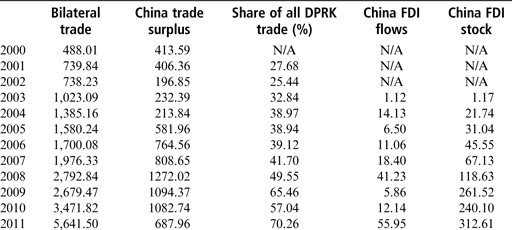
Based on their 2007 survey of Chinese firms involved with North Korea, Haggard, Lee and Noland conclude that: “government support, narrowly construed, does not appear to play a significant role in enabling exchange.”Footnote 67 While valuable, such firm-level surveys alone are unlikely to capture the impact of the broad array of indirect government support detailed above, particularly measures taken since 2009. Trade and investment patterns (see Table 2), augmented by case studies of enterprise decision-making, suggest that government support has indeed played an important role.
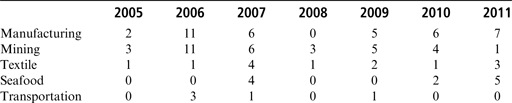
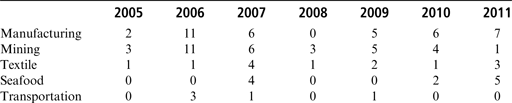
Along with rising trade and investment levels, the timing of new investments also correlates with China's 2005 policy shift. Of the 180 Chinese investments in the DPRK for which the Open Source Centre identified the start date, 148 (82 per cent) were established after 2004. The largest number began in 2006 (45 firms), with 30 more in 2007, and 53 additional starts from 2008 through 2011.Footnote 68 The Chinese Ministry of Commerce's database indicates that 42 per cent of the 110 Chinese companies registered as investors in North Korea arrived after 2008, with a strong rise in manufacturing and mining investments following Wu Yi's 2005 visit (see Table 3). According to MOFCOM, in 2010 Chinese firms completed projects worth US$35 million and signed one new “economic technology cooperation project” worth US$9.22 million. Over the year, a total of 1,176 Chinese workers were sent to North Korea; at year's end, 1,665 Chinese workers were still in country.Footnote 69
New Starts of Chinese Joint Ventures in DPRK, 2005–2011
Source: Chinese Ministry of Commerce. Search engine at: http://wszw.hzs.mofcom.gov.cn/fecp/fem/corp/fem_cert_stat_view_list.jsp?manage=0&check_dte_nian=2000&check_dte_nian2=2011&check_dte_yue=01&check_dte_yue2=12&CERT_NO=&COUNTRY_CN_NA=朝鲜&CORP_NA_CN=&CHECK_DTE=
The nature of these interactions also accord with China's policy. Since 2005, Beijing's motto has been: “government guidance with companies in the lead; market-based operations and mutual benefit.” Indeed, while South Korea's trade and investment with the North is heavily subsidized by the ROK government, most interactions between the North and China are on a market basis.Footnote 70 Bilateral trade is dominated by a de facto barter exchange in which “Chinese oil, machinery, manufactured goods, and food are exchanged for North Korean coal, electricity, minerals, and other natural resources.”Footnote 71
A brief review of major investments further suggests that while both SOEs and private enterprises acted primarily upon market signals, their choices were shaped by infrastructure investments. At critical moments, they turned to local or national officials for political support and to state banks for investment capital.
China Minmetals Corporation (CMC)
CMC (Zhongguo wugang jituan 中国五矿集团) is a national-level SOE and the sixth largest mining company in the world, with assets worth more than 200 billion yuan.Footnote 72 In 2004, CMC embarked upon a year of negotiations aimed at securing access to North Korea's largest anthracite coal mine, Ryongd'ung Coal Mine. CMC's CEO, Zhou Zhongshu 周中枢, finally signed the deal during Wu Yi's October 2005 trip to Pyongyang. Wu Yi's presence clearly eased negotiations. One CMC executive stated that: “our investment in North Korea has been very smooth – similar to our overseas investments elsewhere.”Footnote 73 As North Korea's first approval of a joint venture outside of a special economic zone, the CMC agreement encouraged the DPRK's subsequent opening up of its mineral sector for investment.Footnote 74 Over the next few years, CMC established a representative office in Pyongyang, expanded its operations to a range of mineral-related trade and manufacturing, and even delivered fertilizer on behalf of China's aid programme.Footnote 75
Tonghua Iron and Steel
In 2005, China Tonghua Iron and Steel Group 通化钢铁集团, a provincial SOE, announced plans to invest 7 billion yuan (US$940 million) in a joint venture to develop the Musan mine, Asia's largest open-cut iron ore mine.Footnote 76 Tonghua's decision was influenced by the National Development and Reform Commission's 2005 announcement of its plans to lift China's ceiling for iron ore imports. With Musan's projected annual supply of 10 million tons of iron ore only 7.5 kilometres from its Jilin facilities, Tonghua saw a golden opportunity. To bolster its political connections, Tonghua brought in a local Yanbian 延边 firm and the national-level SOE Sinosteel as minority partners. Of the total investment, 2 billion yuan was earmarked for infrastructure linking Tonghua's Jilin base to the Musan mine, an initiative later incorporated into the Chang-Ji-Tu development plan. To fund the investment, China Development Bank loaned Tonghua 2.4 billion yuan (US$324 million), while Jilin provincial officials strongly encouraged the deal as advancing “the government's main policy directions.”Footnote 77
Wanxiang Group
The Zhejiang-based Wanxiang Group 万象集团 is a private firm, headed by Lu Guanqiu 鲁冠球 who is feted as one of China's “outstanding rural entrepreneurs.”Footnote 78 In November 2007, Wanxiang announced that it would invest US$31 million in the Hyesan Copper Mine, North Korea's largest copper mine. Located only ten kilometres from the Chinese border, the mine's expected annual production of 70,000 tons of copper concentrate was to be exported to China.Footnote 79 Like Tonghua's Musan investment, this mine site was soon linked to the thickening web of rail and road links in China's border region. The project moved forward quickly, driven by collaboration among Chinese firms and local governments. Power lines were connected back to the Chinese grid and water came from a new reservoir created by Chinese firms.Footnote 80 When DPRK officials abruptly halted the project, Wanxiang promptly raised the issue with Beijing. On his 2009 visit, Wen Jiabao inquired into the project and received assurances that the situation was being addressed. The dispute was soon resolved and operations resumed.Footnote 81 In 2012, having survived this “arduous process,” Lu Guanqiu waxed enthusiastically: “North Korea today is like China 30 years ago. Based on our experience, we believe that North Korea will be even more open and free in the future.”Footnote 82
In all three instances, new infrastructure, investment capital and official support encouraged firms’ decisions and sustained their operations. More broadly, the overall rise in trade and investment also matched central policymakers’ goals. Simply put, Beijing's policy succeeded in encouraging local governments and enterprises to expand economic ties with North Korea. However, success has brought new challenges, as diplomats struggle to meet Hu Jintao's pledge to “guide” Chinese corporations in an “orderly” fashion.
China's Principal-Agent Dilemma
Local officials and commercial enterprises are more likely to advance central-level objectives when their preferences are aligned with those goals. When these interests diverge, agents’ autonomy of action and access to “hidden” information enable them to act in ways that may undermine central-level policy. As Shaofeng Chen explains, the likelihood of “defection behavior tends to be larger with ongoing marketization. This problem is further exacerbated by the problem of asymmetric information [between officials and enterprises] and the high costs to monitor their overseas behaviors.”Footnote 83 In the case of China–DPRK ties, a scarcity of formal institutions, intensive trade ties with limited transparency, and a proliferation of small private actors have all intensified Beijing's principal-agent dilemma.
A chaotic border
China's border trade with the DPRK operates, according to two Shenyang-based academics, in a “chaotic” setting. There is an absence of effective government regulations, adequate planning mechanisms, and independent organizations. Many Chinese companies engage in illegal actions or sell counterfeit products, damaging China's image in the DPRK and undermining China's own national security and economic interests. On the DPRK side, pervasive corruption, unpredictability, a lack of transparency and reliable information, and poor infrastructure exacerbate management difficulties. While local governments on both sides have an interest in addressing such issues, they generally lack the capacity or authority to establish effective bilateral arrangements.Footnote 84
According to the People's Bank of China, over 80 per cent of the cross-border trade is conducted in RMB, primarily on a cash basis. Cross-border RMB cash flows rose 114 per cent from 2004 through 2009 (from 1.6 to 3.5 billion yuan). As Teng and Yang point out:
On the one hand, the cross-border circulation of RMB enhances the financial development of the cross-border trade and the economy on both sides, promoting closer interactions and economic cooperation. On the other hand, because the RMB currency exchanges are driven purely by market forces and done entirely outside of the official banking system, this raises difficult questions for financial regulators.Footnote 85
Specifically, cash-based trade impedes the monitoring of trade flows and statistical reporting, eases smuggling and tax evasion, and undermines policy measures designed to encourage legitimate trade through standard channels.Footnote 86 Without adequate local oversight, central-level policies may go unimplemented. For instance, Beijing tightened its limits on grain exports in 2006–07 in response to price inflation. Jilin quickly reached its export quotas, which had been slashed by 50 per cent. Local firms began to smuggle shipments of rice into the DPRK, a practice tolerated by North Korean customs officials. As a local trader explained, “this is how most of the private [non-aid] rice goes into North Korea.”Footnote 87
Private malfeasance
As one Dandong official explained, “large SOEs are more likely to ‘do official business according to official principles’ [gongshi gongban 公事公办], while private companies are less principled or consistent.”Footnote 88 Private firms are likely to be more aggressive than SOEs in their profit-maximizing behaviour. They have few obligations to Chinese diplomats or national bureaucracies and rely instead upon a carefully cultivated local base of support. Successful local private entrepreneurs in China must cut corners to succeed. Commonplace acts such as bribing officials, falsifying contracts and evading laws are unlikely to decline as they move far from home. Even in North Korea's restrictive environment, such actions have exacerbated diplomatic tensions and undermined popular support for China's engagement strategy.
For instance, on 8 May 2012, three Dandong boats fishing in what they insist were Chinese waters were taken hostage by North Korean soldiers at gunpoint.Footnote 89 Ship owner Zhang Dechang 张德昌 soon received a phone call demanding a 1.2 million yuan “fine” for illegal fishing. Refusing to pay, Zhang instead contacted local maritime and border security officials, who assured him that they would resolve the issue.Footnote 90 However, officials took no discernable action until the story was posted online on 15 May. Chinese netizens responded furiously, denouncing North Korea's “lawless behaviour” and decrying this “false brother country.”Footnote 91 Following the online uproar, China's ambassador publically “demanded” that the DPRK respect the “legal rights” of Chinese fishermen.Footnote 92 After the boats finally sailed safely back into Dalian harbour on 21 May, the Global Times urged Chinese citizens to “remain calm and be more understanding of our friendly neighbour.”Footnote 93 Yet, given the absence of a bilateral accord on the maritime boundary, and with the only mechanism for maritime border coordination dating from the 1960s,Footnote 94 future incidents appear likely. A similar dynamic has emerged amidst the boom of mining investment.
In 2006, Zhou Furen 周福仁, the CEO of the Xiyang Group 西洋集团, announced plans to invest US$37.14 million into the Onjin County Iron Ore mine.Footnote 95 Since Zhou's 75 per cent ownership exceeded the DPRK's legal limit, both a public and a “real” contract was signed. Zhou later quipped, “At the time, if I had insisted on a 90–10 split, they probably would have agreed.”Footnote 96 While approving Zhou's venture, Chinese officials repeatedly urged him to act “cautiously.”Footnote 97
After numerous delays, on 6 September 2011 the DPRK partners abruptly demanded new or higher payments for land, water and raw materials. Zhou refused. The North Korean government responded by suspending the contract and freezing all power and water supplies. On 3 March, Xiyang's Chinese workers were deported.Footnote 98 Urging Zhou to remain quiet, the Chinese embassy hosted numerous negotiations, but without success. Once Zhou learned that his factory had been re-opened and the North Korean partners were now selling the iron ore, he immediately issued an online letter bemoaning his five-year “nightmare.” Denouncing his partners’ “corrupt lifestyle,” Zhou claimed that Xiyang had paid some US$800,000 to cover their demands for presents, food, liquor and prostitutes during their China visits.Footnote 99 A month later, the company went public again, with Xiyang's vice-CEO Li Xisheng 李习盛 denouncing Chinese officials’ encouragement to invest in North Korea as “a mistake.” In a rare public criticism, Li declared, “We are hardly the only Chinese enterprise to be cheated in this way by North Korea; however the Chinese government does not actively protect the interests of our type of [private] enterprise.”Footnote 100
Governance challenges
As these instances illustrate, China's aggressive commercial actors have exacerbated diplomatic tensions and undermined domestic support for Beijing's engagement strategy. In response, Chinese diplomats repeatedly implored enterprises to act responsibly. On 20 May 2010, Ambassador Liu Hongcai urged Chinese firms to “respect North Korea's national conditions, abide by its laws, and conduct business in ways to promote friendship and understanding between the two countries.”Footnote 101 At the founding of Sinocham DPRK on 27 April 2012, Ambassador Liu returned to these themes:
I hope that Chinese companies, together with our DPRK comrades, will strive to enhance production and management; and will respect North Korean laws and regulations, respect their North Korean partners, and operate under the principal of mutual interests and common benefit. By doing so, they can make even greater contributions to developing China-North Korean friendship.Footnote 102
The embassy also began tightening its monitoring of Chinese firms. On 14 March 2011, the embassy issued a statement noting that the increase in trade and investment had increased the number of accidents befalling Chinese citizens in the DPRK. The statement warned against the use of illegal agencies to import Chinese labourers, declaring that, “whoever brings in the workers is responsible for them.”Footnote 103 MOFCOM's 2011 report on North Korea also urged Chinese firms to use “caution,” reminding them that “the most common security problems arise when foreigners disobey the DPRK's national security regulations.”Footnote 104 However, the implementation of such controls is impeded by the diverse array of officials involved. As one MOFCOM expert explained:
Coordination is very difficult these days for China's aid programme [in the DPRK], with so many different actors involved, each of them pursuing their own interests. They all have their own information and priorities. This is a very difficult environment for MOFCOM. Even though we are officially in charge of the aid programme, it is very difficult even to remain aware of all the different aid-related activities going on.Footnote 105
By encouraging new investments, Beijing also engenders a moral hazard problem, as official support encourages risky corporate behaviour.Footnote 106 In 2011, MOFCOM warned against “blind” investment in North Korea, urging firms to investigate local infrastructure carefully, review all contracts before signing, and to purchase trade and/or investment insurance.Footnote 107 However, as long as capital continues to flow, such warnings are unlikely to have much effect. Indeed, a 2008 People's Bank of China report found that since 1990, only ten Dandong companies had followed legally approved channels to invest in North Korea. The report estimated that Dandong companies alone had lost some US$20 million by investing in North Korea.Footnote 108
Conclusion
Since 2005, China's incentive strategy has successfully encouraged local governments and commercial actors to expand their economic interactions with North Korea. The key to success lay in the alignment between central-level incentives and the preferences of local governments and commercial actors. Yet this accomplishment brought new challenges. As the number of commercial actors and economic interactions expanded, a scarcity of formal institutions, an increase in intensive trade ties with limited transparency, and a proliferation of small private actors exacerbated diplomatic tensions, eroded border security and undermined popular support for Beijing's engagement strategy. Comparatively, North Korea is both a difficult case for stimulating economic engagement and an easy case for enforcement (owing to its limited economic ties and restrictive domestic environment). Therefore, the dynamics identified here are even more likely to emerge across China's 13 other land neighbours.
The principal-agent framework used to examine these dynamics has limitations in both descriptive accuracy and analytical reach. Clearly, private firms and individual entrepreneurs are not, strictly speaking, “agents” of Chinese officials along the same lines as workers in a modern firm. As a rationalist approach, the principal-agent framework also assumes, rather than investigates, actor preferences. Despite these shortcomings, the approach offers important advantages for studying the Chinese state's role in overseas economic interactions.
To date, debates over the state's role in China's overseas economic expansion have been split between liberal (market-based) drivers versus mercantilist (state-driven) explanations for firm behaviour.Footnote 109 In reality, both are right. The government plays a central role in China's overseas economic interactions and firms are driven largely by profit motives.Footnote 110 Simply accumulating more case studies is unlikely to resolve this debate. The principal-agent framework offers an alternative approach, focusing upon strategic interactions between central leaders, local officials and enterprises. Regardless of their policy objectives, Chinese leaders must be able to influence the actions of their enterprises and local governments. The principal-agent framework analyses the conditions under which they are able to do so. Extending this framework to examine other relationships, such as between central officials and ministries or between central SOE offices and their local branches, offers a promising avenue for future research.