




Introduction
After the landslide Labour victory of July 2024, 2025 represented the first full year of Sir Keir Starmer’s administration. Despite the scale of the election victory, both the party and their leader struggled to cut through in the polls. With the Conservative Party still in recovery after their election defeat, Nigel Farage’s Reform UK took the lead in opinion polls from March. As such, immigration was one of the key policy areas characterising politics in the United Kingdom this year, but the Labour Government also had to contend with a rebellion against planned changes to benefits, leading to a government U-turn. The UK’s place on the world stage was also under scrutiny in 2025, with on-going efforts to maintain the Special Relationship with the US, alongside continued support for Ukraine and the formal recognition of a Palestinian state in efforts to promote a lasting solution to the Israeli-Palestinian conflict.
Starmer had made some minor changes to his team at the start of September, but the resignation of Angela Rayner just days later triggered a wide-ranging Cabinet reshuffle, that saw some substantial movement between senior ministerial roles and the re-entry of Douglas Alexander, a minister between 2006 and 2007 under Tony Blair. A new leftwing political party, Your Party was launched, and former Labour MP Zarah Sultana became their first MP in November. The first by-election of the Starmer Government saw a safe Labour seat lost to Reform UK, emphasising the on-going struggle the government faced in the opinion polls.
Election report
There were no national elections in the UK in 2025.
Cabinet report
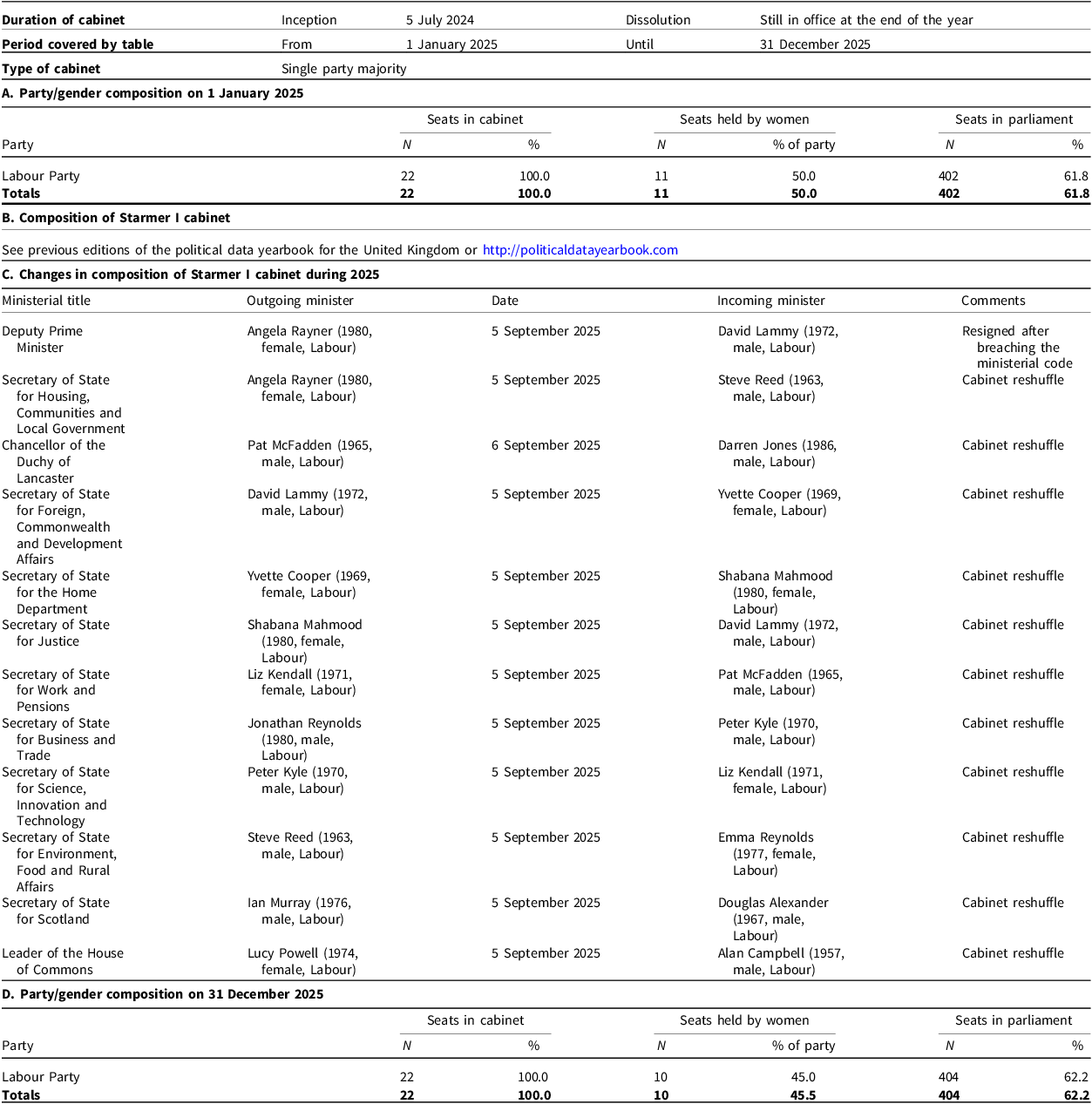
The current government took office on 5 July 2024 and is a single-party majority government. On 1 September, Keir Starmer had made changes to his team at Number 10 and the Cabinet Office, to streamline the running of the Prime Minister’s office – this included the appointment of Danny Jones to the new Cabinet role of Chief Secretary to the Prime Minister. Starmer had not planned to make any substantial changes to his Cabinet until later in his term (Adu Reference Adu2025). However, Deputy Prime Minister and Secretary of State for Housing, Communities and Local Government Angela Rayner resigned on 5 September after Sir Laurie Magnus, the Prime Minister’s Ethics Advisor, found that she had breached the ministerial code after not seeking recommended tax advice when purchasing a property, and as such, underpaid the tax on her purchase. This, alongside a government trying to gain ground lost to Reform UK, led Starmer to conduct a wide-ranging reshuffle of his Cabinet (Whannel Reference Whannel2025). David Lammy moved from Foreign Secretary to replace Rayner as Deputy Prime Minister, and also became Minister for Justice. Lucy Powell, Leader of the House of Commons returned to the backbenches, and Ian Murray, Secretary of State for Scotland (in 2015–2017 and 2019–2023, he was the party’s only Scottish Labour MP) moved to a junior ministerial position. He was replaced by Douglas Alexander, who had previously served in the position under Tony Blair between 2006 and 2007, before losing his seat in 2015, re-entering Parliament in 2024. Emma Reynolds, another former Labour MP who had previously lost their seat and re-entered Parliament in 2024, entered Cabinet for the first time, replacing Steve Reed as Secretary of State for the Environment, Food and Rural Affairs. Reed, in turn, took up Rayner’s former role as Secretary of State for Housing, Communities and Local Government. Shabana Mahmood became Home Secretary, signalling a shift towards a harder approach to immigration. Yvette Cooper, in turn, moved from Home Secretary to fill the gap left by Lammy as Foreign Secretary. With the government U-turn on proposed benefit changes before the Summer recess, Secretary of State for Work and Pensions, Liz Kendall was moved to become Secretary of State for Science, Innovation and Technology, and was replaced by Pat McFadden, the current Chancellor of the Duchy of Lancaster, but also a veteran of junior ministerial positions under Blair and Brown, as well as the Labour campaign coordinator for the 2024 General Election. Full changes may be found in Table 1.
Cabinet composition of Starmer I in United Kingdom in 2025

Table 1. Long description
The table provides detailed information about the composition of the Starmer I cabinet in the United Kingdom for the year 2025. It includes the duration of the cabinet, the period covered, and the type of cabinet. The table is divided into several sections: A. Party/gender composition on 1 January 2025, B. Composition of Starmer I cabinet, C. Changes in composition of Starmer I cabinet during 2025, and D. Party/gender composition on 31 December 2025. Section A lists the party and gender composition with the Labour Party holding all 22 seats in the cabinet, 11 of which are held by women. Section B outlines the composition of the Starmer I cabinet. Section C details the changes in the cabinet composition during 2025, including the outgoing and incoming ministers, dates, and comments on the changes. Section D provides the party and gender composition at the end of the year, showing a slight decrease in the number of seats held by women to 10 out of 22.
Source: UK Parliament (n.d.).
Parliament report
The first by-election of the Starmer administration was held on 1 May 2025 in Runcorn and Helsby. This was a new seat, created by the boundary review ahead of the 2024 General Election, but it had been constructed from largely Labour-held seats, and notional results gave Labour a 12 percentage point majority. The incumbent MP for the seat, who had also been an MP since 2017 for one of the former seats making up Runcorn and Helsby, Mike Amesbury, won a 35 percentage point majority at the 2024 election. However, he had ended 2024 sitting as an independent MP with the Labour party whip withdrawn. After assaulting a member of the public, Amesbury had been suspended by the party and was charged with assault. In January 2025, he pleaded guilty and was subsequently sentenced to ten weeks’ imprisonment, which became non-custodial on appeal. This would have triggered a recall petition, and there was controversy over Amesbury continuing to receive his MP salary. He stepped down as MP on 10 March, triggering a by-election. Sarah Pochin, a former Conservative parliamentary candidate stood for Reform UK and won the seat from Labour’s Karen Shore by six votes. This was the closest by-election result since 1892. Pochin became the first female Reform UK MP and used her maiden speech, which was made during a debate on the Border Security, Asylum and Immigration Bill, to address immigration.
Several Labour MPs had the party whip withdrawn in 2025. Dan Norris, Labour MP for Somerset North East and Hanham was arrested in April for rape and other offences, but refused calls to stand down. Diane Abbott, the first female black MP and Mother of the House was suspended in July after repeating comments on racism that had previously seen her suspended in 2023. Labour sources indicate that she will not regain the party whip (Scott and Allegretti Reference Scott and Allegretti2025). Of the seven Labour MPs who had had the party whip withdrawn in July 2024 after rebelling against the two-child benefit cap, Richard Burgeon, Ian Byrne, Imran Hussain and Rebecca Long-Bailey had the whip reinstated to them in February. The other three (John McDonnell, Apsana Begum and Zarah Sultana) remained suspended, and in July Sultana announced that she would be leaving Labour to found a new party – Your Party – with former Labour leader Jeremy Corbyn (see below). She became the party’s first MP on 18 November. The Labour whip was restored to McDonnell and Begum in July.
One Conservative MP had the party whip withdrawn in 2025 – Patrick Spencer, first elected in 2024 for Suffolk Central and Ipswich North, was charged with sexual assault in May. Danny Kruger, a member of the Shadow Cabinet of both Sunak and Badenoch, defected to Reform UK on 15 September, declaring the Conservatives were ‘over’ and becoming the first sitting Conservative MP to defect to the party. Reform UK MP James McMurdock permanently resigned the party whip in July after a newspaper investigation revealed questions over loans given to his dormant businesses during the COVID-19 pandemic. Rupert Lowe, Reform UK MP for Great Yarmouth was suspended in March after bullying accusations. He announced at the end of June that he was starting his own right-wing anti-immigration political organisation, Restore Britain, and became the leader, although as the year closed he technically still served as an independent MP. These changes have led to an unusually fragmented House of Commons – indeed it is currently home to the largest ever number of opposition MPs who are not members of the Official Opposition.
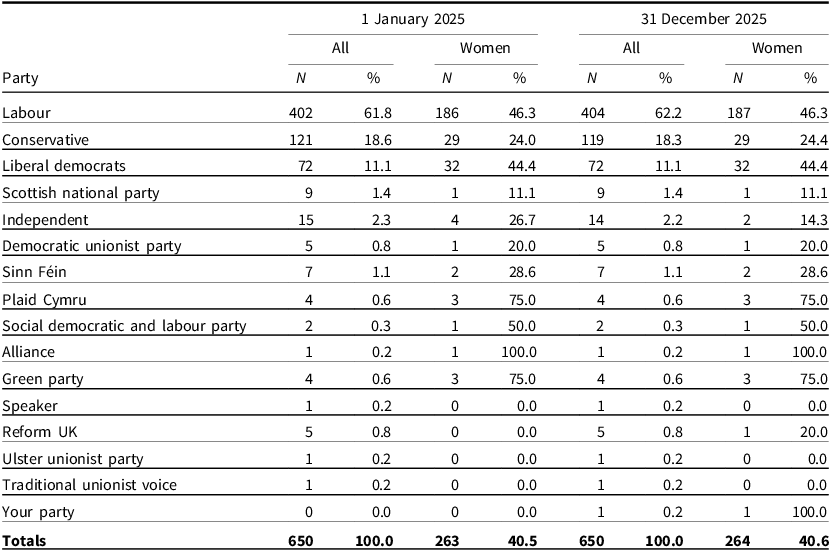
Information on the composition of the House of Commons in 2025 can be found in Table 2.
Party and gender composition of the House of Commons in United Kingdom in 2025

Table 2. Long description
The table presents the party and gender composition of the House of Commons in the UK for 2025. It has 18 rows and 8 columns. The columns are labeled as follows: Party, 1 January 2025 All N, 1 January 2025 All %, 1 January 2025 Women N, 1 January 2025 Women %, 31 December 2025 All N, 31 December 2025 All %, 31 December 2025 Women N, 31 December 2025 Women %. The rows list different political parties and their respective data for the specified dates. Notable parties include Labour, Conservative, Liberal Democrats, and others. Each row provides the number and percentage of members for all and women categories on the specified dates.
Source: UK Parliament (2025a).
House of Lords
During 2025, a Bill to remove hereditary peers from the House of Lords, proposed in the 2024 Labour manifesto, was navigating its way through the chambers, with the Lords offering amendments, which were considered by the Commons in September. The bill entered its final stages as the year closed.
Twenty-five new Labour peers were introduced to the Lords in 2025 (Cabinet Office 2025), partly due to Starmer’s desire to balance the chamber away from Conservative dominance ahead of the planned reforms to hereditary peers in the chamber. These new Labour peers included three former and serving Labour councillors, a former Member of the European Parliament, the Mayor of Lewisham and several former advisors. Others represented expertise in a variety of different fields including health, disaster recovery and education. Five new peerages were awarded by the Liberal Democrats, including to former MP Sarah Teather, Mike Dixon, the party’s CEO, as well as the former chief of staff to Sir Ed Davey and two of their hereditary peers (enabling them to remain in the Lords despite the planned changes). Three peerages were awarded by the Conservatives, to former Olympic swimmer and campaigner for women’s rights in sports, Sharron Davies, long-serving MP John Redwood, who had stood down in 2024, and Simon Heffer, a political commentator. Nigel Farage had written to the Prime Minister in July requesting the ability to appoint Reform UK peers to the Lords, but did not receive a response.
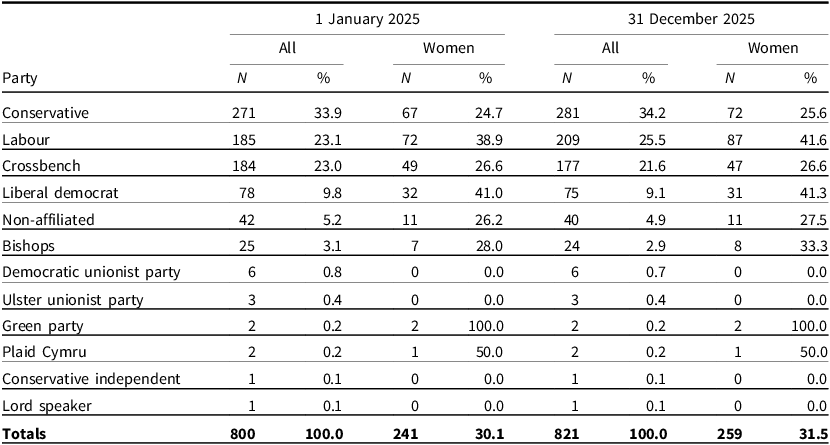
Information on the composition of the House of Lords in 2025 can be found in Table 3.
Party and gender composition of the House of Lords in United Kingdom in 2025

Table 3. Long description
The table presents the party and gender composition of the House of Lords in the UK for 2025. It has 12 rows and 10 columns. The columns are labeled as follows: Party, 1 January 2025 All N, 1 January 2025 All %, 1 January 2025 Women N, 1 January 2025 Women %, 31 December 2025 All N, 31 December 2025 All %, 31 December 2025 Women N, and 31 December 2025 Women %. The rows list different parties and categories: Conservative, Labour, Crossbench, Liberal Democrat, Non-affiliated, Bishops, Democratic Unionist Party, Ulster Unionist Party, Green Party, Plaid Cymru, Conservative Independent, and Lord Speaker. Each row provides the number and percentage of members for each party and gender on 1 January 2025 and 31 December 2025. Notable trends include changes in the number and percentage of women in various parties over the year.
Source: UK Parliament (2025b).
Political party report
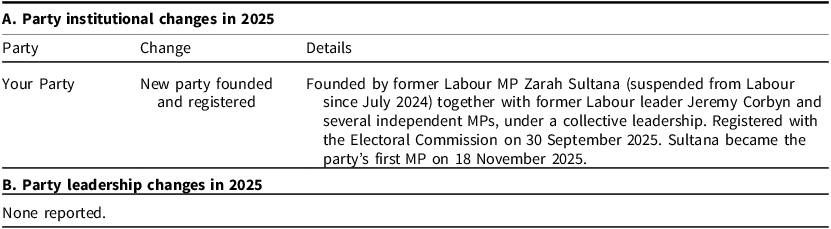
Former Labour MP Zarah Sultana, who had been suspended by the party since July 2024 announced on 3 July that she would be founding a new party with former Labour leader Jeremy Corbyn and several independent MPs (Bloch Reference Bloch2025). The new party was registered with the Electoral Commission on 30 September 2025 under a collective leadership, and Sultana became its first representative in the Commons on 18 November. Details are shown in Table 4.
Changes in political parties in United Kingdom in 2025

Table 4. Long description
A table detailing changes in political parties in the United Kingdom in 2025. The table has two main sections: A and B. Section A focuses on party institutional changes and includes three columns: Party, Change, and Details. Section B covers party leadership changes. Section A has one row detailing the founding of a new party by former Labour MP Zarah Sultana, former Labour leader Jeremy Corbyn, and several independent MPs. The new party was registered with the Electoral Commission on 30 September 2025, and Zarah Sultana became the party’s first MP on 18 November 2025. Section B reports no leadership changes in 2025.
Source: Electoral Commission 2026.
Despite the landslide victory of July 2024, the polling position of Labour throughout 2025 was poor, at 26 per cent in January, falling consistently to 19 per cent by the end of the year. Despite being four percentage points behind Labour in January (YouGov 2025a), which had widened to six points in June, by December the Conservatives were level at 19 per cent with Labour. Reform UK led the polls from April onwards, ending the year with a seven percentage point lead over the government (YouGov 2025b). With five parties within an eleven point range, the polls reflected the fragmented state of politics in the United Kingdom.
For the party leaders, in January only 25 per cent of the public had a favourable opinion of Starmer, declining to just 18 per cent by the end of the year (YouGov 2025c). Kemi Badenoch’s fortunes were marginally more favourable, with 18 per cent, with a more favourable opinion by January, raising to 26 per cent in December (YouGov 2025d). Despite the electoral success of Reform UK, Farage remained a similarly divisive figure, with little change to his popularity of 27 per cent over the year (YouGov 2025e).
Institutional change report
There were no major institutional changes made in the United Kingdom in 2025.
Issues in national politics
In a continuation of the past decade in British politics, immigration remained at the centre of political debate in 2025, not least due to the success of Reform UK in the Runcorn and Helsby by-election and the local elections, where they took control of ten councils for the first time and added 677 new councillors to their ranks. The government signed a deal with France in July allowing the ability to return some of those arriving on small boats back to France in exchange for accepting the same number of asylum seekers from France – this was an attempt to undermine the gangs running the boat crossings and removals began in September. There was also a reduction of Skilled Visa jobs, which excluded social care for the first time, and ended the ability of some visa holders to bring dependents into the country. There was a continued move away from the controversial policy of housing asylum seekers in hotels, using military barracks instead (Home Office 2025). The Border Security, Asylum and Immigration Act passed in December, providing enhanced powers for Border Security, including the ability to seize electronic devices from new arrivals. The new Home Secretary, Shabana Mahmood, announced a substantial overhaul of legal immigration and asylum policy in November, extending the time it takes for asylum seekers to gain settled status, and requiring asylum seekers to reconfirm their status every six years.
The Conservatives sought to reclaim some ground on immigration, with a continued shift to the right and the defection of one sitting MP to Reform UK. Many former Conservative MPs, including former Cabinet ministers Nadine Dorries and David Jones, also defected to the Reform UK party. Conservative leader Kemi Badenoch spoke of the need for integration and the damaging impact immigration has on communities. She spoke out in defence of Robert Jenrick (Aikman and Walker Reference Aikman and Walker2025), the Shadow Justice Secretary, in October, when a secret recording of him remarking on the lack of integration in Birmingham, and not seeing ‘another white face’ emerged.
Conflicts on the international stage also continued to shape British politics in 2025. The government remained committed to supporting Ukraine in the on-going conflict with Russia. A summit of international leaders in London led to the announcing by Starmer of a ‘Coalition of the Willing’ on 2 March (Wong Reference Wong2025) – an initiative bringing together 34 countries to help facilitate negotiations between Ukraine and Russia and ensure any resolution to the conflict is lasting. In June, Defence Secretary John Healey announced the intention to create a Multinational Force Ukraine from the members of the Coalition of the Willing. New Foreign Secretary Yvette Cooper also visited Ukraine in September. Along with France and Canada, in July the UK Government condemned Israeli actions preventing humanitarian aid reaching Gaza, suspending talks on a free trade deal. Also in July, the group Palestine Action were classified as a terrorist organisation after members of the group broke into an RAF base and damaged two planes. By the end of the year almost 3,000 individuals had been arrested after participating in protests in support of the group. The Starmer Government took a historic decision and formally recognised the state of Palestine on 21 September in support of a two-state solution to the conflict.
In December 2024, Starmer had appointed Peter Mandelson to become the British Ambassador to the United States. Mandelson, a former spin doctor, Labour MP, Cabinet minister and European Commissioner for Trade attended Trump’s inauguration and attempted to consolidate closer relations over the course of the year. However, in September, papers and emails relating to convicted sex offender Jeffrey Epstein were released by the US House Oversight Committee. These demonstrated a long-lasting close friendship between Mandelson and Epstein, which had continued after Epstein’s 2008 conviction for soliciting prostitution involving a minor. Amid much controversy, Mandelson refused to resign, and Starmer sacked him on 11 September.
Domestically, the economy was under pressure from the international environment, and the Chancellor Rachel Reeves was under pressure to deliver the growth promised at the General Election; the government confirmed in January that she would serve in her current role until the next election, in an attempt to quell rumours around her replacement. Planned reforms to the benefits system, which would particularly increase the threshold for disability payments in an attempt to make substantial savings had proved to be particularly controversial among Labour backbenchers, and when it became clear that a substantial rebellion was likely, the government made multiple concessions (Stacey and Walker Reference Stacey and Walker2025), holding off on many of the planned changes. In the same week, the Chancellor made headlines when she was seen to cry when sitting on the frontbench, although it later emerged this was due to a ‘personal matter’ (Mason, Pike and Zeffman Reference Mason, Pike and Zeffman2025). The Budget in the Autumn saw the freezing of income tax thresholds, the removal of green levies from energy bills, and rises in the minimum wage and state pensions. However, the economy grew by just 0.1 per cent in the final quarter as 2025 drew to a close.
Data availability statement
The data for this article can be found at the PDY Interactive website: www.politicaldatayearbook.com

 Open access

