Background
Anhedonia is a core symptom of unipolar (UD) and bipolar (BD) depression referring to the inability to experience pleasure or reduced motivation and is associated with dysfunctions of the brain reward system (Hasler & Northoff, Reference Hasler and Northoff2011; Treadway & Zald, Reference Treadway and Zald2011). Converging neurobiological and behavioral evidence has attributed these symptoms to deficits in discrete reward-related processes, including reduction of attentional bias toward positive stimuli (Joormann & Gotlib, Reference Joormann and Gotlib2007), of positive affect in response to pleasant stimuli (Berenbaum & Oltmanns, Reference Berenbaum and Oltmanns1992), and of reward responsiveness (Pizzagalli, Iosifescu, Hallett, Ratner, & Fava, Reference Pizzagalli, Iosifescu, Hallett, Ratner and Fava2008). The available neuroimaging data have revealed numerous functional and structural changes in the neural system subserving these processes in both patients with UD and BD (Bracht, Linden, & Keedwell, Reference Bracht, Linden and Keedwell2015; Diener et al., Reference Diener, Kuehner, Brusniak, Ubl, Wessa and Flor2012; Hamilton, Chen, & Gotlib, Reference Hamilton, Chen and Gotlib2013; Houenou et al., Reference Houenou, Frommberger, Carde, Glasbrenner, Diener, Leboyer and Wessa2011; Wise et al., Reference Wise, Radua, Via, Cardoner, Abe, Adams and Arnone2017) and never-depressed first-degree relatives (Macoveanu et al., Reference Macoveanu, Knorr, Skimminge, Søndergaard, Jørgensen, Fauerholdt-Jepsen and Kessing2014, Reference Macoveanu, Miskowiak, Kessing, Vinberg and Siebner2016a, Reference Macoveanu, Vinberg, Madsen, Kessing, Siebner and Baaré2016b, Reference Macoveanu, Baaré, Madsen, Kessing, Siebner and Vinberg2018; Olino et al., Reference Olino, McMakin, Morgan, Silk, Birmaher, Axelson and Forbes2014; Singh et al., Reference Singh, Kelley, Howe, Reiss, Gotlib and Chang2014). However, it remains unclear how distinct components of reward processing are affected in UD and BD and whether or not some of these changes are also present in unaffected relatives who are at increased risk for mood disorders (Oquendo et al., Reference Oquendo, Ellis, Chesin, Birmaher, Zelazny, Tin and Brent2013). Since UD and BD aggregates in families, neural changes present in both affected patients and their unaffected relatives may provide a neural mechanism for the observed familial risk and can potentially be targeted by novel treatments and aid earlier diagnosis.
The expected reward value (EV) and reward prediction error (RPE) signals have been highlighted as two discrete functions of reward processing associated with the anticipatory and the consummatory phases respectively (Rolls, McCabe, & Redoute, Reference Rolls, McCabe and Redoute2008). The EV denotes the appropriate representation of an expected reward associated with a stimulus as a consequence of reward learning and relies on a coordinated frontostriatal network including the ventral striatum (VS) and orbitofrontal cortex as key nodes (Jia et al., Reference Jia, Macare, Desrivières, Gonzalez, Tao and Ji2016; O'Doherty, Buchanan, Seymour, & Dolan, Reference O'Doherty, Buchanan, Seymour and Dolan2006; Stalnaker, Liu, Takahashi, & Schoenbaum, Reference Stalnaker, Liu, Takahashi and Schoenbaum2018; Yacubian et al., Reference Yacubian, Gläscher, Schroeder, Sommer, Braus and Büchel2006). The RPE represents the difference between expected and actual received reward that support an error-dependent update of value estimates for better prediction of future rewards. In humans, RPE signal was found to be encoded by VS (Abler, Walter, Erk, Kammerer, & Spitzer, Reference Abler, Walter, Erk, Kammerer and Spitzer2006; Berns, McClure, Pagnoni, & Montague, Reference Berns, McClure, Pagnoni and Montague2001; McClure, Berns, & Montague, Reference McClure, Berns and Montague2003), and is likely complemented and enhanced by striatum–amygdala interactions (Ernst et al., Reference Ernst, Nelson, Jazbec, McClure, Monk, Leibenluft and Pine2005; Watanabe, Sakagami, & Haruno, Reference Watanabe, Sakagami and Haruno2013).
Functional magnetic resonance imaging (fMRI) studies in mood disorders have observed abnormalities in reward anticipation and feedback including altered EV and RPE signals in key frontostriatal regions, although the findings are not conclusive. Compared to healthy participants the anticipatory response in UD or BD patients was lower in VS (Pizzagalli et al., Reference Pizzagalli, Holmes, Dillon, Goetz, Birk, Bogdan and Fava2009; Schreiter et al., Reference Schreiter, Spengler, Willert, Mohnke, Herold, Erk and Bermpohl2016; Smoski et al., Reference Smoski, Felder, Bizzell, Green, Ernst, Lynch and Dichter2009) or found lower or higher in prefrontal cortex (PFC) in regions such as orbitofrontal cortex (Nusslock et al., Reference Nusslock, Almeida, Forbes, Versace, Frank, Labarbara and Phillips2012), middle frontal gyrus, the frontal poles and anterior cingulate cortex (ACC) (Knutson, Bhanji, Cooney, Atlas, & Gotlib, Reference Knutson, Bhanji, Cooney, Atlas and Gotlib2008; Smoski et al., Reference Smoski, Felder, Bizzell, Green, Ernst, Lynch and Dichter2009), ventrolateral PFC (Chase et al., Reference Chase, Nusslock, Almeida, Forbes, LaBarbara and Phillips2013, Reference Chase, Fournier, Bertocci, Greenberg, Aslam, Stiffler and Phillips2017), and dorsolateral PFC (Ubl et al., Reference Ubl, Kuehner, Kirsch, Ruttorf, Flor and Diener2015). However, the EV signal in particular was lower in the ACC in BD and UD (Chase et al., Reference Chase, Nusslock, Almeida, Forbes, LaBarbara and Phillips2013) and the RPE signal was lower in UD in VS and midbrain (Gradin et al., Reference Gradin, Kumar, Waiter, Ahearn, Stickle, Milders and Steele2011; Kumar et al., Reference Kumar, Goer, Murray, Dillon, Beltzer, Cohen and Pizzagalli2018), and medial orbitofrontal cortex (Rothkirch, Tonn, Köhler, & Sterzer, Reference Rothkirch, Tonn, Köhler and Sterzer2017). The extent of the reduction in RPE signal in VS was found to correlate with increased anhedonia severity in UD (Gradin et al., Reference Gradin, Kumar, Waiter, Ahearn, Stickle, Milders and Steele2011). In addition, Greenberg et al. (Reference Greenberg, Chase, Almeida, Stiffler, Zevallos, Aslam and Phillips2015) showed a negative linear relationship between reward anticipation and RPE related right VS reactivity in healthy participants and that this linear relationship becomes positive UD patients in proportion with anhedonia severity. However, no significant differences in striatal RPE signal between UD and healthy participants have also been reported (Chase et al., Reference Chase, Nusslock, Almeida, Forbes, LaBarbara and Phillips2013; Rothkirch et al., Reference Rothkirch, Tonn, Köhler and Sterzer2017; Rutledge et al., Reference Rutledge, Moutoussis, Smittenaar, Zeidman, Taylor, Hrynkiewicz and Dolan2017). Altered EV and RPE signals could result in a reduced salience attribution to rewarding cues and dysfunctional reinforcement learning, which in turn may explain anhedonia symptoms in mood disorders (Gradin et al., Reference Gradin, Kumar, Waiter, Ahearn, Stickle, Milders and Steele2011; Kumar et al., Reference Kumar, Waiter, Ahearn, Milders, Reid and Steele2008; Vrieze et al., Reference Vrieze, Pizzagalli, Demyttenaere, Hompes, Sienaert, de Boer and Claes2013).
Having a first-degree relative with an mood disorder is a strong predictor of increased illness risk (Gottesman, Laursen, Bertelsen, & Mortensen, Reference Gottesman, Laursen, Bertelsen and Mortensen2010; Oquendo et al., Reference Oquendo, Ellis, Chesin, Birmaher, Zelazny, Tin and Brent2013; Sullivan, Neale, & Kendler, Reference Sullivan, Neale and Kendler2000; Vinberg, Miskowiak, & Kessing L, Reference Vinberg, Miskowiak and Kessing L2013). Consequently, studies in healthy participants at familial risk are crucial for identifying inherited neurophysiological changes, i.e. endophenotypes, that may precede illness onset. In addition, these studies are not confounded by medication, symptoms and disorder progression. The few extant studies of reward anticipation in individuals at familial risk confirm reduced anticipatory response in VS (Olino et al., Reference Olino, McMakin, Morgan, Silk, Birmaher, Axelson and Forbes2014), consistent with findings in UD and BD (Pizzagalli et al., Reference Pizzagalli, Holmes, Dillon, Goetz, Birk, Bogdan and Fava2009; Schreiter et al., Reference Schreiter, Spengler, Willert, Mohnke, Herold, Erk and Bermpohl2016; Smoski et al., Reference Smoski, Felder, Bizzell, Green, Ernst, Lynch and Dichter2009), and increased in lateral orbitofrontal cortex (Singh et al., Reference Singh, Kelley, Howe, Reiss, Gotlib and Chang2014). No other high-risk study to date has investigated directly EV or RPE. However, in a probabilistic reversal learning reward task performed by BD patients, high-risk relatives, and healthy participants, Linke et al. (Reference Linke, King, Rietschel, Strohmaier, Hennerici, Gass and Wessa2012) found increased amygdala and medial orbitofrontal activation in BD and their relatives to negative feedback during rule reversal, which has been interpreted as RPE signaling. In addition, first-degree relatives of patients with UD who experience subclinical depressive symptoms show blunted reward sensitivity and associated symptoms of anhedonia (Liu et al., Reference Liu, Roiser, Wang, Zhu, Huang, Neumann and Chan2016).
In this twin study, we collected and analyzed fMRI data from 112 monozygotic (MZ) twin individuals. Since MZ twins have the same genetic make-up, comparing affected patients and their unaffected high-risk co-twins with low-risk twins provides a unique possibility to investigate endophenotypes associated with familial risk. Periodic major depressive episodes are a common feature of both UD and BD. Indeed, genetic epidemiological and genome-wide linkage studies show consistent overlap between genetic risk factors of both disorders (Liu et al., Reference Liu, Blackwood, Caesar, de Geus, Farmer, Ferreira and Sullivan2011). Heritability rates in twin studies have been estimated to be up to 49% for UD and 85% for BD with a genetic correlation between BD and UD of 0.65 (Kendler, Ohlsson, Lichtenstein, Sundquist, & Sundquist, Reference Kendler, Ohlsson, Lichtenstein, Sundquist and Sundquist2018; McGuffin et al., Reference McGuffin, Rijsdijk, Andrew, Sham, Katz and Cardno2003). We therefore combined UD and BD patients in remission (affected) twins and their unaffected co-twins (high-risk) to investigate reward signal abnormalities related to increased risk in a continuum of mood disorders. Specifically, the primary aim was to clarify whether changes in EV and RPE signals in the affected compared to low-risk twins are also present in the high-risk twins (Macoveanu et al., Reference Macoveanu, Baaré, Madsen, Kessing, Siebner and Vinberg2018). We further explored the relationship between EV and RPE signals and hedonic ratings in our entire MZ twin sample. Based on the literature, we hypothesized that affected twins would show reduced EV and RPE signals in VS and PFC compared to the low-risk group, with the high-risk group showing changes in the same regions but to a lesser extent compared to the affected group. Upon identified abnormalities in the affected twins we tested possible impact of diagnosis, gender and residual symptoms on the findings.
Methods and materials
Participants
One hundred and twelve eligible MZ twin individuals (53 diagnosed with either BD or UD, 34 high-risk, and 25 low-risk) took part in the current study. This is the subgroup that underwent fMRI which was part of a larger group of 215 MZ twins initially recruited (Ottesen et al., Reference Ottesen, Meluken, Scheike, Kessing, Miskowiak and Vinberg2018). Eligible MZ twins were identified by linking the nationwide record of the Danish Twin Registry and the Danish Psychiatric Central Register. When uncertain, monozygosity was confirmed using pair-wise DNA tests (two pairs excluded following seven uncertain pairs tested). Eligibility criteria were (i) a personal or co-twin history of an affective spectrum diagnosis (i.e. ICD-10 codes F30-34.0 and F38.0) or for low-risk twins neither a personal nor a co-twin history of affective spectrum diagnosis from January 1995 to June 2014, and (ii) age 18–50 years. Twins were excluded if their birth weight was under 1.3 kg, had current severe somatic illness, history of brain injury, current substance abuse, current mood episode defined as scores >14 on either the Hamilton Depression Rating Scale (HDRS; Hamilton, Reference Hamilton1967) or the Young Mania Rating Scale (YMRS; Young, Biggs, Ziegler, & Meyer, Reference Young, Biggs, Ziegler and Meyer1978), were pregnant or were found to be dizygotic by pairwise DNA tests. To ensure familial low-risk of major psychiatric disorders, unaffected twin pairs were excluded if they reported other first-degree relatives with organic mental disorder, schizophrenia spectrum or mood disorders. Out of the initial group, 120 took part in the fMRI investigation. Four of these participants were subsequently excluded due to non-UD or BD diagnosis and another four due to lost behavioral data of the fMRI task. All participants gave informed consent to the study conducted according to the Helsinki declaration. The study was approved by the local ethics committee (H-3-2014-003) and the Danish data protection agency (2014-331-0751).
Clinical assessment and rating instruments
Participants were invited to attend a 1-day assessment when they underwent biological data sampling, clinical ratings of mood symptoms, a diagnostic interview, neurocognitive testing, and lastly, an fMRI investigation. Life-time diagnoses of psychiatric illness were assessed using the Schedules for Clinical Assessment in Neuropsychiatry (Wing et al., Reference Wing, Babor, Brugha, Burke, Cooper, Giel and Sartorius1990). All twins were grouped according to personal and co-twin history of moderate to severe UD or BD. If only one twin from a twin pair was included, data from the Danish Central Research Register were used to determine risk status. Discordant status of twin pairs was defined as one twin with a life-time history of moderate to severe depression or BD and one twin without such history, assessed retrospectively with the SCAN interview. Objective rating instruments included the Hamilton Depression Rating Scale 17 items (HDRS-17), and the Danish Adult Reading Task (DART; Nelson & O'Connell, Reference Nelson and O'Connell1978) to estimate premorbid verbal intelligence. We assessed participants' hedonic tone on the self-reported Snaith Hamilton Pleasure Scale (SHAPS; Snaith et al., Reference Snaith, Hamilton, Morley, Humayan, Hargreaves and Trigwell1995) measuring sustained responsiveness to reward and the Temporal Experience of Pleasure Scale (TEPS; Gard, Gard, Kring, & John, Reference Gard, Gard, Kring and John2006) assessing consummatory and anticipatory pleasure. Mood symptoms and subjective state were also collected using the Major Depression Inventory (Bech, Rasmussen, Olsen, Noerholm, & Abildgaard, Reference Bech, Rasmussen, Olsen, Noerholm and Abildgaard2001), a visual analog scale of current emotions and the State-Trait Anxiety Inventory form Y (STAI; Spielberger, Reference Spielberger1989). The Edinburgh 10-item Inventory (Oldfield, Reference Oldfield1971) was used to assess handedness. All assessors were blinded for participants' group belonging.
Demographic, clinical, and subjective state data analysis
Differences in demographic, clinical, subjective assessment between affected, high- and low-risk groups were assessed in SPSS 20 statistical software (IBM, Armonk, New York, United States) using mixed models analysis of variance with group (affected, high-risk, and low-risk) as fixed factor and twin pairs as random factors. Error rates (missed responses) and response time during the cards guessing paradigm were analyzed using the same statistical model. Upon significant effects of group, pair-wise tests between groups were performed to identify specific significant group differences.
fMRI data analysis
The card guessing fMRI paradigm
The fMRI paradigm was a card guessing game adapted from Chase et al. (Reference Chase, Fournier, Bertocci, Greenberg, Aslam, Stiffler and Phillips2017) and designed to assess neural responses to EV and RPE (Fig. 1). In short, each trial included (i) a choice event where the participant guessed by button press if the value of a card shown later will be higher or lower than 5, (ii) an anticipation event associated with either a possible gain or neutral outcome, a possible loss or neutral outcome, a possible gain or loss, or lastly no possible gain or loss, and (iii) a predetermined outcome event showing the amount gain or lost. Details regarding the paradigm and MRI acquisition protocol can be found in the online Supplementary Material.
The fMRI card guessing paradigm. Figure is adapted with permission from Chase et al. (Reference Chase, Fournier, Bertocci, Greenberg, Aslam, Stiffler and Phillips2017). (a) Trial structure demonstrating choice phase, anticipation phase, numerical feedback, and outcome (win, loss, and neutral). (b) Description of the outcomes associated with each of the four stimuli (win, mixed, neutral, and loss, respectively). Transition probabilities are 0.5 except for the neutral stimulus.

Pre-processing and subject-level statistical analysis
The blood oxygen-level dependent (BOLD) fMRI analysis was performed using FEAT (Woolrich, Ripley, Brady, & Smith, Reference Woolrich, Ripley, Brady and Smith2001), part of FMRIB Software Library (FSL) version 6.0.1 (Jenkinson, Beckmann, Behrens, Woolrich, & Smith, Reference Jenkinson, Beckmann, Behrens, Woolrich and Smith2012). The standard pre-processing steps included non-brain removal, linear and nonlinear registration to structural space, normalization to the Montreal Neurological Institute (MNI) standard space, motion correction and spatial smoothing using a Gaussian kernel of 5 mm FWHM. Correction for geometric distortions related to the B 0 field was performed based on the acquired B 0 field map. All participants' registration to the MNI template was visually inspected.
A general linear model (GLM) was used for the subject-level analysis which included three explanatory variables coupled with the main three events of the card guessing game: choice, reward anticipation, and feedback. The reward anticipation regressor was weighted according to the EV (probability of the outcome × outcome value). The weights were set to +0.5 for the possible win condition (50% chance of winning 6 Danish Krone (DKK)), +0.125 for the mixed condition (50% chance of winning 6 DKK; 50% chance of losing 4.5 DKK), 0 for the neutral condition, and −0.375 for the possible loss condition (50% chance of losing 4.5 DKK). The feedback event was weighted to reflect positive RPE (actual outcome − EV). Accordingly, the highest weights were set for the unexpected wins, and lowest for unexpected losses as follows: +0.875 for a win in the mixed condition (mixed-win), +0.5 for a win in the win–win condition, +0.375 for a no loss in a loss–neutral condition, 0 in the neutral condition, −0.375 for a loss in the loss–neutral condition, −0.5 for no win in the win–neutral condition, and −0.875 for a loss in the mixed-loss condition. The EV and RPE regressors were convolved with a double-gamma hemodynamic response function. In addition, the subject-level GLM included temporal derivatives of task regressors to model slice-timing effects and confounding regressors to remove motion artifacts.
Group-level analysis
The group-level analysis was implemented in FEAT using the FLAME (FMRIB's Local Analysis of Mixed Effects) estimation method (Woolrich, Behrens, Beckmann, Jenkinson, & Smith, Reference Woolrich, Behrens, Beckmann, Jenkinson and Smith2004). We first confirmed EV- and RPE-related activations in the low-risk twins in one-sample t tests. To test our hypotheses, we set up two GLM models for the EV and RPE signals respectively. We assessed the changes in the high-risk and affected twins compared to low-risk participants in an analysis of variance model with one group factor with three levels (low-risk, high-risk, and affected). We further investigated differences in EV and RPE signals between UD and BD patients and between their unaffected twin siblings grouped by the index diagnosis of their affected co-twin (UD or BD) in separate two-sample t tests. Lastly, we performed a correlation analysis across the entire sample testing linear trends between the EV and RPE signals and the SHAPS and TEPS hedonic scores collected outside the scanner. Since our sample contained twin pairs, all GLM models included a covariate for each twin pair to model out their mean in order to account for within-pair variance correlation. Based on our hypothesis, we first estimated the statistical models with the search volume restricted to the VS region-of-interest (ROI). Second, we explored for significant effects in the PFC (see online Supplementary Material). The significance level for clusters was set at p < 0.05 corrected for multiple comparisons subsequent a cluster-forming threshold of z = 2.57 (p < 0.005). We report significant clusters with peak MNI coordinates, number of voxels above threshold in each cluster, and cerebral regions according to the Harvard-Oxford Cortical and Subcortical Structural Atlas (Desikan et al., Reference Desikan, Ségonne, Fischl, Quinn, Dickerson, Blacker and Killiany2006). Mean percent BOLD signal change was extracted from significant clusters with the featquery tool in the FSL package for illustrative purposes and post-hoc analyses performed in SPSS 20. Upon significant findings in the primary analysis, we performed post-hoc analyses testing for differences between patients with UD and BD, and between male and female patients. For these analyses we adjusted the critical p value to 0.004 using Bonferroni correction for 12 comparisons (six regions and two dependent variables). We also tested whether the significant findings persisted after controlling for depression symptoms by adding the HDRS-17 as covariate in the statistical model.
Results
Demographic, clinical, and subjective evaluations
The affected, high-risk, and low-risk groups were comparable in terms of demographic variables related to age, sex, years of education, handedness, and verbal IQ (Table 1). Compared to the low-risk and high-risk groups, the affected group showed higher residual depression symptoms according to HDRS-17 and MDI scores as well as higher state and trait anxiety scores. There were no differences in SHAPS and TEPS hedonic scores among the three groups or between male or female participants, and also no difference in error rates or response times for the card guessing paradigm.
Demographic and clinical comparison of affected, high-risk and low-risk MZ twins (n = 112)

LQ, lateral quotient; NA, not applicable; HDRS-17, Hamilton Depression Rating Scale; YMRS, Young Mania Rating Scale; MDI, Major Depression Inventory; SHAPS, Snaith Hamilton Pleasure Scale; TEPS, Temporal Experience of Pleasure Scale; Error rates, missed responses.
Descriptive variables are presented as group means with range in brackets estimated by a mixed model procedure accounting for within twin-pair dependence. Group comparisons of MZ twins with mood disorder (affected), at risk of mood disorder (high-risk), or at low-risk of mood disorders (low-risk) are reported with p values for the effect of group and pairwise post-hoc group comparisons upon significant effect of group.
a Uncorrected p value represents significant effect of group. Pairwise group comparison showed significantly larger scores in affected compared to both high-risk and low-risk.
Analysis of the EV neural signal
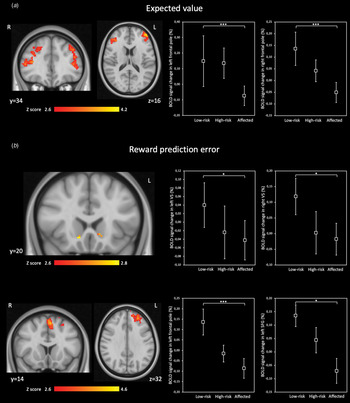
EV-related task activations were confirmed in the low-risk twins who showed a significant response in inferior frontal gyrus, frontal pole, and ACC (Table 2). The EV signal in the VS was not found significantly different between the three groups. Exploratory PFC analysis showed a lower EV signal in the affected compared with low-risk twins bilaterally in the frontal poles extending into middle frontal gyrus (BA 10/46, Table 2, Fig. 2a). The high-risk twins showed no significant change in the EV signal compared to the low-risk group in the VS or PFC.
Neural responses to EV and RPE in affected, high-risk, and low-risk MZ twins (n = 112). The plots show group means with error bars representing the standard error of the mean. Statistical maps thresholded at z > 2.57 with significant clusters overlaid on a standard MNI template. (a) Decreased frontal pole response to EV in affected v. low-risk twins. (b) Decreased RPE response in affected v. low-risk twins in bilateral ventral striatum (VS), right frontal pole and superior frontal gyrus (SFG).

Group differences between the affected, high-risk, and low-risk MZ twins in EV and RPE in the cards guessing fMRI task

BA, Brodmann area, size, number of voxels in the significant cluster, x, y, z, MNI coordinates of peak voxel, z-stat, statistical z values for peak voxel in cluster, p, corrected p values of the cluster within the PFC or the VS ROIs.
Analysis of the RPE neural signal
RPE-related task activations were also confirmed in the low-risk twins who showed a significant response in the right VS and left frontal pole within respective ROIs. The RPE signal in the VS was lower in the affected v. the low-risk twins bilaterally. Exploratory PFC analysis further showed a lower RPE signal in the affected v. low-risk twins in the left frontal pole and superior frontal gyrus (BA9 and 6, Table 2, Fig. 2b). The RPE signal did not significantly change in the high-risk compared to the low-risk group in the VS or PFC.
Post-hoc analyses of the EV and RPE neural signals
The reported regional decrease in cortico-striatal EV and RPE signals in the affected compared to low-risk twins persisted when adjusting for HDRS-17 scores. Furthermore, there were no significant differences between male or female participants in the EV or RPE signals in these regions, and no significant differences between twins with UD or BD.
Correlation analysis between EV and RPE signals and hedonic scores
The exploratory voxel-wise correlation analysis across all participants between the EV and RPE signals and the SHAPS and TEPS hedonic scores revealed a region within dorsal ACC showing a positive correlation between EV signal and decreased hedonic tone (BA32, Table 2, Fig. 3). Explicitly, a higher EV signal in dorsal ACC was associated with a lower hedonic response, as reflected by both higher SHAPS scores and lower TEPS consummatory scores. The association between the EV signal in dorsal ACC and TEPS consummatory scores was also significant in affected twins only (p = 0.01, r = −0.42).
Correlation analysis across all participants (n = 112) between the Snaith Hamilton Pleasure Scale (SHAPS) and Temporal Experience of Pleasure Scale (TEPS) consummatory scores and EV signals. An overlapping dorsal anterior cingulate region (green) showed a positive correlation with decreased hedonic tone (high SHAPS values, and low TEPS values). Statistical maps thresholded at z > 2.57 with significant clusters overlaid on a standard MNI template.

Discussion
This fMRI study including 112 MZ twin individuals explored whether endophenotypes of mood disorders are related to EV and RPE neural signals in reward processing. Specifically, we investigated neural responses in three groups of MZ twins: low-risk, high-risk, and remitted affected twins diagnosed with either UD or BD, while they performed a card guessing fMRI paradigm. Affected twins showed the relatively lowest RPE signals in the a priori ROIs (VS). In addition, the affected twins had a significantly lower prefrontal EV signal bilaterally in the left frontal poles/middle frontal gyrus and lower RPE signal in the left frontal pole and superior frontal gyrus compared to low-risk twins. Since the affected twins have been in remission for an extensive period of time (5 years in average), the reported findings between affected and low-risk twins reflect trait changes rather than state differences. The observed reductions in EV and RPE signals were comparable between UD and BD twins. The high-risk group did not show a significant reduction of the EV or RPE signals, yet both reward signals were consistently lower compared with low-risk twins in the regions where the affected twins showed significant reductions. Self-reported hedonic scores were not significantly different between the groups. Subsyndromal depression and anxiety symptoms in the remitted affected twins were in average somewhat higher than in the high-risk and low-risk twin participants. However, this difference in subsyndromal depressive symptoms was not associated with reported group differences in the EV and RPE signals.
Effective reward processing is critical for successful behavioral adaptation. Both behavioral and biological lines of research bring strong evidence of deficient reward processing in mood disorders (Pizzagalli et al., Reference Pizzagalli, Iosifescu, Hallett, Ratner and Fava2008). The majority of neuroimaging studies investigating altered reward processing in UD and BD have focused on measuring the neural response during anticipation of rewards or either positive or negative feedback using monetary incentives (e.g. Pizzagalli et al., Reference Pizzagalli, Holmes, Dillon, Goetz, Birk, Bogdan and Fava2009), emotional facial expressions (e.g. Keedwell, Andrew, Williams, Brammer, & Phillips, Reference Keedwell, Andrew, Williams, Brammer and Phillips2005) or affective words (e.g. Epstein et al., Reference Epstein, Pan, Kocsis, Yang, Butler, Chusid and Silbersweig2006). However, reward processing involves a number of additional psychological functions, such as elevated attention, valuation, salience attribution, reinforcement learning, and arousal, which contribute to neural activations measured during reward anticipation and feedback (Jia et al., Reference Jia, Macare, Desrivières, Gonzalez, Tao and Ji2016). The EV and RPE signals are discrete functions underlying an effective reward processing (Rolls et al., Reference Rolls, McCabe and Redoute2008). Alteration in the frontostriatal encoding of EV and RPE signals reported here may thus result in inappropriate reward valuation and dysfunctional error-dependent updating of value estimates and/or a reduced attribution of salience to rewarding events, which in turn could mark a vulnerability to anhedonia symptoms experienced during the active phase of mood disorders (Gradin et al., Reference Gradin, Kumar, Waiter, Ahearn, Stickle, Milders and Steele2011; Kumar et al., Reference Kumar, Waiter, Ahearn, Milders, Reid and Steele2008; Vrieze et al., Reference Vrieze, Pizzagalli, Demyttenaere, Hompes, Sienaert, de Boer and Claes2013). Interestingly, a large study in adolescents demonstrated anhedonia-specific dorsal striatum hypoactivation to reward anticipation, independent of low mood and anxiety symptoms (Pornpattananangkul, Leibenluft, Pine, & Stringaris, Reference Pornpattananangkul, Leibenluft, Pine and Stringaris2019).
Our findings support and extend previous findings in UD and BD patients of reduced neural response to reward anticipation or EV and RPE in frontostriatal regions. Several fMRI studies have reported reduced anticipatory signals in striatum in UD and BD (Pizzagalli et al., Reference Pizzagalli, Holmes, Dillon, Goetz, Birk, Bogdan and Fava2009; Schreiter et al., Reference Schreiter, Spengler, Willert, Mohnke, Herold, Erk and Bermpohl2016; Smoski et al., Reference Smoski, Felder, Bizzell, Green, Ernst, Lynch and Dichter2009). In particular, Gradin et al. (Reference Gradin, Kumar, Waiter, Ahearn, Stickle, Milders and Steele2011) showed no changes in the EV signal and reduced RPE signal in the striatum and midbrain in UD patients, with the extent of signal reduction in the bilateral caudate, VS and midbrain correlating with increased anhedonia severity. In BD patients, Chase et al. (Reference Chase, Nusslock, Almeida, Forbes, LaBarbara and Phillips2013) reported no changes in the EV or RPE signals in striatum. Our finding of reduced VS RPE signal in affected v. low-risk twins may be interpreted as impaired error-dependent reward learning as previously suggested in different psychiatric conditions (Gradin et al., Reference Gradin, Kumar, Waiter, Ahearn, Stickle, Milders and Steele2011; Kumar et al., Reference Kumar, Goer, Murray, Dillon, Beltzer, Cohen and Pizzagalli2018; White et al., Reference White, Pope, Sinclair, Fowler, Brislin, Williams and Blair2013).
Consistent with our findings in PFC showing lower EV and RPE signals in affected twins, Smoski et al.'s study (Reference Smoski, Felder, Bizzell, Green, Ernst, Lynch and Dichter2009) showed bilateral decreased in middle frontal gyrus and right frontal pole response to reward anticipation in a Wheel of Fortune task in UD v. control participants. In addition, the EV signal was also found lower in UD and BD v. controls in ACC (Chase et al., Reference Chase, Nusslock, Almeida, Forbes, LaBarbara and Phillips2013) and medial orbitofrontal cortex (Rothkirch et al., Reference Rothkirch, Tonn, Köhler and Sterzer2017) in unmedicated UD patients. Dorsal and middle frontal regions with BA 46 and 9 in particular, have consistently been found to be engaged in solving calculation tasks that implicate cognitive resources (Arsalidou & Taylor, Reference Arsalidou and Taylor2011). Reduced frontal poles/middle frontal gyrus recruitment may therefore reflect a lower neural engagement in the computation of the EV in patients with mood disorders, possibly resulting in a reduced valuation of the expected rewards.
While UD and BD patients may show different patterns of brain connectivity between regions involved in win/loss anticipation (Manelis et al., Reference Manelis, Almeida, Stiffler, Lockovich, Aslam and Phillips2016), we were not able to detect any difference in the EV or RPE signals in the VS and PFC ROIs between UD and BD patients. It is possible that the relatively long time in remission in our affected group may wash out disorder-specific changes.
To our knowledge, this is the first study specifically investigating EV and RPE signals in unaffected twin siblings (high-risk group) of UD and BD and probands. We observed no statistically significant difference in reward processing between the low- and high-risk twins. Yet, the strength of the EV and RPE signals in the frontostriatal regions, where the affected twins showed significant reductions, was consistently lower in the high-risk compared to the low-risk twins (but higher compared to the affected twins). This finding suggests a subsyndromal reduction in reward-related signals in VS and frontopolar regions in high-risk individuals, which can advance increasing the vulnerability to disorder onset. This interpretation is consistent with previous studies that observed reduction in anticipatory and feedback signals in striatum in high-risk compared to low-risk individuals (Gotlib et al., Reference Gotlib, Hamilton, Cooney, Singh, Henry and Joormann2010; Olino et al., Reference Olino, McMakin, Morgan, Silk, Birmaher, Axelson and Forbes2014).
While there was a large inter-subject variability in hedonic ratings, the mean hedonic response was not different between the low-risk, high-risk, and affected groups. The correlation analysis using the SHAPS and TEPS consummatory pleasure scores across all twins revealed a common region in dorsal ACC (BA32) showing increased EV signal in individuals with decreased hedonic scores. Increased recruitment of ACC (BA32), together with other frontostriatal regions, has previously been associated with anticipatory anhedonia in a transdiagnostic meta-analysis in UD and schizophrenia (Zhang et al., Reference Zhang, Lin, Shi, Öngür, Auerbach, Wang and Wang2016). Our finding strengthens the suggested link between hedonic tone and ACC reward-related response, region that may be responsible for monitoring affective conflict during anticipation of attainable gains and found hyperactive in UD (Knutson et al., Reference Knutson, Bhanji, Cooney, Atlas and Gotlib2008).
One of the key strengths of the current fMRI study is the nation-wide register-based recruitment which resulted in an exceptionally large sample of MZ twins who were investigated by assessors blinded to their risk status. Another key strength is that most affected patients in the study had been in remission for a long period up to the study which enabled the identification of trait changes. As a limitation, our reference low-risk group did not show a significant EV signal in VS. This may have precluded the detection of possible reductions in the VS signal in the affected twins. In addition, combining the UD and BD patients in our primary analysis limits result interpretations regarding diagnosis-specific abnormalities. This approach maximizes the power to detect disease related changes and risk endophenotypes shared between UD and BD patients or between their high-risk twin siblings respectively. However, we also investigated differences between the UD and BD patients and their high-risk twin siblings.
In conclusion, by showing a lower frontostriatal sensitivity to signals representing EVs and RPEs, our findings strengthen the notion of reduced valuation of expected rewards and decreased error-dependent reward learning in mood disorders. These changes may underpin a vulnerability to anhedonia symptoms such as loss of interest and the decreased ability to feel pleasure commonly experienced during depressive episodes. Our data also show a trend reduction in reward-related signals in unaffected co-twins in the same frontostriatal regions where their affected co-twins showed significant changes. If this finding can be replicated in larger cohorts, it may represent an endophenotypic trait possibly indicating an increased risk for disorder onset.
Supplementary material
The supplementary material for this article can be found at https://doi.org/10.1017/S0033291720000367.
Financial support
The study was supported by the Lundbeck Foundation (Grant R108-A10015). HRS holds a 5-year professorship in precision medicine at the Faculty of Health Sciences and Medicine, University of Copenhagen which is sponsored by the Lundbeck Foundation (Grant R186-2015-2138). KWM holds a 5-year Lundbeck Foundation Fellowship (Grant R215-2015-4121).
Conflict of interest
During the last 3 years the following authors report received honoraria with no association with the current study: LVK as a consultant for Lundbeck; HRS as a speaker from Sanofi Genzyme, Denmark and Novartis, Denmark, as a consultant from Sanofi Genzyme, Denmark and as a senior editor (NeuroImage) and editor in chief (NeuroImage-Clinical) from Elsevier Publishers, Amsterdam, The Netherlands, and received royalties as book editor from Springer Publishers, Stuttgart, Germany; MLP received a honorarium from Sunovion Pharmaceuticals; KWM received consultancy fees from Lundbeck, Allergan and Janssen; MV received consultancy fees from Lundbeck A/S. The rest of the authors have nothing to disclose.
Ethical standards
The authors assert that all procedures contributing to this work comply with the ethical standards of the relevant national and institutional committees on human experimentation and with the Helsinki Declaration of 1975, as revised in 2008.