Introduction
The Asian Values Thesis claims that Asia's collectivistic traditions create immunity against the West's individualistic emphasis on emancipative values and liberal democracy. More importantly, it is held that Asia's immunity persists even under the imprint of economic modernization. A major implication of this thesis is that Asia can modernize economically without adopting the emancipative consequences of modernization known from the West, including liberal democracy.
Whether right or wrong, the Asian Values Thesis reaches far beyond Asia itself in either case. The thesis touches upon a key dispute in the contemporary understanding of modernity, which pitches cultural relativism against developmental universalism. If the Asian Values Thesis is correct, there is no common emancipative logic that unifies modernization processes across cultures. In this case, developmental universalism is wrong and cultural relativism is right: there would be no inter-culturally shared modernity; instead, there would be various culture-specific modernities and Asian modernity would be one of them – opposed to Western modernity by Asia's culturally ingrained refusal of human emancipation.
The Asian Values Thesis has been criticized for its political instrumentality, disqualifying it as an ideologically motivated rhetoric to legitimize oppressive power practices in authoritarian regimes. Treatments of the factual claims of the Asian Values Thesis have re-interpreted the writings of Confucius, Buddha, and other formative texts in an attempt to demonstrate that Asia's cultural traditions are reconcilable with the ideas of human emancipation and liberal democracy. By contrast, direct empirical tests of the Asian Values Thesis on the basis of representative survey data are sparse. In fact, no study so far has tested in a systematic Asian–Western comparison the claim that people in Asian countries show a particular immunity against the Western emphasis on emancipative values and liberal democracy and that this immunity withstands the imprint of modernization.
Using representative population data from the World Values Surveys, this article fills this gap, employing an Asian–Western comparison to determine whether and to what extent people in Asian countries oppose the Western emphasis on emancipative values and liberal democracy and whether they do so even under the imprint of modernization. The article is organized into four sections. Section 1 gives a brief overview of the debate on Asian values and reviews the empirical findings available so far. Section 2 derives empirically testable propositions from the previous discussion. Section 3 introduces the data and describes the variables I use to test these propositions. Section 4 presents the test results. The article concludes with a dismissal of Asian exceptionalism, emphasizing that Asian cultures are not exempted from the emancipative logic of modernization.
1. Theoretical background
A brief review of the Asian values debate
What is known as the ‘Asian values debate’ originated in the World Conference on Human Rights, held in 1993 in Vienna. At this occasion, the Chinese and Singaporean delegations forcefully objected to the universalistic interpretation of human rights advocated by the ‘West’. In the name of cultural diversity, Chinese and Singaporean delegates propagated a culture-specific notion of human rights. It was argued that the collectivistic traditions of Asia – and above all of Confucian East Asia – are inherently opposed to the West's individualistic emphasis on emancipative values and liberal democracy that inspires the idea of universal human rights. The West's repeated attempts to declare its individualistic tradition as common under a universal concept of human rights has been dismissed by Asian delegates as a violation of other cultures’ right to value their collectivistic traditions.
These views have been made prominent by former Singaporean leader Lee Kwan Yew. His thesis of Asia's cultural distinctness from the West has been published in a widely debated Foreign Affairs interview with Fareed Zakaria (Reference Yew1994). Lee Kwan Yew's views have found a wide resonance for various reasons (Thompson, Reference Thompson2001, Reference Thompson2004). To begin with, the argument was put forward by the representative of a country that modernizes successfully without embracing democracy – a point that so far also characterizes the largest nation of Asia and the world: China. The cases of China and Singapore seem to provide powerful evidence that Asian countries can embark on a culture-specific path of modernization that avoids the emancipative consequences known from the West, in particular democracy.
Moreover, the Asian Values Thesis mirrored another provocative contribution: the Clash of Civilization Thesis by Huntington (Reference Huntington1996). A key point in the Clash of Civilization Thesis is the West's uniqueness in its emphasis on emancipative values and liberal democracy. Particularly in Asia, the idea of a cultural clash with the West resonated with a long tradition of writings that emphasize the unique dominance of authoritarian values in Asia. Influential authors, such as Pye (Reference Pye1985), portray Asia's authoritarian values as long being incompatible with Western emancipative values, from which liberal democracy takes its justification. Most recently, Bell's (Reference Bell2006) Beyond Liberal Democracy follows this line of reasoning, concluding that liberal democracy cannot be legitimized in Asia on the basis of Western emancipative values, but has to be rooted in Asian traditions of thinking. Sensitive as this approach may seem, it continues to take for granted an untested empirical claim: emancipative values do not resonate among Asians, not even under the imprint of modernization.
Another domain of support can be found in cross-cultural psychology, where the ‘East–West’ difference has for some time been described in terms of a collectivism–individualism dualism (Triandis, 1995; Schwartz and Ros, Reference Schwartz and Ros1995). ‘Asians’ are described as having distinctly ‘inter-dependent’ personalities, in juxtaposition to the ‘in-dependent’ personalities of ‘Westerners’ (Markus and Kitayama, Reference Markus and Kitayama1998). More generally, the Asian Values Thesis profits from the intellectual climate of cultural relativism that is still en vogue in Western and Eastern circles alike (Wong, Reference Wong2006).
Not surprisingly, there was immediate opposition to the Asian Values Thesis. Disagreement was voiced by human rights activists in Asia, such as Aung San Suu Kyi, and academics from the region, such as Xiarong Li. Some of the most powerful rebuttals were issued by widely read Francis Fukuyama (Reference Fukuyama1995) and by Nobel price laureate Amartya Sen (Reference Sen1997). The most intriguing objections raised against the Asian Values Thesis are: instrumentality, selectivity, and what has been called the ‘genetic fallacy’ (Li, Reference Li, Gehring and Galston2003).
Sen, for instance, argues that the rejection of the Asian Values Thesis throughout many parts of Asia already belies one of the thesis's fundamental premises: the existence of a uniform Asian value system. Moreover, there is an obvious connection between political position and support of the Asian Values Thesis, which uncovers support as ideologically motivated. Supporters were mostly found among leaders of authoritarian regimes, such as Singapore's Lee Kwan Yew or China's Li Peng. Critics were found among regime opponents, such as the Dalai Lama, and leaders of democratic regimes, including Taiwan's Lee Teng-Hui and South Korea's Kim Dae Jung (Kim, Reference Yew1994; Dalai Lama, Reference Lama1999). The Asian Values Thesis has thus been dismissed as a smokescreen to hide oppressive power practices behind the parlance of cultural pluralism.
Fukuyama (Reference Fukuyama1995) and others argue that no cultural system is inherently consistent. The complexity of any cultural system allows one to read into it what one wants to read into it. Thus, what proponents of the Asian Values Thesis define as Asian values is a selective reading of a rich cultural heritage – this selectivity being more indicative of what these proponents want Asian values to be than what Asian values really are.
Another criticism has been raised by Li (Reference Li, Gehring and Galston2003) who accuses proponents of the Asian Values Thesis of the ‘genetic fallacy’. This is the erroneous assumption that a cultural achievement always has to remain the sole property of its locus of origin. Hence, the concept of liberal democracy cannot be dismissed as inapplicable to non-Western cultures simply by pointing to its Western origin.
Most of the criticism of the Asian Values Thesis is directed against the political motivation behind it. Empirical approaches that try to prove the thesis wrong in its factual statements usually elaborate on Asian philosophical traditions in an attempt to show that there are elements in Confucianism, Buddhism, and Hinduism that embrace emancipative values and are compatible with liberal democracy (Kim, 1994; Fukuyama, Reference Fukuyama1995; Sen, Reference Sen1997; De Bary, Reference De and Theodore1998; Dalai Lama, Reference Lama1999). By contrast, evidence for the thesis that the values of Asian populations are immune against the West's emphasis on emancipative values and liberal democracy and remain so even under the imprint of modernization is sparse. Indeed, only a handful of studies use representative data from population surveys in Asia and the West to test key aspects of the Asian Values Thesis. What did these studies find out?
Empirical tests of the Asian values thesis
Nathan (Reference Nathan2007) uses survey data from the East Asia Barometer to examine Confucian values, which he operationalizes as ‘traditional social values’ with an emphasis on conformity and authority. Doing so, Nathan finds that Confucian values and democratic values adversely affect support for democracy in a sample of eight Asian societies: Japan, Hong Kong, South Korea, China, Mongolia, the Philippines, Taiwan, and Thailand. In each of these societies, Confucian values undermine support for democracy.
In a joint study with Chu, Diamond, and Shin, Nathan analyzes the same data for the same set of countries with respect to notions of democracy. The authors find that even though the Western liberal understanding of democracy is supported throughout most Asian countries, it is also rivaled by alternative understandings that emphasize strong leadership, social harmony, and other typically Asian values (Chu et al., Reference Chu, Diamond, Nathan, Shin, Chu, Diamond, Nathan and Shin2008: 12–13).
A study by Chang and Chu (Reference Chang and Chu2002) supports this interpretation. The authors analyze survey data from mainland China, Hong Kong, and Taiwan and find that traditional social values negatively affect democratic values in a Western understanding, such as support for human rights. Park and Shin (Reference Park and Shin2007) confirm this result with data for South Korea. Thus, the studies by Nathan (Reference Nathan2007), Chang and Chu (Reference Chang and Chu2002) and Park and Shin (Reference Park and Shin2007) support the Asian Values Thesis.
On the other hand, Fetzer and Soper (Reference Fetzer and Soper2008) disconfirm the findings of Chang and Chu for two representative samples of Taiwanese citizens. According to Fetzer and Soper, traditional social values do not consistently hamper democratic values in a Western sense. On a broader basis of evidence, Dalton and Ong (Reference Dalton, Ong, Dalton and Chull2006) examine data from the World Values Survey to show that traditional social values do not impede support for democracy more in East Asia than in Western countries, including the US, Canada, Australia, and New Zealand. Thus, there is nothing particularly Asian or Confucian about the existence of traditional social values, nor is there anything particularly Asian or Confucian about the conflict between traditional social values and democratic values: these sets of values conflict with each other in both the East and West. Supporting the findings of Dalton and Ong (Reference Dalton, Ong, Dalton and Chull2006), Flanagan and Lee (Reference Flanagan and Lee2001) also use World Values Survey data, showing that the process of modernization has changed the values of South Koreans and the Japanese in ways that promoted democratic reforms in these countries. These three studies rather disconfirm the Asian Values Thesis.
Valuable as these studies are, none of them is conclusive enough to settle the debate. The studies by Park and Shin (Reference Park and Shin2007) and Fetzer and Soper (Reference Fetzer and Soper2008) both focus on one country only and are thus unsuited to make generalizations across the wider Asian region. The studies by Flanagan and Lee (Reference Flanagan and Lee2001), Chang and Chu (2202), and Nathan (Reference Nathan2007) as well as Chu et al. (Reference Chu, Diamond, Nathan, Shin, Chu, Diamond, Nathan and Shin2008) each analyze more than one country but remain confined to Asia. These studies ignore the Asian–Western contrast that constitutes the core of the Asian Values Thesis. The Thesis's key claim of an Asian–Western chasm in the value of human emancipation and liberal democracy can only be tested by an Asian–Western comparison.
Dalton and Ong's (Reference Dalton, Ong, Dalton and Chull2006) study is the only one that probes into an Asian–Western comparison. It is the most conclusive study on this matter. Still, the finding that traditional social values do not undermine support for democracy more in Asia than in the West does not provide an exhaustive test of the Asian Values Thesis. Noteworthy as this finding is, it leaves the two key claims of the Asian Values Thesis untested:
(1) People in Asian countries resist the Western emphasis on emancipative values and this resistance does not vary with people's exposure to modernization.
(2) Void of Western emancipative values, people in Asian countries resist the Western emphasis on liberal democracy and this resistance does not vary either.
This article examines these unproven claims of the Asian Values Thesis for the first time in an Asian–Western comparison.
2. Propositions and counter-propositions
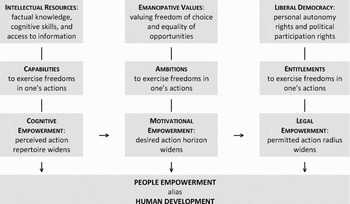
The two key claims of the Asian Values Thesis are in direct opposition to a universalist notion of modernization, as formulated in the Human Development Thesis by Welzel et al. (Reference Welzel, Inglehart and Klingemann2003) (see also Welzel and Inglehart, Reference Welzel, Inglehart, Dalton and Shin2006). According to the Human Development Thesis, modernization is basically an emancipative process whose major thrust is to empower people to exercise freedoms in their actions. As shown in Figure 1, the process of people empowerment is supposed to manifest itself in a threefold way: (1) cognitive empowerment when growing intellectual resources increase people's capabilities to exercise freedoms; (2) motivational empowerment when rising emancipative values elevate people's ambitions to exercise freedoms; (3) legal empowerment when the institutionalization of liberal democracy widens people's entitlements to exercise freedoms.
Human development as people empowerment

Due to the Human Development Thesis, the three partial empowerments cannot be seen in isolation from each other but are intimately linked through the ‘utility logic of freedoms’. The utility logic of freedoms implies that people perceive freedoms as valuable enough to struggle for their legalization whenever they see themselves capable to handle these freedoms. Accordingly, people's ambitions to exercise freedoms adjust to their capabilities to exercise freedoms. This adjustment has proven so useful to managing reality that evolution has anchored it as a key coping mechanism in the human mind. Because of its evolutionary origin, the utility logic of freedoms operates in a culture-invariant way that is common to our species, triggering similar mental reactions to similar external stimuli. Consequently, Asian cultures are not exempted from the utility logic of freedoms and its consequences. One of these consequences is that processes of cognitive empowerment, such as rising levels of education and increasing access to information, result in a corresponding empowerment in ambitions, as reflected in the rise of emancipative values. Another consequence is that, as soon as people have adopted emancipative values, they endorse a liberal notion of democracy, since this is the notion that translates the spirit of emancipative values into the domain of regime orientations.
Applied to Asia, the Human Development Thesis reverts the two key claims of the Asian Values Thesis into their opposites:
(1) People in Asian countries do not invariantly resist the Western emphasis on emancipative values; instead emphasis on emancipative values varies in Asia, as it does in the West, with people's cognitive empowerment.
(2) Not entirely void of emancipative values, people in Asian countries do not invariantly resist the Western emphasis on liberal democracy; instead the endorsement of liberal democracy varies in Asia, as it does in the West, with people's emancipative values.
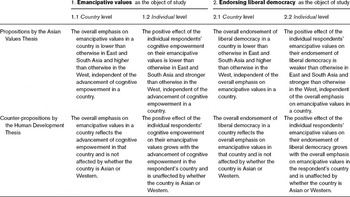
For the empirical analyses, it is helpful to convert these general hypotheses into directly testable propositions. Accordingly, Table 1 suggests a number of propositions and counter-propositions. Separate propositions are formulated for an emphasis on emancipative values and an emphasis on liberal democracy as objects of study. For both objects, propositions are specified at the country level and at the individual level. At both levels, propositions derived from the Asian Values Thesis are in direct opposition to counter-propositions derived from the Human Development Thesis.
Turning the Asian Values Thesis and the Human Development Thesis into specific propositions

At the country level, the critical question is how a population's belonging to Asia or the West affects its overall emphases on emancipative values and on liberal democracy. According to the Asian Values Thesis, a population's overall emphases on emancipative values and on liberal democracy are lower than otherwise in Asia and higher than otherwise in the West (Propositions 1.1 and 2.1). According to the Human Development Thesis, a population's overall emphasis on emancipative values does not depend on its belonging to Asia or the West; instead, it depends on how far the process of cognitive empowerment is advanced in a country (Counter-Proposition 1.1). Likewise, a population's overall emphasis on liberal democracy does not depend on its Asian or Western belonging, it depends on how strong a population's overall emphasis on emancipative values has grown (Counter-Proposition 2.1).
At the individual level, the critical question is how a population's belonging to Asia or the West varies the impact of a respondent's cognitive empowerment on her emancipative values and the impact of her emancipative values on her endorsement of liberal democracy. According to a strong version of the Asian Values Thesis, the impact of cognitive empowerment on emancipative values and that of emancipative values on endorsing liberal democracy are inexistent in Asia and only exist in the West. In a more moderate formulation (which is the one chosen in Table 1), the effects are at least weaker than otherwise in Asia and stronger than otherwise in the West (Propositions 1.2 and 2.2). The Human Development Thesis assumes the opposite on both accounts. First, a respondent's cognitive empowerment strengthens her emancipative values more the farther advanced the process of cognitive empowerment is in the respondent's country – no matter whether that country is Asian or Western (Counter-Proposition 1.2). Second, a respondent's emancipative values strengthen her endorsement of liberal democracy more the stronger the overall emphasis on emancipative values has grown in the respondent's country – no matter whether that country is Asian or Western (Counter-Proposition 2.2). The logic of these two counter-propositions is one of contextual enforcement: as an individual-level characteristic, cognitive empowerment has an emancipative-minding impetus and emancipative values have a liberal-minding impetus, but these impetuses become stronger the more prevalent the attribute in question is in a respondent's country.
3. Data and measurements
To test the above listed propositions, I use data from the World Values Surveys (WVS), which provide nationally representative data of the beliefs and values of more than 90 societies around the globe.Footnote 1 Among these societies, 15 in total are Asian (in alphabetic order): Bangladesh, China, Hong Kong, India, Indonesia, Japan, Kyrgyzstan, Malaysia, Pakistan, The Philippines, Singapore, South Korea, Taiwan, Thailand, and Vietnam.
Advocates of the Asian Values Thesis do not deny that there are manifold differences among Asian countries. Nevertheless, the thesis holds that – despite these differences – Asian countries share a weaker than usual emphasis on emancipative values and a weaker than usual emphasis on liberal democracy, in contrast to stronger than usual emphases in Western countries. In order to test this hypothesis, one has to arrange countries into Asian and Western groups and to examine whether these groupings affect the emphases on emancipative values and liberal democracy in the predicted direction. To do so, I use a global scheme of ten culture zones inspired by Huntington (Reference Huntington1996) and described by Welzel et al. (Reference Welzel, Inglehart and Klingemann2003). This scheme groups countries covered by the WVS in the following way:
• Protestant (non-English) West: Denmark, Finland, Iceland, Netherlands, Norway, Switzerland.
• English West: Australia, Canada, Ireland, New Zealand, USA, UK.
• Catholic West: Austria, Belgium, France, Germany (West), Italy, Luxemburg, Malta, Portugal, Spain.
• Ex-communist West: Croatia, Czech Republic, Hungary, Latvia, Lithuania, Poland, Slovakia, Estonia, Germany (East), Slovenia.
• Ex-communist East: Albania, Armenia, Azerbaijan, Belarus, Bosnia-Herzegovina, Bulgaria, Georgia, Macedonia, Moldova, Romania, Russia, Serbia-Montenegro, Ukraine.
• Muslim Core Zone: Algeria, Egypt, Iran, Iraq, Jordan, Morocco, Saudi Arabia, Turkey.
• Sub-Saharan Africa: Burkina Faso, Ethiopia, Ghana, Mali, Nigeria, Rwanda, South Africa, Tanzania, Uganda, Zambia, Zimbabwe.
• Latin America: Argentina, Brazil, Chile, Colombia, Dominican Republic, El Salvador, Guatemala, Mexico, Peru, Trinidad-Tobago, Venezuela, Uruguay.
• South Asia: Bangladesh, India, Indonesia, Malaysia, Pakistan, Philippines, Singapore, Thailand.
• East Asia: China, Hong Kong, Japan, Kyrgyzstan, South Korea, Taiwan, Vietnam.
I use this ten-fold grouping of countries to see whether there is an Asian–Western division over people's emphases on emancipative values and liberal democracy. As will become evident, instead of a twofold Asian–Western division, we find a threefold division with East Asia placed in between the four Western culture zones, on the one hand, and South Asia, on the other hand. For this reason, the statistical analyses uses a threefold group contrast, using country dummies for ‘Western Country’, ‘East Asia’, and ‘South Asia’. For the Western Country dummy, respondents are coded 1 when their country is included in one of the four Western country groups of the list above and 0 otherwise. For the East Asia dummy, respondents are coded 1 when their country is included in the East Asian group of the list and 0 otherwise. For the South Asia dummy, respondents are coded 1 when their country is included in the South Asian group and 0 otherwise.Footnote 2
In order to test the propositions in Table 1, we need measures of how strongly people emphasize emancipative values and liberal democracy. Based on WVS data, valid measures for both variables are available.
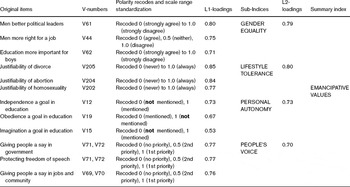
To measure emancipative values I use an index that has been tried and tested by Welzel (Reference Welzel and Inglehart2010) (see also Welzel and Inglehart, Reference Welzel2010). In a Western understanding, emancipative values comprise orientations that emphasize freedom of choice and equality of opportunities among individuals. With WVS data, these values can be measured by orientations that emphasize:
(1) gender equality,
(2) lifestyle tolerance,
(3) personal autonomy, and
(4) people's voice.
Twelve items of the WVS in total cover these topics and have been asked in the same format repeatedly. Three of the 12 items tap gender equality in the areas of women's access to politics, education, and labor. Another three items cover the lifestyle tolerance related to people's reproductive choices in the areas of child birth (abortion), cohabitation (divorce), and sexual orientation (homosexuality). Still another three items cover the topic of personal autonomy related to the themes of independence, imagination, and obedience as desired child qualities. Finally, three items cover the people's voice domain, asking how strong a priority people place on having a ‘say in important government decisions’, on having a ‘say in how things are done at their jobs and in their communities’, and on ‘protecting freedom of speech’.
Each of the 12 items is rescaled into a range from 0 for the least emancipative position and 1.0 for the most emancipative position. The 12 rescaled items are summarized in a two-step procedure, as shown in Table 2. In the first step, the four three-item groups are averaged into four sub-indices for gender equality, lifestyle tolerance, personal autonomy, and people's voice. Each of the four sub-indices yields a multi-point index with minimum 0, maximum 1.0, and manifold fractions in between, e.g. 0.10, 0.25, 0.33, 0.50, 0.66, 0.75, 0.80, and so on. In the final step, the four sub-indices are averaged into an overall index of emancipative values, yielding an even more fine-grained multi-point index with minimum 0 for respondents taking the least emancipative position on all 12 items and 1.0 for respondents taking the most emancipative positions on all 12 items.Footnote 3
Conceptualizing emancipative values with WVS data

Note: Coefficients are factor loadings resulting from a hierarchical factor analysis over the country-pooled individual-level dataset of WVS II-V (N = 106,609). First-level factor analysis over 12 items with oblimin-rotation (delta = 0.25) creates a four-dimensional solution under the Kaiser-criterion, with a KMO of 0.77 (Cronbach's alpha for the 12 items is 0.68). Second-level factor analysis with the four extracted factors from the first-level analysis produces a one-dimensional solution under the Kaiser-criterion, with a KMO of 0.76.
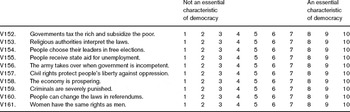
Considering people's emphasis on liberal democracy, the WVS used for the first time in round five (conducted in 2005–8) a question that asks people how strongly they emphasize each of ten different notions of democracy, as shown in Table 3.
WVS item-battery asking for people's notion of democracy
Many things may be desirable, but not all of them are essential characteristics of democracy. Please tell me for each of the following things how essential you think it is as a characteristic of democracy. Use this scale where 1 means ‘not at all an essential characteristic of democracy’ and 10 means it definitely is ‘an essential characteristic of democracy’ (read out and code one answer for each):

These items were designed to measure the emphases on four different notions of democracy:
(1) a liberal Western notion when people emphasize the freedoms that empower people as democracy's defining feature;
(2) a social notion when people emphasize redistributive policies that are part of the welfare state as democracy's defining feature;
(3) a populist notion when people emphasize bread-and-butter and law-and-order issues that are often widely popular but have in fact little to do with democracy as democracy's defining feature;
(4) an authoritarian notion when people emphasize anti-democratic extra powers of the military and religious authorities as democracy's defining feature.
The liberal notion is covered by the items referring to free elections (V154), referenda votes (V160), civil rights (V157), and equal rights (V161). The social notion is covered by the items addressing the welfare state (V155) and economic redistribution (V152). The populist notion is included in the items relating to economic prosperity as a bread-and-butter issue (V158) and fighting crime as a law-and-order issue (V159). And the authoritarian notion is covered by the items favoring military intervention (V156) and religious authority (V153) as defining elements of democracy.
Advocates of the Asian Values Thesis characterize the liberal notion of democracy as a Western notion that is not universally endorsed among people in non-Western cultures, most notably in Asia. Recent evidence by Dalton, Shin and Jou (Reference Dalton, Shin and Jou2007) seems to contradict this proposition, showing that the liberal notion of democracy is endorsed all around the globe. Valid as this evidence might be, it is not necessarily conclusive. As outlined by Schedler and Sarsfield (Reference Schedler and Sarsfield2006), people can have mixed notions of democracy, so that even a strong endorsement of liberal democracy can be confused by a similarly strong endorsement of conflicting notions of democracy. Some evidence that this possibility is a reality in Asia is provided by Chu et al. (Reference Chu, Diamond, Nathan, Shin, Chu, Diamond, Nathan and Shin2008: 12–13). Thus, what matters is how exclusively people connote democracy in liberal terms. The liberal notion of democracy may not be absent in Asian countries, but it might be more strongly rivaled by alternative notions than is the case in Western countries. If this were true, there would be an Asian–Western difference as regards the dominance of liberal over competing notions of democracy. In this case, the Asian Values Thesis would be correct. In order to test this possibility, the endorsement of liberal democracy has to be measured in opposition to the endorsement of conflicting notions of democracy.
One possibility for doing this is to look at how respondents score on average over all liberal items and over all non-liberal items and then calculate the difference between the two averages. However, this would treat all non-liberal understandings equally when in fact their conflict with the liberal understanding varies in strength.
Relative to the liberal definition, an authoritarian definition of democracy is directly contradictory. Thus, one can qualify someone's understanding of democracy as consistently liberal only if the person emphasizes the liberal features of democracy and at the same time rejects the authoritarian ones. This means that the authoritarian item rating has to be subtracted with full weight from the liberal item rating.
The populist understanding of democracy defines features as democratic that have nothing to do with the definition of democracy. Thus, if we want to measure how exclusively liberal people define democracy, the populist item ratings have to be subtracted from the liberal ones too. Yet, populism should not be subtracted from liberalism with the same weight as authoritarianism. This is so for the following reason. While the authoritarian definition is plainly anti-liberal, the populist one is just non-liberal: it rivals but does not contradict the liberal understanding, indicating a lower degree of tension. The existing but lesser tension should be modeled by subtracting the populist item ratings from the liberal ones, yet subtracting them with a lower weight than the authoritarian ones.
The authoritarian definition of democracy contradicts the liberal definition and is hence anti-liberal. The populist definition of democracy rivals the liberal one and is thus non-liberal. By contrast, the social definition of democracy is neutral to the liberal definition. The social definition addresses redistributive features whose endorsement or rejection both are compatible with a liberal definition of democracy. Endorsement of the social features is compatible with a social-liberal understanding of democracy. Refusal of the social features is compatible with a market-liberal understanding of democracy. In other words, any position towards redistributive features is equally compatible with a liberal definition of democracy. Because of this neutrality, the social item ratings should not be subtracted from the liberal item ratings when one wants to measure the dominance of the liberal over contradictory and rival definitions, but not over compatible definitions.
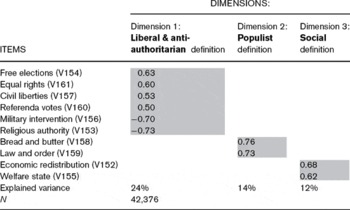
The exploratory factor analysis of the ten democracy items in Table 4 confirms this consideration.Footnote 4 There are three dimensions that shape people's notion of democracy. The first dimension represents a direct polarity between the liberal notion and the authoritarian notion: the liberal items load on the positive pole, the authoritarian ones at the negative pole of this liberal and anti-authoritarian dimension. The second dimension represents the populist and the third one the social notion of democracy. This pattern justifies an index that measures how dominantly liberal people define democracy by subtracting from people's liberal item rating their authoritarian item rating with full weight and their populist item rating with half a weight, as expressed in this formula (see Klingemann, Reference Klingemann and Norris1999 for a similar rationale):
1.0 * Ø liberal rating −0.67 * Ø authoritarian rating −0.33 * Ø populist rating
After having recoded all item ratings from their original 1–10 scales into 0–1.0 scales, this formula produces an index from –1.0, for the case that alternative notions entirely dominate the liberal one, to +1.0, for the opposite case. A score of 0 on this index indicates that a respondent endorses the liberal and alternative notions of democracy equally strongly.Footnote 5
Empirical dimensions in popular notions of democracy

Notes: Entries are factor loadings. Items are standardized for each respondent's mean rating over all items. Factor analysis specified with varimax rotation under the Kaiser criterion. Loadings below 0.40 not shown. Data source is the country-pooled individual-level dataset of WVS V (2005–8)
In order to test the Asian Values Thesis against the counter-propositions from the Human Development Thesis, we need measures of cognitive empowerment at the individual level and the country level. At the individual level, I measure cognitive empowerment by people's level of formal education. This information is taken from WVS question V238, which asks for people's level of education on an eight-point ordinal scale.Footnote 6 Even though educational systems differ in content and quality between countries, in each country a higher level of education usually implies more factual knowledge, higher problem awareness, and better intellectual skills. Thus, formal education is a formidable proxy for differences in people's cognitive empowerment at the individual level.
The advancement of an entire country's cognitive empowerment can be measured in a broader fashion than just by education. In addition to education, other areas of cognitive empowerment include the availability of information technology in a country and a country's per capita scientific output. The World Bank provides a summary index of all three aspects of cognitive empowerment (formal education, information technology, scientific output) and labels it ‘Knowledge Index (KI)’.Footnote 7 In the words of its authors, ‘the KI measures a society's ability to generate, adopt and, diffuse knowledge. The KI is the simple average of the normalized scores of a society on the key variables in the three knowledge economy pillars: education, innovation, and ICT.’ Accordingly, the knowledge index is based on such measures as the tertiary enrollment ratio per cohort (education), the number of patents per 10,000 inhabitants (innovation), and the number of internet hosts per 1,000 inhabitants (ICT). I have rescaled the index into a range from 0 to 1.0, with higher fractions indicating a higher extent of ‘knowledge development’, the label used in the following for this variable.
4. Findings
Distributions and rankings on emancipative values
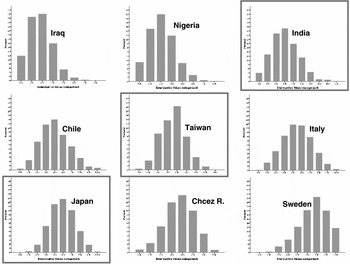
Figure 2 illustrates for a selection of nine countries how populations distribute over the index of emancipative values. Since I use country-mean scores in emancipative values, we have to be sure that these mean scores validly represent a country's central tendency. For this to be the case, national distributions must be single-peaked and mean-clustered. Otherwise, as in the case of a bimodal distribution with peaks at opposite ends, country-mean scores hide polarizations and are not a good representative of central tendencies in emancipative values.
Selected national distributions over the emancipative values index. In each of the nine diagrams, the x-axis displays the index of emancipative values in ten consecutive intervals, each of .10-width, from 0 to 1.0.

Because of space restrictions, Figure 2 only depicts nine out of 87 countries for which the index of emancipative values is available. To select these nine countries, I divided the emancipative values index into three scale ranges: low (from 0 to 0.33 scale points), medium (from 0.33 to 0.66), and high (above 0.66 scale points). Then I selected for each of the three ranges three countries, making sure that every time one Asian country is included. The three countries in the top row of Figure 2 have mean scores in the low range of emancipative values with India being one of the Asian countries in this group. The countries in the second row have mean scores in the middle range of emancipative values with Taiwan being an Asian representative in this group. The three countries in the last row have mean scores in the upper range of emancipative values with Japan being an Asian representative.
Looking at Figure 2, we find single-peaked and mean-clustered distributions everywhere. I can assure that this is the case, without a single exception, for all 87 country samples. Hence, national mean scores in emancipative values can be considered as valid representations of a given population's central cultural tendency.
Figure 2 evidences two additional points. First, emancipative values vary within Asian countries by the same distributional shape and to about the same extent as they do within non-Western countries. Second, the variation in emancipative values between Asian countries can be as pronounced as that between non-Asian countries. This is obvious from the fact that we find at least one Asian country in all three scale ranges of emancipative values. There is no Asian homogeneity indicating a consistently weak emphasis on emancipative values, as the strong version of the Asian Values Thesis suggests.
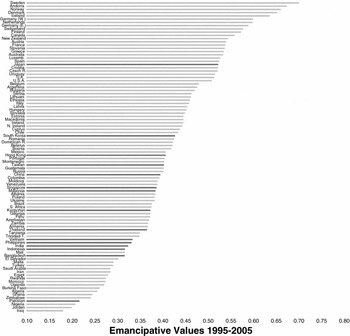
Figure 3 ranks all countries on the index of emancipative values. Again, contrary to the strong version of the Asian Values Thesis, Asian countries do not cluster in a homogenous group in opposition to the ‘West’. Instead, we find Asian countries across the entire scale range, with Japan ranking well among Western countries. In fact, Japan's mean score in emancipative values is above that of the UK and even the US. In the midfield, we find South Korea, Taiwan, and Hong Kong with emancipative values at about the level of Ireland or Portugal, to use some Western examples.
The ranking of countries on the emancipative values index

On the other hand, most South Asian countries – including Pakistan, Bangladesh, India, and Indonesia – cluster in the lower third of emancipative values where we don't find a single Western country. According to this pattern, it is South Asia in particular rather than Asia in general that appears to be distinct from the West. But this finding does not support South Asian exceptionalism, because countries in South Asia share this distinction from the West with Core Muslim countries and Sub-Saharan African countries.
Cognitive empowerment and emancipative values
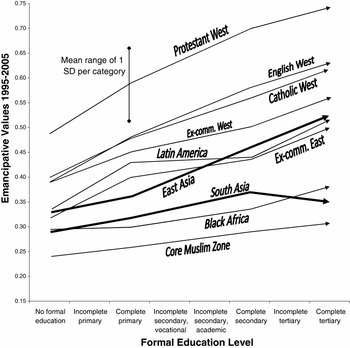
The Human Development Thesis considers emancipative values as a manifestation of motivational empowerment, which is supposed to advance in response to people's cognitive empowerment, as levels of education rise. To test this proposition, Figure 4 shows separately for each of the ten culture zones how strongly people at different levels of education emphasize emancipative values. Levels of education increase from lowest at the left end to highest at the right end.
Emancipative values by level of education across culture zones

Figure 4 seems to confirm Proposition 1.1 of the Asian Values Thesis at least partially. The overall emphasis on emancipative values is lower in East and South Asia than in all four groups of Western countries. This pattern holds true for people at every level of education. But again, this pattern is more pronounced for South Asia than for East Asia. In fact, among the most educated, East Asians place almost as much emphasis on emancipative values as do people in Western countries. Once educated, East Asians’ emancipative values are closer to Westerners’ emancipative values than to those of South Asians.
Proposition 1.2 of the Asian Values Thesis too seems to be partially confirmed, but once more only for South Asia, not East Asia. Even though education associates with stronger emphasis on emancipative values among people of all culture zones, this universality is considerably weaker in South Asia than in Western countries, and in fact is broken with respect to people at the highest level of education. This is evident from the flatter upward slope by which education associates with emancipative values in South Asia and the drop of that slope towards the highest level of education. Again, however, South Asia is not unique in this regard: it shares with Sub-Saharan African countries and Core Muslim countries a weaker – though still positive – association between education and emancipative values.
As concerns the effect of education in East Asia, Proposition 1.2 does not hold at all. On the contrary, formal education associates even somewhat more strongly with emancipative values in East Asia than it does in Western countries. This is obvious from the slightly steeper slope by which emphasis on emancipative values rises with education in East Asia.
So far, the evidence seems to confirm the Asian Values Thesis at least partially. Yet, even this partial confirmation can be misleading. Overall, Asian countries might show a lower emphasis on emancipative values for other reasons than an inherited Asian–Western cultural chasm. Likewise, the association between education and emancipative values might be weaker in South Asia than in Western countries for other reasons than a cultural chasm. As the Human Development Thesis suggests, one of these reasons is the advancement of cognitive empowerment in a country, which is manifest in a country's knowledge development. Thus, the farther knowledge development is advanced in a country, the stronger is the population's overall emphasis on emancipative values and the stronger is the association between education and emancipative values within this country. If this were true, one could conclude the following: the overall emphasis on emancipative values is lower in most of Asia than in the West and the association between education and emancipative values is weaker in most of Asia than in the West because the process of knowledge development is less advanced in large parts of Asia than in most of the West, and not because of an innate cultural resistance of Asia against emancipative values.
The analyses in Table 5 subject these propositions to a rigorous statistical test, using multi-level models that simultaneously explain within-country and between-country variation in emancipative values. Under ‘country-level’ effects, we find country-level characteristics that explain variation in emancipative values between countries due to the propositions derived from the Asian Values Thesis and the Human Development Thesis. These country-level characteristics include culture zone dummies for East Asia, South Asia, and Western countries as well as a country's knowledge development. Note that the culture zone dummies capture each and every commonality that countries within the same culture zone might share – including commonalities we are not even aware of.
Multi-level model explaining within-country and between-country variation in emancipative values

Notes: Models estimated with HLM 6.01. Entries are unstandardized regression coefficients with T-ratios in parentheses. Individual-level variables are country-mean centered; country-level variables are global-mean centered, except for the country dummies. Explained variances calculated from change in random variance component related to empty model. Significance levels: n.s. (not significant) p ≥0.05; * p <0.050; ** p <0.010; p <0.005.
Under ‘individual-level effects’ one sees individual-level characteristics that might explain within-country variation in emancipative values. Under ‘fixed’ individual effects, basic socio-demographic variables for age, sex, and religious denomination as well as political interest are included.Footnote 8 These variables have been found in the literature to affect emancipative values Welzel (Reference Welzel2011). But they are not in themselves of interest here as neither the Asian Values Thesis nor the Human Development Thesis makes a specific claim about these variables’ impact. They are only included as controls in order to isolate the effect of the variable of interest. The variable of interest is formal education, a proxy of cognitive empowerment at the individual level. ‘Random’ means that education is not ‘fixed’ to have constant effects on emancipative values; instead, education's effect is allowed to vary across countries. Doing so is necessary to test the assumption of Proposition 1.2 that the individual-level effect of cognitive empowerment on emancipative values is contextually shaped in direction and strength by country-level characteristics, especially a country's belonging to Asia or the West.
What do we find? Model 1–1 specifies a pure culture zone model that tests the Asian Values Thesis without taking the counter-propositions of the Human Development Thesis into account. The model seems to partially confirm the Asian Values Thesis. If the respondent's country belongs to the West, this adds 0.11 scale points to the 0.37 average score in the overall emphasis on emancipative values. The significantly positive effect of a Western belonging on the respondents’ emphases on emancipative values confirms Proposition 1.1 of the Asian Values Thesis.
If the respondent's country belongs to East Asia, this adds another 0.04 scale points to the average emphasis on emancipative values. This effect is insignificant but its positive sign contradicts Proposition 1.1 of the Asian Values Thesis. If the respondent's country belongs to South Asia, this reduces the average emphasis on emancipative values by 0.02 scale points. But even though the direction of this effect is in accordance with Proposition 1.1, its negligible size and insignificance contradict the proposition.
Proposition 1.2, too, is only partly confirmed. In general, education has a positive effect on emancipative values, adding 0.10 scale points to the 0.37 average score in emancipative values when formal education is at its highest level, at 1.0 for people with a university degree. But when formal education is at its highest level and when this is the case in a Western country, this increases emancipative values by another 0.03 scale points. If, by contrast, a respondent's country is South Asian, this weakens the emancipative effect of education, decreasing emancipative values by 0.03 scale points. This is in accordance with Proposition 1.2, but the effect is barely significant, providing only a weak confirmation of the proposition. Moreover, a respondent's belonging to East Asia increases the emancipative effect of education and even though this strengthening does not cross the significant hurdle, its positive sign contradicts Proposition 1.2.
What happens if we test the Asian Values Thesis against the counter-propositions of the Human Development Thesis? The answer to this question is straightforward. As is obvious from Model 1–2, Propositions 1.1 and 1.2 of the Asian Values Thesis are disconfirmed in every aspect when we test them against the counter-propositions of the Human Development Thesis. Specifically, the effects of the Asian and Western culture zone dummies on emancipative values diminish to negligible size and drop to insignificance (in the case of both East and South Asia) or almost insignificance (in the case of the West), once we control for a country's knowledge development. This finding is a full confirmation of Counter-Proposition 1.1 as suggested by the Human Development Thesis.
Similarly, the impact of the Asian and Western culture zone dummies on education's emancipative effect diminishes to negligible size and full insignificance, once we control for a country's knowledge development. To what extent the individual respondents’ education strengthens their emancipative values varies to 35% with the respective country's knowledge development. Taking this into consideration, it does not matter whether a country is Asian or Western. This finding is an outright confirmation of Counter-Proposition 1.2 by the Human Development Thesis.
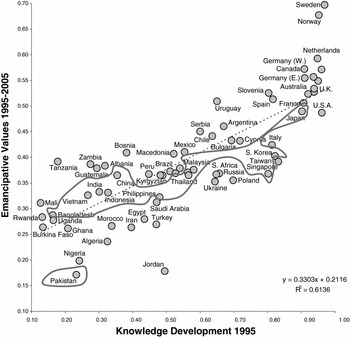
For illustration purposes, Figure 5 plots a country's overall emphasis on emancipative values on the vertical axis against the advancement in knowledge development on the horizontal axis. Knowing how far knowledge is developed in a country, explains more than 60% of the between-country variation in emancipative values. As the gray-circled zone indicates, Asian countries are found all along the entire stretch of this relationship and are, with the exception of Pakistan, usually located close to the regression line. In other words, Asian countries are no outliers to the general relationship between cognitive empowerment, as indicated by knowledge development, and motivational empowerment, as indicated by emancipative values.
Knowledge development and emancipative values across countries

Emancipative values and the endorsement of liberal democracy
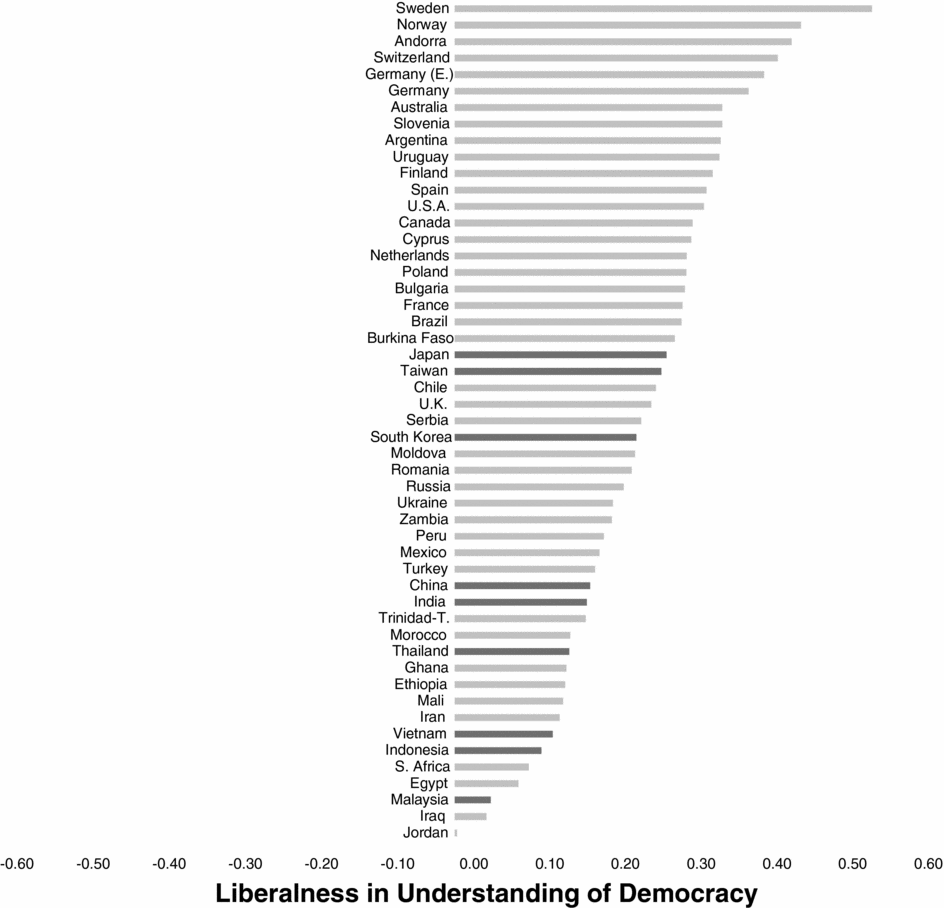
Figure 6 ranks countries by how unequivocally people endorse a liberal notion of democracy. Asian countries are again marked in dark gray. Since the item battery underlying this measure has only been fielded in the most recent round of the WVS, only nine Asian countries are covered.
Country ranking on how unequivocally liberal people define democracy
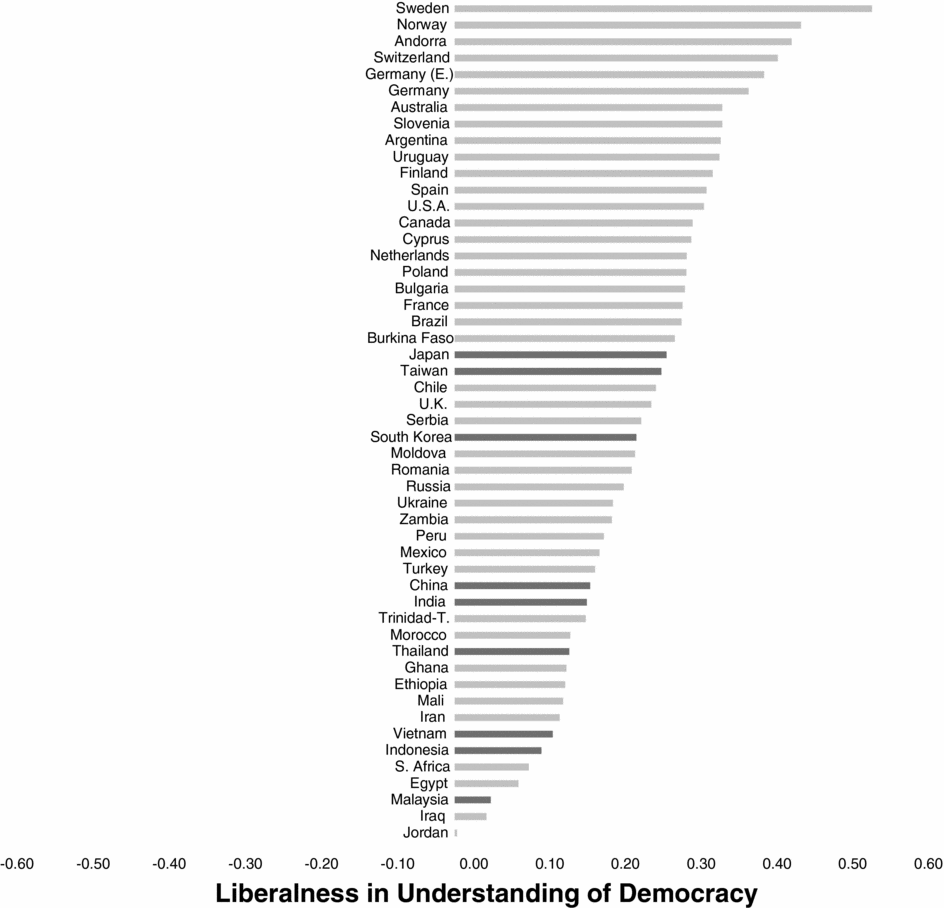
It is important to note that the scale can grow into the negative, which would be the case for any country where fewer people define democracy in liberal than in alternative terms. Apparently, this is not the case in any country that has been surveyed, and these countries cover all culture zones of the world. In every country, more people define democracy in liberal terms than in alternative terms. This includes all Asian countries. Despite this universality, people in most Asian countries define democracy less unequivocally in liberal terms than people in almost every Western country. And again, we find South Asian countries more on the bottom of the ranking than East Asian countries.
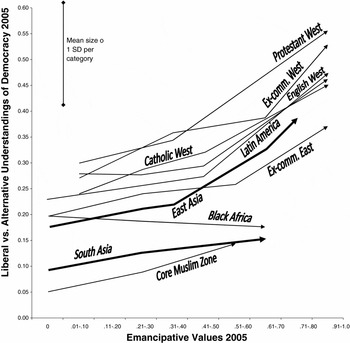
Figure 7 examines the relationship between people's emancipative values and how unequivocally they endorse liberal democracy, separately for each culture zone. As suggested by the Human Development Thesis, it is generally true that when people emphasize emancipative values more strongly, they also endorse liberal democracy more unequivocally.Footnote 9 The exception from this rule is Sub-Saharan African countries but not Asian countries. Nevertheless, Propositions 2.1 and 2.2 of the Asian Values Thesis appear to be at least partly confirmed. On average, liberal democracy is less unequivocally endorsed in East Asian countries than in Western countries and much less unequivocally endorsed in South Asian countries than in Western countries. And this pattern holds true for people at each level of emancipative values. However, on high levels of emancipative values, East Asians endorse liberal democracy almost as unequivocally as Westerners do, and much more unequivocally than South Asians do. The cultural chasm over liberal democracy is larger between South and East Asia than between Asia in general and the West.
Liberalness in people's notion of democracy by emancipative values across culture zones

As is the case with Proposition 1.2, Proposition 2.2 appears to be partially confirmed only: it seems to hold true for South Asia where emancipative values associate less strongly with the endorsement of liberal democracy than in the West, but does not hold true for East Asia where emancipative values associate with the endorsement of liberal democracy at least as strongly as in the West.
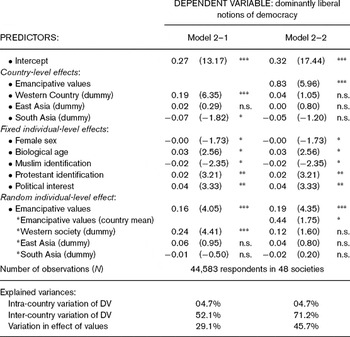
Model 2–1 of the multi-level analyses in Table 6 subjects these results to a more rigorous statistical test. In line with the graphical analysis, we see Propositions 2.1 and 2.2 partially confirmed and partially disconfirmed. The propositions are partially confirmed insofar as we find the expected positive Western influence on a country's overall endorsement of liberal democracy and on the nexus between emancipative values and the endorsement of liberal democracy within countries. But we find the propositions also disconfirmed because the expected negative effects of a country's belonging to East Asia are inexistent while the expected negative effects of a country's belonging to South Asia are either only barely significant or entirely insignificant.
Multi-level models explaining within-country and between-country variation in people's notion of democracy

Notes: Models estimated with HLM 6.01. Entries are unstandardized regression coefficients with T-ratios in parentheses. Individual-level variables are country-mean centered; country-level variables, except culture zone dummies, are global-mean centered. Explained variances calculated from change in random variance component related to empty model. Significance levels: n.s. (not significant) p ≥ 0.05; * p < 0.050; ** p < 0.010; p < 0.005.
Yet, as Model 2–2 shows, even the partial confirmation of Propositions 2.1 and 2.2 breaks down when we control for the counter-propositions of the Human Development Thesis. More precisely, as soon as we control for the effects of a country's cultural belonging to Asia or the West for the overall emphasis on emancipative values in that country, the belonging to Asia or the West turns out to be fully insignificant. A country's overall emphasis on emancipative values, by contrast, explains by more than 70% how unequivocally liberal this country's population defines democracy. Moreover, a country's overall emphasis on emancipative values explains variation in the effect of people's own emancipative values on their endorsement of liberal democracy to 45%. These results provide a straight confirmation of Counter-Propositions 2.1 and 2.2 by the Human Development Thesis.
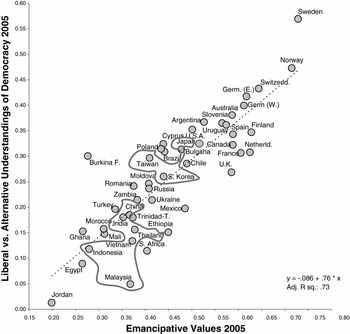
For illustrative purposes, Figure 8 plots the overall endorsement of liberal democracy in a country against the overall emphasis on emancipative values in that country. The general relationship is striking. Knowing how strongly a country's population emphasizes emancipative values explains 73% of the between-country variation in how strongly people in this country endorse liberal democracy. On average, a 0.10 scale point increase in emancipative values associates with a 0.08 scale points increase in endorsing liberal democracy. And as we can see when looking at the location of the Asian countries, we find nothing exceptional about them. They are no outliers of the general trend. In fact, most Asian countries are located closely to the regression line.
Emancipative values and liberalness in people's notion of democracy across countries

Conclusion
The Asian Values Thesis has mostly been criticized for its political instrumentality. Empirically oriented treatments have usually taken a historical approach, trying to show by text exegeses of the writings of Confucius and various other sources that Asia has a diverse and rich cultural tradition that can be reconciled with the ideas of human emancipation and liberal democracy. By contrast, apart from a handful of studies, few scholars tested directly the empirical claim that the values of Asian populations largely oppose emancipative values and liberal notions of democracy and continue to do so even under the imprint of modernization.
This article tried to fill this gap. What I found are gradual differences between Asian and Western countries over emancipative values and liberal notions of democracy but no categorical difference. In fact, the differences between East Asia and South Asia are bigger than those between Asia in general and the West. More importantly, I find the same forces that nurture emancipative values and liberal notions of democracy in the ‘West’ to do exactly the same in the ‘East’. This is so because large parts of Asia are undergoing a human development process whose logic is culture-invariant in a key aspect: it is basically a process of people empowerment with pervasive emancipative consequences. These insights question the still widely fashionable parlance of ‘multiple modernities’ and ‘cultural exceptionalisms’ that have for too long been able to stigmatize any emphasis on developmental universals as politically incorrect. These insights also characterize as wishful thinking the desires of authoritarian leaders to pick from the modernization process the economic growth part while avoiding its emancipative consequences known from the West. And since the logic of the human development process is an emancipative one that advances people empowerment, liberal democracy becomes an unavoidable part of this process at one point. In this regard at least, Fukuyama's (Reference Fukuyama1990) End of History Thesis makes a valid point.
About the author
Christian Welzel holds the chair for Political Culture Research at the Center for the Study of Democracy, Leuphana University, Lueneburg Germany. He is professor-pro-tempore at the Higher-School of Economics St. Petersburg, Russia, and Vice President of the World Values Survey Association and a regular visiting professor at the Center for the Study of Democracy at UC Irvine. Author of some 80 scholarly publications, Christian Welzel's research focuses on modernization, democratization, human values, cultural change and human empowerment in comparative perspective.