In the early 2000s, a previously uncommon Clostridioides (formerly Clostridium) difficile strain termed ribotype 027 acquired high-level resistance to fluoroquinolone antibiotics and caused large outbreaks in North America and Europe. Reference McDonald, Killgore and Thompson1,Reference He, Miyajima and Roberts2 Selective pressure exerted by fluoroquinolone use was identified as a risk factor for infection with 027 strains. Reference Owens, Donskey and Gaynes3–Reference Muto, Blank and Marsh7 Therefore, it is plausible that reductions in fluoroquinolone use might be useful to control C. difficile infection (CDI) outbreaks due to 027 strains. In some small quasi-experimental interventions, fluoroquinolone reductions in conjunction with other control measures have been associated with reductions in CDI and in the proportion of cases due to fluoroquionolone-resistant 027 strains. Reference Kallen, Thompson and Ristaino8–Reference Lawes, Lopez-Lozano and Nebot10 Moreover, studies in England have reported large reductions in CDI and in the proportion of cases due to the 027 strain after introduction of a national program to improve infection control measures and reduce use of cephalosporins and fluoroquinolones. Reference Wilcox, Shetty and Fawley11,Reference Dingle, Didelot and Phuong Quan12 The decline in CDI was driven by reductions in fluoroquinolone-resistant isolates from 4 distinct genotypes, including 027. Reference Dingle, Didelot and Phuong Quan12
Although reports of reductions in the 027 strain with reduction in fluoroquinolone use are compelling, some caution is warranted. Epidemic C. difficile strains often decline in the absence of antibiotic restriction. Reference Belmares, Johnson and Parada13,Reference Hensgens, Goorhuis, Notermans, van Benthem and Kuijper14 For example, the prevalence of the 027 strain decreased markedly in the Netherlands beginning in 2007 with no change in nationwide fluoroquinolone use. Reference Hensgens, Goorhuis, Notermans, van Benthem and Kuijper14 Recent studies suggest that the prevalence of the 027 strain may be decreasing in the United States, Reference Thorpe, McDermott and Tran15 but whether the reductions are attributable to reductions in fluoroquinolone use remains unknown. In the Veterans’ Affairs (VA) Healthcare System, the prevalence of CDI due to the 027 strain decreased from 26% in 2013 to 17% in 2016 in hospitals conducting routine testing for the 027 strain. Reference Giancola, Williams and Gentry16 Here, we tested the hypothesis that facility-level fluoroquinolone use in these VA hospitals would be a predictor of healthcare facility-associated (HCFA)-CDI due to 027 strains.
Methods
Study design
We conducted a nationwide retrospective cohort study of patients testing positive for C. difficile during or following stays in VA hospitals that consistently used and documented test methods that included evaluation for infection with epidemic ribotype 027 strains between October 1, 2011, and September 30, 2018. Within these facilities, we used visual summaries to characterize the trends over time, overall, and at the facility level. To estimate associations between facility-level fluoroquinolone use and rates of HCFA-CDI due to 027 strains, controlling for time, facility complexity level, and adjusting for correlated outcomes within facilities, we used a multilevel logistic regression model. We hypothesized that fluoroquinolone use impacts HCFA-CDI due to 027 strains, but we sought to control for environmental time trends and differences across hospital complexities in testing this association. We fit an additional model including facility-level use of other antibiotics frequently associated with CDI (ie, cephalosporins and clindamycin) and with macrolides because this class of antibiotics has been associated with infection due to the 027 strain. Reference Owens, Donskey and Gaynes3,Reference Wieczorkiewicz, Lopansri and Cheknis4 The study protocol was approved by the Institutional Review Board of the Louis Stokes Cleveland VA Medical Center.
Data sources and definitions
The Veterans’ Administrations Informatics and Computing Infrastructure was used to obtain data from the Corporate Data Warehouse, a central data repository of the VA Healthcare System that contains administrative, clinical, laboratory, and pharmacy data linked using unique patient identifiers. We generated a nationwide cohort of adult patients with 1 or more hospital admissions during the study period and a laboratory diagnosis of CDI meeting criteria for classification as an initial episode of HCFA-CDI. Reference McDonald, Gerding and Johnson17,Reference Lessa, Mu and Bamberg18 Recurrent cases defined as positive tests from the same patient occurring within 90 days of a prior positive test were excluded. Cases associated with hospital or long-term care facility (LTCF) admissions were included and were further classified as hospital-onset (positive CDI test on hospital day 4 or greater), LTCF-onset (positive CDI test on day 4 or greater of LTCF stay), and community onset-HCFA (positive CDI test within 4 weeks after discharge from the hospital or LTCF). CDI cases were identified based on positive C. difficile results by polymerase chain reaction (PCR) for toxigenic C. difficile or enzyme immunoassay (EIA) for toxin. CDI rates were expressed as the number of HCFA cases per 10,000 bed days-of-care (BDOC) for each fiscal year.
Testing for the 027 strain was performed either using the Xpert C. difficile/Epi Assay, (Cepheid Sunnyvale, CA) or the Verigene C. difficile test (Luminex, Austin, TX). We identified hospitals that tested and categorized >80% of CDI cases as positive or negative for the 027 strain for at least one quarter of fiscal years 2011–2018 based on the presence of test results for both CDI diagnosis and for the 027 strain for the same stool specimen. We also included results from facilities where 027 test results were reported as a comment added to the CDI test result. Antibiotic use was summarized across fiscal years 2011–2018 for these facilities; modeling and 027 rate calculations were performed on the subset of calendar quarters from each facility where the testing criteria were met.
For the each hospital, bar-coded administered medication data in days of therapy (DOT) per 1,000 bed days of care (BDOC) were obtained for the following acute-care inpatient systemic antimicrobial agents: fluoroquinolone (levofloxacin, moxifloxacin, norfloxacin, ciprofloxacin, ofloxacin), first-, second-, and third-generation cephalosporin (cefazolin, cepharadine, cephalexin, cefadroxil, cephalotin, cefuroxime, cefoxitin, cefprozil, cefaclor, cefotetan, cefamandole, cefonicid, cefmetazole, cefotaxime, ceftazidime, ceftriaxone, cefdinir, cefditoren cefixime, cefpodoxime-proxetil, ceftibuten, cefoperazone), macrolide (azithromycin, clarithromycin), and lincosamide (clindamycin). We determined the hospital complexity level and regions for each facility from VA facility summaries. The facility complexity level is determined for VA facilities based on characteristics such as patient population and type of clinical services offered. Reference Szabo19 Level 1 facilities are most complex, with further subdivision based on the size of the population served (ie, 1a, large; 1b, moderately large; 1c, small). Level 2 includes moderately complex facilities, and level 3 includes the least complex facilities.
Statistical analysis
The percentage of initial HCFA-CDI cases that were due to the 027 strain were calculated by dividing the number of 027-positive HCFA-CDI cases by the total number of HCFA-CDI cases that included an available result from testing for the 027 strain. Rates of HCFA-CDI and HCFA-CDI due to ribotype 027 were measured as number of positive initial HCFA-CDI cases per 10,000 BDOC and 027-positive HCFA-CDI cases per 10,000 BDOC, respectively. The nonparametric Mann-Kendall trend test was performed to detect a monotone increasing or decreasing trend over time for HCFA-CDI due to ribotype 027 and for in-hospital antibiotic use.
For the study facilities, we used visual summaries and multilevel logistic regression models predicting HCFA-CDI due to the 027 strain versus non-027 strains with time and facility complexity level as fixed effects and facility as a random effect to adjust for correlated cases within facilities. The data were stratified by 2-year periods: fiscal years 2011–2012, 2013–2014, 2015–2016, and 2017–2018. Facility complexity level was deemed high (level 1) and low (levels 2 and 3). The analyses were performed using R version 3.5.1 statistical software (The R Foundation for Statistical Computing, Vienna, Austria) with the lme4, merTools, lmtest, and trend packages.
Results
Of 152 VA acute-care facilities, 55 (36%) reported results for 027 strains and CDI for at least 80% of CDI cases for at least one-quarter of fiscal years 2011–2018, which increased from 12 facilities in 2011–2012, to 50 in 2017–2018. Within the analyzed calendar quarters for these facilities, 5,091 of 5,197 initial HCFA-CDI cases (98%) were tested and included in our analysis. This high rate suggests that the analyzed facilities generally instituted a uniform testing protocol. Of the 5,091 HCFA-CDI cases tested, 1,017 (20.0%) were positive for the 027 strain. Of the 1,017 infections due to 027 strains, 609 (60%) were community-onset HCFA, 280 (28%) were hospital-onset, and 128 (13%) were LTCF-onset.
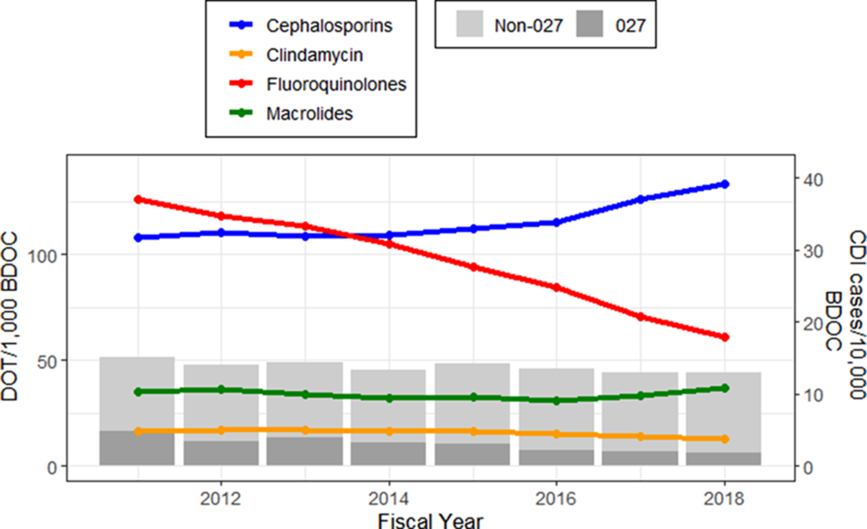
Figure 1 shows the overall rates of fluoroquinolone, cephalosporin, macrolide, and clindamycin use in the 55 analysis facilities and HCFA-CDI, stratified by 027 and non-027 strains, in the calendar quarters with 027 testing. Across the facilities, fluoroquinolone use on inpatient wards decreased by 52% from 2011 to 2018, with concurrent reductions in the overall HCFA-CDI rate of 13% and in the proportion of HCFA-CDI due to 027 strains of 55%. A statistically significant downward trend was detected in the annual HCFA-CDI rate due to 027 strains (Mann-Kendall trend test, P = .002) but not in the HCFA-CDI rate due to non-027 strains.
Overall rates of fluoroquinolone and cephalosporins use in days of therapy (DOT) per 1,000 bed-days-of-care (BDOC) and healthcare facility-associated (HCFA)-Clostridiodes difficile infection (CDI) in the 55 study hospitals, stratified by ribotype 027 and non-027 strains.

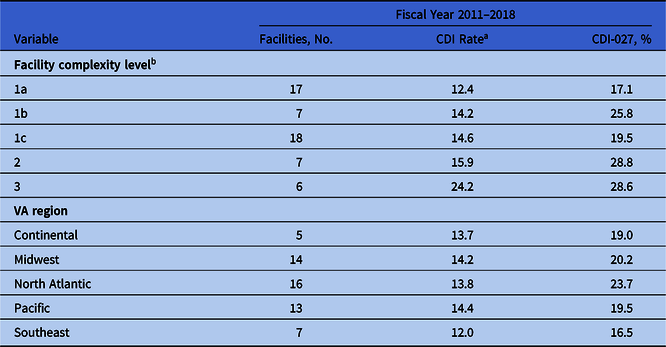
Table 1 shows the distribution of facilities by size, complexity level, and region along with the rate of HCFA-CDI and the percentage due to 027 strains. The percentage of HCFA-CDI cases due to 027 was higher in facilities with lower complexity levels (levels 2 and 3). The proportion of HCFA-CDI cases due to 027 strains was highest in North Atlantic (24%) and Midwest (20%) regions.
Distribution of Study Facilities by Size, Complexity Level, and Region Along with the Number of Healthcare Facility-Associated (HCFA) Clostridioides difficile infection (CDI) Rate and the Percentage Due to Ribotype 027 Strains

a Rate expressed as number of initial episodes of HCFA-CDI per 10,000 bed days-of-care (BDOC).
b Complexity level determined based on facility characteristics such as patient population and type of clinical services offered. Level 1, most complex with further subdivision based on the size of the population served (ie, 1a, large; 1b, moderately large; 1c, small); Level 2, moderately complex facilities; Level 3, least complex facilities.
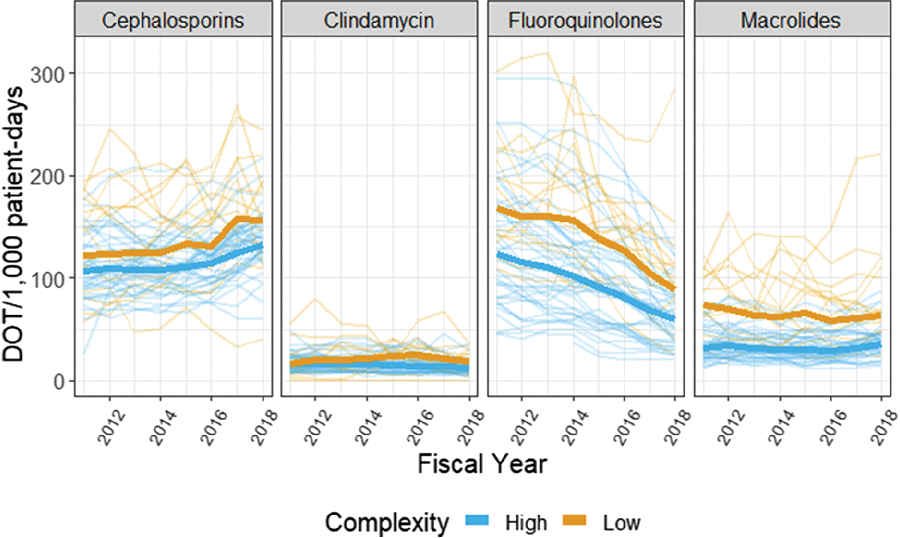
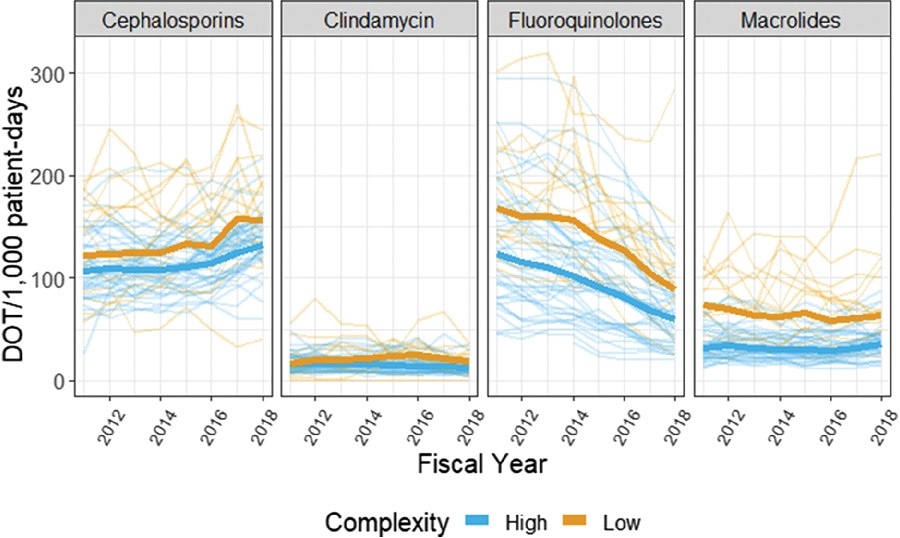
Facility-level antibiotic use was associated with facility complexity. We examined fluoroquinolone, cephalosporin, macrolide, and clindamycin use over time, stratified by facility complexity level. As shown in Figure 2, all of these antibiotic classes had higher aggregate rates of inpatient use in facilities with lower complexity (levels 2 and 3) in comparison to more complex facilities (level 1).
Cephalosporins, clindamycin, fluoroquinolone, and macrolides use in days of therapy (DOT) per 1,000 bed-days-of-care (BDOC) over time in the 55 study hospitals, stratified by facility complexity level. Facility complexity was categorized as high (1a, 1b, and 1c) or low (2 and 3).
To further evaluate the effect of fluoroquinolone use on rates of HCFA-CDI due to 027 strains, we developed a multilevel logistic regression model for the prediction of the proportion of HCFA-CDI cases due to 027 strains. We first estimated a model predicting 027 strains among HCFA-CDI cases using fiscal year and facility complexity, showing a decrease in predicted probabilities of 027 from 2011 to 2018 and higher predicted probabilities of 027 in lower-complexity facilities. To this model, we added fluoroquinolone use as a continuous value to assess its association with 027 while adjusting for fiscal year and complexity. The model improved with the addition of fluoroquinolone use as a predictor (likelihood ratio test P = .007). The model did not improve with the addition of region as a predictor (likelihood ratio test P = .99).
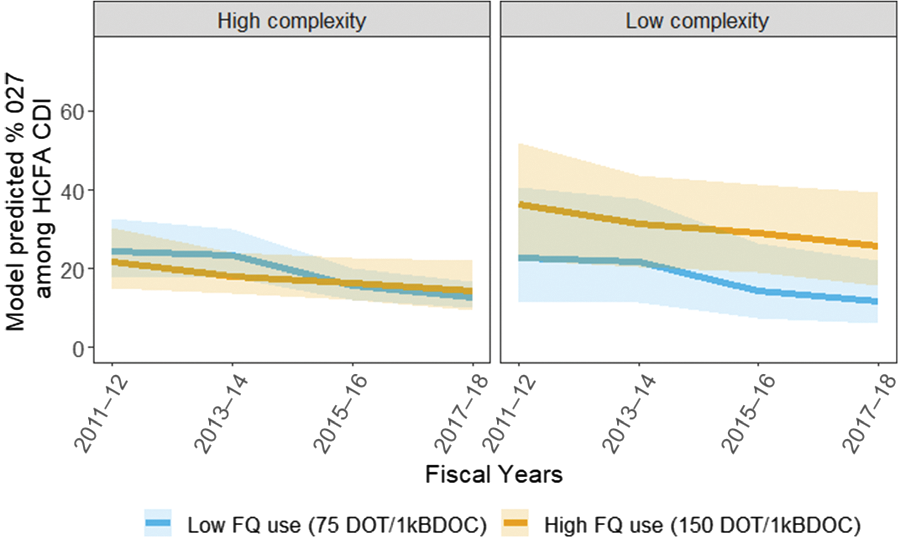
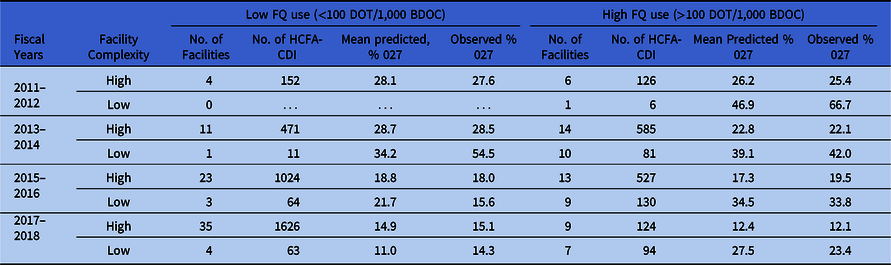
In this model, we observed significant interactions between fluoroquinolone use and facility complexity level (P = .003) and fluoroquinolone use and time (P = .03) on the probability of HCFA-CDI cases due to the 027 strain. As a measure of the association of effect, Supplemental Table S1 (online) presents the odds ratios of HCFA-CDI cases due to the 027 strain, with an increase of 100 fluoroquinolone DOT/BDOC for high- and low-complexity facilities over time. To further illustrate estimated model effects, Figure 3 shows the model-predicted probability of 027 across time and complexity for 2 representative levels of fluoroquinolone use: 75 DOT/1,000 BDOC and 150 DOT/1,000 BDOC. Given the detected interactions of fluoroquinolone use with time and facility complexity, we chose these high and low values within the observed range of our data to illustrate these interaction effects. A more pronounced effect of fluoroquinolone use was observed in facilities with lower complexity levels where the rates of 027 were higher in the earlier years of analysis and decreased more dramatically in facilities with lower fluoroquinolone use. Table 2 presents the observed and predicted rates of 027 by fiscal year, complexity, and fluoroquinolone use dichotomized at 100 DOT/1,000 BDOC. When cephalosporin, macrolide, and clindamycin use were added to this model, none were statistically significant.
Multilevel logistic model for prediction of the proportion of healthcare facility-associated (HCFA)-Clostridiodes difficile infection (CDI) cases due to 027 strains, controlling for facility complexity and time and adjusting for correlated cases within facilities. Data were stratified by 2-year periods (ie, fiscal years 2011–2012, 2013–2014, 2015–2016, and 2017–2018), facility complexity was categorized as high (1a, 1b, and 1c) or low (2 and 3). The predicted values were generated for two representative levels of fluoroquinolone use: 75 days of therapy (DOT) per 1,000 bed-days-of-care (BDOC) and 150 DOT/1,000 BDOC.

Observed and predicted rates of ribotype 027 Clostridioides difficile infections by fiscal year, facility complexity, and fluoroquinolone use
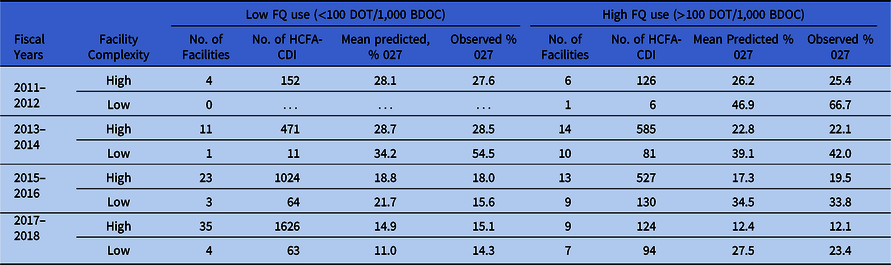
Note. FQ, fluoroquinolone; DOT, days-of-therapy; BDOC, bed days of care; HCFA-CDI, healthcare-facility–associated Clostridioides difficile infection.
Discussion
In the 55 VA hospitals studied, fluoroquinolone use on inpatient wards decreased by 52% from 2011 to 2018, with no concurrent reduction in cephalosporin use. During this period, there was a concurrent 13% reduction in HCFA-CDI and a 55% reduction in the proportion of HCFA-CDI cases due to fluoroquinolone-resistant ribotype 027 strains. In low-complexity facilities, facility-level fluoroquinolone use was a significant predictor of HCFA-CDI due to 027 strains. These facilities also had higher fluoroquinolone use and higher rates of CDI due to 027 strains. These findings build upon a growing body of evidence supporting reductions in use of fluoroquinolones as a control measure for CDI, particularly in settings where ribotype 027 or other fluoroquinolone-resistant strains are common. Reference Donskey6–Reference Dingle, Didelot and Phuong Quan12
During the study period, the VA Healthcare System implemented national initiatives to control CDI and to improve antimicrobial stewardship. Reference Evans, Kralovic, Simbartl, Jain and Roselle20,Reference Madaras-Kelly, Jones and Remington21 The national initiative to control CDI began in July 2012 in all facilities and focused primarily on environmental cleaning and disinfection and other strategies to prevent transmission. Reference Evans, Kralovic, Simbartl, Jain and Roselle20 The national Antimicrobial Stewardship Initiative began nationwide in 2010 and was associated with a significant reduction in inpatient antibiotic use and a nonsignificant trend toward reduced fluoroquinolone use. Reference Madaras-Kelly, Jones and Remington21 Both initiatives may have contributed to the overall reduction in HCFA-CDI in the study hospitals. However, the fact that fluoroquinolone use predicted facility HCFA-CDI due to 027 strains suggests that the reduction in fluoroquinolone use played a crucial role in reducing infections due to the 027 strain. Improved cleaning or reductions in total antibiotic prescribing would not be expected to selectively reduce infections due to the 027 strain. Reference Dingle, Didelot and Phuong Quan12
One unexpected finding from our study was that the proportion of HCFA-CDI cases due to 027 was lower in facilities with higher complexity levels. Notably, the use of all the studied antibiotic classes (fluoroquinolones, cephalosporins, clindamycin, and macrolides) was significantly lower in facilities with higher versus lower complexity. One potential explanation for these observations is that higher complexity facilities might be more likely to have formal antimicrobial stewardship programs that emphasize limiting use of fluoroquinolones. Others have noted that higher-complexity VA facilities were more likely to de-escalate antimicrobial therapy for healthcare-associated pneumonia than lower-complexity facilities. Reference Madaras-Kelly, Jones and Remington21
Our study has some limitations. The patient population included predominantly elderly men. Data on C. difficile strains were restricted to the determination of 027 versus other strain types. We cannot exclude the possibility that some non-027 strains may have been resistant to fluoroquinolones. Facilities were not automatically retained in the analysis once they reached the 80% threshold, which may have impacted ability to assess trends over time. However, the multilevel logistic model yielded similar conclusions when only the 28 (78%) facilities included in 3 or 4 consecutive 2-year periods were included (data not shown). Only 13 facilities were categorized as low complexity versus 42 with high complexity. Finally, we cannot exclude the possibility that factors other than reductions in fluoroquinolone use contributed to the decrease in the 027 strain, particularly in high-complexity facilities where facility-level fluoroquinolone use was not a significant predictor of HCFA-CDI due to 027 strains. Control measures such as hand hygiene, environmental cleaning, and patient isolation might have a disproportionate effect on fluoroquinolone-resistant strains if these strains spread preferentially in the hospital setting. Reference van Kleef, Kuijper, Bonten and Cooper22 It is possible that higher-complexity facilities had more robust infection control and cleaning programs than less complex facilities, but we did not have information on adherence to these infection control measures.
In summary, in 55 VA hospitals, we found that facility-level fluoroquinolone use was a significant predictor of HCFA-CDI due to fluoroquinolone-resistant 027 strains. These results provide support for reductions in fluoroquinolones as a control measure for CDI in settings where ribotype 027 or other fluoroquinolone-resistant strains are common causes of infection. A randomized trial would be useful to provide additional evidence regarding the utility of reducing fluoroquinolone use as a control measure for C. difficile. Substantial reductions in fluoroquinolone use may be feasible because these agents are often prescribed unnecessarily or for longer than necessary durations. Reference Hecker, Son and Murphy23
Supplementary material
To view supplementary material for this article, please visit https://doi.org/10.1017/ice.2020.383
Acknowledgments
Financial support
This work was supported by the Department of Veterans’ Affairs.
Conflicts of interest
C.J.D. has received research funding from Clorox, Pfizer, and PDI. All other authors report no potential conflicts.