
It is clear that Marion D'Cruz relishes this role of agent provocateur … And while she first came to prominence as a dancer, she is now more well known as a voice – often sharp-tongued, and often of dissent, resisting being silenced. Just as she refuses to allow her artistic work to be pigeonholed, she also refuses to accept the conventional role of seniority. She could, for example, become a critic, but she rejects this codified position. She can be the most exasperating of creatures, refusing to lead, follow or get out of the way.Footnote 1
Born in 1953, Marion D'Cruz is a pioneering Malaysian contemporary dancer-choreographer, and Gostan Forward is an excavation of her life history. Conceived in 2009 as a solo lecture performance, the text traces Marion's growth as a student, dancer, choreographer and educator, revealing her choices, strategies and influences over the span of a forty-five-year dance career. I collaborated with D'Cruz on devising the show, and continue to work periodically as director as the piece continues to be revived, and revised, for performance both at home in Kuala Lumpur, and abroad.
Derived from the nautical phrase ‘to go astern’, gostan is used in Malaysian English and the local pidgin, Manglish, to suggest moving backwards, or a reversal. To ‘gostan forward’ initially sounds paradoxical, since it means to go in opposing directions simultaneously. In the context of the performance, the title has many meanings. For instance, D'Cruz suggests that it may characterize the often conflicted nature of Malaysian politics, and a stalled national project. But this state of movement, tension and flirtation is also at the centre of joget – a popular Malay folk dance with Portuguese roots often performed by couples at festivals and weddings that D'Cruz practised and researched as a university student. And, as Malaysian critic Kathy Rowland has observed, the title may also describe the impetus of the work itself: ‘Gostan Forward is ostensibly a look-back. In view of her current trajectory, however, it can be read as a gathering of force towards the future’.Footnote 2
In 1982, a year after her return from a life-changing sojourn in New York that she discusses in Gostan Forward, D'Cruz conceived Solo, a one-woman performance that toured to seven cities and towns in Malaysia and Singapore. Billed as ‘an encounter with traditional Malay court dance and a discovery of new dance’, Solo was an important attempt to present contemporary dance to local audiences.Footnote 3 But in hindsight, we can also say that Solo was the first instance when D'Cruz's identities as a student, dancer, choreographer and educator were conflated onstage. In this early, prototype performance lecture, D'Cruz used the first half of the programme to introduce the history of two traditional court dances, demonstrate their physical vocabulary, and then perform them. This method of showing–telling–performing was then repeated in her own choreographies. Informed by her training in ballet and contemporary dance, as well as classical, court and folk forms from the Malay, Indian, Javanese and Balinese traditions, they showcased a hybridizing of East and West, and the traditional and contemporary.
Two years later, in 1984, D'Cruz and her producers for the project, Krishen Jit and Chin San Sooi, formed Five Arts Centre, a collective of artists, producers and activists dedicated to generating alternative art forms and images in the contemporary arts landscape that remains a major force in Malaysian performance and arts to this day.
Gostan Forward is not a retrospective: it engages with only a small fraction of D'Cruz's sixty-odd pieces of choreography. Rather, the performance is an excavation of embodied memory, using some of D'Cruz's favourite dances and most significant choreographic works as starting points, to gostan into her own history, Malaysian history, dance history. This is how she recounts the process of generating material for Gostan Forward:
Mark [Teh] invited designer Grey Yeoh into the project. Grey, at that time, was twenty-five years old, a former student of mine. The process of excavation of stories and experiences from my mind, soul and body was interesting. The two young men would come to my house and Mark would say, quite randomly, ‘Tell us about New York, Marion’ … and I would tell stories … randomly. Or, ‘Tell us about USM’. They would take notes. We would eat and drink and ‘play’. After each session, they would do research and find more stories to corroborate my stories. ‘Proof’ … so to speak. At the subsequent session, they would talk about the material they found – [for example] articles about a project I had been involved in. I too would find things … an old programme, articles. These additions would then trigger more memories and more stories. Memory needs to be nurtured. If you force yourself to remember, you will remember more and more. It is an act of will that requires desire, time and effort. And through the excavation of memory is fact and fiction and fantasy.Footnote 4
Malaysia is a highly racialized society. A legacy of the colonial era, governance since Independence has turned significantly on the classification of the population according to the formal racial categories of Malay, Chinese, Indian and Others, where Malays, according to the nativist concept of bumiputera (‘sons of the soil’) enjoy special social and economic rights. This discourse hardly reflects the ground-level ethnic complexity of Malaysia. But its prevalence does go some way to explaining why a first-generation Malaysian such as D'Cruz – officially ‘Indian’, though, unlike many Malaysian-Indians who are of south Indian origin – refers at various points in her text to those classifications, as well as to the discrimination she encountered in learning and practising ‘Malay’ performance forms. This information is also useful in understanding the magnitude of the political earthquake that took place on 9 May 2018, when the Barisan Nasional (National Front), a coalition of race-based parties that has governed the country along identitarian lines for sixty-one years, was finally defeated at the ballot box by another, nominally more multicultural, coalition, Pakatan Harapan (Alliance of Hope). After six decades under the same government – a government both defined against, and in the image of, the British colonial powers that preceded it – there is much to decolonize, unlearn and undo. There is also a need to introduce and practise major institutional, legal and psychological reforms.
That the new government is led by the nonagenarian Mahathir Mohamad, who was prime minister and leader of Barisan Nasional (BN) from 1981 to 2003, is an uncomfortable paradox. Many of the problems of governance and competence that have plagued BN more recently can arguably be traced to his time in office. And yet, after breaking with BN, he was widely seen as the only person who could lead an alternative coalition to victory over them. This has resulted in some distinctive ironies. Many of the ministers and lawmakers who now work alongside Mahathir were strongly critical of him during the 1980s and 1990s. Indeed, in some cases, they served time as political prisoners under his rule. In order to recognize the complexities of this, then, it is important to move away from an easy narrative of Mahathir's recent return as the ‘saviour’ of Malaysia. Instead one needs to understand that this moment of change has been a long process, built on ten years of street protests against corruption and for electoral reform organized by the BERSIH Coalition for Clean and Fair Elections, on twenty years of coalition building between opposition parties, and on forty years of civil-society activism, beginning with human rights and women's rights groups established in the late 1970s and 1980s.
Gostan Forward does not tell this political story as such. But, as D'Cruz notes in her text, her return to Malaysia from New York in 1981 coincided with the beginning of Mahathir's first tenure as prime minister (‘M and M in the bright lights!’). So the time frame is the same, and the stories are not only interwoven, but continue to change. Each time D'Cruz and I have revised Gostan Forward, we have included new episodes or anecdotes to make the performance more resonant for the place or occasion. As mentioned in the text itself, the version below was first performed at the Kobe-Asia Contemporary Dance Festival in 2012.Footnote 5 At the time of writing (July 2018), D'Cruz and I are beginning to consider what changes to make ahead of a performance in Bangkok, Thailand, later in the year, including how to reflect the outcome of the general election. As Malaysians witness the return of key figures from the 1990s to the national stage – a political gostan forward – and adjust to new situations and changed relations, Marion D'Cruz's life history offers significant provocations and timely reflections on art making, resistance and resilience.
Mark Teh, 31 July 2018
NegarakuFootnote 6
(A large desk, and chair. There are two television sets onstage and a screen or white wall where images are projected. marion is seated, face buried in her hands. Softly, ‘Mamula Moon’ begins to play. marion sways to the music. She gets up, and starts dancing. Images of the Malaysian flag and a hibiscus appear on the televisions and are projected on the screen. marion starts to sing the ‘Negaraku’ over ‘Mamula Moon’.)
You know, I love the idea that my national anthem is actually a love song.
1957, I was three years old. Malaysia – Malaya at that time – was heading towards Independence. British colonialism, over. Japanese Occupation, over. Independence, but no national anthem. So they decided to have a competition inviting people to compose a national anthem. Five hundred entries … all crap. So they decided to take the tune of the Perak state anthem, put new lyrics, and make it the national anthem. Then some fler [guy] did some research and found out that the Perak anthem was actually ‘Terang Bulan’ – ‘Bright Moon’ – from Indonesia.Footnote 7 Then some other fler did more research and found out that ‘Terang Bulan’ is from an old Hawaiian love song called, ‘Mamula Moon’.
When I was small, not too long ago, we used to sing ‘Negaraku’ like a dirge. (Sings accordingly.)
I loved it.
Then in the 1990s the prime minister decided we were a happy, groovy nation and the ‘Negaraku’ became upbeat. (Sings an uptempo version.)
Now it is neither a dirge, nor upbeat. It's just … Negaraku … (sings)
It's nothing. But at least it's honest. The national anthem is nothing … and the nation is filled with nothingness.
Bunga Manggar Bunga RayaFootnote 9
Bunga Manggar Bunga Raya came out of a sense of extreme grief and loss, both personal and national. Personal, because I had lost my husband, Krishen Jit, to death; national, because in 2007, I felt that I was losing my country … to death.Footnote 10 Crime, censorship, corruption, ISA, Mongolian model Altantuya, Lina Joy.Footnote 11 The list was endless and scary.
We had lost the plot. Blanked out. Censorship had escalated to ridiculousness. Last year they decided to ban a dance called poco-poco. Footnote 12 Poco-poco is a simple, very democratic dance … old people can do, young people can do, fat people can do, thin people can do. But the floor pattern, a cross – Christian! – so, ban. So, as the nation was going ‘Rah! Rah! Rah!’ and celebrating fifty years of Independence, I decided that I too would ‘Rah-rah’ and would put the crap onstage. To present and represent, and invent and reinvent Malaysia onstage. To look at the crap; to look for a sweeter, gentler Malaysia … lost and far away.
I invited over forty people to be in the show, ranging from trained performers to sponsors. Eventually twenty-two people said yes: from trained performers, theatre workers, a biologist, a visual artist, a media consultant, a lighting designer, a filmmaker. And I said to them, ‘If you had the time and space in this show, what would you say about your relationship with Malaysia at this point in time?’ And I told them to bring something tangible, not just an idea in their head.
Some said ‘Ala, I don't want-lah, Marion! I just want to do’.Footnote 13 Some ‘I'm bringing, I'm bringing, Marion!’ (Pause.) And I'm still waiting. Many brought. Things like Panadol, a Good Morning towel, the Rukun Negara, a primary-school exercise book, ‘Mamula Moon’, the history of ‘Negaraku’.Footnote 14 Anne James brought her police report from when her bag was snatched.Footnote 15 James Lee brought a picture of a gun and told the story of how a businessman friend of his got a call one day from someone who asked, ‘Do you want a gun?’Footnote 16 How strange is that?? I am so waiting for that call. I want a gun. We put all these things on the mirror of our studio, shared stories and tried to incorporate all these things into the show, trying to work in a very democratic process. The idea was to create multiplicity: many stories, many bodies, many ideas, many minds, many Malaysias.
I like to believe that as the democratic space in the nation was becoming smaller, the democratic space in our studio expanded. Democracy is not easy. You have to negotiate different bodies, different experiences, different ages – the youngest was nineteen and the oldest was fifty.
Rehearsal schedules were a nightmare. Vernon: ‘I'm coming, I'm coming, Marion! I really want to be in the show’.Footnote 17 Eventually he came for very few rehearsals; so there is Vernon always watching. Audience watching Vernon, watch the performance. But because we allowed for multiple readings, Vernon could be Big Brother – ‘Somebody's watching you!’ Or always on the edge, excluded, marginalized.
And when you have Anne James on stage, Anne just has to sit there and you are compelled to watch her. She really does not have to do anything. You just watch her, waiting for her to lift a shoulder … or breathe. She is such an experienced performer, with weight and power. Then you have Wyn, who has fine theatre intelligence up here (pointing to her head), but has energy circles that go this way (arms cycle inwards) instead of this way (arms cycle outwards).Footnote 18 So you have to take all these things and negotiate and work to bring out each one's greatest potential.
So democracy is tough, but I could have never have gotten Bunga Manggar Bunga Raya without that group of people and without that process. People felt it belonged to them. They took ownership and invested in it. I mean the Cilayu moment when James decides, ‘I do not want to be Chinese, I do not want to be Malay, I am just … Cilayu’.Footnote 19 Or the Hari Azizan moment where Hari decides, ‘I am Malay but I just want to hang out with the Chinese boys!’Footnote 20 They brought those moments in. Magic moments.
Two months before the show I was talking to my friend Janet in Penang and I said, ‘Janet, you have to be in this show. It's my swansong’. Janet is an old friend and fellow theatre worker in Penang. She's like a Penang gangster! Janet said, ‘Ya, sure’.Footnote 21
‘No, Janet, seriously, you must be in this show! You are such an arrogant, rude, cruel but good director that no one can direct you. You must be in this show so I can be rude and cruel to you’. So she said, ‘Okay, I'll be in the show if I can just ride a bicycle onstage’. So I said okay. One month later after watching a rehearsal, she said, ‘I want three bicycles’. So we gave her three bicycles: a kid's tricycle, an old squeaky bike which we hired from an old lady, and a BMX.
That scene of Janet and Puay Tin in Bunga Manggar Bunga Raya is my favourite scene.Footnote 22 Janet riding the old squeaky bike round and round in a pool of light; Puay Tin singing ‘Negaraku’ in Hokkien, holding cards with translations; works of art by the artist Liew Kung Yu … My favourite scene because it reminds me of a sweet, gentle, just Malaysia – lost and far away.Footnote 23
Full dress rehearsal, the theatre was filled with students – my students, Janet's students, Anne's students, Puay Tin's students, Mark's students – and they were laughing hysterically.Footnote 24 Oh my God! I made a funny show? My work is not funny, it's dark! Once I showed my New Directions concert to Lari Leong, a Malaysian dancer-choreographer based in Paris, and he said, ‘Marion, your work is dark, you must find the light’.Footnote 25
Here I was, fifty-three years old … I had found the light!
Janet and I, sitting backstage watching the show, quite perturbed actually.
I said to Janet, ‘Janet, they are laughing too much’.
Janet said, ‘Ya, ya, something wrong, Marion, too funny’.
Something wrong? Too funny???? But what do you do – it's full dress rehearsal. You just let it go. You can't unfunny it at full dress rehearsal!
The response to Bunga Manggar was overwhelming – SMSs, phone calls, blogs, reviews – ‘Thank you, Marion, for this gift!’ I don't think it was just about the show. I think it was about Malaysians feeling: ‘We also feel like this, we also don't want this crappy Malaysia, we also want to be Chilayu’.
Julian, who was arrested under the Internal Security Act in 1987 – Operation Lallang.Footnote 27 And when he came out a year later, he was a completely different person.
Interesting that he says theatre and not dance! But that's the question they have been asking me for a hundred years: ‘But is it dance, Marion?’ A few years ago I would say, ‘It is dance, don't worry about it’. Now I really don't know and I don't care. Last week a student said to me, ‘You doing Gostan Forward at the Kobe-Asia Contemporary Dance Festival ah??’ I said ‘Yes’. And he goes ‘Gostan is a dance show-meh??’ The other more interesting question is, ‘And why are you always wanting to work with non-dancers and non-performers, Marion?’
When I began this journey I was in search of contemporary Malaysian dance and a new vocabulary. I wanted people who were interested to journey and search with me. A trained dancer spends so much time and energy to get their body to do these impossible things – the perfect turnout, the perfect line. So you put them in an urn, and they come out like this (dances gracefully). I wanted something else. I did not know what I wanted, but I knew what I did not want. Non-trained performers, if they are strong and flexible and creative and ‘mad’, are freer with their bodies.
Now, fifty-eight years old … what do I want? I want a fat bank account and a thin body. And I want to make work that is so ordinary and extraordinary all at the same time, so that people, when they look, they feel, ‘Waah … ’ and then say, ‘but I can do that!’
Performance art (Fig. 1)
( marion puts a pink, striped pillowcase over her head, completely covering her face and head. She re-enacts some of the movements from the original performance of Sook Ching. This entire section is done in this manner.)
(Colour online) Marion D'Cruz. In the background, video projection of Wong Hoy Cheong's painting Sook Ching (1989). Photograph by Philip Craig (2009). © Five Arts Centre.
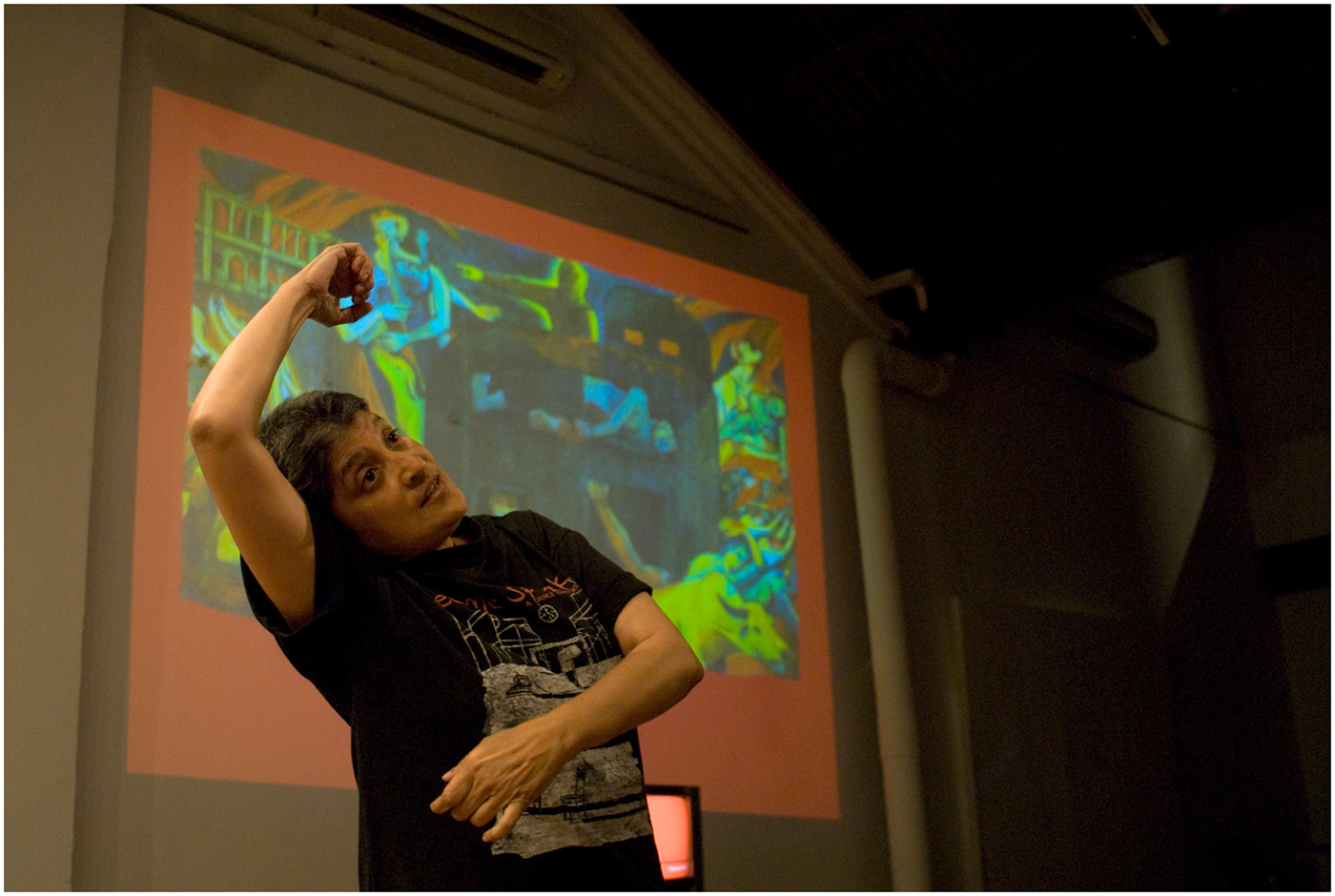
Between 1989 and 1992 I had the extreme good fortune to work with visual artists Wong Hoy Cheong, Liew Kung Yu and Raja Shahriman, in work that later came to be known as performance art. It was an interesting time for collaboration. I had started collaborating with my dancers, but with my dancers I was still shaping and making decisions. Still at the top of the triangle, so to speak, making the aesthetic decisions. But these were my peers, fellow artists, a few years younger than me, but we were all early- to mid-career artists on individual artistic journeys; and our journeys converged. I learnt a helluva lot about the world of visual arts, how visual artists worked, and how to release power to fellow artists. Shared aesthetic vision. It was a liberating experience.
Sook Ching was made in 1990. Wong Hoy Cheong had done a painting and a video based on the Japanese Occupation.Footnote 28 The video had interviews with old people who had stories to tell about the Japanese Occupation. We made performance directly based on the painting and video, taking sounds, text, movements, poses and emotions from the video and painting. For every rehearsal we would unroll and put up the painting and play the video and improvise. I remember I used to say to the performers, ‘When you don't know what to do, just copy a pose from the painting’. And that's exactly what they did.
Sook ching means purification by elimination. The Japanese officers would go into villages, gather all the people into an open area, line them up rows upon rows upon rows, and walk down these rows with an informant who was hooded. The informant would point out people who were anti-Japanese, Communist, pro-Independence, freedom fighters. Then they would take these people into the jungle, make them dig their own graves and shoot them. More than 60,000 Chinese were killed in the sook chings in Malaysia and Singapore. Purification by elimination.
We made Sook Ching for the First International Video Arts Festival at the National Art Gallery in Kuala Lumpur in November 1990. Two days before the performance they wanted to ban us because the issue was too sensitive. Thankfully, somebody on the Gallery Board said, ‘Call the Japanese Embassy and ask them’. Apparently the Japanese Embassy said, ‘It is fine. That is history. Go ahead’. Three hundred people turned up, partly because of the rumour that we were going to be banned and also because it was the first International Video Art Festival in Malaysia.
And there we were pointing. It was as if we had jumped out of the painting into reality.
At the end of the performance the performers are running … lari lari lari – run run run … That came from a story that when the villagers heard the trucks and the sirens they would shout … lari lari lari … and the performers would run until all the audience left … and there would only be Charlene sweeping, and me watching.Footnote 29
That original painting Sook Ching is now owned by the Fukuoka Art Museum in Japan.
New York
( marion sings the old standard ‘New York, New York!’ in full.)
I went to New York City to move out of the realm of my gurus. I had had many gurus – teachers – good ones, young, old, filled with knowledge and wisdom and art. And I was a good student; perfect kinesthetic memory. My dance education had been quite formal – theory, academia, years of Malay dance, Indian dance, ballet. Practising my ballet at the bus stop. My house, big garden … main road with cars, buses, bikes, me … a swan. Why at the bus stop? Because there was a bar! But I needed to find me, the dancer, alone and me, the choreographer. I was a young dancer wanting to learn choreography – to see if I could be a choreographer. That was the gap in my dance studies.
New York City, 1980s. It was ‘in’ to be Asian. Indonesia was flavour of the month. Malaysia? Not a blink on the radar. But there I was and I had many advantages:
• I could speak English well, so I could access more than many other beautiful Asian dancers who spoke little English.
• I had been to America before so there was less culture shock.
• I could do all these exotic dances – ‘Are you double-jointed?’ ‘No’.
• And I had a personal tour guide for the first two months …
‘Marion, this is the Village … and this is NYU’. Krishen, my husband … to be.
So I took the journey many artists took – took dance classes, took choreography classes, lecture-demos, taught, waitressed, babysat, cleaned houses, danced. Then, a curious incident took me a step further. The Malays say it's takdir, fate. It's all about being in the right place at the right time – luck, takdir, and then the hard work.
Friends of mine were getting married and my gift to them was to perform terinai at their wedding party. Terinai is a wedding dance from Perlis and tells the story about the bride and groom, their love play, candles symbolizing their new life.Footnote 30 So there I was – New York loft … wine and cheese wedding party. Me in full costume – shiny songket sarong, blouse, headdress, cucuk sanggul, candles, cassette in the cassette player – doing Terinai, while Americans watched and said, ‘She's gonna burn the place down!’Footnote 31 After the performance a woman comes and chats and asks me, ‘Would you like to come choreograph for a play I am doing?’ Of course I said sure. She was Ruth Maleczech, director of Wrong Guys with a company called Mabou Mines.
The scene was called ‘The Gangster Frieze’. Four guys, in these window-like structures, doing sinister movements. I used silat movements – Malay martial arts – and because they were good, trained actors, they learnt the silat very well. Then I discover that they were going to be in the nude! OH MY GOD! If my silat guru could see me now – four white men doing silat in the nude in New York City!
You know it's much easier to do these things far away from home … away from the scrutiny of gurus and a home audience. Now if you ask me to choreograph anyone in the nude I will surely say, ‘No, thank you. Please ask Swee Keong’.Footnote 32 But that took me on to choreographing Joe Papp's Shakespeare in the Park's Tempest directed by Lee Breuer with Raul Julia as Prospero. Raul Julia doing silat on the giant turntable set, thankfully, in a bathrobe. Children doing Malay dance movements to gamelan music – the gamelan made from tin drums!
I also started choreographing for myself. I lived in a small room in the home of Margaret Leng Tan, a brilliant, intense pianist from Penang and Singapore who had graduated from Juilliard. Margaret was working with interesting music by John Cage, Alan Hovhaness and others. The Cage music was prepared piano where you put paper and nuts and screws and bolts in between the strings of the piano to create this sound, East–West fusion … Gamelan Piano.
I would hear her rehearsing upstairs. One day she said, ‘You should dance to this music’. So I did – choreographed three solos – two to John Cage music and one to Alan Hovhaness’. And for all three pieces I cheated – I used props – a mask in one, a scarf in another and candles in the third. I had this mask but had never learnt mask dance. But masks are magical and powerful – you put on the mask and sit very still in front of a mirror and the mask will tell you what to do.
Margaret decided we should perform for John Cage, and set it up. There we were, Juilliard School, huge stage, a thousand seats … three people in the audience: Martha Hill, head of Juilliard, Ralph Samuelson from the Asian Cultural Council and John Cage looking like a tong sampah man [refuse collector]. Margaret: grand piano, tiny, intense, China-doll hairstyle, energy that burst from Manhattan to Penang. Me: small, intense, trying to conjure energy from Manhattan to Johor Baru.Footnote 33
(Music starts – marion puts on mask and dances ‘Bacchanale’ to John Cage's composition of the same name, for two minutes.)
It went on like that for ten minutes! Now I cannot even do one minute! When I think of the piece now, it was what I tell my students not to do, copy and paste. I copied and pasted silat vocabulary and mask dance vocabulary. But I think what ‘saved’ the dance was that I created a concept.
• The dancer creates a ritual of silat movements to prepare to put on the mask.
• Puts on the mask and becomes the mask. Enjoys.
• Cannot take off the mask.
• Horror.
• Back to the ritual to be able to wrench the mask off.
• Ending in the question, ‘Who am I? Who is the mask?’
John Cage loved it and wrote us a mesostic. He used to write these poem-like things with a word down the spine of the piece. In this case our names – Marion D'Cruz and Margaret Tan.
So the question is, why did I come home? Things were going great! (Pause.) My visa ran out; but I could have thrown my passport into the Hudson River and married my gay boyfriend which many artists did. But there was also family and a personal relationship to sort out and some sort of sense of mission. This new choreography that I had begun – East–West, traditional–modern. This search for Malaysian contemporary dance vocabulary – what would it mean in New York City? What would it mean, here in Malaysia? And some sense that if it was going to mean anything, it would mean more here in Malaysia.
I had a dancer friend, Ricci Reyes, and her fiancé was Richard Adan, a Puerto Rican actor. All of us used to work at a small restaurant called Binibon owned by Ricci's parents. One morning Richard went to work at 6 a.m., a man came in with two women and asked to use the toilet. Richard said the toilet was only for staff. An argument started and Richard said, ‘Let's take this outside’. They stepped outside and the man stabbed Richard. Richard died on the pavement in front of Binibon restaurant, on the Lower East Side.
The man was Jack Abbott, a convicted killer who was in the state penitentiary in Utah or Texas or something. A year before that he had read Norman Mailer's Gary Gilmore story and he wrote to Norman Mailer saying, you don't know the fuck about what happens in prison.Footnote 34 So Norman Mailer said, okay, tell me. A correspondence began between Mailer and Abbott. By 1981 Mailer declared Abbott a literary genius and published a book of his letters, In the Belly of the Beast. Jack Abbott was in New York that weekend for the book launch … found himself in Binibon restaurant and killed my friend, Richard Adan.
Immediately, New York City became dark and sad and ugly and scary and at that moment it was quite easy to hop on a plane and come home. What if I had not come home? I would not be lying here telling you this story.
Solo ’82
I came home and launched into dance making. Did Solo Marion D'Cruz in 1982 which introduced two classical Malay dances, Terinai Mengadap, and Timang Burung from Joget Gamelan, as a solo form – that was quite unusual – and four new solos exploring vocabulary for contemporary Malaysian dance.Footnote 35 We performed in seven cities, Penang, Ipoh, Kuala Lumpur, Seremban, Malacca, Johor Baru and Singapore. It was something like this – explaining what I was trying to do – but at that time I was twenty-eight years old. Less talking and more dancing. Now old, more talk, less dance. The year was 1981 when I came home … an important year … when Mahathir Mohamad became prime minister. The young doctor from Kedah constructing the nation. The young dancer from Johor Baru constructing Malaysian contemporary dance. M and M in the bright lights! I was twenty-eight years old.
Urn Piece
By 1988 I was thirty-five years old and I had become an armchair choreographer. No more meticulous mathematical choreography of East and West, tradition and modernity. I had discovered the joy of improvisation as a choreographic process. I would just sit with a script or idea or plot or urn and the dancers would improvise. And by 1988 I was blessed with the best improvisers – free, imaginative, mad and willing to journey with me on this search for a new vocabulary. And I would take the material and shape it. There was greater ownership of the material by the performers, much deeper, coming from their bodies, not mine.
(marion sits on the corner of the table and imagines being in an urn and re-enacts parts of the Urn Piece.)
When you sit in an urn, you are safe and wet and cold – and you think, this is like being in a womb. Your mind doesn't remember but your body does: kinaesthetic memory, muscle memory. And there is really no reason to come out. But then the performer in you locks in and you know there's an audience out there. And you know that you have the power to tantalize, provoke, shock, entertain. So you throw some water out and the audience goes, ‘AHH!’ Or you run your fingers on the edge of the urn and a child in the audience goes, ‘Mama, ulat [worm] mama, ulat!’ Or you stretch your hand straight out and it really looks odd. It looks bizarre, like the body is dismembered. Or you roll your head on the rim of the urn … And because you trust the urns – which are big and strong and sexy, and you trust the earth, the water, the wet gunny sack dress – you can do anything. When we performed in Fort Canning in Singapore I would lie across two urns and look up at the night sky, moon, stars, trees and bats. And I would slide out and lie upside down for no reason except that I could and the urns would hold me.
The Urn Piece was made in 1988 to complete the New Directions concert. I had made four pieces exploring the relationship between text and movement. Text as a starting point to inspire movement, and I needed one more piece to make a full concert. So I was looking for a text, I wanted to continue with that exploration. Playwright Leow Puay Tin was around and I asked her, ‘Puay Tin, do you have a text I can play with?’ Puay Tin gave me Dream Country.Footnote 36
The text is about a child who takes her mother back to the old country to die and the women are always crying and it's raining and the green river is flowing and the grass is wet. And what struck me the most was all this wetness and how I was going to create this wetness onstage. Then this image rises in my head of a head coming out of an urn. We jumped into the car, went to Chin San Sooi's house in Klang.Footnote 37 I knew he had these Chinese urns with the dragons. Jumped into the urns – too small – jumped back into the car, to the nursery in Taman Tun. The guy's name is Shin Mun Lee. Big beautiful urns, strong, sexy. Jumped in. Shin Mun says, ‘You doing drama, ah?’ ‘Ya, we are doing Ali Baba and the 40 Thieves’. Bought three urns. Called Normah Nordin.Footnote 38 Normah was running Centre Stage at that time from a house in Bangsar with a big garden. ‘Normah, I'm doing this urn dance and I need a place to rehearse outside. Can I rehearse in your garden?’ ‘Ya, sure’, Normah said.
Krishen used to call us the ‘Ya-Ya Sisterhood’ – simply ask people and they say ‘ya-ya’; simply people ask you and you say ‘ya-ya’.
Took the urns to Normah's garden, filled them with water and jumped in – and the Urn Piece choreographed itself. The urns and water and earth told our bodies what to do. I started by reading the text but realized very soon that the Urn Piece had a life of its own – images of birth, life and death – three women on a journey. The first is the free spirit, happy, brave, light. The second is the burdened mother figure, the only one to leave the urns, comes back to die – the others play on her grave and wash in her funeral water. The third is the frightened spirit, does not want to be born, wants to stay in the urn forever and has to be forced out.
The reactions to the Urn Piece were as bizarre as the piece. One person said it was three women masturbating onstage. You wish. I went into a bank once and the man said ‘You're the woman who came out of the urn’. I went to Central Market and you know the boys who paint? Well, there was this painting of the Urn Piece from a picture that had come out in the papers – three urns, two dancers, and in the third urn a strange face. I asked the guy Apa benda ini (What's this)? He said someone had brought the photograph and told him to paint it but replace the third dancer with his own face. So somewhere in Kuala Lumpur is a painting of the Urn Piece with Anne George, Noraini Jane Ariffin and what's-his-name!!??Footnote 39 On the one hand it's so bizarre. On the other, quite wonderful, I suppose!
Ibrahim Hussein painted a huge, beautiful piece inspired by the Urn Piece.Footnote 40 But the best reaction was from Uncle James. I went to the designer's house one morning to check the programme copy. Pius Eugene was the designer – brother of gangster Janet – and his dad was sitting in the living room.
‘Good morning, Uncle. How are you?’
And he says, ‘So, I see you're bathing in public these days!’
‘Er … bathing in public??? Er … what do you mean Uncle??’
‘In the papers all, water jars, clothes all torn, wet all, bathing in public I tell you’.
‘Oh, err … that … err … yes, Uncle … er … no, not bathing in public … trying to make art …’
‘Art all, I don't know what you and Janet are doing. When are you all going to get a proper job?’
Dear Uncle James, I am still making art. I have a proper job. And you have made it into my art show!
After the first performance of Gostan Forward in 2009, one of my students asked me, ‘So are you going to do a real retrospective and redo all these pieces?’ I said, ‘No need-lah. I have so many ideas in my head all the time. Why repeat?’ But I do want to do the urn piece again, five thousand urns, five thousand people. Dataran Merdeka.Footnote 41 But only when my country is reborn.
Swan Song
The New Directions concert began with the making of Swan Song. I had read the poem Nyanyian Angsa by Indonesian poet, director, actor W. S. Rendra in the 1970s while at Universiti Sains Malaysia. The poem is a very powerful one about the last seven hours of a prostitute named Maria Zaitun. In the poem she is thrown out of the brothel and rejected by doctor and priest, all symbols of feudal patriarchy, and then she finds her glory after death in the Jesus Christ figure, who makes love to her and takes her into heaven as whore and bride, both. The poem uses strong, coarse language – provocative and inspiring.
So I had read it in the 1970s and thought one day I'll do something with this. Then, in 1986 I got married and in 1987 I met Rendra in Indonesia while travelling around South East Asia with Krishen, meeting people like Rendra and Arifin C. Noer and others; Krishen gave me elevated status, because I was the wife of Krishen Jit.
Then in 1987 while in the Philippines, I was watching a very boring performance by the Bayanihan Company. Bayanihan is the most famous folk dance company in the world. They began in 1956 and now there are forty Bayanihans around the world. So I'm watching Bayanihan and this image rises in my head, of me and Anne James sitting back to back doing Swan Song. You know, to make good art, to make good anything, you need to have dream time … where you sit … and just dream.
(Sits still, silent, for a full minute.)
So this image of me and Anne James, sitting back to back, saying the text, and doing Swan Song. I came back in 1987 … Malaysia was reeling from Operation Lallang. The same Operation Lallang that arrested Julian Jayaseelan. I went into the studio and started making Swan Song. I would just sit there and read the text and Anne James and Anne George would improvise. And I would shape it – try this there, do this again. It took eleven months to make the thirty-minute piece and because it was thirty minutes long I started playing with all sorts of ideas to create multi-focus. It was the longest piece I had made.
First, to create a live soundscape – because taped music was not going to work. Noraini Jane was working with Normah at Centre Stage and I asked her to sing and she said she'd try – the Ya-Ya Sisterhood! There was Jane … beautiful in her kebaya, sitting very still: (sings a melody.)Footnote 42 Then, when the evil doctor comes on, she goes (guttural moans) … these amazing sounds!
And I thought, in dance and theatre and live performance, there is no one final product. Each time you see the creation of the final product. It happens right there with the audience. Every time, a new final product. Many final products. But in a painting you do not see the process: once it's done you see a final product that's fixed. What if we allowed the audience into the process – put an artist onstage to paint for thirty minutes? I asked and Ismail Zain said yes, he would paint.Footnote 43
And that's how it panned out … the two dancers playing all the roles and saying the text, the singer providing the soundscape, someone always running around indicating time and the world spinning while Maria Zaitun's life ends, the artist painting. There were many versions: Anne James and Anne George, Noraini Jane, Ismail Zain. Then Anne James and me, with different musicians and artists. And the constant in all those versions, besides Rendra's poem, the other constant is Anne James. She has done every single performance of Swan Song. In Kuala Lumpur, Penang, Singapore, Vienna, Hong Kong, Japan.
Anne and I used to look alike. We don't anymore …
( anne james enters stage. She and marion sit back to back on the table and perform an excerpt from ‘Nyanyian Angsa’.) Footnote 44
marion (sings): Rah Rah Rah … Rah Rah ah ah ah …
(speaks): The owner of the brothel said to her
You have been down for two weeks now …
You are getting sicker,
You are not bringing in any money.
In fact you owe me money.
I do not like losing money.
I can carry you no longer.
Today you must leave.
both: The angel who guards paradise
whose face is bright and malicious
whose sword burns
points accusingly at me
My blood freezes (Darahku beku)
Maria Zaitun is my name
An unfortunate whore
Not pretty enough and too old.
(both perform as anne speaks.)
anne: Twelve o'clock in the afternoon
The sun high in the sky
No wind. No clouds
Maria Zaitun leaves the brothel
No suitcase
No possessions
She walks swaying
Body fevered
Syphilis burning her
Ulcers on her neck
crotch, armpits, breasts
marion: Her eyes red
Her lips dry
Her gums bleeding
(marion, conversation-style, as the doctor; anne is Maria Zaitun.)
marion: Her heart troubles her again
She goes to the doctor's
Where many are waiting before her
And sits among them
Suddenly they move aside, holding their nostrils
She swears angrily
The nurse takes her arm hastily
She takes her turn before them
and no-one complains
‘Maria Zaitun
You owe me quite a bit of money’, says the doctor
‘Yes’, she replies.
‘How much do you have?’
‘None’
The doctor shakes his head and orders her to undress
She feels pain as she undoes her blouse
and it sticks to an ulcer under her armpit
‘That's sufficient’, says the doctor
Not even examining her
Then he whispers to the nurse:
‘Give her an injection of Vitamin C’
Startled the nurse whispers back:
‘Vitamin C?
Doctor, wouldn't she be better off with salversan?’
‘Why?
She cannot pay
And she is nearly dead
Why give her expensive medicines
From abroad?’
(marion and anne speak simultaneously.)
marion: Malaikat Penjaga Firdaus
Wajahnya iri dan dengki
dengan pedang yang menyala
menuding kepadaku.
anne: The angel who guards paradise
whose face is bright and malicious
whose sword burns
points accusingly at me
marion: My blood freezes
anne: Darahku beku.
both: Maria Zaitun is my name
An unfortunate whore.
Not pretty enough and too old.
At the end of the piece, I used terinai movements to celebrate Maria Zaitun's entry into Heaven.
(marion sings and dances with anne.)
Sambil menari
Kumasuki taman Firdaus
Dan ku makan epal sepuaskan
Maria Zaitun namaku
Pelacur dan pengantin adalah saya.Footnote 45
(anne walks offstage. marion repeats the song, as she dances.)
Terinai (Fig. 2)
I learnt Terinai in the 1970s in USM.Footnote 46 When I learnt terinai, my mind, my soul and my body became one and I knew, at that moment, why I was a dancer. The 1970s were an interesting time in USM, in the nation. 1969 racial riots; 1970 National Cultural Congress; 1971–2 National Culture Policy, Malay Language, Malay Culture. What did it mean to be Malay? What did it mean to be non-Malay? Claim your nation! Claim your nation! USM made it possible for us to claim, so we did. We claimed culture, arts, politics, student politics, activism …
(Colour online) Marion D'Cruz, explaining the Terinai. In the background, projection of D'Cruz performing the Terinai as a student in the 1970s. Photograph by Philip Craig (2009). © Five Arts Centre.

Deep and wide engagement – Wayang Kulit, Makyong, Terinai – we claimed. Angela Tan and I were the first non-Malay, non-Kelantanese, female student dalangs in the history of Wayang Kulit in this country.Footnote 47 Being a student dalang was the most difficult, most challenging, most terrifying performance I have ever done in my life. The reviewer said, Angela's voice was better at delineating the different voices of the characters and my dancer's sensibility was better at the manipulation of the puppets. I married the reviewer many years later.
By 1977, I was doing my master's in Joget Gamelan and Zamin Haron (now known as Chandrabanu) was a fly-in–fly-out lecturer, teaching Terinai.Footnote 48 He used to come from Perlis with Pak Meh the Terinai guru … old, dark leathery skin, wise. I was Miss Goody Two Shoes, with perfect kinaesthetic memory. Pak Meh would teach this way one week and this way the next. I would say, Pak Meh, minggu lepas Pak Meh buat macam ini. Minggu ini Pak Meh buat macam ini! Footnote 49 And he would say, Anak, buat aje. Buat aje. Footnote 50 So we buatlah.Footnote 51 1979 graduated with master's, came to KL [Kuala Lumpur] to work as a part-time instructor in KBN. KBN – Kompleks Budaya Negara [National Cultural Complex] – also an interesting place in the 1970s; more possibilities, more inclusive in some ways.
SEA Games 1979's cultural festival, Krishen Jit was artistic director of the festival, Zamin Haron, the choreographer of Inderaputra.Footnote 52 Inderaputra was one of the first major dance dramas that showcased Malay dance – classical and folk in a big way. Zamin was all over the place and because I knew these forms I had to teach Terinai to the dancers and do the solo male part, the Selom. There were many beautiful dancers but no time, so Marion, do. On the one hand this was fine, can do, can do-lah, but on the other hand some interesting reactions. Budak India tidak boleh menari Melayu, came out in print.Footnote 53 Budak India tidak boleh menari Melayu.
Thankfully, while most of this nation has regressed – gostan – in some areas of dance, we have progressed, forward. Gostan Forward. Gostan Forward. Now budak India boleh menari Melayu, budak Melayu boleh menari Cina, budak Cina boleh menari India and in Johor, semua budak boleh menari Zapin.Footnote 54 Would you like to Zapin with me?
You know, Malay classical dance is one of the most difficult forms to master. In forms like ballet and Bharatha Natyam, if you can master the physical demands of the form, your sixteen pirouettes, your adavus, you can still impress because the technical demands are huge.Footnote 55 You can still be a good dancer. But in Malay classical dance, it's not so difficult to learn the actual movements. What's impossible is to breathe the soul of the dance. I look at my students and say ‘Kamu dah hafal gerak, tapi kamu belum menjiwai, mendalami’.Footnote 56 And they look at me and say ‘Kami cubalah, teacher’.Footnote 57 But I can see on their faces that they want to ask, ‘What the fuck do you mean?’
So I try and create an image for them, I say, ‘You must imagine the serunai inside your body and as the sound comes through, it flows through your veins and you do not have to think and the movements come and you become a great dancer!’Footnote 58 And they look at me and say, ‘Kami cubalah, teacher’. But really, what do I mean?
The Terinai they do today is small; ours was expansive. And I say, ‘Kamu buat macam ini pasal?’ ‘Teacher, kita belajar macam tu’. Footnote 59
Terinai Mengadap is my favourite dance along with Topeng Tua.Footnote 60 I never learnt Topeng Tua but while studying Kebyar Duduk in Bali I watched many performances of Topeng Tua and I would stay as still as the dancer and move when he moved and breathe when he breathed.Footnote 61 And then, I stole it and put it into my body.
(marion sits on the table, dons mask. Serunai music begins. She performs her combination of Terinai and Topeng Tua.) (Fig. 3)
… anak, buat aje … buat aje …Footnote 62
(Colour online) Marion D'Cruz performing her combination of Terinai and Topeng Tua. Photograph by Philip Craig (2009). © Five Arts Centre.



