


Deliberative democracy has entered a kind of adolescence. Many of the broad questions emerging from its infancy have been explored extensively, and thus we know much more about both the potential and the limits of deliberation than we did a decade ago. That said, the future is still open, especially in matters of practice. Purely theoretical questions still remain, to be sure, but many of the big advances in our understanding of deliberation are likely to come by carefully aligning normative and empirical inquiry in a way that allows the two to speak to each other in mutually interpretable terms (Neblo Reference Neblo2005, 170; Thompson Reference Thompson2008, 16).
Many scholars, however, are skeptical that deliberative democracy is a practically viable theory, even on its own terms. They argue that most people dislike politics and that deliberative initiatives would amount to a paternalistic imposition. Any apparent enthusiasm for popular involvement is rooted in people's loathing of corruption, not in any deep interest in having their voices heard. As a result, deliberation would serve as, at best, yet another opportunity for the small number of people who are already deeply involved in politics to press their advantages. At worst, it would waste social resources, deepen inequality, and aggravate mass cynicism. Deliberative democrats disagree, arguing that disaffection with politics is largely endogenous to the failures of democracy understood as the pure play of power. Given the significant resources being poured into both applied deliberative institutions (e.g., Deliberative Opinion Polls or the British Columbia Citizens Assembly) and research on them, the stakes in determining who is right are high, both in political science and political practice.
In this article, we begin by reviewing the current state of the debate about deliberative participation, concluding that it has become confused by trying to extrapolate from current, naturally occurring patterns of political participation to conclusions about latent demand for deliberative opportunities. We reformulate the question as “Who is willing to deliberate?” rather than simply “Who deliberates?”Footnote 1 Our question is pertinent because some deliberative democrats claim that people would deliberate more if they were offered better opportunities for such interaction. Cook, Delli Carpini, and Jacobs (Reference Cook, Delli Carpini, Jacobs and Rosenberg2007, 33), for example, found that “85% of those who said they had not attended a meeting to discuss public issues reported they had never been invited to do so.”
Next, we evaluate a basic disagreement between deliberative democrats and their critics. Do citizens (reluctantly) mobilize in the face of perceived corruption as a way of chastening elites, or do otherwise enthusiastic citizens demobilize out of feelings of disgust and despair? We find much stronger evidence for the demobilization thesis, setting the stage for new deliberative opportunities as a plausible supplement to the status quo. Using a large national sample, we analyze the determinants of people's hypothetical willingness to deliberate, varying many institutional features of the deliberative forum. Some citizens may not really know their own minds, however, or they may want to appear more civically oriented than they really are. So, using a different national sample, we also analyze the determinants of people's actual participation in response to a real invitation to deliberate with their member of Congress. We find that (1) willingness to deliberate in the United States is much more widespread than expected; (2) it is precisely people who are less likely to participate in traditional partisan politics who are most interested in deliberative participation; and (3) people are attracted to such participation as a partial alternative to “politics as usual,” rather than reluctantly participating merely to chasten corrupt elites. Taken together, these findings suggest that average citizens do not regard deliberative opportunities as filigree on “real” politics or as an indulgence for political activists and intellectuals.
BEYOND SKEPTICISM AND OPTIMISM ABOUT DELIBERATIVE PARTICIPATION
Critics of deliberative democracy have good reasons to be skeptical that more deliberative opportunities will make a positive difference. Barely half of the U.S. population bothers to show up and vote, even in presidential elections. Why should we believe that they will be lining up for more costly and demanding forms of deliberative participation? Posner (Reference Posner2003, 107), for example, argues that deliberative democracy is “purely aspirational and unrealistic . . . with ordinary people having as little interest in complex policy issues as they have aptitude for them.” Less polemically, Mutz (Reference Mutz2002) finds that mere exposure to political disagreement demobilizes people out of even nondeliberative participation. Eliasoph (Reference Eliasoph1998) argues that otherwise concerned and involved citizens may avoid group deliberation because group dynamics narrowly delineate acceptable forms of political talk. Even major deliberative democrats express similar concerns. Jane Mansbridge's (Reference Mansbridge1980) classic study of deliberation finds that the sometimes adversarial nature of deliberation may have a chilling effect on speech in situations where deliberators have repeat interactions. Sunstein (Reference Sunstein2009) goes further, arguing that people's natural proclivity is to avoid exposing themselves to ideas and viewpoints with which they disagree. Delli Carpini, Cook, and Jacobs (Reference Delli Carpini, Cook and Jacobs2004, 321) sum up this line of concern: “[D]eliberation is so infrequent [and] unrepresentative . . . as to make it at best an impractical mechanism for determining the public will, and at worst misleading or dangerous.”
If the deliberative thesis is correct, however, then existing patterns of deliberation do not necessarily reflect how citizens would participate given more attractive opportunities. Thus, settling the real disagreement here requires that we broaden our focus beyond current levels of deliberation in the mass public and the characteristics of those who already engage in it without being offered novel opportunities.Footnote 2 Given the recent proliferation of applied deliberative forums and research on them, surprisingly little work has focused on who is willing to participate.Footnote 3 This gap is a missed opportunity to understand a crucial component of deliberative politics. To the extent that deliberative theory is procedural, the composition of the deliberating body looms as a major question (Gutmann and Thompson Reference Gutmann and Thompson1996). Most studies do report on the characteristics of those who engage in deliberation, and many contrast these individuals with those who do not participate. Luskin and Fishkin (Reference Luskin and Fishkin2005), for example, report 114 difference-of-means (or distributions) tests on a great range of demographic, attitudinal, behavioral, and other variables. Such analyses are crucial for showing that the sample of participants in the National Issues Convention was representative enough to warrant the normative benefits ascribed to Deliberative Opinion Polls. However, their applied concerns lead Luskin and Fishkin to treat potential selection mechanisms as, in effect, nuisance variables. To get beyond the stalemate between skeptics and optimists about deliberation, we need a different analytical strategy that focuses on selection mechanisms as theoretically and substantively important phenomena in themselves.
Once we understand the basic psychology and sociology of deliberative participation, we can link up with normative theory to think more systematically about which selection processes really threaten the goals of deliberation and perhaps devise remediation strategies. Many critics reasonably worry that deliberation in practice could be perverse, magnifying political inequality if the people who select into deliberation are already privileged (Sanders Reference Sanders1997). Other critics are concerned that racial dynamics produce less than representative deliberative groups, with ensuing negative outcomes for underrepresented minorities (Mendelberg and Oleske Reference Mendelberg and Oleske2000). Some sources of variation in willingness to deliberate may be normatively benign, and others that are less benign might be ameliorated in practice if we understood how they worked. But we cannot know until we sort out such selection processes. Alternately, it may be that inequalities in deliberative participation run so unavoidably deep that deliberative reforms would be hopelessly perverse from the outset.
The best known study to address the putative desire for greater deliberation came to a resoundingly negative conclusion that should give potential reformers pause. In their important and influential book, Stealth Democracy, John Hibbing and Elizabeth Theiss-Morse (Reference Hibbing and Theiss-Morse2002) argue that most Americans want nothing to do with a more deliberative democracy, that such reticence is reasonable, and, moreover, that their unwillingness is a good thing because the average citizen is ill equipped to discharge the duties that deliberative theorists would assign to them. In effect, Hibbing and Theiss-Morse argue that people's apparent desire for more participatory democracy is actually a misleading artifact of what Lacy (Reference Lacy2001) calls “nonseparable preferences.” The idea behind nonseparable preferences is simple: people often condition their preference on a given question on the status of some other question. For example, if citizens prefer divided government, then they may condition their vote for senator on the party of the sitting president. In the present context, the claim is that most people hate politics, but the only thing that they hate more than being involved in politics is the thought that corrupt politicians might feather their own nests at the expense of the public good. So, citizens condition their choices to participate on their perceptions of corruption. Far from participation being attractive in itself, citizens reluctantly consent to be involved only to prevent their summum malum. If the political process could be made less corrupt, then they would eagerly withdraw and prefer that it operate quietly in the background. Deliberative reforms predicated on the contrary “are unlikely to improve the system and may very well damage it” (Hibbing and Theiss-Morse Reference Hibbing and Theiss-Morse2002, 162).Footnote 4
The stealth democracy thesis thus runs precisely counter to one of deliberative theory's central claims—that a significant amount of citizen apathy is actually a consequence of frustration with and disempowerment in the current political system.Footnote 5 This claim is also a matter of “nonseparable” preferences, although in the opposite direction from the Stealth thesis. Citizens still condition their choices to participate on their perceptions of corruption: if the political process could be rendered more rational and responsive in their eyes, then they would be more inclined to engage it robustly. The disagreement between the stealth thesis and the deliberative thesis could hardly be clearer, and the stakes on which is right could hardly be higher.Footnote 6
Hibbing and Theiss-Morse (Reference Hibbing and Theiss-Morse2002) are among the most unequivocal critics of the deliberative project, but they are hardly alone (Bartels Reference Bartels, MacKuen and Rabinowitz2003; Eliasoph Reference Eliasoph1998). Fair-minded reviews of the relevant social-psychological literature reinforce similar worries (Mendelberg Reference Mendelberg, Carpini, Huddy and Shapiro2002). Posner (Reference Posner2004) does not even believe that new data are necessary to make the case against deliberation. He mounts an argument from revealed preferences, denying any distinction between “Who Deliberates?” and “Who Wants to Deliberate?” a priori. Dismissing Ackerman and Fishkin's (Reference Ackerman and Fishkin2004) proposal for “deliberation day,” he argues that “If spending a day talking about the issues were a worthwhile activity, you wouldn't have to pay voters to do it” (Posner Reference Posner2004, 41). Synthesizing the various strands from this larger literature, Hibbing and Theiss-Morse (Reference Hibbing and Theiss-Morse2002, 161–62) conclude that “pushing people to be more involved in politics and political decision making will not lead to better decisions, better people, or a more legitimate political system. Theorists are misguided if they think otherwise.”
At least three lines of response to the claims of such skeptics have emerged so far. First, Thompson (Reference Thompson2008) has pointed out that deliberative democracy is a normative theory that is supposed to challenge the status quo, so arguing that American politics as it stands does not meet this normative standard hardly disposes of the normative claims.Footnote 7 Muhlberger (n.d.) combines a similarly normative response with empirical evidence that antideliberative attitudes are part of a larger syndrome of antidemocratic attitudes (e.g., authoritarianism) that cannot be dismissed as a simple matter of citizen preferences.Footnote 8 Finally, Dryzek (Reference Dryzek2005) levels a more fundamental attack on standard survey methods, arguing that they cannot capture the inherently holistic, social, and dynamic aspects of deliberative opinion formation.
All three lines of critique have merit, although they also risk being seen as overly dismissive. Here we pursue a different strategy by confronting the claims of deliberation's critics on their own terms. We start by conceding that Hibbing and Theiss-Morse (Reference Hibbing and Theiss-Morse2002), as the most sophisticated and recent of such critics, make a strong circumstantial case given their evidence. However, we execute much sharper, direct tests that, on the critics' own terms, should be decisive. Our direct tests of people's willingness to deliberate both reverse Hibbing and Theiss-Morse's findings and explain how their circumstantial evidence led them to mistaken conclusions. Although it is true that many people find standard partisan politics and interest group liberalism distasteful, these people tend to see deliberation as a partial alternative to standard forms of participation, and are thus much more open to deliberating than expected.Footnote 9 Critics may have a case against theories of direct or participatory democracy if they simply call for a larger volume of standard forms of political participation.Footnote 10 Many critics assume that deliberative democracy is simply an extension of participatory democracy. But the theory does not conceive of deliberation as merely “voting plus”—an activity for political junkies akin to attending rallies or donating to an issue advocacy group. Nor do average citizens regard it this way, as we will see. Thus, it would be hasty in the extreme to dismiss deliberative reforms as hopelessly utopian or perverse merely because many citizens do not vote or find much about status quo politics distasteful. Deliberative democracy cannot (and should not) do without voting and much of the machinery of status quo politics—quite the contrary. But rather than thinking of deliberation as, at best, a nice frill to add to interest group liberalism (Walzer Reference Walzer and Macedo1999), we might better think of the deliberative character of a political system as conditioning the legitimacy of standard democratic practices. As New York governor and reformist presidential candidate Samuel J. Tilden urged, “The means by which a majority comes to be a majority is the more important thing.”Footnote 11
CONDITIONAL PREFERENCES ABOUT DELIBERATIVE PARTICIPATION
As noted previously, deliberative democrats and their critics make starkly contrasting claims about why people would or would not want to participate more in politics, and thus about the prospects for various democratic reforms. Hibbing and Theiss-Morse (Reference Hibbing and Theiss-Morse2002), for example, aim to resolve the question of why citizens, who purportedly hate politics, would nonetheless want more direct forms of democracy. They answer that the only thing that most citizens hate more than participating in politics is for corrupt politicians to subvert the process: “Ironically, the more the public trusts elected officials to make unbiased decisions, the less the public participates in politics” (159). They state their broader thesis in stark terms:
Americans do not even want to be placed in a position where they feel obliged to provide input to those who are making political decisions. . . . People often view their political involvement as medicine they must take in order to keep the disease of greedy politicians and special interests from getting further out of hand. . . . This form of latent representation, stealth democracy, is not just what people would settle for; it is what they prefer, since it frees them from the need to follow politics. . . . This desire for empathetic, unbiased, other-regarding, but uninstructed public officials is about as distinct as possible from the claim that people want to provide decision makers with more input than is currently done. (131–32)
We agree that citizens want empathetic, unbiased, and other-regarding public officials. But once we acknowledge the need for elected representatives, no sensible person would prefer alienated, biased, and selfish public officials. The real disagreement thus hinges on whether people want “uninstructed” public officials.Footnote 12 On this point, deliberative democrats and their critics do indeed disagree.
Deliberative democrats argue that much disaffection with modern mass democracy stems from feelings of disempowerment and disillusionment. If citizens believed that the system was less rigged and corrupt, they would be more willing to contribute their voices to the process. As suggested previously, the contest between these two claims can be usefully framed as a question of nonseparable preferences (Lacy Reference Lacy2001). That is, people's preference about one question (whether to participate more or less) is conditional on a second question (whether the political system is more or less corrupt).
Recent public opinion research gives us a sharp, simple framework for testing the competing accounts of nonseparable preferences. In a national survey, we asked each respondent two versions of a question about the conditions under which people would be more or less interested in getting involved in politics. The first question stipulates that the conditions Hibbing and Theiss-Morse (Reference Hibbing and Theiss-Morse2002, 158) see as underpinning stealth-motivated participation get better, and in the second, they get worse.
If politics were [less/more] influenced by self-serving officials and powerful special interests, do you think that you would be more or less interested in getting involved in politics? [1:Definitely more interested; 2: Probably more interested; 3: Probably less interested; 4: Definitely less interested]Footnote 13
Following Lacy (Reference Lacy2001), we sort subjects into three categories to test for conditioning. Those subjects who give the same response to both questions have “separable preferences” because their attitudes toward involvement in politics remained the same whether we stipulated more or less influence by self-serving officials and special interests. “Positive complements” (Lacy Reference Lacy2001) are subjects who would want to participate less under the condition of less corruption (consistent with the stealth thesis, the two processes move in the same direction, with less perceived corruption leading to less participation and more perceived corruption to more participation). “Negative complements” are subjects who would want to participate more under the condition of less corruption (consistent with the deliberative thesis, the processes would move in opposite directions).
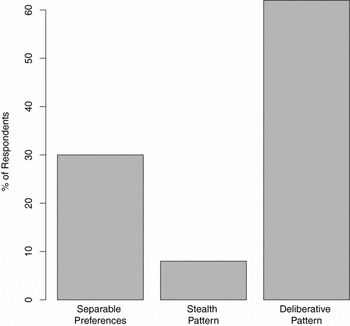
Figure 1 demonstrates considerable attitude dependence (nonseparability), with only 30% of respondents exhibiting separable preferences. On the one hand, the results do uncover some evidence for the stealth thesis (i.e., that some people participate in politics only as a form of taking their medicine and that they would happily withdraw if they could). However, such “positive” complements were relatively rare, comprising only 8% of respondents—many fewer than one would have predicted given the circumstantial evidence for the stealth thesis presented in Hibbing and Theiss-Morse (Reference Hibbing and Theiss-Morse2002). On the other hand, the test found vastly more evidence in favor of the deliberative thesis (i.e., that people would participate more if they believed that the system were less corrupt and would be further demobilized if it became even more corrupt). A solid majority, 62% of respondents, were “negative” complements, dwarfing the rate of the stealth pattern. For every respondent who fit the stealth thesis, another eight fit the deliberative thesis.
Separability of Interest in Politics and Change in Corruption (N = 404)

We also asked a similar pair of questions about deliberative forms of participation more specifically:
Recently, there has been interest in helping regular citizens get more input into the policy process. For example, some organizations run sessions where citizens discuss important issues with their members of Congress. If politics were [less/more] influenced by self-serving officials and powerful special interests, do you think that you would be more or less interested in participating in such a session? [1: Definitely more interested; 2: Probably more interested; 3: Probably less interested; 4: Definitely less interested]
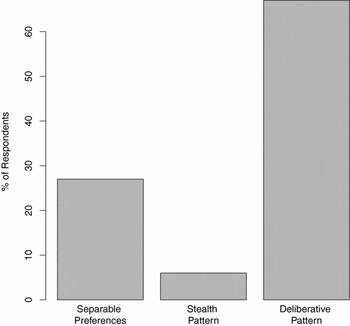
As Figure 2 illustrates, the results were even more skewed in favor of the deliberative thesis: more than 11 times as many subjects fit the deliberative patternFootnote 14 as did the stealth pattern. This test showed even more enthusiasm for specifically deliberative opportunities than for more general political participation. We agree that the stealth thesis is “distinct from the claim that people want to provide decision makers with more input than is currently done” (Hibbing and Theiss-Morse Reference Hibbing and Theiss-Morse2002, 132). However, on this matter, the stealth thesis applies to only a small portion of the public, whereas the deliberative thesis applies to a wide swath.
Separability of Interest in Deliberating and Change in Corruption (N = 404)

To understand what went wrong with the stealth thesis, we need to revisit another claim, namely, that “stealth democracy, is not just what people would settle for; it is what they prefer” (Hibbing and Theiss-Morse Reference Hibbing and Theiss-Morse2002, 131). Hibbing and Theiss-Morse provide strong evidence that many people do hold stealth beliefs. We agree that many people would settle for stealth democracy given a restricted range of choices. However, as we will see, this is not what they would ultimately prefer if they believe that effective republican consultationFootnote 15 might be available. Here we demonstrate that most people with stealth attitudes also have highly conditional attitudes regarding participation, and that their frustration with status quo politics is not the same as apathy or dislike of political involvement per se. Hibbing and Theiss-Morse (among others) miss this conditioning and so end up overextending their otherwise insightful analysis of stealth attitudes. To substantiate this claim, we now shift gears and turn to a more detailed discussion of who is willing to deliberate.
THEORY AND DATA ON DELIBERATIVE PARTICIPATION
The terms “deliberation” and “deliberative democracy” encompass a range of phenomena and mean somewhat different things to different people (Neblo Reference Neblo2007). In this article, we focus on direct, real-time deliberation among citizens, and direct, real-time deliberation between citizens and their elected representatives. To investigate citizens' interest in these two deliberative processes, we conducted two surveys in the summer of 2006. The first investigates citizens' attitudes toward hypothetical opportunities for deliberation, as did Hibbing and Theiss-Morse's (Reference Hibbing and Theiss-Morse2002) study. The second survey investigates citizens' expressed interest in and behavioral response to a real opportunity to deliberate in online forums with their member of the U.S. House of Representatives, where the invitation (via the investigators) comes from the members themselves.
To investigate the determinants of citizens' interest in participating in a hypothetical deliberative session, we randomized the characteristics of the hypothetical deliberative session and collected data on the attitudes and attributes of respondents.Footnote 16 These sessions were hypothetical in the sense that there was no promise or suggestion that the respondent's answer would lead to an invitation to an actual session. We embed these experimental variables and individual covariates in a statistical model to uncover the conditions that motivate citizens' participation in deliberative sessions. We specify the models drawing on four broad currents of theoretical work: sociological, psychological, “philosophical,” and institutional.
First, we draw on the well-established literature on sociodemographic processes to identify the individual-level characteristics that prompt civic volunteerism. In their landmark study of participation, Verba, Schlozman, and Brady (Reference Verba, Schlozman and Brady1995) find that resources, recruitment, and engagement drive traditional political participation. Burns, Schlozman, and Verba (Reference Burns, Schlozman and Verba2001) extend that general account, reaching further back into “the private roots of public action.” We start from this base by including a broad array of demographic and political variables known to influence traditional political participation. We expect that many of the same factors that drive one's willingness to attend a rally, for example, may also drive deliberative participation. Time, money, and education are fairly general resources. In contrast, deliberative theorists conceive of deliberation as a partial alternative to traditional partisan politics and interest group liberalism (or, perhaps, a condition enhancing the legitimacy of traditional politics). Conceived as such an alternative, deliberation may be especially motivating to precisely those people for whom traditional participation (under status quo conditions) is relatively unattractive. We thus have conflicting theoretical expectations and regard it as an open question as to how such factors will play out.
Second, deliberation differs theoretically from standard forms of participation in that it is especially cognitively effortful. Thus, in addition to standard demographic, resource, and engagement predictors, we also include a set of psychological antecedents of motivation that have strong theoretical links to the kinds of demands that may be particular to deliberative participation. Mutz (Reference Mutz2006) argues that many people are conflict avoidant, and so will be especially keen to avoid the inherently contentious give and take of deliberation. Cacioppo and Petty (Reference Cacioppo and Petty1982) describe the personality variable need for cognition as the extent to which people enjoy effortful cognitive activities. Bizer et al. (Reference Bizer, Krosnick, Holbrook, Wheeler, Rucker and Petty2004) develop the need to evaluate as a disposition to make judgments or take sides. Because several studies show that both the need for cognition and the need to evaluate play an important role in forming and changing attitudes, they are good theoretical candidates for increasing one's willingness to deliberate. As with some of the other standard participation predictors, we have competing theoretical expectations about how political efficacy might relate to willingness to deliberate. Several studies have shown, unsurprisingly, that feeling confused and powerless in the face of politics is demotivating. However, deliberative forums are designed to be opportunities to remediate confusion and provide an alternate channel for involving oneself in politics. Citizens could therefore regard deliberative opportunities as a chance to become more empowered. Again, how these competing mechanisms will play against each other is an open question. (See the online supplementary Appendix for the original items and details on scale construction at http://www.journals.cambridge.org/psr2010006).
Third, we note that deliberative democracy aspires to go beyond participation in status quo, power politics. As a result, we also include measures of people's preferences over democratic practice and processes, a facet of the social psychology of procedural justice (Lind and Tyler Reference Lind and Tyler1988). The idea here is that citizens have implicit folk “philosophies” about how democracy is supposed to work and beliefs about how various political processes measure up to those folk philosophies. We include Hibbing and Theiss-Morse's (Reference Hibbing and Theiss-Morse2002) original four stealth items because they were intended to tap such folk intuitions. We also include an index of people's trust in government under this rubric because critics of deliberation claim that any apparent interest in more direct democracy is predicated on a lack of trust in current decision makers. Thus, we should observe a significant negative interaction between stealth and trust—those high on the stealth index but low on trust will want to participate, but those high on both will opt out at higher rates.Footnote 17 We also include an index we label sunshine democracy—a positive rewording of the stealth items. The original idea behind the sunshine items was to make the stealth index more reliable and balanced in coding, and to assess acquiescence bias in the marginal distribution of the original items, which were all coded such that agreement indicated higher stealth. Toward that end, we included a “Neither Agree nor Disagree” response option and wrote four new items (in italics) similar in content to the original stealth items (no italics), but reverse coded so that agreement indicated lower stealth:
[Stealth 1] Elected officials would help the country more if they would stop talking and just take action on important problems.
[Sunshine 1] It is important for elected officials to discuss and debate things thoroughly before making major policy changes.
[Stealth 2] What people call “compromise” in politics is really just selling out one's principles.
[Sunshine 2] Openness to other people's views and a willingness to compromise are important for politics in a country as diverse as ours.
[Stealth 3] Our government would run better if decisions were left up to successful business people.
[Sunshine 3] In a democracy like ours, there are some important differences between how government should be run and how a business should be managed.
[Stealth 4] Our government would run better if decisions were left up to nonelected, independent experts rather than politicians or the people.
[Sunshine 4] It is important for the people and their elected representatives to have the final say in running government, rather than leaving it up to unelected experts.
Despite the rather direct content overlap, the sunshine items correlated well with each other, but not with the original Stealth items, resulting in two separate factors.Footnote 18 Surprisingly, the two scales are nearly orthogonal, correlating at only r = −0.07. Moreover, this weak connection is not a matter of acquiescence bias; including a methods factor in the measurement model (Podsakoff et al. Reference Podsakoff, MacKenzie, Lee and Podsakoff2003) only increases the strength of the relationship to r = −0.12.Footnote 19 Later, we argue at greater length that this counterintuitive finding indicates contextual conditioning on the part of many citizens when it comes to stealth/sunshine beliefs.Footnote 20 The sunshine items tap how they think that representative democracy should work in principle, whereas the stealth items tap what they would settle for as a step away from the corrupt status quo.Footnote 21
Finally, willingness to deliberate is likely to vary according to the institutional characteristics of the deliberative events themselves. There are many ways to construct a deliberative forum, even if we restrict them to direct, real-time events. To get a sense of how willingness to deliberate varies according to several dimensions relevant to both theory and applied deliberative institutions, we embedded an experiment permuting the following variations in the CCES survey:
Recently, there has been interest in helping regular citizens get more input into the policy process. For example, many organizations run [1 day/1 hour] sessions where citizens [come together/use the Internet] to discuss [important issues/immigration policy] [<none>; with local officials; with their member of Congress]. [<none>; Participants get $25 as thanks for their involvement.]
If you had the chance to participate in such a session, how interested do you think you would be in doing so? (5) Extremely interested; (4) Quite interested; (3) Somewhat interested; (2) Not too interested; (1) Not at all interested.
In sum, we varied (1) the length of the deliberative session; (2) whether it was face to face or computer mediated; (3) involved an unspecified issue or a specific issue; (4) whether it was conducted among citizens, as a consultation with a local official, or their member of Congress; and (5) whether subjects got a monetary incentive to participate.
People are busy and politics takes time, so it seems obvious to test for people's sensitivity to the amount of time necessary to participate in a deliberative event as well as their sensitivity to monetary incentives. In addition to their practical relevance, these conditions might also clarify the role of traditional cost–benefit considerations in willingness to deliberate (analogous to the voting literature's interest in sensitivity to costs and benefits narrowly construed, versus notions of duty, norms, or habit).
Computer-mediated deliberation is generally more convenient (for those who have access to the Internet) and greatly reduces travel and logistical costs. Moreover, it accommodates geographically disparate participants, which is especially crucial for deliberation within subpublics that might not be geographically concentrated. In addition, the relative buffer of computer-mediated deliberation may mitigate reluctance to deliberate among those who dislike conflict or prefer partial anonymity. There are potential down sides as well: “digital divide” bias, decreased civility, loss of nonverbal communication channels, etc.
We included a general versus specific topic manipulation to determine whether marginal rates of interest in deliberation are predicated on people imagining the one topic that most interests them, versus a more general interest in talking about important issues of the day. Much political behavior research shows that most people have a narrow range of issues that they care about enough to be mobilized to participate around. Under an interest group liberalism frame, we should not be surprised to find that participation is linked to particular interests. Deliberative theory, however, predicts somewhat weaker such effects for deliberative participation because we have reasons to participate deliberatively even when we do not have a large, direct stake in some particular outcome.
Finally, there are both theoretical and practical differences between deliberation among fellow citizens (i.e., horizontal deliberation) versus citizens and their elected representatives (i.e., vertical deliberation), so we randomized the type of session.
Before explaining variation in expressed willingness to deliberate, we should note that absolute levels of interest in deliberative participation were quite high. A large majority of people (83%) expressed at least some interest in participating in a deliberative session. Combining across the various conditions, 27% said that they would be “Extremely” interested in participating, another 27% said they would be “Quite” interested, and 29% “Somewhat” interested. Twelve percent said they were “Not too interested,” and only 5% said that they were “Not at all” interested. Because this sample's stealth attitudes were comparable to what Hibbing and Theiss-Morse (Reference Hibbing and Theiss-Morse2002) report, there is little reason to believe that peculiarities of the sample can account for such a high level of general interest in deliberation.
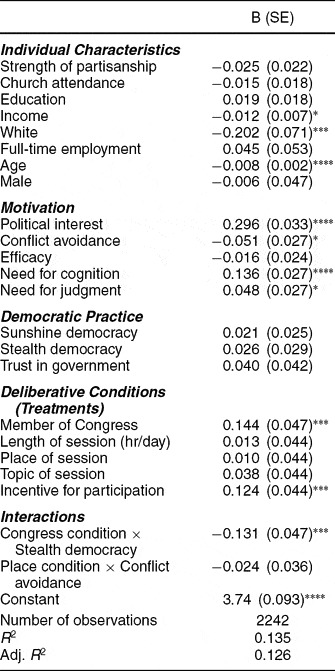
The desire to “get more input into the policy process” by discussing one or more issues with an official and/or other “regular citizens” appears to differ in its predictors from participation in partisan politics and interest group liberalism. Of the seven demographic characteristics from the literature, only education is even of the sign usually associated with greater participation in partisan politics or interest group liberalism (and unlike its function in predicting voting, etc., it is not statistically significant here).Footnote 22 See Table 1. Younger people, racial minorities,Footnote 23 and lower-income people expressed significantly more willingness to deliberate, all of which are reversals from traditional participation patterns. Women, less partisan people, and non-churchgoers were also slightly more likely to want to deliberate, although not to a statistically significant degree. On these criteria, it would appear that the kinds of people attracted to the deliberative opportunities offered are fairly distinct from those drawn to partisan politics and interest group liberalism. These results are consistent with deliberative democracy's claim to provide an outlet for those frustrated with status quo politics.Footnote 24
Hypothetical Willingness to Deliberate (CCES Respondents); OLS Regression Estimates

Notes: CCES, Cooperative Congressional Election Study; OLS, ordinary least squares. All covariates, except the level 1 dummies and treatment dummies, have been centered.
*p < .1, ***p < .01, ****p < .001.
There were fewer surprises with the effect estimates for the cognitive antecedents of motivation. General political interest, need for cognition, need for evaluation, and conflict avoidance all had significant effects in the expected direction (i.e., positive for the first three and negative for the last). Efficacy had a small, negative coefficient but was not statistically significant. Similarly, the insignificant interaction between conflict avoidance and the face-to-face versus online condition suggests that the distance provided by online discussion does not ameliorate conflict avoidant people's relative distaste for deliberation.
Presenting the results from the variables in people's attitudes toward democratic processes is a bit more complicated. None of the main effects for stealth, sunshine, or trust are significant.Footnote 25 However, the interaction between stealth and the experimental “Congress” condition was negative and highly significant, indicating that, with the other variables controlled, people high on stealth were not as attracted as were others by the hypothetical prospect of talking with their (presumptively corrupt) members of Congress.Footnote 26
The main effect for the Congress condition was positive and significant.Footnote 27 Most people were motivated by the thought of talking with a high-ranking government official, so there seems to be somewhat more enthusiasm for vertical (i.e., republican) deliberation than horizontal deliberation. Unsurprisingly, people were also attracted by a monetary incentive. More surprisingly, people did not seem especially sensitive to the length or mode of the deliberative session. These findings merit further attention because they may indicate a theoretically interesting insensitivity to certain kinds of participation costs (akin to some findings in the voting literature), or they may reflect an inability to vividly imagine the logistical costs of participation at the time of response. There was also no significant effect on general, unspecified issues versus a specific issue of the day (immigration policy). This last finding suggests that, contrary to an interest group politics frame, people are not especially parochial in their willingness to deliberate.Footnote 28
When taken together, the five manipulations in the question wording experiment constitute a 2 × 2 × 2 × 3 × 2 experimental design, yielding 48 conditions. We have good theoretical reasons to include the main effects in the model, but we had no theoretical expectations about interactions among the conditions. It is possible, however, that some of the manipulations jointly explain willingness to participate in deliberative sessions. When we test for this more complex conditioning in a fully factorial analysis of variance, however, we find that none of the interactions between experimental conditions had significant effects in a saturated model (even with an “n” over 3,000).Footnote 29 So, the main dimensions on which deliberative forums vary do not seem to interact much at all. One could spin a large number of plausible ad hoc hypotheses about how they might have interacted (e.g., that those getting to talk to a member of Congress would be less sensitive to financial incentives, or that people would be more sensitive to the topic when investing a full day). So, by ruling such hypotheses out, this negative result is of considerable interest in itself.
Overall, these findings present quite a different picture of willingness to deliberate than what we might have expected if we thought of deliberation as just another form of traditional political participation. We now turn to comparing these results on interest in hypothetical deliberation with those analyzing actual behavior in response to a concrete invitation to deliberate.
DELIBERATING WITH MEMBERS OF CONGRESS
In the summer and early fall of 2006, we conducted a series of field experiments in which random samples of citizens from 13 congressional districts were offered an opportunity to participate in an online deliberative forum with their member of Congress to discuss immigration policy.Footnote 30 Sixty-five percent of respondents agreed to participate in principle.Footnote 31 Subjects who agreed to participate in principle were randomized into treatment and control groups.Footnote 32 Of those assigned to the treatment condition, 34% showed up on the specified date and time for the discussion with their member of Congress. Given typical response rates to surveys, and the relatively burdensome requirements of this invitation (four surveys, reading background materials, plus an hour long commitment at a specific date and time), these participation rates are reasonably high.Footnote 33
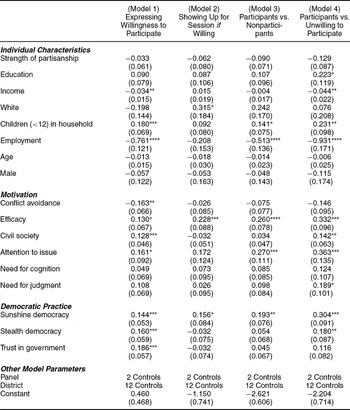
Because actual participation was conditional on agreeing to participate initially, we first estimated both stages simultaneously as a Heckman selection model. However, rho was not significant (p = .428), indicating that patterns in the determinants of the actual turnout were not conditioned on patterns in initial agreement to participate.Footnote 34 We report the determinants of people's willingness to participate in the first column of Table 2. As with the preceding varying deliberative conditions experiment, willingness to deliberate in this field experiment did not follow the standard pattern from previous research on participation in traditional partisan politics and interest group liberalism.Footnote 35 Again, the coefficients for age, race, gender, strength of partisanship, and income were all the reverse sign of models predicting standard participation, although of these variables only income was statistically significant in predicting willingness to participate.Footnote 36 Being white predicted a slightly higher rate of actually showing up for the session.Footnote 37 Unlike the hypothetical experiment, in this specification, traditional employment dampened willingness to deliberate, probably as a proxy for constraints on specific dates and times. However, having young children in the household (which would also seem to affect availability negatively) was positive and significant.
Participation in Deliberative Sessions with Member of Congress (Knowledge Networks)

Notes: We refer to those who said they were unwilling to participate as 0s, those who said they were willing but did not show as 1s, and those who said they were willing and did show as 2s. Model 1 is a binary logit comparing {0} to {1,2}. Model 2 compares {1} to {2}. Model 3 compares {0,1} to {2}. Model 4 compares {0} to {2}.
*p < .1, **p < .05, ***p < .01, ****p < .001.
We also included a more extensive battery of questions (Civil society) about participation in nonpolitical forms of civic engagement. Consistent with Putnam (Reference Putnam2000) and contrary to Hibbing and Theiss-Morse (Reference Hibbing and Theiss-Morse2002, 184–89), an index of such engagement powerfully predicts willingness to deliberate.Footnote 38 The motivational factors all had the expected sign. Conflict avoidant people were significantly less likely to want to deliberate, whereas efficacious people and those paying attention to the issue were slightly more likely to express willingness.Footnote 39
Some of the most powerful and most interesting results hinge on citizen's attitudes toward democratic practice. Recall that sunshine attitudes and trust in government were not significant in the hypothetical deliberation model. In the current model, however, both are substantively large, statistically significant, and positive. This finding regarding trust fits uncomfortably with the stealth democracy story because, in that theory, those who trust government should be willing to withdraw and let it operate in the background. Instead, respondents seem more willing to participate in deliberation with a government in which they have more trust—a behavioral result reinforcing the findings reported previously regarding nonseparable attitudes toward deliberative participation. Because the sunshine index was designed to mirror the content of stealth with the opposite valence, it is not too surprising that it should positively predict willingness to deliberate. Indeed, as reported in column 2, sunshine is one of the few factors with a significant effect in driving turnout for the session among those who report a willingness to participate.
Things become even more interesting when we consider the results for stealth. In the hypothetical model, stealth had large, negative, and significant effects in the Congress condition. Yet, here we get a complete reversal. Stealth has substantively large, statistically significant, and positive effects on willingness to deliberate. Given Hibbing and Theiss-Morse's (Reference Hibbing and Theiss-Morse2002) interpretation of stealth attitudes, this stark reversal is difficult to explain. Indeed, that the sunshine and stealth indexes should point powerfully in the same direction is, in itself, perplexing at first blush. The items for the scales were explicitly designed to point in opposite directions in their content. However, if we question the standard interpretation of stealth, the results become less perplexing. If many or most people expressing stealth beliefs have conditional attitudes about the content of the items, then a different interpretation of the meaning of stealth offers itself. On the standard interpretation, most people dislike politics intrinsically and do not want to be more involved, but reluctantly agree to more direct democracy as a hedge against the corrupt status quo. They would most prefer a nondemocratic technocracy that operates in the background. Recognizing that this model might not be achievable, they settle for more referenda and other forms of direct democratic control.
We agree with Hibbing and Theiss-Morse (Reference Hibbing and Theiss-Morse2002) that most citizens prefer stealth democracy to direct democracy, and more direct democracy to the status quo. However, we extend by one step the same move that they make regarding direct democracy. That is, just as with the apparent desire for more direct democracy, people do not really hold stealth democracy as their first preference. Instead, they will settle for stealth democracy if the civics textbook version of deliberative representative democracy is not achievable.Footnote 40
With this expanded menu in view, we can see why the stealth index reverses its effect between the hypothetical and actual offer to deliberate. The actual offer from their member communicates new information about that member that runs counter to their stereotypes of politicians. Constituents might believe that most members of Congress are corrupt politicians who do not really care about what average citizens think. But when their member, in effect, says, “No, really, I do want to talk with you. Will 2 weeks from Tuesday at 7 pm work?”, they update and reason that their member must be one of the (perhaps few) good ones. The frustration and desire for reform evinced by stealth attitudes indicate motivation for change, rather than apathy or aversion. On this reading, those high on stealth order their preferences thus:
status quo ➔ more direct democracy ➔ stealth democracy ➔ more deliberative representative democracy
These preferences are not single peaked with respect to Hibbing and Theiss-Morse's (Reference Hibbing and Theiss-Morse2002, 47) notion of “process space,” so it makes sense that the stealth index might behave nonmonotonically when new options enter the perceived choice set.
Perhaps people high on stealth might want to participate in deliberation with their member of Congress at higher rates for entirely different reasons. For example, they might consider it a golden opportunity to hold their presumptively corrupt member's feet to the fire. But this explanation would not account for why the effect should reverse itself so dramatically between the hypothetical version of talking to one's member of Congress and the actual version. Any proffered alternative explanation must make sense of how the new information being conveyed by the member's concrete offer leads to the reversed effects of stealth beliefs specifically.Footnote 41
The model in the second column of Table 2 tests for the determinants of actually participating in a deliberative session, conditional on having reported willingness to participate. Once a participant expressed intent to attend a session, there are few determinants of who actually shows up. This implies that the key to explaining participation is in understanding who expresses willingness to participate.
The third column of Table 2 reports an alternate way to code participation, where we group those who do not show up for a session (those who say they will not participate with those who say they will but do not).Footnote 42 Column 3 finds a few additional significant results compared to the second (attention to issue and young children in the household enhance participation, and employment suppresses participation). In addition, race is no longer net predictive of actual participation. We ran a series of Wald tests comparing the coefficients in model 3 (net deliberative turnout) to a model with the same specification and the same subjects, predicting their vote turnout. (See http://www.journals.cambridge.org/psr2010006). Partisanship, education, income, employment, age, civil society, sunshine, and stealth all showed significant differences in the expected direction, indicating that even variables that are not statistically significant in model 3 may nevertheless differ significantly from their effect on more traditional forms of political participation (i.e., several of these null results are a departure from the norm when it comes to voting). Put differently, on many criteria, actual deliberative participation in our sessions draws a significantly less biased population than voting. Again, these findings suggest that it is deeply misleading to think of deliberative participation as the provenance of activists and political junkies or any other proper subset of participants in “real” politics.
We conceptualize the propensity to actually participate as a continuous latent index, anchored at one end by those who have no interest at all in participating in such sessions, and at the other end by those for whom participating in the sessions is their top priority; most respondents fall somewhere in between these two end points. Reporting an interest in participating (but not actually participating) indicates an intermediate level of interest in participating: something more than dismissing participating out of hand, but something less than actually committing the time to attend (perhaps by overcoming obstacles to do so). The results in columns 1 to 3 suggest that most of the consequential movement is at the low end of the latent index; once someone reports intent to show up, whether he or she does is largely random, perhaps due to exogenous conflicts with the meeting time.
Alternatively, one might worry that reporting intent to participate, but failing to show up, represents only a kind of social desirability. If one believed this counter interpretation, it might be tempting to say that, outside the sunshine index and a few other variables, the significant findings in the first column are simply uncovering determinants of social desirability rather than determinants of actual participation. If it is the case, however, that those who express intent to participate are actually the type that are likely to actually show up, then the dependent variable in the third column combines two distinct types among the recoded zeroes: those who certainly will not show up, and those who are likely to show up but do not for some exogenous reasons.
To get some leverage on whether the determinants uncovered in the first column are actually predicting motivation toward behavior rather than simply social desirability, we have added a fourth column to Table 2, with a dependent variable that equals zero for those who are unwilling to attend and one for those who actually do attend (i.e., this model discards those who report intent to show up but do not, or equivalently, an unordered model with independent errors comparing these two categories). In column 4, we observe that there are quite a few determinants of who actually shows up, compared to those who are unwilling to participate. Indeed, most coefficients in this final model are of similar magnitude and precision to those reported in the first column: only efficacy and sunshine show a statistically significant difference on a Wald test of equality across equations in models 1 and 4, in both cases merely reinforcing the effect already present in model 1.Footnote 43 Thus, models 2 and 4, together, provide fairly strong evidence for interpreting the respondents' expressed willingness to participate as an indicator of a genuine, if diffuse, interest in participating, rather than a mere expression of social desirability.
INTERPRETING ANTIDELIBERATIVE ATTITUDES
Deliberative democracy is rooted in the notion that legitimate political decisions must typically come with a rationale that does not merely restate the will of the decision maker, whether that decision maker is a dictator, a politburo, or even a democratic majority. In that sense, it is the antithesis of authoritarianism. Alas, much evidence suggests that authoritarian attitudes are not uncommon among citizens of even the most consolidated democracies (Altemeyer Reference Altemeyer1981). Indeed, certain “soft” authoritarian (Muhlberger n.d.) attitudes garner levels of support that would seem to make deliberative democracy a pipe dream. Take, for example, two of the items from the stealth scale:
Elected officials would help the country more if they would stop talking and just take action on important problems.
What people call “compromise” in politics is really just selling out one's principles.
As with previous studies, we find that large portions of the public agree with these statements: 66% agreed with the “talk versus action” item, and 43% agreed with the “compromise” item.Footnote 44 Because compromise and especially debate are essential to deliberation, it would seem reasonable to infer that many members of the public have attitudes that would make it difficult for them to function in a deliberative public culture.
Yet, it is worth exploring more closely what these attitudes mean and how they function in a broader view of public debate. A different frame on similar questions produces precisely the opposite conclusion, namely, that average citizens evince a remarkably favorable disposition for deliberative participation. Consider the agreement rates of positively framed versions of the two preceding questions, from the sunshine scale:
It is important for elected officials to discuss and debate things thoroughly before making major policy changes. [92% Agree]
Openness to other people's views, and a willingness to compromise are important for politics in a country as diverse as ours. [83% Agree]
Even more people agree with these prodeliberative attitudes than with the corresponding stealth statements. It is thus incorrect to infer that large majorities of the public have unambiguously negative attitudes about debate and compromise. We do not want to repeat the same mistake in the opposite direction by arguing that large majorities of citizens have unambiguously positive attitudes about debate and compromise. Indeed many of the citizens in our sample agreed with both the positive and negative versions of these questions. Either citizens are deeply confused about these issues (i.e., they exhibit rampant nonattitudes) or they are deeply conflicted.
Our many systematic findings regarding stealth and sunshine indicate that the nonattitudes explanation is implausible here. If we were really dealing with random noise, then the indices would not have so many interpretable causes and consequences. We are left to conclude that large portions of the public have complex and conditional attitudes about the role of debate and compromise in public discourse. In our view, such complexity is unsurprising and perhaps quite appropriate. The folk intuition that much elite political talk is a mix of reasonable debate and demagogic drivel seems entirely sensible. Similarly, some compromises are rightly regarded as reasonable, even noble, forms of mutual accommodation, whereas others are cynical or craven.
Hibbing and Theiss-Morse (Reference Hibbing and Theiss-Morse2002) suggest that most citizens overreact to the negative parts of the mix and discount the positive. Quoting a participant in one of their focus groups as complaining that “Congress bickers all the time between the two parties, and they're always struggling for the power, rather than taking care of the issue,” they argue that “people's impatience with deliberation and compromise is an important element of the American political system” (137). However, this inference assumes that there is little truth to this person's accusation about the quality of elite political discourse. The implication is that most people typically misperceive genuine deliberation as bickering and reasonable compromise as the result only of power struggles. On the basis of this and other comments in their focus groups, Hibbing and Theiss-Morse infer that “The notion that debating among elected officials may actually be necessitated by their responsibility to represent the interests of diverse constituencies across the country is rejected by most people” (142).
We doubt that most people are so simplistic and reductive in their views. Accordingly, we decided to test this claim more systematically. We asked a standard Likert agree/disagree question based on a close paraphrase of Hibbing and Theiss-Morse's (Reference Hibbing and Theiss-Morse2002) inference, quoted previously: “One of the main reasons that elected officials have to debate issues is that they are responsible to represent the interests of diverse constituencies across the country.”Footnote 45 Far from most people rejecting this notion, only a small minority disagrees with it (6%). A large majority (84%) explicitly agrees with it. Most citizens seem quite willing to make room for debate and compromise, although (reasonably, in our view) they do not regard all debate as constructive or sincere, nor all compromise as principled. It is simply inaccurate to characterize all public frustration with partisan politics and interest group liberalism as rooted in naive perfectionism. As we have seen, it is precisely those people who are high on stealth who want to deliberate when given a signal that they can actually have both rational debate and republican consultation at the same time. There is no contradiction between passionate support for democratic ideals and despair about the way status quo practices subvert them. Such attitudes can coexist in the same person, be activated by different stimuli, and interact in complex ways. Take, for example, the other pair of questions from the stealth scale:
Our government would run better if decisions were left up to successful business people.
Our government would run better if decisions were left up to nonelected, independent experts rather than politicians or the people.
Hibbing and Theiss-Morse (Reference Hibbing and Theiss-Morse2002) choose a negative frame for their data on these questions. Having found that 32% of citizens agreed with the “business people” statement and 31% with the “experts” statement, they infer from these numbers that the public likes “decision-making structures that are not democratic, and not even republican” (138). Simply turning around the frame provides a more optimistic interpretation though: each statement was rejected by more than two thirds of the public, so it seems gratuitously pessimistic to describe the public as having a broad fondness for nondemocratic decision-making structures.Footnote 46
That said, it does seem troubling that a substantial minority of the public appears so frustrated with the status quo that it would forgo even the minimal autonomy afforded by the institutions of representative democracy. However, in qualitative follow-up interviews on these questions,Footnote 47 we found that many respondents who agreed with the “successful business people” item interpreted it as implying that such people would make good candidates for public office (e.g., Ross Perot or Michael Bloomberg), rather than directly crafting policy qua business people. On this interpretation, there is nothing at all antidemocratic about such beliefs. Indeed, the other interpretation conjured up images of having energy policy crafted by oil executives—a prospect that was decidedly unpopular, even among those who initially agreed with the item.
Finally, as with the first pair of stealth questions, there was substantially more agreement with the reverse coded statements than with the original ones:
In a democracy like ours, there are some important differences between how government should be run and how a business should be managed. [73% Agree]
It is important for the people and their elected representatives to have the final say in running government, rather than leaving it up to unelected experts. [80% Agree]
Whereas significant minorities agreed with the stealth questions, large supermajorities agreed with the corresponding sunshine versions. Unlike the first pair of stealth items, most of the public is not even conflicted here—they simply reject the stealth attitudes and embrace the sunshine ones. We conclude that any picture of the American public as so desperate to avoid politics that they are willing to submit lightly to plutocratic or technocratic rule is deeply misleading.
WHY SOME PEOPLE ARE UNWILLING TO DELIBERATE
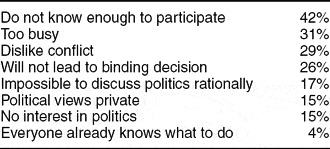
None of the foregoing is meant to suggest that the public is unambiguously positive about the prospects of a more deliberative democracy. Critics are surely right that substantial numbers of people do not want to deliberate, even if they overestimate how many. Recall that in our experiment assessing interest in participating in different kinds of deliberative sessions, we found a skew toward substantial interest: Extremely interested 27%; Quite interested 27%; Somewhat interested 29%; Not too interested 12%; Not at all interested 5%. Of the 17% who said they were “Not too” or “Not at all” interested, we followed up to find out why they did not want to participate. Critics argue that the main reasons are that most people are uninterested in politics and that they consider deliberation unnecessary because everyone already knows what needs to be done. We did not find much support for these claims. Indeed, as Table 3 shows, they were among the least cited reasons. As argued previously, people seem to regard deliberation as a partial alternative to more standard partisan politics and interest group liberalism. As a result, a general lack of interest in politics as conventionally understood does not seem to drive people's unwillingness to participate in deliberation. Similarly, consistent with our finding that most Americans are well aware that debate and compromise are often necessary, few people find deliberation pointless on the grounds that everyone already knows what needs to be done. On the contrary, the modal response to the question about why respondents did not want to deliberate indicates that many people are quite humble in the face of complex policies and do not believe that they know enough to participate meaningfully.
Percent Citing Reasons for Not Wanting to Deliberate (Among Those “Not Too” or “Not at All” Interested in Deliberating)

We do, however, find support for the claim that conflict aversion is a substantial deterrent to people's willingness to deliberate. We found substantial conflict aversion in our sample, with 32% agreeing with their conflict aversion item on the baseline survey and 29% of those not interested in participating in the hypothetical deliberative session citing it as their reason why. That said, many factors go into people's decisions to do things, and it would be easy to overestimate the effect of conflict aversion. For example, 60% of those who were conflict avoidant on the baseline survey were nevertheless willing to deliberate with their member of Congress. Thus, even though some aversion to conflict may be widespread, it is hardly decisive with respect to participating in deliberation.
If we multiply out the rate of people who were not interested in deliberating (17%) with the percentage of those who cite conflict aversion as the reason (29%), then we get a predicted net decrease in willingness to deliberate due to conflict aversion of about 5%. As it happens, this estimate comports well with the behavior we observe in the model predicting willingness to deliberate with one's member of Congress. Holding the other variables constant, moving from one standard deviation above the mean to one standard deviation below the mean on a conflict avoidance index predicts about a 6% decrease in one's willingness to deliberate. This level of suppression indicates that conflict aversion should be regarded as a significant, but not overwhelming, impediment to realizing a deliberative culture.
A NOTE ON THE CONSEQUENCES OF DELIBERATION
Many scholars (Eliasoph Reference Eliasoph1998; Hibbing and Theiss-Morse Reference Hibbing and Theiss-Morse2002; Mendelberg and Oleske Reference Mendelberg and Oleske2000; Mutz Reference Mutz2002; Posner Reference Posner2003; Sanders Reference Sanders1997; Sunstein Reference Sunstein2009) worry that pushing deliberation on reluctant citizens, beyond wasting time and resources, will cause actual harm by leading to even greater frustration with and aversion toward politics. Even some scholars who are highly sympathetic to deliberative democracy echo such concerns (e.g., Mansbridge Reference Mansbridge1980) under some circumstances. This article focuses on who is willing to deliberate, not the content and consequences of deliberation, which we address in concurrent work. Here we cannot fully develop our response to such worries, and for now, we concede that caution in interpreting the policy implications of our results is warranted. But it is worth noting briefly that nothing like these negative consequences came to pass in our field experiments. Quite the contrary, participants almost uniformly described the experience as positive: 95% Agreed (72% Strongly Agreed) that such sessions are “very valuable to our democracy,” and 96% Agreed (80% Strongly Agreed) that they would be interested in doing similar online sessions for other issues. Such positive reactions were nearly independent of whether the citizens were of the same party or agreed on the issue with their member of Congress or the majority of the other citizens in the session. Open-ended responses to the sessions were also overwhelmingly positive, with participants remarking on various aspects of the sessions that fit quite well with the hopes and intentions of deliberative democrats. For example:
It was great to have a member of Congress want to really hear the voices of the constituents.
I believe we are experiencing the one way our elected representatives can hear our voice and do what we want.
I thought he really tried to address the issues we were bringing up instead of steering the conversation in any particular direction, which was cool.
I realized that there are A LOT more sides to this issue than I had originally thought.
In addition to these positive attitudes, we identified positive causal effects on people's issue-specific political knowledge, attention to politics beyond the issue under discussion, external political efficacy as a result of participation, and their propensity to discuss politics with people in their social network (with many more potential benefits—and harms—of deliberation yet to be tested for).Footnote 48 Again, we acknowledge that it is entirely possible that these positive attitudes and effects are peculiar to something about our forums. The preliminary evidence, however, suggests that deliberation did not produce the perverse results critics worried would ensue.
CONCLUSION
Many scholars of political behavior (as well as many nonacademics interested in politics) are inclined to be skeptical of the aspirations of deliberative democrats. The story goes that average citizens hate politics and cannot even get it right when they show up every 4 years (if they show up) to cast a vote on a simple binary choice between candidates who have been bombarding them with information for months. How can anyone seriously expect them to want to participate in more detailed discussion of policy, much less do so competently? The intuition behind such skepticism is reasonable on its face. However, the aspirations of deliberative democrats do not seem so hopelessly utopian when we consider that many citizens are demobilized precisely by the peculiarities of partisan and interest group politics that political sophisticates take as exclusively constitutive of political participation. The motivation and competence to participate are not arranged in such an ordered way as to preclude a greater desire for alternative forms of participation. Our findings suggest that willingness to deliberate is much higher than research in political behavior might suggest, and that those most willing to deliberate are precisely those turned off by standard partisan and interest group politics. If the standard forms of participation can be embedded in a more deliberative framework, then the tension between the two may well lessen. Far from rendering deliberative democratic reforms ridiculous or perverse on their own terms, these findings suggest that the deliberative approach represents opportunities for practical reform quite congruent with the aspirations of normative political theorists and average citizens alike.




Comments
No Comments have been published for this article.