1. Introduction
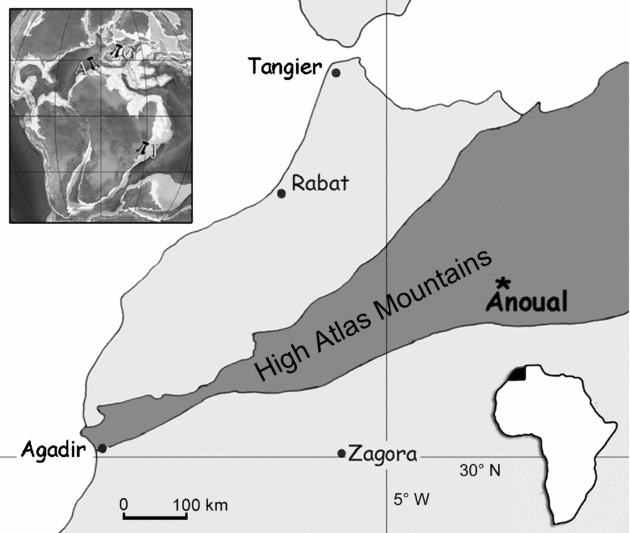
The so-called site of Anoual is located in the eastern High Atlas Mountains (northern Morocco; Fig. 1), east of the eponymous city, in the lenticular Ksar Metlili Formation. It has yielded an extremely diverse microvertebrate fauna, including fishes, amphibians, turtles, sphenodontians, squamates, archosaurs and mammals (see Knoll, Reference Knoll2000; Evans & Sigogneau-Russell, Reference Evans and Sigogneau-Russell2001; Gardner, Evans & Sigogneau-Russell, Reference Gardner, Evans and Sigogneau-Russell2003; Jones, Evans & Sigogneau-Russell, Reference Jones, Evans and Sigogneau-Russell2003 and references therein). The age of this assemblage is well constrained as Berriasian by the combined dating provided by nannoliths and a charophyte (Sigogneau-Russell, Monbaron & Kaenel, Reference Sigogneau-Russell, Monbaron and Kaenel1990; Mojon, Haddoumi & Charrière, Reference Mojon, Haddoumi, Charrière and Mojon2005). Considerable attention has been drawn to the mammalian component of this assemblage, which is not surprising, as it stands as the best Mesozoic mammalian fauna in Gondwana in terms of abundance of specimens and taxonomic diversity (see Sigogneau-Russell et al. Reference Sigogneau-Russell, Evans, Levine and Russell1998 and references therein; Sigogneau-Russell, Reference Sigogneau-Russell1999a, Reference Sigogneau-Russell and Blandinb, Reference Sigogneau-Russell2003; Hahn & Hahn, Reference Hahn and Hahn2003). In contrast, no detailed work has been dedicated to the dinosaurian representatives, which is particularly unfortunate as the evolution of dinosaurian faunas at the dawn of the Cretaceous is presently very poorly known on a global scale (Weishampel et al. Reference Weishampel, Barrett, Coria, Le Loeuff, Xu, Zhao, Sahni, Gomani, Noto, Weishampel, Dodson and Osmólska2004). Thus, with respect to Africa, there is simply no other dinosaurian site of definitive Berriasian age. The aim of this paper is to present a detailed survey of the theropod teeth from Anoual.
Map showing the position of the Anoual locality. The lower right corner inset shows the position in Africa of the region depicted in the main map (from Sigogneau-Russell et al. Reference Sigogneau-Russell, Evans, Levine and Russell1998, Fig. 1). The upper left inset is a palaeogeographic map of the Early Cretaceous (120 Ma) from Blakey (unpub. data, 2001: http://jan.ucc.nau.edu/~rcb7/globaltext2.html), in which pins point to the position of the Anoual (A), but also Galve (G) and Jema River (J) sites. A detailed stratigraphic section of the Red Beds of the Anoual Syncline showing the position of the fossiliferous lens of the Ksar Metlili Formation is available in Sigogneau-Russell, Monbaron & Kaenel (Reference Sigogneau-Russell, Monbaron and Kaenel1990, Fig. 10).

2. Material and methods
The microvertebrate remains from the ‘synclinal d'Anoual’ (SA) are housed in the Muséum national d'Histoire naturelle (Paris). They were obtained by Dr D. Sigogneau-Russell (Muséum national d'Histoire naturelle, Paris) after acid dissolution of limestone blocks collected at the site in the 1980s and sifting and sorting of the residue under a binocular microscope.
Theropod teeth are, in general, morphologically conservative and typically possess few discrete characters that can be used to identify them confidently. Their detailed systematic study was initiated by Currie, Rigby & Sloan (Reference Currie, Rigby, Sloan, Carpenter and Currie1990) and is presently based on a small number of relatively simple characters such as cross-sectional shape, the respective positions of mesial and distal carinae, denticle morphology and density, and tooth size. These characters have, at least partly, evolved in correlation with functional necessities and were doubtless strongly subject to homoplasy. In addition, morphological variation in theropod teeth, even within a single jaw, is presently not well appreciated. Nevertheless, recent studies suggest that statistical tools can help to discriminate between theropod teeth of similar gross morphology (see Smith, Vann & Dodson, Reference Smith, Vann and Dodson2005; but also Samman et al. Reference Samman, Powell, Currie and Hills2005; Smith, Reference Smith2005, Reference Smith2007).
The present identification was limited to four categories: Theropoda indet., Maniraptoriformes indet., Maniraptora indet. and Velociraptorinae indet. All suprageneric taxa used in this paper follow Sereno (unpub. data, 2005: http://taxonsearch.org/dev/file_home.php), with adoption of the phylogenetic schemes of Holtz, Molnar & Currie (Reference Holtz, Molnar, Currie, Weishampel, Dodson and Osmólska2004) and Holtz & Osmólska (Reference Holtz, Osmólska, Weishampel, Dodson and Osmólska2004) for taxa more basal than Coelurosauria, that of Hwang et al. (Reference Hwang, Norell, Ji and Gao2004) for taxa within Coelurosauria exclusive of those within Dromaeosauridae, and that of Makovicky, Apesteguía & Agnolín (Reference Makovicky, Apesteguía and Agnolín2005) for Dromaeosauridae. Particular emphasis was placed on the following key characters:
(a) teeth without serrations: Maniraptoriformes indet. (e.g. Hwang et al. Reference Hwang, Norell, Ji and Gao2004, supplementary data; Makovicky, Apesteguía & Agnolín, Reference Makovicky, Apesteguía and Agnolín2005, supplementary information);
(b) teeth with distal serrations but lacking mesial ones: Maniraptora indet. (e.g. Ruiz-Omeñaca & Canudo, Reference Ruiz-Omeñaca and Canudo2003);
(c) teeth with mesial denticles smaller than distal ones (DSDI ≫ 1): Velociraptorinae indet. (e.g. Rauhut & Werner, Reference Rauhut and Werner1995; Rauhut, Reference Rauhut2002; Currie & Varricchio, Reference Currie, Varricchio, Currie, Koppelhus, Shugar and Wright2004).
The teeth that were overly fragmentary and lacking diagnostic characters were identified only as Theropoda indet. All of the teeth described here are confidently attributable to Theropoda, but the possibility that some of this material belongs to distant taxa such as crocodylomorphs or squamates cannot be categorically excluded so far (some serrated teeth from Anoual were considered as pertaining to unknown ziphodont crocodylomorphs and therefore excluded from this study).
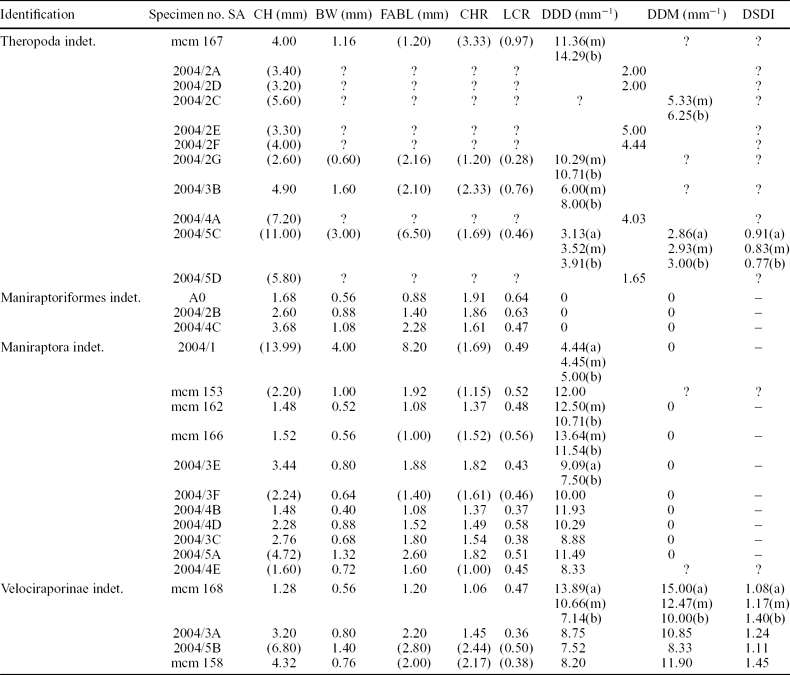
Binocular and scanning electron microscopy techniques were employed to study the material. For most of the specimens, measurements were taken with an eyepiece with a graduated ruler connected to an Olympus SZH stereomicroscope. For the largest specimens, a digital caliper was also used. Measurements for each specimen are presented in Table 1. When possible, these are the crown height (CH), the basal width (BW), the fore–aft basal length (FABL), the crown height ratio (CHR), the lateral compression ratio (LCR), the denticle density for the distal and mesial carinae (DDD, DDM) and the denticle size density index (DSDI). Details regarding the measurement of these parameters are provided in Grigorescu (Reference Grigorescu, Petrescu and Dragastan1984), Currie, Rigby & Sloan (Reference Currie, Rigby, Sloan, Carpenter and Currie1990), Farlow et al. (Reference Farlow, Brinkman, Abler and Currie1991), Rauhut & Werner (Reference Rauhut and Werner1995), Sankey et al. (Reference Sankey, Brinkman, Guenther and Currie2002) and Smith, Vann & Dodson (Reference Smith, Vann and Dodson2005). The tooth orientation terminology used herein follows the proposal of Smith & Dodson (Reference Smith and Dodson2003).
Measurements of the theropod teeth from Anoual (see Section 2 for abbreviations)

(a), (m) and (b) indicate that the measurement has been taken in the apical, middle, and basal part of the carina, respectively. Bracketed values are based on deficient data and are indicative of the state of preservation of the specimen only.
3. Systematic palaeontology
Dinosauria Owen, Reference Owen1842
Saurischia Seeley, Reference Seeley1888
Theropoda Marsh, Reference Marsh1881
Theropoda indet
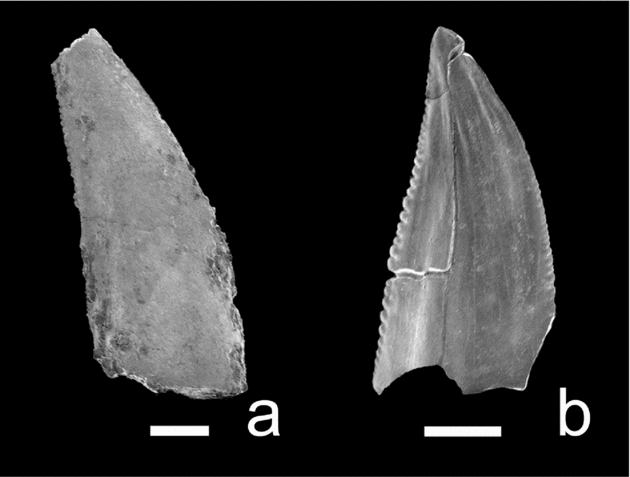
SA mcm 167. This specimen is reduced to a distal fragment of a crown (Fig. 2a). In distal view, it is slightly curved laterally (?lingually) and the carina appears relatively central. The lateral sides are smooth, especially at the base. The carina bears very fine serrations (see Table 1) on the basalmost two-thirds of the crown. The break reveals a centrally located inner groove that extends from the base of the crown fragment toward the apex, but that progressively disappears before reaching it.
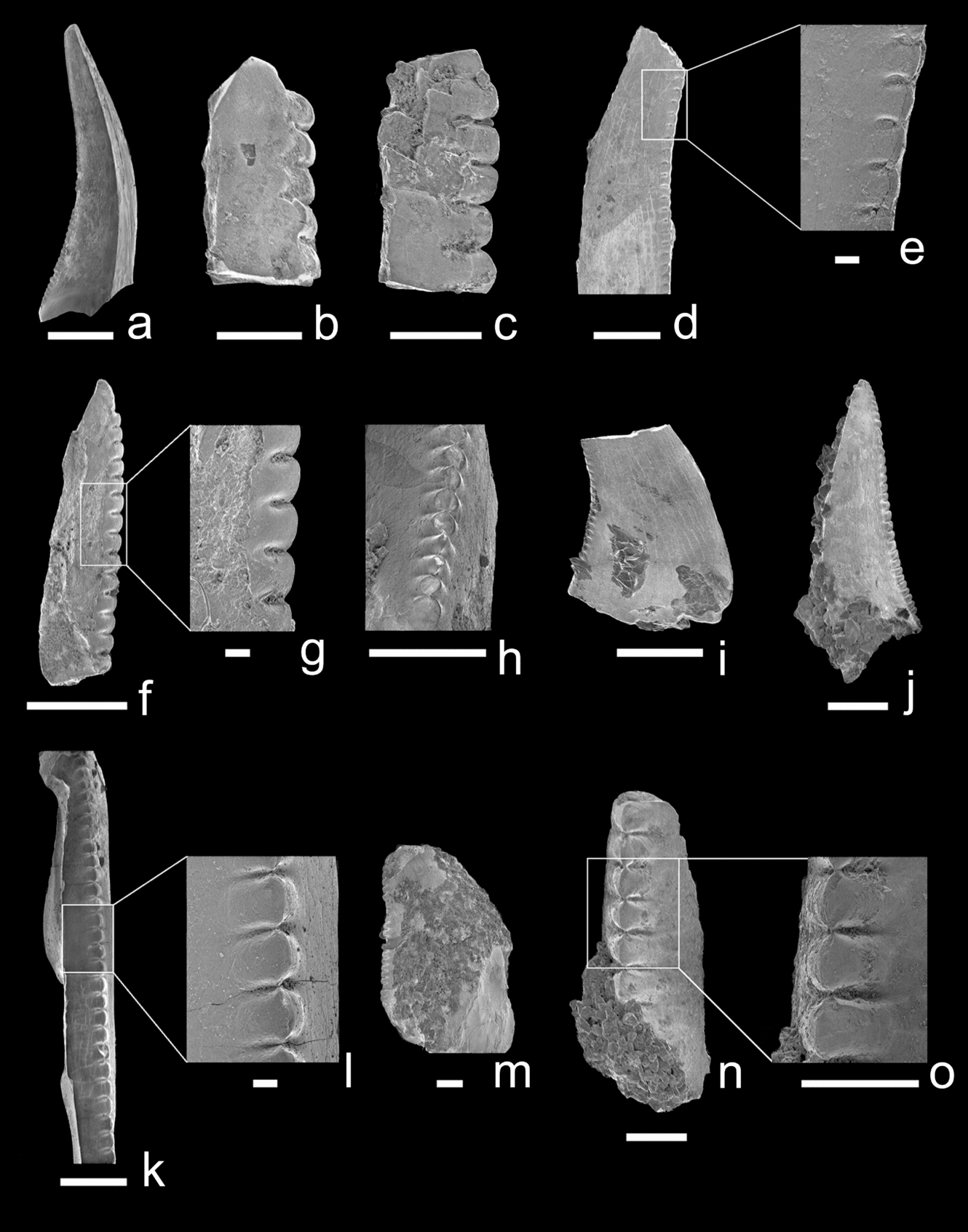
Theropod teeth from the Berriasian of Anoual (Theropoda indet.). (a) SA mcm 167 (lateral view); (b) SA 2004/2A (lateral view); (c) SA 2004/2D (lateral view); (d) SA 2004/2C (lateral view); (e) SA 2004/2C (detail of serrations); (f) SA 2004/2E (lateral view); (g) SA 2004/2E (detail of serrations); (h) SA 2004/2F (detail of serrations); (i) SA 2004/2G (lateral view); (j) SA 2004/3B (lateral view); (k) SA 2004/4A (?distal view); (l) SA 2004/4A (detail of serrations); (m) SA 2004/5C (lateral view); (n) SA 2004/5D (?distal view); (o) SA 2004/5D (detail of serrations). Scale bars = 1 mm (a–d, f, h–k, m–o) and 0.1 mm (e, g, l).

SA 2004/2A. It is a small fragment of carina with five relatively coarse, chisel-like serrations (Fig. 2b).
SA 2004/2D. It is also a small fragment of carina with five relatively coarse, chisel-like serrations (Fig. 2c).
SA 2004/2C. This specimen is a fragment of a serrated distal carina (Fig. 2d). As far as we can assess them, the lateral sides of the crown appear smooth. The serrations (Fig. 2e) are much finer than in SA 2004/2A (Fig. 2b) and do not reach the base. They are relatively even and oriented perpendicular to the longest axis of the tooth. The interdenticle pits are oval in labial and lingual views, giving to the denticle a waisted, axe-like morphology in lateral view. This compares well with some of the denticles of Nuthetes teeth as figured by Milner (2002, Fig. 2). Incidentally, the DDD is similar to that of some teeth attributed to Fukuiraptor (Currie & Azuma, Reference Currie and Azuma2006, table 1).
SA 2004/2E. It is a narrow fragment of mesial carina bearing 14 medium-sized, chisel-like serrations oriented roughly perpendicular to the long axis of the crown, except for the smaller ones at one extremity (?apical) which are slightly tilted (Fig. 2f, g).
SA 2004/2F. This is a fragment of a relatively straight (?distal) carina with 15 rounded or chisel-like serrations oriented perpendicular to the edge of the crown (Fig. 2h).
SA 2004/2G. It is a small crown sagittally broken and lacking the apex (Fig. 2i). The preserved lateral side is relatively flat and smooth. The mesial edge is not well preserved. The distal edge bears a series of fine serrations extending nearly down to the base.
SA 2004/3B. It is a fragment of serrated distal carina (Fig. 2j), which describes a slight sigmoid curve in labial or lingual view, as in Carcharodontosaurus (Sereno et al. Reference Sereno, Dutheil, Iarochene, Larsson, Lyon, Magwene, Sidor, Varricchio and Wilson1996), for example. The lateral sides of the crown seem to have been smooth. The distal curvature of the crown was insignificant. The series of medium-sized serrations extends all along the height of the crown, those in the middle part of the crown being the largest and the most distinct. The serration density is close, for example, to that of the maxillary and dentary teeth of Huaxiagnathus (Hwang et al. Reference Hwang, Norell, Ji and Gao2004) and to that of a number of isolated teeth attributed to Saurornitholestes (Sankey, Standhardt & Schiebout, Reference Sankey, Standhardt, Schiebout and Carpenter2005, table 7.2).
SA 2004/4A. It is a narrow fragment of carina with 28 chisel-like serrations (Fig. 2k, l).
SA 2004/5C. Despite being an imperfectly preserved tooth (Fig. 2m), this specimen is interesting in being one of the largest recovered at Anoual. One side appears to have been flatter than the other. The distal carina is not strongly curved. Both the mesial and distal carinae bear medium-sized, plesiomorphic, chisel-like serrations. As far as can be determined, their density is similar to that of the tetanuran Condorraptor (Rauhut, Reference Rauhut2005), the Tyrannosauridae (Currie, Rigby & Sloan, Reference Currie, Rigby, Sloan, Carpenter and Currie1990), and a tooth from the Maastrichtian of Cassagnau (France) identified by Laurent, Bilotte & Le Loeuff (Reference Laurent, Bilotte and Le Loeuff2002, pl. 2C) as from an undetermined Dromaeosauridae, to cite but a few examples. This corroborates the hypothesis that denticle density alone is not determinant for systematic allocation (Farlow et al. Reference Farlow, Brinkman, Abler and Currie1991). The DSDI is similar to the mean DSDI of Ceratosaurus (Smith, Reference Smith2005, Fig. 17C) and to that of a tooth referred to Eocarcharia (Sereno & Brusatte, Reference Sereno and Brusatte2008, p. 30). The LCR of SA 2004/5C may also have been similar to that of Eocarcharia (Sereno & Brusatte, Reference Sereno and Brusatte2008, p. 30).
SA 2004/5D. This specimen is a fragment of carina with eight chisel-like serrations (Fig. 2n, o). It could be interpreted as evidence for the presence of a theropod of a larger size than that from which SA 2004/1 (see below) comes (or, alternatively, a theropod with proportionally larger teeth).
Tetanurae Gauthier, Reference Gauthier1986
Coelurosauria Huene, Reference von Huene1914
Maniraptoriformes Holtz, Reference Holtz1995
Maniraptoriformes indet
SA A0. This is a crown devoid of serrations or denticulations (Fig. 3a). The mesial edge lacks a well-marked carina. The distal edge bears a discrete carina, which is strongly eccentric (offset from the centre in distal view) and absent on the basalmost third of the crown. Assuming that this deflection is toward the lingual side, SA A0 would be a tooth from the right dentary or left maxilla, possibly from the rostral part. The crown is slightly curved ?labially. The ?labial side is relatively smooth except for a faint baso-apical ridge that possibly originates from a labial migration of a mesial carina. The ?lingual side is uniformly smooth.
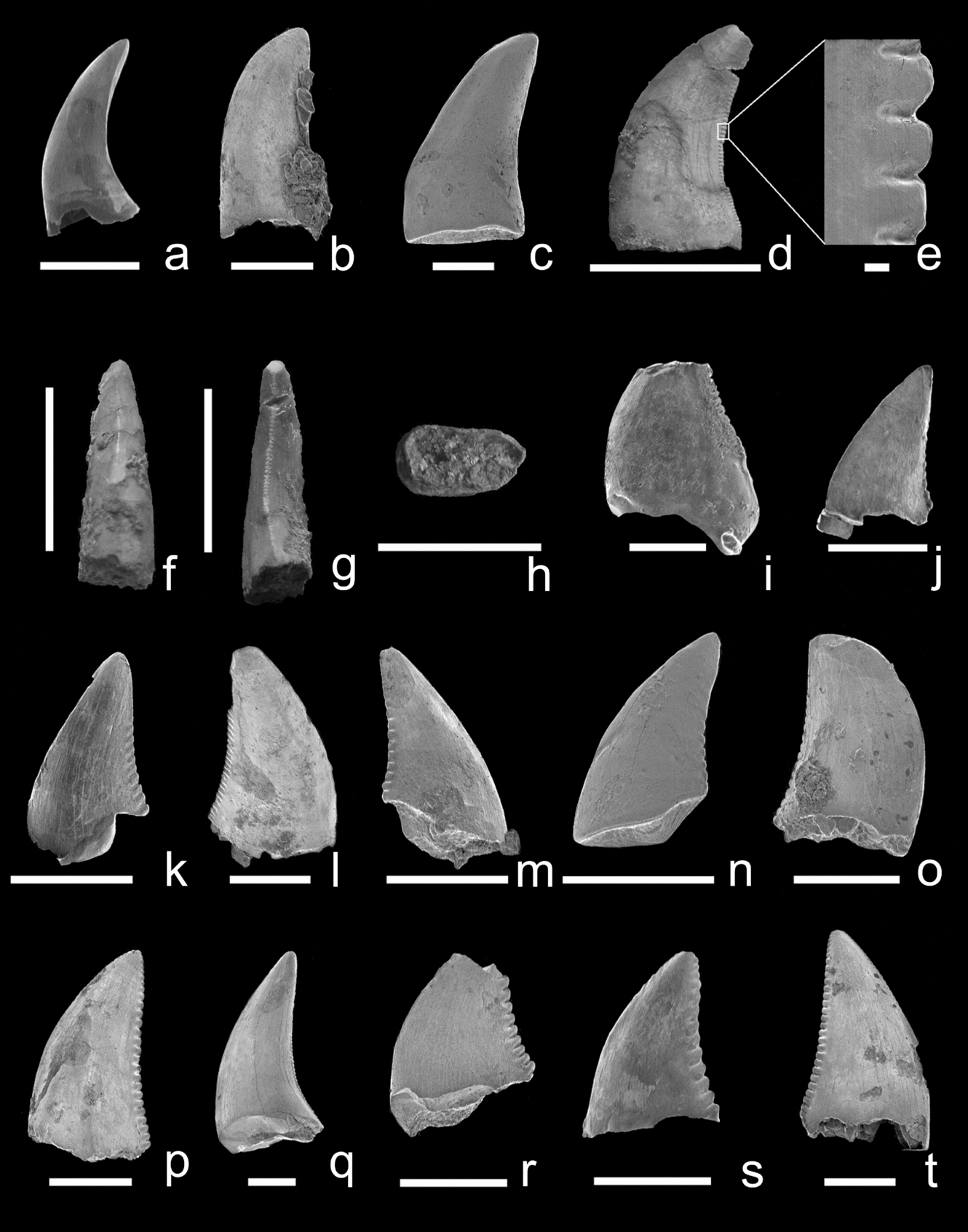
Theropod teeth from the Berriasian of Anoual (Maniraptoriformes indet., Maniraptora indet. Morphotype I to III, Velociraptorinae indet. Morphotype I). (a) SA A0 (?lingual view); (b) SA 2004/2B (lateral view); (c) SA 2004/4C (lateral view); (d) SA 2004/1 (?lingual view); (e) SA 2004/1 (detail of serrations); (f) SA 2004/1 (mesial view); (g) SA 2004/1 (distal view); (h) SA 2004/1(basal view); (i) SA mcm 153 (lateral view); (j) SA mcm 162 (lateral view); (k) SA mcm 166 (lateral view); (l) SA 2004/3E (lateral view); (m) SA 2004/3F (lateral view); (n) SA 2004/4B (lateral view); (o) SA 2004/4D (lateral view); (p) SA 2004/3C (lateral view); (q) SA 2004/5A (lateral view); (r) SA 2004/4E (lateral view); (s) SA mcm 168 (lateral view); (t) SA 2004/3A (lateral view). Scale bars = 10 mm (d, f–h), 1 mm (a–c, i–t) and 0.1 mm (e).

SA A0 is superficially similar to isolated teeth from the Barremian of Castellote (Spain) assigned by Ruiz-Omeñaca, Canudo & Cuenca-Bescós (Reference Ruiz-Omeñaca, Canudo and Cuenca-Bescós1996, Fig. 13) to Coelurosauria indet., and also evokes a tooth from the Maastrichtian of Romania that Codrea et al. (Reference Codrea, Smith, Dica, Folie, Garcia, Godefroit and Van Itterbeeck2002, Fig. 4N) referred to the Euronychodon morphotype.
Theropod teeth from the Berriasian of Anoual (Velociraptorinae indet. Morphotype II and III). (a) SA 2004/5B (lateral view); (b) SA mcm 158 (lateral view). Scale bars = 1 mm.

SA 2004/2B. This is a crown with both lateral sides smooth and only slightly and relatively homogeneously convex (Fig. 3b). The apex is blunt. The crown is only very slightly curved distalward as the distal carina is almost straight. The mesial edge bears a discrete, but acute, carina that originates from the apex and vanishes at about mid-height of the crown. Interestingly, this carina is centrally positioned apically, but diverges laterally (?lingually) toward the base. The distal carina follows a straighter, though still eccentric, course and extends much further basally, nearly reaching the base of the crown. Neither carina bears serrations.
A lingually diverging mesial carina has been considered as diagnostic of Dromaeosaurus (Currie, Rigby & Sloan, Reference Currie, Rigby, Sloan, Carpenter and Currie1990; Currie, Reference Currie1995, p. 577; Baszio, Reference Baszio1997, p. 35) and as characteristic of dromaeosaurine Dromaeosauridae (Currie, Reference Currie1995, p. 589; Rauhut, Reference Rauhut, Martin and Krebs2000, Reference Rauhut2002). Nevertheless, in Dromaeosaurus this character concerns lateral teeth, whereas the ‘rounded’ appearance of SA 2004/2B suggests that it is an exemplar from the premaxilla (see e.g. Baszio, Reference Baszio1997, pl. 1 Fig. 5; Zinke, Reference Zinke1998, Fig. 3A). Assuming that SA 2004/2B is indeed a premaxillary tooth, the presence of carinae on both the mesial and distal edges argues against close affinity with a number of Coelurosauria, notably Compsognathidae (Currie & Chen, Reference Currie and Chen2001, p. 1711). Interestingly, the mesial carina of the premaxillary teeth of Richardoestesia (= Ricardoestesia) gilmorei curves toward the lingual surface, according to Baszio (Reference Baszio1997, p. 39). He has figured such a tentatively identified tooth (Baszio, Reference Baszio1997, pl. 4, Fig. 49), which does resemble SA 2004/2B, although the former is finely serrated. The LCR is similar to that of a tooth from the Berriasian of Denmark pertaining to a Dromaeosauridae, according to Lindgren et al. (Reference Lindgren, Currie, Rees, Siverson, Lindström and Alwmark2008, p. 258). All in all, SA 2004/2B appears to represent a derived member of Maniraptoriformes, although that assertion is not supported by any synapomorphy.
SA 2004/4C. This is a shed crown with both lateral sides smooth and slightly flattened (Fig. 3c). The mesial edge is uniformly curved except for the basal fifth, which is straight. It bears a sharper carina than does the distal edge. Both carinae are slightly eccentric and their deflections are not toward the same side. There is no evidence of any serrations on either carina. The basal surface of the crown shows a central aperture.
The specimen is closely similar to the theropod teeth from the Maastrichtian of Aveiro and Taveiro (Portugal) identified as ‘Famille aff. Coeluridae’ by Antunes & Sigogneau (Reference Antunes and Sigogneau1992, pl. 2; also Antunes & Sigogneau-Russell, Reference Antunes and Sigogneau-Russell1996, table 1), ‘?Coeluridae’ by Galton (Reference Galton1996), Theropoda indet. by Pereda Suberbiola (Reference Pereda Suberbiola1999) and Coelurosauria indet. by Weishampel et al. (Reference Weishampel, Barrett, Coria, Le Loeuff, Xu, Zhao, Sahni, Gomani, Noto, Weishampel, Dodson and Osmólska2004, p. 592).
Maniraptora Gauthier, Reference Gauthier1986
Maniraptora indet. Morphotype I
SA 2004/1. This is the largest complete theropod tooth recovered to date at Anoual (Fig. 3d–h). The labial and lingual sides are smooth and flat (Fig. 3d). The mesial edge shows no obvious serrations, but possesses a discrete, acute carina that disappears toward the base of the crown (Fig. 3f). The distal carina shows an eccentricity (Fig. 3g) that suggests that this tooth comes from the rostral part of the right dentary or left maxilla. In addition, this carina describes a slightly sigmoid line, even though the crown is itself fairly straight in mesial and distal views (Fig. 3f, g). The serrations are small, rounded or chisel-like and are oriented perpendicular to the longest axis of the crown (Fig. 3d, e). They are of relatively uniform size, except for the basal ones, which are smaller. The root is resorbed (Fig. 3h).
Except for bearing comparatively finer (but morphologically similar) denticles, SA 2004/1 resembles, for instance, a specimen from the Barremian of Galve (Spain) identified as Dromaeosauridae indet. ‘type C’ (Ruiz-Omeñaca et al. Reference Ruiz-Omeñaca, Canudo, Cuenca-Bescós, Amo, Jagt, Lambers, Mulder and Schulp1998; Barco et al. Reference Barco, Ruiz-Omeñaca, Canudo, Cuenca-Bescós and Barco2004, Fig. 4.15), an isolated tooth from the Maastrichtian of Vitrolles (France) also identified as Dromaeosauridae indet. (Garcia et al. Reference Garcia, Pincemaille, Vianey-Liaud, Marandat, Lorenz, Cheylan, Cappetta, Michaux and Sudre1999, pl. Fig. 2), as well as the seventh maxillary crown of Tsaagan figured by Norell et al. (Reference Norell, Clark, Turner, Makovicky, Barsbold and Rowe2006, Fig. 16). Incidentally, the distal carinae of the complete velociraptorine crowns studied by Sweetman (Reference Sweetman2004) are somewhat sinusoidal in distal view, recalling SA 2004/1. Finally, the DSDI of SA 2004/1 is close to the mean DSDI of Dromaeosaurus, according to Baszio (Reference Baszio1997, p. 35) and, incidentally, the DDD of this tooth is similar to that of Velociraptor, according to Barsbold & Osmólska (Reference Barsbold and Osmólska1999). An assignment of SA 2004/1 to the Dromaeosauridae would therefore have some support.
SA mcm 153. This specimen is a fragmentary tooth lacking the apex (Fig. 3i). The labial and lingual sides are smooth and uniformly convex. The mesial edge of the crown possesses a discrete sharp carina. The distal edge bears medium-sized serrations. These carinae are slightly eccentric. Naturally, the preserved part of the root shows no acute carina and no serrations on the edges. There is no evidence of a constriction between the crown and the root.
SA mcm 162. This crown (Fig. 3j) shows some affinities with SA mcm 153 (Fig. 3i). It is relatively straight in mesial and distal views. Both lateral sides are smooth and homogeneously bulging. The mesial edge is unserrated. The distal edge bears serrations that disappear well before the apex. The carinae are relatively centrally positioned. Although not identical, SA mcm 162 presents some similarities with a tooth from the Barremian of Castellote identified by Ruiz-Omeñaca, Canudo & Cuenca-Bescós (Reference Ruiz-Omeñaca, Canudo and Cuenca-Bescós1996, Fig. 19) as Dromaeosauridae indet.
SA mcm 166. It is a small specimen (Fig. 3k) that shows some similarities to SA mcm 162 (Fig. 3j). Both lateral sides are smooth. The mesial edge is devoid of serrations. The distal edge bears relatively obliquely oriented (~ 45° with respect to the central axis of the crown) serrations, except for at the apex. The carinae are relatively centrally positioned. The systematic importance of obliquely oriented serrations should not be overestimated. They are present in a variety of theropods and, as suggested by Ostrom (Reference Ostrom1969, p. 40), could have varied (that is, become more horizontally oriented) during ontogeny.
SA 2004/3E. This is a crown that resembles SA 2004/1 (Fig. 3d–h), but is much smaller (Fig. 3l). It is rather straight in mesial and distal views. Both lateral sides are fairly smooth and flattened. In mesial and distal views, both carinae appear eccentric, but straight. The mesial edge possesses a carina that is devoid of serrations and that extends from the apex to nearly reach the base of the tooth. The distal carina is serrated. SA 2004/3E resembles a tooth from the Maastrichtian of the northwestern USA identified as cf. Saurornitholestes sp. (Sankey, Reference Sankey, Sankey and Baszio2008, Fig. 2.12).
SA 2004/3F. This is a small tooth with fairly smooth sides (Fig. 3m). Both carinae are relatively centrally positioned and follow the very slight lateral curvature of the crown. The mesial edge bears an acute carina that extends from the apex to nearly reach the base. The basal surface of the tooth is oval in outline. The serrations, which are restricted to the distal edge, are oriented perpendicular to the longest axis of the crown.
SA 2004/4B. This small tooth is generally similar to those of dromaeosaurids (Fig. 3n). The lateral sides are smooth. The distal edge is serrated, except for its apical third. The height of this tooth is similar to that of SA mcm 162 (Fig. 3j).
Apart from its wider interdenticle spaces, SA 2004/4B shows characters recalling those of isolated teeth from the Barremian of Castellote identified by Ruiz-Omeñaca, Canudo & Cuenca-Bescós (Reference Ruiz-Omeñaca, Canudo and Cuenca-Bescós1996, figs 17, 18), Canudo, Cuenca-Bescós & Ruiz-Omeñaca (Reference Canudo, Cuenca-Bescós and Ruiz-Omeñaca1997, Fig. 2a) and Ruiz-Omeñaca & Canudo (Reference Ruiz-Omeñaca and Canudo2001, Fig. 7) as Dromaeosauridae indet. The LCR is similar to that of a tooth from the Berriasian of Denmark pertaining to a Dromaeosauridae according to Lindgren et al. (Reference Lindgren, Currie, Rees, Siverson, Lindström and Alwmark2008, p. 257).
SA 2004/4D. Although the apex is lacking, this specimen (Fig. 3o) is reminiscent of SA 2004/4B (Fig. 3n). The lateral sides are fairly smooth. The mesial carina lacks serrations. This carina is sharpest in the middle part of the crown. The distal edge bears relatively faint serrations that disappear toward the apex. The root is completely resorbed. The LCR is similar to that of a tooth from the Berriasian of Denmark pertaining to a Dromaeosauridae, according to Lindgren et al. (Reference Lindgren, Currie, Rees, Siverson, Lindström and Alwmark2008, p. 258).
SA 2004/3C. This is another tooth of the same overall morphology (Fig. 3p). Both lateral sides are smooth and only moderately convex. There are no obvious serrations on the mesial edge, but a discrete, acute carina extends from the apex to nearly reach the base. The distal carina bears serrations that are oriented perpendicular to the axis of the crown from the apex to the base. In mesial and distal views, both carinae appear straight and relatively centrally located. The basal side shows a central, elongate aperture that presumably extends inside the crown toward the apex.
Maniraptora indet. Morphotype II
SA 2004/5A. This is a relatively strongly recurved crown (Fig. 3q). The lateral sides are smooth and flattened. The mesial carina lacks serrations, but is rather sharp. The distal carina bears a series of minute, shallow, chisel-like serrations that disappear before reaching the apex. The carinae are not opposite, but strongly deflected toward one another, similar to those figured by Bakker, Williams & Currie (Reference Bakker, Williams and Currie1988, Fig. 12) in a tooth of Tyrannosauridae. The basal side presents a slit-like central aperture.
SA 2004/5A recalls a theropod tooth from the Middle Jurassic of Great Britain figured by Evans & Milner (Reference Evans, Milner, Fraser and Sues1994, Fig. 18.7D, E) and considered by these authors as pertaining to a relative of Late Cretaceous maniraptorans. It also shows some similarity to another Middle Jurassic theropod tooth figured by Alifanov & Sennikov (Reference Alifanov and Sennikov2001, Fig. 1b) that these workers classified as from a member of Coelurosauria. It also bears some resemblances to the distally serrated premaxillary teeth of the possible basal maniraptoran Juravenator (Göhlich & Chiappe, Reference Göhlich and Chiappe2006, Fig. 1). Its CHR and LCR are very close to those of a possible velociraptorine tooth from the Late Cretaceous of Madagascar studied by Fanti & Therrien (Reference Fanti and Therrien2007, supplementary data, MSNM V 5349).
Maniraptora indet. Morphotype III
SA 2004/4E. It is a tooth (Fig. 3r) with smooth and uniformly convex (one being more strongly bulged than the other) lateral sides. As far as can be ascertained, the mesial carina is devoid of serrations. Nevertheless, this carina is somewhat jagged toward the apex, which renders the absence of mesial serrations in the complete tooth uncertain. The distal edge bears deep serrations separated by relatively large interdenticle slits. Their size and precise shape vary along the crown, but most are pointed apically rather than chisel-like. The tooth has an almond-shaped outline in basal view.
The pattern of denticulation of this crown can be considered as a derived character. It distinguishes this tooth from those of a wide array of theropods including Dromaeosaurus (Currie, Rigby & Sloan, Reference Currie, Rigby, Sloan, Carpenter and Currie1990). The possibility that SA 2004/4E pertains to Troodontidae is worth considering because members of this taxon generally have teeth with proportionally large and apically hooked denticles (Makovicky & Norell, Reference Makovicky, Norell, Weishampel, Dodson and Osmólska2004). However, although the incomplete state of the specimen makes a definitive identification impossible, we judge this option unlikely in view of the description of Troodon teeth in Currie, Rigby & Sloan (Reference Currie, Rigby, Sloan, Carpenter and Currie1990) and of teeth that were confidently referred to this taxon by Baszio (Reference Baszio1997). In fact, SA 2004/4E is most reminiscent of a probable tooth of Saurornitholestes figured by Currie, Rigby & Sloan (Reference Currie, Rigby, Sloan, Carpenter and Currie1990, Fig. 8.2S) and considered by Sankey et al. (Reference Sankey, Brinkman, Guenther and Currie2002, p. 755) as being from a very young individual. SA 2004/4E would also fit perfectly well in the collection of probable Saurornitholestes teeth figured by Baszio (Reference Baszio1997, pl. 2). SA 2004/4E also evokes some Microraptor teeth (Hwang et al. Reference Hwang, Norell, Ji and Gao2002, Fig. 5), both in denticle morphology and DDD. Finally, the distal denticle morphology of SA 2004/4E recalls to some extent that of the lateral teeth of Atrociraptor (Currie & Varricchio, Reference Currie, Varricchio, Currie, Koppelhus, Shugar and Wright2004, Fig. 4.4B–D). Therefore, this morphotype probably pertains to a dromaeosaurid, and judging from its ‘stoutness’ may come from a young individual (e.g. Norell et al. Reference Norell, Clark, Dashzeveg, Barsbold, Chiappe, Davidson, McKenna, Perle and Novacek1994).
Dromaeosauridae Matthew & Brown, Reference Matthew and Brown1922
Velociraptorinae Barsbold, Reference Barsbold1983
Velociraptorinae indet. Morphotype I
SA mcm 168. This well-preserved, small and short crown (Fig. 3s) is straight in mesial and distal views and its lateral sides are smooth. On the mesial edge, only some faint, apically inclined serrations are visible on the apical third of the crown. The distal edge is marked by large and deep serrations that are especially prominent on the basal half; their shape changes apically from pointed to chisel-like, and this cannot be accounted for by differential tooth wear. Both carinae are slightly eccentric. The extremely small size of this specimen together with the deepness of its serrations may suggest that it comes from a juvenile individual.
Because of the non-uniform curvature of the mesial carina in lateral view and its central prominence, SA mcm 168 is reminiscent of a tooth crown from the Campanian of the Spanish Pyrenees identified as Dromaeosauridae indet. by Torices Hernández (Reference Torices Hernández2002, pl. 1, Fig. 4; Reference Torices Hernández, Vidarte and Fernández-Baldor2003, Fig. 3D). Nevertheless, the latter crown completely lacks mesial serrations. The DSDI of SA mcm 168 is close to the mean DSDI of Velociraptor, according to Smith (Reference Smith2005, Fig. 17C) and Dromaeosaurus, according to Fanti & Therrien (Reference Fanti and Therrien2007, supplementary data) and identical to two teeth of a possible dromaeosaurid from the Maastrichtian of northern Madagascar (Fanti & Therrien, Reference Fanti and Therrien2007, supplementary data).
SA 2004/3A. This is an only moderately bulging crown (Fig. 3t). The lateral sides are fairly smooth, being marked only by a series of extremely fine baso-apically trending enamel cracks that possibly indicate that this tooth endured a phase of subaerial exposure before its subsequent subaqueous transport and burial. The carinae are relatively straight and centrally positioned. Serrations are present on both. Mesially, serrations extend up to the apex, but not down to the base. There is no clear evidence of a constriction at the base of the crown.
Numerous teeth with a similar overall shape to that of SA 2004/3A (Fig. 3t) have been previously described from Cretaceous strata. To cite just three instances, this specimen resembles a lateral tooth of Deinonychus antirrhopus that Ostrom (Reference Ostrom1969, Fig. 23A) figured together with the type specimen of this species, an isolated tooth from the Maastrichtian of Quintanilla del Coco (Spain) that Pol et al. (Reference Pol, Buscalioni, Carballeira, Francés, López Martinez, Marandat, Moratalla, Sanz, Sigé and Villatte1992, Fig. 5.3) identified as belonging to a possible dromaeosaurid, and a crown from the Barremian of the Isle of Wight (Great Britain) that Sweetman (Reference Sweetman2004, Fig. 3C) determined to be from a velociraptorine. In addition, a close match of the DSDI of SA 2004/3A is found in a tooth from the Barremian of Castellote that Ruiz-Omeñaca, Canudo & Cuenca-Bescós (Reference Ruiz-Omeñaca, Canudo and Cuenca-Bescós1996, Fig. 23) identified as being from an indeterminate dromaeosaurid, as well as a tooth from the Campanian of the Tremp Syncline (Spain) that Torices Hernández (Reference Torices Hernández2002, Reference Torices Hernández, Vidarte and Fernández-Baldor2003) and Torices et al. (Reference Torices, Ruiz-Omeñaca, Canudo and López-Martínez2004) determined as Dromaeosauridae indet. and cf. Dromaeosauridae indet., respectively. Finally, the DSDI of SA 2004/3A is close to the mean DSDI of Velociraptor (Smith, Reference Smith2005, Fig. 17C).
Velociraptorinae indet. Morphotype II
SA 2004/5B. This is an imperfectly preserved, elongate tooth (Fig. 4a). The lateral sides are flattened and apparently were originally smooth. The crown is not strongly carinated. It bears chisel-like serrations on both edges, but those on the distal one are much better marked. The straightness of the distal edge possibly suggests a location near the rostral or caudal end of the toothrow. However, it is difficult to ascertain the original position of SA 2004/5B in the jaw, because the degree of distal curvature varies considerably between (and within) taxa. For example, in Compsognathus (Stromer, Reference Stromer1934, Fig. 1; Ostrom, Reference Ostrom1978, p. 86; Rauhut, Reference Rauhut, Martin and Krebs2000, Fig. 11.7), the distal curvature increases rostrally. The inverse tendency is supposed to occur in velociraptorines (e.g. Sankey et al. Reference Sankey, Brinkman, Guenther and Currie2002).
SA 2004/5B resembles, to some extent, specimens such as the isolated tooth from the Barremian of Castellote identified by Ruiz-Omeñaca, Canudo & Cuenca-Bescós (Reference Ruiz-Omeñaca, Canudo and Cuenca-Bescós1996, Fig. 16) as Dromaeosauridae indet. However, the LCR of the former appears to have been significantly lower, to cite just one difference. SA 2004/5B bears a stronger resemblance to the assortment of teeth from the Kimmeridgian of Guimarota (Portugal) and the Barremian of Uña (Spain) identified as cf. Richardoestesia sp., except possibly for the presence of a longitudinal groove on both the labial and lingual sides in these latter (Rauhut & Zinke, Reference Rauhut, Zinke and Meléndez1995; Zinke, Reference Zinke1998; Rauhut, Reference Rauhut, Martin and Krebs2000, Reference Rauhut2002). The overall shape and DSDI are closely similar between SA 2004/5B and these Iberian cf. Richardoestesia teeth. Incidentally, the DDD of SA 2004/5B is also comparable to the average DDD of Richardoestesia, according to Baszio (Reference Baszio1997, pp. 39–40). In overall morphology, LCR and DDD, SA 2004/5B is also strongly reminiscent of the tooth from the Campanian of L'Abeller (Spain) identified as being from a Richardoestesia-like theropod (Prieto-Márquez et al. Reference Prieto-Márquez, Gaete, Galobart and Ardèvol2000). Furthermore, in some aspects, SA 2004/5B matches the teeth of Richardoestesia isosceles as described by Sankey et al. (Reference Sankey, Brinkman, Guenther and Currie2002, pp. 757–8), although this taxon could in fact be a basal tetanuran such as a spinosaurid (Sankey, Reference Sankey, Sankey and Baszio2008) or even a crocodyliform (Company et al. Reference Company, Pereda Suberbiola, Ruiz-Omeñaca and Buscalioni2005, p. 351) rather than a maniraptoran theropod. These resemblances indicate that the allocation of SA 2004/5B to Velociraptorinae is not certain. Incidentally, the DSDI of SA 2004/5B is also close to the mean DSDI of Troodon (Smith, Reference Smith2005, Fig. 17C).
Velociraptorinae indet. Morphotype III
SA mcm 158. This is a weakly recurved tooth (Fig. 4b). The crown is labiolingually flattened. The lateral sides are not smooth, but are instead marked by apicobasally oriented ridges. One side (Fig. 4b) shows numerous low ridges that become less distinct mesially; however, two much stronger ridges appear near the mesial carina. These two ridges extend from the apex to the middle of the crown, where they end abruptly. In addition, this side of the crown is not homogeneously bulging; instead it is somewhat corrugated. The opposite side of the crown is simpler, in that a limited number of medium-sized apico-basal ridges cover the surface and disappear toward the base of the tooth. Both edges exhibit a centrally placed, serrated carina. The mesial serrations are clearly finer than the distal ones, except toward the base. They nearly reach the apex, although they become very indistinct apically. The distal serrations also extend high on the crown. They point slightly apically.
This tooth resembles those of ‘paronychodontids’ due to the presence of baso-apically oriented ridges that extend along the height of the crown. Nevertheless, according to Currie, Rigby & Sloan (Reference Currie, Rigby, Sloan, Carpenter and Currie1990, p. 117), ‘Paronychodon’ teeth are flattened and ridged on one side and convex on the other. These authors identify serrated teeth of this kind as Troodon, Saurornitholestes, and possibly Dromaeosaurus, depending on serration morphology. The teeth of Troodon are generally distinct in showing a peculiar denticle morphology (Currie, Rigby & Sloan, Reference Currie, Rigby, Sloan, Carpenter and Currie1990) that eliminates close affinities with SA mcm 158. In contrast, Currie, Rigby & Sloan (Reference Currie, Rigby, Sloan, Carpenter and Currie1990, Fig. 8.5A) figured a tooth reminiscent of SA mcm 158 as ‘'Paronychodon’ (Saurornitholestes)'. More recently, Sankey et al. (Reference Sankey, Brinkman, Guenther and Currie2002, p. 754) described, as ‘?Dromaeosaurus Morphotype A’, teeth of seemingly greater affinity to SA mcm 158 because ridges are present on both sides but are better developed on the convex one. Interestingly, SA mcm 158 also fits relatively well with teeth from the caudal half of the dentary of the abelisauroid Masiakasaurus, as described by Carrano, Sampson & Forster (Reference Carrano, Sampson and Forster2002, p. 514, Fig. 5E), but has a higher DSDI. The DSDI of SA mcm 158 is, in contrast, similar to that of the isolated holotypic teeth of Saurornitholestes langstoni (Sues, Reference Sues1978, pp. 390–1, pl. 4A), to that of a tooth from the Barremian of Castellote identified by Ruiz-Omeñaca, Canudo & Cuenca-Bescós (Reference Ruiz-Omeñaca, Canudo and Cuenca-Bescós1996) as Dromaeosauridae indet., to that of the maxillary teeth of Bambiraptor (Burnham et al. Reference Burnham, Derstler, Currie, Bakker, Zhou and Ostrom2000, p. 2), to the mean DSDI of some teeth from the Bathonian of the Mahajanga Basin (Madagascar) comparable to those of velociraptorines (Maganuco, Cau & Pasini, Reference Maganuco, Cau and Pasini2005, Fig. 9), and it also falls within the error bar for the DSDI of Deinonychus, according to Smith (Reference Smith2005, Fig. 17C). All characters considered, the identification of the intriguing specimen SA mcm 158 as a velociraptorine is thus reasonable, but only tentative. In fact, the presence of a flat or concave area along each carina in the lateral teeth has been considered to be a ceratosaurian synapomorphy (Rauhut, Reference Rauhut2004).
Incidentally, Zinke (Reference Zinke1998, p. 185) highlighted the occurrence of ‘Paronychodon’-like teeth in the Iberian Peninsula, in the Upper Jurassic and Lower Cretaceous (but see Rauhut, Reference Rauhut, Martin and Krebs2000, p. 78). Currie, Rigby & Sloan (Reference Currie, Rigby, Sloan, Carpenter and Currie1990) clarified the systematic position of the serrated teeth found in North American Upper Cretaceous beds and identified as ‘paronycodontid’. Nevertheless, there remain significant uncertainties regarding ‘true’, unserrated ‘Paronychodon’ teeth, although they may also be from maniraptoriform theropods.
4. Discussion
Our knowledge of the diversity of Mesozoic theropods has increased tremendously in the last fifteen years or so, together with that of nonavian dinosaurs as a whole (Wang & Dodson, Reference Wang and Dodson2006). Nevertheless, a broadly accepted phylogenetic hypothesis for Theropoda has yet to be arrived at. This constitutes a critical shortcoming in referring isolated teeth to clades within Theropoda. Additional obstacles to the study of the theropods from Anoual are our very poor knowledge of the morphological changes experienced by theropod teeth during ontogeny, and of Berriasian theropod diversity worldwide.
The dental and skeletal record of theropods of well-constrained Berriasian age is extremely poor on a global scale (Weishampel et al. Reference Weishampel, Barrett, Coria, Le Loeuff, Xu, Zhao, Sahni, Gomani, Noto, Weishampel, Dodson and Osmólska2004). This is particularly so for Gondwana, where there is simply no theropod-producing site of definitive Berriasian age apart from Anoual. With respect to the Gondwanan ichnological record, the Antenor Navarro Formation tracksites (Brazil: Leonardi & Carvalho, Reference Leonardi, Carvalho, Schobbenhaus, Campos, Queiroz, Winge and Berbert-Born2002, Reference Leonardi, Carvalho, Carvalho, Cassab, Schwanke, Carvalho, Fernandes, Rodrigues, Carvalho, Arai and Oliveira2007 and references therein) may be essentially of this age (Valença, Neumann & Mabesoone, Reference Valença, Neumann and Mabesoone2003), but this is not yet well substantiated. In Africa, the closest sites to Anoual stratigraphically are possibly those of the Jema River (Ethiopia; Fig. 1), although they are likely to be Tithonian (uppermost Jurassic) in age (Goodwin et al. Reference Goodwin, Clemens, Hutchison, Wood, Zavada, Kemp, Duffin and Schaff1999). However, these localities have so far yielded only a small handful of indeterminate theropod specimens, some of which were compared to allosaurid and dromaeosaurid teeth (Werner, Reference Werner1995; Goodwin et al. Reference Goodwin, Clemens, Hutchison, Wood, Zavada, Kemp, Duffin and Schaff1999). The two indeterminate theropod teeth (at least one of them probably being from a maniraptoran) described by Mateer (Reference Mateer1987) and believed to come from the Enon Formation (South Africa) are possibly of earliest Cretaceous age, but this remains uncertain. Sites in the Galve area (Spain; Fig. 1), although outside Gondwana, are especially close to Anoual from both a stratigraphic and palaeogeographic point of view. In fact, a stratum of probable Berriasian age there has yielded a fragment of crown of maniraptoriform (Barco & Ruiz-Omeñaca, Reference Barco, Ruiz-Omeñaca, Meléndez, Herrera, Delvene and Azanza2001a). A slightly older (but possibly still Berriasian in age) centrum from the same formation has been identified as being from an indeterminate theropod (Barco & Ruiz-Omeñaca, Reference Barco, Ruiz-Omeñaca, Meléndez, Herrera, Delvene and Azanza2001b). A relatively large tooth from the same area and formation was recently formally described and identified as from a possible allosauroid by Canudo et al. (Reference Canudo, Ruiz-Omeñaca, Aurell, Barco and Cuenca-Bescós2006). Finally, the same formation has yielded two teeth of indeterminate theropods (Royo-Torres et al. Reference Royo-Torres, Cobos, Alcalá, Bello, Alonso and Gozalo2003) near Riodeva (Spain) and a fragmentary tooth of a possible maniraptoran (Suñer, Santisteban & Galobart, Reference Suñer, Santisteban and Galobart2005) near Alpuente (Spain).
As detailed above, of the 29 isolated theropod teeth recovered at Anoual, 11 specimens (~ 38 %) could not be identified beyond Theropoda, 3 (~ 10%) were identified as Maniraptoriformes indet., 11 (~ 38 %) as Maniraptora indet. (3 morphotypes), and 4 (~ 14 %) as Velociraptorinae indet. (3 morphotypes). There is thus no incontrovertible evidence of the presence of Ceratosauria or of basal clades of Tetanurae such as Spinosauridae and derived Carcharodontosauridae, the teeth of which are often considered readily identifiable (even in juvenile form) and are so commonly found at a number of Moroccan sites of middle Cretaceous age (Weishampel et al. Reference Weishampel, Barrett, Coria, Le Loeuff, Xu, Zhao, Sahni, Gomani, Noto, Weishampel, Dodson and Osmólska2004, pp. 571, 604).
In fact, Velociraptorinae may well be represented in the majority of the specimens identified only as Maniraptora indet. (notably SA 2004/1, SA 2004/3E, SA 2004/3C and SA 2004/4E), even though the presence of Compsognathidae and/or Troodontidae in this sample cannot be ruled out (the character ‘teeth with distal serrations but lacking mesial ones’ having arisen in parallel in Compsognathidae and Deinonychosauria, according to the supplementary data of Hwang et al. Reference Hwang, Norell, Ji and Gao2004). Other theropods that cannot definitively be excluded from this sample are non-velociraptorine Dromaeosauridae like the microraptorines Graciliraptor and Sinornithosaurus (whose teeth have distal serrations that are significantly larger than the mesial ones: Xu & Wu, Reference Xu and Wu2001; Xu & Wang, Reference Xu and Wang2004). In fact, the presence of serrations and their extent on the mesial dental carina have been considered to be variable characters in velociraptorines, depending principally on position within the dental arcade and the ontogenetic stage of the individual (Currie, Rigby & Sloan, Reference Currie, Rigby, Sloan, Carpenter and Currie1990; Norell et al. Reference Norell, Clark, Dashzeveg, Barsbold, Chiappe, Davidson, McKenna, Perle and Novacek1994; Sankey et al. Reference Sankey, Brinkman, Guenther and Currie2002). Besides, the lack of serrations on the mesial edge has been reported in some teeth of the putative velociraptorine Nuthetes from the Berriasian of the United Kingdom (Milner, Reference Milner2002), as well as in Velociraptor by Osborn (Reference Osborn1924, pp. 1, 2). This character state is also known in the microraptorine Microraptor and the questionable unenlagiine Shanag, which also show unserrated teeth (Xu, Zhou & Wang, Reference Xu, Zhou and Wang2000; Hwang et al. Reference Hwang, Norell, Ji and Gao2002; Turner, Hwang & Norell, Reference Turner, Pol, Clarke, Erickson and Norell2007), as does the unenlagiine Buitreraptor (Makovicky, Apesteguía & Agnolín, Reference Makovicky, Apesteguía and Agnolín2005). Hence, even the teeth identified here as Maniraptoriformes indet. could well be from species of the clade Dromaeosauridae.
The presence and relative abundance of teeth pertaining to Dromaeosauridae at Anoual should be highlighted in view of the earliest Cretaceous age of the site. Admittedly, a coeval possible dromaeosaurid is known in Europe (Milner, Reference Milner2002), Kimmeridgian members of this clade may well have been found in Portugal (Zinke, Reference Zinke1998), and even the existence of a stem-lineage representative of Dromaeosauridae has been hypothesized in the Callovian of Kyrgyzstan (Averianov, Martin & Bakirov, Reference Averianov, Martin and Bakirov2005). However, all other Berriasian or earlier reported occurrences of dromaeosaurids remain unsubstantiated. Increasing theoretical data suggest that Dromaeosauridae were globally distributed by the Late Jurassic Epoch (Makovicky, Apesteguía & Agnolín, Reference Makovicky, Apesteguía and Agnolín2005). Nevertheless, the subclade of dromaeosaurids comprising velociraptorines and dromaeosaurines is still generally thought to have diversified in Laurasia during the Cretaceous Period (Novas & Pol, Reference Novas and Pol2005).
The occurrence, in the Berriasian of northern Morocco, of low level taxa of possibly derived position within the maniraptoran clade (Velociraptorinae and perhaps Dromaeosaurinae, Richardoestesia and ‘Paronychodon’) that are also present in the Lower Cretaceous and even Upper Jurassic of the Iberian Peninsula has interesting palaeobiogeographic implications. The issue is compounded by the complex nature, particular location and palaeogeographic history of the European region, which is considered to have been an archipelago for much of Jurassic and Cretaceous times (Fig. 1). However, in view of some temporally calibrated phylogenetic hypotheses of maniraptoran theropods (e.g. Novas & Pol, Reference Novas and Pol2005; Turner et al. Reference Turner, Hwang and Norell2007; but see also Hartman, Lovelace & Wahl, Reference Hartman, Lovelace and Wahl2005; Makovicky, Apesteguía & Agnolín, Reference Makovicky, Apesteguía and Agnolín2005), the rifting of the Iberian plate from Gondwana early in the Mesozoic (around the Triassic–Jurassic boundary), and the subsequent palaeogeographic history of the former during Jurassic and Cretaceous times (Dercourt, Ricou & Vrielynck, Reference Dercourt, Ricou and Vrielynck1993; Dercourt et al. Reference Dercourt, Guetani, Vrielynk, Barrier, Biju-Duval, Brunet, Cadet, Crasquin and Sandulescu2000) make it unlikely that these faunal similarities originated from vicariant events. A geodispersal explanation is therefore favoured and provides additional support for the existence of one or more trans-Tethyan passages allowing terrestrial faunal interchanges between Europe and North Africa during Late Jurassic–Early Cretaceous times. It should be noted that, besides theropods, other elements of the tetrapod fauna from Anoual show Laurasian affinities (e.g. Hahn & Hahn, Reference Hahn and Hahn2003; Sigogneau-Russell, Reference Sigogneau-Russell2003; Gheerbrant & Rage, Reference Gheerbrant and Rage2006).
Another interesting characteristic of the Anoual theropod fauna is the extremely small size of the specimens (which are mostly isolated tooth crowns, suggesting they are shed teeth). In fact, the largest well-preserved dinosaur tooth crown found at Anoual, which lacks only the very tip, is less than 14 mm tall (SA 2004/1, Maniraptora indet. Morphotype I; Fig. 3d–h). The size of this specimen is commensurate with the shed dromaeosaurid teeth mentioned by Barsbold & Osmólska (Reference Barsbold and Osmólska1999) at the type locality of Velociraptor (Campanian; Bayn Dzak, Mongolia). SA mcm 158 (Velociraptorinae indet. Morphotype III; Fig. 4b) is 4.32 mm tall, about the size of the largest crown in the juvenile and only known specimen of Scipionyx (Dal Sasso & Signore, Reference Dal Sasso and Signore1998). SA mcm 168 (Velociraptorinae indet. Morphotype I; Fig. 3s) is a complete tooth crown only 1.28 mm tall. Small teeth do not necessarily imply small body size, because even within Dromaeosauridae there are some taxa with proportionally tiny teeth (e.g. Buitreraptor: Makovicky, Apesteguía & Agnolín, Reference Makovicky, Apesteguía and Agnolín2005), but if the same body proportions as Deinonychus antirrhopus (Ostrom, Reference Ostrom1969, Reference Ostrom, Weishampel, Dodson and Osmólska1990; Paul, Reference Paul1988a, Reference Paulb; Farlow et al. Reference Farlow, Brinkman, Abler and Currie1991; Brinkman, Cifelli & Czaplewski, Reference Brinkman, Cifelli and Czaplewski1998; Smith, Vann & Dodson, Reference Smith, Vann and Dodson2005) are assumed for the individual animal that yielded SA mcm 168, then the latter possibly reached less than 50 cm in total length.
Sweetman (Reference Sweetman2004, p. 362) invoked possible remote breeding sites to explain the absence of juvenile specimens in his material. Although the overwhelming prevalence of small elements at Anoual could indicate that this site represents one of Sweetman's (Reference Sweetman2004) hypothesized ‘breeding grounds’, it could also well be explained by environmental factors or/and taphonomic processes (sorting during transport from upstream ecosystems), such as has been proposed for the localities of Uña and Guimarota (Rauhut, Reference Rauhut2001, Reference Rauhut2002). This is especially plausible in view of the palaeoenvironmental data of the Ksar Metlili Formation that suggest this unit essentially represents a deltaic plain deposit (Haddoumi et al. Reference Haddoumi, Alméras, Bodergat, Charrière, Mangold and Benshili1998).
The problem rests on knowing whether these small teeth are from immature animals (like frogs from the same site: Jones, Evans & Sigogneau-Russell, Reference Jones, Evans and Sigogneau-Russell2003), from minute-toothed but ‘standard’ sized theropod taxa, or from dwarf species (or, as the case may be, from a combination of these possibilities). At the moment, the evidence for one hypothesis over the others is very poor and somewhat conflicting. In any case, the significance of the Anoual fauna is further highlighted.
5. Conclusions
The theropod fauna from the Anoual locality is important for our knowledge of the diversity of this group immediately after the J–K boundary. From both a palaeogeographic and a stratigraphic point of view, the closest theropod sites to Anoual are situated outside Gondwana, in the Iberian Peninsula. Nevertheless, only a very few theropodan specimens have been recorded there to date, and they are far from being suitable for precise systematic identification (Barco & Ruiz-Omeñaca, Reference Barco, Ruiz-Omeñaca, Meléndez, Herrera, Delvene and Azanza2001a, Reference Barco, Ruiz-Omeñaca, Meléndez, Herrera, Delvene and Azanzab; Royo-Torres et al. Reference Royo-Torres, Cobos, Alcalá, Bello, Alonso and Gozalo2003; Suñer, Santisteban & Galobart, Reference Suñer, Santisteban and Galobart2005; Canudo et al. Reference Canudo, Ruiz-Omeñaca, Aurell, Barco and Cuenca-Bescós2006).
Theropod remains from Anoual encompass a relatively wide morphological variety, suggesting that, in earliest Cretaceous times, northern Morocco was inhabited by diverse species. Only small to minuscule teeth have been recovered to date. Although this cannot be demonstrated with certainty so far, most of these species could prove referable to Dromaeosauridae. The probable presence of velociraptorine dromaeosaurids at Anoual suggests Laurasian affinities for the theropod fauna of this site and, on the whole, provides support for the existence of at least one trans-Tethyan passage allowing terrestrial faunal interchanges during Late Jurassic and/or earliest Cretaceous times.
Acknowledgements
D. Sigogneau-Russell (Muséum national d'Histoire naturelle, Paris) is deeply acknowledged for the loan of the theropod material from Anoual. Prospecting and initial collection at Anoual was done by M. Monbaron (Université de Fribourg, Fribourg) and was supported by the Fonds National Suisse de la Recherche Scientifique. Critical reading by M. C. Lamanna (Carnegie Museum of Natural History, Pittsburgh), J. Pereda Suberbiola (Universidad del País Vasco, Bilbao), J. B. Smith (National Geographic Society, Washington) and R. Tykoski (Museum of Nature & Science, Dallas) significantly improved the manuscript. C. Chancogne (Muséum national d'Histoire naturelle, Paris) kindly took the scanning electron micrographs. FK holds a ‘Ramón y Cajal’ research contract from the Ministerio de Ciencia e Innovación (Madrid) and is supported by the research project CGL 2008-05813-C02-01.