




No CrossRef data available.
Article contents
Production and comprehension of graphic symbol utterances expressing complex propositions by adults who use augmentative and alternative communication systems
Published online by Cambridge University Press: 23 June 2004
Abstract
We explored production and comprehension of complex sentences constructed using a limited vocabulary on a graphic symbol display with voice output by 25 adults who use augmentative and alternative communication. When asked to construct subject (SS) and object (OS) relative clause sentences, only a minority of participants encoded SS and OS relative clause sentences using different word orders. When asked to interpret graphic symbol utterances, most participants chose an SS interpretation. Thus, the word order used most frequently in production appeared to have a single preferred interpretation. The relationship between the word orders produced in graphic symbol utterances and the way the same word orders are interpreted is not necessarily straightforward.
Information
- Type
- Articles
- Information
- Copyright
- © 2004 Cambridge University Press
Augmentative and alternative communication (AAC) systems have been developed to address the complex communication needs of children and adults with severe expressive communication impairments (i.e., that preclude the use of speech for daily communication). In many AAC systems, in particular those designed for children who are not yet able to read, messages are composed by selecting sequences of graphic symbols, representing words and concepts, arranged on visual displays and devices incorporating synthesized or digitized speech (Beukelman & Mirenda, 1998). Use of graphic symbol AAC systems rather than speech for expressive communication while language learning is underway presents unique challenges that may impact the nature of the linguistic skills children ultimately acquire (Blockberger & Sutton, 2003; Smith & Grove, 1999; Sutton, Soto, & Blockberger, 2002; von Tetzchner & Martinsen, 1996). As an example, use of expressive grammar by typically developing children is determined by their own inherent capabilities and their experience with mature language use models. In contrast, linguistic expression for children who use AAC systems is not solely under their own control: they construct their messages using vocabulary, tools, and strategies provided by intervenors (e.g., therapists, teachers, parents). Further, they use an output modality (visual–graphic) that differs from the input modality (verbal–auditory; Smith & Grove, 1999) and for which they have few models of competent use (von Tetzchner, 2000). Characteristics of graphic symbol AAC systems may place major constraints on production of language structure (see Sutton, Soto, & Blockberger, 2002, for a review).
Restrictions that might be imposed on expressive communication for children in need of AAC are of particular concern when one considers the importance usually accorded to production in the process of language acquisition. Scholars attribute a variety of facilitative functions to production, including consolidation of new knowledge, analysis of units, practice, hypothesis testing, and social interaction (e.g., Boysson–Bardies, 1999; Bruner, 1975; Chapman, 1992; Nuyts, 1992; Peters & Menn, 1993; Snow, 1999; Tomasello & Brooks, 1999), and some hold the strong view that production directly impacts linguistic representation or the process of acquisition itself (e.g., Liberman & Mattingly, 1985, 1989; Locke & Pearson, 1990; Studdert–Kennedy, 1991). Others attribute a less prominent role to production and hold that opportunities for comprehension through language exposure are more important (e.g., Chomsky, 1986; Crain & Thornton, 1998). Thus, the atypical acquisition situation of children in need of AAC presents a unique context in which fundamental questions can be addressed by examining variables believed to influence language development but not typically under experimental control.
In order to pursue explorations of language acquisition by children needing AAC, however, a deeper understanding of AAC message construction characteristics is needed. It is widely acknowledged that differences exist across AAC and spoken language forms and global characteristics of interaction (Beukelman & Mirenda, 1998; Gerber & Kraat, 1992; Kraat, 1985; Light, Collier, & Parnes, 1985; Nelson, 1992; Udwin & Yule, 1991). However, few systematic investigations of the structures of AAC messages have been conducted to date.
Utterances produced using AAC systems, in particular systems based on graphic symbols, are often described as reduced or different when compared to spoken sentences. Reductions and variations in constituent orders produced using AAC systems have been noted among children (e.g., Bruno, 1989; Kraat, 1991; Smith, 1996; Udwin & Yule, 1990), adolescents (Kelford–Smith et al., 1989; Sutton, 1989), and adults (Nakamura, Newell, Alm, & Waller, 1998; Soto & Toro–Zambrana, 1995; Sutton, 1989; Sutton, Gallagher, Morford, & Shahnaz, 2000), although participants with different communication profiles and using a variety of AAC systems were included in these studies. AAC utterances may appear reduced or different when compared to spoken sentence structures as a consequence of the design of AAC displays (i.e., which graphic symbols are included and how they are arranged on display surfaces). Grammatical markers and function words (e.g., articles, determiners, plurals, past tense, relative pronouns) may be eliminated from displays, especially those based on graphic pictures/symbols, in order to include as many content words (nouns, verbs, adjectives, adverbs) as possible within the limited space available. Space concerns are becoming less of an issue, given that technological advances permit, in principle, storage of large vocabularies and somewhat easier access to grammatical markers, but content words still tend to be favored by the choice and organization of vocabulary on a particular display surface.
Patterns of interaction between persons using AAC and their speaking partners (e.g., Kraat, 1985) may also lead to differences between spoken utterances and those constructed using AAC displays. Interlocutors may attempt to facilitate interaction by finishing sentences started on the AAC display and by providing interpretations of symbol sequences that appear to be complete (i.e., “early interpretation,” as in Sutton, Gallagher, Morford, & Shahnaz, 2002). These practices serve to accelerate communication and may enhance the rate of information exchange, but they do not encourage production of complete syntactic structures, and in particular, multiclause structures. It may be difficult, therefore, for listeners or observers to recognize the structure of AAC utterances, especially those containing complex structures.
Theoretical perspectives currently under exploration in the literature attribute the differences in structures used in AAC utterances' spoken language sentence structures to the use of compensation strategies or to characteristics of the visual–graphic communication modality. It is proposed that compensation strategies may be used in order to convey the desired message, despite cognitive, physical, and linguistic constraints imposed by the need for an AAC system (von Balkom, 1998; von Balkom & Welle Donker–Gimbrère, 1996). Alternatively, modality-specific (i.e., visual–graphic vs. auditory–oral) characteristics may determine the shape of possible messages (Smith, 1996; Soto, 1997). These perspectives are not necessarily mutually exclusive, and it is likely that both compensation and modality (as well as other factors) influence message construction using AAC systems.
Although not specifically designed to test these theoretical contrasts, studies to date involving participants with no disabilities tend to support the modality-specific hypothesis (e.g., Nakamura et al., 1998; Smith, 1996; Sutton & Morford, 1998; Sutton et al., 2000). The research strategy typically used in these studies has been to ask participants with no disabilities to use a graphic symbol display to construct utterances of different types in situations where factors requiring compensation strategies are controlled. For example, the possibility that vocabulary limitations might influence production was controlled by including all vocabulary needed to construct target sentences on the symbol displays used. Ease of physical access to vocabulary was ensuring that the size of the displays was well within the range of easy access by individuals with no motor impairment (i.e., no larger than a standard page or laptop computer screen). Facility with the content and operation of the AAC system used for the experimental tasks was guaranteed by providing familiarization and training. These studies found that, when compared to spoken models, constituents were omitted and/or reordered in sentences constructed using graphic symbols by both speaking children (Smith, 1996: Sutton & Morford, 1998) and adults (Nakamura et al., 1998; Sutton et al., 2000). Further, these modifications seemed systematic rather than random or idiosyncratic, suggesting that the modality of expression (visual–graphic symbols) influenced the utterance structures used.
Analyses of utterances produced by individuals who use AAC for daily communication suggest that the modality of expression influences utterance structures in ways similar to those noted in studies of participants with no disabilities, but a variety of additional characteristics were also observed (see Soto, 1997, 1999, for reviews). Some of the commonalities mentioned could be described as compensations rather than strictly modality-specific characteristics, such as the use of circumlocutions used in order to explain a word meaning that was unavailable on the individual's AAC system. Studies reviewed by Soto (1997, 1999) were primarily analyses of utterances produced by individuals using AAC in conversation but studies including participants with no disabilities involved experimental sentence construction tasks. At present, studies are lacking that provide comparable data regarding utterances constructed using a visual–graphic AAC system by participants with no disabilities and participants who use an AAC system for daily communication.
The aim of the present study was to examine utterances produced by participants who use AAC for daily communication on a controlled experimental task that had previously been used with participants with no disabilities (Sutton et al., 2000). Sutton et al. (2000) asked adult speakers of English to use a graphic symbol display with speech output to construct two types of complex sentences that were presented verbally with an accompanying photograph. The complex sentences containing two predicates were subject relative clause sentences (SS, e.g., “The girl who pushes the clown wears a hat.”) and object relative clause sentences (OS, e.g., “The girl pushes the clown who wears a hat.”). The graphic symbol display contained a small vocabulary and no grammatical markers (e.g., third person “-s” and relative pronoun “who”), in order to explore sentence construction when word order was the only available means of indicating relationships among the constituents, as would be the case when grammatical markers are absent from an AAC display. Thus, the two sentence types (SS and OS) would be ambiguous based on the content words alone (e.g., GIRL PUSH CLOWN WEAR HAT). If participants attempted to use two different word orders to convey the two types of utterance structures, they would be obliged to modify the sequence of the spoken words they heard. The large majority of the participants used two different word orders for SS and OS sentences, although a total of nine different word orders were used across the two sentence types. The most frequent response pattern observed was to maintain the proximity of the attribute (e.g., WEAR HAT, or HAT alone) and its noun even though this tendency sometimes resulted in constituent orders that differed from the spoken English word order (e.g., GIRL WEAR HAT PUSH CLOWN or GIRL HAT PUSH CLOWN for the SS sentence “The girl who pushes the clown wears a hat,” contrasted with GIRL PUSH CLOWN WEAR HAT or GIRL PUSH CLOWN HAT for the OS sentence “The girl pushes the clown who wears a hat”). Most individual participants used a single response pattern across the majority (>85%) of trials. Thus, the participants were consistent in the ways they constructed two distinct types of complex sentences on a graphic symbol display.
The present study explored production of the same complex structure containing two predicates, subject (SS) and object (OS) relative clauses, using a small vocabulary on a graphic symbol display with speech output, by adults who use AAC systems for their daily communication. A sentence interpretation task using the same structures was also administered. Three research questions were addressed. First, do adults who use AAC produce different word order patterns when using a graphic symbol display to construct utterances corresponding to distinguish SS and OS structures? Second, are similar word order patterns used within this participant group? Third, how do the participants interpret potentially ambiguous graphic symbol utterances corresponding to SS or OS sentences?
METHOD
Participants
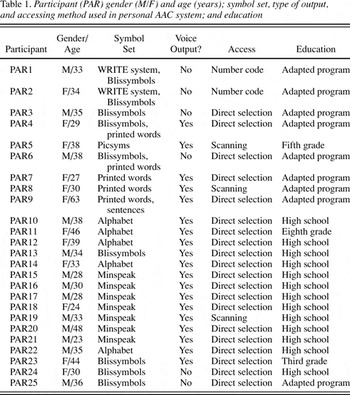
The participants were 25 adults whose native language was English and who used an AAC system for daily communication. All participants had a diagnosis of cerebral palsy and severe motor speech impairment and reported hearing and vision (or corrected vision) to be within normal limits.
Additional cognitive and linguistic criteria for participation were kept to a minimum, given that accurate assessment of these skills is difficult for individuals with severe motor impairment. Criteria were applied only to assure that participants possessed the minimum linguistic skills necessary to perform the experimental tasks. Participants who reported completion of a regular high school curriculum were assumed to possess an adequate level of skill without further testing (see Table 1). All other participants demonstrated comprehension of spoken English syntax at least equivalent to 6- to 7-year-old level (i.e., exceeding the age at which typically developing children comprehend and produce relative clauses; e.g., Crain, 1987; Crain, McKee, & Emiliani, 1990). Because language tests for older individuals that cover sentence-level syntactic comprehension are rare, the Grammatic Understanding subtest of the Test of Language Development—Primary (TOLD-P; Newcomer & Hammill, 1982) was chosen to assess comprehension level. The picture-choice response format could be adapted relatively easily for individuals with physical limitations, and the test covered the age level at which children typically acquire relative clauses.

In-depth assessment of language and communication measures (e.g., typical patterns of sentence use, types of clauses produced spontaneously, conversational skills) was not carried out with the participants. It is difficult to evaluate these skills in individuals who use AAC in ways comparable to those used with speaking individuals (Hunt Berg, 2001; Müller & Soto, 2001; Sutton & Gallagher, 1995), and the study was not designed to explore hypotheses of the relationships of these skills to the specific syntactic questions addressed. The participant description measures were selected with regard to the research questions rather than to provide a detailed or exhaustive discussion of each individual participant's language and communication skills.
Participants used a variety of AAC systems for their daily communication, including systems based on graphic symbols, the alphabet, or a combination of these, and including systems accessed by direct selection, scanning, or eyegaze encoding (see Table 1).
Materials
Photographs
The photographs depicted reversible agent–action–patient events enacted by figurines in which one of the figurines had a particular attribute. There were 16 photographs constructed by combining four pairs of people (Per-1, Per-2: girl–clown, clown–girl, boy–clown, clown–boy) with one of two reversible actions (Act: push, pull) and one of two attributes (Attr: hat, scarf).
Graphic symbol display
The displays used in the study contained nine symbols from the Picture Communication Symbols picture set (Johnson, 1981, 1985, 1992) and were mounted on a MacawIII™ programmed to speak each word as the corresponding symbol was selected. Eight of the symbols represented the elements depicted in the photographs (people, actions, attributes), and thus constituted the vocabulary used in the experimental tasks. A separate symbol for “start over” was included on the display so that participants could change symbol selections, if needed. A different random arrangement of the symbols on the display was used for each participant.
The spoken symbol labels recorded onto the MacawIII were controlled for speaker characteristics, sound quality, prosody, and loudness. All occurrences of each word were identical. One male speaker made all recordings in a sound booth. Each word was recorded one at a time, followed by a pause, onto high quality audiotape and subsequently recorded onto the MacawIII in the same square as the corresponding graphic symbol. Loudness of recording (live voice onto audiotape and taped words onto the MacawIII) was controlled by passing the audio signal through a clinical audiometer (GSI-10) set at 55 db HL (normal conversational speech level).
Participants selected symbols on the display using the methods that they employed for their personal AAC systems. The MacawIII device incorporated both direct selection and scanning as selection methods. For participants who used eyegaze to select symbols on their AAC systems, the symbols on the experimental display were arranged on distinct locations of the participants' eyegaze frames so that they could be selected directly using eyegaze. For participants who used direct selection via an infrared light pointer (not available on the MacawIII), alternate strategies were discussed individually and each participant selected an option judged to be of minimum effort and most closely resembling his or her usual method. For example, one participant, who usually employed an infrared light pointer, chose to refer to the individual symbols on the display using a number (1–9) written in each square beside the symbol. Another participant, who also usually used an infrared light pointer, chose to mount each symbol of the display temporarily on his device and to program the corresponding cell with the accompanying spoken word.
Spoken sentences
Spoken sentences corresponding to the photographs were subject and object relative clause structures in which the order of the major constituents (i.e., the content words) was identical. In subject relative sentences (SS; e.g., “The girl who pushes the clown wears a hat”) and object relative sentences (OS; e.g., “The girl pushes the clown who wears a hat”), the only difference in the sequence of words is the placement of the relative pronoun “who.” There were eight exemplars of each sentence type (SS and OS).
Tasks
Training
Training to assure that all participants were familiar and comfortable with the materials and task demands was provided prior to the experimental tasks. The training was identical to that described in Sutton et al. (2000) and included familiarization with the vocabulary, practice with sequencing symbols, and constructing utterances using the display. First, participants were asked to select each picture on the display when named by the experimenter. The Start Over key was identified and participants were told that they could use this symbol to indicate an error or if they wanted to begin their response again. All participants correctly identified all pictures on the display following the first presentation.
Second, participants were given an opportunity to practice using the display to construct a sequence of symbols. A printed row of five symbols was presented and the participant selected the symbols on the display in the same sequence as they appeared in the row. Participants could select the Start Over picture if they made a mistake or wanted to redo the sequence. Participants were required to encode eight consecutive rows correctly. Participants would have been excused from the study if this criterion were not reached within 24 trials, but all participants passed the sequencing training in less than 15 trials.
Third, practice was provided for constructing utterances using the experimental display. The participant viewed a set of four photographs that differed from each other in only one feature. For example, one practice set included the following four photographs: photo A: two girls and two clowns, one girl pushes one of the clowns and wears a hat; photo B: two girls and two clowns, one girl pushes one of the clowns and wears a scarf (no one wears a hat); photo C: two girls and two clowns, one girl pushes one of the clowns and the second girl wears a hat (the girl pushing the clown does not wear a hat); photo D: two girls and two clowns, one girl pushes one of the clowns and the clown wears a hat (the girl does not wear a hat). The experimenter described one photograph using an SS or OS relative clause sentence and pointed out how the photographs differed from each other. The experimenter then repeated the sentence and asked the participant to construct the same sentence using the display. Participants were encouraged but not required to use complete utterances (i.e., to include symbols for all the content words mentioned in the spoken sentence) and were given a chance to revise their response if desired. There were eight practice trials, four examples of SS relatives and four examples of OS relatives, presented in random order.
Sentence construction task (SCT)
This task was the same as the relative clause production task described by Sutton et al. (2000). Participants constructed sentences using the symbol display. On each trial, the experimenter showed one photograph and spoke the corresponding SS or OS sentence, and the participant was asked to make the same sentence using the graphic symbol display. Each participant received a different random ordering of the photographs and their corresponding sentences. There were eight trials each for SS and for OS sentences. The experimenter recorded the sequence of pictures selected by participants on a prepared response sheet.
Symbol-utterance interpretation task (SUIT)
This task was similar to the Comprehension Task described by Sutton et al. (2002) and permitted exploration of participants' interpretations of the potential ambiguity of symbol sequences representing SS and OS relative clause sentences. In the SUIT, the examiner, not the participant, constructed utterances by pointing to sequences of symbols on the experimental display. Participants were asked to choose one photograph (from an array of two) that best depicted the symbol utterance constructed by the experimenter. The symbol utterances were symbol sequences corresponding to the SS and OS spoken sentences described above. Recall that these spoken sentences contained the identical sequence of major constituents; the only difference between them was the placement of the relative pronoun “who.” Thus, the sequence of symbols representing only the major constituents would be identical for both SS and OS sentences. The photographs offered as response options represented the SS interpretation and the OS interpretation of the symbol sequence presented. For example, the response options for the sequence GIRL PUSH CLOWN WEAR HAT were Photograph A depicting a girl wearing a hat and pushing a clown and Photograph B depicting a girl pushing a clown and the clown wearing a hat. There were eight symbol sequences, which were constructed by combining the people, actions, and attributes (as well as the symbol for WEAR) described in the Materials section, presented twice (with each photograph on the right and on the left), for a total of 16 trials.
General procedures
Each participant was seen individually in a quiet location. The subtest of the TOLD-P was administered (if needed). The participant's means of access to the experimental tasks (i.e., selecting symbols on the experimental display) was discussed and potential alternate strategies established (if needed). The training was presented followed by the SCT and finally the SUIT. Sessions were videotaped for reliability purposes.
Response coding
Responses on the SCT were coded using procedures similar to those described by Sutton et al. (2000). First, distinctive encoding pattern (DEP) scores were calculated. For each participant, the symbol utterances constructed on the display for pairs of spoken SS/OS sentences composed of exactly the same content words were examined. The pair was scored as the same, if the participant used the identical sequence of symbols to encode both sentences of the pair, or different, if any differences were observed. For example, if a participant constructed the symbol utterance GIRL PUSH CLOWN WEAR HAT in response to the spoken sentences “The girl pushes the clown who wears a hat” and “The girl who pushes the clown wears a hat,” this pair would be scored as “same.” However, if the same participant constructed the symbol utterance GIRL PUSH CLOWN HAT in response to the spoken sentence “The girl pushes the clown who wears a hat” and GIRL HAT PUSH CLOWN in response to the spoken sentence “The girl who pushes the clown wears a hat,” this pair would be scored as “different.” A cutoff score of at least 6/8 (i.e., 75%) was established to classify participants who consistently demonstrated a DEP (+DEP participants) and those who did not (−DEP participants).
Second, word order patterns in the symbol utterances were classified and coded according to categories developed by Sutton et al. (2000). Additional categories were added as required by the data obtained. The frequency of use of each type of word order pattern was calculated for each participant for SS and OS sentences.
Third, frequencies of choice of SS and OS photographs on the SUIT were calculated for each participant. An individual participant's response pattern was classified as SS if the participant selected the SS photograph on more than 80% of trials (n=8), OS if the participant selected the OS photograph on more than 80% of trials, or no preference (NP) if he or she selected the SS or OS photograph on 25–75% of trials.
Reliability
Reliability was assessed on 40% of the data on the SCT for coding of responses and word order patterns, and on 40% of the data on the SUIT for photograph selection. The judgments of a second trained examiner who viewed the videotaped sessions and independently recorded and coded responses were compared with those made by the original examiner. Interjudge agreement was 100% for response recording, 93% for word order pattern assignment (SCT), and 100% for photograph selection (SUIT).
RESULTS
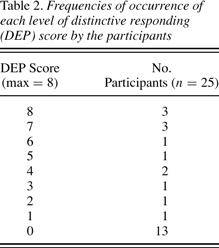
DEP scores among the participants covered the entire scale (see Table 2), ranging from 0 (use of exactly the same word order for SS and OS sentences) to 8 (consistent use of different word orders for SS and OS sentences). Six participants' DEP scores were 6 or greater (i.e., 75% or greater use of a DEP). These participants were considered to have responded distinctively and were classified as the +DEP participants. The remaining 19 participants constructed different word orders on fewer than 63% of SS and OS sentence pairs, including 13 participants whose scores were 0. These 19 participants were considered not to have responded distinctively and were classified as the –DEP participants.

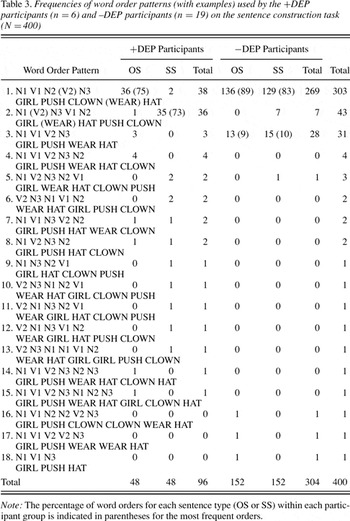
The participants used a total of 18 different word order patterns (see Table 3). The large majority of symbol utterances were the same word order: N1 V1 N2 (V2) N3 (Word Order 1). This response pattern occurred on 303 trials (N=400) and accounted for over 75% of all responses across participant groups (+DEP and –DEP) and sentence types (SS and OS; see Table 3). Word Order 1 most closely resembles English word order, because it contains the major constituents in the sequence in which they were spoken by the examiner. However, it does not reflect the difference in structure or meaning between SS and OS sentences, signaled in spoken English by grammatical markers.

Among the remaining word orders, all of which occurred considerably less frequently than Word Order 1, two were observed somewhat more frequently than the rest. These were N1 (V2) N3 V1 N2 (Word Order 2), used on a total of 43 trials, and N1 V1 V2 N3 (Word Order 3), used on a total of 31 trials. Word Orders 2 and 3 together represent 18.5% of all responses (n=400). The remaining 15 word orders were each observed rarely. Word Orders 4 and 5 occurred on a total of four and three trials, respectively (N=400). Four Word Orders (6–9) were each used on two trials, and nine word orders (10–18) were each used on only one trial (i.e., once by one participant). Together, these 15 rare word orders accounted for less than 6% of the data.
Different patterns of word order use were observed across the two participant groups (+DEP and –DEP), both in terms of the primary data patterns and in terms of use of less frequently occurring word orders. Among the +DEP participants, Word Order 1 occurred for 75% of responses for OS sentences (n=48), but for only 4% of responses for SS sentences (n=48; see Table 3). Word Order 2 occurred for 73% of responses for SS sentences but for only 2% of responses for OS sentences. The use of Word Order 1 for OS sentences and Word Order 2 for SS sentences was clearly the predominant response pattern for the +DEP participants. Among the –DEP participants, in contrast, Word Order 1 occurred for a high percentage of both OS and SS responses: 89% (n=152) and 84% (n=152), respectively. The use of Word Order 1 for both OS and SS responses was clearly the predominant pattern for the –DEP participants.
The +DEP and –DEP participants also differed in the broader distribution of responses across various, if infrequently used, word order patterns. The +DEP participants used a total of seven word orders other than Word Order 1 for OS sentences (25%) and a total of 10 word orders other than Word Order 2 for SS sentences (27%). The use of a broad range of orders may reflect the effort by these participants to find a way to distinguish the two sentence types.
For the –DEP participants, the less frequent responses patterns were distributed across only 3 (SS) or 4 (OS) different word orders. Word Order 3 was used for 9 and 10% of OS and SS responses, respectively, and Word Order 2 was used for 5% of SS responses (but 0% of OS responses). The remaining infrequently used word orders among the –DEP participants were 15, 16, and 17 for OS sentences (a total of 3%), and 5 (only one response by one participant) for SS sentences. The use of word orders other than Word Order 1 by this group did not contribute to a distinction between the sentence types, and thus, may have been motivated by other factors such as ease of production.
Individual response patterns were examined to determine whether the group data patterns noted above were also reflective of overall individual performance. The individual data could show a pattern similar to that of the group (i.e., one word order used predominantly and infrequent use of other orders by each participant), or they could show consistent use of a few patterns by most participants and variable use of other patterns by only a few participants. Further, individual patterns may or may not differ for SS and for OS sentences. Consistent use was defined as use of a single word order pattern on more than 85% (i.e., ≥7/8) of trials for each sentence type (SS and OS).
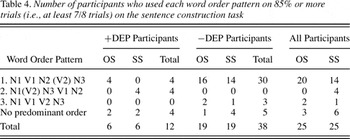
Most of the 25 participants used a consistent word order for SS sentences (19 participants) and for OS sentences (22 participants; see Table 4). Among the 18 word orders noted above within all of the data, only three patterns were used consistently (more than 85% of trials) on an individual basis: Word Orders 1, 2, and 3 (see Table 4). Further, although both the +DEP and –DEP participants used Word Order 1, consistent use of Word Orders 2 and 3 was limited to one participant group. Only +DEP participants used Word Order 2 consistently and only –DEP participants used Word Order 3 consistently (see Table 4).

The individual data patterns were similar to those observed within the group data. The majority of the participants used a single word order consistently for each of the two sentence types (SS and OS). Most +DEP participants (4/6) used Word Order 1 and Word Order 2 (OS and SS, respectively). In contrast, –DEP participants tended to use Word Order 1 for both SS and OS sentences (13/19). Only one other Word Order (3) was used consistently, and only by two –DEP participants.
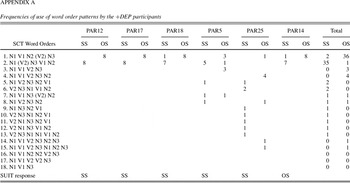
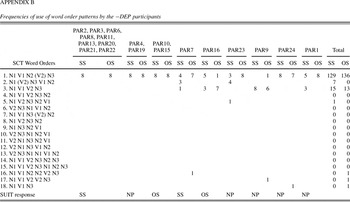
Further examination of the individual data within the +DEP and –DEP participant groups suggested the possibility of two different patterns of responding within each group (see Appendixes A and B). Within the +DEP participant group, four participants used only two word orders (1 and 2). In contrast, a single +DEP participant (PAR25) used a total of 12 different word orders across SS and OS sentences and was the only participant to produce nine of the very low frequency word orders (see Appendix A). A second +DEP participant (PAR5) used a total of six different orders, four for SS and four for OS sentences (two word orders overlapped for one trial of each sentence type). Within the –DEP group, 13 participants used Word Order 1 consistently for both SS and OS sentences (see Appendix B). The remaining 6 –DEP participants, on the other hand, did not directly reproduce the spoken word order: they used a variety of different orders but nonetheless did not consistently distinguish SS and OS sentences in their graphic symbol utterances. They may have attempted to distinguish the sentence types but used word order strategies that were not successful.
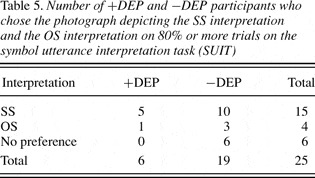
On the SUIT, most participants (19/25) consistently chose one interpretation: SS for 15 participants, and OS for 4 participants. Thus, there seems to be a preference or bias toward assigning the attribute (hat or scarf) to the agent of the action, as if the potentially ambiguous order represented an SS rather than OS relative clause sentence structure. The individual data on the SUIT were examined together with the individual SCT data to explore whether a relationship existed between the response patterns on the two measures, specifically, distinctiveness and consistency of responding on the SCT and consistency of response choice on the SUIT (see Appendixes A and B). All of the +DEP participants responded consistently on the SUIT: most (5/6) chose the SS interpretation and only one chose the OS interpretation. Three types of patterns of SCT and SUIT responses were identified in the +DEP participant group. First, three participants who consistently chose the SS interpretation on the SUIT also distinctively encoded SS and OS sentences on the SCT using Word Orders 1 and 2. This finding is somewhat surprising because these participants used the word order presented on the SUIT to encode OS sentences exclusively, not SS sentences. These three participants, therefore, produced Word Order 1 to encode OS sentences but, as listeners, assigned an SS interpretation to exactly the same word order. Second, one +DEP participant consistently used Word Order 1 for SS sentences and Word Order 2 on the SCT (thus encoding them distinctively), and also chose the OS interpretation on the SUIT (i.e., the interpretation congruent with the production pattern). Third, three +DEP participants used Word Order 1 to encode OS sentences on the SCT but interpreted the same order as an SS sentence on the SUIT. They may have recognized that an alternative canonical order was available for SS sentences, but not for OS sentences, or they may have seen the advantage of placing the attribute in proximity to the constituent it modified. If a preference exists toward an SS interpretation of the potentially ambiguous word order presented on the SUIT, the one participant who preferred the OS interpretation may well have overcome the SS bias twice: first, on the production task in order to use distinctive orders (i.e., using this SUIT order for OS sentences only), and second, on the interpretation task in order to maintain consistency with his responses on the production task.
Among the –DEP participants, over two-thirds (13/19) responded consistently on the SUIT and they also favored the SS interpretation (10/13 participants; see Table 5). However, almost one third (6/19; in contrast to none of the +DEP participants) showed no preference (NP). Among the 14 –DEP participants who demonstrated consistent use of Word Order 1 on the SCT, the majority (9/14) also consistently chose the SS interpretation on the SUIT (see Table 5). This finding is also surprising because these participants used a single word order, Word Order 1, to describe both SS and OS photographs on the SCT but did not interpret the same word order as applying to both SS and OS photographs on the SUIT. This may indicate a preference for the SS reading, together with the recognition that both OS and SS readings are possible.

Although no definitive relationships could be established between response patterns on the SCT and the SUIT across participant groups, these results suggested that participants who responded consistently, whether distinctively or not (3/4 +DEP and 9/14 –DEP participants), on the SCT tended to favor the SS interpretation on the SUIT. Further, the NP response pattern on the SUIT was observed only among the –DEP participants, equally frequently among those who responded consistently and inconsistently on the SCT. The OS interpretation was infrequently chosen across participant groups, even though the order of graphic symbols presented was identical to Word Order 1, the most frequent order used to encode OS relative clauses on the SCT, across participant groups.
DISCUSSION
Opportunities to observe complex utterance construction by individuals who use AAC systems are rare. In naturalistic settings, listeners are likely to interpret the individual's utterances before completion, and thus, before a multiclause structure can be encoded. We provide an initial investigation of complex utterance construction by individuals who use AAC. The specific task developed allowed us to consider not only whether and how these individuals encode complex syntactic structures, but also how they resolve the ambiguity generated by syntactic structures that are distinguished only by grammatical elements not available on the AAC system. Specifically, we asked participants, who are individuals who use AAC for daily communication, to encode SS and OS relative clauses in English that differed only in the placement of the relative pronoun “who” (“The girl who pushes the clown wears a hat.” vs. “The girl pushes the clown who wears a hat.”).
The most fundamental finding of the study was that all participants produced graphic symbol utterances that encoded two predicates. Further, an important and rather surprising result was that only a minority of participants encoded SS and OS relative clauses with distinctive structures. The majority (19/25) of the participants used the same word order(s) for both SS and OS sentences. It would be premature to conclude that these participants were unaware that the two types of sentences were different. In fact, most of these participants associated the word order they used for both SS and OS sentences on the production task consistently with a single interpretation (SS for 10 participants and OS for three participants) on the sentence interpretation task. Thus, the word order used most frequently by these participants appeared to have a preferred interpretation, even though they used it to encode two types of sentences. This suggests that these participants were aware that a distinction existed but nonetheless did not mark this distinction in their own productions.
Although it is not clear from the data obtained why the majority of participants did not construct different word orders on the graphic symbol display for SS and OS sentences, explanations of this finding can be proposed based on effort, communication pressure, and expectations that the listener would be able to interpret the utterances appropriately. First, these participants may simply have copied the word order of the spoken sentences, without making an effort to mark the syntactic distinction they presented. They may have recognized the distinction but may simply have chosen not to encode it in their own productions. Second, the fact that a single photograph was shown along with each spoken sentence meant that a clear, distinctive description of the photo was not necessary in order to identify it accurately. The pragmatic demands of future experimental tasks will need to be greater to ensure that participants feel compelled to mark the distinction. In the context of the current task, these participants may have considered the word orders they used as equally acceptable ways to convey the desired message, or even that the experimenters wanted them to use English word order. Third, the results may be an indication that individuals who use AAC expect interlocutors to determine distinctions in meaning when the English syntactic structure is ambiguous due to the absence of grammatical markers. In other words, interlocutors may be more successful in identifying the intended meaning when an ambiguous English syntactic structure is used than when an alternative, unambiguous, but atypical, structure is used.
The use of atypical and agrammatical syntactic structures by individuals who use AAC during spontaneous interaction is well documented (Bruno, 1989; Kelford Smith, Thurston, Light, Parners & O'Keefe, 1989; Kraat, 1991; Smith, 1996; Soto & Toro–Zambrana, 1995; Sutton, 1989; Udwin & Yule, 1990). In the current study, we purposely structured the task in such a way that the use of the target English word order would lead to ambiguous utterances. In a sense, then, the task was structured to encourage the use of atypical structures. The predominant use of the target English word order within this context may be an indication that for participants in this study, who all had a high level of English proficiency, the use of English syntax in and of itself was important. Individuals who use AAC may function under similar sociolinguistic pressures as speakers of minority languages who gain social status through their proficiency in the majority language.
Although it occurred less frequently, it is important to note that some participants did distinctively encode the potentially ambiguous complex syntactic structures in the production task. Typically, these adults distinguished the structures by producing word orders that took advantage of constituent proximity in the sequence of constituents, by placing the attribute (HAT or SCARF) next to the person wearing it. One of these word orders (Word Order 1, see Table 3) reflected the word order of the major constituents in the target English sentences. In the other word order (Word Order 2, see Table 3), the attribute was moved from its original position to be placed in closer proximity to the person to whom it applied. It is interesting that both of these word orders reflected possible English word orders (e.g., “The girl who pushes the clown wears a hat” and “The girl who wears a hat pushes the clown.”). From the current data, we cannot determine whether the use of Word Order 2 was motivated by a strategy of constituent proximity or by the participants' knowledge of an alternative English word order to encode SS relative clauses. This issue deserves further investigation because constituent proximity is a strategy used by speaking participants to interpret AAC utterances that do not conform to English syntax (Sutton et al., 2002). Only two participants distinguished SS and OS structures by using a variety of word orders that did not reflect possible English constructions (see Table 3). This finding suggests that individuals who use AAC and who have proficient knowledge of English may use canonical structures (i.e., those most typical of the language) when they are available to mark distinctions in meaning. Only two participants actually created novel ways of marking the distinction between the SS and OS spoken sentences.
Interpretation of the most frequent graphic symbol sequence used for both SS and OS relative clauses on the production task revealed a strong preference to comprehend this sequence (Word Order 1) as an SS relative clause. Over half of the participants (15/25) preferred the SS interpretation, whether or not they responded distinctively or consistently in production. Within the context of this study, the preference for the SS interpretation may seem surprising. Using the vocabulary in the production task, there are two possible word orders to indicate an SS relative in English: GIRL (WEAR) HAT PUSH CLOWN and GIRL PUSH CLOWN (WEAR) HAT. In contrast, only one order can be used for an OS relative: GIRL PUSH CLOWN (WEAR) HAT. This order is identical to the second of the two possible word orders for the SS relative. Thus, an interpretation strategy based on maintaining a distinction between SS and OS sentences without grammatical markers would favor the OS interpretation, because there would be no other way to encode an OS relative and an alternative for encoding an SS relative exists: GIRL (WEAR) HAT PUSH CLOWN. However, this was not the approach adopted by the majority of the participants in the study. Instead, their interpretation of the graphic symbol sequences follows predictions derived from spoken language comprehension processes. Specifically, Traxler, Morris, and Seely (2002) found that object relative clauses were more difficult to process than subject relative clauses. This difficulty is mediated if the first noun phrase is inanimate. This pattern of results suggests that the reason participants were slower to process object relative clauses was that they initially interpreted them as subject relative clauses, that is, they assumed that the animate noun phrase was the subject of both the primary and the dependent clauses (Traxler et al., 2002). Participants in the current study also most often assigned the first noun phrase the role of subject for both clauses. However, because there were no grammatical markers to distinguish subject and object relative clauses, the subject relative clause reading was maintained. The production and comprehension results as a whole suggest that the relationship between the word orders an individual produces in graphic symbol utterances and the way he or she interprets the same word orders are not necessarily straightforward.
Finally, the results of this experiment demonstrate that even in a highly structured task environment, there are enormous individual differences in the way that individuals who use AAC systems encode complex propositions from English into graphic-symbol utterances. Indeed, the results are a strong indicator that individuals who use AAC systems do not constitute a single population. Although a majority of the participants used a consistent strategy for utterance producing and interpreting graphic symbol utterances in the two tasks, the patterns within and across the tasks differed substantially across participants. The variability in performance is particularly interesting when compared to the performance of speaking participants with no prior experience using AAC systems reported in Sutton et al. (2000). These participants formed a bimodal distribution with a great deal of uniformity within each cluster of participants. Seventy-nine percent of participants (n=43) distinguished between SS and OS relative clauses using two parallel utterance structures (Word Orders 1 and 2 of the current study), whereas 16% did not distinguish between SS and OS relative clauses and always used exactly the same utterance structure (Word Order 1 of the current study). Only two participants were inconsistent in their response patterns, but even they produced one utterance structure consistently to encode SS relatives, and used a variety of patterns to encode the OS relatives, thus maintaining a distinction between the two sentence types. The two primary patterns observed by Sutton et al. (2000) were also observed in the current study, but the frequency of occurrence was reversed. Sixteen percent of participants (n=25) in this study distinguished SS and OS relative clauses using two parallel utterance structures, in contrast to 56% percent who used the same utterance structure across the task, marking no distinction between SS and OS relative clauses. However, almost one-third of the participants in the present study did not follow either of these two patterns or any other recognizable pattern. These participants appeared to employ idiosyncratic strategies for encoding the spoken stimulus sentences.
Further research will be needed to explore possible explanations of the greater variability in message construction by individuals who use AAC systems for daily communication when compared to AAC system use by speaking participants. In addition to investigating the specific utterances that individuals who use AAC systems produce, there is a need to relate individual characteristics and AAC experiences to performance in order to understand how to account for the variability between individuals. A similar trend in spoken language acquisition research is currently underway (e.g., Lieven, 1997). Given that some aspects of the communication process are very different when using AAC and when using spoken language, some factors related to individual differences among AAC users may be similar to those involved for speakers while other factors may operate differently in the two groups. For example, individual AAC users and their usual communication partners may work out idiosyncratic strategies for dealing with issues such as the reduced rate of message transmission or limited available vocabulary during their interactions. Further, the magnitude of differences in language experiences developmentally for children needing AAC systems and for children with typical speech acquisition that have been proposed in the literature could be taken to suggest that individual differences in early experiences of children needing AAC (e.g., type of intervention, interaction style of early communication partners, expectations for participation in communication) could result in differences in the ways they may learn to resolve linguistic challenges.
By complementing experimental studies with analyses of dense observational databases, both individual paths of acquisition and their parallels can be determined. A greater understanding of the processes involved in language acquisition in atypical contexts, such as that experienced by children needing AAC systems, will lead to improved intervention strategies to foster language development so that these children can benefit fully from their language learning experiences.
APPENDIX A

APPENDIX B

ACKNOWLEDGMENTS
The authors wish to thank all the participants. This study, which was conducted while the first (A.E.) and third (T.M.G.) authors were in the School of Communication Sciences and Disorders, McGill University, Montreal, Canada, was funded by the Social Sciences and Humanities Research Council of Canada.
References
Beukelman D., &
Mirenda P.
1998.
Augmentative and alternative communication: Management of severe communication disorders in children and adults
(2nd Ed.).
Baltimore:
Brookes.
Blockberger S., &
Sutton A.
2003.
Towards linguistic competence: The language experiences and knowledge of children with extremely limited speech. In
J. Light,
D. Beukelman, &
J. Reichle (Eds.),
Communicative competence for individuals who use AAC.
Baltimore, MD:
Brookes.
Boysson–Bardies B. de
1999.
Comment la parole vient aux enfants.
Paris:
Éditions Odile Jacob.
Bruner J.
1975.
From communication to language: A psychological perspective.
Cognition, 3,
255–288.Google Scholar
Bruno J.
1989.
Customizing a Minspeak vocabulary for a preliterate child: A case example.
Augmentative and Alternative Communication, 5,
89–100.
Chapman R.
1992.
Processes in language acquisition and disorders.
St. Louis:
Mosby.
Chomsky N.
1986.
Knowledge of language: Its nature, origin, and use.
New York:
Praeger.
Crain S.
1987.
On performability: Structure and process in language understanding.
Clinical Linguistics and Phonetics,
1,
127–
145.Google Scholar
Crain S.,
McKee C., &
Emiliani M.
1990.
Visiting relatives in Italy. In
J. deVilliers &
L. Frazier (Eds.).
Language processing and language acquisition
(pp. 335–356).
Dordrecht:
Reidel.
Crain S., &
Thornton R.
1998.
Investigations in universal grammar.
Cambridge:
MIT Press.
Gerber S., &
Kraat A.
1992.
Use of a developmental model of language acquisition: Applications to children using AAC systems.
Augmentative and Alternative Communication,
8,
19–
32.Google Scholar
Hunt Berg M.
2001.
Exploring CHILDES for multi-modal transcription in augmentative and alternative communication. In
S. von Tetzchner &
J. Clibbens (Eds.),
Understanding the theoretical and methodological bases of augmentative and alternative communication
(pp. 42–51).
Toronto:
ISAAC.
Johnson R.
1981.
The Picture Communication Symbols.
Solana Beach, CA:
Mayer–Johnson.
Johnson R.
1985.
The Picture Communication Symbols—Book II.
Solana Beach, CA:
Mayer–Johnson.
Johnson R.
1992.
The Picture Communication Symbols—Book III.
Solana Beach, CA:
Mayer–Johnson.
Kelford Smith A.,
Thurston S.,
Light J.,
Parners P., &
O'Keefe B.
1989.
The form and use of written communication produced by physically disabled individuals using microcomputers.
Augmentative and Alternative Communication,
5,
115–
124.Google Scholar
Kraat A.
1985.
Communication interaction between aided and natural speaker: A state of the art report.
Toronto:
Canadian Rehabilitation Council for the Disabled.
Kraat A.
1991.
Methodological issues in the study of language development among children using aided language: Reactant paper 1. In
J. Bordin &
E. Björck–Åkesson (Eds.), Methodological issues in research in augmentative and alternative communication
(pp. 118–123).
Vällingby:
Swedish Handicap Institute.
Liberman A., &
Mattingly I.
1985.
The motor theory of speech perception revised.
Cognition,
1,
1–
36.Google Scholar
Liberman A., &
Mattingly I.
1989.
A specialization for speech perception.
Science,
243,
489–
494.Google Scholar
Lieven E.
1997.
Variation in a cross-linguistic context. In
D. I. Slobin (Ed.),
The cross-linguistic study of language acquisition
(Vol. 5, pp. 199–263).
Mahwah, NJ:
Erlbaum.
Light J.,
Collier B., &
Parnes P.
1985.
Communicative interaction between young nonspeaking physically disabled children and their primary caregivers: Part 1—Disourse patterns.
Augmentative and Alternative Communication, 1,
74–
83.Google Scholar
Locke J., &
Pearson D.
1990,
Linguistic significance of babbling: Evidence from a tracheostomized infant.
Journal of Child Language,
17,
1–
16.Google Scholar
Müller E., &
Soto G.
2001.
Capturing the complexity of aided interactions: A conversation analysis perspective. In
S. von Tetzchner &
J. Clibbens (Eds.),
Understanding the theoretical and methodological bases of augmentative and alternative communication
(pp. 64–83).
Toronto:
ISAAC.
Nakamura K.,
Newell A. F.,
Alm N., &
Waller A. C.
1998.
How do members of different language communities compose sentences with a picture-based communication system? A cross-cultural study of picture-based sentences constructed by English and Japanese speakers.
Augmentative and Alternative Communication,
14,
71–
80.Google Scholar
Nelson N.
1992.
Performance is the prize: Language competence and performance among AAC users.
Augmentative and Alternative Communication,
8,
3–
18.Google Scholar
Newcomer P., &
Hammill D.
1982.
Test of Language Development—Primary.
Austin, TX:
PRO-ED.
Nuyts,
1992.
Aspects of a cognitive–pragmatic theory of language.
Amsterdam:
Benjamins.
Peters A., &
Menn L.
1993.
False starts and filler syllables: Ways to learn grammatical morphemes.
Language,
69,
742–
777.CrossRefGoogle Scholar
Smith M.
1996.
The medium or the message: A study of speaking children using communication boards. In
S. von Tetzchner &
M. H. Jensen (Eds.),
Augmentative and alternative communication: European perspectives
(pp. 119–136).
London:
Whurr.
Smith M., &
Grove N.
1999.
The bimodal situation of children learning language using manual and graphic signs. In
F. Loncke,
J. Clibbens, &
L. Lloyd (Eds.),
New directions in AAC: Research and practice
(pp. 9–30).
London:
Whurr.
Snow C.
1999.
Social perspectives on the emergence of language. In
B. MacWhinney (Ed.),
The emergence of language
(pp. 257–276).
Mahwah, NJ:
Erlbaum.
Soto G.
1997.
Multi-unit utterances and syntax in graphic symbol communication. In
E. Björck–Åkesson &
P. Lindsay (Eds.),
Communication … naturally: Theoretical and methological issues in augmentative and alternative communication
(pp. 26–32).
Västerås, Sweden:
Mälardalen University Press.
Soto G.
1999.
Understanding the impact of graphic sign use on the message structure characteristics of individuals with severe speech impairments. In
F. Loncke,
J. Clibbens, &
L. Lloyd (Eds.),
New directions in AAC: Research and practice
(pp. 40–48).
London:
Whurr.
Soto G., &
Toro–Zambrana W.
1995.
Investigation of Blissymbol use from a language research paradigm.
Augmentative and Alternative Communication,
11,
118–
130.Google Scholar
Studdert–Kennedy M.
1991.
A note on linguistic nativism. In
R. Hoffman &
D. Palermo (Eds.),
Cognition and the symbolic processes: Applied and ecological perspectives
(pp. 39–58).
Hillsdale, NJ:
Erlbaum.
Sutton A.
1989.
The social–verbal competence of AAC users.
Augmentative and Alternative Communication,
5,
150–
164.Google Scholar
Sutton A., &
Gallagher T.
1995.
Comprehensive assessment of a child using an AAC system: A comparison of two techniques.
American Journal of Speech–Language Pathology,
4,
60–
68.Google Scholar
Sutton A.,
Gallagher T.,
Morford J., &
Shahnaz N.
2000.
Relative clause sentence production using AAC systems.
Applied Psycholinguistics,
21,
473–
486.Google Scholar
Sutton A.,
Gallagher T.,
Morford J., &
Shahnaz N.
2002.
Interpretation of graphic symbol utterances.
Augmentative and Alternative Communication,
18,
205–
213.Google Scholar
Sutton A., &
Morford J.
1998.
Constituent order in picture pointing sequences produced by speaking children using AAC.
Applied Psycholinguistics,
191,
525–
536.Google Scholar
Sutton A.,
Soto G., &
Blockberger S.
2002.
Grammatical issues in graphic symbol communication.
Augmentative and Alternative Communication,
18,
192–
204.Google Scholar
Tomasello M., &
Brooks P.
1999.
Early syntactic development: A constructionist grammar approach. In
M. Barrett (Ed.),
The development of language
(pp. 161–190).
East Sussex, UK:
Psychology Press.
Traxler M. J.,
Morris R. K., &
Seely R. E.
2002.
Processing subject and object relative clauses: Evidence from eye movements.
Journal of Memory & Language,
47,
69–
90.Google Scholar
Udwin O., &
Yule W.
1990.
Augmentative communication systems taught to cerebral palsied children—A longitudinal study: I. The acquisition of signs and symbols, and syntactic aspects of their use over time.
British Journal of Disorders of Communication,
25,
195–
309.Google Scholar
van Balkom H.
1998,
August.
Enhancing natural language compensation (NLC) through augmentative communication.
Paper presented at the International Society for Augmentative and Alternative Communication (ISAAC), Dublin.
van Balkom H., &
Welle Donker–Gimbrère M.
1996.
A psycholinguistic approach to graphic language use. In
S. von Tetzchner &
M. H. Jensen (Eds.),
Augmentative and alternative communication: European perspectives (pp. 153–170).
London:
Whurr.
von Tetzchner S.
2000.
Introduction to augmentative and alternative communication
(2nd ed.).
London:
Whurr.
von Tetzchner S., &
Martinsen H.
1996.
Words and strategies: Communicating with young children who use aided language. In
S. von Tetzchner &
M. H. Jensen (Eds.),
Augmentative and alternative communication: European perspectives (pp. 65–88).
London:
Whurr.
Participant (PAR) gender (M/F) and age (years); symbol set, type of output, and accessing method used in personal AAC system; and education
Frequencies of occurrence of each level of distinctive responding (DEP) score by the participants
Frequencies of word order patterns (with examples) used by the +DEP participants (n=6) and –DEP participants (n=19) on the sentence construction task (N=400)
Number of participants who used each word order pattern on 85% or more trials (i.e., at least 7/8 trials) on the sentence construction task
Number of +DEP and −DEP participants who chose the photograph depicting the SS interpretation and the OS interpretation on 80% or more trials on the symbol utterance interpretation task (SUIT)
Frequencies of use of word order patterns by the +DEP participants
Frequencies of use of word order patterns by the −DEP participants
 You have
Access
- 10
- Cited by