My talk honors the contribution of Ithiel de Sola Pool to empirical political theory, a field pioneered by Pool, David Easton, and Gabriel Almond, inter alia. Pool's Reference Pool1967 edited volume, Contemporary Political Science: Toward Empirical Theory illustrates some of the important early works in this field, a field designed to generate political theory from the systematic examination of empirical data. To demonstrate the kind of work Pool developed, I begin my talk by suggesting what studying altruism and genocide taught me about broader themes in political, social, and moral theory. I then suggest how I developed a new theory of moral choice in order to explain the surprising finding that identity trumped choice for all the participants I interviewed about their actions during the Holocaust and World War II, from Nazis and bystanders to rescuers of Jews.Footnote 1 This paper thus summarizes the highlights of the 2010 Pool Lecture to provide a few illustrations of the empirical findings that led me to develop an identity-based theory of moral choice.
EMPIRICAL WORK AS FOUNDATION FOR THEORY
The Heart of Altruism: Portraits of a Common Humanity (Monroe Reference Monroe1996) presented results from survey and narrative interviews with entrepreneurs, philanthropists, heroes, and rescuers of Jews during the Holocaust. Findings suggested altruism is explained not by traditional demographic forces—such as religion, education, gender, or other sociodemographic characteristics—or from theories based on self-interest, such as cost-benefit analysis, rational choice theory or evolutionary biological explanations stressing kin selection or group selection. Instead, psychological factors, especially identity and sense of self in relation to others proved critical. The Hand of Compassion: Moral Choice during the Holocaust (Monroe Reference Monroe2004) made a closer examination of rescuers or Jews to ask about the more precise nature of the psychological process underlying altruism. It treated altruism as an analytical lens to lend insight into moral and ethical issues and found identity trumps choice. How we see ourselves in relation to others sets and delineates the range of acts we find available, not just morally but empirically. Ethics in an Age of Terror and Genocide (Princeton University Press, forthcoming) asked whether the ethical framework found among rescuers has an analogue for other people. In other words, are all people as constrained by their identities as rescuers are, and, if so, what constitutes the critical contours in an underlying ethical framework we all might possess?
IDENTITY SETS AND CONSTRAINS CHOICE
Using a respondent-driven snowball sample, I interviewed over 100 people who lived through World War II and categorized them into bystanders, rescuers, or Nazi supporters. Some interviews served only as background, with respondents asking not to be described, only quoted; other interviews were formal and were transcribed and served as text for analysis by independent coders. Results from these interviews suggested that self-image and identity—especially our sense of self in relation to others and the way we view ourselves in relation to the world—set and delineate the range of choice options we find available, not just morally but cognitively. People's worldview determined whether they saw themselves as people who could help or as people who were helpless observers of political events, under threat and fighting for their very existence. Core values integrated into the speakers' sense of self created canonical expectations about what kind of behavior they believed normal and appropriate. A sense of moral salience moved rescuers beyond mere sympathy for the suffering of others to create a moral imperative to act. It was the speakers' cognitive categorization system that established a critical relationship between “the other,” moving individuals in need into a classification of someone “just like us” or reducing them to strangers perceived as different, threatening, or even people considered beyond the boundaries of the community of concern. Overall, these findings suggest psychological dehumanization is a prerequisite for genocidal aggression and show how the moral psychology works through the reclassification of “the other” to determine our response to another's suffering.
Let me now present several illustrations of these findings and then suggest how I used these findings on the psychology surrounding genocide to develop a broader theory of moral choice, one applicable to other forms of ethnic, religious, racial, and sectarian prejudice, aggression, and violence.
EMPIRICAL DIFFERENCES BETWEEN RESCUERS, BYSTANDERS AND NAZI SUPPORTERS: COGNITIVE CATEGORIZATION, IDEALIZED COGNITIVE MODELS, AND AGENCY
Interestingly, all participants interviewed emphasized the importance of identity. Surprisingly, no one spoke of any kind of agonistic choice.
Survivors noted of rescuers: “These were not people making choices on reflection. They just had to do it because that's the kind of people they were” (Tanay Reference Tanay, Rittner and Meyers1986). Rescuers themselves explained their behavior through reference to identity, revealing a strikingly similar sense of how they saw themselves in relation to others. Indeed, rescuer after rescuer used such similar phrases that it became a kind of leitmotif. “But what else could I do?” they would ask when probed on why they risked their lives for strangers. “They were human beings, like you and me.” This linking of identity with choice was conspicuous and focused on a categorization system in which all people—rescuer, Nazi, and Nazi victims—were classed as human beings who were similar not different.
Tony (rescuer): We all are like cells of a community that is very important. Not America. I mean the human race…. Every other person is basically you. You should always treat people as though it is you. That goes for evil Nazis as well as for Jewish friends who are in trouble.
For rescuers like Tony, all human beings—even “evil Nazis” are classed in the same category. All rescuers expressed this sense of being people strongly connected to others via bonds of a common humanity, bonds which then led to a sense of moral salience, the feeling that another's suffering was relevant for them, that it demanded action to help, not just generalized feelings of sympathy or concern. This moral salience foreclosed other options. Not helping was simply not imaginable for rescuers. Rescuers' moral life was complex, and their sense of who they were might be highly related to duty for one person, to role models, socialization, or religion for another. Sometimes, I even found what seemed an innate predisposition to do good. All of these factors were mentioned by different rescuers as explanations for their behavior. But what was not mentioned was choice.
Bystanders expressed a similar lack of choice but articulated none of the sense of moral salience found among rescuers. Tony's cousin Beatrix reflects the bystander self-image: passive, with a low sense of agency in which the speaker describes herself as helpless, low in efficacy, and fatalistic. Beatrix has no choice because she has no ability to help. The bystander refrain was: “But what else could I do? I was alone against the Nazis.” The same lack of choice, but vastly different perceptions of themselves in relation to others and enormously different behavior. This lack of choice I found a startling omission. The link between lack of agency and choice was clear in the bystanders' protestations that they did not know anything about what was going on during the war, as demonstrated in the following exchange with Beatrix, Tony's bystander cousin:
Q. Did you know about the concentration camps during the war?
Beatrix: Yes.
Q. Did you know that the Jews were being gassed?
Beatrix: Yes. I can't tell you who told this, but my husband heard a lot …
Q. How did you react?
Beatrix: You couldn't do anything.
Q. There was nothing you could do.
Beatrix: No. No…. [Long pause]You could not do anything.
Another interviewee was a German I call Kurt. Kurt was drafted into service and said he did not like the Nazis, yet explained how he had to fight for them anyway. Why? Because he had no choice.
Q. Do you have a feeling that you were caught up in history? You keep mentioning these other things repeating themselves …
[Kurt became agitated and interrupted.]
Kurt: Ya. Why do we do this again?
Q. But I'm hearing … a kind of futility at doing it again and yet you kept on doing it. Does it never occur to you?
[Kurt interrupted, with some vehemence.]
Kurt: Ya. Can I change this? I have no power to change this!
Certainly, there is much objective evidence to suggest why Kurt might have had to fight for the fatherland, but—significantly—Kurt did not mention these. Instead, his explanation stressed forces beyond his ability to influence, such as the winds of history; he did not mention the Gestapo or specific retaliation or even fear. This view is shared with Nazi supporters, including a Dutchman who wrote propaganda for the Nazis and was an enthusiastic member of the party during the war.
Q. Did you know much about what went on with the Jews?
Fritz (Nazi Propagandist): Not much…. I did know that there were concentration camps. But I didn't know what was happening there. You stick your head in the sand, like an ostrich.
Q. You stuck your head in the sand.
Fritz: Yes, I must say now.
Q. You didn't really want to know about it?
Fritz: No.
Q. You never thought about helping anybody or trying to hide anyone?
Fritz: I hadn't the possibility to help people. I didn't see the need of it at that time. I didn't know what was happening.
This link between not knowing—whether the ignorance was carefully cultivated or subconscious in origin—and not helping was evident for many Nazi supporters and bystanders that I interviewed. The importance of this link has been noted before, by survivor Primo Levi, among others: “Shutting his mouth, his eyes and his ears, he [the average German] built for himself the illusion of not knowing, hence not being an accomplice to the things taking place in front of his very door” (Levi Reference Levi1965, 215). A Dutch bystander makes clear how this linkage works psychologically, as she describes how she obtained her lovely home from a doctor who sold his practice and left Holland for some reason “unknown” to Beatrix.
Beatrix: It was a very old-fashioned home, and so we had in the attic…. We made a part where you could go away to hide.
Q: Was there anyone you were hiding?
Beatrix: My husband had been taken away once; for one day. That [happened] with all the [medical] specialists, because they had taken their name plates from the doors. After one day he could come back home.
Q: So you had a hiding place for your husband to hide.
Beatrix: He hasn't been there, but our neighbor of the other side, he had to hide for a certain moment.
Q: Why was he hiding?
Beatrix: I don't remember why.
Q: Was he Jewish?
Beatrix: He wasn't Jewish, no. Because if you were Jewish you were immediately away or you had gone to Africa. When my husband made that trip to Africa, a lot of Jewish people were abroad. We saw it already coming.
Q: But you were not hiding Jews in the attic?
Beatrix: No.
Q: Did you know any people who were Jewish at that time?
Beatrix: Yes.
Q: But nobody approached you …
Beatrix: No, because there were a lot of Jews who stayed there and didn't want to hide. After some times, they were taken away too because a lot of Jews who lived normally, and had only to wear the Star of David. Yes. He had known in the hospital because there have been several Jews put away so nobody knew …
Q: They were hidden in the hospital …
Beatrix: Yes.
Q: And your husband knew about this.
Beatrix: He knew about this, yes …
Q: How about during the war. Were you involved in any of the politics that was going on then during the war?
Beatrix: No. There were no … they were all the same against the Germans. I am such a terrible woman that still I should not like it if one of my children was married to a German. I always have something against the Germans …
Q: Because of the war …
Beatrix: Yes, because of that. There were a lot of German boys who didn't like it at all and had to do it.
Q: But you didn't get involved in any of the anti-German activities during the war yourself?
Beatrix: No.
Q: You were kind of the … normal average person if you will. Did you know what was going on? What was your impression of what was happening? Did you …
Beatrix: Did I know?
Q: Yes. What did you think was the situation for the Jews? You said a lot of them that you knew went to Africa . . the man who sold your husband …
Beatrix: Yes. And they went to a camp in the neighborhood, I can't say the name. I knew it …
Q: What kind of camp was it?
Beatrix: Those camps. There was no gas, but they had a very bad life.
Q: So it was work camp?
Beatrix: Yes.
Q: Did you know about the concentration camps during the war?
Beatrix: Yes.
Q: Did you know that the Jews were being gassed?
Beatrix: Yes. I can't tell you who told this, but my husband heard a lot when he worked in the hospitals …
Q: How did you react?
Beatrix: You couldn't do anything.
Q: There was nothing you could do.
Beatrix: No. No. All the Jews I knew were already away. No.
Q: So there was nobody you knew who was still here. They had all gone.
Beatrix: Basically, yes. I knew no one, but still there were Jews, and they had their sign. But [pause] no.
Q: Did you just feel that you were kind of helpless in this situation to do anything, to stop it from happening?
Beatrix: You could not do anything. You could hide them. But you have help in the house. We had too much people around because we had a practice at home…. You couldn't do anything.
Q: So you basically just tried to lay low and make it through and avoid the Germans as much as possible.
Beatrix: I must honestly tell you that I knew everything on the minute exactly about my news …
Q: So you didn't want to know anything …
Beatrix: No.
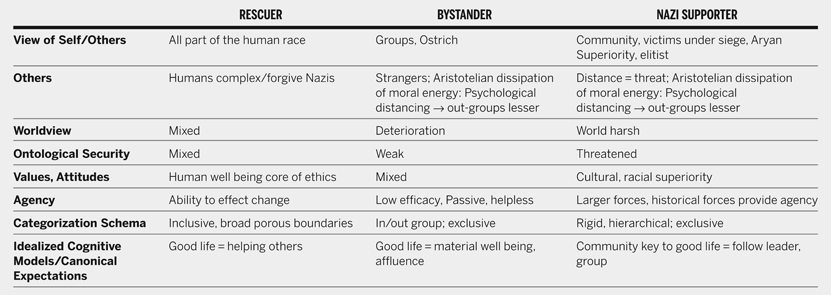
The above exchange reveals how the psychological process of denial and ignorance involves cognitive twists among bystanders like Beatrix, with Beatrix's inability to help being closely related to her canonical expectations about “the good life”—in Beatrix's case, the leisure time provided her by having help in the house. (Beatrix ignores the fact that many rescuers worked with their domestic help to hide Jews.) Another important explanation for behavior was the idealized cognitive models people carried around inside their heads. In this case, we can see how Beatrix's concept of what it means to be a human being and to have a good life enters her political psychology. For Beatrix, the good life is heavily materialistic, having the leisure time to play squash and tennis. In contrast, rescuers spoke of the good life as one that involves helping other people. For rescuers, happiness comes not from leisure time or material possessions but rather from sharing with others.
If the political psychology of bystanders is complex, that of the Nazis resembles something out of Alice in Wonderland. Florentine, the wife of one of the top two Dutch Nazis and herself prominent in Nazi activities before her marriage, was totally unrepentant, a true believer who remained staunchly loyal to her Nazi ideals, even after her husband was captured and killed by his Canadian captors. Florentine devoted the rest of her life to traveling around the world, speaking on behalf of Nazi causes and “telling people the truth” about what happened during World War II. Her view of the Nazis as simple, trusting people, tricked and threatened by Jews, resembled other Nazis' worldviews. It is not unique and, as bizarre as it might sound, it is a worldview in which the Nazis become the victims of Jewish plots.
Q: So you think the Christians have treated the Jews too, uh, too well throughout history? Is that what you are saying?
Florentine: We are too nice, I think. We are defenseless against them.
Q: Why do you say that? What do you mean by that? I'm trying to understand your view…. [A]re you thinking that the Holocaust was really made up? That it was not something [that was] real? Is that what you are suggesting?
Florentine: It's the biggest business in the world.
Q: The biggest what?
Young Nazi: Business. The Jews themselves, they call the Holocaust a Shoah. A Show-a. There's no business like Sho-ah business. That's the Jews themselves who say so. And it is.
Florentine: Yes, I agree. I agree.
What is perhaps most striking is that for all of these individuals, identity, not agonistic choice, was critical for explaining Holocaust behavior. Character counted more than the influences traditionally said to provide the impetus behind moral action (religion, education, gender, etc.) and emotions and feelings trumped the cool and impartial calculus of reason. These findings provided empirical foundation for scholarly accounts of virtue ethics and for our more general understanding of why it is so important to develop good moral character. Yet, character is not all. It was the sense of one's self in relation to other people that was decisive. It is not just identity but the perception of the relationship between the rescuer and “the other” that seems key.
Beyond this, rescuers, bystanders, and Nazi supporters differed significantly in their worldviews and their idealized cognitive model for what constitutes the good life. For bystanders such as Beatrix, happiness comes from having the time and the servants and the money to provide leisure that constitutes the good life, which Beatrix described as playing squash and tennis. Her cousin Tony and other Dutch rescuers reveal a distinctly different idealized cognitive model for the good life, one in which happiness comes from making others happy. A Dutch rescuer on the Gestapo Most Wanted List articulated this view.
Q: You're talking about practical aspects of life now. Before, it seemed to me that you were talking more about the meaning of life in some sense. You were speaking, if I may use that term, about what it means to be a human being. What does it mean to be a human being to you?
John (Dutch rescuer): I have some privileges, we get in turn some responsibilities. To have the abilities of speech, of hearing. I can walk. I am thankful for what I have. My responsibility is to share with others. Because otherwise life would not be possible. I have seen in my life people who are selfish and not happy. People who have power and money and everything, and they don't have enough. Never enough. They are not happy. I have seen people who are unselfish, and happy, people who don't have very much, and are happy with what they have. My ambition, my aim is to be happy. Then [you ask], how can you be happy? By being selfish? [John shook his head]
Q: You would not have been happier if you had simply taken all your family and sat out the war in Switzerland? After the war, you could have said, “At least my family is intact. I love them. I've been a good person. I haven't done anything wrong.” You would not have been happier doing that?
John: You have to do what is right. You have to think about more than yourself. You have to think about yourself, certainly. You have to eat and have a home. But you must not concentrate on that. It is not my aim, it is not my rule to say, I, I, I. I have seen others around me, Salvation Army people, they are very happy. Why? Because they are helping. I see a lot of people who are very rich, but they don't have enough. I think happiness comes through helping other people. I am convinced of that. I see it around me. I see it for myself. I am really happy. I can make other people happy.
Q: When you spoke of being given certain gifts and how these gifts entail certain obligations and duties, the things you mentioned were not being born into a wealthy family or being born into the Dutch tradition of helping people. Instead, the things you mentioned as gifts are things such as the ability to speak and hear, things that every human being—except in rare cases—is born with. And yet, you speak of these as gifts. Are you suggesting that merely having the gift of life entails certain responsibilities?
John: Yes, I think so. And I am happy that I can fulfill my responsibilities.
In contrast, Nazi supporters linked happiness and self image via the community. Their chief goal seemed not to be personal happiness but rather the need to protect the community.
The main differences among the rescuers, bystanders and Nazi supporters are summarized in table 1.

IMPLICATIONS OF FINDINGS
I tried to use the empirical findings illustrated above—however briefly—to answer two particular puzzles: (1) What causes genocide? And (2) Is there a psychological process by which universal and possibly innate human needs for consistency and self-esteem provide a foundation for moral action that is not based on religion, reason or externally imposed rules or laws?
In thinking about what causes ordinary people to become killers, I found recategorization of “the other,” the framing of political choice, and the emotional distancing of the other played key roles. In asking what causes some people to risk their lives and those of their families for strangers, I found the individual's sense of moral salience and agency was critical.
What is the importance of these findings, however, in broader terms? Does everyone have an ethical perspective? Yes, and the psychological differences that fill in the basic cognitive framework are critical in determining how we act toward others. A moral sense may well be innate—and I think the jury is still out on that question—but what gets filled in via socialization and life experiences is crucial.
Can we use this empirical work to create a broader theory of political choice? Yes, when such work is set in the broader context of research on moral choice, it can bring into focus the psychological dimension of ethics to shed light on one of the central themes in normative political science: how we treat others. Can we construct a theory of moral choice? Can we find a broader theory of political choice in these data? If we think of politics as including any of our acts that affect others, or even if we speak only of normative political acts, I believe we can use these findings to reasonably develop a theory of political choice. At this point, I am prepared to offer the following as a theory of moral choice and to leave open the question of whether it also provides the general contours of a theory of political choice as well.
Our moral choices reflect our basic sense of who we are in relation to others. Identity constrains moral choice through setting the range of options we perceive as available, not just morally but cognitively. Identity exerts its influence by filtering the actors' sense of who they are in relation to others through the actors' worldview, sense of ontological security, and idealized cognitive models. All these lead to a cognitive classification or categorization system that effectively creates a particular ethical perspective through which actors view the world, others around them, and the situations demanding a moral choice. This process exists because identity is more basic than conscious choice. Much of moral behavior emanates in a psychological process that appears spontaneous, reflecting intuitions and emotions that affect how we see ourselves in relation to others at the time of action. Moral behavior does not result merely from conscious deliberation, although such conscious deliberations indeed may enter the equation. But what we say we have chosen may reflect who we are as much as—perhaps even more than—any conscious calculus based on reasoning. This dynamic model makes identity central to moral action. Predicting moral choice requires us to understand the political perspective of the actor at the moment action is taken. It is the ethical perspective that constitutes the link between the social and individual influences on behavior. To understand moral choice, we need to understand how these influences in turn relate to the critical role played by identity perceptions in deriving moral behavior and moral choice, whether that action takes the form of helping and peaceful cooperation or involves us in the stereotyping and prejudice that deteriorates into conflict, including ethnic, religious, racial, and sectarian violence.
CONCLUSION
I have tried to honor Ithiel de Sola Pool's interest in empirical political theory by using my empirical analysis of altruism and genocide to derive a more general theory of moral choice. Empirical work on wartime behavior during World War II and the Holocaust suggests a new theory of moral choice, one in which the critical components are identity and political psychology, including character, self image, or, more particularly, our sense of who we are in relation to others. The sense of self in relation to others works to cognitively classify or categorize others by working through the filters of our individual idealized cognitive models, worldviews, and sense of ontological security. The above forces come together to result in cognitive classification of others, which also works through framing of normative political choice to set the boundaries of entitlement, effectively differentiating those to whom we accord fellow feeling from those to whom we do not. This establishes moral salience, the feeling that moves us beyond a generalized sympathy at the plight of others to a felt imperative to act to alleviate another's suffering. All of these will result in a normative political act, whether that act is one we find morally commendable, neutral, or negative. This theory is designed to explain how the categorization and classification of others influences our treatment of them. What drives the theory is the basic human psychology. Each of us wants to be treated well. Recognizing that others have similar needs leads us to extend these universal rights of entitlement reciprocally, treating others as we ourselves wish to be treated. The moral psychology is reminiscent of tenants found in religious teachings and philosophical systems of ethics. Insofar as this ethical reciprocity is a fundamental correlate of our human capacity for intersubjective communication and the need to distinguish boundaries via categorization, ethical reciprocity is more basic than an intellectualized sense of duty or religion. Indeed, the power of both religious and philosophical admonitions may emanate from their resonance with the basic moral psychology.
Taken as a whole, this model and the empirical work on which it is based shows us an alternative way of viewing one's self. The existing dichotomy, so dominant in political science, in which the individual is posed in juxtaposition to the group and the individual's self-interest is set adjacent to or versus the common interest may not reflect the basic way our brains work. It raises interesting questions for us concerning our ties to others and what we need to flourish as individuals. Looking at the question of identity in this manner encourages us to rethink our basic need for human connection and human flourishing. Analyzing the cognitive frameworks of rescuers in particular suggests that the need for others is more than our need for their cooperation in our own individualistic enterprises or even for their help in ensuring our individual survival. It is a fundamental part of our human nature to crave acceptance, validation, and affirmation from others. Ethically, the critical point is simple: we can find self-esteem and self-respect only when others help us claim it. We can claim it in ourselves, only when we grant it to others.