Introduction
Parasite populations are fragmented into infrapopulations, which are assemblages of parasite individuals within individual hosts. Such fragmentation promotes inbreeding, but could also favour female-biased sex ratios (Wilson and Colwell, Reference Wilson and Colwell1981; Poulin, Reference Poulin1997). Proportions of adult males and females in infrapopulations commonly differ from Fisher's optimal one-to-one sex ratio (Roche and Patrzek, Reference Roche and Patrzek1966). The most commonly observed biased sex ratio in parasites generally favours females, but exceptions have been reported (Dobson, Reference Dobson1964; Müller-Graf et al., Reference Müller-Graf1999; Stuart et al., Reference Stuart2006; Beltran and Boissier, Reference Beltran and Boissier2010).
Numerous studies have been performed to test the effects of various population-related and epidemiological traits on parasite sex ratio (e.g. Read et al., Reference Read1995; Shutler et al., Reference Shutler, Bennett and Mullie1995; Haukisalmi et al., Reference Haukisalmi, Henttonen and Vikman1996; D’Ávila et al., Reference D’Ávila2012). Host–parasite interactions can easily be influenced by crowding, i.e. the presence of conspecific competitors and other species within the communities (Ostfeld and Keesing, Reference Ostfeld and Keesing2012). However, conflicting results have been obtained, with factors such as prevalence, infection intensity, and crowding demonstrated to be either significant or non-significant for sex ratio patterns (Selvan et al., Reference Selvan, Campbell and Gaugler1993; Poulin, Reference Poulin1997; D’Ávila et al., Reference D’Ávila2012; Ostfeld and Keesing, Reference Ostfeld and Keesing2012; Kloch et al., Reference Kloch2015). Wassom (Reference Wassom1993) considered each host individual as a unique ecosystem, in which both host and parasite genetic variability can influence the outcome of host–parasite interactions. Differential strain-specific host immunity has been recorded for a model nematode parasite, Heligmosomoides polygyrus (Reynolds et al., Reference Reynolds, Filbey and Maizels2012). It has also been shown that host immune status is the strongest factor determining the sex and progeny sex ratio in the nematode species Strongyloides ratti (Gemmill et al., Reference Gemmill, Viney and Read1997; Harvey et al., Reference Harvey2000). The importance of a genetic basis of resistance to parasites can be seen in artificial selection experiments for low faecal worm egg count (WEC), in which selected host genotypes show large reductions in WEC when infected with gastrointestinal parasites (Karlsson and Greeff, Reference Karlsson and Greeff2006; Kemper et al., Reference Kemper2010). In addition, more specific genetic backgrounds, such as supernumerary chromosomes (B chromosomes), may also interact with the parasite community (Gorlov and Tsurusaki, Reference Gorlov and Tsurusaki2000; Adnađević et al., Reference Adnađević2014). B chromosomes (Bs) are additional dispensable parts of the eukaryote genome and can be present or absent in individuals of a particular population of a given species. They may vary in morphology and chromosome properties, but nonetheless there are some unique characteristics of all Bs. They do not recombine with the standard set of chromosomes during meiosis and are not necessary for either development or survival of individuals carrying them in their genotype (Vujošević et al., Reference Vujošević2009; Banaei-Moghaddam et al., Reference Banaei-Moghaddam2015). This host-related component of ecological interaction should not be overlooked, as the genetically based immune response provides a dynamic environment to which the parasites must adapt.
Mice of the genus Apodemus are considered a model species for both host–parasite interactions (together with their most studied parasite, Heligmosomoides polygyrus), and polymorphism of B chromosomes. The yellow-necked mouse, Apodemus flavicollis (Melchior, 1834), is a fairly common rodent in forest ecosystems in Europe (Petrov, Reference Petrov1992). Almost all populations of this species are polymorphic for the presence of B chromosomes (Zima and Macholán, Reference Zima and Macholán1995; Vujošević and Blagojević, Reference Vujošević and Blagojević2004). Although the true nature of these chromosomes is not known in detail, previous studies have shown the adaptive advantage of yellow-necked mice with B chromosomes (Zima et al., Reference Zima, Piálek and Macholán2003; Blagojević and Vujošević, Reference Blagojević and Vujošević2004). Furthermore, their interaction with an expression of immune genes was demonstrated by detection of lower Tgf-β gene expression in the presence of B chromosomes (Adnađević et al., Reference Adnađević2014). Interactions between parasite infrapopulation sex ratios and the yellow-necked mouse, i.e. the host's genetic background, have not been addressed previously.
Experimental studies have shown effects of various factors on parasite sex ratios. However, the significance of some community measures, such as crowding, was less apparent in natural populations (Haukisalmi et al., Reference Haukisalmi, Henttonen and Vikman1996). Therefore, additional sources of (unexplained) sex ratio variation in natural populations should be looked for amongst other ecological factors, such as immunological aspects of host–parasite relationships, host-specific and parasite-related factors. It is common practice in ecological studies to treat the functional groups of terrestrial nematodes as being synonymous with feeding groups (Bongers and Bongers, Reference Bongers and Bongers1998). However, mammalian endoparasitic nematodes fall into one and the same feeding group, so the basic ecological differences have to be drawn from their life histories (e.g. infection mode, mechanisms of dispersal, host specificity, the presence of intermediate hosts). Recently, Blasco-Costa and Poulin (Reference Blasco-Costa and Poulin2017) argued that studies should focus on life cycles of each particular species, as ecological interaction in one life stage could be affected both by previous and subsequent stages. Together with life history traits, the sex determination system could play a role in shaping the sex ratio of adult nematode parasites (Müller-Graf et al., Reference Müller-Graf1999). The delicate interdependence between sex determination systems and sex ratio evolution has been widely described (Eshel, Reference Eshel1975; Bull, Reference Bull1983, Reference Bull1985; Werren and Beukeboom, Reference Werren and Beukeboom1998), but has not usually been evaluated in populations of parasites.
The primary aim of this study was to investigate the range of infrapopulation sex ratios for common nematode parasites of the yellow-necked mouse. Furthermore, this study aimed to determine which population-, host- and parasite-related factors influence the variation in parasite sex ratios in wild populations.
Materials and methods
Collection and examination of mice for B chromosomes
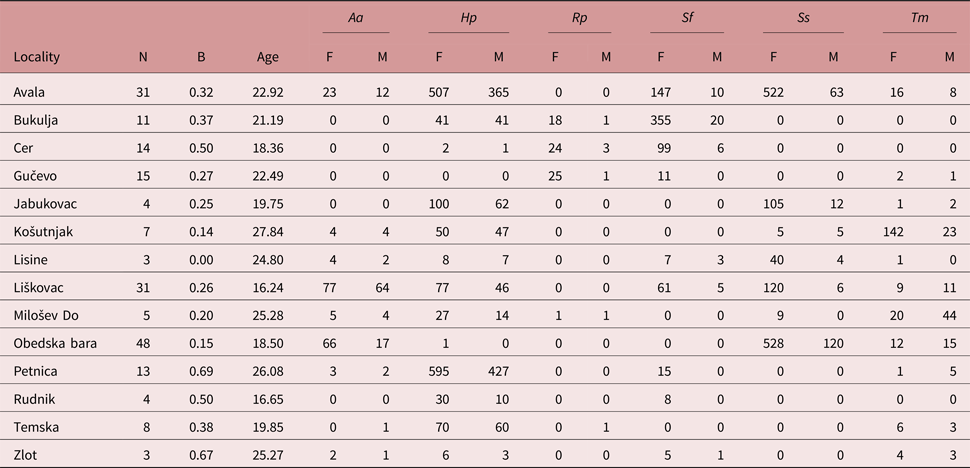
We studied fourteen localities in Serbia (table 1), from where 197 infected yellow-necked mice were collected. At each locality, trapping was carried out for three nights using Longworth traps provided with hay and cereals. The age of each individual was estimated from dry eye lens weight (Nabagło and Pachinger, Reference Nabagło and Pachinger1979). Following dissection, the chromosomes of each mouse were prepared directly from bone marrow cells using standard techniques (Hsu and Patton, Reference Hsu, Patton and K1969). The presence of B chromosomes in an individual host genotype was inferred from 30 analysed metaphase figures, and the host was labelled as having Bs if metaphase figures contained more than 48 chromosomes (standard complement). The intestinal tract of each animal was removed and cut longitudinally in order to release its contents, which were then deposited in water. The supernatant was decanted until it was clear, to allow for further parasite examination. A total of 5584 nematode individuals were detected from the intestinal contents under a stereomicroscope and preserved in 70% ethanol. The nematodes were identified according to the identification keys of Ryzhikov et al., (Reference Ryzhikov1979) and Genov (Reference Genov1984).
The occurrence of females (F) and males (M) of Aonchotheca annulosa (Aa), Heligmosomoides polygyrus (Hp), Rictularia proni (Rp), Syphacia frederici (Sf), S. stroma (Ss) and Trichuris muris (Tm), relative to host age (mean dry eye lens mass in mg) and the frequency of hosts with B chromosomes (B) at locality.

To evaluate the importance of lifecycle factors and sex determination types for variation in adult sex ratio, we pooled our findings with data from sixteen previously published articles on infrapopulation sex ratio in parasitic nematodes. Only data for mammalian parasites were analysed, to rule out the type of host immunological response as a differential factor. Selection of mammalian parasites only was also based on the profound differences in life history traits shown for parasites of invertebrate and vertebrate hosts (Morand, Reference Morand1996). From articles where effects of anthelmintics were studied experimentally, only the data from control group hosts were included in the analysis. The final set comprised 1248 infrapopulation sex ratio data for 20 nematode species. For each species, the sex determination system was defined together with qualitative life history traits chosen according to their relevance for natural selection (presence of an intermediate host, egg hatching in the definitive host, egg hatching in the soil, infectiveness of L3, migration within the host body). All species were described through the presence or absence of these life history traits. Mode of transmission, i.e. the interplay between the presence of an intermediate host and the place and timing of egg hatching, has already been underlined as an important factor for genetic diversity and reproductive strategy evolution in parasites (Poulin, Reference Poulin1995; Barrett et al., Reference Barrett2008).
Data analysis
All calculations and statistical tests were performed in R software (version 3.2.0, R Core Team, 2015) in basic and specific statistical packages. Sex ratio was defined as the proportion of males in every infrapopulation of each parasite species. Deviations from unity for the sex ratio were validated by chi-square test with significance adjusted by the sequential Bonferroni correction. The sex ratio data for each parasite species were fitted by generalized linear models (GLMs) as proposed (Wilson and Hardy, Reference Wilson, Hardy and ICW2002), to ascertain significant factors that influence sex ratio variation. Data fitting started from the full models, which incorporated host-related factors (age, sex and the presence of B chromosomes), temporal and spatial ecosystem identity (trapping season and locality), and one infracommunity-specific factor – crowding (calculated as the total number of adult nematodes in the host) – as well as two-way interactions among these factors.
Meta-analysis data were also fitted by GLM in which the full model incorporated defined adaptive life history traits and sex determination type. As sex determination was the only factor with more than two levels, differences among diverse sex determination types were analysed by post-hoc Tukey's multiple mean comparisons test in the multcomp 1.3-8 package (Hothorn et al., Reference Hothorn, Bretz and Westfall2008).
In both analyses, extensive exploration among all potential generalized linear models was performed in the glmulti 1.0.7. package (Calcagno, Reference Calcagno2013), followed by backward selection, in order to select the best fitting model by two appropriate criteria (AIC and AICc). All top models (within ΔAICc <2.0) were further compared by Akaike weights, and those with the greatest weights were reported. Afterwards, the chosen best fitting models were validated by 10-fold and leave-one-out cross-validation with the boot 1.3-17 package (Canty and Ripley, Reference Canty and Ripley2015).
Results
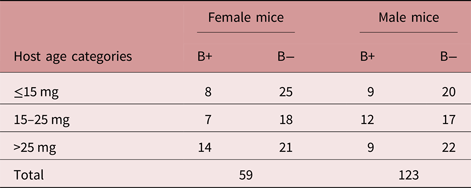
The studied yellow-necked mouse populations showed considerable cytogenetic variation. In total, B chromosomes were present in 30% of the 197 hosts (table 1). Namely, 35 had one B chromosome in their genome, 20 had two Bs, and four individuals had three Bs. In 15 individuals the genotype could not be described. The proportion of mice carrying Bs is within the range of previous reports (Zima and Macholán, Reference Zima and Macholán1995; Vujošević and Blagojević, Reference Vujošević and Blagojević2004), so the host sample was considered to be representative genetically. Hosts belonging to all previously determined age categories of yellow-necked mice (Vujošević et al., Reference Vujošević2009) were present in the samples (table 2). Six nematode species were recovered: Aonchotheca annulosa (Dujardin, 1845), Heligmosomoides polygyrus (Dujardin, 1845), Rictularia proni (Seurat, 1915), Syphacia frederici (Roman, 1945), S. stroma (Linstow, 1884) and Trichuris muris (Schrank, 1788).
The occurence of B chromosomes in 182 genotyped hosts relative to host age (dry eye lens mass in mg) and sex.

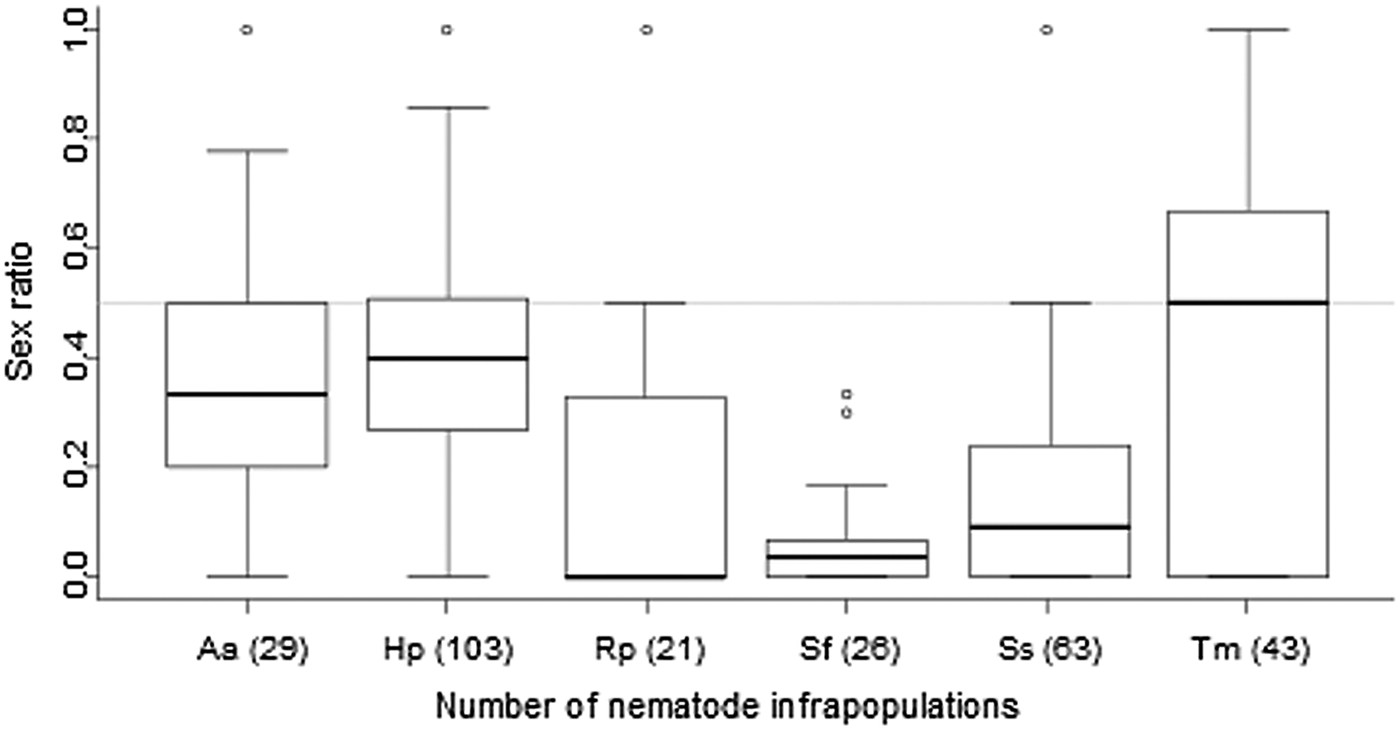
The calculated sex ratios in infrapopulations varied from 0 (no males) to 1 (no females) in most species (fig. 1). The single exception was Syphacia frederici, for which the highest sex ratio was 0.33; i.e. females were more numerous in all infrapopulations of this species. Mean values for the sex ratio in all accounted species were <0.5. However, the statistical significance of deviation from one-to-one sex ratio was not commonly observed, as infrapopulation sizes were rather small. Overall, the largest proportion of infrapopulations significantly deviating from an equalized sex ratio was found in Syphacia species (17% of S. stroma infrapopulations and 46% of S. frederici infrapopulations).
Variation in sex ratios of Aonchotheca annulosa (Aa), Heligmosomoides polygyrus (Hp), Rictularia proni (Rp), Syphacia frederici (Sf), S. stroma (Ss) and Trichuris muris (Tm), with the number of infrapopulations recovered in parentheses. The median male/female ratio is within boxes (horizontal lines), with outliers (o). The grey line denotes equal proportion of males and females in an infrapopulation.

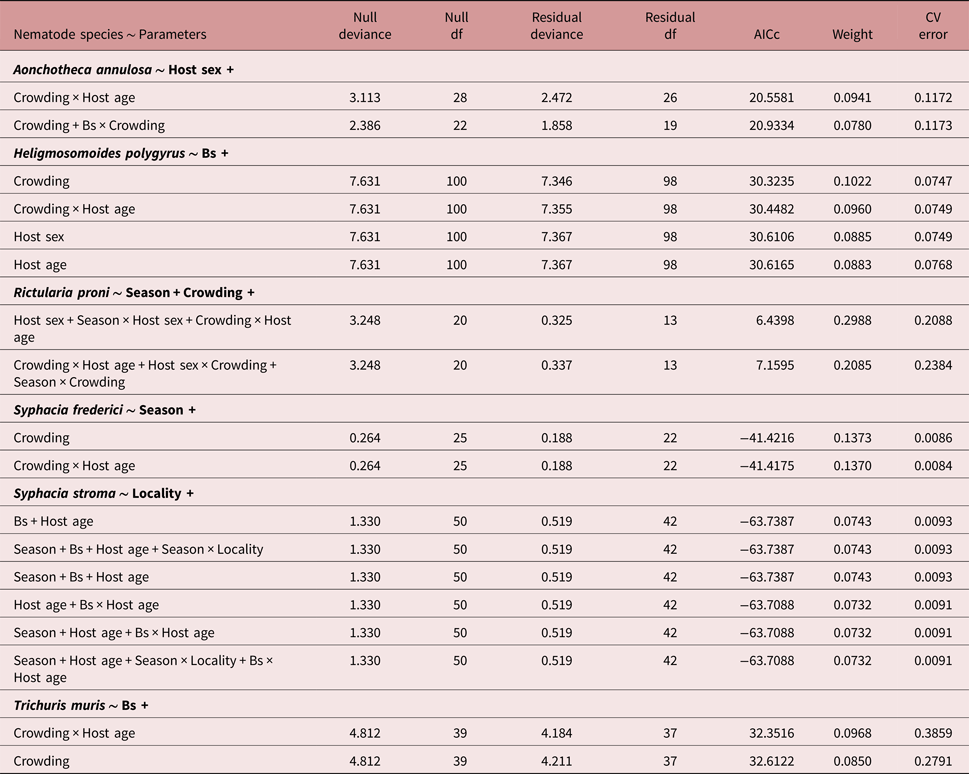
Variation in sex ratios differed among the recovered species, as did the factors found to be significant in GLMs (table 3). Each species experienced a significant influence of different factors and factor combinations, from spatial variation to the effect of crowding. Cross-validation of best fitting models showed low error rates for most species, with the exception of models of R. proni and T. muris sex ratios, for which mean error rates were higher than 0.20. The values of error rates did not differ between 10-fold and leave-one-out approaches. Variation of overall ecosystem characteristics among localities was significant for only one species – S. stroma. Seasonal variation was a significant factor in explaining sex ratio differences in three species (R. proni, S. frederici and S. stroma). Crowding, used here as the proxy for competition intensity among nematodes, was shown to be relevant for sex ratios in almost all analysed species. Host-related characteristics usually had significant effects in interaction with other factors (such as the interaction between host age and parasite crowding) but also exhibited direct effects on two parasite species (A. annulosa and S. stroma).
The best fitting generalized linear models of sex ratio variation in Aonchotheca annulosa, Heligmosomoides polygyrus, Rictularia proni, Syphacia frederici, Syphacia stroma and Trichuris muris.

Bs, the presence of B chromosomes in the host karyotype; df, the number of degrees of freedom; Weight, model's Akaike weight; CV error, leave-one-out cross-validation error rate values
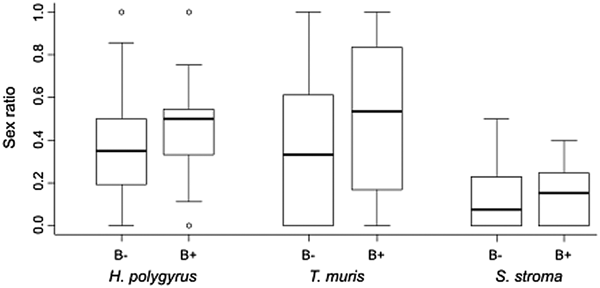
The most intriguing finding was that the presence of B chromosomes in the host genotype significantly and directly affected the sex ratio in Heligmosomoides polygyrus, Syphacia stroma and Trichuris muris (table 3), which could mean that host B chromosomes act as parasite sex ratio distorters. The hosts with B chromosomes in their genomes harboured a significantly higher proportion of H. polygyrus males. A similar, but less clear, trend was observed in S. stroma and T. muris (fig. 2).
The sex ratio of Heligmosomoides polygyrus, Syphacia stroma and Trichuris muris in Apodemus flavicollis with (B+) and without (B−) B chromosomes. The median male/female ratio is within boxes (horizontal lines), with outliers (o).

Fitting the meta-analysis data revealed two best models that are nested, so the minimal one was kept. It contains only two explanatory factors, sex determination type and hatching of eggs in the soil, both being highly significant at P < 0.001. Furthermore, a statistically significant difference among three sex determination types (P < 0.01) was revealed by Tukey's post-hoc test.
Discussion
Sex ratios in the infrapopulations of nematode parasites recovered from yellow-necked mice displayed a full range of values from 0 to 1. In line with the theoretical background and the majority of earlier studies in wild populations of parasites (Wilson and Colwell, Reference Wilson and Colwell1981; Poulin, Reference Poulin1997), females were the prevailing sex. Male-biased and all-male infrapopulations were scarce.
It has been stressed that intraspecific variation in sex ratios could be seasonal and density-dependent (Haukisalmi et al., Reference Haukisalmi, Henttonen and Vikman1996) and that the composition of parasite communities in the yellow-necked mouse may vary both temporally and spatially (Ferrari et al., Reference Ferrari2004; Čabrilo et al., Reference Čabrilo2016). Such findings were confirmed in our study, as the seasonal dependence of the infrapopulation sex ratio was seen in three species, two of which belong to the same genus (Syphacia). However, seasonal variation was never the only significant factor affecting the nematode species investigated herein (table 3). Rather, in the best fitting models, it was accompanied by significant effects of crowding (as seen in R. proni and S. frederici) or spatial geographical variation (in S. stroma). Crowding, i.e. quantification of the presence of other parasites, was indeed a very important factor for most species in this study. The sex ratio in the parasite families Trichuridae and Capillariidae has already been shown to be influenced by crowding, where smaller infrapopulations are female-biased (Cabaret, Reference Cabaret1983; D’Ávila et al., Reference D’Ávila2012). For the most common parasite of the yellow-necked mouse, H. polygyrus, crowding expressed equivocal effects (Courtney and Forrester, Reference Courtney and Forrester1973; Keymer and Hiorns, Reference Keymer and Hiorns1986), and no effect of crowding was found in related species (Kloch et al., Reference Kloch2015). However, in our sample of H. polygyrus infrapopulations, crowding was an important factor in the best fitting models (table 3). It could be speculated that the amount of other parasites shows an ambiguous effect, either the result of direct competition or a confounding effect of host–parasite interactions. In the latter case, the importance of parasite crowding should be expected to be specific for each host species, rather than for each parasite species. Taken into consideration together, three of the community- or ecosystem-related factors (trapping locality, season and community crowding) had a considerable influence on differences seen in sex ratios in the parasite infrapopulations.
The host-related factors exhibited interesting patterns (table 3). Host age showed up as a significant factor usually through interaction with crowding. The reason for this, namely that parasite load can change and increase with host age, was already indicated in several previous studies (e.g. Montgomery and Montgomery, Reference Montgomery and Montgomery1989; Behnke et al., Reference Behnke2001). Host sex had a stronger effect on sex ratio, although in one species only (A. annulosa). Sex-biased parasitism has occasionally been observed in mammalian hosts. This pattern is considered to be a complicated phenomenon involving several different mechanisms (Krasnov et al., Reference Krasnov2005). Thus, hormonal and immune differences between host sexes could play a role in the selective sweep of parasites (Krasnov et al., Reference Krasnov2005; Hu et al., Reference Hu2011). Infrapopulation regulatory mechanisms in most studied species might have been resistant to diversity among microhabitats driven by differences between host sexes. Most of our results follow a long line of studies in which no significant effect of host sex on the composition of parasite communities was detected (e.g. Kisielewska, Reference Kisielewska1970; Abu-Madi et al., Reference Abu-Madi2000; Behnke et al., Reference Behnke2001).
The diverse host genetic background, described through the presence of B chromosomes, was shown to be an important factor for parasite sex ratio variation. The effects of B chromosomes on their carriers can be very different (Jones and Rees, Reference Jones and Rees1982). Interactions between host B chromosomes and parasites have rarely been studied and then in very distant species. For instance, in the freshwater turbellarian Polycelis tenuis B chromosomes increased susceptibility to diseases (Melander, Reference Melander1950), whereas harvestman (Metagagrella tenuipes) specimens with an odd number of Bs were more resistant to parasites (Gorlov and Tsurusaki, Reference Gorlov and Tsurusaki2000). In this study, infrapopulations of H. polygyrus, S. stroma and T. muris in hosts with B chromosomes had more males than infrapopulations in hosts without Bs (fig. 2). The presence of Bs in yellow-necked mice has previously been associated with lower expression of the immune system gene Tgf-β (Adnađević et al., Reference Adnađević2014). This interaction of supernumerary chromosomes with the immune system could be the cause of sex ratio distortion in the studied parasite infrapopulations. In addition, new findings that B chromosomes in this species originate from sex chromosomes (Rajičić et al., Reference Rajičić2017) and that some genes are present on them (Makunin et al., Reference Makunin2018) could contribute to uncovering their effect on parasite sex ratio. Whatever the proximal cause, either selective mortality or expulsion of one sex, the general consequence was an increase in the proportion of males in infrapopulations inside hosts with B chromosomes. Alternatively, the relative increase of males in infrapopulations could result from a switch in parasite life history strategy, induced by adaptation to the new host genotype (Bs present). This elevated proportion of males could facilitate the maintenance of parasite genetic diversity through sexual reproduction. Furthermore, enhanced parasite genetic diversity could boost host resistance (Ganz and Ebert, Reference Ganz and Ebert2010). More extensive laboratory research is needed to find the ways that specific host genetic backgrounds interfere with parasite sex ratios and genetic diversity.
In the meta-analysis, the sex determination system was demonstrated to play a significant role in nematode sex ratio variation. This role was most pronounced in oxyurid nematodes of the genus Syphacia characterized by the haplodiploid sex determination system. Very low proportions of males in Syphacia infrapopulations are unusual for Oxyurida in general, as higher relative numbers have been reported, e.g. for Aspiculuris tetraptera and Ivaschkinonema alticola from the family Heteroxynematidae (Tarasovskaya, Reference Tarasovskaya2008). Among other factors, the haplodiploid sex determination system was probably the most significant cause of the extreme female-biased sex ratio seen in Syphacia. It has been shown that sex ratio in haplodiploid animals is female-biased, the extent of which depends on the presence of females that produce only male offspring (Godfray, Reference Godfray1990). Noticeable sex ratio differences, so-called ‘split sex ratios in haplodiploids’ (Gardner et al., Reference Gardner, Alpedrinha and West2012), were not recorded among the analysed Syphacia infrapopulations. On the contrary, sex ratios were uniform. Other possible explanations for low male proportions could involve the influence of a specific life cycle. Of three life history traits that were significant in our models, lack of hatching in soil was the only one common among the genera with the lowest sex ratios, Syphacia and Rictularia. However, it cannot be generally concluded that egg hatching in an intermediate or definitive host is correlated with lower male frequencies, as there were species in our meta-analysis that showed a contrasting pattern.
In conclusion, our study has confirmed the predominant pattern of female-biased sex ratios in vertebrate parasite infrapopulations. The sex ratio of each recovered nematode species showed different reactions to environment-, host- and parasite-related factors. The most unusual and previously not investigated host-related factor that acted as a sex ratio distorter was the presence of B chromosomes in genomes of host yellow-necked mice. The meta-analysis of life cycle and sex determination system effects upon sex ratios of parasite infrapopulations yielded statistical significance of the sex determination system and specific life history patterns, such as hatching of eggs in the soil. The effect of these life history traits needs further investigation in order to be confirmed in a wider range of parasite species.
Financial support
This study was supported by the Ministry of Education, Science, and Technological Development of Republic of Serbia (Grant No. 173003).
Conflict of interest
None.
Ethical standards
The study was conducted under permits issued by the Ministry of Agriculture and Nature Protection, Republic of Serbia (number: 353-03-250/2010-04). The mice were treated according to Directive 2010/63/EU of the European Parliament and the Council of 22 September 2010 on the protection of animals used for scientific purposes. All animal procedures were approved by the Ethical Committee for the Use of Laboratory Animals of the Institute for Biological Research “Siniša Stanković”, University of Belgrade.