Introduction
The size of the meat market in Pakistan at present is over three million tons per annum, consisting of 767,000, 616,000 and 1,711,000 tons for poultry, mutton and beef, respectively (Economic Survey, 2010-11). Meat is the second largest food commodity after milk, and demand is growing at almost 6% per annum while supply is growing at 1.8%, leaving a demand gap of 4.2% (PBIT, Reference PBIT2011). This gap is likely to grow in the prevailing circumstances.
The meat sector in Pakistan has enormous export potential. The world meat market continues to grow with countries such as Saudi Arabia and Malaysia continuing to import increasing amounts of meat. Pakistan's meat industry is taking steps to penetrate the global export meat market. Geographically, Pakistan occupies an important place in the area and has significant advantages with respect to the vast, untapped market in its neighbouring countries where Pakistani meat enjoys a competitive advantage. The poultry meat industry in Pakistan consists of chicken (98.5%), duck (1%) and quail/ sparrow (0.5%) (Economic Survey, 2010-11). Poultry meat is a good source of cheap, palatable and nutritious protein and contributes around 1.1% in the national Gross Domestic Product (GDP) and 4.8% in the agricultural GDP (Sabir, Reference SABIR2007). Poultry meat carries an advantage over red meat in terms of its low percentage of fat compared to beef and mutton, and is therefore, viewed as ‘non-fattening’ and associated with the prevention of hardening of the arteries (Alam and Shaikh, Reference ALAM and SHAIKH2007). The increasing human population of Pakistan (2.05% growth rate; Economic Survey, 2010-11) is the main reason for the higher demand for poultry meat, but the supply chain of poultry meat for consumers through markets is still following traditional lines.
In Pakistan all types of meat (rural poultry, beef, mutton, and fish) are traditionally raised, except for large scale commercial poultry (Prabakaran, Reference PRABAKARAN2003). The demand from local consumers for Halal, Hygienic and Healthy (3Hs) frozen meat and value added meat products, and its subsequent price, are increasing day by day due to the changing eating habits of people in various urban areas. Higher meat prices are due to increasing urbanisation, higher feed costs (Ayyub et al., Reference AYYUB, BILAL and AHMAD2011), fuel charges and middle-men monopolies in the supply chain.
The per capita income in Pakistan is US$1254 and the country is undergoing severe stressful economic conditions due to recent conflicts (Economic Survey, 2010-11). In spite of stressful economic conditions, the government has launched many projects for the development of the meat industry for export. The emerging poultry meat industry has projects in Pakistan for the production and processing of all types of meat products in different areas. Recently the Lahore Meat Company has been established by the provisional government with a 50% share by the Iranian government to satisfy the demand for Halal meat, which has a 23% share of the total meat required globally. The company is moving towards an integrated Halal meat value chain in Pakistan and this project will enable the meat industry to fulfil the export demands at competitive prices whilst remaining within World Trade Organisation (WTO) requirements. This is a favourable time for Pakistan to take the initiative to introduce modern meat processing technology in the global Halal meat sector. The objective of the present review is to discuss the structure of the current Pakistan meat market, especially poultry meat, and elaborate on the emerging problems within the industry.
Structural Profile of meat industry of Pakistan
Pakistan's meat industry consists mainly of white and red meat. White meat comes from poultry and fish whereas red meat sources include sheep (mutton), goat (chevron), cattle, buffalo (beef), and to some extent camel (Economic Survey, 2010-11). Proper commercial farming of meat has been adopted for poultry only (Prabakaran, Reference PRABAKARAN2003). Poultry meat comes from nondescript rural poultry, commercial broilers, commercial culled layers, culled breeding flocks and quail. Poultry meat contributes 24.8% of the total meat production in the country. About 70% of the meat is produced in the Punjab province of the country. The current investment in the poultry industry is about Rs.200 billion (Economic Survey, 2010-11). Whereas poultry meat has a proper market and supply chain, other meat types have no developed commercial markets.
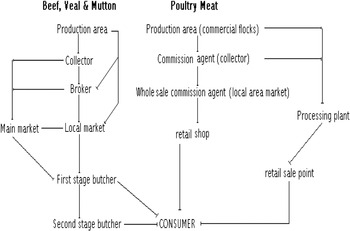
Middlemen collect the animals from their local growing areas and from farms in the case of (commercially raised) poultry and fish. Many farmers do not get the chance to sell their animals or birds directly to the main markets. Middlemen/brokers sell them to the wholesaler; from there the animal goes to be butchered. Butchers provide slaughter houses and then supply the meat to consumers, usually directly to homes, hotels, parties, functions, festivals etc. (Figure 1). In 1980, the first poultry meat processing plant (250 birds/hour) was established at the Poultry Research Institute, Rawalpindi, as a demonstration model, with the assistance of United Nations Development Programme. Now the demand for processed meat in the country is increasing. Subsequently, two large commercial processing plants (K&N and Menu with capacity of about 6000 birds/hour) and many small processing plants (including Zenith Associates, Anees Associates, Kat Co Associates, United Casings and Dogar Associates) in private sectors have been established. The Punjab Agriculture and Meat Company is building a meat processing plant at Shahpur Kanjaran, Lahore, named ‘The Lahore Meat Processing Complex’. This will be Pakistan's biggest automated processing plant that complies with international standards. The Avian Research and Training Centre at the University of Veterinary and Animal Sciences has recently established a modern quail meat processing plant at a cost of Rs.30 million. There are about 176 abattoirs in operation throughout the Punjab under local governments which account for 60% of legal slaughtering. However, there is still a need for more meat processing units.
The structural profile of Pakistan meat industry.

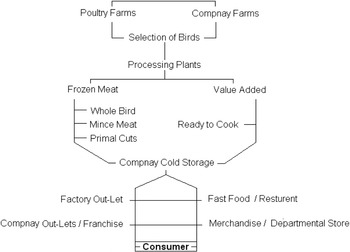
The demand for frozen and value added poultry products is increasing day by day in Pakistan. Different products including whole birds, minced meat, prime cuts and other products including nuggets, burger patties, chicken tempura, croquettes, kofta, fun nuggets, hot tenders, chapli kabab, shami kabab, tender pops and haray bhary nuggets, which are available for sale at company out-lets, franchises and merchant stores for consumers. To meet the 3Hs, good quality meat requires automated processing plants (Figure 2), mechanical and bio-security at slaughter houses, chicken breeding and an open market for the meat from local growers.
The structural flow of frozen poultry meat & value added meat products in Pakistan meat industry.

Scope of meat industry
The poultry meat industry has big opportunities for indigenous as well as foreign investors. Therefore many investors of the textile industry have shifted their investment into the poultry meat market due to a severe crisis in the textile market. The gap between demand and supply in Pakistan is about 4.1% (PBIT, Reference PBIT2011) and per capita the availability of chicken meat, beef, and mutton and total meat is 4.33, 9.66, 3.47 and 17.46 kg, respectively. The annual growth rate of chicken meat is 7.8% (Economic Survey, 2010-11). At present, Pakistan is exporting about US$13.95 million worth of live animals and the growth rate for exported meat is 56% (Economic Survey, 2010-11). The fast growing population, increased urbanisation and changing eating habits of people in the region are creating the chance for the development of the poultry meat industry on a scientific basis. The demand for value added meat products and the export of Halal meat are other opportunities for meat producers in Pakistan (Ayyub et al., Reference AYYUB, BILAL and AHMAD2011) especially as recently the World Health Organization declared the country free of bird flu. In the near future, the fast growing meat industry of Pakistan will be exporting Halal meat in substantial quantities to other Islamic countries, particularly Gulf countries.
Constraints of the meat industry in Pakistan
The poultry industry has many emerging constraints including a lack of modernisation, meat processing. These include the lack of a value chain approaches to production and marketing, value added products, integration among various commercial and government institutions, quality control system as well as high meat prices, the energy crisis, escalating feed costs, no disaster management for poultry and livestock, a lack of interest and incentives shown by the government and an emphasis only on revenue and tax collection (Maqbool et al., Reference MAQBOOL, BAKHSH, HASSAN, CHATTHA and AHMAD2005). The complicated structure of the poultry meat industry and the unnecessary hurdles within the supply chain are creating uncertainty for current and new investors.
Poultry reared for meat production come under four different farming systems: 1) Environmental controlled poultry farming; 2) Semi-environmental controlled poultry farming; 3) Open housed poultry farming; 4) Rural poultry farming in small flocks (akin to organic farming). In Pakistan about 50% of broiler farming has been shifted to environmentally and semi-environmentally controlled farming systems, however many areas still have open house farming systems. Rural poultry is the vital component of rural life. With low inputs, village chicken farming is capable of generating cheap and readily harvestable meat and eggs for immediate home consumption and sale for income generation, while at the same time performing a useful social hygiene function. In some communities, village chickens are important in breaking the cycle of poverty, malnutrition and disease.
The production of healthy day-old chicks is of prime importance in the production of healthy and hygienic meat production. In Pakistan, the Big Birds, K&N, Quality and Al-Noor companies have grandparent (GP) flocks of broilers, and these flocks are well managed and disease free. Other companies like SB Chicks, Islamabad Chicks, Olympia Chicks, Ani Chicks, Sabir Chicks and Jadeed Chicks are well known companies which also have disease free and well managed broiler breeder flocks and provide healthy chicks as compared to other broiler breeder companies in the country.
Livestock are reared under three different management set ups: 1) rural subsistence livestock production, 2) Peri-urban semi commercial poultry/livestock production, 3) Range livestock production. These systems differ widely in resources, capacities, production targets, marketing, and returns. However, in Pakistan there is no specialised breed for chicken meat production. The poultry industry fully depends on imported GP day old flocks. Presently, the country has about 730,000 broilers GP which are imported from Holland, Germany and USA (SBI, Reference SBI2009).
Hygienic abattoir facilities are lacking at slaughter houses in Pakistan, and poor inspection of meat slaughtering (pre- and post-mortem) of birds is common in the meat industry. A lack of equipment and insufficient staff are the problems of future concern for butcheries. Abattoirs are deficient in refrigeration and lairage facilities. In slaughter houses there is no proper management system for the disposal of blood, viscera, offal, and no proper cutting and skin removal equipment, which causes damage to the skin and carcass and subsequently the quality and value of the carcass is reduced. The government holds key responsibility to develop and provide the necessary hygiene and environmental legislative frameworks. These need to be supplemented by regulatory systems (‘directives’) issued by the government, designed to implement and strictly enforce the laws. Unfortunately these are absent in all stages of meat processing (FAO, Reference FAO2008). Recently, the Poultry Research Institute, Rawalpindi submitted a draft on ‘The Punjab Poultry Production Act’ to the Government of the Punjab for implementation under the Annual Development Program ‘Strengthening Regulatory Control and Capacities of Poultry Research Institute’.
Consumers prefer fresh carcasses, however the trend is now changing towards pressed, minced and canned meat (only in well-established urban areas). There are two main reasons for this, firstly that most citizens are uneducated about meat quality and products due to illiteracy, poverty, the presence of negative propaganda by non-progressive communities about processed meat, its lack of availability and local traditions. Secondly, house wives typically cook and purchase food items, and do not always select fresh meat. The type of meat, quality, selected cuts and joints and the demand and supply monopolisation are the main factors for fluctuating meat prices. The cost of distribution of poultry from the producer to the consumer is very high, mainly due to the profit taken out by middlemen involved at various stages. This reduces the profit to poultry farmers and discourages them from expanding their production units (Abedullah et al., 2007). The profit share of the middlemen needs to be reduced in order to lower prices at the retail level. The government needs to take initiatives to develop laws which allow producers to sell their products directly in the market and therefore cut out the middlemen (Islam, Reference ISLAM2003).
In Pakistan the price of other meats (beef and mutton) is stable, but the price of poultry and fish fluctuates with demand and supply. Chicken is the cheapest meat of all the types available. The price of beef is 10-29% higher and mutton is 44-56% higher than chicken, and mutton is 38% higher than beef in the local market. The price of fish is equal to beef throughout the year.
There are no systems for grading and quality for meat (apart from by the physical appearance of the live animal). This is especially true for beef but somewhat in poultry and more in mutton (chest and hind leg cuts are preferred). Cuts of poultry are well developed now, but not for beef and mutton. Whereas low income families have beef as the preferred food item, high earning families prefer mutton as a status symbol, however poultry is consumed equally by everyone.
Poultry meat is collected from poultry farms by contractors or farmers themselves carry them to the whole sale market, where butchers buy them and sell to consumers at their shops (Figure 1).
Pakistan has no recognised institute for poultry meat bioscience and technology with research facilities or training programs to remove primitive and inefficient processes in the meat industry using scientific methods. Therefore, the appropriate training of labour is essential in Pakistan. Currently, the number of people involved in meat bioscience and technology is unacceptably low. Subsequently, the meat industry remains underdeveloped and there is no exploitation of the huge potential in the meat industry which could be achieved by collaboration with supporting fields.
Generally, scientific methods are not adopted for processing meat at butcher shops, except in some poultry processing plants. The carcass type, anatomy, and consumer demand determine the poultry meat cuts used. The cut size and colour of the meat attracts the consumer in the selection of meat items. Therefore developed meat cuts are now traditionally necessary for butchers and consumers. Old non-scientific cut methods must be replaced with scientific cut methods. Customers prefer meat colour rather than juiciness or tenderness, explaining why some illegal techniques are used by butchers to maintain colour or produce a bright shiny carcass. There is no grading of real scientific quality on the basis of cut. There are no retail shops for manual meat cutting and graded cuts, although the demand is there. There is also no concept of storage, due to the demand for fresh meat on the butcher's side and the high cost of electricity on the consumer's side. Due to the lack of preservation facilities, short periods between cutting and sales are necessary to avoid shrinkage and decreases in brightness in meat colour by evaporation and microbial growth on the cut surface.
Microbial inspection and meat hygiene are very important but largely ignored. One should be careful about the exterior physical dirtiness before slaughter. Dirty knives and unwashed hands during dressing of the carcass further question the level of hygiene. There are no microbial standards for meat in Pakistan. There has been no modification of slaughter houses and they therefore have out-dated designs. One municipality has one slaughter house and has one veterinary officer but no meat laboratory.
There is a very little HACCP/ISO22000 implementation in the meat industry. A well-planned and well-managed flock can be a good source of fresh poultry meat. Large scale commercial broiler production and merchandising techniques often result in market prices that are difficult to match with a backyard flock. Therefore, small flock owners should not plan to produce more birds than the family can use or market locally, either live or dressed. Most small flocks produce only enough meat for home consumption. There is no trend in specialised products or characteristics of meat (high fat, low fat, protein, age, breed etc.).
In the ‘Punjab Poultry Production Act’ the following points are included regarding the hygiene in fresh meat processing:
1. Ante-mortem and post-mortem inspection of slaughtered birds and the maintenance of hygienic practices are carried out to ensure that fresh meat produced for human consumption is safe and wholesome.
2. Risk analysis based on accepted scientific methodology should be undertaken wherever possible, so as to improve current knowledge. These analyses will promote the following principles of meat hygiene:
a. there should be consistently applied food safety standards so as to assure a safe and wholesome meat supply; if an adequate food supply is threatened in some local trade situations, safety standards may include treatment sufficient to remove any hazard;
b. Ante-mortem and post-mortem inspection procedures should be appropriate to the spectrum and prevalence of diseases and defects present in the particular class of slaughter livestock being inspected;
c. Process control systems should limit microbial contamination of meat to as low as practicable level as possible, and prevent subsequent growth to levels that may constitute a hazard.
d. Hazard Analysis Critical Control Point (HACCP) under the control and supervision of the controlling authority provides a scientific approach to food safety and wholesomeness throughout the production, processing and distribution of fresh meat, and the HACCP approach should wherever possible, together with other quality assurance procedures.
Understanding the underlying biochemical mechanisms relating to meat quality and the inherent qualities of the muscle fibres is not considered as useful information for the industry. Meat production quality and efficiency depends on breed, sex, health factors, and nutritional factors.
Many factors like aesthetics, social norms, and psychological factors including spending power, the type and nature of cooking, available time and occupation behaviour are creating hurdles in the development of a modern meat market. In our country the first requirement for meat is as a food item against hunger, then to fulfil the animal protein requirement. People mostly use meat for taste and sensory perceptions and for traditional reasons.
Minimising the limitations
In spite of all of the hurdles and constraints, the meat industry in Pakistan is growing sharply and many efforts have been made to exploit the potential of the existing indigenous meat industry. By following certain guidelines points, the industry can flourish rapidly. These include, lower priced feed for animals, elimination of the monopolisation by middlemen (minimise the distance between producer and consumer), socio-economic stability of the farmer and consumer by technical investment and proper extension services. Non-descript breeds of poultry have a huge meat potential for investors in Pakistan.
The country can expect considerable profits through the following steps, such as enhancing all types of meat production, establishing disease free zones in different areas, developing centres for technical services, surveillance of different toxins and diseases, strict certification rules, loan facilities at minimum mark-up and establishment of a syndicate for meat exporters (Ayyub et al., Reference AYYUB, BILAL and AHMAD2011).
Recently, the Pakistan Ostrich Company has been established to provide technical support and professional advice in setting up successful ostrich businesses. It assists its clients in managing ostrich breeding and farming, marketing and sales of adult birds and provides consultancy services for protecting client's investment and assets. As a result, ostrich is now treated as ‘the meat of the millennium’. At present, many new ostrich farms have been opened in the Punjab province, with capacities ranging between 50 to 200 birds (Suhawa, Dina, Sargodha, Khanpur, Rahim Yar Khan, Shekupura, Gujranwala, Wazirabad, Sahiwal, and Lahore). The ostrich grows at a very high rate and can gain 100 kg in just 10 months without a specific die program (Adams and Brian, Reference ADAMS and BRIAN2003). The bird has the best feed-to-gain ratio of any land animal in the world, due to a very efficient FCR. In contrast, cattle need 20 kg of feed to gain 1 kg of body weight while an ostrich needs only 3.5kg feed to gain 1 kg of bodyweight. In Pakistan, the ostrich has been classified as an exotic species in Punjab Wildlife Act-2007, because it falls in the category of non-native birds under Rule 7 of Punjab Wildlife (Protection, Preservation, Conservation and Management) Rules, 1974. However, the Chief Minister, Government of the Punjab has approved the proposal on 01-11-2011 to reclassify the ostrich as a livestock species instead of wildlife. Ostrich meat is a good addition to the Pakistan poultry meat industry to fulfil the animal protein requirements of the fast growing population.
Conclusions
The traditional and religious beliefs and demand of different income groups for different types of meat quality are the main hurdles in developing healthy and hygienic meat production. Providing fresh slaughtering at a local shop with small processing plants (Figure 3) could to change the mind set of consumers for adopting frozen poultry meat in Pakistan. This model, with some variations, already exists in the meat markets of large cities. Although a single man slaughters the Halal chicken at the premises, other processes will be completed through a plant at the shop in front of consumers for their satisfaction.
Layout plan for fresh slaughtering of poultry birds through the Halal method at the shop with a small processing plant.