One's native language is normally a marker of national identity. This is particularly true of China, which many regard as a relatively linguistically homogeneous nation. The huge impact of the spread of English on the local culture of China alongside a buoyant wave of global capitalism raises interesting questions such as the following: (i) Does the spread of English challenge or undermine the sense of China's national identity? (ii) By drawing upon English as a new linguistic and cultural resource, is China now redefining its own culture? (iii) What strategies are observable in the use of English intranationally in contemporary China? To answer these questions, this study examines the use of English in China's real estate advertising. The relatively new discourse of real estate advertisements in mainland China has been attributed to the process of increasing urbanization which has accelerated since 2000. In addition, as one of the most fundamental symbols of a nation, land is closely associated with national identity, which suggests that real estate transformed from land can be taken as a source discourse for an investigation of national identity (Smith, Reference Smith1991; First and Avraham, Reference First and Avraham2007). By focusing on the use of English in China's real estate advertising and its possible association with the national identity of mainland China, this study discusses the strategic use of English as a linguistic and cultural resource in identity construction.
Introduction
The status of English in China today is unbelievably high, and approximately 350 million Chinese people are currently learning English at all levels of education (Yang, Reference Yang2006). Regardless of diverse levels of proficiency, a relatively large number of Chinese young people have some knowledge of English. More and more people, especially in coastal cities like Shanghai and Shenzhen, have already acquired a working knowledge of the language. Among all the Chinese media, English has become a strong language subordinate only to Chinese. A number of English-language newspapers and magazines are published for domestic as well as international readers. China Central Television (CCTV) and many local television stations in large cities like Shanghai, Beijing, and Guangzhou have regular English programmes. For Chinese people, knowledge of English is a symbol of social status and social distance, utilized by advertisers to associate values of modernity and sophistication to particular products or services (e.g. Huang, Reference Huang2001; Ye & Qin, Reference Ye and Qin2004). Despite official favour and the general popularity of learning English in China, however, there are a number of tensions associated with the current craze for the language. For many, English is both a threat to national identity and cultural traditions, as well as a powerful instrument for the development of China as a powerful global economy, leading some to characterize English as ‘a desirable evil’ for China (Adamson, Reference Adamson2004: 207).
Data for this study
The data for this study were drawn from four Chinese newspapers circulated in mainland China over 2007, one year before the 2008 Beijing Olympic Games. These newspapers were Beijing Evening News, Guangzhou Daily, Ningbo Evening News and Southeast Business News. With the intention of minimizing the risk of bias, the source newspapers selected had different degrees of quality in terms of advertising value, as judged by annual circulation and sum of advertising revenue.
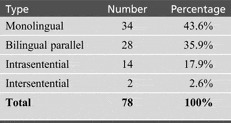
A total number of 94 real estate advertisements with English occurrence were collected. Among the specific products being advertised were apartments, villas, office buildings, complexes, shopping malls, and decoration services. As indicated in Table 1, residential property, namely, apartments and villas, accounted for the largest number of the total (75.6%), followed by office buildings (9.6%), complexes (7.4%), shopping malls (5.3%) and decorative services (2.1%). What was particularly noteworthy was that the highest frequency of English occurrence, except for English brand names, was in the domain of headlines. Following this, an analysis of English mixing in advertisement headlines was then carried out. Structurally, four types of English mixing in headline were recognized: monolingual (43.6%); entirely or partially bilingual parallel (35.9%) with Chinese and English translation or vice versa; intrasentential (17.9%) and intersentential Footnote 1 (2.6%), as indicated in Table 2.
A summary of products in China real estate advertising

A summary of types of English mixing in headline

The 71 residential property advertisements were taken as a major focus for examining the issue of language and national identity in this context. One reason for such a focus on identity issues is that research has revealed that many nation-states derive their collective meaning through the creation of ‘fictive ethnicity’ based on family, in which the home and the residential environment play a significant part (Balibar, Reference Balibar, Balibar, Wallerstein, Balibar and Wallerstein1991). This is particularly the case in China where, culturally, family and nation, or private and public, are not two separate realms. Since the time of Confucius, the family has been seen as the basic building block of Chinese society, and as an anchor for national identity. By virtue of the association of the family to 家 [jia, lit. ‘home’] and a house, the concreteness of jia and the significance of house can be extended to the nation.
Results and discussion
Data analysis revealed three themes of national identity constructed and presented in the advertisements studied: first the search of the nation for global belonging; second the preservation and affirmation of China as a distinctive collective; and third the construction of China as a growing power in the global political system, seeking to elevate its international status. The function of English in this context varied somewhat. In most cases English was used to explicitly present the first theme of national identity encoded through the semantic meaning of the headline and/or brand name. Compared with Chinese, this way of constructing identity through the use of English is arguably more powerful persuasively, given the symbolic values of English in relation to modernity and internationalization. Sometimes English was also employed to provide a semantic nuance or cultural meaning that its Chinese counterpart lacked. On other occasions, the use of English appeared to have little resonance with national identity but was merely used for ‘decorative’ purposes (McArthur, Reference McArthur1998). One point of significant relevance is that the role of English in most cases was not separably single but often complicated. In order to get a more comprehensive insight on the use of English and its possible contribution to constructing China's national identity, the following sections of this article discuss the three themes of national identity – global belonging, distinctive identity, growing power – and the possible association of English with them.
In search of global belonging
What struck me most while examining the data were the findings of an expressed orientation towards a global community. Of the residential housing advertisements, 24 (33.8%) used the English word global, international, or world or as a core word in their headlines. Representative headlines included BOBO International BOBO 国际 [Guoji, lit. international] (Bobo City);Footnote 2Dali Architecture, World Outlook (Dali Vista); Huzhou, Always Be Remembered By The World (Tian Yi Villa); and Master opens the international horizon of the financial street (C-Park). Other headlines are illustrated in Figures 1, 2 and 3 below.
The Global House advertisement ‘The world is flat’ headliner is parallel to its Chinese translation

The Parkvista advertisement: WHETHER AS A WORKPLACE OR RESIDENCE, PARKVISTA PUTS THE WORLD AT YOUR FEEET

The Mayland International Resort advertisement ‘EXPERIENCE OF THE SOUTH CALIFORNIA FLAVOR, ENJOY INTERNATIONAL NEW LIFE’

In addition, 17 residential housing projects (23.9%) and six office buildings (66.7%) were named, described, or presented in the same terms as foreign, particularly western, entities, as if they were in California, London, New York, Paris, Rome, etc. (see Figures 3, 4, 5 and 6). Interestingly, similitude in name is often accompanied with similitude in design through visual reference to architectural codes detachable from place (see Figure 4). The presentation of transnational space surely calls into question the conventional thinking both of living space and a sense of belonging, which contributes to orienting Chinese people towards internationalization.
The Notting Shire advertisement

The Bourton-on-the-water advertisement

The Beijing Bay advertisement Chinese villa, The nobility's class

As to the ways of naming practice, in addition to drawing occasionally upon relatively original architectural styles and developmental models, it was found common for the local properties to be marketed with a special brand name in terms of a place or country abroad. Given the fact that English is a global language, the practice of naming or describing the local properties in English rather than Chinese (see Figure 4) may serve as a vehicle for global affiliation, allowing China to venture outside of its own national boundaries to seek international similarities and a related sense of global belonging. While a few architectural styles and developmental models were presented exclusively in English, the names of foreign places and countries were not always presented in monolingual English. When used alongside its Chinese translation, English may serve a mainly ‘decorative’ purpose (McArthur, Reference McArthur1998) (see Figures 5, 6 and 7). Sometimes, however, buildings are named in Chinese but refer to international locations. So we have apartment blocks, villa estates and office buildings named in different forms like: Bourton-on-the-water, 英伦水岸 (Yinglun shui'an, lit. Bourton-on-the-water); Morgan Business, 摩根商务 (Mogen shangwu, lit. Morgan Business); 纳丹堡 (Nadan bao, lit. Nadan Castle); 芭堤水岸 (Badi shui'an, lit. Pattaya Bank); Notting Shire, 诺丁郡 (Nuoting jun, lit. Nottinghamshire); and 天籁莱茵 (tianlai Laiyin, lit. Tianlai Rhine).
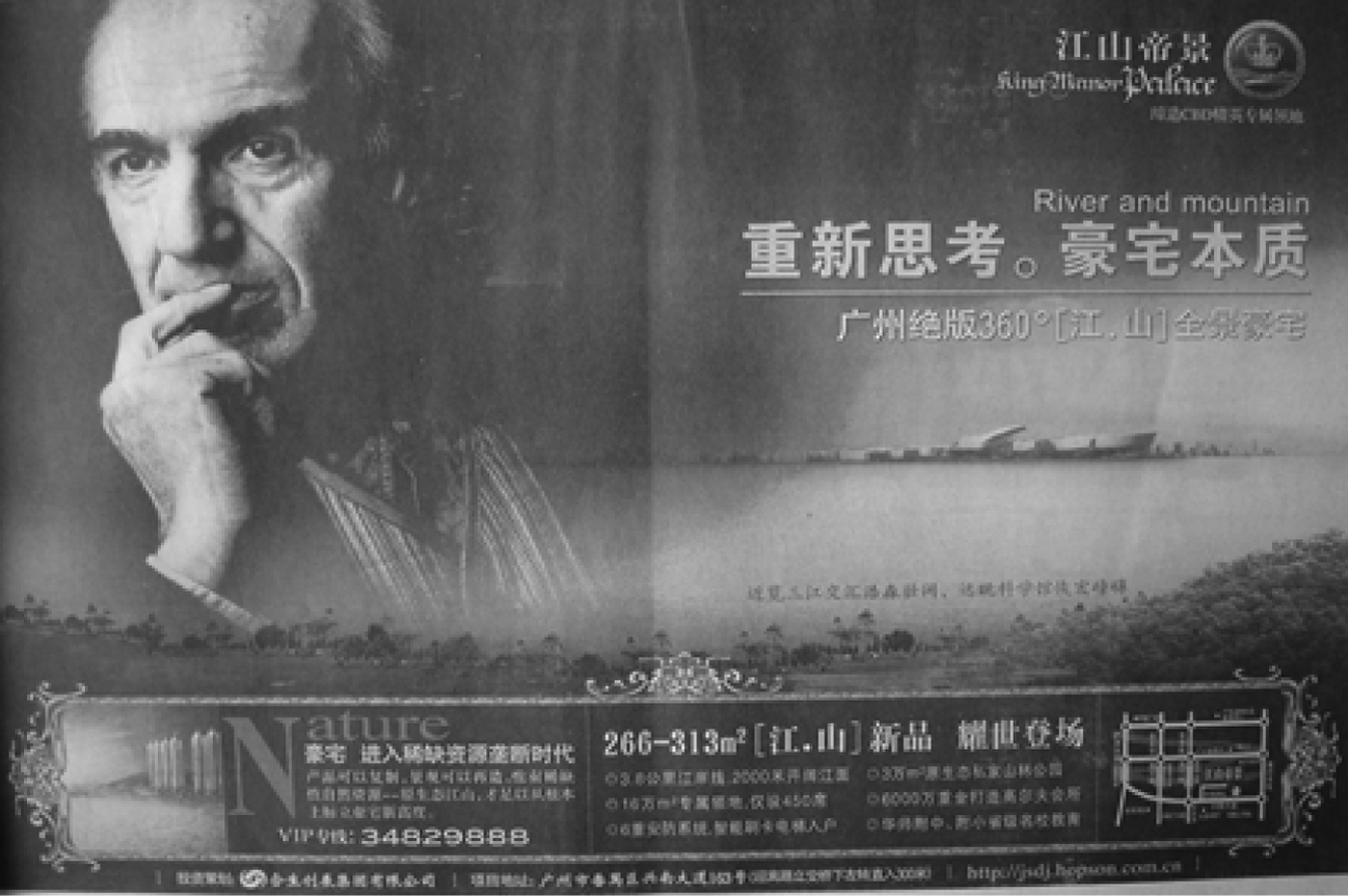
The Jiangshan Dijing advertisement: ‘King Manor Palace’

Aiming for a distinctive identity
Instead of blindly copying exotic foreign names for residential housing projects, sinicized names, such as 北京 CDB (lit. Beijing CDB), 保利 Cambridge (lit. Baoli Cambridge), 东方 LEHAS (lit. East LEHAS), and 宁波 HOPSCA (lit. Ningbo HOPSCA), were developed to define the attributes of nine residential housing projects (12.7%). This way of placing an extra Chinese name before an English head carries many localized connotations for the head concepts. While English was used to produce the originality of head concepts, the presentation of the modifiers in Chinese was basically grounded on the close association of Chinese with local distinction.
Another way of constructing China as distinctive is directly attaching local attributes to apartments and villas. Among the residential property advertisements, six (8.5%) were designed to highlight particular attributes of the local, either through the definition of the product, or by a focus on the ‘Chineseness’ of the architecture, or both. In these cases the use of English adds little to this theme of national identity. A good example is the Beijing Bay advertisement (see Figure 6), the headline of which is composed of the two syntactically parallel phrases:
中国大宅 万乘之尊 [zhongguo dazhai wancheng zhizun, lit. Chinese big house, the emperor with ten thousand chariots at his command] Chinese villa. The nobility's class.
The headline has the effect of linking the house advertised to two sets of social attributes, given the juxtaposition of 中国大宅 (zhongguo dazhai, lit. Chinese large house) with ‘Chinese villa’. However, despite the English nominal compound, the attributes of the villa are branded solely with intrinsic ‘Chineseness’, as visually indicated by the elements of traditional Chinese architecture in the illustration, private enclosure, rectangular courtyard, upwards-curving roof, and the high walls separating the handkerchief-sized plot securely from others. An appeal to traditional Chinese architecture is a useful discursive practice, by means of which the sense of a distinctive Chinese cultural community is conveyed.
Aspiring to be powerful
The architectural nostalgia, it is worth noting, that has the function of inspiring a sense of pride and value in China's architectural legacy is congruent with the nationalistic mood emerging from the historical recall of China's past greatness. Presented in the Beijing Bay advertisement, the aspiration of China to become a powerful nation in the new world order is mainly expressed through the inclusion of particular Chinese words and phrases appearing in the body copy, including 鼎级 [dingji, lit. ‘emperor-level’],Footnote 3 尊享 [zunxiang, lit. ‘your majesty’],Footnote 4 皇脉 [huanmai, lit. ‘the royal blood’], 宫纬 [gongwei, lit. ‘the royal palaces’], and 盛景 [shengjing, lit. ‘flourishing scene’]. Of particular note, shengjing, normally associated with the imperial glories under the dynasties of the Tang (618–907) and the Song (969–1279), is reminiscent of a flourishing age and past greatness. One point that must be made concerns the contribution of the English phrase ‘The nobility's class’ in the headline to the construction of this aspect of national identity. As this is presented in English, this phrase evokes the imagery of the upper class of China as well as the aristocratic system of Britain. In the data, the portrayal of China as a potentially powerful state is accomplished by connecting the qualities of residential properties to the glorious past of China or others through intertextual allusion. In addition to the headline of the Beijing Bay advertisement, found in the residential housing advertisements were four more headlines (7%) that explicitly promoted notions of royalty through the use of English words such as caste, king, princely and royal: Caste of surpassing quality, 巅峰身份 [dianfeng shenfen, lit. ‘summit identity’] (Star River); My Royal Life, My Gold Way (Gubei); Princely life by Forbidden City (Naga); and The great hills and lakes for the king (Lake Valley).
Intertextual practice of this kind was found quite clearly in the Jiangshan Dijing advertisement (see Figure 7 below). This advertisement is special in that its royal property is not only conveyed by the Chinese word 帝 [di, lit. ‘emperor’] being part of the brand name, but also enriched through the use of English words ‘King Manor Palace’ close to the emblem. More precisely, 帝 is associated with the social structure of the empire in the past of China, while the term manor refers to a large country house that belonged to people of a high social class in England. The advertisement gives the potential Chinese house purchaser the opportunity to buy into the aristocracy of imperial China or of the privileged classes of Britain. The attempt of elites in China to legitimize their new-found status and social standing may also be extended to the nation, and thus linked to China's growing power and its political aspirations on the global stage.
Conclusion
The findings of this study suggest that in public discourses the national identity of contemporary China is somewhat contested. Even though China's national identity is being somewhat eroded by transnational linguistic and cultural practices, there are attempts – even in advertising – to maintain and valorize its distinctive cultural identity.Footnote 5 With reference to real estate advertising, as this study has indicated, the role of English is not insignificant in the negotiation of national identity, with English used as a linguistic and cultural resource in somewhat surprising and unexpected fashion.
 SONGQING LI is currently Lecturer in English Language and Communication at Xi'an Jiaotong-Liverpool University, China where he teaches Advertising and the Media, and Business Communication. He obtained his PhD from the National University of Singapore (2010) and MA from the University of East Anglia (2004). His research interests include bilingualism in the mass media, critical discourse analysis, English as a global language, and multimodality. Email: lsq1004@gmail.com