Introduction
Melbourne (Australia) has been voted the world’s most livable city for the sixth consecutive year, where the Lord Mayor Robert Doyle said ‘We do not take this title for granted and are constantly planning and implementing policies that will continue to improve our quality of life’ (Wright, Reference WRIGHT2016). While improving the quality of life is essential to wellbeing, the Organization for Economic Cooperation and Development has said in their report that ‘citizens are not as healthy and happy as they deserve to be’ (OECD, 2010, p. 11). They point out that ‘education’ is a key factor that empowers people to improve their attitudes toward healthy lifestyles and quality of life. By providing education from an early age, Queano (Reference QUEANO2015) argues that children will learn that it is through education one can have better chances and opportunities in life, which in turn may improve the quality of life. Educational leaders across various sectors of government, departments of education, schools, and researchers have recognized that improving education outcomes ‘is not simply only through numeracy and literacy, but that positive school engagement as well as social and emotional wellbeing are also fundamental building blocks to success’ (Aebersold, Reference AEBERSOLD, Vaughan, Harris and Caldwell2011, p. 3). This paper forms part of a wider research project Pre-service teacher attitudes and understandings of Music Education [2013–2017] at an Australian metropolitan university in Melbourne where ethical approval was granted at Deakin University to undertake the study. The wider project investigated music pedagogies, teacher identities, and engagement in non-western music using interviews, questionnaires, and observation notes. This paper focuses on primary music education within the Bachelor of Education (primary), an initial teacher education (ITE) undergraduate program (course/degree) for non-specialist pre-service teachers (PSTs). The terms PSTs and students are used interchangeably. For this paper, the research focus is based on the question: Can positive learning environments change attitudes and build confidence for generalist students undertaking music education? I contend that a happy and safe environment may improve student’s confidence to participate in music activities and it may enhance their sense of overall wellbeing as generalist PSTs.
Confidence
Generalist teachers often lack confidence to teach music in the primary classroom (Biasutti, Hennessy & de Vugt-Jansen, Reference BIASUTTI, HENNESSY and DE VUGT-JANSEN2015; Joseph, Reference JOSEPH2014; Baldwin & Beauchamp, Reference BALDWIN and BEAUCHAMP2014; Ballantyne et al. Reference BALLANTYNE, MARGARET, SCOTT and MEISSNER2008; Russell-Bowie, Reference RUSSELL-BOWIE2009; Holden & Button, Reference HOLDEN and Button2006). Tertiary music educators are challenged to prepare students for the classroom. Research has shown that students lack prior music experience; some had bad music experiences at school and were told that they cannot sing; some lack commitment to engage with the subject as generalist students; some may not have had a chance to observe or teach music when on placement (Prichard Reference PRICHARD2017; Hennessy, Reference HENNESSY2017; Kelly, Reference KELLY2015; Ballantyne & Packer, Reference BALLANTYNE and PACKER2004). For some, the time allocated for music education within their ITE program is insufficient to fully prepare them as generalist music teachers (Jeanneret Reference JEANNERET1997; Parliament of Victoria 2013; Hennessy, Reference HENNESSY2017). In a recent Australian study, Garvis and Lemon (Reference GARVIS and LEMON2013) have found that the most prominent factor across 35 studies was that generalist primary teachers lack confidence in teaching the Arts (music). They found that many students had ‘little experience to draw upon to develop positive beliefs of teaching the Arts in generalist classrooms’ (Garvis & Lemon, Reference GARVIS and LEMON2013, p. 103). They argue that teacher confidence is formed during teacher training (Garvis & Lemon, Reference GARVIS and LEMON2013). A study undertaken by Holden and Button (Reference HOLDEN and Button2006, p. 36) confirms that students lack confidence to teach music as non-music specialist; the authors suggest here is a ‘need to increase teacher confidence in music, through developing subject knowledge and demonstrating to teacher’s musical activities which do not require a high level of musical performance on their part’. Students need to trail ideas in class that can be transferred into their future classrooms.
Preparing generalist students to teach music can be challenging. There is no recipe of how best to teach (Bloomfield, Reference BLOOMFIELD2010). Therefore, by providing a range of music activities that can be used in the classroom, modeling good practice that empowers students to take risks, and asking questions in a safe and happy environment may be a way for students to build their confidence and competency skills. Creating a learner-centered approach for students that promotes creativity and divergent ways of learning is essential in order for students to be active learners (Biasutti , Hennessy & de Vugt-Jansen, Reference BIASUTTI, HENNESSY and DE VUGT-JANSEN2015). This environment may foster a sense of wellbeing where students feel happy (Sheldon & Lyubomirksy, Reference SHELDON and LYUBOMIRKSY2006). From the analysis of questionnaire data, students reported a positive increase in their outlook to music education which may have enhanced their general wellbeing.
Wellbeing
Wellbeing is a multifaceted construct and difficult to accurately define. Nair, John, Mehrotra, & Kutty (Reference NAIR, JOHN, MEHROTRA and KUTTY2018, p. 69) suggest:
It denotes a good quality of life across several dimensions, including subjective wellbeing (high positive affect, low negative affect, high satisfaction with life), psychological wellbeing (self-acceptance, mastery and competence, positive relations and engagement and growth), meaning in life (framework for looking at life and sense of fulfilment), and quality of life (in the context of spiritual, religious and personal beliefs).
It is beyond the scope of this paper to discuss the various dimensions of wellbeing in life; rather it can be broadly defined as the presence of positive emotions (hedonia) and positive psychological and social functioning (eudaimonia) (Papinczak et al., Reference PAPINCZAK2015; Keyes, Shmotkin & Ryff, Reference KEYES, SHMOTKIN and RYFF2002). Burnard and Dragovic (Reference BURNARD and DRAGOVIC2015) point out that wellbeing and mental health include two key features, namely empowerment and active participation of individuals. This is as an important element contributing to the positive outcomes for wellbeing as it contributes to the social component of music engagement (Joseph & Southcott, Reference JOSEPH and SOUTHCOTT2018; Weinberg & Joseph, Reference WEINBERG and JOSEPH2017; Skingley, Martin & Clift, Reference SKINGLEY, MARTIN and CLIFT2016). Research has found that engaging with music offers a variety of benefits to health and wellbeing (Joseph & Southcott, Reference JOSEPH and SOUTHCOTT2017; Fancourt, Ockelford & Belai, Reference FANCOURT, OCKELFORD and BELAI2014; Hallam, Reference HALLAM2010; Clift, Reference CLIFT, Macdonald, Kreutz and Mitchell2012). Music brings much satisfaction, enjoyment, and happiness to people (Morinville, Miranda & Gaudreau, Reference MORINVILLE, MIRANDA and GAUDREAU2013) and has mental, physical, and emotional relations with wellbeing (Hallam, Reference HALLAM2010). Research shows the benefits of music education across all ages in relation to singing, health, and wellbeing (Adler & Seligman, Reference ADLER and SELIGMAN2016; Macdonald, Reference MACDONALD2013; MacDonald, Kreutz & Mitchell, Reference MACDONALD, KREUTZ and MITCHELL2012). In particular, the benefits of singing together or making music together are myriad (as found in the present study); these include: contributing to a sense of happiness, combating social isolation, releasing emotional stress, offering a sense of belonging, validation and purpose, and providing positive outcomes for wellbeing (Creech et al., Reference CREECH, HALLAM, VARVARIGOU and MCQUEEN2014; Hallam, Reference HALLAM2010; Clift et al., Reference CLIFT, HANCOX, STARICOFF and WHITMORE2008; Joseph & Southcott, Reference JOSEPH and SOUTHCOTT2015).
Though researchers have argued that experiencing and participating in music in isolation shows emotional and physical wellbeing (Khalifa et al., Reference KHALIFA2003), Lamont (Reference LAMONT2011) found that experiencing music with others has an improved positive outcome. Promoting a sense of independence, empowerment, competence, and belonging in the area of ITE is core to preparing students for future classrooms as their ‘pedagogical wellbeing’, a term coined by Soini, Pyhältö & Pietarinen (Reference SOINI, PYHÄLTÖ and PIETARINEN2010, p. 737). Therefore ‘developing teaching–learning process, including for example planning classroom activities, interacting with pupils, making evaluations, and choosing and developing instructional tools’ can be regarded as ‘pedagogical wellbeing’ in ITE (Soini, Pyhältö & Pietarinen, Reference SOINI, PYHÄLTÖ and PIETARINEN2010, p. 737).
Setting the scene
ITE programs in Australia prepare primary teachers for the profession as specialist and as generalist. ITE programs have been ‘significantly influenced by teacher registration institutes and the development of national guidelines and state requirements for teacher certification and registration’ (Knipe, Mills & Garoni, Reference KNIPE, MILES, GARONI, Brandenburg, McDonough, Burke and White2016, p. 390). At Australian universities, teaching courses are accredited through the Australian Institute for Teaching and School Leadership, which ensures that ITE program standards are met and align with Professional Standards for Teachers (Bahr & Mellor, Reference BAHR and MELLOR2016). The Arts (Dance, Drama, Media, Music, and Visual Arts) in Australia are core learning areas within the Australian Curriculum (ACARA, 2017).
This paper focuses on Primary Arts Education: Focused Study, a core unit (subject) taken in the fourth year of study by students within the Bachelor of Education (primary). There are two core arts education units within the 32-unit program. Music within the first is shared with other Arts education areas, and students only receive six hours during a eleven-week semester. For the second unit which is the focus of this paper, students self-select from Dance, Drama, Music, or Visual Arts one Arts area for a semester. They attend three hours across 11 weeks of the semester. Students are taught about the Victoria Curriculum, covering the elements of music through composition, creativity, and multicultural songs through a range of activities (singing, moving, listening, composing, and playing on melodic and non-melodic instruments). Content also includes teaching approaches such as Orff, Kodály, Dalcroze, and creative music making. In the main, students mostly learnt through seeing, hearing, and doing in-class; this approach of teaching and learning resonates with the Orff approach (Campbell, Reference CAMPBELL2008). During the class (workshop), theory is put into practice where students had the opportunity to experience hands-on practical music-making and sharing with their peers and the sessional tutor. This interaction gave them the opportunity to participate and reflect on what they learnt, how they learnt, as well as on ways to teach.
The music curriculum for the unit and assessment tasks is placed in the ‘cloud’ (online); this is prepared for the unit by myself (a full-time tertiary music educator) and taught by a part-time sessional tutor. In Australia, the word sessional is used for those who work on a contract basis and are part-time (Anderson, Reference ANDERSON2007). In addition to the face-to-face practical class, students are expected to weekly refer to the cloud material, which includes resources, reading materials, and recordings as part of their self-directed activities. Supplementary to this, the sessional weekly notes are a recap of the work covered. This would help those who may have missed the class or felt shy to ask questions in class. The online environment serves as a useful teaching and learning resource for assignments and for future use in classrooms. The weekly lessons were intentionally set up to be engaging, participatory, and non-threatening in order to foster a happy, safe, trustworthy, and enjoyable teaching and learning environment. The unit has two assignments: individual (essay type) and a group assessment (composition with an individual reflection).
Methodology
In this study, I employed qualitative research methodology as a purposeful way to describe, explain, and interpret the data as a holistic approach (Williams, Reference WILLIAMS2007). As a phenomenological qualitative case study, it is ‘bounded by time and activity’ (Creswell, Reference CRESWELL2014, p. 43) and is exploratory in nature (Yin, Reference YIN2009). Case study methodology is a way to understand and explain a phenomenon under study (Creswell & Poth, Reference CRESWELL and POTH2016; Baxter & Jack, Reference BAXTER and JACK2008; Merriam & Tisdell, Reference MERRIAM and TISDELL2016; Denzin & Lincoln, Reference DENZIN and LINCOLN2005). Do positive learning environments change attitudes and build confidence for generalist students? For this paper, I draw on questionnaire data gathered between 2014 and 2016 in a natural setting that includes participants’ viewpoints (Creswell, Reference CRESWELL1994; Williams Reference WILLIAMS2007).
Materials
Questionnaires are often used in qualitative research as a form of data collection to illustrate, elaborate, or probe, thus giving participants the chance to respond at their leisure, expressing their views, and in their own words (Bazeley, Reference BAZELEY2006; Creswell, Reference CRESWELL2014; Palinkas, Green & Hoagwood, Reference PALINKAS, GREEN and HOAGWOOD2015). Questionnaires ‘invite an honest personal comment’ (Cohen, Manion & Morrison, Reference COHEN, MANION and MORRISON2000, p. 255) and provide a ‘rich description of the respondent reality at a relatively low cost to the researcher’ (Jackson & Trochim, Reference JACKSON and TROCHIM2002, p. 307). In 2013, having reviewed anonymous unit evaluations from the university to improve the teaching and learning experience for both students and music educators, I designed a questionnaire that included two closed questions and ten open-ended questions. The questionnaire was initially piloted with a small sample in 2013 to improve the teaching and learning experience for students and teachers. According to Bird (Reference BIRD2009), closed questions are easy to analyze and code, whereas open questions are more difficult to analyze but are likely to provide responses that add depth and meaning. The closed questions required students to tick a box regarding their gender and age range. The open questions included: Why did you choose music as your study focus for this unit? What did you enjoy about the music class? What were some of the issues/limitations when working on the group assignment? Do you feel your confidence and competence has grown? Give reasons. What was challenging in the unit? Did you find the online material useful? Give reasons. Make any further comments about the primary music unit that would assist me in preparing future non-music specialists. Only some of the responses to the opened-ended questions will be discussed in the findings, giving participants the chance to express their views (Palinkas, Green, & Hoagwood, Reference PALINKAS, GREEN and HOAGWOOD2015).
At the end of the semester, all music students were provided with hardcopies of the Plain Language Statement and Consent Form. This was administered by either a research assistant, sessional music tutor, or myself. The document explained the wider study and included the anonymous questionnaire. Participation was voluntary. Upon completion, students could either place the questionnaire on the piano for collection or in a ‘drop off box’ pinned to the notice board outside my office.
Participants
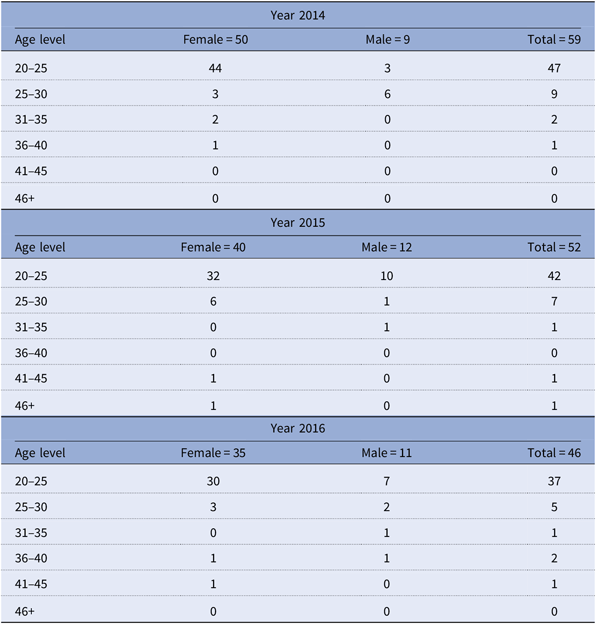
Students in their final year of study undertaking a core unit Primary Arts Education: Music Focused Study were purposively selected in order to ‘understand what happens or what things mean’ (Tai & Ajjawi, Reference TAI and AJJAWI2016). While age and gender are not the focus of the paper, Table 1 outlines the year of study, age, and gender of students. Across the study, the majority of students (80%) were in the age group of 20–25 across the three years.
Age, gender and year level

Table 2 outlines the number of music students enrolled and the number of students who completed the questionnaire.
Enrolment and response rate

Analysis
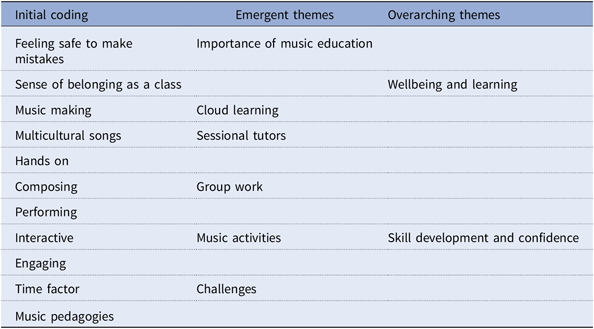
Thematic analysis was used as a strategy to analyze the data; this is commonly employed in qualitative research (Castleberry & Nolen, Reference CASTLEBERRY and NOLAN2018). Thematic analysis is a way of seeing, making sense, and analyzing qualitative information (Boyatzis, Reference BOYATZIS1998). Thematic analysis is a method that identifies, analyzes, and reports on themes that emerge from the data at a level and depth that quantitative analysis lacks (Braun & Clarke, Reference BRAUN and CLARKE2006). All questionnaires were compiled and grouped according to each question (Oppenheim, Reference OPPENHEIM1992). Answers were read and re-read before initial coding began. Inductive coding was guided by the content of the data (Braun & Clarke, Reference BRAUN and CLARKE2006). For this paper, data were coded into categories and grouped into two overarching themes (see Table 3). As no statistical data are reported, inferences to other institutions or learning areas cannot be made.
Table of themes

Findings
Most PSTs at some point of their schooling experienced music education – for some in a positive way; and some may have been told they cannot sing in tune or play in time, which may have negatively influenced their ability to want to participate in music activities in their ITE program. Because of this, some PSTs may feel they lack the confidence and competence to participate in class and feel nervous to teach music in their future classrooms as generalist teachers. The findings are reported under two overarching themes: Wellbeing and Learning, and Skill Development and Confidence.
Wellbeing and Learning
This overarching theme is discussed under three subthemes: importance of music education, cloud learning, and sessional tutors.
Importance of music education
Most PSTs chose music as a focus study because they ‘enjoyed the first core unit’; one said ‘I gained good ideas that I actually used on placement’; another similarly added, ‘I wanted to extend what I learnt’ and ‘I think music is important to include in the primary school’. Many PSTs said they ‘like music’, they ‘enjoy playing’, they ‘enjoy listening’, and they ‘enjoy singing’. Most PSTs said they recognized the importance of music in everyday lives and ‘wanted to learn more about how to teach it in the classroom’. At the fourth-year level of study, PSTs recognize that ‘music is hugely beneficial to make children feel a sense of belonging in the classroom’; they learnt about how music ‘creates a sense of community’ through ‘active participation’. It was interesting to note that some PSTs commented on the importance of music ‘involving all children in a fun activity’, allowing ‘children to be creative’, and making them ‘feel good to be able to participate’.
Those students who did not select music as their first choice were initially not happy about participating in class; they felt they had no choice as some were ‘automatically put into music by the system’; and some admitted, ‘music was the best time slot that correlated with my work hours so I chose it out of convenience not choice!’. Nevertheless, their attitudes changed as they felt ‘they gained confidence to be innovate’ to participate; they ‘felt included’ and warmed up to ‘feeling safe to make mistakes’ and ‘enjoyed and learnt about the benefits of music’. Through learning about multicultural songs, PSTs learnt about the importance of including children from different ethnic backgrounds. They commented on how music can help children ‘share their culture with others through song and feel good’, which resonates with the Victorian Curriculum that calls for ‘respecting music across cultures and traditions’ (Victorian Curriculum, 2017). Many PSTs related music teaching to improving children’s ‘listening skills’ and ‘reading skills’, which can only benefit and motivate children and give them ‘a sense of achievement and success’.
Cloud learning
In addition to face-to face classes, the cloud material was clearly set out weekly for students to engage with readings and activities. While many students felt it was ‘very thorough’ and ‘most informative’, ‘removing the stress of having to find things’ over the study, an even spread of PSTs felt they only looked at the material ‘to assist with the assignment’; and some admitted, ‘I never looked at it’. Some PSTs felt ‘the content was overwhelming’, ‘sometimes the links did not open’; and for non-music specialist, ‘it was too much of reading to sift through’ and ‘confusing as I am not a specialist’. One PST summed it by saying, ‘though I could not keep up with the readings, the teaching resources were useful for my future classroom’. It was heartwarming to note that some of the PSTs valued the weekly notes; some indicated, ‘it helped me understand and prepare for the class’; in the main, most of the responses indicated ‘it helped me with the assignments’, ‘it helped break down what I need to do for the assignment’. For many PSTs across the study, the cloud material was a space to ask the tutor questions if they felt shy to do so in class. One student summed up by saying, ‘it [the cloud material] made me feel comfortable to locate the material, making me feel less anxious as I am not musical’.
Sessional tutors
The sessional plays an important role in the teaching and learning of the unit and contributes to the overall wellbeing of the class where positive emotions associated with wellbeing are fostered. Sessional X took the class in 2014 and Y took the class in 2015 and 2016. The positive feedback about them was overwhelming from all PSTs. Words such as ‘excellent’, ‘outstanding’, ‘knows her stuff’, ‘enthusiastic’, and ‘passionate’ were among the common descriptors. PSTs in the main felt the sessional created a healthy environment that positively impacted their learning and wellbeing. The most common collective comments included: ‘Y was accommodating of our abilities and not scary’, ‘X gave us enough notes’, ‘X she made it easy for me to find everything and use it’, ‘X rocked’, ‘Y was wonderful, very supportive and enthusiastic’, and ‘Y was friendly, approachable and helpful’.
The sessional tutors were willing to take risks; they spent much time (online and face-to-face) with the students and gave them extra time out of class to help them gain skills and understand how to teach or integrate music into their future classrooms. PSTs felt empowered and enriched by the ‘personal care’ and interest shown by the sessional. PSTs said they felt the music workshop with the sessional made them feel ‘safe’ and ‘happy’ to a large extent while they ‘had fun’ and ‘enjoyed the activities’ and ‘felt good and confident to teach music’; they gathered enough ideas to be able to ‘unpack the curriculum’ and ‘integrate music into the classroom’. In 2015, an incursion took place where Musical Futures (2017) ran a two-hour workshop as part of the music teaching class, and PSTs strongly felt this aspect of the unit most fulfilling. PSTs commented, ‘playing the instruments was exciting and ‘working as a whole class bonded us as a class’. Many said they enjoyed the Musical Futures workshop; one PST summed it up, ‘a great opportunity I never played on the guitar before’; and another added, ‘I loved the drum beats and playing basics like chords to popular songs which children in school know’. Providing happy, positive, fun, and interactive teaching and learning experiences in music education may foster deeper learning where connections can be made between theory and practice.
Skill development and confidence
This overarching theme is discussed under three subthemes: group work, music activities, and challenges.
Group work
Undertaking group work in class and performing as a group when preparing a soundscape or playing instrumental accompaniment to a song or writing a rap was the highlight across the study; it created a positive healthy environment that fostered learning through enjoyment. Students commented: ‘working together allows for everyone’s input’, ‘group work allows for diversity of skills and abilities’, ‘the hands-on approach on to how to compose was great, and we forgot we were actually learning!’ Positive feedback about working with others included: ‘soundscapes is a great way to break up the written work kids learn’, ‘soundscape’s is great to integrate other learning areas’, ‘I can create a soundscape with the kids in my class as I did my own composition and worked with others so now I know how to do one’, and ‘it gave us all a feeling like we belonged and could do it’.
Negative comments from the data mainly resonated how some students found ‘it is challenging to work with peers of different musical abilities’. One student felt, ‘making a time to meet to rehearse was problematic’ and ‘coordinating the group to be in tune when singing and using effective movements was challenging’. Regarding the allocation of songs for their assignments, one PST said, ‘I don’t think it is fair for some groups to receive more high-pitched songs than others, unfortunately we are all not great singers!’ Some PSTs felt about group work thus: ‘you are put into groups with people you don’t necessary like’; this may make it stressful for students; however, it might also prepare them for the real world where they need to learn how to work with people they may not always get on with. Some PSTs felt getting on in the group was challenging, as either all wanted to take the lead or some merely went along for the ride and did the bare minimum. Some of the common comments that resonated time management included: ‘it was hard to make time to work on the group performance out of class time when we work’, ‘the music room and instruments were not always available which caused stress for members of the group especially when some students do attend class’, ‘allow more opportunities to access instruments for rehearsals outside of workshop times’, and ‘it is not fair if we work and have to also make time to practice’. One PST felt that ‘performing in front of everyone when I was not sure of what I was doing’ would leave you feeling anxious, scared, and nervous. This can negatively impact students’ ability to feel good about themselves or the subject.
Music activities
PSTs found that learning in a sequential way helped them to be able to participate and understand their music work (learning to compose, playing classroom instruments, and writing a rap). The hands-on experience provided PSTs with some skills to be able to trial in their future classrooms. By engaging, exploring, and experiencing practical in-class music activities, PSTs across the years found this was a great way to learn how to teach when they lacked the confidence or skills. PSTs felt empowered to participate in class; their confidence levels increased as non-music specialists; they said the class was ‘practical and we did activities that we could take away and use in our classrooms’, ‘it was interactive’, ‘it was fun’, ‘it was hands-on’, and ‘it was multimodal’. PSTs mostly felt they ‘learnt a variety of music activities that can be applied in their future classrooms’. Linking theory (curriculum and approaches of music) to practice in a ‘doing’ rather than ‘reading about it’ manner broadened students’ music knowledge, skills, and understandings.
Challenges
There were a range of challenges that some PSTs encountered; for example, some could not regularly attend all classes due to work or family commitments, consequently making it hard to catch up on in-class activities and the cloud material. Some students felt learning about different music approaches (Orff, Kodály, and Dalcroze) very confusing, especially when they missed class. Due to time constraints, three consecutive weeks were allocated for Orff, Kodály, and Dalcroze approaches. One aptly said, ‘I am still pretty muddled, I don’t know which is which’. Many PSTs felt ‘not being able to read the music score’, ‘not being able to confidently do the hand sings’, and ‘sing in tune’ were real challenges across the unit. While most found ‘the rhythmic games’ useful, fun, and exciting, many said, ‘using sol-fa’ was the hardest. The sessional tutor had to work hard to identify ways to build students’ confidence to overcome some of these challenges. The tutor, PSTs commented, ‘did not pick on us’, ‘made us feel comfortable to make mistakes’, and ‘slowly worked through teaching methods’. Though work was weekly uploaded online by the sessional tutor, some PSTs found it ‘boring and stiff’. PSTs commented about group work: ‘making time to write the rap was challenging’; ‘managing outside life and uni class commitments is a big challenge’. Many PSTs felt they did not always get enough time to write out their own notes in relation to how to teach; one summed it up by saying, ‘allow [us] time to write about things we did in class’.
Discussion
Tertiary educators in ITE primary programs are expected to create positive learning spaces for generalist PSTs so that would feel comfortable and confidence to include music in their future classrooms. Studies have found that PSTs lack confidence to teach music (Baldwin & Beauchamp, Reference BALDWIN and BEAUCHAMP2014). By creating a friendly, happy, and safe learning and teaching space, students felt confident to engage, experience, and explore music teaching and learning. From the above findings, comments from the PSTs showed that their confidence and competency skills, knowledge, and understandings over the course of the unit improved. Those having negative attitudes about music education may have been told in their primary school that you ‘can’t sing in tune’, ‘you can’t keep to the beat’, and ‘you not musical’; they soon recognized the myriad benefits of music education in the primary school through reading material and in-class activities (Parliament of Victoria, 2013). All participants across the study were ‘willing to give it a go’ as a core unit; they needed to be engaged in order to pass their ITE program. It has been argued that PSTs lack a belief in themselves to confidently teach music as generalist teachers (Biasutti , Hennessy & de Vugt-Jansen, Reference BIASUTTI, HENNESSY and DE VUGT-JANSEN2015; Russell-Bowie, Reference RUSSELL-BOWIE2009; Holden & Button, Reference HOLDEN and Button2006). However, I contend that creating a teaching and learning environment that is participatory, engaging, and non-threatening may help improve students’ confidence levels (Holden & Button, Reference HOLDEN and Button2006).
Though music engagement can be enjoyable, inspiring, and fulfilling, it can also cause PSTs to be anxious if they feel they are not musical. The feedback about the cloud material was rather overwhelming for many students. While it was time-consuming to set up the weekly material by myself and by sessional tutors, it helped with assessments, and it served as a useful resource. The online and face-to-face environments ‘were highly valued’ by the students as these served as a learning repository (Torrisi-Steele & Drew, Reference TORRISI-STEELE and DREW2013). Overall, the hands-on activities provided PSTs with a range of experiences to draw on for the assignments and for their future classrooms (Garvis & Lemon, Reference GARVIS and LEMON2013). The psychological feeling of being included and also engaging with the material in class and online fosters a sense of wellbeing in student learning (Burnard & Dragovic, Reference BURNARD and DRAGOVIC2015). While students did not have the chance to trial lessons when on placements, which may have improved their confidence and boosted their morale (Hennessy, Reference HENNESSY2006), the in-class, hands-on experiences gave them much enjoyment, satisfaction, and happiness (Morinville, Miranda & Gaudreau, Reference MORINVILLE, MIRANDA and GAUDREAU2013), which may contribute positively to their overall wellbeing. While there was much to cover in a short time – for example, teaching about the Orff, Kodály, and Dalcroze approaches – the teaching–learning experience proved beneficial for students and for their future classrooms. It is no surprise that time provision for music education within ITE programs is rather limited (Prichard Reference PRICHARD2017; Kelly, Reference KELLY2015; Hennessy, Reference HENNESSY2017; Garvis & Riek, Reference GARVIS and RIEK2010).
Undertaking the teaching and learning activities as a group showed ‘clear benefits to be gained, not only musically, but personally and socially’ (Kokotsaki & Hallam, Reference KOKOTSAKI and HALLAM2007, p. 107). Though PSTs said there is ‘too much to learn and do’, ‘I felt pressured as I am not musical’, and ‘I felt things were rushed as we had lots to cover’, they also learnt over the semester how to ‘show respect’, ‘build on the strength of other’s when composing’, ‘listen to others’, and ‘work cohesively’. Such comments promote a healthy teaching and learning environment that may foster wellbeing (Southcott & Joseph, Reference SOUTHCOTT and JOSEPH2015). The sessional tutors presented an environment that offered the PSTs a sense of belonging, providing fun activities to understand the music component within the Victorian Curriculum (Victorian Curriculum, 2017). As voice (singing) was often used, the sessional tutors encouraged group activities and class singing that contributed to students feeling happy and good about their efforts and progress, all of which resonate with positive outcomes of wellbeing (Creech et al., Reference CREECH, HALLAM, VARVARIGOU and MCQUEEN2014; Hallam, Reference HALLAM2010; Clift et al., Reference CLIFT, HANCOX, STARICOFF and WHITMORE2008; Joseph & Southcott, Reference SOUTHCOTT and JOSEPH2015). By providing a positive learning experience, the sessional helped build a ‘caring’, ‘respectful’, and ‘safe’ classroom where individual abilities were considered, giving all PSTs the opportunity to succeed and gain confidence. One effective way of fostering a positive environment was through group activities. Thram (Reference THRAM2015, p. 68) suggests that ‘group participation in music making should be central to music education’.
Conclusion
The teaching staff must provide a ‘pedagogy of wellbeing’ (Soini, Pyhältö & Pietarinen, Reference SOINI, PYHÄLTÖ and PIETARINEN2010) that promotes competence, confidence, empowerment, and belonging when preparing music generalist teachers for future classrooms. By reflecting and commenting on PSTs’ work, the sessional tutors modeled what would be expected of teachers at schools in Australia. As future teachers, PSTs learnt through in-class activities and group work that was ‘interactive’, inclusive’, ‘learner-centered’, and ‘collaborative’. They learnt how to embrace social learning as a way to make their future students feel included, safe, and supported. However, ‘there is much work still to be done in providing non-specialists with effective long-term training and support to increase their music skills, subject knowledge, and confidence, to enable them to make a more marked difference to children’s [music] education’ (Holden & Button, Reference HOLDEN and Button2006, p. 23). It is a good starting point for tertiary music educators to spend much time planning, preparing, and presenting the best they can in order to improve teachers’ and students’ overall wellbeing. A happy teaching and learning environment breeds success for all concerned.
Despite being a small study, which is a limitation in itself, the research by Mayer (Reference MAYER and Mayer2017) has reported that small-scale studies are desirable as these inform and contribute to teacher education practice. It has shown that by providing a constructive, happy, fun, enjoyable, and safe learning and teaching space, PSTs’ attitudes about teaching music as generalists in primary classrooms have largely shifted as their confidence and competency levels have increased. In this way, their overall sense of wellbeing in a positive environment may have improved. The Department of Education and Early Childhood (2014, p. 31) advocates that all education settings have the capacity to ‘promote and nurture the health, wellbeing and engagement of learners’, and argues that this can be done by ‘providing high quality education programs for all learners’.
While this study was undertaken at one university, a limitation in itself, generalizations to other universities in Australia cannot be made. Another limitation was that only one type of research instrument was employed, and no statistical data were included. If the study is to include universities within Australia and/or internationally, I recommend that interview data of students and teaching staff and observation notes be included and a mixed-methods approach be adopted. To further explore PSTs’ lived experience, I recommend a longitudinal study to provide evidence showing what teaching approaches are most effective in developing students’ confidence and sense of wellbeing. These insights may assist when designing new units for ITE programs. Further longitudinal research could also include primary schools where PSTs could teach a collection of multicultural songs as a way to explore cultural diversity. This would help gain a better understanding of how music education is valued by PSTs and children at schools. I contend that a happy and safe environment may improve PSTs’ confidence to participate in music activities; it may even enhance their sense of overall wellbeing. Though this paper highlighted the aspects of music teaching and learning in promoting PSTs’ wellbeing, further longitudinal studies are needed within teacher education courses focusing on innovative ways of teaching and learning that can promote healthy minds for living and learning.