I. INTRODUCTION
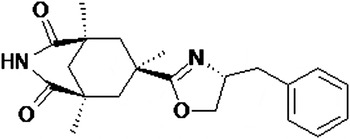
(1R,5S,7R)-7-[(S)-4-benzyl-4,5-dihydrooxazole-2-yl]-1, 5,7-trimethyl-3-azabicyclo-[3.3.1]-nonane-2,4-dione (Figure 1) represents a key building block of Ru or Ir organometallic complexes which could potentially be suitable as a stereoselective catalyst of the asymmetric hydrogenation reaction.
Structural formula of the title compound, (1R, 5S, 7R)-7-[(S)-4-benzyl-4,5-dihydrooxazole-2-yl]-1,5,7-trimethyl-3-azabicyclo-[3.3.1]-nonane-2,4-dione.

Production of enantiomerically pure compounds is an important task for today's chemistry, especially because opposite enantiomers have usually different effects on the live system. Asymmetric hydrogenation represents nowadays a valuable and versatile method of production of enantio-enriched material starting from an achiral precursor.
II. EXPERIMENTAL
A. Sample preparation
The title compound was prepared according to the general procedure published by Yanagisawa et al. (Reference Yanagisawa, Watanabe, Kikuchi and Yamamoto2000). The key starting compounds were cis,cis-1,3,5-trimethyl-1,3,5-cyclohexane-tricarboxylic acid (Kemp's acid) and (S)-2-amino-3-phenyl-1-propanol (l-phenylalaninol). The product crystallized after evaporation from ethyl acetate. The structure was confirmed by nuclear magnetic resonance analysis.
B. Diffraction data collection and reduction
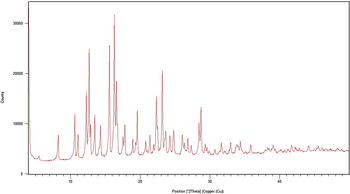
The diffraction pattern for the title compound was collected at room temperature using an X'Pert PRO θ–θ powder diffractometer with parafocusing Bragg–Brentano geometry and CuKα 1 radiation (λ = 1.5406 Å; generator setting: 40 kV, 30 mA). An ultrafast X'Celerator detector was employed to collect XRD data over the angular range from 4 to 60°2θ with a step size of 0.017°2θ and a counting time of 20.32 s per step. The experimental powder diffraction pattern is depicted in Figure 2. The software package HighScore Plus V3.0d (PANalytical, Almelo, Netherlands) was used to smooth the data, to fit the background, and to eliminate the Kα 2 component. The top of the smoothed peak method was used to determine the peak positions and intensities of the diffraction peaks.
X-ray powder diffraction pattern of the title compound using CuKα 1 radiation (λ = 1.5406 Å).

Automatic indexing of the experimental XRD pattern was done using DICVOL04 (Boultif and Louër, Reference Boultif and Louër2004).
III. RESULTS
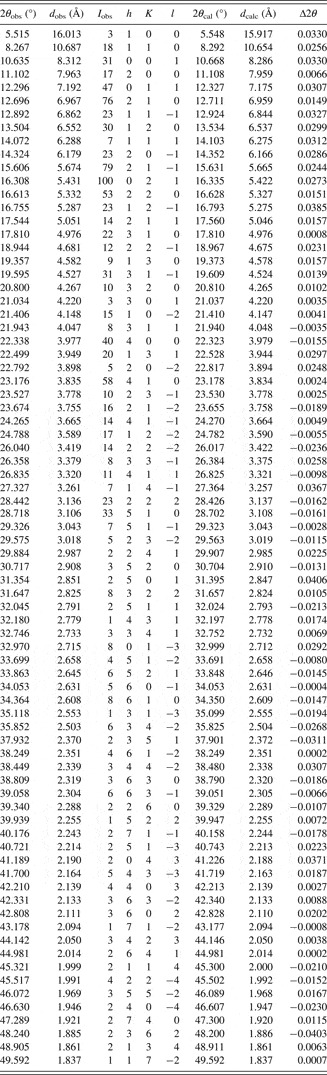
Automatic indexing results obtained by DICVOL04 show that the title compound is monoclinic with space group P21 and unit-cell parameters: a = 16.061(4) Å, b = 14.340(5) Å, c = 8.361(2) Å, β = 97.678(4)°, unit-cell volume V = 1908,54 Å3, and Z = 4 (Table I). The figures of merits are F 20 = 185.9(0.0037, 29) (Smith and Snyder, Reference Smith and Snyder1979) and M 20 = 69.3 (de Wolf, Reference De Wolff1968). All the lines were indexed and are consistent with the P21 space group.
Indexed X-ray powder diffraction data for the title compound, C21H26N2O3. Only the peaks with I rel of 1 or greater are presently reported [a = 16.061(4) Å, b = 14.340(5) Å, c = 8.361(2) Å, β = 97.678(4)°, unit-cell volume V = 1908.54 Å3, Z = 4, and space group P21]. All measured lines were indexed and found to be consistent with the P21 space group. The d-values were calculated using CuKα 1 radiation (λ = 1.5406 Å).

ACKNOWLEDGMENT
This work was supported by the Grant Agency of the Czech Republic (grant no. GAČR 104/09/1497).