Introduction
The demand for out-of-hospital emergency medical services (EMS) has increased worldwide.Reference Wrigley, George, Smith, Snooks, Glasper and Thomas1, Reference Lambe, Washington and Fink2 This is also the case in Japan, where the number of ambulances dispatched in many cities has continued to increase over several decades. In Tokyo, for example, the number of emergency transports of patients increased from 480,139 in 1998 to 583,082 in 2008, an increase of approximately 21%.3
For critical patients, the first link in the chain of survival is prehospital time, and attempts have been made to improve survival after cardiac arrest, in particular, by minimizing this time. It has been shown convincingly that the delay from estimated time of collapse until defibrillation is of ultimate importance among patients who are found in ventricular fibrillation.Reference Herlitz, Ekström, Wennerblom, Axelsson, Bång and Holmberg4, Reference Holmberg, Holmberg and Herlitz5 Additionally, it has been shown that the outcome of acute myocardial infarction is related to the time between the onset of symptoms and the start of thrombolytic treatment.Reference White, Norris and Brown6, 7
In Japan, stroke represents a leading cause of death and serious long-term disability, and imposes the greatest burden on health care resources. Timely access to acute medical treatment may be critical for patients with severe stroke. In cases of acute ischemic stroke, reducing the time to treatment with a tissue plasminogen activator, even within the three-hour time window, is crucial for improved outcome.Reference Marler, Tilley and Lu8 More recently, a new treatment for intracerebral hemorrhage, which must be administered within a limited period of time (four hours) after symptom onset, has emerged.Reference Mayer, Brun and Begtrup9 Thus, delays in the prehospital setting must be minimized in order that patients suffering a stroke can receive effective treatment as quickly as possible. Several studies have investigated social and demographic factors associated with prehospital delays among stroke patients.Reference Kleindorfer, Lindsell and Broderick10-Reference Chang, Tseng and Tan12 However, little information is available about the impact of prehospital delays on the subsequent clinical conditions of stroke patients.
The impact of a short prehospital delay on the mortality rates of stroke patients may be less relevant than the impact of such delays on the mortality rates of those experiencing heart attacks. However, it is possible that prehospital delays lead to neurological deterioration. One of the most important indicators of neurological status is level of consciousness, which is strongly associated with outcome in stroke patients. Clinicians often decide whether treatment should proceed aggressively or be discontinued on the basis of the patient's level of consciousness. In particular, the withdrawal of care occurs most frequently in patients with Glasgow Coma Scale (GCS) scores of 3 or 4 (decerebrate status and no response, respectively), values that indicate irreversible brain damage. Thus, the GCS at admission may greatly influence a patient's prognosis.
The aim of this study was to examine the impact of prehospital delays on the level of consciousness exhibited by patients with severe stroke at admission who had been transported by Emergency Medical Services (EMS).
Methods
This retrospective study assessed patients diagnosed with cerebrovascular diseases and admitted to the Trauma and Critical Care Unit of a hospital in Tokyo, Japan from April 1998 through March 2008. The Trauma and Critical Care Unit, in which all patients with neurological symptoms are evaluated, serves tertiary emergency cases. The diagnosis of cerebrovascular diseases is based on computed tomography and/or magnetic resonance imaging performed on all patients. The study protocol was approved by the internal review board of Teikyo University School of Medicine.
Data on the time of the following prehospital events were obtained: (1) time of the call to the ambulance service; (2) time of the arrival of the ambulance at the patient's location (on-scene); and (3) time of the arrival of the ambulance at the hospital. Additionally, the following demographic and clinical data were obtained from medical records: sex; age; type of stroke; and GCS score at admission.
The medical records of all patients diagnosed with cerebrovascular diseases and admitted to the Trauma and Critical Care Unit of the hospital were reviewed. Cases with the following exclusions were not included in the study: (1) missing data for the time from call to the time of ambulance arrival on-scene, or from the time from ambulance arrival on-scene to arrival at the emergency center (hereafter referred to as the center); (2) missing data on the patient's GCS score at admission; and (3) > 60 min elapsed time from call to arrival at the center.
Glasgow Coma Scale scores at admission were categorized as: 3 and 4; 5 through 8; 9 through 12; and 13 through 15. Data were collected on the distributions of GCS scores in 5-minute intervals from call to arrival at the center. A Cochran-Armitage trend test was used to determine whether the proportion of GCS scores of 3 and 4 increased as a function of the time from call to arrival at the center. A logistic regression model was constructed to predict GCS scores of 3 and 4 at admission. Two multivariate models were produced: Model 1 included sex, age, time from call to arrival on-scene, and time from arrival on-scene to arrival at the center; and Model 2 included sex, age, and time from call to arrival at the center (time from call to arrival on-scene plus time from arrival on-scene to arrival at the center). Values of P < .05 were deemed to indicate statistical significance. All analyses were performed using SAS v. 9.1 software (SAS Institute Inc., Cary North Carolina, USA).
Results
A total of 882 patients with symptoms of a stroke were admitted to the hospital Trauma and Critical Care Unit from April 1998 through March 2008. Of these, data from the charts of 170 patients met exclusion criteria, and were excluded from analysis, leaving a sample size of 712. The sample consisted of 51% males and 49% females of ages ranging from 10 to 95 years (mean 64, SD = 13 years with missing age data for one patient). Of the total sample, 375 patients (53%) were diagnosed with intracerebral hemorrhage, 280 (39%) with subarachnoid hemorrhage, 54 (8%) with cerebral infarction, and three with other diagnoses. The mean GCS score at admission was 6 (SD = 3), and nearly 80% (n = 551) of the patients were deeply comatose; 313 (44%) patients had GCS scores of 3 and 4; 238 patients (33%) had GCS scores of 5-8; 101 (14%) patients had GCS scores of 9-12; and 60 (8%) patients had GCS scores of 13-15.
The mean time from call to arrival on-scene was 7 (SD = 3) minutes (median 7; interquartile range 5-9); mean time from arrival on-scene to arrival at the center was 30 (SD = 8) minutes (median 29; interquartile range 25-35); and mean time from call to arrival at the center was 37 (SD = 8) minutes (median 36; interquartile range 32-42). Figure 1 presents the distribution of GCS scores at admission according to time from call to arrival at the center. Results of the Cochran-Armitage trend test indicated that the proportion of patients with GCS scores of 3 and 4 increased significantly as a function of time from call to arrival at the center (P = .032).
Distribution of the Glasgow Coma Scale (GCS) Scores at Admission by 5-minute Intervals from Call to Arrival at the Center. The proportion of patients with GCS scores 3 and 4 significantly increased over time (P = .032).

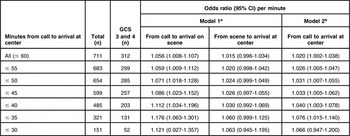
A logistic regression model for predicting GCS scores of 3 and 4 was produced. In Model 1, a longer call-to-on-scene time was significantly associated with poor GCS scores (OR =1.056/min; 95%CI = 1.008-1.107) (Table 1). When the data on prehospital times were analyzed in terms of 5-minute intervals, odds ratios were greater in patients with shorter call-to-on-scene times, with the exception of patients with delays of ≤30 min.The effect of call-to-on-scene time was the greatest when the analyses were restricted to patients waiting for ≤35 min (OR = 1.176; 95% CI = 1.063-1.301). Similarly, in Model 2, a longer call-to-center time was significantly associated with poor GCS scores (OR = 1.020; 95% CI = 1.002-1.038). The effect of call-to-center time was the greatest in patients with waiting times of ≤35 min (OR = 1.076; 95% CI = 1.015–1.140).
Logistic Regression Analysis Predicting GCS Scores of 3 and 4 at AdmissionFootnote c

a Model 1 included sex, age, time from call to arrival on-scene, and time from arrival on-scene to arrival at the center.
b Model 2 included sex, age, and time from call to arrival at the center.
c One patient was excluded due to missing age data.
Abbreviations: CI, confidence interval; GCS, Glasgow Coma Scale.
Discussion
In this study, prehospital delays were significantly associated with poorer GCS scores at admission in patients with severe stroke. While the observed differences between GCS groups in prehospital delays were relatively small in terms of minutes, they were clinically significant. The influence of these time intervals on consciousness level is relevant and important, as it may underscore larger issues that affect the overall access to care among these patients.
On average, the time following a call for an ambulance to its on-scene arrival was very short, just seven minutes. The average time from ambulance call to arrival at the center for the acute stroke patients in the study was 37 minutes. These time intervals are similar to previously published prehospital waiting times for both myocardial infarction and stroke.Reference Kleindorfer, Lindsell and Broderick10, Reference Hutchings, Mann and Daya13, Reference Evenson, Schroeder, Legare, Brice, Rosamond and Morris14
However, in this study the time from the call for an ambulance to the ambulance's arrival on-scene significantly influenced the level of consciousness of patients, independent of the time from the ambulance's arrival on-scene to its arrival at the center. The findings from this study indicate that patients who experienced a shorter interval between the call for an ambulance and the arrival of the ambulance on-scene exhibited a more favorable risk profile than patients who experienced a longer time interval. It is not clear why a small difference in the time from the emergency call to the arrival on -scene precipitated poor GCS scores. Indeed, EMS in Japan is intended to provide transportation rather than prehospital medical care, and only a few members of the ambulance teams are qualified as Emergency Life-Saving Technicians and are allowed to administer defibrillation and medication.15 It is unclear how early arrival on the scene related to preventing neurological deterioration. Members of ambulance teams usually give supplemental oxygen to unconscious patients, which may have affected patients’ levels of consciousness, although oxygen supplementation after admission did not appear to be of benefit to stroke patients studied in previous research.Reference Rønning and Guldvog16
Patients in Japan are not responsible for the costs associated with prehospital care. Calling for an ambulance for minor conditions or when one's own transportation to the hospital is unavailable occurs frequently in Japan. Given that increased use of ambulances consumes capital and human resources, it is important to limit the use of ambulances for non-essential services to minimize delays within the EMS system.
This study has some limitations that must be considered when interpreting the results. Importantly, the results may not be directly applicable to other emergency service groups, particularly those providing non-urban emergency services. This study did not investigate the direct association between prehospital delays and deterioration in consciousness. Information on the level of consciousness at onset, at ambulance call, or on-scene was not available. Thus, it is unclear whether prehospital delays led directly to neurological deterioration. However, it is unlikely that it took longer to transport patients with poor GCS scores than to transport those with better GCS scores, given that ambulance members would likely take note of patients with poor GCS scores and try to transport them as rapidly as possible. The data did not reveal any association between prehospital delays and patients’ outcomes, measured in terms of survival or neurological functioning at discharge (data not shown). However, admission GCS scores of 3 or 4 compared with GCS scores of ≥5 were significantly associated with mortality at discharge (74% vs 25%; chi-square test = P < .001; missing data = 27).
Conclusions
This study showed that prehospital delays were significantly associated with poor levels of consciousness at admission among patients suffering from severe stroke. As level of consciousness is strongly associated with outcome in stroke patients, reducing prehospital time may be essential to improving outcomes in patients with severe stroke.