INTRODUCTION
Mangroves are a major component of tropical and sub-tropical semi-closed intertidal regions that support rich fauna and play an important role in estuarine and coastal food webs (Alongi & Christoffersen, Reference Alongi and Christoffersen1992; Barbier et al., Reference Barbier, Hacker, Kennedy, Koch, Stier and Silliman2011; Gajdzik et al., Reference Gajdzik, Vanreusel, Koedam, Reubens and Muthumbi2014). These areas are commonly colonized by associations of benthic invertebrates living in or on the substrate, having a high taxonomic diversity and occupying different microhabitats according to their life habits (Nagelkerken et al., Reference Nagelkerken, Blaber, Bouillon, Green, Haywood, Kirton, Meynecke, Pawlik, Penrose, Sasekumar and Somerfield2008).
Benthic invertebrates play an important role in the mangroves by helping to cycle and conserve nutrients in the system including the consumption of microphytobenthic individuals, plant debris and detritus deposited in the sediment, thus incorporating organic matter in their biomass (Koch & Wolff, Reference Koch and Wolff2002). They are also responsible for the transformation of detritus, facilitating mineralization by bacteria, and also promoting oxygenation of the substrate through bioturbation and sediment remobilization (Coull, Reference Coull1999; Koch & Wolff, Reference Koch and Wolff2002).
Knowing the relationship between benthic fauna and sediment is a prerequisite for understanding the structure and dynamics of benthic associations. Several authors, studying the relationships between organisms and sediments in marine and estuarine environments (Forbes & Lopez, Reference Forbes and Lopez1990; Snelgrove & Buttman, Reference Snelgrove and Buttman1994), found that the benthic invertebrates are closely related to the sediments they inhabit. The highest density of these organisms occurs in unconsolidated substrate, consisting predominantly of quartz sand, reducing dark mud, shell fragments, oyster beds and mangrove remains (Snelgrove & Buttman, Reference Snelgrove and Buttman1994; Giere, Reference Giere2009). Individual occurrences tend to be higher in mud or fine sand, rich in organic matter, and lower in coarse and medium sand (Selleslagh et al., Reference Selleslagh, Lesourd and Amara2011).
Species distribution is controlled by characteristics of the mangrove community, sediment properties and tidal changes (Yijie & Shixiao, Reference Yijie and Shixiao2007; Lee, Reference Lee2008). The mangrove fauna often show horizontal and vertical zonation (Farrapeira et al., Reference Farrapeira, Ramos, Barbosa, Melo, Pinto, Verçosa, Oliveira and Francisco2009; Santos et al., Reference Santos, Gomes, Vasconcellos, Silva and Araujo2014). Some of them dominate in mud areas whereas others are dominant on the shrubs and leaves and around pneumatophore roots (McLachlan et al., Reference McLachlan, Winter and Botha1977). The pattern of vertical distribution of infauna is an important aspect of the structure, species interactions and organism activity in the soft bottom sediments (Safahieh et al., Reference Safahieh, Nabavi, Vazirizadeh, Ronagh and Kamalifar2012). Notwithstanding, highest macroinfauna densities were always observed in the surface sediments and both predation and physical disturbance act mainly on the upper layer of sediments, where their effects are more visible than in deeper layers (Alongi & Christoffersen, Reference Alongi and Christoffersen1992; Dittmann, Reference Dittmann2000; Valença & Santos, Reference Valença and Santos2013).
The mangrove vegetation also plays an essential role related to protection of many species that dwell there. The prop-roots and pneumatophores of mangrove trees form a habitat for a wide variety of species and become home to terrestrial as well as marine plants, algae, invertebrates and vertebrates, some occurring in high densities (Manson et al., Reference Manson, Loneragan, Skilleter and Phinn2005). Mangrove roots work as filters to retain sediment, preventing erosion and stabilizing the coast (Barbier et al., Reference Barbier, Hacker, Kennedy, Koch, Stier and Silliman2011). At the same time, the structural complexity of the substrate increases the rate of colonization and the available area for the fauna establishment (Jacobi & Langevin, Reference Jacobi and Langevin1996). In addition, the mangrove vegetation protects organisms which suffer the influence of tides, predation and competition (Corrêa et al., Reference Corrêa, Oliveira and Uieda2008).
Despite their ecological importance, little is known about the relationship between benthic invertebrates distribution and the local habitat characteristics in south-eastern Brazil mangroves. It is very important to provide information on the benthic fauna in mangroves to improve our understanding of the importance of these coastal systems and to help support effective management plans and actions for ensuring their wise use and protection. The aim of this study was to investigate the spatial and temporal distribution of the benthic community in a mangrove channel located in the inner area of the Sepetiba Bay. In addition, we attempted to describe the type of substrate determinant on the distribution of species and the role of the prop roots on the maintenance of local benthic fauna. The tested hypotheses are that the most abundant groups avoid competition as they occupy different types of substrata, and that the longitudinal distance from the sea also affect the occurrence and distribution of the benthic fauna across the channel.
MATERIALS AND METHODS
Study area
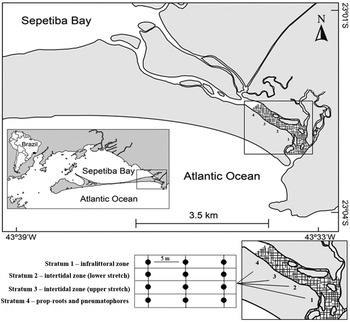
The Guaratiba mangrove is located in the inner area of the Sepetiba Bay in a protected area, the Biological and Archaeological Reserve of Guaratiba (RBAG) (Figure 1). This reserve was created by the State Law no. 7.549 of 20 November 1974, which defined the first limits of this area, incorporating in its perimeter the Guaratiba mangrove. Guaratiba coastal plains are located between coordinates 43°35′–44°01′W and 22°53′–23°05′S, in the north-east part of the Sepetiba Bay (Figure 1). The tidal wave is stationary type, modulated by other physical factors such as winds, bottom morphology and channel morphology. Annual average water temperature is 23.5°C and average rainfall is ~1300 mm, with peaks of rainfall in January and March and drought in June and August (Soares & Schaeffer-Novelli, Reference Soares and Schaeffer-Novelli2005). This study was conducted in the Guaratiba mangrove main channel, which has a length of ~2.2 km and connects the bay to the Atlantic Ocean.
Study area with indication of the four stations and four strata sampled in the Guaratiba Mangrove main channel.

The mangroves have well-preserved forests and hypersaline plains with integrated systems: ocean, estuary, rivers, mangrove forests and channels, forming a complex ecosystem. This region is characterized by a microtidal regime, with a tidal range below 2 m. The mangrove forest is composed of Avicennia schaueriana, Laguncularia racemosa and Rhizophora mangle. The areas near tidal channels are dominated by R. mangle with an increase in the contribution of A. schaueriana and L. racemosa towards the continent (Soares & Schaeffer-Novelli, Reference Soares and Schaeffer-Novelli2005). This ecosystem is ecologically important for its high productivity, retention of fine sediment, preventing channels silting and trapping of heavy metals.
Field sampling
Data collection was conducted between October 2008 and August 2009, according to a systematic design (Figure 1) in four areas of the main mangrove channel (station 1, the outermost station – near the sea connection; stations 2 and 3, intermediate stations; station 4, the innermost station). Samplings were designed to cover well-characterized conditions of different seasons: spring (October and November), summer (January and February), autumn (April and May) and winter (July and August). In each station, three sampling sites in the sediment were defined (strata 1, 2 and 3), distributed at the infralittoral zone (stratum 1), at the intertidal zone – lower stretch (stratum 2), and at the intertidal zone – upper stretch (stratum 3). In addition, prop roots that could be used as substrate to invertebrate fauna were also collected. Sediment was collected at each site during low tide, with a PVC ‘corer’ (50 cm long, 10 cm diameter) with a collecting area of 0.00785 m2 at a depth of 15 cm. Roots were cut at ground level nearly 15 cm and placed in plastic bags. Biological samples were collected at each stratum (in three transects/replicates) and each station, in eight excursions, totalling 384 samples (3 transects × 4 strata × 4 stations × 8 months). Sediment samples for particle-size and organic carbon analyses totalled 96 samples (3 strata × 4 stations × 8 months). At each sampling occasion, we measured the environmental variables of temperature (degree Celsius), salinity (ppt), dissolved oxygen (mg l−1) pH, turbidity (NTU) and conductivity (μS cm−1). These measurements were performed using a multiprobe YSI 556.
Data processing
A sub-sample of 300 g of sediment was used for the particle-size analyses in sieves of different mesh size over 15 min (Suguio, Reference Suguio1973) gathering the silt and clay fractions. Grain size was classified in accordance to Wentworth (Reference Wentworth1922) with corresponding values of phi. Per cent of organic carbon was determined through the oxidation of organic matter wet with potassium dichromate in sulphuric acid medium, employing as an energy source the heat given off from the sulphuric acid and/or heating (McLeod, Reference McLeod1975).
Grain size parameters were calculated according to Folk & Ward (Reference Folk and Ward1957) and classified according to Shepard (Reference Shepard1954). The mean granules size was determined from each granulometric fraction weight retained in each sieve, using the software SysGran 3.0 (Camargo, Reference Camargo2006).
Biological samples were initially screened in plastic trays (80 cm × 40 cm × 7 cm) using tap water for removal of the largest specimens, then sieved through a 0.5 mm mesh and examined under light stereo microscope for identification of the smallest specimens. All identified specimens were preserved in 70% ethanol solution. Voucher specimens were deposited in the macroinfauna collection of the Laboratory of Fish Ecology, Universidade Federal Rural do Rio de Janeiro.
Data analyses
The relative abundance as the number of individuals and percentage (RA) were calculated for the benthic community of the sediment and prop roots. In addition, Shannon diversity indices (H′) and Margalef's richness (D) were performed considering the organisms that were identified to genus and species level or taxa represented by single species.
Environmental variables and biological descriptors (H′, D and number of abundant species) were compared among stations and seasons (fixed factors) by Permutational Analysis of Variance (PERMANOVA) (Anderson, Reference Anderson2001; McArdle & Anderson, Reference McArdle and Anderson2001). Prior to analyses, biological data and environmental variables of the water were Log10 (x + 1) transformed whereas % sediment type was arcsin transformed. Euclidean distance matrices were calculated for univariate variables (species abundance, Shannon index, Margalef richness and % sediment type).
Data were converted to triangular similarity matrices using the Bray–Curtis similarity coefficient. One-way analysis of similarity (ANOSIM; Clarke & Warwick, Reference Clarke and Warwick2001) was used to compare significant differences in community structure among stations, and seasons. Canonical correspondence analysis (CCA) was performed to assess environmental and sediment influences on benthic organisms. The Fine Sand (FS) and Very Fine Sand (VFS) sediment variables were grouped for being collinear. Multivariate analyses were performed with the software PRIMER-E + version 6.02, and CANOCO v.4.5.
RESULTS
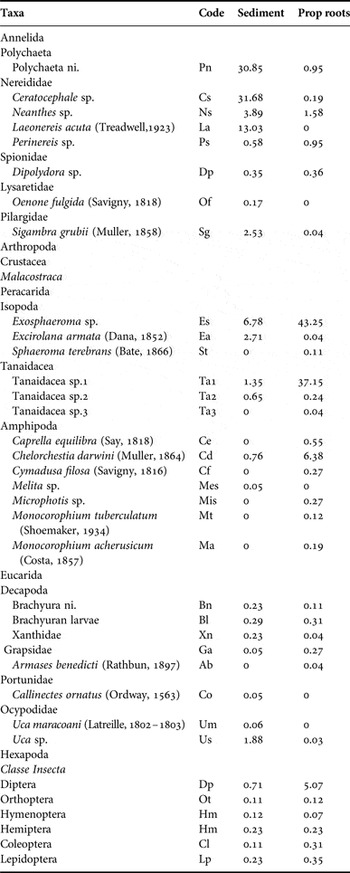
A total of 4217 individuals in 35 taxa were observed during the study period. Polychaeta, Isopoda and Tanaidacea were the numerically dominant groups. Ceratocephale sp. and Laeonereis acuta were the most abundant species in the sediment, whereas Exosphaeroma sp. and Tanaidacea sp.1 were the most abundant species on the prop roots (Table 1).
Relative abundance (%RA) of the benthic community of the sediment and prop roots at Guaratiba mangrove channel, south-eastern Brazil. ni., not identified.

The granolometric fractions did not change among seasons. Therefore, only the comparisons among stations were shown. Most of the samples were classified as fine sand according to Folk & Ward (Reference Folk and Ward1957). Sediment was composed of different fractions, as shown by the low value of sorting (poorly sorted), and the curves ranged from approximately symmetric to negative (Table 2). Organic carbon was higher in stations 2, 3 and 4 compared with 1. Granules and very coarse sand were comparatively higher in station 2, whereas coarse sand and medium sand were higher in station 1. Very fine sand was higher in station 3 whereas silt and clay were higher in stations 3 and 4.
Results for PERMANOVA comparisons, mean and standard deviation of granulometric composition and organic carbon in sediment among stations in Guaratiba mangrove main channel, south-eastern Brazil.

OC, organic carbon; G, granules; VCS, very coarse sand; CS, coarse sand; MS, medium sand; FS, fine sand; VFS, very fine sand; S + C, silt + clay; SD, standard deviation; GD, grain diameter (φ); PS, poorly sorted; SYM, symmetrical; NEG, negative. NS, non-significant difference.
No significant differences in physico-chemical variables were found among the stations. However, seasonal differences were found for some of these variables (Table 3). Temperature was significantly higher in summer and lower in winter. Dissolved oxygen was higher in autumn and spring compared with winter, whereas turbidity was higher in summer and spring and lower in autumn.
Results of PERMANOVA comparisons, mean and standard deviation of environmental variables of the water among seasons at Guaratiba mangrove main channel, south-eastern Brazil. NS, non-significant difference.

Longitudinal (or spatial) and temporal changes in infaunal assemblages
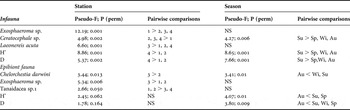
Significant differences in species abundance among stations were found for the dominant taxons Exosphaeroma sp., Ceratocephale sp. and Laeonereis acuta. The highest abundance of Exosphaeroma sp was recorded in station 1, for Ceratocephale sp. in sites 2, 3 and 4, and for Laeonereis acuta in site 3. Species richness and Shannon diversity were significantly higher in station 4 than in stations 1 and 2 (Table 4). For seasons, Ceratocephale sp. was more abundant in summer than in winter, spring and autumn. Species richness and Shannon diversity were also significantly higher in summer. The ANOSIM analysis did not reveal any significant differences in sediment assemblage structure among stations (Global R = 0.069, significance level of 0.1%) and seasons (Global R = 0.036, significance level of 0.3%) suggesting an overlap in faunal composition at different areas and seasons.
Results of PERMANOVA for comparisons of numerical abundance of dominant species and descriptors of the benthic community among stations and seasons in Guaratiba mangrove main channel, south-eastern Brazil. NS, non-significant difference.

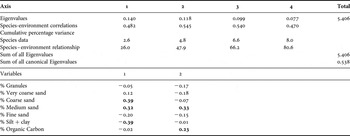
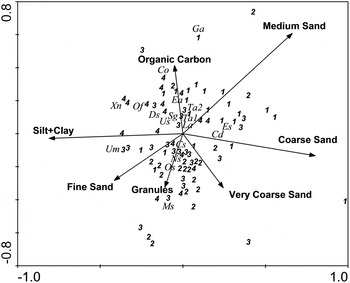
The first two axes of CCA explained 44.9% of the total variance of the species environment correlation. Axis 1 showed positive correlation with coarse sand and medium sand and negative correlation with silt + clay. Medium sand and organic carbon presented positive correlation with axis 2 (Table 5).
Results of Canonical Correspondence Analyses of benthic numerical abundance and scores of correlation of sediment variables at Guaratiba mangrove main channel, south-eastern Brazil. Significant correlation between sediment variables and the first two CCA axes in bold.

Samples from station 1, with medium and coarse sediment, were associated with higher abundance of Exosphaeroma sp. and Chelorchestia darwini (Muller, 1864). Station 2 and 3 are formed mainly by granules and sandy sediment ranging from fine to very coarse, and were associated with Melita sp. Station 4 had samples of sediment with silt + clay and high organic carbon associated with Oenone fulgida (Savigny, 1818), Decapoda Xanthidae and Callinectes ornatus (Ordway, 1563) (Figure 2).
Ordination plots of the first two axis of Canonical Correspondence Analysis on abundance of benthic community and characteristics of the sediment in the Guaratiba mangrove main channel, south-eastern Brazil. Bi-plot of species, samples coded by stations (1, 2, 3 and 4) and environmental variables. Code of species as in Table 1.

Spatial and temporal changes in epibiont fauna assemblages
In the prop roots, significant differences in species abundance among stations were found for Chelorchestia darwini, Exosphaeroma sp. and Tanaidacea sp.1, with the two first being more abundant in station 3, and the latter in stations 1 and 2. Species richness and Shannon diversity did not differ significantly among stations (Table 4). For seasons, Chelorchestia darwini was more abundant in autumn than summer and winter. Species richness and Shannon diversity were also significantly higher in autumn. ANOSIM analysis also did not reveal any significant differences in prop roots community structure among stations (Global R = 0.095, significance level of 0.2%) and seasons (Global R = 0.093, significance level of 0.1%).
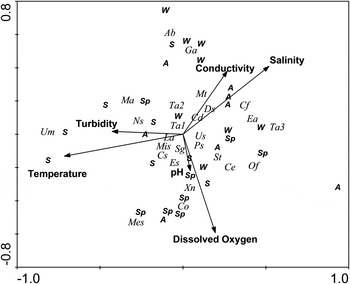
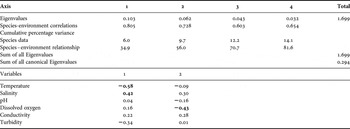
The first two axes of CCA explained 56.8% of the total variance of the species-environment correlation. Axis 1 showed positive correlation with salinity and negative correlation with temperature. Dissolved oxygen had negative correlation with axis 2 (Table 6). Uca maracoani was associated with higher temperature and turbidity during the summer. Melita sp., Callinectes ornatus (Ordway, 1563), Decapoda of Xanthidae family were associated with higher dissolved oxygen and pH in spring. Species of the Grapsidae family and Armases benedicti (Rathbun, 1897) were associated with conductivity, whereas Cymadusa filosa (Savigny, 1816) and Excirolana armata (Dana, 1852) with salinity (Figure 3).
Ordination plots of the first two axis of Canonical Correspondence Analysis on abundance of benthic community and physic-chemical characteristics of the water in the Guaratiba mangrove main channel, south-eastern Brazil. Bi-plot of species, samples coded by seasons (S, summer; A, autumn; W, winter; Sp, spring) and environmental variables. Code of species as in Table 1.

Results of Canonical Correspondence Analyses of benthic numerical abundance and scores of correlation of environmental variables at Guaratiba mangrove main channel, south-eastern Brazil.

DISCUSSION
The benthic community of Guaratiba mangrove main channel was predominantly composed of polychaetes and microcrustaceans, namely of the Isopoda and Tanaidacea orders. Crustaceans and polychaetes worms have also been recorded in other mangrove areas as main organisms of the benthic fauna (Pravinkumar et al., Reference Pravinkumar, Murugesan, Prakash, Elumalai, Viswanathan and Raffi2013; Musale et al., Reference Musale, Desai, Sawant, Venkat and Anil2015). The sediment has predominantly sandy fractions, spatially stratified. It was possible to determine a coarser sediment gradient at the station with the closest connection with the ocean compared with the inner stations in the mangrove channel. These results are typical of fringe mangroves (Cintrón et al., Reference Cintrón, Lugo, Martinez, D'Arcy and Corrêa1985) whose connection to the sea allows the presence of coarse sediments. Difference in sediment texture is, therefore, an important component of mangrove habitat to define the benthic assemblage.
Infaunal assemblage
Station 4, located in the innermost part of the channel is the farthest area from the connection with the sea, and had the highest richness and diversity of species, showing consistent faunal composition. This pattern shows how the type of sediment influences species distribution, with species selecting substrates with more silt and clay fractions. These fractions have most of the organic carbon content, in non-labile fraction, demonstrating the great ground potential in storing carbon in finer fractions by the formation of an organic-mineral complex (Stevenson, Reference Stevenson1994).
Both, the fine grain size of the sediment and the largest organic carbon content seem to exhibit direct influence on the distribution of species of Polychaeta. Indeed, the percentage of silt and clay, as well as the amount of organic matter are main factors structuring the Polychaeta community (Riera et al., Reference Riera, Tuya, Pérez, Ramos, Rodríguez and Monterroso2015). The polychaetes Laeonereis acuta and Ceratocephale sp. were dominant in the study area with the greatest abundance being recorded in silty-clay substrate. This configuration of the substrate seems to be a preferred habitat for these species, as previously described by Santos & Lana (Reference Santos and Lana2001) for estuarine regions of north-eastern Brazil.
Generally, microcrustacean species were associated with coarser fractions of the sediment (Mariano & Barros, Reference Mariano and Barros2015). The coarser sand fraction is associated with organic matter free or labile and according to Hook & Burke (Reference Hook and Burke2000) is especially important to nitrogen retention, playing an important role in the cycling of soil nutrients. McLachlan et al. (Reference McLachlan, Winter and Botha1977) and Coull (Reference Coull, Higgins and Thiel1988) point out that sediments with coarser fractions have more space between the grains, which promotes a greater variety of niches that can be occupied by other individuals. However, only the isopod Exosphaeroma sp. was significantly more abundant in station 1, where the sediment was mainly composed of medium and coarse sand. Since the presence of coarser fractions in the sediment indicates a greater hydrodynamics (Yaacob & Mustapa, Reference Yaacob and Mustapa2010), station 1 can be considered a more unstable environment where few species adapt, specializing in occupying these niches with more space between the grains, where other species cannot colonize. Thus, the dynamism and force of currents in the areas near the connection to the sea can be considered as determining factors for the dominance of a few species.
Sediment differences are of crucial importance for most benthic animals, since their feeding strategies tend to be highly adapted to sediment type (McLachlan et al., Reference McLachlan, Jaramillo, Defeo, Dugan, Ruyck and Coetzee1995; Zhuang et al., Reference Zhuang, Zhang, Zhang and Wang2004). Considering the particle size distribution of the Guaratiba mangrove main channel, the pattern of species distribution may be related to structural habitat complexity, since it presents a great mix of grains and allows the movement of organisms. According to Centurión & López Gappa (Reference Centurión and López Gappa2013), poorly sorted sediments provide many microhabitats that can support a high biodiversity of benthic organisms, and the presence of a large fraction of sediment generally confers a greater heterogeneity in the microhabitat but are unstable and highly mobile environments.
Epibiont faunal assemblage
In this study, we did not observe significant differences in richness and diversity among stations for the epibiont fauna. These results can be explained by the homogeneous character of the evaluated environmental parameters. On the other hand, the warmer seasons were richer and more diverse than the colder seasons.
The species of microcrustaceans Exosphaeroma sp., Tanaidacea sp.1 and Chelorchestia darwini, and dipteran larvae were significantly more abundant in samples of the prop roots. Recent studies have demonstrated the preference of aquatic invertebrates in colonizing the mangrove vegetation or increase the densities near the prop-roots (Jaxion-Harm et al., Reference Jaxion-Harm, Pien, Saunders and Speight2013), such as Diptera that were found associated with other groups like Isopoda, Amphipoda and Tanaidacea forming a diverse and abundant community (Corrêa et al., Reference Corrêa, Oliveira and Uieda2008). Corroborating the preference of Amphipoda, by this type of habitat, Serejo (Reference Serejo2004) reported that C. darwini is commonly found in mangrove habitats in both the sediment and the associated vegetation. Likewise, isopods are commonly found inhabiting Rhizophora mangle trunks and roots as was also observed by Hendrickx & García-Guerrero (Reference Hendrickx and García-Guerrero2003). The colonization of marginal vegetation by microcrustaceans contributes to increase habitat complexity by enhancing the number of available niches, and providing shelters (Coull & Wells, Reference Coull and Wells1983; Gillikin & Kamanu, Reference Gillikin and Kamanu2005), thus reducing predation effect and increasing the efficiency of the species foraging (Corrêa et al., Reference Corrêa, Oliveira and Uieda2008). Countless studies over the years have demonstrated the importance of plant species in the structuring of different taxa of benthic invertebrates (Heck & Thoman, Reference Heck and Thoman1981; Corrêa et al., Reference Corrêa, Oliveira and Uieda2008).
Exosphaeroma sp., although much more abundant in the prop roots, had a significant contribution in the sediment. This suggests that the microtidal regime of the area and the limited channel area favour the marginal vegetation as an attractive habitat for certain species and an efficient mechanism to avoid competition and predation in the sediment. Therefore, the distribution of species is a feature that varies greatly from one habitat to another, and from a set of environmental variables and specific biotic interactions of each region it is difficult to establish a preferred pattern. Moreover, the high hydrodynamic condition of the mangrove channel that connects the bay to the sea contributes to the unstable characteristics of this system. On the other hand, the tidal elevation is an important factor structuring benthic assemblages since the marginal vegetation is exposed to tidal inundation and accessible for colonization.
The tested hypothesis that the benthic fauna uses different mangrove areas to avoid competition seems to be confirmed since the most abundant species coexist occupying the marginal vegetation in different seasons or stations or in different sediment grain fractions. In fact, this is the first time that the benthic invertebrate community of a mangrove area in south-eastern Brazil is described and a spatial partitioning by dominant species was detected. This study is of extreme importance for future comparisons with similar areas of south-eastern Brazil, and to provide subsidies for management measures of this system threatened by anthropic activities.
ACKNOWLEDGEMENTS
The authors thank technicians from Laboratory of Fish Ecology for helping in fieldwork. We also thank Dr Paulo Cesar de Paiva for helping to identify the polychaetes and Dra. Cristiana Serejo and Dr André Senna for helping to identify the isopods and amphipods. Laboratory of Soils of Universidade Federal Rural do Rio de Janeiro helped with the sediment analyses.
FINANCIAL SUPPORT
This work was funded by FAPERJ – Carlos Chagas Foundation for Supporting Research of the Rio de Janeiro State and by CNPq – Brazilian National Council for Research Development. F.G.A. receives funding from FAPERJ and CNPq and D.S.S. received scholarship from CNPq.