Fibromyalgia is becoming a major health problem due to its high prevalence (2–6 % of the population), insufficient knowledge of its etiology, lack of an effective approach, its high socio-healthcare costs (Pastor, Lledó, López-Roig, Pons, & Martín-Aragón, Reference Pastor, Lledó, López-Roig, Pons and Martín-Aragón2010), and, especially, due to the interference that the symptoms cause in the patients’ vital functioning (Verdunt, Pernot, & Smeets, Reference Verbunt, Pernot and Smeets2008). The relevance of psychological variables such as anxiety, depression, coping, pain acceptance, self-efficacy, etc., is well founded (González, Férnadez, & Torres, Reference González, Fernández and Torres2010; Huber, Suman, Biasi, & Carli, Reference Huber, Suman, Biasi and Carli2008; Sánchez, Martínez, Miró, & Medina, Reference Sánchez, Martínez, Miró and Medina2011), but it is unclear how they interact with the symptoms or which predict a poorer functioning. The symptoms that cause the greatest interference, other than pain, fatigue and sleep disturbance, are the cognitive problems (memory problems, poor concentration, poor attention, and mental confusion) that around 70% of patients suffer from (Gelonch, Garolera, Rosselló, & Pifarré, Reference Gelonch, Garolera, Rosselló and Pifarré2013; Leavitt & Katz, Reference Leavitt and Katz2009).
As for the processes underlying these cognitive problems in patients with fibromyalgia, the most affected are working memory (Glass, Reference Glass2010; Munguía-Izquierdo, Legaz-Arrese, Moliner-Urdiales, & Reverter-Masía, Reference Munguía-Izquierdo, Legaz-Arrese, Moliner-Urdiales and Reverter-Masía2008), episodic memory, complex attentional processes and those that require processing distracting information (Glass, Reference Glass2009). Specifically, more complex attentional processes such as monitoring or executive control are more altered than other more automatic processes such as orientation (Miró, Lupiañez, Hita et al., Reference Miró, Lupiáñez, Martínez, Sánchez, Díaz-Piedra, Guzmán and Buela-Casal2011). Similarly, in simple tasks (response inhibition) involved in executive functioning, some studies have not found differences between FG and CG (Glass et al., Reference Glass, Williams, Fernández-Sánchez, Kairys, Barjola, Heitzeg and Schmidt-Wilcke2011) and others have reported deficits in temporal orientation and response inhibition (Correa, Miró, Martínez, Sánchez, & Lupiáñez, Reference Correa, Miró, Martínez, Sánchez and Lupiáñez2011). Therefore, it is necessary to further analyze the most complex cognitive processes such as executive functions, processes that can change thoughts and actions and that include sustained and selective attention, inhibition of inappropriate responses, formulating goals, planning and completing plans to achieve goals (Schmeichel, Reference Schmeichel2007). Solberg, Roach, and Segerstrom (Reference Solberg, Roach and Segerstrom2009) indicate that the ability to handle multiple symptoms (characteristic of fibromyalgia) and the emotional consequences it entails depends on executive functioning and the ability to self-regulate. They also state that even main cognitive deficits arise from deterioration in these functions. Moreover, Verdejo-García, López-Torrecillas, Pita, Delgado-Rodríguez, and Bechara (Reference Verdejo-García, López-Torrecillas, Pita, Delgado-Rodríguez and Bechara2009) found a poorer performance in executive functions in FG compared to CG, although other studies found contradictory results (Apkarian et al., Reference Apkarian, Sosa, Krauss, Thomas, Fredrickson, Levy and Chialvo2004; Kim et al., Reference Kim, Kim, Kim, Nam, Han and Lee2012; Surh, Reference Suhr2003; Wallit, Roebuck-Spencer, Bleiberg, Foster, & Weinstein, Reference Walitt, Roebuck-Spencer, Bleiberg, Foster and Weinstein2008).
On the other hand, chronic pain may cause a deterioration in executive functioning and the emotional states involved in decision-making, since, after evaluating decision-making based on emotions using the Iowa Gambling Task (IGT), patients suffering from fibromyalgia learnt less throughout the task (Verdejo-García et al., Reference Verdejo-García, López-Torrecillas, Pita, Delgado-Rodríguez and Bechara2009) and chose more disadvantageous cards (Walteros et al., Reference Walteros, Sánchez-Navarro, Muñoz, Martínez-Selva, Chialvo and Montoya2011) that the CG. In addition to clarifying what cognitive processes are most affected, it is necessary to investigate the role played by variables such as pain, anxiety, depression or medication (Glass, Reference Glass2008; Reyes del Paso, Pulgar, Duschek, & Garrido, Reference Reyes del Paso, Pulgar, Duschek and Garrido2012). Some studies suggest that fibromyalgia patients show more subjective complaints than objective neuropsychological alterations and that these are caused by factors such as effort, depression or fatigue (Suhr, Reference Suhr2003). Some studies also show that factors such as low levels of cortisol and depressive symptoms are related to cognitive dysfunction (Sephton et al., Reference Sephton, Studts, Hoover, Weissbecker, Lynch, Ho and Salmon2003). On the other hand, there is evidence of precise cognitive impairment in working memory, episodic memory and verbal fluency, which does not correlate with depression, anxiety, fatigue (Dick, Eccleston, & Crombez, Reference Dick, Eccleston and Crombez2002; Munguía-Izquierdo et al., Reference Munguía-Izquierdo, Legaz-Arrese, Moliner-Urdiales and Reverter-Masía2008, Park, Glass, Minear, & Crofford, Reference Park, Glass, Minear and Crofford2001) or the medication been taken (Grisart, Van der Linden, & Masquelier, Reference Grisart, van der Linden and Masquelier2002).
Therefore, it is necessary to further progress in the study of the relationship between cognitive functioning and fibromyalgia since there are some contradictions and methodological problems, such as lack of agreement on what are the most altered processes and modulating variables, small sample sizes and diversity in the tests used (Gelonch et al., Reference Gelonch, Garolera, Rosselló and Pifarré2013). To help solve these problems, our first aim is to assess the degree of impairment of executive functions and decision-making, analyzing previously used tests (WCST and IGT), but in larger samples. On the other hand, and given the lack of agreement in the studies reviewed, the second aim is to analyze how variables related to the perception and impact of pain, anxiety, depression and medication influence these cognitive functions.
Method
Participants
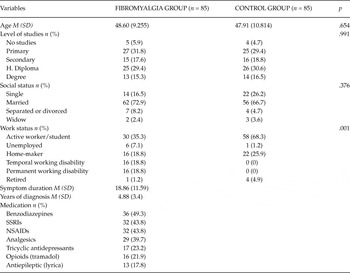
The sample consisted of 170 women divided into two groups, fibromyalgia group (FG) (n = 85) and control group (CG) (n = 85). The average age of the FG was 48.60 ± 1.04 years and the CG was 47.91 ± 1.17 years. Most had primary studies (FG = 31.8%; CG = 29.4%) or a higher diploma (FG = 29.4%; CG = 30.6%), were married (FG = 72.9%; CG = 66.7 %) and worked outside the home (FG = 35.3%; CG = 68.3%). No significant differences in sociodemographic variables were found, except for the employment status variable, χ 2 (5) = 45.86; p = .001, where FG had a higher percentage of women with a working disability. In the FG, the mean duration of symptoms was 13.97 ± 1.18 years and mean years of diagnosis was 4.88 ± 3.6 years. Among those taking medication (85.8 % of FG), benzodiazepines (49.3 %), SSRIs (43.8%) and NSAIDs (43.8 %) were the most consumed prescriptions (Table 1).
Sociodemographic and clinical characteristics

Procedure
The FG was recruited from the Granada Fibromyalgia Association (AGRAFIM). The exclusion criteria included having any neurological disorder, chronic pain of malignant origin (cancer) or serious psychopathological disorders (personality disorders, psychotic disorders, substance abuse, major depressive disorder with severe symptoms and suicidal thoughts or other severe disorders from the DSM-IV-TR axis 1 (American Psychiatric Association, 2000). The CG was recruited in different centers (health workers, civil servants, workshop students, family relatives of first year psychology students). Their exclusion criteria included, in addition to those specified for the FG, those who were suffering from fibromyalgia or had a severe rheumatic illness. Prior to data collection, the participants were informed about the procedure and gave informed consent verbally.
Instruments
Executive functioning
The following indexes from the Wisconsin Card Sorting Test (WCST) by Haeton, Chelune, Talley, Kay, and Curtiss (Reference Haeton, Chelune, Talley, Kay and Curtiss1993) were assessed: Number of categories, percentage of perseverative errors (which indicates poor cognitive flexibility or inability to change the rules according to positive or negative contingencies), percentage of non-perseverative errors and failures to maintain set (related to distraction, poor attentional ability and deficits in working memory). Deficits in executive functioning are reflected in the low number of categories, the increasing percentage of perseverative errors and in the failures to maintain set. For more information, see the Spanish adaptation of De la Cruz (Reference De la Cruz1997).
Decision-making
The Iowa Gambling Task (IGT) was used. This test is a computerized decision-making task, which includes uncertainty, risk and assessment of reinforcement and punishment. The original version (IGT ABCD), by Bechara, Damasio, Damasio, and Anderson (Reference Bechara, Damasio, Damasio and Anderson1994), has four blocks of letters. Blocks A' and B' are disadvantageous (they provide immediate and substantial gains but also very high punishments or delayed losses, i.e. they provide more losses than gains) and C' and D' are advantageous (they provide small immediate gains and small, long-term losses, thus providing more gains than losses). Optimal performance requires learning the contingencies of each block and choosing each time the more advantageous cards (learning curve). In the variant of the original version (IGT EFGH), blocks E' and G' are advantageous, providing high immediate punishment (losses) and high delayed rewards (gains) and blocks F' and H' are disadvantageous since they offer very low, immediate punishments and very low future rewards (Bechara, Damasio, & Damasio, Reference Bechara, Damasio and Damasio2000). By including the two versions, hypersensitivity to reinforcement (response pattern where the choice of disadvantageous blocks predominates in the original version) and lack of sensitivity to punishment (response pattern where the choice of advantageous blocks predominates in the variant) or to future consequences (choosing disadvantageous blocks in both versions) can be analyzed (Bechara et al., Reference Bechara, Damasio and Damasio2000; Bechara, Dolan, & Hindes, Reference Bechara, Dolan and Hindes2002).
Anxiety and depression
The Spanish adaptation, by Quintana et al. (Reference Quintana, Padierna, Esteban, Arostegui, Bilbao and Ruiz2003), of the Hospital Anxiety and Depression Scale (HADS) was used. The maximum score for both variables is 21. The test-retest reliability is greater than .86, and the internal consistency is .86 for anxiety and .86 for depression.
Impact of pain
It was measured using the Pain and impact on daily activities scale (intensity, suffering from pain and impact on daily life) that ranges between 0 and 6. It is part of the Spanish adaptation of the West Haven-Yale Multidimensional Pain Inventory (Pastor, López, Rodríguez, Terol, & Sánchez, Reference Pastor, López, Rodríguez, Terol and Sánchez1995). The reliability coefficient varies between .59 and .86.
Pain intensity
A total index that assesses pain severity (sum of the sensory, affective and evaluative index) and a present pain intensity scale, with scores ranging from 0 to 5 of the McGill Pain Questionnaire (Lázaro, Bosch, Torrubia, & Baños, Reference Lázaro, Bosch, Torrubia and Baños1994) was used.
Statistical analyses
Statistical analyses were performed with the SPSS 15.0 program. The Student t-test for independent samples was used to analyze the percentage of perseverative errors and percentage of non-perseverative errors variables. The Mann-Whitney test was used for the number of categories and failures to maintain set, since these did not meet assumptions for parametric testing. The IGT learning curve was analyzed using a 2x5 MANOVA with a between-subjects factor (FG and CG) and a within-subjects factor (scores from the 5 blocks). To evaluate the neuropsychological functioning explanatory variables, a regression analysis was performed for each variable. The dependent variables were: Percentage of perseverative errors, percentage of non-perseverative errors, number of categories and failures to maintain set, IGT score from both versions. The independent variables were: Duration of treatment with benzodiazepines (BZP duration) and with opioids (opioid duration), total McGill index, level of pain present, pain and impact on daily activities, and level of anxiety and depression. Previously, assumptions of normality, equality of variance-covariance matrices and homoscedasticity of the variables were checked.
Results
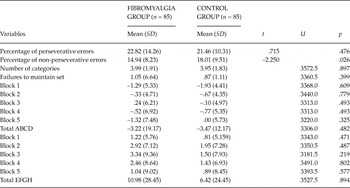
First, the comparison between groups was carried out, finding a percentage of non-perseverative errors significantly higher in the CG than in the FG (t(169) = –2.250; p = .026). The other variables showed no significant differences (Table 2).
Descriptive statistics and contrasts (Student t/Mann – Whitney U) for the executive functioning and decision-making variables

In relation to decision-making, the results of the MANOVA for IGT (ABCD) indicated an effect of the within variable “block”, F(4, 164) = 2.465; p = .047 but not for the interaction, F(4, 164) = .711; p =.585. When calculating the Greenhouse-Geisser corrected value for the block variable, the result was not statistically significant, F(3, 611) = 2.281; p = .065. Since this significance value was close to the alpha level of .05, the within-subjects factor was explored. Regarding the between-subjects factor, group was found not to be statistically significant, F(1, 167) = .010, p = .921.
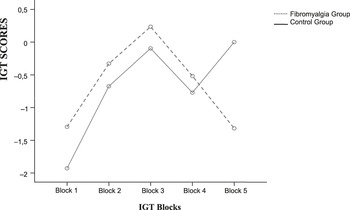
The means graph shows how the learning curve evolved (Figure 1), indicating that the trend of the scores of task performance was of quadratic form. The FG learnt the same way as the CG in the learning blocks (1 to 4). However, once learning had occurred (block 5), the FG selected advantageous cards to a lesser extent. When a non-parametric Mann Whitney test was carried out, this difference was not statistically significant, U = 3220.0; p = .325 (Table 2).
IGT ABCD learning curve scores.

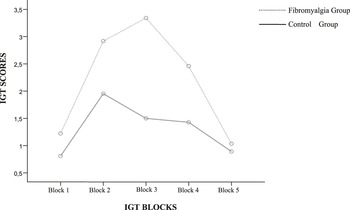
The results of the multivariate contrast for IGT EFGH did not indicate an effect of the within-subject variable “block”, obtaining a Greenhouse-Geisser value, F(3, 587) = 2.313; p = .065. The interaction was also not significant, F(3, 587) = .469; p =.734. The effect of the group variable in the performance of this task, F(1, 167) = 1.157, p = .284), was discarded. The trend analysis of the evolution of scores across the EFGH blocks showed it was quadratic, F(1, 167) = 7.35; p = .007 (Figure 2), although without differences between FG and CG, as can be observed in Table 2.
IGT EFGH learning curve scores.

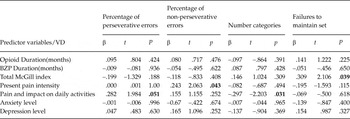
Regression analysis showed that the pain and impact on daily activities was the variable that had a greater relationship with executive functioning, both for the percentage of perseverative errors (t = 1.984; p = .051) and the number of categories (t = –2.203; p = .031). The total McGill index score, which indicates greater severity of pain, was significantly related to the failures to maintain set scores (t = 2.10; p = .039). Present pain intensity was related to the percentage of non-perseverative errors (t = 2.063; p = .043). The levels of anxiety, depression and medication were not related to performance in executive functioning (Table 3).
Regression analysis for executive functioning (n = 85)

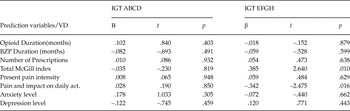
The total McGill index score (t = 2.640; p = .010) and pain and impact on daily activities (t = –2.475; p = .016) were related to scores on the IGT (EFGH). None of the variables related to scores on the IGT (ABCD). Anxiety, depression or medication did not relate to scores on decision-making (Table 4).
Regression Analysis for decision-making (n = 85)

Discussion
The first finding of this study is that executive functions were not altered in the FG, in contrast with research showing deficits in working memory (Dick, Eccleston, & Crombez, Reference Dick, Eccleston and Crombez2002; Munguía-Izquierdo et al., Reference Munguía-Izquierdo, Legaz-Arrese, Moliner-Urdiales and Reverter-Masía2008; Park et al., Reference Park, Glass, Minear and Crofford2001; Seo et al., Reference Seo, Kim, Kim, Song, Lee, Kim and Chang2012) or in executive functions (Verdejo-García et al., Reference Verdejo-García, López-Torrecillas, Pita, Delgado-Rodríguez and Bechara2009). Neither does it support Solberg et al.’s (Reference Solberg, Roach and Segerstrom2009) hypothesis, which indicated that cognitive impairment in fibromyalgia was due to deficits in executive functioning. However, it is consistent with the research of Apkarian et al., (Reference Apkarian, Sosa, Krauss, Thomas, Fredrickson, Levy and Chialvo2004); Kim et al., (Reference Kim, Kim, Kim, Nam, Han and Lee2012); Surh (Reference Suhr2003) and Wallit, Roebuck-Spencer, Bleiberg, Foster, and Weinstein (Reference Walitt, Roebuck-Spencer, Bleiberg, Foster and Weinstein2008), who found no significant differences between FG and CG. They also yielded scores very similar to those in this study for the percentage of perseverative and non-perseverative errors, although the number of categories was slightly lower. This indicates that, in fibromyalgia patients, some processes such as attentional ability, immediate memory, delayed memory, recall with distractions or with higher cognitive load (Correa et al., Reference Correa, Miró, Martínez, Sánchez and Lupiáñez2011; Dick et al., Reference Dick, Eccleston and Crombez2002; Leavitt & Katz, Reference Leavitt and Katz2009; Miró, Lupiañez, Hita et al., Reference Miró, Lupiáñez, Martínez, Sánchez, Díaz-Piedra, Guzmán and Buela-Casal2011) are more altered than cognitive flexibility, variable that is specifically measured with the WCST (Apkarian et al., Reference Apkarian, Sosa, Krauss, Thomas, Fredrickson, Levy and Chialvo2004; Surh, Reference Suhr2003; Wallit et al., Reference Walitt, Roebuck-Spencer, Bleiberg, Foster and Weinstein2008). In addition, the sample size of the present study (n = 180) was relatively larger than in other studies that have evaluated these variables (Dick et al., Reference Dick, Eccleston and Crombez2002; Kim et al., Reference Kim, Kim, Kim, Nam, Han and Lee2012; Park et al., Reference Park, Glass, Minear and Crofford2001; Verdejo-García et al., Reference Verdejo-García, López-Torrecillas, Pita, Delgado-Rodríguez and Bechara2009; Walteros et al., 2009), therefore it is plausible that these results can be more generalized to the population suffering from fibromyalgia. Another explanation for this finding is the origin of FG (association) since patients recruited from the pain and rheumatology units are more deteriorated in the degree of functional disability, quality of life and psychological distress (Calandre et al., Reference Calandre, García-Carrillo, García-Leiva, Rico-Villademoros, Molina-Barea and Rodríguez-López2011; Verbunt et al., Reference Verbunt, Pernot and Smeets2008). Hence, it is possible that they are also more cognitively impaired (Grace, Roach, & Segerstrom, Reference Grace, Roach and Segerstrom1999). Comparing these results with those of another study (Verdejo-García et al., Reference Verdejo-García, López-Torrecillas, Pita, Delgado-Rodríguez and Bechara2009) in which they measured the same variables across a sample obtained from a specialized care unit, a great difference is observed. The percentages of both perseverative and non-perseverative errors of this latter study are far superior to those of our study. One the problems with the WCST is that it does not include the response “other”, and sometimes healthy subjects fail to decipher the simple rules as they theorize more complex rules not included in the test. This leads to a greater number of non-perseverative errors while perseverative errors remain at acceptable levels (Kaplan, Sengör, Gürvit, Genç, & Güzelis, Reference Kaplan, Sengör, Gürvit, Genç and Güzelis2006). This explains the higher percentage of non-perseverative errors and the low percentage of perseverative errors in the CG.
The second important finding is that, in the IGT ABCD learning curve, FG showed a lower frequency of advantageous choices in block 5. This indicates a worsening trend in the conceptual period performance, in which rules are supposed to have been learnt already, i.e., the FG learns in the same way as the CG (block 1 to 4), but once achieved, a non-significant worsening in execution (block 5) occurs. This reveals a certain hypersensitivity to reinforcement (at the end of the IGT ABCD, they chose more disadvantageous cards which yield greater immediate rewards) and insensitivity to punishment or ability to tolerate increased punishment to obtain a delayed reinforcement (in IGT EFGH, the FG selected advantageous cards in same way as the CG, which provide high immediate punishment followed by delayed rewards) (Bechara et al., Reference Bechara, Damasio and Damasio2000; Bechara et al., Reference Bechara, Dolan and Hindes2002). This may be due to a reinforcement desire to compensate for chronic pain (Verdejo et al., Reference Verdejo-García, López-Torrecillas, Pita, Delgado-Rodríguez and Bechara2009).
The third finding is that pain and impact on daily activities were related to the percentage of perseverative errors and number of categories scores. The total McGill index score (which indicates greater severity of pain) was related to failures to maintain set (associated with distraction and poor attention ability) and pain intensity related to the percentage of non-perseverative errors. The remaining variables (anxiety, depression and medication) were not related to performance in executive functioning. This finding is in line with those who point out the relationship between pain and impact on daily activities and working memory, speed of information processing and executive functioning in fibromyalgia patients (Park et al., Reference Park, Glass, Minear and Crofford2001; Verdejo-García et al., Reference Verdejo-García, López-Torrecillas, Pita, Delgado-Rodríguez and Bechara2009). This finding also supports studies that observed no relationship between levels of anxiety and depression and executive functioning (Iezzi, Duckworth, Vuong, Archibald, & Klinck, Reference Iezzi, Duckworth, Vuong, Archibald and Klinck2004; Park et al., Reference Park, Glass, Minear and Crofford2001; Surh, Reference Suhr2003). In addition, the fact that pain severity and perceived impact on daily life are related to performance on the WCST connects with the pain interference pattern. This pattern states that chronic pain captures attention and consumes a portion of the limited attentional resources, which, in turn, cannot be devoted to other cognitive tasks, leading to their deterioration (Eccleston & Crombez, Reference Eccleston and Crombez1999). On the other hand, brain abnormalities such as reduced activation of brain areas related to executive functioning (premotor cortex, supplementary motor area, cingulate cortex, prefrontal cortex, right inferior frontal cortex and insular cortex) and hyperactivation in the temporal gyrus/fusiform gyrus were observed in a FG, while performing a task involving response inhibition (Glass et al., Reference Glass, Williams, Fernández-Sánchez, Kairys, Barjola, Heitzeg and Schmidt-Wilcke2011). These authors suggest that compensatory brain plasticity processes (high activation of the right inferior temporal gyrus/fusiform gyrus) occur as a way of normalizing the abnormal brain activity, allowing the FG to achieve the same performance as the CG in response inhibition tasks. These data link with the pain interference pattern previously explained, indicating that the resources devoted to processing pain are occupying part of the cognitive resources (and brain areas; Glass et al., Reference Glass, Williams, Fernández-Sánchez, Kairys, Barjola, Heitzeg and Schmidt-Wilcke2011, Luerding, Weigand, Bogdahn & Schmidt-Wilcke, Reference Luerding, Weigand, Bogdahn and Schmidt-Wilcke2008; Mercado et al., Reference Mercado, González, Barjola, Fernández-Sánchez, López-López, Alonso and Gómez-Esquer2013) that should be devoted to the execution of cognitive tasks. The fact that the FG still perform tasks similarly to the CG can be explained by these compensatory brain mechanisms (Glass et al., Reference Glass, Williams, Fernández-Sánchez, Kairys, Barjola, Heitzeg and Schmidt-Wilcke2011).
The fourth result is that pain severity and pain and impact on daily activities were related to the IGT EFGH scores, while anxiety, depression or medication were not associated with these scores. None of the analyzed variables related to IGT ABCD scores. The reviewed studies corroborate this, as they show a slight relationship between anxiety and depression and decision-making in patients with migraines (Mongini, Keller, Deregibus, Barbalonga, & Mongini, Reference Mongini, Keller, Deregibus, Barbalonga and Mongini2005) and no relationship with patients with chronic pain (Apkarian et al., Reference Apkarian, Sosa, Krauss, Thomas, Fredrickson, Levy and Chialvo2004) or fibromyalgia (Verdejo-García et al., Reference Verdejo-García, López-Torrecillas, Pita, Delgado-Rodríguez and Bechara2009). Finally, consistently with Dick et al.’s (Reference Dick, Eccleston and Crombez2002) and Grisart and Van der Linden’s (2001) studies, medication is not related to performance on neuropsychological variables.
Limitations of this study include not being able to control some important variables in fibromyalgia such as sleep disturbance (Prados & Miró, Reference Prados and Miró2012), which may interfere with attentional processes (Miró, Lupiañez, Hita et al., Reference Miró, Lupiáñez, Martínez, Sánchez, Díaz-Piedra, Guzmán and Buela-Casal2011). Further studies indicate that, after a cognitive behavioral intervention for the treatment of insomnia, fibromyalgia patients show significant improvements not only in the quality of sleep and daily functioning, but also in alertness and executive functioning (Miró, Lupiañez, Martinez et al., Reference Miró, Lupiáñez, Martínez, Sánchez, Díaz-Piedra, Guzmán and Buela-Casal2011). The basic processes of executive control and response inhibition have not been evaluated through simple tasks (ANT-I task, Go/no Go task, STROOP). Therefore, this should be taken into account in future research, along with tasks that analyze more complex executive function processes (WCST, IGT, etc.) and possible brain alterations observed in patients with fibromyalgia (Glass et al., Reference Glass, Williams, Fernández-Sánchez, Kairys, Barjola, Heitzeg and Schmidt-Wilcke2011, Luerding et al., Reference Luerding, Weigand, Bogdahn and Schmidt-Wilcke2008; Mercado et al., Reference Mercado, González, Barjola, Fernández-Sánchez, López-López, Alonso and Gómez-Esquer2013).
In conclusion, alterations in executive functioning and decision-making have not been found in the FG, but pain severity and impact related to these processes to a greater extent than the level of anxiety, depression or medication, which may indicate that pain interferes with neuropsychological functioning. However, pain interference failed to produce a significant deterioration (as compared to a CG). One might consider the possibility of the existence of a subgroup of patients with fibromyalgia with greater impairments than others in these functions. This hypothesis needs further study for its corroboration.
AGRAFIM, Dr. Antonio Verdejo-García.