Epidemiology of Nicotine Addiction
Nicotine addiction is one of the most common and preventable chronic psychiatric conditions characterized by the compulsion to seek and use nicotine.Reference Koob and Volkow 1 Worldwide, there are approximately 1.1 billion adult smokers and 80% of them live in low- and middle-income countries. 2 More than 7 million smokers die each year because of smoking related diseases, around 890,000 of which are being exposed to second-hand smoke (ie, indirect exposure to smoke exhaled by smokers).Reference Collins, Jerry and Bales 3 Stopping nicotine consumption can lead to significant withdrawal symptoms for instance, depressed mood, attention/concentration problems, anhedonia, cravings, dysphoria, anxiety, irritability, and somatic problems (such as insomnia and weight gain).Reference Koob and Volkow 1 , Reference D’Souza 4 In the United States, about 40% to 50% of smokers try to stop smoking every year, however, only about 6% are able abstain for at least 6 to 12 months.Reference Malarcher 5 The majority of relapses happen within the first week of abstinence, with 15% to 28% of smokers staying abstinent for 1 month, 10% to 20% remaining abstinent 3 months, and 3% to 5% for 6 months.Reference Hughes, Keely and Naud 6 The longer a smoker stays abstinent, the better the chances that the abstinence will sustain. A study measuring success rates found that only 12% of smokers who stopped smoking for 1 month remained abstinent at the follow up stage (ie, 1.5 years). Of those who stayed abstinent for 1 to 3 months, 25% remained abstinent long term. A long term success rate of 52% could be found in smokers who stayed abstinent for 3 to 6 months, again suggesting that the longer the initial abstinence period, the greater the probability of long-term abstinence.Reference Gilpin, Pierce and Farkas 7 Therefore, due to these low abstinence rates, it is necessary to find new pharmacotherapeutic options for nicotine addiction which could enhance abstinence rates.
The Glutamate System and Nicotine Addiction
Glutamate is the major excitatory neurotransmitter in the central nervous system (CNS) and is produced from glutamine by the enzyme glutaminase, which is localized in neurons and glia.Reference Pistillo, Clementi, Zoli and Gotti 8 Over 90% of the synapses in the human brain are glutamatergic. Glutamate has the opposite effect to the neurotransmitter of Gamma Aminobutyric Acid (GABA), which is one of the main inhibitory neurotransmitters of the CNS. Numerous authors have suggested that glutamate signaling in the brain plays a major role in the nicotine addiction. 9–11 Furthermore, glutamate neurotransmission in the CNS is involved in various disorders such as schizophrenia, depression, addiction, and neurodegenerative diseases, such as Alzheimer’s, Parkinson’s and multiple sclerosis.Reference Mihov and Hasler 11 –Reference Terbeck, Akkus, Chesterman and Hasler 13 Glutamate signaling activates its receptors, which are categorized in two large groups: the metabotropic glutamate receptors (mGluRs) and ionotropic glutamate receptors (iGluRs). Fast acting ionotropic (iGlu) receptors include N-methyl-d-aspartate receptor (NMDAR), α-amino-3-hydroxy-5-methyl-4-isoxazolepropionic acid receptor (AMPA) and kainate. Slow acting metabotropic receptors involve the mGluR1 to mGluR8. They are predominantly localized on postsynaptic as well as on glia cells in the brain, coupled with a G-protein. The mGlu receptors are classified into three groups; Group I receptors (mGluR1 and mGluR5), Group II receptors (mGluR2 and mGluR3), and Group III receptors (mGluR4, mGluR6, mGluR7, and mGluR8).Reference Pistillo, Clementi, Zoli and Gotti 8
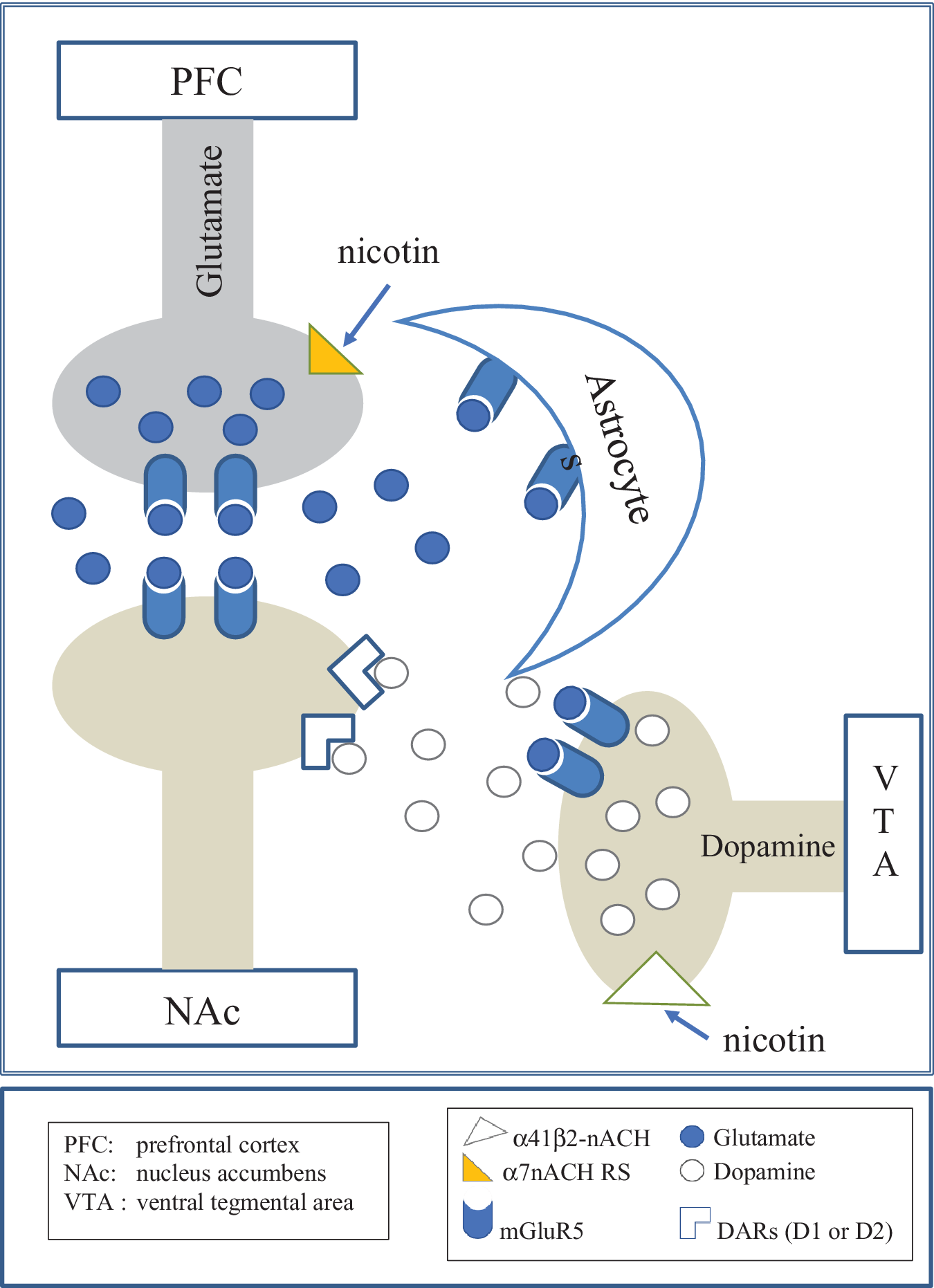
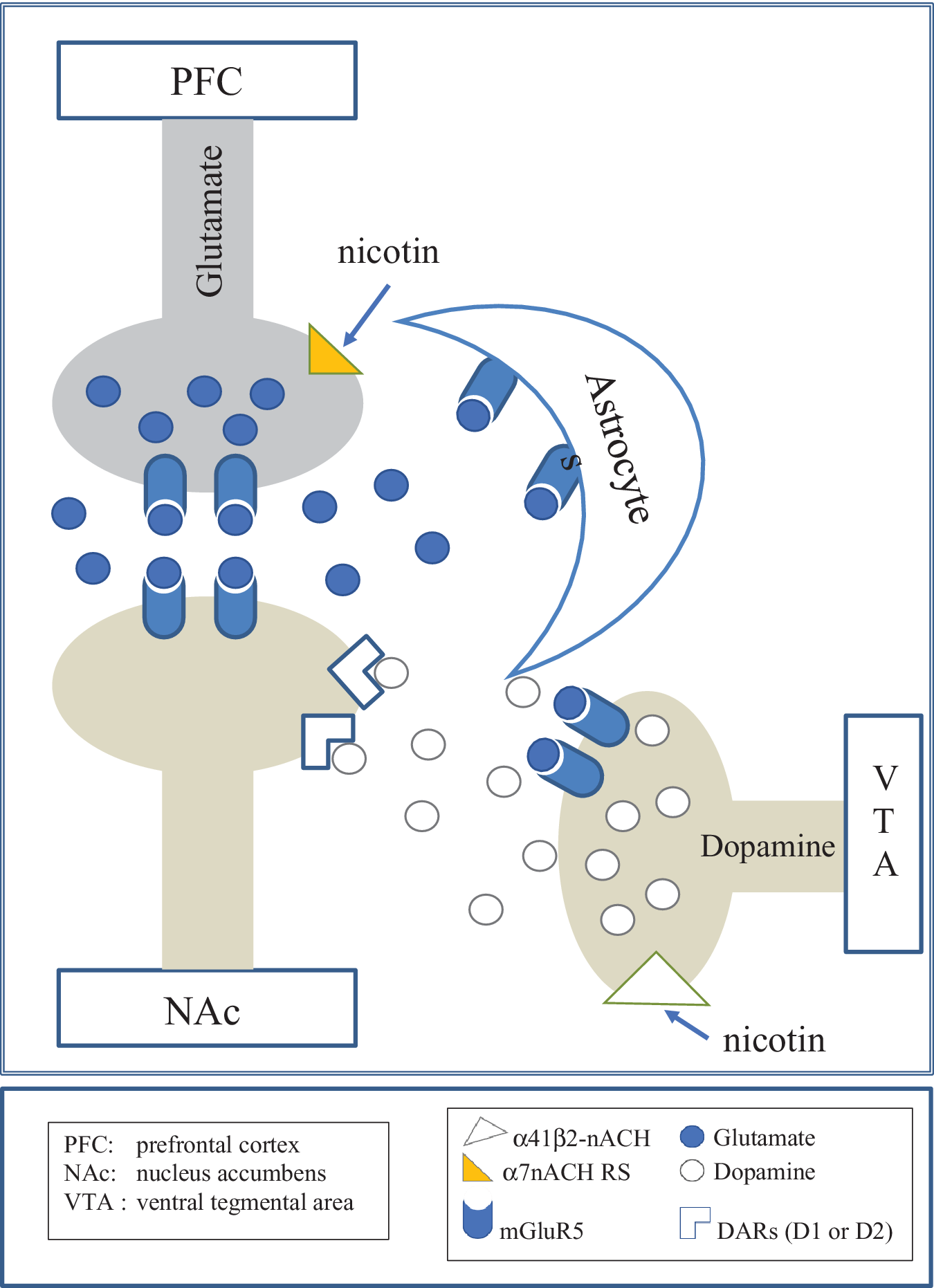
Several preclinical studies have found that nicotine increases glutamatergic transmission through activation of nicotinic acetylcholine receptor (nAChRs) located on glutamatergic afferents in the ventral tegmental area (VTA) and the nucleus accumbens (NAc)Reference Li, Semenova, D'Souza, Stoker and Markou 14 (see Figure 1 for depiction of this action). Furthermore, long-term nicotine exposure could cause changes in dopamine (DA) and glutamate systems.Reference Pistillo, Clementi, Zoli and Gotti 8 For example, it was found that nicotine injections enhanced the brains reward function in rats as measured through intracranial self-administration.Reference Chiamulera, Marzo and Balfour 15 Nicotine dependence is the result of a positive effect of nicotine, specifically, it induces a DA increase in NAc. DA extracellular overflow is subsequently implicated in behavioral motivation and dependence, as it activates the reward system. Indeed, there is evidence that chronic nicotine administration can lead to a reduction of glutamate transmission in the meso-cortico-limbic system, mainly in NAc and VTA.Reference Pistillo, Clementi, Zoli and Gotti 8 , Reference D’Souza and Markou 16 Early withdrawal symptoms in rats following chronic nicotine administration, was associated with decreased glutamate transmission and compensatory changes in glutamate receptors.Reference D’Souza and Markou 16
The figure shows the processes leading to nicotine dependence. It shows that nicotine release, triggers an interaction with nicotinic acetylcholine receptor (nAChRS) on dopaminergic and glutamatergic neurons, particularly on metabotropic glutamate receptor 5 (mGluR5). Nicotine triggers the change of mGluR5 availability. It further illustrates the accumulating evidence suggesting that mGluR5 is significant in nicotine addiction.
More recently, using magnet resonance spectroscopy (MRS) in humans, the glutamatergic systems in nicotine addicted participants was investigated. The researchers found that smoking led to lower glutamate levels in the anterior cingulate cortex (ACC) and prefrontal cortexReference Moeller, London and Northoff 17 regions associated with reward processes. In another MRS study, glutamate levels in the thalamus were compared between smokers and nonsmokers, showing lower thalamic glutamate in smokers.Reference O’Neill, Tobias and Hudkins 18
Pharmacological interventions targeting the glutamate system have been used to discover novel therapeutic treatments for smokers. N-acetylcysteine is traditionally used as a mucolytic in chronic obstructive pulmonary disorder. It is a precursor of l-cysteine that has the ability to enhance glutamate transmission and restore the reduced glutamate level caused by nicotine addiction.Reference Asevedo, Mendes, Berk and Brietzke 19 –Reference Bowers, Jackson, Maldoon and Damaj 21 Studies have shown that treatment with N-acetylcysteine led to participants reporting less withdrawal symptoms, decreasing their daily cigarette consumption, and significantly decreasing the reward effect of nicotine consumption compared to the control group.Reference Schmaal, Berk, Hulstijn, Cousijn, Wiers and Brink 22 However, over time, about 50% of the participants relapsed.Reference McClure, Gipson, Malcolm, Kalivas and Gray 20 , Reference Deepmala, Slattery and Kumar 23
The Role of mGluR5 in Nicotine Addiction in Preclinical Studies
Metabotropic glutamate receptor 5 (mGluR5) belongs to the Group I metabotropic receptors and its actions are predominantly excitatory. Most mGluR5s are on postsynaptic neurons, but they are also found on presynaptic neurons, on glial cells, and on intracellular membranes with the ability to activate multiple cell signaling pathways. MGlu5 is a G protein-coupled receptor that activates phospholipase C, which produces diacyl glycerol and inositol triphosphate, which in turn increases calcium. Therefore, mGluR5 is responsible for Ca2+ fluctuations and regulates the activity of locomotor networks and neurotransmitter release. Recently, the extracellular signal-regulated kinase (ERK) as a downstream mediator of mGluR5 activity has been investigated in relation to addiction because of its role in synaptic plasticity, including maladaptive forms of plasticity associated with drug abuse.Reference Stevenson, Hoffman, Maldonado-Devincci, Faccidomo and Hodge 24 Furthermore, calcium ions are one type of second messengers and the Ca2+ signaling pathway is a key component of the mechanisms that regulate neuronal excitability, information processing, and cognition, and it has been implicated in various neural diseases.Reference Chiamulera, Marzo and Balfour 15 , Reference Jong, Sergin, Purgert and O’Malley 25 , Reference Olmo, Ferreira-Vieira and Ribeiro 26 A high density of mGluR5 can be found in several brain areas such as the forebrain, striatum, limbic system, amygdala, hippocampus, NAc, olfactory tubercle, and cerebral cortex.Reference Olmo, Ferreira-Vieira and Ribeiro 26 Furthermore, mGluR5 is critically implicated in normal and aberrant neuroplasticity and is involved in learning, motivation, motor coordination, reward behavior, substance abuse, memory, and emotion. Several recent reviews have suggested a potential association between mGluR5 and nicotine addiction.Reference Mihov and Hasler 11 , Reference Terbeck, Akkus, Chesterman and Hasler 13 , Reference Chiamulera, Marzo and Balfour 15 In an mGluR5 knock out model study, it was suggested that this receptor is implicated in anhedonia and somatic signs of nicotine withdrawal.Reference Stoker, Olivier and Markou 27 These findings are consistent with pharmacological studies showing mGluR5 related signaling in nicotine addiction. In animal studies, rats who were treated acutely with nicotine (subcutaneously) showed increased levels of extracellular glutamate in the NAcReference Reid, Fox, Ho and Berger 28 and downregulation of mGluR5 expression.Reference Pistillo, Clementi, Zoli and Gotti 8 , Reference Li, Semenova, D'Souza, Stoker and Markou 14 Such an inverse relationship between mGluR5 and glutamate levels as determined by MRS have also been found in humans.Reference Abdallah, Hannestad and Mason 29 In addition, intracellular interactions between protein kinases and metabotropic receptors in the striatum, might regulate behavioral changes in response to drug abuse.Reference Lee and Messing 30 Specifically, repeated exposure to nicotine increased ERK phosphorylation in adult rats.Reference Yang, Sohn and Kim 31
Interestingly, pharmacological studies have found functional interactions of mGluR5 with DA D1/D2, NMDA, adenosine A2, and GABA receptors.Reference Mihov and Hasler 11 , Reference Terbeck, Akkus, Chesterman and Hasler 13 , Reference Chiamulera, Marzo and Balfour 15 The mGlu5 receptor was co-localized with DA and adenosine receptors in the striatum, including the NAc, where they are involved in the regulation of dopaminergic neurotransmission.Reference Chiamulera, Marzo and Balfour 15 , Reference Jong, Sergin, Purgert and O’Malley 25
More research is needed to understand the potential interactions between mGluR5 signaling and dopaminergic neurotransmission in the reward system. It is established that DA and glutamate system are anatomically closely located in the meso-cortico-limbic area. These brain regions are important in the regulation of motivation behaviors and emotions. Researchers have shown the interaction between mGlu5 and DA receptors, with mGluR5 being involved in the regulation of DA release in the NAc.Reference Chiamulera, Marzo and Balfour 15 It can be suggested that mGluR5 plays a major role in the regulation of the reinforcing effects of nicotine through modulation of dopaminergic neurotransmission.Reference Paterson, Semenova, Gasparini and Markou 32 The interaction of both systems suggests the importance for both; controlling addiction, and reward-related behavior in nicotine addiction, by demonstrating that the strong rewarding effect of DA overflow can be modulated by mGluR5 inhibition.Reference Chiamulera, Marzo and Balfour 15 Furthermore, the direct inhibition of NMDAR channels are regulated by the mGlu5 receptors through the protein complex formed by Homer.Reference Moutin, Raynaud and Roger 33 Activation of NMDAR is responsible for long-term learning and memory and plays main role in development in drug addiction.Reference Andrzejewski, McKee, Baldwin, Burns and Hernandez 34
Therapeutical Potential of mGluR5-NAMs in Preclinical Studies
Several studies used negative allosteric mGlu5 receptor antagonists 3-((2-Methyl-4-thiazolyl)ethynyl)pyridine (MTEP) or 3-((2-Methyl-4-thiazolyl)ethynyl)pyridine (MPEP)Reference Mihov and Hasler 11 , Reference Chiamulera, Marzo and Balfour 15 to study the relevance of mGluR5 signaling in nicotine addiction. Prior treatment with MPEP (which inhibits the responding for nicotine) for 30 minutes resulted in a dose-dependent reduction of nicotine self-administration while at the same time, decreased extracellular DA level in NAc.Reference Tronci and Balfour 35 Furthermore, pretreatment with MPEP in rats inhibited responses to nicotine, suggesting MPEP inhibits nicotine-seeking behavior.Reference Tronci, Vronskaya, Montgomery, Mura and Balfour 36 Furthermore, the effect of MPEP administration in nicotine-treated rats was highly significant compared to control and saline-treated rats. The response to nicotine in rats was greater if they were pretreated with nicotine for 8 days prior to the testing session.Reference Barnes, Sheffler, Semenova, Cosford and Bespalov 37 MPEP’s effect on nicotine consumption may be mediated by intracellular protein kinases, such as ERK in the brain reward system.Reference Yang, Sohn and Kim 31 Mavoglurant and other medications (eg, AZD2066, Basimglurant), which target mGluR5, have been examined in human research as an aid for nicotine cessation. However, these medications have the potential to cause some serious side effects in humans, such as hallucinations, skin reactions, and cognitive problems.Reference Barnes, Sheffler, Semenova, Cosford and Bespalov 37 MTEP and MPEP were shown to decrease nicotine intake, however, neither appeared to reduce the reward enhancing effects of nicotine. In an intravenous nicotine self-administration study, MPEP injection reduced self-administration in a dose-dependent manner, while it did not alter general locomotion and lever pressing for sweetened food reward in rats.Reference Tronci, Vronskaya, Montgomery, Mura and Balfour 36 This could either indicate that food was a more rewarding treat than nicotine or a nicotine-specific involvement of mGluR5. MGluR-NAMs lead to a reduction of nicotine self-administration, but have no influence on the motivation enhancing effect of nicotine.Reference Barnes, Sheffler, Semenova, Cosford and Bespalov 37 , Reference Palmatier, Liu, Donny, Caggiula and Sved 38 In a wide preclinical study, rats that received the pretreatment with MPEP and were either nonconditioned or operant conditioned to nicotine, showed that MPEP attenuated the reinforcing properties of nicotine. It suggests that the activity of mGlu5 receptors may play an important role in provoking drug-seeking behavior and nicotine cravings in habitual smokers exposed to cues associated with their smoking habit.Reference Tronci, Vronskaya, Montgomery, Mura and Balfour 36 In addition, pretreating rats with dose-dependent MPEP and nicotine causes attenuated DA overflow in the NAc.Reference Chiamulera, Marzo and Balfour 15 , Reference Tronci, Vronskaya, Montgomery, Mura and Balfour 36 It is therefore hypothesized that mGluR5 antagonists downregulate the increasing extracellular DA from injections of nicotine. Antagonists at mGlu5 receptors may therefore lead to smoking cessation.Reference Li, Semenova, D'Souza, Stoker and Markou 14 , Reference Chiamulera, Marzo and Balfour 15 , Reference Tronci, Vronskaya, Montgomery, Mura and Balfour 36 But a further study with rats showed that MPEP enhances the effect of nicotine and induces the conditioned place preference.Reference Rutten, Van Der Kam, De Vry, Bruckmann and Tzschentke 39 It was hypothesized that the effect of MPEP on the mesolimic system may induce the rewarding effect of nicotine.Reference Rutten, Van Der Kam, De Vry, Bruckmann and Tzschentke 39 However, this finding differs from past studies.Reference Li, Semenova, D'Souza, Stoker and Markou 14 , Reference Chiamulera, Marzo and Balfour 15 , Reference Tronci and Balfour 35 , Reference Tronci, Vronskaya, Montgomery, Mura and Balfour 36 In addition, mGluR5-targeting drugs may help to prevent relapse during nicotine withdrawal. The mGluR5-NAM showed a significant potential therapeutic effect, decreasing nicotine seeking behavior.Reference Mihov and Hasler 11 , Reference Chiamulera, Marzo and Balfour 15 , Reference Barnes, Sheffler, Semenova, Cosford and Bespalov 37 Furthermore, mGluR5-NAM should not lead to altering mood or cognitive enhancing effects of nicotine.Reference Palmatier, Liu, Donny, Caggiula and Sved 38 Similarly, preclinical studies on the effects of mGluR5-NAMs during early nicotine abstinence have shown that these drugs may worsen the somatic and depression-like symptoms of nicotine withdrawal.Reference Chiamulera, Marzo and Balfour 15 , Reference Barnes, Sheffler, Semenova, Cosford and Bespalov 37 The situation of either timing or combination of mGluR5 targeting therapeutics needs further investigation.
mGluR5 and Nicotine Addiction in Humans
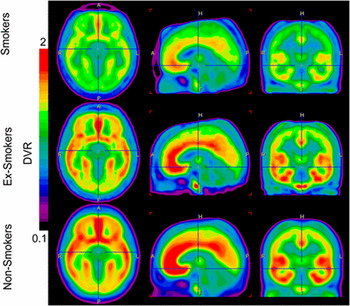
Positron emission tomography (PET) radioligands, such as [11C]ABP688Reference Ametamey, Treyer and Streffer 40 are used in humans to assess the distribution of mGluR5 in the brain and its subsequent role in smoking addiction. In a series of studies, the availability of mGluR5 in non-smokers, smokers and ex-smokers (abstinent for an average of 25 weeks) was investigated.Reference Akkus, Ametamey and Treyer 9 , Reference Akkus, Treyer and Johayem 10 These results provided support for markedly lower mGluR5 density in smokers. Among 14 smokers, global mGluR5 distribution volume ratio (DVR) was 20.6% lower in the gray matter compared to 14 nonsmokers.Reference Akkus, Ametamey and Treyer 9 Furthermore, it was found that 14 ex-smokers, had a higher mGluR5 density compared to smokers, which may be due to incomplete recovery of the receptors, especially because the ex-smokers were abstinent for only 25 weeks on average. Lower mGluR5 binding may be an adaptation to chronic increases in glutamate as a result of chronic nicotine administration (See Figure 2). In a follow-up study, 14 nonsmokers, 14 smokers, 14 long-term ex-smokers (abstinent for greater than 1.5 years), and 14 recent ex-smokers (abstinent for 5-12 month) were compared. Long-term ex-smokers and nonsmokers showed no difference in mGluR5 binding and long-term ex-smokers showed significantly higher mGluR5 binding compared to recent ex-smokers. Seven of the recent ex-smokers were still abstinent even after 1 year and showed higher mGluR5 distribution volumes at baseline than relapsing participants.Reference Akkus, Treyer and Johayem 10 The effect of smoking on mGluR5 availability is strongReference Akkus, Ametamey and Treyer 9 , Reference Akkus, Treyer and Johayem 10 and comparable to nicotine effects on mGluR5 in cocaine users.Reference Hulka, Treyer and Scheidegger 41 Here, smoking results in lower mGluR5 binding than in the cocaine using and control groups, and cocaine does not appear to affect mGluR5 binding.Reference Hulka, Treyer and Scheidegger 41 A similar reduction of mGluR5 binding as a result of smoking has also been shown in schizophrenia.Reference Akkus, Treyer, Ametamey, Johayem, Buck and Hasler 42 It is suggested, that chronic nicotine abuse disturbed the homeostasis of glutamatergic transmission, and might lead—via increasing glutamate release—to a down regulation of mGluR5 density in the cortex.Reference Akkus, Ametamey and Treyer 9 , Reference Chiamulera, Marzo and Balfour 15
Images display the average brain uptake of mGluR5 distribution volume ratio (DVR) in the three diagnostic groups. The brain uptake is visibly reduced in the smoker and ex-smoker group, compare with the non-smoker group (See Akkus et al,Reference Akkus, Ametamey and Treyer 9 open access).

A current longitudinal animal study has shown the impact of chronic nicotine exposure on mGluR5 using the novel radiotracer [18F]PSS232. Here, PET shows lower [18F]PSS232 binding. Furthermore, after prolonged nicotine withdrawal, [18F]PSS232 binding normalized in these rodents.Reference Müller Herde, Mihov and Kramer 43 These results replicate those from a previous study by the authors.Reference Akkus, Ametamey and Treyer 9 However, a further study on mGluR5 binding in major depressive disorder found significantly lower caudate mGluR5 DVR in smokers relative to nonsmokers, although this difference did not survive correction for multiple comparisons.Reference Abdallah, Hannestad and Mason 29
In summary, there is growing preclinical and clinical evidence that mGluR5 plays an important role in nicotine addiction. So far, drugs targeting mGluR5 did not show clinical utility because of lack of consistent efficacy or severe side effects. Nevertheless, findings encourage research into therapeutic drugs targeting mGluR5 as combination therapies for patients to treat their nicotine addiction.
Disclosures
Funda Akkus, Sylvia Terbeck, Connor. Haggarty, Valerie Treyer, Janan Janine Dietrich, Stefanie Hornschuh, and Gregor Hasler report no conflicts of interest affecting this publication.