Introduction
The military is generally considered a stressful occupation, similar to emergency services such as the police. However, unlike other occupations in which the risk of stressful events may be similar on a day-to-day basis, in the military the frequency and intensity of stressful events experienced by personnel deployed on operations is without comparison. Military life also requires personnel to spend extended periods away from family and friends when they are unable to help deal with events at home (Mulligan et al. Reference Mulligan, Jones, Davies, McAllister, Fear, Wessely and Greenberg2012). Media, political and research coverage on the mental health consequences of deployments to Iraq and Afghanistan has tended to focus on post-traumatic distress disorder (PTSD), and there is less discussion of common mental disorders (CMD), such as depression and anxiety. Evidence from a representative UK military cohort study showed that a single deployment was not associated with an increased risk of CMD [as assessed by the General Health Questionnaire (GHQ); Goldberg et al. Reference Goldberg, Gater, Sartorius, Ustun, Piccinelli, Gureje and Rutter1997] in regular personnel, with only some evidence for an increased risk in reservists (Hotopf et al. Reference Hotopf, Hull, Fear, Browne, Horn, Iversen, Jones, Murphy, Bland, Earnshaw, Greenberg, Hacker Hughes, Tate, Dandeker, Rona and Wessely2006). Additionally, being deployed in a combat role (those personnel most exposed to traumatic events) was not associated with CMD, even though it is associated with an increased risk of PTSD (Fear et al. Reference Fear, Jones, Murphy, Hull, Iversen, Coker, Machell, Sundin, Woodhead, Jones, Greenberg, Landau, Dandeker, Rona, Hotopf and Wessely2010).
While there are several studies that look at the risk factors for CMD in the military, the question of whether being in the military itself is a risk factor for CMD has not been directly addressed. Some studies do compare prevalence in the military with general population data, but to date these have all been forced to compare different measures of CMD, which is a major limitation. For example, data from a clinical interview study in the UK military showed that the prevalence of neurotic disorders (depression, generalized anxiety and panic), assessed by the Patient Health Questionnaire (PHQ), was similar to the prevalence of neurotic disorders from the Adult Psychiatric Morbidity Survey (APMS; a UK clinical interview study), which used a different measure, the Clinical Interview Schedule – Revised (CIS-R; Iversen et al. Reference Iversen, van Staden, Hughes, Browne, Hull, Hall, Greenberg, Rona, Hotopf, Wessely and Fear2009). Baseline data from the US Millennium military cohort, also using the PHQ, found that the prevalence of CMD was not higher in the military compared to US general population studies, such as the National Comorbidity Survey Replication (Riddle et al. Reference Riddle, Smith, Smith, Corbeil, Engel, Wells, Hoge, Adkins, Zamorski and Blazer2007).
Alternatively, population-based samples can be used to compare different occupations that have been randomly sampled, for example using data from the APMS in England (McManus et al. Reference McManus, Meltzer, Brugha, Bebbington and Jenkins2009), but given the relatively small number of individuals included who are serving in the Armed Forces, such studies are forced to combine occupations to ensure adequate statistical power. Data from a combined dataset of the 1993 and 2000 APMS found some evidence for a lower prevalence of CMD for non-commissioned officers and other ranks in the Armed Forces, and in police, compared to the average for the other occupational groups (Stansfeld et al. Reference Stansfeld, Pike, McManus, Harris, Bebbington, Brugha, Hassiotis, Jenkins, Meltzer, Moran and Clark2013). However, data from the UK Occupational Disease Intelligence Network suggested that the UK Armed Forces are one of the occupational groups with higher rates of work-related mental disorder in addition to police officers, teachers and social workers (Health and Safety Commission, 2001). This is in agreement with findings from another study showing a higher prevalence for the public administration and defence sectors (Carder et al. Reference Carder, Turner, McNamee and Agius2009). Population studies also have the advantage of being representative of different geographical regions, which is important given that military personnel are recruited from across the UK.
We are not aware of any comparisons between representative UK military samples and the UK general population which have used the same tool to assess mental health. In light of previous research on a ‘healthy worker effect’ (Li & Sung, Reference Li and Sung1999) it would be expected that the serving military should have better mental health than the general population, which includes individuals who are unemployed and those with long-term health problems and disabilities who are more likely to report CMD (Ford et al. Reference Ford, Clark, McManus, Harris, Jenkins, Bebbington, Brugha, Meltzer and Stansfeld2010). However, it is not known what the difference would be when the general population is restricted to individuals in employment.
We therefore aimed to examine the prevalence of CMD (i.e. personnel who screened positive for probable CMD) in a serving UK military sample compared to the prevalence in individuals in employment from the Health Survey for England (HSE) and to examine whether the difference between these samples was greatest for particular CMD symptoms which could reflect increased occupational stress in the military. A further aim was to examine whether there was regional variation in the prevalence of CMD in the general population and how this corresponded to recruitment data by region for the UK military.
Methods
Samples
King's Centre for Military Health Research (KCMHR) cohort study
The KCMHR cohort is a large representative study of military personnel in the Naval Services, British Army and the Royal Air Force. Data were collected in 2004–2006 (phase 1) (Hotopf et al. Reference Hotopf, Hull, Fear, Browne, Horn, Iversen, Jones, Murphy, Bland, Earnshaw, Greenberg, Hacker Hughes, Tate, Dandeker, Rona and Wessely2006) and then again in 2007–2009 (phase 2) (Fear et al. Reference Fear, Jones, Murphy, Hull, Iversen, Coker, Machell, Sundin, Woodhead, Jones, Greenberg, Landau, Dandeker, Rona, Hotopf and Wessely2010). The first phase of the KCMHR cohort study recruited approximately 10% of UK military personnel who had been deployed to the first phase of the Iraq war, known as Operation (Op) TELIC 1, and a further sample of the military who had not been deployed to Iraq at that time. Reservists were oversampled at a ratio of 2:1. In total, 10 299 participants responded [8711 regulars, 1588 reservists (including late responders); 59% response rate]. Of the participants who completed phase 1 of the study, 5905 had been deployed to Op TELIC 1 before they completed the questionnaire (Hotopf et al. Reference Hotopf, Hull, Fear, Browne, Horn, Iversen, Jones, Murphy, Bland, Earnshaw, Greenberg, Hacker Hughes, Tate, Dandeker, Rona and Wessely2006).
For phase 2, 9395 participants from phase 1 were available for follow-up, including 37 who returned a completed phase 1 questionnaire after the end of data collection. Of the 9395 participants available for phase 2, 6429 completed this data collection (68% response rate), referred to as the ‘follow-up’ sample. Response at phase 2 was associated with being older, female, an officer and a regular. There was no evidence that health status at phase 1 was associated with response at phase 2. There were two additional samples recruited at phase 2. The first was a random sample of 896 personnel deployed to Afghanistan on Operation HERRICK between April 2006 and April 2007, termed the ‘HERRICK’ sample (response rate 50%). The second, referred to as the ‘replenishment’ sample, included a random sample of 2665 individuals who joined the UK Armed Forces between April 2003 and April 2007 (response rate 40%). In total, 9990 individuals completed the phase 2 questionnaire (overall response rate 56%) (Fear et al. Reference Fear, Jones, Murphy, Hull, Iversen, Coker, Machell, Sundin, Woodhead, Jones, Greenberg, Landau, Dandeker, Rona, Hotopf and Wessely2010).
Although this cohort included both regulars and reservists, and serving and ex-serving personnel, in the current study the military sample was restricted to regulars who were in service at phase 1 (N = 7786) or phase 2 (N = 6511). The number of participants who had completed the GHQ was 7670 and 6420, for phases 1 and 2, respectively. There was some overlap between the phase 1 and 2 samples, with 3737 serving regulars included in both of the samples. The difference between the overlapping and independent samples for the prevalence of probable CMD at both phases was small (phase 1 only sample: 19.8%, overlapping sample at phase 1: 17.8%; phase 2 only sample: 19.1%, overlapping sample at phase 2: 18.3%).
Health Survey for England (HSE)
The general population data is from the HSE, an annual cross-sectional survey of children and adults living in private households in England which measures health and health-related behaviours. The survey comprises an interview and a nurse visit. The datasets used in the current study are the 2003 (n = 14 836, adults aged ⩾16 years) and 2008 (n = 15 102, adults aged ⩾16 years) data collections, which are similar to the dates of data collection for the KCMHR military cohort study (Sproston & Primatesta, Reference Sproston and Primatesta2004). The samples were selected to be representative of the whole population, at both a national and regional level: 73% of eligible households took part in the 2003 HSE survey (66% of adults in the sampled households were interviewed) and there was a household response rate of 64% for the 2008 HSE (58% of adults in the sampled households were interviewed).
The sample was restricted to (i) those who were in employment, (ii) to individuals aged 18–64 years in 2003 so that the age range was comparable to the phase 1 KCMHR sample, and to ages 18–66 years in 2008 to match the range for the phase 2 KCMHR sample and (iii) individuals who reported being in the Armed Forces in the HSE were excluded from the analyses. After these exclusions the sample sizes were 8200 in 2003 and 8159 in 2008. Not all of these individuals had completed the GHQ; in 2003 there was data available for 7841 and in 2008 for 7782 participants.
Restricted samples for the HSE and the KCMHR cohort
Due to differences in the demographic characteristics of the HSE general population and the military samples on sex and age, the samples were further restricted to males only and to the ages of 18–44 years for a restricted analysis described in the statistical analysis section. This was because the military sample was predominantly male and had small numbers in the 45–64 years age category. The number of participants with GHQ data available was 2281 for the 2003 HSE and 6393 for phase 1 of the military cohort, and 2140 for the 2008 HSE and 5240 for phase 2 of the military cohort.
Recruitment data for the British Army
Recruitment data was provided by the UK Ministry of Defence for the British Army (the largest of the three services), by region and by recruitment year (April–March) for 2003/2004 and for 2007/2008.
Measures
Demographic characteristics
Data was available on sex, age, level of education (categorized as O levels/GCSE or below and A levels or higher) and marital status in both the HSE and the KCMHR military studies. New variables were created for social class with two categories of lower and higher social class which aimed to be comparable across the military and general population samples. These were based on the National Statistics Socio-economic Classification (NS-SEC-5) categories in the HSE and ‘higher social class’ was defined as those in managerial and professional occupations and ‘lower social class’ included those in intermediate occupations, small employers and own account workers, lower supervisory and technical occupations and semi-routine occupations. For the military sample this measure was based on military rank and ‘higher social class’ included commissioned officers and senior non-commissioned officers (SNCOs: Sergeant and Warrant Officer or above) (who are both more likely to have managerial responsibilities) and ‘lower social class’ included junior NCOs and other ranks.
Common mental disorder
Probable CMD was assessed using the General Health Questionnaire (GHQ-12). This is a 12-item questionnaire widely used to screen for symptoms of CMD (Goldberg et al. Reference Goldberg, Gater, Sartorius, Ustun, Piccinelli, Gureje and Rutter1997). The questionnaire is not a diagnostic interview, but validation studies indicate acceptable criterion validity with the CIS-R (Hardy et al. Reference Hardy, Shapiro, Haynes and Rick1999). Each of the symptoms was rated on a four-point scale, for example ‘not at all, ‘no more than usual’, ‘rather more than usual’ or ‘much more than usual’ for negative items and ‘more so than usual’, ‘same as usual’, ‘less so than usual’ or ‘much less than usual’ for positive items. For this study the bi-modal scoring method of 0-0-1-1 was used, with those endorsing a negative symptom as ‘rather’ or ‘much more than usual’, or a positive symptom as ‘less’ or ‘much less than usual’, classified as reporting a symptom. Possible scores for the full scale ranged from 0 to 12 and a 3/4 cut-off was used to represent caseness for probable CMD.
Data analysis
Information on sampling weights
In the 2003 and 2008 HSE, individual response weights were calculated which represented the probability of an individual responding multiplied by the household weight. In the KCMHR military cohort, weights to account for non-response were created at phase 2. The decision was made to only use weights in the analyses for the 2008 HSE v. phase 2 military analyses, due to response weights not being available at phase 1 of the military study.
Statistical analysis
Stata v. 11.0 was used for all of the statistical analyses (StataCorp, 2009).
-
(1) The 2003 HSE and phase 1 military samples, and the 2008 HSE and phase 2 military samples were combined using the ‘append’ command in Stata. All of the variable names were amended to be the same across the datasets.
-
(2) The prevalence of probable CMD in the 2003 and 2008 HSE and phases 1 and 2 of the KCMHR military study was calculated. For the 2003 HSE and phase 1 military study, both the frequencies and percentages were unweighted. For the 2008 HSE and phase 2 military study, the frequencies were unweighted and the percentages were weighted.
-
(3) Logistic regressions were conducted to calculate odds ratios (OR) and 95% confidence intervals (CI) with probable CMD as the outcome and sample (general population v. military) as the explanatory measure. The unadjusted and adjusted (adjusted for sex, age, social class, education and marital status) ORs are presented. The analyses were unweighted for the 2003 HSE v. phase 1 military analysis and weighted for the 2008 HSE v. phase 2 military analysis.
-
(4) The prevalence for each of the individual GHQ symptoms was calculated. Unadjusted and adjusted (adjusted for sex, age, social class, education, marital status) logistic regressions were conducted to calculate the odds of each symptom in the military compared to the general population.
-
(5) In the 2003 and 2008 HSE samples, the prevalence of probable CMD stratified by government office region was calculated. For the recruitment data from the British Army, for both 2003/2004 and 2007/2008 the proportion of new recruits for each region was calculated as a percentage of the total number of new recruits.
-
(6) The analyses were repeated restricted to males only and to the ages of 18–44 years. The analyses described in points (1)–(3) above were conducted in this restricted sample (other than those which included sex as a covariate).
Results
Comparing the prevalence of probable CMD in the military to the general population
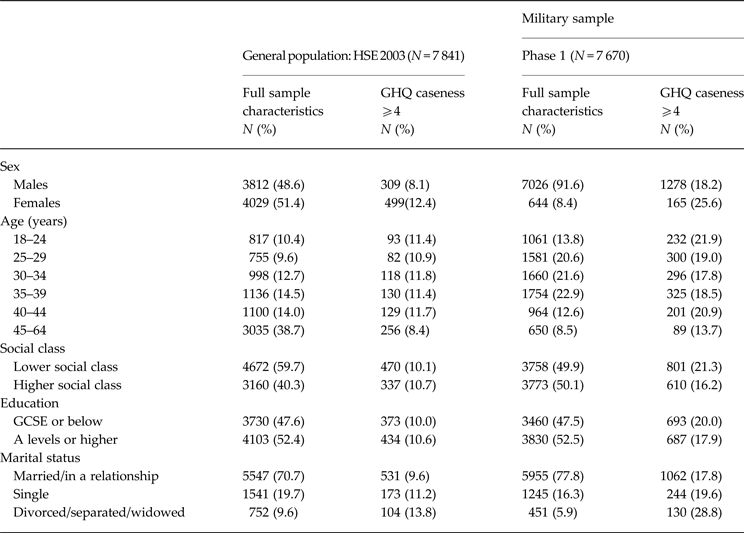
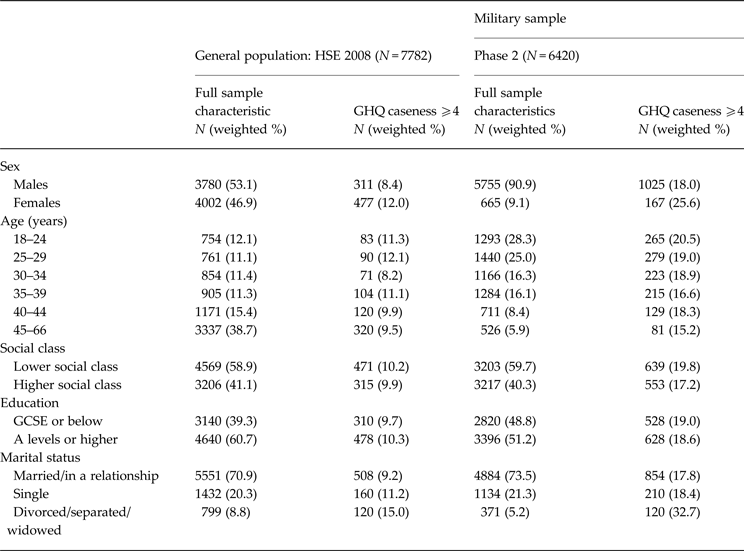
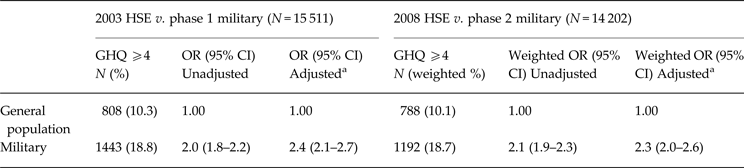
In both the HSE and the KCMHR military samples, the prevalence of probable CMD was stable across the time points, with no evidence for an increase or decrease over time in the cross-sectional HSE studies or the two phases of the military study. Comparisons between serving military personnel and the general working population show that the prevalence of probable CMD was approximately double in the military (Tables 1 and 2). This trend was shown when both comparing phase 1 of the military study to the 2003 HSE, and comparing phase 2 to the 2008 HSE. When results were stratified by sex, age and other demographic variables, the effect was seen across strata suggesting that these variables could not explain the differences. The prevalence of probable CMD was higher in females than in males in all of the samples, with a quarter of females in the military meeting the criteria for probable CMD. In the military samples, the prevalence was lower in those in a higher social class (i.e. commissioned officers and senior NCOs), but the proportion was still increased compared to those in the general working population (regardless of social class). The highest prevalence across all of the subgroups was found in military personnel who were divorced, separated or widowed, with 29% and 33% meeting the criteria for probable CMD at phases 1 and 2, respectively. Table 3 shows that after adjusting for sex, age, social class, education and marital status, there was a 2-fold increase in the odds of probable CMD for serving military compared to the general working population.
Prevalence of common mental disorders in Health Survey for England (HSE) 2003 and military phase 1 samples

Unweighted % presented.
Prevalence of common mental disorders in Health Survey for England (HSE) 2008 and military phase 2 samples

Weighted % presented (using response weights).
Examining the association between population type and prevalence of common mental disorders

HSE,Health Survey for England; GHQ,General Health Questionnaire; OR, Odds ratio; CI, confidence interval.
a Analyses adjusted for sex, age, social class, education and marital status.
Endorsement of the individual GHQ symptoms in the military and the general population
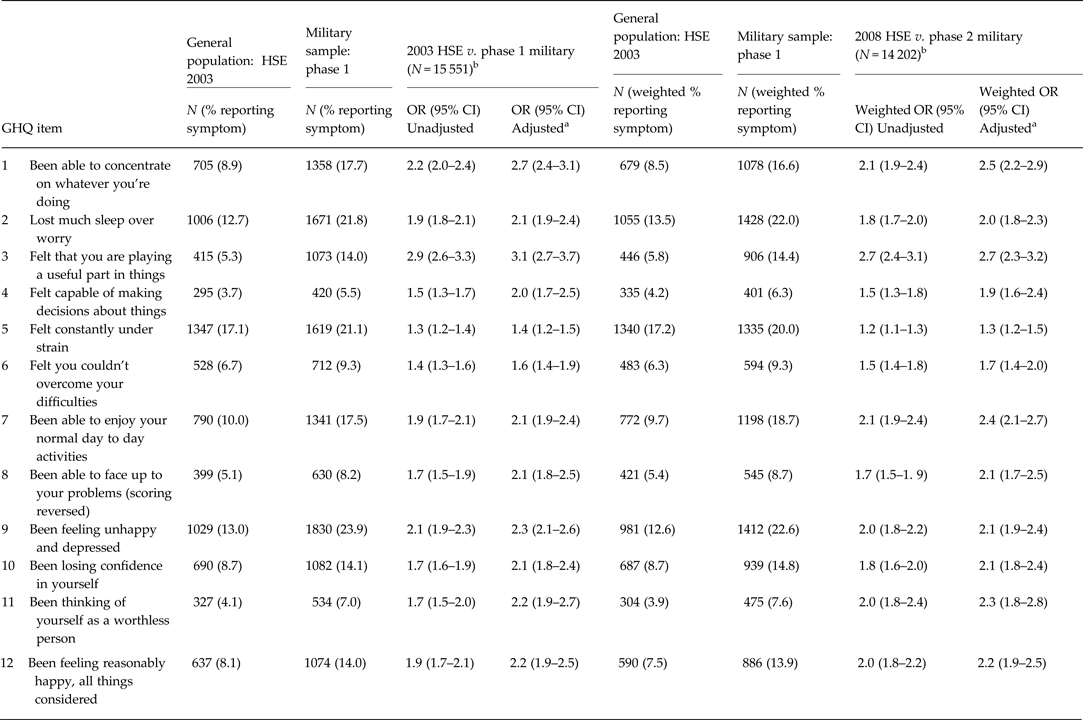
Table 4 shows that across all of the 12 GHQ items, a greater proportion of military personnel endorsed each symptom compared to the general population. The largest difference between the samples was shown for the symptoms: ‘GHQ 1: been able to concentrate on whatever you're doing’, ‘GHQ 3: felt that you are playing a useful part in things’, and ‘GHQ 9: been feeling unhappy and depressed’. The smallest difference was shown for the symptom: ‘GHQ 5: felt constantly under strain’ which was only slightly more common in the military, with 21% endorsing it compared to 17% of the general working population.
The proportion endorsing the individual General Health Questionnaire (GHQ) symptoms comparing phase 1 v. 2003 Health Survey for England (HSE) and phase 2 v. 2008 HSE

OR, Odds ratio; CI, confidence interval.
a Analyses adjusted for sex, age, social class, education and marital status.
b The sample size differs for each symptom dependent on the proportion of missing data.
The prevalence of probable CMD by geographical region in the general population and recruitment to the British Army by region
The British Army recruitment figures showed that 2003/2004 recruitment was highest in the North East Brigade (17.6%), followed by the North West Brigade (14.11%), the East Brigade (12.9%) and the South (10.9%) and London District (10.9%) brigades. For 2007/2008 recruitment was also highest in the North East (16.76%), followed by the East Brigade (13.6%), the North West Brigade (12.8%), the West Midlands (10.2%) and London District (9.9%) brigades. In the HSE, restricted to those in employment, the prevalence of probable CMD was broadly similar across the government office regions in England. In 2003, the highest prevalence was in the North East (11.6%) and South East (11.5%) regions and in 2008 in the East Midlands (11.4%) and the West Midlands (11.4%). Although some of these regions are areas of high recruitment to the British Army, the regional differences in CMD are not large enough to explain the difference between the UK general population and military.
Comparing the prevalence of probable CMD in males aged 18–44 years only
The difference between the general population and the military samples remained when the samples were restricted. The prevalence of probable CMD for the restricted 2003 HSE was 9.1% and in the military at phase 1 was 18.7% with a 2-fold increase in odds after adjustment for age, social class, educational attainment and marital status (OR 2.4, 95% CI 2.0–2.8). The prevalence of probable CMD in the restricted 2008 HSE sample was 9.2% and was 18.2% in the phase 2 military sample. There was a 2-fold increase in odds in the military after adjustment (OR 2.1, 95% CI 1.8–2.6).
Discussion
This study shows that serving military personnel are more likely to endorse symptoms of CMD compared to those selected from a general population study as employed in other occupations, with an approximate doubling of prevalence of probable CMD in the military. In both the general population and military samples, the expected trends were found across gender and marital status, with higher rates in females in both samples and also in those who were divorced, separated or widowed. Prevalence was lower in those with a higher educational attainment and in a higher social class (rank) in the military, but there was little difference between these social occupational classifications in the HSE, which was unexpected. Accounting for all of these factors did not explain the difference in the prevalence of probable CMD between the military and the general population, suggesting that it did not result from the expected demographic differences between samples.
The UK military differs from most other occupations in that their responsibilities change between training and deployment, they often spend time away from family, they can live with their work colleagues and there is occupational support and healthcare services that are specific to military personnel. Previous studies have not found a single deployment to be associated with CMD when personnel return and levels of CMD do not seem to be higher during the time of a deployment (Mulligan et al. Reference Mulligan, Jones, Davies, McAllister, Fear, Wessely and Greenberg2012). It is therefore difficult to explain why the prevalence found in the military study is so much higher than the general population, but some possible explanations are given in the following sections.
Confounding and selection bias
There are likely to be differences between individuals who go into a military occupation, compared to those who choose other occupations, so there may be predisposing differences between the individuals in these samples, rather than the difference resulting from being in the armed forces itself. For example, there are known factors associated with mental disorder including exposure to childhood adversity (Iversen et al. Reference Iversen, Fear, Simonoff, Hull, Horn, Greenberg, Hotopf, Rona and Wessely2007; Clark et al. Reference Clark, Caldwell, Power and Stansfeld2010), and childhood socioeconomic class (SEC) (Muntaner et al. Reference Muntaner, Eaton, Miech and O'Campo2004). Many of these risk factors may be more common in individuals who are recruited into the military, particularly childhood adversity which could not be adjusted for in the regression analyses, although the difference between the samples existed after controlling for a range of other demographic confounders. Within the military, the prevalence of probable CMD did differ by reports of childhood adversity, ranging from 14% in personnel who reported no childhood adversity to 25% in those reporting ⩾2 adversities (results available on request). However, the prevalence of probable CMD is still somewhat higher in the military sample reporting no childhood adversity compared to the overall general population sample. The military recruitment data also suggested that personnel were more likely to be recruited from particular areas of the UK, but the HSE data suggested that there was no substantial geographical variation in the prevalence of CMD. A study comparing the prevalence of CMD between countries found slightly higher GHQ-12 scores for Northern Ireland and Wales compared to England, with no difference between England and Scotland (Murphy & Lloyd, Reference Murphy and Lloyd2007). Another potential confounding factor is role in the military, with the possibility that particularly subgroups may have a much higher prevalence of CMD; however, in this sample the prevalence of CMD was only 1% higher in those employed in a combat role in their parent unit, compared to those in other roles (results available on request). Furthermore, although we cannot discount recruitment bias, there is no evidence that any bias would have been likely to differ between the two samples and the difference in the prevalence of probable CMD is unlikely to be explained by recruitment bias.
Measurement of CMD using the GHQ
The GHQ covers a range of symptoms so one explanation for this difference may be that particular symptoms are elevated in the military sample, which accounts for the higher prevalence overall. Comparisons across the samples showed that there was a significant difference for all of the symptoms, with a consistently higher prevalence in the military sample. The symptom with the greatest difference between samples was ‘felt that you are playing a useful part in things’ with almost three times the odds of not agreeing with this symptom in the military at both time points. It is also surprising, given the nature of the military occupation that the smallest difference between the military and general population was found for the symptom ‘felt constantly under strain’. Overall examination of the symptom profiles seems to suggest that the symptoms more commonly reported in the military may relate less to feeling under stress, but seemed to comprise low mood and internalizing thoughts. It is, however, worth noting that for the majority the military surveys were not completed during a deployment, when feelings of stress may have been increased. The symptom profiles could therefore have differed if the survey had been conducted during deployment; although the overall prevalence of probable CMD does not appear to be higher during deployment (Jones et al. Reference Jones, Mitchell, Clack, Fertout, Fear, Wessely and Greenberg2013). In summary, while there is some difference between the samples in the pattern of response, the difference is large for all symptoms, so outlying symptoms are not accounting for the higher scores in the military.
A reporting bias
One of the main differences between the HSE and the military study is that the former is a general population household study and the latter is an occupational study. In a recent systematic review we found evidence that higher levels of CMD are reported in occupational studies, which may be more likely to be framed as studies of ‘stress at work’, compared to general population studies which are framed more generally (Goodwin et al. Reference Goodwin, Ben-Zion, Fear, Hotopf, Stansfeld and Wessely2013). Occupational studies seem to be affected by a framing effect, in which the context of the study may result in an individual venting any frustrations regarding their job in their responses, and consequently results in a response bias. Our systematic review also showed that occupational studies in a military setting had a lower prevalence of CMD compared to studies of other professions, specifically academics and teachers and social workers (Goodwin et al. Reference Goodwin, Ben-Zion, Fear, Hotopf, Stansfeld and Wessely2013), suggesting that the effect seen in the current study does not indicate a general pattern of higher levels of CMD in the military compared to other occupations. This was also reflected in previous findings from the APMS, that occupations other than the military have the highest rates of CMD (Stansfeld et al. Reference Stansfeld, Head, Rasul, Singleton and Lee2003).
There are differences between the studies in regard to the administration of these surveys as the HSE was completed in person by an interviewer and the military study was a self-administered postal questionnaire (or in some cases was self-administered during a base visit). There is evidence that self-administration methods are associated with a greater willingness to report socially undesirable behaviours such as illegal drug use (Tourangeau et al. Reference Tourangeau, Rips and Rasinki2000). The same may be expected for reports of mental health symptoms, with further evidence from a military population that reporting of PTSD symptoms was higher in anonymous compared to identifiable participants (Fear et al. Reference Fear, Seddon, Jones, Greenberg and Wessely2012). Additionally, there is lower social desirability and higher willingness to disclose sensitive information in self-administered questionnaires with the reverse shown in face-to-face interviews (Bowling, Reference Bowling2005). However, these factors may not have substantially impacted on reporting given that the GHQ was completed as a self-completion booklet during the HSE interview and the military questionnaire was not anonymous.
Direction of these effects
It is important to acknowledge that the potential issues of selection and reporting bias would all have widened any true difference between the samples in the same direction, by increasing reporting of symptoms in the military sample and decreasing reporting in the general population sample. For example, selection into the military may not be independent of other risk factors for CMD and the self-administration method for the military survey may also have increased disclosure of sensitive information on mental health symptoms. The accumulation of these different effects is likely to have been significant. A future study that can assess mental health symptoms at the point that individuals join the military, or enter other occupations, would shed more light on this matter.
Strengths and limitations
The strengths of this study include large representative samples for both the general population and the military, in which we were able to identify those in employment or currently serving in the military. Both of these studies used the same questionnaire (GHQ-12) and scoring method so the results were more comparable than studies which have used different assessment tools. The potential limitations include the demographic differences between the samples, although the variation existed after restricting to males of a comparable age. It is also difficult to create measures of social class which are comparable across the military rank system and the general occupational classes, so adjustment for this simplified variable may not have fully accounted for any complex social class effects. There was also a lack of independence between the phase 1 and 2 samples of the military cohort study, whereas the HSE samples were independent. It is possible that our investigations into geographical regions did not capture the true difference because government office regions are large and heterogeneous regions, but our assessment of the prevalence between regions in the general population suggests that this is an unlikely explanation of the difference between the two studies.
Implications
This study has shown that a fifth of serving military personnel meet the criteria for probable CMD, suggesting that defence mental health services should continue to keep their services focused on depression and anxiety, in addition to PTSD. Whether our results could be explained by specific aspects of military life (such as the upheaval of moving home every 2–3 years or having the threat of compulsory deployment to high-risk combat duties) requires further investigation. The prevalence of CMD was also higher in military personnel in a lower social class (rank) which may be accounted for by predisposing factors, such as childhood adversity, in addition to differences in occupational role and lack of autonomy in their job. The types of symptoms that were most common in the military, compared to the general population were those which seemed to represent low mood and internalizing cognitions (e.g. not feeling that they were playing a useful part in things), as opposed to feeling under strain. Further implications from a research perspective suggest that the nature of a study should be taken into account when making comparisons, and it is difficult to know in the current study whether the difference that was found represents an increased risk of CMD in military personnel, or the effect of study context.
Conclusions
In the UK, symptoms of CMD are more commonly endorsed in the serving Armed Forces, compared to the general working population. This study showed that there was approximately double the numbers screening positively for CMD in the military population, compared to those selected from a general population study as employed in other occupations. This difference was not accounted for by demographic factors including sex, age, education, social class and marital status. This effect may be partly explained by a difference in predisposing factors between the samples, such as childhood adversity, and also the context of the studies, with evidence from previous research for higher reports of symptoms from the GHQ in occupational compared to population studies. Drawing comparisons with other populations, even if using the same questionnaire, is tricky and particularly if no modifications to the data are made to reduce confounding.
Acknowledgements
This work was supported by the UK Ministry of Defence (MoD). The authors’ work was independent of the funders and the paper was disclosed to the MoD at the point of submission. The funders had no role in study design, data collection and analysis, decision to publish, or preparation of the manuscript. L.G., S.W. and M.H. are part funded by the National Institute for Health Research (NIHR) Mental Health Biomedical Research Centre at South London and Maudsley NHS Foundation Trust and King's College London.
Declaration of Interest
S.W. is Honorary Civilian Consultant Advisor in Psychiatry to the British Army and a Trustee of Combat Stress, a UK charity that provides services and support for veterans with mental health problems. N.G. sees patients for occupational mental health assessments on a private basis.