Disasters have impacted over 6.9 trillion people and caused damages totalling US $2.6 trillion over the last 5 decades. 1 Natural and technological disasters affect and disrupt millions of people, indifferent to age, gender, race, and socioeconomic status.Reference Baker and Cormier 2 Disasters may create uncertainty for individuals regarding their immediate and long-term future as well as exacerbate and create stressors that contribute to a wide range of physical, behavioral, cognitive, and emotional symptoms.Reference Baker and Cormier 2 - Reference Ausbrooks, Barrett and Martinez-Cosio 6 Technological disasters may differ in their impact compared to natural disasters,Reference Ritchie, Gill and Farnham 7 - Reference Arata, Picou and Johnson 9 with some research suggesting that technological disasters, in particular, are more likely to negatively affect social capital and individuals’ sense of well-being.Reference Ritchie, Gill and Farnham 7 For both natural and technological disasters, there is an increasingly large body of literature exploring which factors most impact resilience at both the individual and community levels, and how these factors impact an individual and community’s ability to cope with the effects of disaster.Reference Cutter 10 - Reference Holling 15 Scholarly definitions of resilience are diverse. Within the context of this manuscript, resilience relates to an individual’s ability to cope with risk, adversity, and stress.Reference Adger 14 - Reference Holling 15 Though the concept of resilience continues to be debated,Reference Cutter 10 - Reference Cutter, Barnes and Berry 11 central to much resilience research is a focus on both protective and risk factors, and an analysis of how different forms of stress (eg, trauma, disaster) impact these factors.Reference Cutter 10 - Reference Hobfoll, Stevens and Zalta 16
However, less research has focused on how older individuals are impacted in post-disaster settings and the implications that this has on resilience research and interventions. Research on the effect of disasters on older adults suggests that older individuals’ resilience may be at risk following disasters because of problems related to their health.Reference Baker and Cormier 2 , Reference Brown, Rothman and Norris 17 - Reference Tuohy and Stephens 20 Possible health issues facing older adults include limited mobility, problems in cognition, hearing, and vision, vulnerability to disease or infection, and mental well-being.Reference Baker and Cormier 2 , Reference Brown, Rothman and Norris 17 - Reference Tuohy and Stephens 20 Previous literature has suggested that additional areas where older adults may be vulnerable relate to their livelihood, self-protection, social capital (including social networks and connections), lack of access to resources, susceptibility to abuse and violence, limited knowledge regarding the use of information technology, and limited access to political power and representation.Reference Burnett, Dyer and Pickins 19 - Reference Jenkins, Laska and Williamson 36
Because coastal areas are simultaneously areas of increased risk for technological (man-made) and natural disasters, and areas that are seeing rapid demographic increases in the percentage of older retirees,Reference Cutter and Emrich 25 continued research on the impact of technological disasters on older adults is essential. The Deepwater Horizon oil rig explosion of 2010 is an example of one of these technological disasters that resulted in one of the largest hydrocarbon disaster events in US history, killing 11 crewmembers, and pouring over 4.9 million barrels of oil into the Gulf of Mexico.Reference Smith, Smith and Ashcroft 37 Though the total long-term economic and environmental cost of the disaster has yet to be determined, damages to the US Gulf Coast economy are estimated to be at least $36.8 billion.Reference Smith, Smith and Ashcroft 37 People residing in Gulf Coast communities in Louisiana, Alabama, Florida, and Mississippi have been faced with a rapid, unanticipated change to their environment.Reference Fan, Prescott and Zhao 26
Gaps in the Literature
Resilience research is increasingly being turned to for a more holistic view of the variety of factors (eg, health, social, economic) that influence individual and community well-being in a disaster context,Reference Cutter 10 - Reference Hobfoll, Stevens and Zalta 16 , Reference Cutter, Ahearn and Amadei 30 and, ultimately, their ability to withstand adversity. However, to date there are no known studies that systematically investigate how the resilience of older individuals is affected by social, physical, and mental health factors in technological disaster settings, and how these areas of resilience may be interconnected. The majority of studies on older adult resilience tend to focus primarily on health factors, or on only one area of resilience.Reference Ngo 31 - Reference Cherniack 32 Most studies investigating impacts on physical and mental health post-disaster have indicated that these events exacerbate existing health problems.Reference Sanders, Bowie and Bowie 33 Disaster research on older individuals has also tended to focus more on their vulnerability, viewing individuals through a deficit model, and focusing on disabilities and the impaired functional status of older adults.Reference Sanders, Bowie and Bowie 33 - Reference Rothman and Brown 34 Empirical findings have demonstrated that older populations have the highest casualty rate during disasters compared with other age groups,Reference Gibson 35 - Reference Jenkins, Laska and Williamson 36 highlighting the importance of improved care and interventions. However, there is a need for research that explores both strengths and weaknesses of individuals in post-disaster settings. Because accurate pre- and post-disaster planning is necessary to ensure that the safety and needs of all individuals impacted by disastersReference Baker and Cormier 2 , Reference Burnett, Dyer and Pickins 19 are met, the lack of evidence about the specific needs of older adults is concerning and important to address.
Current Study
This study uses a modified version of Andersen’s Behavioral Model of Health Utilization Reference Andersen, Rice and Kominski 38 and Hobfoll’s (1989) Conservation of Resources (COR) model.Reference Hobfoll 39 - Reference Hobfoll 41 To investigate the impact of individual resilience factors on individual resilience, Andersen’s model was modified with the community disaster resilience modelReference Cutter, Burton and Emrich 42 and the hazards-of-place model of vulnerability used in disaster management literature.Reference Cutter, Boruff and Shirley 29 According to the model, equitable disaster mitigation would occur when demographic (eg, age, gender) and need variables (eg, contextual disaster risk and population health) accounted for most of the variance in individual resilience, whereas inequitable disaster mitigation would occur when social structure (eg, individual social vulnerability) and enabling resources (eg, individual economic resilience) determined individual outcomes. The COR model, which takes a resource (as opposed to deficit) approach to understanding individual and community responses to stressors is useful for analyzing how resource protection or resource loss may impact resilience.Reference Hobfoll 39 , Reference Hobfoll and Lilly 43 In times of stress, individuals may actively focus on maintaining the resources (ie, social ties or housing) that they perceive as being most essential to their well-being.Reference Hobfoll 41 Although individual or community resilience is impacted by a multitude of factors, in general, the more resources that one is able to “maintain” or “gain” the more resilience is likely to be supported.Reference Hobfoll 39 - Reference Hobfoll 41 , Reference Chen, Westman and Hobfoll 44
Although the COR model has been used to analyze other technological disasters,Reference Arata, Picou and Johnson 9 its application to older adults in technological disaster contexts has yet to be explored.Reference Chen, Westman and Hobfoll 44 This study expands these models and theories by investigating differences in age across individual contextual factors, and by exploring how equitable and inequitable variables within the context of COR differ among individuals ages 65 years and older. The concept of equitable/inequitable disaster mitigation can pertain to both tangible physical mechanisms (eg, economic resilience) and less tangible resources such as community preparedness or social support. Adding an explicit analysis of the role of age to these models offers an important contribution to the scant body of literature on disaster resilience and self-mastery following disasters. Because of the unique vulnerabilities faced by older adults in post-disaster settings,Reference Fernandez, Byard and Chien-Chih 27 - Reference Jenkins, Laska and Williamson 36 this study explores the impact of the Deepwater Horizon oil spill on the resilience of older adults.
Study Purpose
This study adds to the limited literature on older adult resilience within a technological disaster context, by investigating differences in individuals ages 65 years and older through exploring how equitable (eg, gender or health) and inequitable variables (eg, economic resources) differ based on age group. These differences can be analyzed in terms of COR theory.Reference Arata, Picou and Johnson 9 , Reference Hobfoll 39 - Reference Hobfoll 41 Adding an analysis of age offers an important contribution to the body of literature investigating the disaster resilience of older adults post technological disasters. The aims of this study were to (1) provide baseline information about the factors impacting older individuals affected by the Deepwater Horizon oil spill; and (2) explore how demographic, health, and social factors act as predictors of resilience for older adults.
METHODS
The study uses a cross-sectional design. Data for the study are publicly available in SPSS and SAS format and was derived from the Centers for Disease Control and Prevention (CDC) Gulf States Population Survey (GSPS) (described in the following). 45
Gulf States Population Survey
The GSPS was a 12-month telephone survey, conducted 8 months after the Deepwater Horizon oil spill from December 2010 to December 2011. Data were collected from a random sample of households in a total of 25 counties and parishes located within a 32-mile radius of the oil spill. These parishes and counties were selected by GSPS for inclusion because they were all within 32 miles of a coastal area that had been closed for fishing because of the spill’s impact. 45 The purpose of the survey was to provide information about the mental and behavioral health of residents affected by the oil spill. The final sample used for this data analysis included 5,713 older adult residents from Florida, Alabama, Mississippi, and Louisiana. In addition to only surveying individuals within those counties and parishes directly impacted by the oil spill, inclusion criteria for the study included respondents answering affirmatively to a question asking about their awareness of the Gulf of Mexico Deepwater Horizon oil spill. Stata 14 was used to conduct the final data analysis. No institutional review board approval was required for this analysis because it uses de-identified, secondary data.
Measures
Outcome Variables
Resilience in the context of this study is framed as a “buffer” mechanism used to avoid or sustain limited disruption as a result of the oil spill. The Pearlin Mastery Scale is a Likert-type response scale measuring an individual’s psychological resilience (the outcome measure for this study).Reference Pearlin and Schooler 46 The scale consists of 5 questions, with 5-Likert-type response options ranging from “strongly disagree” to “strongly agree” for each item, creating a scale with values ranging from 0-25. The abbreviated version has satisfactory internal reliability (Cronbach’s alpha=0.77). The Pearlin Mastery Scale has firm basic psychometric propertiesReference Pearlin and Schooler 46 with documented reliability and validity.Reference Pearlin and Schooler 46 - Reference Pearlin, Menaghan and Lieberman 49 This self-mastery scale has been used with several large-scale population surveys.Reference Pearlin and Schooler 46 - Reference Pearlin, Menaghan and Lieberman 49 Because the outcome variable ranges from 0-25, a linear regression model was used to assess how well models incorporating demographic, health, and social factors are at predicting overall resilience for older adults.
Predictor Variables
Demographics
The Social Vulnerability Index (SoVI), supplemented by a COR theory approach, was used to decide which demographic variables would be most appropriate to include in the analysis.Reference Cutter, Boruff and Shirley 29 , Reference Hobfoll 39 Following the SoVI categories, the following variables were included for analysis: (1) gender, (2) age – used as the predictor variable in this study, (3) race, (4) Hispanic/Latino, and (5) marital status. Race was turned into a dichotomous variable with white coded as 0, and all other racial categories coded as 1.
Physical and psychological health
The physical and psychological health of individuals was measured through use of a self-rated general, physical, and mental health measure, asking participants about previous diagnoses of anxiety or depression (ever diagnosed), and the amount of alcohol consumed. Self-rated health questions were rated on a 5-item Likert-type scale, ranging from “excellent” to “poor” with items recoded so that “excellent” was associated with a higher score and “poor” with a lower score. The GSPS characterized heavy drinkers as individuals who reported having more than 2 drinks a day (for males) and more than 1 drink a day (for females).
Social factors
Social resilience was measured through asking individuals about their overall life satisfaction, their emotional support, experiences with either physical or emotional violence, and whether they lived alone. Life satisfaction was measured by asking individuals to rate how satisfied they were with their life on a 4-item scale ranging from “very satisfied” to “very dissatisfied.” Emotional support was measured by asking individuals how often they received the social and emotional support they needed (options included “always,” “usually,” “sometimes,” “rarely,” and “never”). Physical violence was measured by asking individuals whether they had ever had an intimate partner hit, slap, push, kick, or hurt them in any way. Emotional violence was measured by asking individuals whether an intimate partner had ever put them down, humiliated them, or tried to control what they could do. Respondents answered either “yes” or “no,” and those responses were recoded into yes (1) and no (0). Living alone was measured through collapsing participant responses about how many adults lived in their household into “only themselves” (living alone), or “more than just themselves” (not living alone) – living alone coded as 1 and not living alone coded as 0.
RESULTS
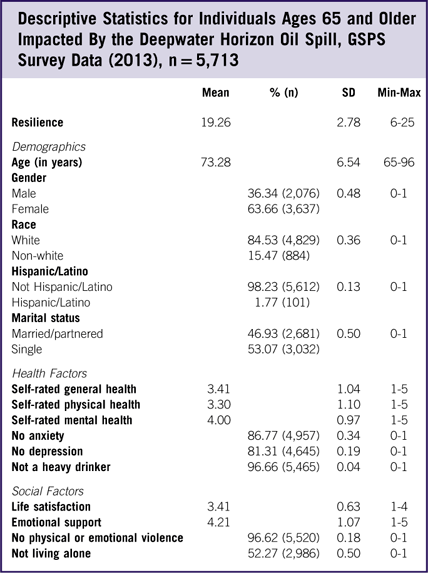
The final sample for this analysis was 5,713 individuals ages 65 and older (Table 1). The mean resilience score was 19.36 (SD=2.78). The majority of the participants were female 63.66% (n=3,637) (male 36.34%, n=2,076). Most of the study sample identified as white 84.53% (n=4,829) (non-white, 15.47%, n=884). Less than 2% of respondents identified as Hispanic/Latino (n=101), with 98.23% (n=5,612) identifying as non-Hispanic or non-Latino. The average age of respondents was 73 (SD=6.54) years. A little over half of participants were not currently in a relationship (53.07%, n=3,032) with 46.93% (n=2,681) of participants reporting that they were either married or with a partner. About half of the participants reported living alone (52.27%, n=2,986). The mean for self-rated general health was 3.41 (SD=1.04), for self-rated physical health, it was 3.30 (SD=1.10), and, for self-rated mental health, the score was 4.00 (SD=0.97) (scale of 1-5). The majority of participants did not have an anxiety (86.77%, n=4,957) or depression diagnosis (81.31%, n=4,645). The majority of individuals did not report heavy drinking (96.66% non-heavy drinkers, n=5,465). On a scale of 1-4, most individuals reported high life satisfaction (3.41, SD=0.63). Individuals similarly rated their emotional support as high (4.21, SD=1.07) on a scale of 1-5. Most participants did not report experiencing physical or emotional violence (96.62%, n=5,520).
Descriptive Statistics for Individuals Ages 65 and Older Impacted By the Deepwater Horizon Oil Spill, GSPS Survey Data (2013), n=5,713

Four separate standard multiple regression models were conducted to investigate whether demographic factors, health factors, social factors, and a combined factor model resulted in increased levels of individual resilience amongst older adults (65 years and older) living within a 32-mile radius of the Deepwater Horizon oil spill.
Model 1 (Demographics)
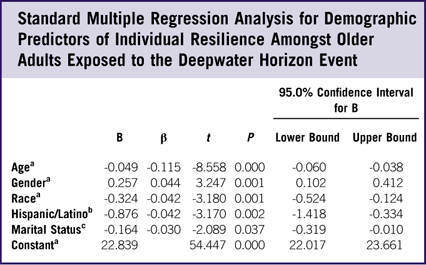
A standard multiple regression analysis was performed to investigate whether demographics (age, gender, race, Hispanic/Latino, relationship status) resulted in an increased level of individual resilience. The R2 statistic was statistically significant F (5; 5,712)=23.152, P=0.0001, R2 adjusted=0.019, indicating that 1.9% of the variance in individual resilience can be explained by demographics. A summary of the regression coefficients is presented in Table 2 and indicates that age, gender, race, being Hispanic/Latino, and relationship status contributed significantly to the prediction of an increase in individual resilience in Model 1.
Standard Multiple Regression Analysis for Demographic Predictors of Individual Resilience Amongst Older Adults Exposed to the Deepwater Horizon Event

Note: n=5,712; df=5.
a P<0.001; b P<0.01; c P<0.05.
Model 2 (Health Factors and Demographics)
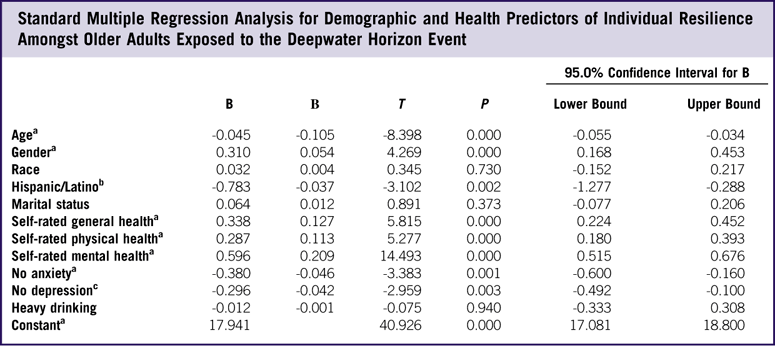
The second model investigated the role of health and demographic factors on individual resilience. A standard multiple regression analysis was performed to investigate whether health factors and demographics (age, gender, race, Hispanic/Latino, relationship status, self-rated general health, self-rated physical health, self-rated mental health, no anxiety diagnosis, no depression diagnosis, no heavy drinking) resulted in an increased level of individual resilience. The R2 statistic was statistically significant F (11; 5,712)=117.481, P=0.0001, R2 adjusted=0.183, indicating that 18.3% of the variance in individual resilience can be explained by health factors and demographics. A summary of the regression coefficients is presented in Table 3 and indicates that age, gender, Hispanic/Latino, self-rated general health, self-rated physical health, self-rated mental health, no anxiety diagnosis, and no depression diagnosis contributed significantly to the prediction of an increase in individual resilience in Model 2.
Standard Multiple Regression Analysis for Demographic and Health Predictors of Individual Resilience Amongst Older Adults Exposed to the Deepwater Horizon Event

Note: n=5,712; df=11.
a P<0.001; b P<0.05; c P<0.01.
Model 3 (Social Factors and Demographics)
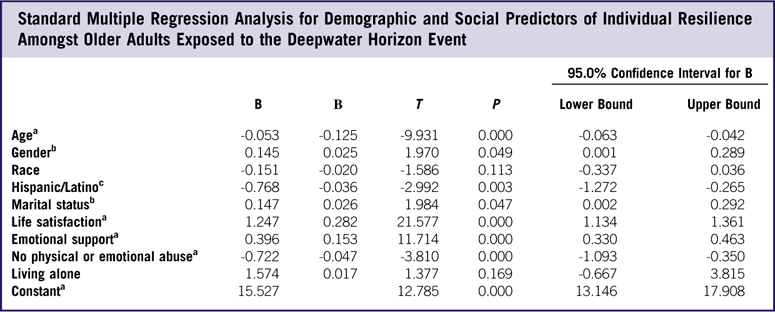
A standard multiple regression analysis was performed to investigate whether social factors and demographics (age, gender, race, Hispanic/Latino, relationship status, life satisfaction, emotional support, no physical or emotional abuse, living alone) resulted in an increased level of individual resilience. The R2 statistic was statistically significant F (9; 5,712)=116.891, P=0.0001, R2 adjusted=0.154, indicating that 15.4% of the variance in individual resilience can be explained by social and demographic factors. A summary of the regression coefficients is presented in Table 4 and indicates that age, gender, Hispanic/Latino, relationship, life satisfaction, emotional support, and no physical or emotional abuse contributed significantly to the prediction of an increase in individual resilience in Model 3.
Standard Multiple Regression Analysis for Demographic and Social Predictors of Individual Resilience Amongst Older Adults Exposed to the Deepwater Horizon Event

Note: n=5,712; df=9.
a P<0.001; b P<0.05; c P<0.01.
Model 4 (Combined: Demographics, Health, and Social)
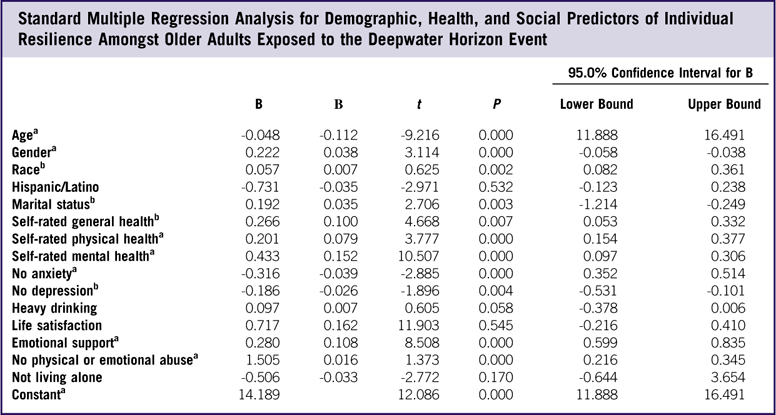
The final model was a standard multiple regression analysis to investigate whether the first 3 models combined (demographics, health, and social factors) resulted in an increased level of individual resilience. The R2 statistic was statistically significant F (15; 5,712)=110.365, P=0.0001, R2 adjusted=0.223, indicating that 22.3% of the variance in individual resilience can be explained by demographic, health, and social factors. A summary of the regression coefficients is presented in Table 5 and indicates that age, gender, race, marital status, self-rated general health, self-rated physical health, self-rated mental health, no anxiety diagnosis, no depression diagnosis, emotional support, and no physical or emotional abuse contributed significantly to the prediction of an increase in individual resilience in Model 4.
Standard Multiple Regression Analysis for Demographic, Health, and Social Predictors of Individual Resilience Amongst Older Adults Exposed to the Deepwater Horizon Event

Note: n=5,712; df=15.
a P<0.001; b P<0.01; c P<0.05.
DISCUSSION
In addition to providing baseline information about the demographic, social, and health factors impacting older adults affected by the Deepwater Horizon oil spill, this study contributes to our understanding of which factors act as predictors of resilience for older adults. The overall findings of this study suggest that, although older individuals overall have high resilience scores, they may be less resilient in certain areas. The results of this study provide support for previous research that has investigated resilienceReference Ritchie, Gill and Farnham 7 - Reference Cutter 10 , Reference Hobfoll, Stevens and Zalta 16 , Reference Morrow and Phillips 23 , Reference Chen, Westman and Hobfoll 44 , Reference Cutter 50 - Reference Gill, Ritchie and Picou 55 and are expected to inform how researchers conceptualize resilience among older adults, and how resilience varies across the life span of the individual. This study adds to the literature that applies a COR model to understanding technological disastersReference Arata, Picou and Johnson 9 and supports research suggesting that resilience is not uniformly experienced across the life span.Reference Brown, Rothman and Norris 17 - Reference Blaikie, Cannon and Davis 18 , Reference Tuohy and Stephens 20 , Reference Cutter, Ahearn and Amadei 30 - Reference Cherniack 32 , Reference Dwyer, Zoppou and Nielsen 52 - Reference Pinsker, McFarland and Stone 54 Comparing differences across the models, there are a few notable variations. Interestingly, after adding health factors (Model 2) or social factors (Model 3), race and marital status are no longer significant predictors of resilience. In Model 4 (combined), however, being non-white was positively associated with higher resilience scores.
In all models, age was negatively associated with resilience scores and being female was positively associated. In contrast to Models 1 and 2, identifying as Hispanic or Latino was positively associated with increases in resilience scores in our social factors model (Model 3). Increases in life satisfaction and having high emotional support scores were positively associated with resilience. Not surprisingly, reporting physical or emotional abuse was negatively associated with resilience scores. Living alone was not significantly associated with resilience scores. However, emotional support was positively associated with resilience in both the social factors (Model 3) and combined (Model 4) models. This may indicate that social resilience is not necessarily contingent on emotional support being provided by live-in family or caretakers. The role of emotional support following technological disasters has been documented by previous researchers,Reference Ritchie, Gill and Farnham 7 - Reference Arata, Picou and Johnson 9 , Reference Gill, Ritchie and Picou 55 and this study builds upon these findings for older adults. Additionally, although vulnerability to exploitation was not explicitly assessed in this study, these findings support previous research indicating the importance of social factors in being protective against social vulnerability following technological disasters.Reference Ritchie, Gill and Farnham 7 - Reference Arata, Picou and Johnson 9 , Reference Pinsker, McFarland and Stone 54 These findings may be useful for informing community education efforts or disaster preparedness programs.
All four models in this analysis significantly accounted for variance in individual resilience scores, but models that incorporate social and health factors seem to be better at accounting for variance in resilience scores. An application of the COR theory suggests that maintenance of health and social resources appears to be most imperative for predicting individual resilience. Although additional factors that are beyond the scope of this examination are undoubtedly important, the results of this analysis suggest that health and social factors may be especially important for contributing to resilience for older individuals. It is encouraging that most individuals reported fairly high general, physical, and mental health, although physical and general health received lower rankings, suggesting that these may be areas where there are still needs for services.Reference Brown, Rothman and Norris 17 , Reference Burnett, Dyer and Pickins 19 , Reference Sanders, Bowie and Bowie 33 - Reference Rothman and Brown 34 Few individuals reported problems with drinking, suggesting that heavy drinking may not be a coping mechanism heavily used by these individuals to deal with post-disaster trauma and recovery.
Most individuals reported relatively high life satisfaction and emotional support, suggesting that social resilience may be an area where many older individuals have strengths. This is important because previous literature has tended to focus on the vulnerabilities of older adults following disasters without also focusing on strengths.Reference Cutter and Emrich 25 , Reference Fernandez, Byard and Chien-Chih 27 - Reference McGuire, Ford and Okoro 28 , Reference Ngo 31 - Reference Gibson 35 Finding mechanisms to ensure that these social supports are able to remain in place after disasters may also be an important area for researchers and practitioners to focus their efforts. The fact that over half of individuals in the study live alone has important implications for those designing interventions for these individuals. Technological disasters have delayed impacts, with the effects of the disaster only having visible impact months, or even years, after the actual disaster.Reference Gill, Ritchie and Picou 55 Thus, reports of distress may be delayed for an extended period before individuals recognize that they have a form disorder (eg, depression). The relatively low rates of physical and emotional violence reported by this sample of older adults are positive, though the increased vulnerability of older individuals to these forms of violence suggests that this is still an area where future attention should be focused.Reference Baker and Cormier 2 , Reference Norris 24
The results also indicate that there is immense variation in the resilience of individuals ages 65 and older. Overall, in this analysis, females tended to have a higher resilience score than their male counterparts. This reflects some previous research that females may be especially resilient compared with males across some dimensions, and in some disaster contexts.Reference Enarson and Morrow 21 - Reference Norris 24 The impact of race on resilience in these models is mixed, having a positive and negative association with resilience scores depending on the construct model (eg, health or social). Similarly, identifying as Hispanic or Latino was negatively associated with resilience in the demographic model, health, and combined models, but was positively associated with resilience in the social resilience model.
It is also surprising that marital status had a relatively small impact on resilience scores because previous literature suggests that marital status can be protective, in some cases.Reference Norris 24 Having high general, physical, and mental health scores was positively associated with resilience scores, highlighting the importance of providing health supports for individuals in post-disaster settings. Though a relatively small group of these individuals reported being diagnosed with anxiety or depression, the finding that this was negatively associated with resilience scores is concerning and suggests that there may be a need to provide tailored mental health services for these individuals in post-disaster settings. Life satisfaction was associated with high resilience scores, as was having high levels of emotional support. Finding ways to facilitate these factors for older individuals may be an important way to support older individual resilience.
Although gender and age were significant predictors of resilience across all models, the results of the model testing lend support for an inequitable disaster mitigation model,Reference Cutter, Boruff and Shirley 29 with social and health indicators explaining the most variance in the resilience levels of older Gulf Coast residents. This research also lends support to research suggesting that technological disasters may be unique in their impact on social resilience factors.Reference Ritchie, Gill and Farnham 7 - Reference Arata, Picou and Johnson 9 , Reference Gill, Ritchie and Picou 55 Although this study does not allow for an explicit comparison between technological and non-technological disasters, these findings suggest that psychological well-being may not inherently be undermined by technological disasters. This is in contrast to previous findingsReference Ritchie, Gill and Farnham 7 , Reference Arata, Picou and Johnson 9 , Reference Cherry, Sampson and Nezat 53 , Reference Gill, Ritchie and Picou 55 which have documented the negative impact of technological disaster on psychological health. Future research should further investigate what factors are most protective of psychological well-being following a disaster. This analysis also provides important findings for practitioners regarding the areas where older individuals may be most in need of support (ie, those who are very old, those experiencing emotional or physical abuse), and lends support to previous research regarding the specific vulnerabilities of older adults.Reference Sanders, Bowie and Bowie 33 - Reference Jenkins, Laska and Williamson 36 , Reference Dwyer, Zoppou and Nielsen 52 - Reference Cherry, Sampson and Nezat 53
Limitations
There are several limitations of this data set that should be noted. Given that the data are the result of surveys distributed post-disaster and is cross sectional, it is difficult to determine the full extent of the disaster on resilience (we do not know what the resilience level was before the disaster). The findings in this study may reflect sample bias, given that this was solely a telephone survey. This also somewhat limits our ability to draw conclusions about causation. Exploring changes in resilience may help identify which resources are easier for individuals to maintain or are more at risk following a technological disaster.
In addition, in this data set, there is limited minority representation, with 84% of the sample being white and less than 2% identifying as Hispanic or Latino. Although this study contributes to filling the knowledge gap on differences in resilience across the life span, future research could explore differences in subgroups of older individuals, because it is not expected that the experiences of all individuals over age 65 will be the same, and there may be unique vulnerabilities and strengths based on subgroup. In addition, we did not explicitly compare older individuals to those under the age of 65 years. Nor did we look at differences in resilience levels among different age groupings of individuals over age 65. Across all of these models, resilience scores tended to decrease as age increased, suggesting that, as individuals age, their vulnerabilities may increase, highlighting the need for research that specifically investigates within group differences among those older than age 65.
Because of the lack of research specifically analyzing the needs of older individuals following technological disasters, we focused on identifying and exploring which variables were most likely to act as predictors of individual resilience. Future research should turn to exploring the differences in needs and resilience between older and younger individuals; and to comparing the differences in impact of natural and technological disasters on older adults. This study is intended to stimulate further research in this area because this approach can yield substantive findings for policy and practice.
CONCLUSION
Although there is an increasing body of research investigating the role of resilience at both the community and individual levels in post-disaster settings, differences in resilience based on age have been less explored. This research lends support to findings that resilience varies greatly among individuals and communities, and that individuals may have high levels of resilience in some areas but lower levels in others. In contrast to research that solely uses a deficit approach to understand the impact of disasters, these findings contribute to our understanding of the strengths of (and protective factors for) older adults in post-disaster contexts.
All models (demographic, health, social, and combined) acted as significant predictors of individual resilience. However, health and social resilience models accounted for more of the variance in resilience scores, and there are important variations among the models. Of particular interest is the finding that being female was protective across all models, a finding that is supported by some previous research showing that men are more vulnerable in certain areas post-disaster, perhaps because of pre-existing social support mechanisms or stigma surrounding help-seeking behavior.Reference Enarson and Morrow 21 , Reference Morrow and Phillips 23 The findings provide practitioners with some baseline knowledge to focus their interventions on the areas where it is most needed to empower resilient older adults and communities, and to identify the areas where there may be current gaps in services.
Conflict of Interest
The authors report no conflict of interests.