INTRODUCTION
Since 2003 the Portable Antiquities Scheme, an initiative to record archaeological objects found by members of the general public, has covered the whole of England and Wales, following a pilot phase from 1997.Footnote 1 Surveys of Roman period finds recorded by the PAS have been published annually in Britannia since 2004. This eighth report, as in previous years, gives a short synthesis of the frequency of the different artefact types recorded and an overview of their distribution. Descriptions of significant individual artefacts recorded by the Finds Liaison Officers then follow. Additionally, this report provides a summary account of the Roman coins recorded by the Scheme since its inception in 1997.Footnote 2
OVERVIEW
20,315 artefacts of Roman date were recorded on the PAS database in 2010; this figure includes those finds to which a date has been attributed that spans the late Iron Age and early Roman period. The 2010 data include 4,717 pot sherds, 43 glass fragments, 188 tile fragments, 3 quern fragments, 4 tesserae, 24 architectural fragments, and 15,336 coins and other metallic objects. The total number of non-Treasure metallic finds recorded is closely comparable to that of previous years (16,921 for 2009 and 14,608 for 2008). Objects qualifying as treasure under the terms of the Treasure Act 1996 are published in the Treasure Annual Report by the British Museum and are excluded from this survey.
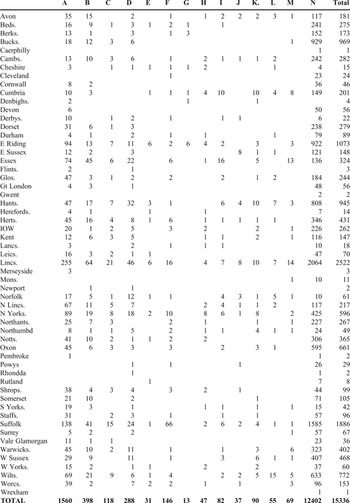
As in previous reports, Table 1 shows the number of Roman non-ceramic artefacts recorded on the PAS database by county. For convenience of presentation and to enable comparison with other datasets, including the previously published PAS summaries, the non-ceramic artefacts have been subdivided according to function, based on the scheme proposed by Crummy, with some modifications.Footnote 3 The best represented counties in Table 1 are, as in all previous years, in eastern England, especially Lincolnshire, Suffolk and East Yorkshire. Once again, the 2010 data from Norfolk include only a small proportion of the many artefacts recorded from the county, although all records have been entered onto the Norfolk Historic Environment Record. Much smaller quantities of artefacts are recorded from Wales, western, upland central and northern England, as well as heavily urbanised areas, for obvious reasons related to land use. In the counties with smaller numbers, individual groups often account for a high percentage of finds; for example the majority of Roman coins from Devon this year derive from a single findspot at Ipplepen (Teignbridge). Numbers from individual counties fluctuate significantly over the course of time (for example, there are fewer from Leicestershire and Warwickshire than in 2009, and more from Wiltshire) — a further reminder that any assessment of distribution patterns is much more securely based on data accumulated over several years of recording.
NUMBERS OF NON-CERAMIC ARTEFACTS RECORDED BY THE PAS IN 2010 BY COUNTY AND TYPE

KEY
A. Brooches
B. Other objects of dress and personal adornment
C. Toilet and medical equipment
D. Household utensils, furniture fittings, copper-alloy vessels, keys, weights, textile equipment
E. Objects associated with written communication
F. Objects associated with religious beliefs and practices
G. Harness equipment
H. Button-and-loop fasteners, toggles
I. First- to third-century military equipment
J. Fourth-century belt fittings
K. Studs/mounts
L. Miscellaneous objects
M. Objects of unknown/uncertain function
N. Coins
Coins continue to be by far the most common artefact recorded and the 12,402 single coin finds recorded in 2010 account for 81 per cent of all metallic finds. This percentage closely resembles that of 2009, but is higher than in earlier years, reflecting the further success of the initiative in recording large assemblages of Roman coins in toto.Footnote 4 In 2010 the percentage of all finds accounted for by coins in each county again varies. In 25 counties where more than 100 examples are recorded, coins comprise on average 80 per cent of all finds, but there is substantial variation around this average — in Essex coins account for 42 per cent of all finds, whereas in Buckinghamshire they account for 96 per cent.
In general the quantities of artefacts in other categories and the representation of different find types remain broadly consistent with those documented in previous years, brooches accounting for 10 per cent of all finds recorded and other items of personal adornment 3 per cent. In general, the proportions of the more frequently represented artefact types show limited regional variation, with some anomalies. For example, brooches and personal ornament account for 23 and 14 per cent respectively of all finds recorded in Essex, while brooches alone represent 31 per cent of finds recorded in North Lincolnshire. Given the vagaries of reporting of finds and their recording, again greater emphasis should be given to distribution patterns established over several years.
The publication of this eighth summary, in a year in which the Scheme, in most part, has received a further four years of funding, provides an opportunity to note the scale of the sample of artefacts now documented and available for study. An overview of the coins is presented at the end of this report, but the numbers of other artefacts should also be highlighted. For example 12,968 brooches have been added to the database between 2003 and 2010, to be compared with the collection of ‘over 3,000' used as the reference sample in Bayley and Butcher's study of Roman brooches in Britain, to which the Richborough assemblage could be compared.Footnote 5 As well as Walton's thesis on coins, other doctoral theses underway in London, Leicester and Southampton have been exploring both the formation processes responsible for the data recorded by the PAS and the insights into Romano-British society that can be derived from them.Footnote 6 In addition to their quantitative contribution, many pieces also add significantly to our impression of the array of Romano-British imagery. This year, this includes not only the iconography of small individual portable artefacts and dress items, but also of military and religious costume ensembles and images that decorated public spaces and shrines.
ARTEFACT DESCRIPTIONS
The entries below set out some highlights of the past year's discoveries recorded by the Finds Liaison Officers.Footnote 7 Fuller details of the objects recorded by the PAS can be obtained from the Schemes’ central office,Footnote 8 and there are full descriptions of finds on the PAS website: www.finds.org.uk. The reference number in brackets associated with each record is the PAS identifying find record.Footnote 9 For supplementary online figs 1–18 see www.journals.cambridge.org/bri
CUMBRIA
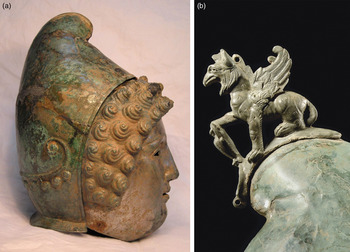
(1) Crosby Garrett (LANCUM-E48D73) (figs 1–2; online fig. 1).Footnote 10 An extremely fine, near-complete, copper-alloy two-piece Roman cavalry sports helmet dating from the late first to mid-third century a.d., found in association with unrecorded earthworks in pasture adjacent to Crosby Garrett Fell. The circumstances in which the helmet was discovered, reported, restored and eventually sold, have been described elsewhere.Footnote 11 The form of the helmet, its condition, patina, corrosion products and soil accretions are entirely consistent with its use, deposition and re-discovery in Cumbria. The description is based on observation and metallurgical examination while the helmet was undergoing restoration at Christie's in advance of its sale at auction (7 October 2010). Unfortunately, formal archaeological conservation of the object was not possible and some details were only observed when the helmet was displayed for viewing after restoration.Footnote 12
Crosby Garrett helmet: (a) right profile; (b) griffin figurine soldered on head piece, as restored (No. 1).
(Photos: Christie's; © Christie's)

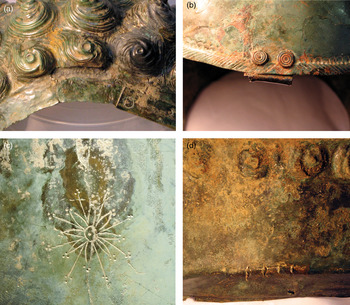
Crosby Garrett, details: (a) close-up of hair with temporary resin filling; (b) hinge riveted to the helmet back which connected with the top of the visor; (c) rosette on back of helmet; (d) four nicks on the underside of the neck guard (No. 1).
(Photos a, b and d: Darren Bradbury; © Darren Bradbury; c: Christie's; © Christie's)

Helmets of this type were worn by auxiliary cavalrymen for show exercises — the hippika gymnasia, flamboyant displays of military horsemanship, put on by élite cavalry units for commanders and inspecting governors or emperors. These comprised complex exercises on horseback and mock battles, in which the participants, mounts and troopers, were decked in richly-decorated equipment, the most striking of which being the helmets, as memorably described by Arrian.Footnote 13
The Crosby Garrett helmet comprises a face mask and a head piece with a griffin figurine crest attachment (fig. 1). It was found in at least 68 fragments (online fig. 1), many of which were found to join and the restored helmet is now c. 90 per cent complete; the survival of the head piece, albeit broken and distorted before restoration, is exceptional. Some general dimensions for the helmet can be given, based on its post-restoration form: a maximum height (241 mm) and width (224 mm) of the mask, including the hair, and a maximum width for the head piece (185 mm). The finely wrought face mask depicts an idealised, youthful male face, with luxuriant curly hair in tight corkscrews; the individual strands are finely incised in the three rows which are visible (fig. 2a). On either side, the curls descend to the mid-point of the full cheeks. The fine eyebrows are indicated by short diagonal engraved strokes which arch from the brow of the nose to the hairline. The upper and lower eyelids have incised lashes and in the centre of both eye-holes perforated metal rings survive to represent the iris. Traces of the reserved white metal coating are visible on the face, but it is likely that the hair and helmet would have appeared in bright natural bronze. The nostrils are pierced for ventilation, the full lips are parted and the philtrum is shown.
Originally the mask would have been hinged at the centre of the brow within the curly hair.Footnote 14 A simple hinge riveted to the head piece connected the latter to the top of the mask (fig. 2b). In the upper rim of the mask is a rectangular hole that held this hinge. Below it are small marks where visor and helmet had rubbed against each other, as well as a riveted strip fastened as a repair. It was fastened at the neck by a leather strap which encircled the nape of the head piece and would have been secured by its eyeleted ends to an iron stud near the jawline on each side of the mask, where slight remains of iron corrosion survive.Footnote 15 The head piece takes the form of a high cap with its peak falling forward, representing a ‘Phrygian’ cap of a type used in Roman art as a signifier of diverse eastern ethnic groups, as well as of certain gods and heroes, including inter alios Ganymede, Attis, Ascanius and Mithras. An associated bronze figurine in the form of a winged griffin, with its right paw raised and resting on a fluted amphora, was originally attached to the top of the headpiece: the curvature of the griffin's integral base-plate, as well as remains of solder on its underside, correspond exactly to the curvature of the crest of the head piece and a patch of solder preserved on it (fig. 1b). The anatomy of the griffin is quite finely modelled and incisions on the body and across the wings represent tufts of fur and feathers respectively; similarly hatching suggests the longer fur on the backs of the griffin's legs. Below the amphora is an oval recess and at the end of the figurine's base-plate is a loop. Around the back of the helmet runs a raised ridge which curls at both ends, terminating in a moulded finial. This ridge is decorated with tongue ornament (which also extends onto the body of the head piece on either side) and carries two loops, to which — along with a further loop below the griffin — colourful streamers could have been attached. A single rosette is incised above this ridge at the back of the head piece, with petals and lines radiating from the centre, each ending in clusters of punched dots. Higher up are pairs of similar rosettes on both sides of the head piece (fig. 2c). Below the ridge, running around the head piece, is a single row of twelve curls, below which the neck-guard splays, with some small perforations. On the underside of the neck-guard are four nicks that might relate to the production process (fig. 2d); these may be analogous to the incised numbers on the underside of the neck-guard of the Ribchester helmet.Footnote 16 The rim of the head piece, where it joins the mask, is decorated with strips of incised diagonal hatching and tongues.
Ruth Fillery-Travis reports as follows on the XRF analysis: ‘A handheld Innov-X Systems Model Alpha 4000 portable x-ray fluorescence spectrometer was used to analyse seven areas of the metal surface of the helmet, but without any preparation or removal of corrosion products. The analyses of the face and helmet sections examined consistently reported an alloy content of approximately 82 per cent copper, 12 per cent zinc, 6 per cent tin and trace levels of lead. It should be noted that whilst the corrosion layers appeared thin and compact, the low penetration of this analytical technique means that these results reflect the chemical composition of the corroded surface layer rather than that of the object itself when made. The presence of tin in the Crosby Garrett helmet distinguishes it from the Ribchester helmet and the Hawkedon gladiator helmet,Footnote 17 both of which were simple binary alloys of copper and zinc. However, even allowing for corrosion action, the alloy composition remains within that expected for a Roman period copper-alloy object.Footnote 18 It was not possible to confirm the nature of the white metal coating of the face. The analyses of the griffin reported approximately 68 per cent copper, 4 per cent zinc, 18 per cent tin and 10 per cent lead. Lead is known to precipitate into corrosion layers and, therefore, the lead levels in these analyses are likely to be artificially raised. However, since both helmet and griffin were subject to broadly the same depositional conditions, differing corrosion processes are unlikely to explain the marked difference in proportions of zinc to tin between the griffin and the helmet. The compositional analyses, therefore, almost certainly indicate that the griffin mount was cast in a different alloy from the helmet.’
The form of the Crosby Garrett head piece is difficult to parallel, though a fragmentary example of a Phrygian cap is known from Ostrov, Romania.Footnote 19 The mask corresponds to well-known types, such as those of Robinson's Cavalry Sports Type C and Kohlert's Type V, dated from the end of the first to the mid-third century a.d.Footnote 20 Masks of this group — most in bronze though some are of iron — are characterised by idealised (‘Greek’) youthful male faces, usually beardless with luxuriant curly hair, sometimes in similar corkscrew form. It is also difficult to find specific parallels to the crest figure in the form represented on the Crosby Garrett helmet. Winged griffin figurines have been identified in other military contexts, including the forts at Strageath (Perths.) and Trawscoed (Dyfed).Footnote 21 More significant perhaps is a possible analogous find associated with the Ribchester helmet, not among the hoard items purchased by Townley but later described as a ‘sphinx of bronze, which, from the remains of solder on the lower side, and also from its curvature, appeared to have been attached to some convex surface, probably to the top of the helmet’.Footnote 22 It is not inconceivable that this object, which is lost, was also a griffin, but had perhaps been confused with a similar hybrid creature. The griffin is otherwise rare as a motif in the iconography of sports helmets or parade armour, with a repoussé example on either side of the headpiece from Sheik 'Idaba (Egypt) being one exception.Footnote 23 Lions and, especially, eagles, the progenitors of the griffin, are much more common on military items — the head and breast of an eagle sometimes forming the crest of sports helmets in particular, as, for example, that from Tell Oum Houran, Syria.Footnote 24 The range of potential associations for the griffin — a frequent motif in public as well as private art and linked with diverse deities, including Apollo, Dionysius and Nemesis — makes it difficult to establish which is most relevant here. Nemesis, a goddess of fate associated with vengeance, is perhaps the most appropriate for this very visible item of a trooper's equipment, but an apotropaic role is equally plausible.Footnote 25
Although the face mask is of a widely occurring type, the ensemble of mask, head piece and crest figurine is not paralleled and it is difficult to establish definitively whether it represents a member of a specific ethnic group, for example Sarmatian or Persian, or a mythological figure. The only figure in a Phrygian cap regularly occurring on parade armour, especially phalerae, is Ganymede, framed by the head and legs of the uplifting eagle. The Crosby Garrett piece, combining a portrait of an eastern youth with an eagle-hybrid figure, might be analogous in spirit to this.
Findspots of cavalry sports helmets are distributed across the breadth of the Empire, with the greater number in Germany and the Netherlands. The Crosby Garrett helmet is the third (near-)complete example found in Britain, the earlier discoveries coming from forts at Ribchester (Lancs.) in 1796 and Newstead (Borders) in ‘about 1905’. In addition, a separate copper-alloy face mask from Newstead was found in 1907.Footnote 26 Contexts of discovery include graves, hoards and destruction deposits in and around forts and beyond.Footnote 27 While some British examples were found closely associated with garrisons (for example at Newstead and Ribchester), there are other cases (for instance the pieces from Guisborough (N Yorks.) and Worthing (Norfolk)) where there is no fort in the immediate vicinity. Recent discussion of the ‘lifecycle’ of Roman military equipment provides possible models by which such helmets may have come to be deposited in a context away from a garrison — perhaps by hoarding of a valuable metal object, votive deposition to mark retirement from service, or burial with the dead.Footnote 28 In the case of Crosby Garrett, the visor was found placed face downwards and the head piece was either folded in half prior to deposition or was ‘squashed’ as a result of the weight of earth above it. The griffin was found detached from the helmet's crest. There was no trace of associated finds or human remains. On this limited evidence, a votive offering or hoarding of loot might better explain its deposition within the earthworks. Although no Roman garrisons are documented in the immediate vicinity, the nearest was located only c. 6 km away at Brough and there are others at no great distance further to the north-west in the Eden Valley — Kirkby Thore, Brougham and Old Penrith — all with attested cavalry elements during the period to which helmets of this type are dated.Footnote 29
NORTH YORKSHIRE
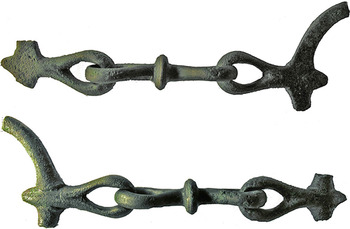
(2) Norton-on-Derwent (LVPL-ECD916) (fig. 3).Footnote 30 A copper-alloy derivative three-link bridle bit dating to the Late Iron Age or early Roman period. The central bit is 63.5 mm long and 20.5 mm wide. It consists of tear-drop-shaped loops on either side of a bar with a large moulded collar at the centre, which is decorated with incised grooves around each edge. Attached to each loop of the central bit is an incomplete D-sectioned cheek ring with a decorative projection which tapers to a rounded end.
Norton-on-Derwent, derivative three-link bridle bit (No. 2). Scale 2:3.
(Photo: V. Oakden; © V. Oakden and Liverpool Museums)

Three-link bridle bits are known from the Late Iron Age or in hoards of native tradition dated to a.d. 50–125, for example from Saham Toney (Norfolk), Seven Sisters (Neath-Port Talbot), Stanwick/Melsonby (N Yorks.), and Middlebie (Dumfries.).Footnote 31 Moulds for three-link bridle bits have been found at Prestatyn (Denbighs.) in a workshop context probably dating as late as a.d. 100–120.Footnote 32 Single examples recorded by PAS have been found in Leyburn (N Yorks.) (LANCUM-535083), Wallington (Herts.) (BH-777325), and Durnford (Wilts.) (WILT-13C344).
EAST YORKSHIRE
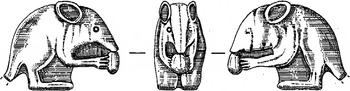
(3) Hayton (FASW-8B6455) (fig. 4).Footnote 33 Copper-alloy figurine of a rodent, probably a mouse, with a dark brown and green patina. The animal is hunched and is depicted eating a flat cake or piece of bread held between its front paws. The ears are well-modelled with a hollow central recess. One of the eyes, which is circular and outlined by a concentric moulding, is visible, while the other is obscured by lead corrosion. The front paws have four claws, but none are visible on the hind paws. The base of the hind legs and paws is flat and the figure is free-standing. A trace of the circular-sectioned tail survives, but most is missing. Lead corrosion is present on the base between the lower legs and at the bottom of the body. The figure is 35.5 mm long, 13.2 mm wide and 25.2 mm high, and weighs 44 g. Figurines and other representations of mice are known in small numbers across the Empire. British examples include a figurine from a disturbed burial in York and another from the fort at Loughor (Swansea), the latter, like the Hayton example, is also shown on its hind legs with food between its front paws.Footnote 34
Hayton, figurine of a mouse (No. 3). Scale 1:1.
(Drawn by B. McNee; © B. McNee)

NORTH LINCOLNSHIRE
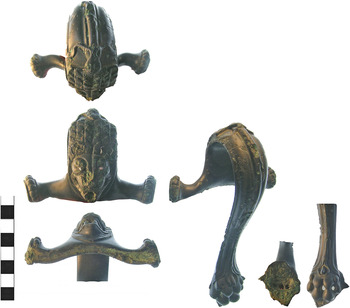
(4) Appleby (SWYOR-E54DB2) (fig. 5).Footnote 35 A copper-alloy handle from a wine jug or oenochoe; 127.1 mm long, 75.4 mm wide and 245 g in weight. The handle has a smooth grey patina, with only a few small areas of corrosion where it has been damaged. Its findspot lies in close proximity to the Roman villa sites at Winterton and Horkstow. The handle arches strongly upwards from the T-shaped crossbar which would have been soldered to the vessel rim (in a deeply grooved recess). Each end of the crossbar terminates in a raised roundel with a finely moulded multi-lobed rim bordering a flat end. The handle, where it joins the crossbar, carries a finely modelled lion's head with a snarling open mouth, carefully detailed teeth and lips, lines rendering the detail of the muzzle, silvered eyes and ears outlined with silver wire. The stylised mane frames the face and rises to the highest part of the elegant S-shaped handle. At this point it meets the head of a moulded lizard, the body of which stretches down the handle as a pronounced central rib with legs on either side. At its foot, the handle expands to form a four-toed lion's paw. The spaces between the four toes are open and the claws are picked out. The edge of the handle adjacent to the lion's head is beaded.
Appleby, handle from a wine jug with lion's head at top and paw at base and moulded lizard down centre (No. 4). Scale 1:2.
(Photo: A. Cooper; © A. Cooper)

The modelling and combination of animal images make this a significant addition to the repertoire of bronze dining or washing gear from the province. A similar example is known from Santon Downham (Suffolk) or Santon (Norfolk),Footnote 36 and parallels can also be noted in Gallia Belgica. A very similar handle for a round-bodied jug, also ending in an open-mouthed lion's head, with a rib down the centre of the handle (though not in the form of a lizard) and a four-toed lion's paw resting on a circular roundel decorated with volutes, was found with lavish grave furnishings at the Cortil-Noirmont tumulus (in the ‘Field of Tombs’) at Brabant, Belgium.Footnote 37 Bronze jugs from Bois-et-Borsu are not dissimilar.Footnote 38
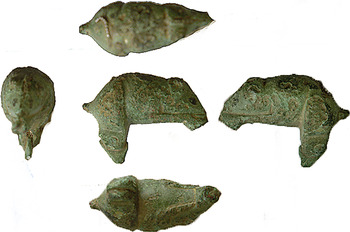
(5) Roxby cum Risby (NLM-A19B05) (fig. 6).Footnote 39 A small hinged zoomorphic brooch depicting a three-dimensional and naturalistically modelled mouse, holding a nut or seed between its forelimbs. The stub of a hinged pin survives below its hindquarters. The tail begins as an integrally cast stump, but is apparently continued by ten silvered beads of metal curling across the end of the mouse's back. The eyes are probably silver, but now appear as dark grey patches. The centres of the ears are defined by a semi-circular punch. The brooch is 20.3 mm long, 8.4 mm wide, 14.4 mm thick, and weighs 5.3 g. Mice are rare as zoomorphic plate brooches, but are represented in other media.Footnote 40
Roxby cum Risby, zoomorphic plate brooch in the form of a mouse (No. 5). Scale 3:2.
(Photo: M. Foreman; © North Lincolnshire Museum)

LINCOLNSHIRE
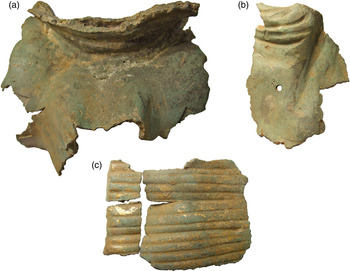
(6) North Carlton (LIN-31B698) (fig. 7; online figs 2–4).Footnote 41 Fragments from a life-size bronze statue, discovered over an area approximately 2 m square, at a metal-detecting rally about three miles from Lincoln.
North Carlton, bronze statue: (a) Fragment A; (b) Fragment B; (c) Fragment C (No. 6). Scale 2:3.
(Photo: A. Daubney; © A. Daubney)

Fragment A (fig. 7a), a substantial, heavy fragment with rough broken edges, showing a swathe of cloth over undulating folded drapery, is probably from the trunk or lap of a life-size figure, but is difficult to locate specifically; some distortion may have taken place during breaking up and deposition. The swathe and the underlying drapery comprise parts of two separate soldered pieces, the join being most visible on the reverse where a lead-alloy patch overlies it (online figs 2–3). Several rectangular recesses can be noted on the broken edge of the undulating sheet, one of which seems to be associated with a possible rivet hole (online figs 2–3). These matrices for patches are approximately 1 mm deep, but the other dimensions vary: in the single case where it can be established the patch is 23 mm wide (online fig. 4). Repairs to casting flaws (also attested on Fragment C), especially holes in the metal, are widely documented on ancient bronze statuary, including, for example, the head of Hadrian from the Thames.Footnote 42 The underside of the casting is relatively smooth, except in one corner where a large amount of casting waste survives. The swathe is c. 142 mm long from break to break and 4 mm thick; the undulating drapery is c. 130 mm long and c. 35 mm wide in its maximum dimensions and is 2 mm thick. The lead-alloy solder on the rear is c. 3 mm thick.
Fragment B (fig. 7b) is irregular in form and is, at its greatest extent, 95 mm long and 68 mm wide, with a thickness between 1.5 and 3 mm. It represents drapery which seems more closely moulded over the body beneath than in Fragment A, with some shallow curving folds across the upper part of this fragment (as represented in the image) meeting a deeper crease which runs diagonally from the centre. Near the centre is a drilled circular hole with a diameter of 4 mm. The reverse is generally smooth, but with some patches of casting waste adhering to it. In general the breaks at the edge of the fragment are irregular and rough. Part of the matrix for a rectangular repair is visible on one broken edge. On another edge there is possible evidence for the rolling of the metal at a join and for file marks.
Fragment C (fig. 7c) comprises three joining pieces preserving traces of gilding, one larger (59 by 64 by 3 mm) and two smaller (respectively 29 by 21 by 3 mm and 24 by 21 by 3 mm), which have separated from one another after folding. The surface of the lightly arched sheet is cast with up to twelve parallel narrow, flat folds, some tapering towards the edge on the largest fragment. The individual folds are at most c. 4 mm wide. A small rectangular patch is visible, which covers a small hole. This piece might derive from drapery or, perhaps, from the lower part of a horse's neck or flank where the skin ripples as the muscle beneath contracts. Such rippling is visible on well-preserved examples of equestrian statues, especially that of Marcus Aurelius from the Palazzo dei Conservatori and the better preserved of the two horses from the Cartoceto bronzes (Pergola, Marche), as well as those from San Marco, Venice.Footnote 43
This is a significant addition to the finds of monumental bronze statuary from Britain, of which several examples have been recorded by the Portable Antiquities Scheme in recent years and which increasingly suggest that a substantial number of statues originally populated Romano-British public spaces.Footnote 44 The fragments give little clue as to the identity of the subject(s). The vicinity of the colonia to the findspot makes it plausible that they derive from an (equestrian?) statue of an emperor or other civic patron. A life-size bronze foreleg of a horse is also known from Lincoln, the stance of which has been compared with the Capitoline statue of Marcus Aurelius and which is thought to be part of an imperial(?) equestrian statue.Footnote 45 The findspot, close to both Ermine Street and the branch route leading towards Doncaster, via the river crossing at Littleborough, means that alternative derivations are possible, for example the fragments may have come from a domestic or funerary context associated with a villa, or a monument on the road itself. Equestrian statues (if it is such) in a private context, however, are rare and an original placing in association with an urban monument is more plausible.Footnote 46
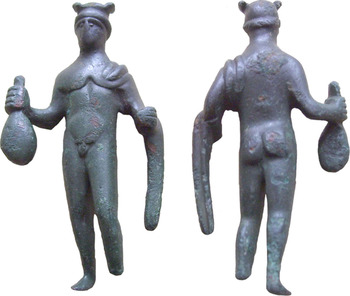
(7) Wickenby (LIN-3A2272) (fig. 8).Footnote 47 A near-complete copper-alloy figurine of Mercury, 67 mm high and 37 mm wide. The surface of the figurine is pitted in places, though generally in good condition with a pale green/blue patina. Mercury is depicted standing in a contrapposto pose and naked, apart from a cloak draped across the back of the left shoulder and over the left arm and a petasos with two wings. The muscles on the torso are defined by moulded lines; the genitals are worn and damaged. The face is also worn with deep-set eyes below a heavy brow-line. The right forearm projects from the body and is bent at the elbow; in his right hand Mercury holds a large money bag. The left forearm also projects at a right angle and it is likely that the hand, which has a circular hole through it, might have grasped a caduceus. The left foot is missing. Despite the number of Mercury figurines in Britain, this particular pose is only occasionally paralleled, for example at St Donats (Vale of Glamorgan) and London Bridge; more numerous parallels can be found in other provinces.Footnote 48
Wickenby, figurine of Mercury (No. 7). Scale 1:1.
(Photo: A. Daubney; © A. Daubney)

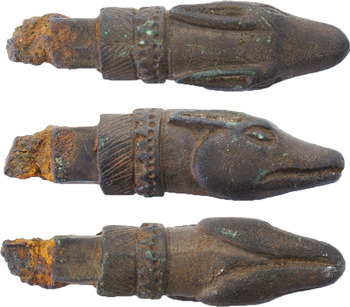
(8) Claxby with Moorby (NCL-864495) (fig. 9).Footnote 49 A copper-alloy knife-handle in the form of a three-dimensional canine head, with clear details in high relief, extending from a rectangular-necked shaft. The object is 71.6 mm long, 18.8 mm wide, 18.8 mm thick, and weighs 98.7 g. The dog's snout is elongated and pointed and the mouth is shown slightly open with teeth visible between the downturned lips. The eyes are lentoid with raised pointed ovals representing the pupils. Immediately above and behind the eyes are the bases of pointed ears which lie flat against the side of the animal's head and are moulded with a triangular indent to represent the inner ear. The open end of the shaft has a rectangular moulded collar. Adjacent to the head, this collar carries a band of punched circular stamps with another band of triangular recesses behind, but no traces of the original enamel survive. The wider part of the collar is decorated with incised oblique lines, perhaps depicting fur. The corroded fragment of a rectangular-sectioned iron shank survives in the socket. A fragment of the iron blade is attached to the handle. The object is hollow from the end of the shaft to approximately halfway along the snout, after which it is solid. Parallels for zoomorphic knife-handles depicting canines are known from the Rhineland.Footnote 50 Amongst the zoomorphic knife-handles recorded by the Portable Antiquities Scheme is an example from Canvey Island, Essex (ESS-BE3913).
Claxby with Moorby, knife-handle in the form of a canine head (No. 8). Scale 1:1.
(Photo: R. Collins; © R. Collins)

LEICESTERSHIRE
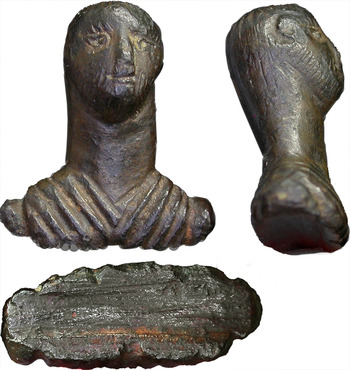
(9) Sibertoft (LEIC-176D93) (fig. 10).Footnote 51 A small copper-alloy mount in the form of an adult male bust, of which the subject cannot be specifically identified. The long broad neck supports a head which is too small in proportion to it. The general shape of the face is fully modelled, though individual features are in low relief. Long angled grooves represent the eyebrows; the lentoid eyes are asymmetrically placed in relation to the simple sub-rectangular nose and the mouth is a horizontal slot. Radiating incised curved lines depict hair and parallel incised lines on the chin and upper lip represent a short beard and moustache. The ears are crudely rendered by curved mouldings. Parallel angled ridges across both shoulders, visible on front and back, represent folds of drapery. The shoulders are formed by sub-spherical terminals. The underside is sub-rectangular and concave. The object is 29 mm high, 27 mm wide, 14 mm thick, and weighs 23.9 g. The close-cropped hair might indicate an early to mid-third-century a.d. date.
Sibertoft, copper-alloy bust in the form of an adult male (No. 9). Scale 2:1.
(Photo: W. Scott; © W. Scott)

NORTHAMPTONSHIRE
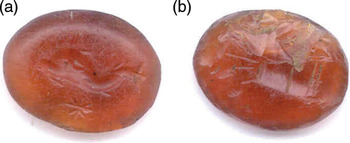
(10) Rushton (NARC-E77EF0) (fig. 11).Footnote 52 An unusual two-sided, oval cornelian intaglio of the ‘Gnostic’ (or ‘Magical Amulet’) variety,Footnote 53 which is likely to originally have been set in a second-century finger-ring. It depicts, on the slightly convex upper face, a dolphin with a star below cut in retrograde.Footnote 54 On the opposite side, which is flatter and has sustained some post-depositional damage, is an altar with three rays emanating from it.Footnote 55 The intaglio is 14 mm long, 10.5 mm wide, and weighs 0.8 g. Intaglios with a design on both sides are rare and this suggests that the gem has been re-used and re-set, perhaps being re-cut for a third-century ring. The re-cutting and re-setting, if not the original cutting (of the dolphin), were probably undertaken in Britain (M. Henig pers. comm.).
Rushton, two-sided cornelian intaglio: (a) obverse; (b) reverse (No. 10). Scale 2:1.
(Photo: J. Cassidy; © J. Cassidy)

HEREFORDSHIRE
(11) Ashperton (HESH-73B625) (fig. 12).Footnote 56 A copper-alloy harness fitting/terret ring of early Roman date (a.d. 43–150). The terret is irregular in plan and has a rectangular attachment bar which joins a curving skirt. From the centre of the skirt a moulded and waisted shank extends and links the skirt to the hoop in the form of a pelta. The terret is 69.5 mm long and 54 mm at its widest point. The skirt and pelta plate are respectively 21 mm and 4.6 mm thick; it weighs 72 g. A direct parallel for the terret ring has not been found, but similar fittings occur at Margidunum (Notts.) and in Pannonia.Footnote 57
Ashperton, harness fitting/terret ring (No. 11). Scale 1:1.
(Photo: P. Reavill; © P. Reavill and Birmingham City Council)

HERTFORDSHIRE
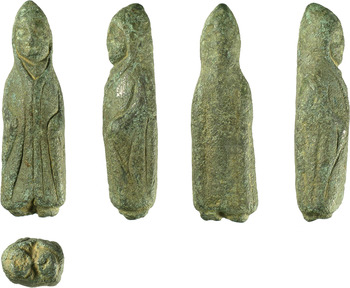
(12) Buntingford (BH-712AC1) (fig. 13).Footnote 58 A copper-alloy figurine in the form of a standing hooded figure, a genius cucullatus, facing forward with head tilted slightly to his right. The hood narrows to a point and frames the face, of which the features are schematically rendered: each eye consists of a disproportionately large circular depression; the nose is a low but pronounced ridge and the mouth an upturned shallow crescent. The folds of the cloak are more fully rendered on the front and sides of the figurine, and a line down the centre of the figure indicates where the garment comes together, trimmed on each side by a thicker band of cloth which extends downwards from the hood. Approximately halfway down the body, the seam is punctuated by a shallow conical depression, possibly representing an attachment point for a separate, now-missing, element. The modelling of the cloak indicates that the arms are beneath in separate folds: where they extend towards the front, the folds hang looser beneath. Two broken, short projections, representing legs or feet, protrude from beneath the cloak; the break is heavily patinated, suggesting that the base was lost in antiquity. The surface of the figurine is also patinated and exhibits traces of corrosion. The face shows possible signs of wear. The surviving part of the figurine is 48.9 mm high, up to 14 mm wide, and 12 mm thick; it weighs 39.3 g. Examples of cucullati are rarer in Britain than on the Continent, and most of the British examples have been recovered either from Hadrian's Wall or from the area around Cirencester. The majority of known instances take the form of stone relief sculptures, often of three cucullati; single figures are quite rare. This figurine, lying outside the main documented distribution, is a significant addition to the corpus.Footnote 59 A further possible but poorly preserved copper-alloy cucullatus from West Sussex has also been recorded by PAS.Footnote 60 The main emphasis of this figurine, like others, lies in the more or less schematic rendering of the hooded cloak as the key identifying attribute.
Buntingford, figurine in the form of a standing hooded figure (genius cucullatus) (No. 12). Scale 1:1.
(Photo: J. Watters; © J. Watters)

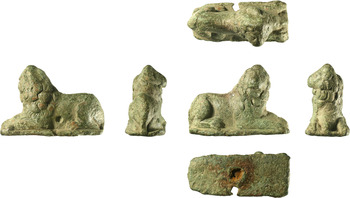
(13) Shenley (BH-2159D4) (fig. 14). A copper-alloy object in the form of a recumbent lion, with the head of another animal between its front legs. The naturalistically modelled figure lies with its head turned, facing to the right. The long mane extends to the top of the forelegs and clumps of fur are separately rendered. The muzzle is prominent (and shows signs of wear), the mouth is slightly open, and the eyes are small and indented. The slender body narrows towards the hindquarters. Fore- and hindlimbs are fully modelled, though the latter seem disproportionately small in relation to the animal's size. The lower hind legs are held tight to the body, the paws have clearly defined toes, and a narrow tail descends to the base. Between the front legs is the head of an animal, too worn to identify. The lion sits upon a thin rectangular plate, on the underside of which, near the centre, is a sub-square socket containing iron corrosion. Cut into the back edge of the plate is a second smaller square perforation. Above this, in the side of the lion, is a circular depression. The surfaces are worn and corroded, and a dark patch on the top of the body may represent iron corrosion. The object is 69.2 mm long, 29 mm wide, 47.8 mm high, and weighs 263 g. The form of this piece suggests it may be a furniture fitting. Lions, or just their heads, are images found on other Roman portable metal items. The lion holding prey is perhaps better known as a funerary motif,Footnote 61 but also occurs on artefact types such as a key handle in the form of a lion holding the head of a horse between its forepaws recorded by PAS (SWYOR-F1D5D6).
Shenley, possible furniture mount in the form of a recumbent lion (No. 13). Scale 1:2.
(Photo: J. Watters; © J. Watters)

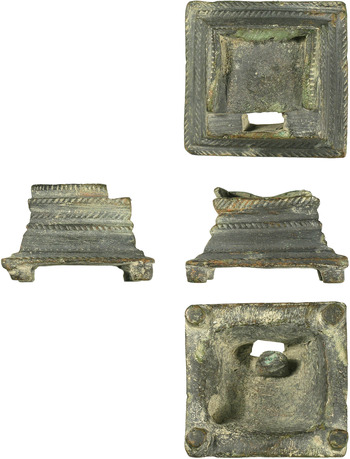
(14) Therfield (BH-FEEB56) (fig. 15).Footnote 62 A copper-alloy figurine base in the form of a truncated, four-sided pyramid with a hollow underside, measuring 40.9 mm wide, 39 mm deep and 26.7 mm high, and weighing 84.4 g. Moulded bands of varying widths, which bear hatching in alternating directions, decorate the foot and sides of the base. On top of the base, there is a further hatched, raised band on three sides; in places it seems to have been folded over, perhaps to secure the figurine or through damage. This band has been removed from the fourth side, where there are traces of filing, and at the centre of this side is a rectangular aperture. This hole is an attachment point, and a forward-facing tab on the underside would have served to secure the figurine. On the bottom of the base are four circular feet, one at each corner, as well as a circular casting flaw in the centre and evidence for filing. The upper surface of the object bears traces of a black substance, which may be corroded silvering or tinning. The richness of the moulding on a base of this type is rare, but similar examples are documented across the Western provinces.Footnote 63
Therfield, figurine base (No. 14). Scale 1:1.
(Photo: J. Watters; © J. Watters)

BEDFORDSHIRE
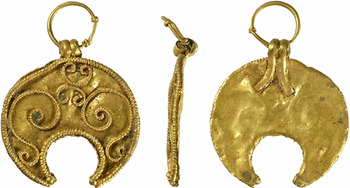
(15) Stagsden (BH-16AE53; 2010 T267) (fig. 16).Footnote 64 A late first- to early second-century a.d. gold lunular ear-ring; 24.1 mm in diameter, 31.5 mm high (from attachment ring to crescent terminals), and 2.47 g in weight. The decorative part comprises a flat crescent-shaped piece of sheet gold, decorated with applied filigree wire. A strand of rilled wire, c. 1.1 mm thick, forms a border around the outer edge, with each crescent terminal decorated with a single gold bead. The inner field is decorated with thinner rilled wire (c. 0.5 mm) curled into spirals, comprising two back-to-back crescents, with ends rolled back, and two larger more complex loose spirals filling the rest of the field. Originally, the returns on the ends of the spirals were set with spherical green glass beads, only one of which survives intact, with another smaller fragment also preserved. The attachment consists of a strip of cambered gold, split at one end and soldered to the back of the plate and curved forward above the plate to form a loop. This loop holds a ring of gold wire with overlapping terminals, each of which coil around the shank twice (Allason-Jones Type 3).Footnote 65 The ear-ring is paralleled by one found in London, now in the British Museum.Footnote 66 Although it may appear that there was no way of attaching the ear-ring to the ear lobe, evidence from inhumation graves has provided confirmation of their function.Footnote 67
Stagsden, gold lunular ear-ring (No. 15). Scale 3:2.
(Photo: J. Watters; © J. Watters)

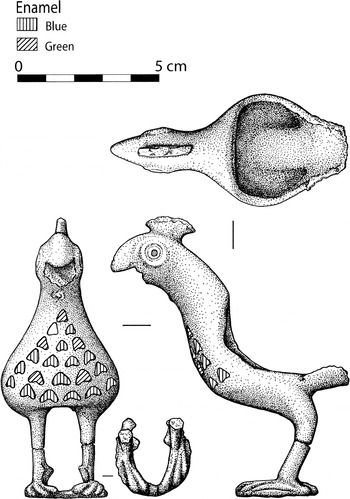
(16) Cople (SOM-745EA2) (fig. 17; online figs 5–6).Footnote 68 An enamelled, copper-alloy container in the form of a cockerel standing on a pedestal; now in two fragments. The cockerel is 68.4 mm high excluding the legs, 106.7 mm including the legs and base, c. 72 mm beak to tail, and has a maximum width of 43.3 mm across the chest; the two pieces together weigh 105 g. The head, comb, neck, half of the body and legs are present, but the tail, wings, back, wattle and lower beak are missing. The cockerel is hollow with an opening in the back from neck to tail, which would have been covered by the wings. The missing tail and wattle would have been cast separately. The eyes are formed by raised discs in reserved metal, with an indented central dot of blue enamel surrounded by an incised circle. The comb is directly between the eyes and two indents in its curved upper edge divide it into three sections. A rough point on the underside of the head indicates where the wattle was attached. The chest is decorated with six rows of triangular and arched cells which represent stylised plumage. These are inlaid in a stepped arrangement and with each row decreasing by one cell from six at the base to one at the apex. The top cell is green; one cell is missing in the second row, while the other is blue; in the third and fifth rows blue and green cells alternate, and in the fourth and sixth all cells are blue. In the sixth row the cells are curved.
Cople, enamelled copper-alloy container in the form of a cockerel (No. 16). Scale 2:3.
(Drawn by M. Trevarthern; © M. Trevarthern)

The lower legs have small spurs projecting inward and the three toes of each foot, which survive complete, curve and follow the contour of the horse-shoe-shaped flat pedestal. The survival of the lower legs, feet and pedestal is unusual, since in most cases the body and upper legs are broken and separated from the stand. The form of the Cople pedestal is not known for any other cockerels of this type from the North-Western provinces. The birds from Ezinge (Groningen, Netherlands) and Tongeren (Belgium), for example, both stand on a concave pedestal on a small domed base.Footnote 69
Only a small number of similar vessels/cockerels, which probably date to the late second or early third century a.d., are known from the North-Western provinces, where the centres of bronze and enamel working were the Rhineland and Belgium.Footnote 70 Similar examples are known from Lancashire (LANCUM-361F75), London, Cologne, Slyne-with-Hest, Tongeren and Ezinge. The most commonly accepted interpretation of their function is as oil lamps.Footnote 71 However, while this may be possible for the cockerels from Tongeren and Slyne-with-Hest, Menzel argued that it may not have been for those from Cologne and London, owing to their shape and the fact that the lids (wings) were soldered to the bodies of the birds, making it difficult to refill them.Footnote 72 In at least one case, from Buchten (Netherlands), an alternative votive use is attested: the cockerel's feet rest on an angled disk attached to a pedestal below, which carries an incised inscription dedicating the object to the goddess Arcanua — a deity only otherwise attested on a single stone inscription from Buchten — by Ulpius Verinus, a veteran of legio VI.Footnote 73
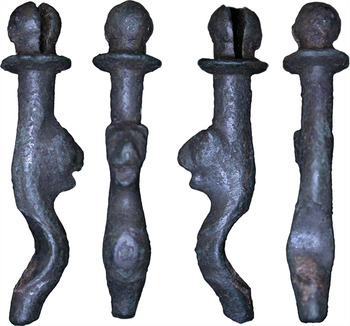
(17) Great Barford (LEIC-7D8B32) (fig. 18).Footnote 74 An incomplete copper-alloy tripod leg; 46 mm long, 11 mm wide, 10 mm thick, and weighing 9.8 g. From its base the shaft curves for approximately one third of its length, the bow ending with a protruding lion's head. Above this, the shaft straightens and the top, separated from the rest of the shaft by a circular disc, is formed by a sphere with a rectangular-sectioned slit cut through it. Similar examples are documented from London, Cirencester, Liège and Tongeren.Footnote 75 On analogy with complete examples from Leiden, Liège, Trier and in the Morel collection, British Museum, these may comprise individual legs of a small tripod supporting the drip-collector of a pricket candlestick.Footnote 76
Great Barford, zoomorphic tripod leg fragment (No. 17). Scale 3:2.
(Photo: W. Scott; © W. Scott)

GREATER LONDON
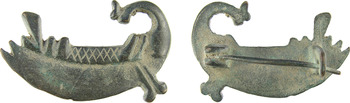
(18) Chelsea (LON-8265B7) (fig. 19).Footnote 77 A Roman copper-alloy plate brooch found on the Thames foreshore near Chelsea Bridge, upstream from the City. It is cast to form a stylised boat with a curving stern and is 34.75 mm long, 21.7 mm wide, 14.8 mm thick, and weighs 6.9 g. The forefoot is made up of two pointed ‘prongs’, representing the rostrum (beak) and the prow, which is triangular. The stern curves forward over the boat to end in a terminal with three rounded lobes, a stylised representation of the aplustrum, a counterpart at the stern to the figure on the prow, serving as both ornament and shelter for the helmsman. A pair of steering oars or rudders is represented at the stern end. A lattice along the side of the vessel, incised with a row of seven saltires, represents the balustrade for the parados or side gangway, protecting the marines. No rowers are depicted. On the reverse are the twin lugs and axis bar to secure the hinged pin, which is still present, as is the catchplate.
Chelsea, plate brooch depicting a stylised boat (No. 18). Scale 4:3.
(Photo: K. Sumnall; © K. Sumnall)

The subject is an unusual one for a plate brooch. Ettlinger documents a single example in her corpus of Roman brooches from Switzerland, though unlike this one it shows the heads of three sailors.Footnote 78 In its general form the boat recalls representations in other media, such as two small finds showing warships found in London — a first-century mottled jasper intaglio set in an iron ring from the WalbrookFootnote 79 and a late Antonine or Severan cornelian gem found on the foreshore at King's Reach, Winchester Wharf, Southwark.Footnote 80 The Arras medallion carries a similar representation of balustrade and aplustrum, while the structural detail of the latter is more fully rendered on Trajan's Column in the opening scene of the Second Dacian War.Footnote 81
SUFFOLK
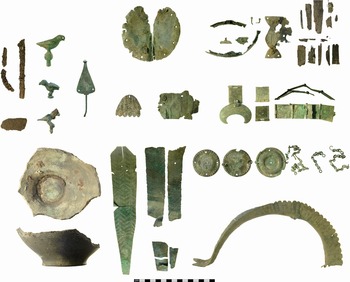
(19) Near Bury St Edmunds (SF-D4D044) (fig. 20; online figs 7–18).Footnote 82 A group of 61 objects, almost certainly to be identified as a hoard of votive material, most of which are copper-alloy, but also including objects and fragments of iron, wood and bone and pottery sherds. The report of its discovery through metal detection was followed up by excavation.
Near Bury St Edmunds, hoard of votive material (No. 19).
(Photo: A. Brown; © Suffolk County Council)

The group was found within and around a micaceous greyware vessel. Fifteen copper-alloy artefacts and one iron object were buried within it and were removed by the finder. The uppermost objects appear to have been the three sheet copper-alloy ‘feathers’ (online figs 7–9) decorated with incised chevrons, folded to fit into the top of the vessel. Beneath them was a copper-alloy headdress, comprising three discs with pellet borders stacked one on top of the other, each with four evenly-spaced circular apertures, two of which retained copper-alloy connecting loops, along with the remains of a copper-alloy chain in three long sections, which presumably connected the discs (online fig. 10). Beneath the headdress was a folding hinged strap or belt, with one long section intact together with fragments of seven hinged links (online fig. 11) and two separate additional links in the form of a flat crescent-shaped pendant (60.1 mm wide and 1 mm thick) (online fig. 12). One link is attached by means of a small copper-alloy loop and traces of textile are visible on one of the hinges. At the base of the vessel were three copper-alloy bird figurines (online figs 13–15). Two of these have been more or less fully modelled anatomically, with incisions to represent the detail of feathers, while the third is much more schematically rendered. Two hold items in their beaks. From the feet of all three are elements for attachment, perhaps to a staff or sceptre. Another item which may be identified as a staff or sceptre terminal is the lance-shaped copper alloy sheet (online fig. 16); this has a globular terminal knop at its apex and two circular apertures at either corner of its base, which is serrated; a slender shaft is still attached.
Other finds in the vessel include a cylindrical iron rod in three fragments and further pieces of sheet copper alloy, including one with a flattened in-situ rivet (online fig. 17). Among the objects from the context surrounding the vessel is a life-size crest for a Corinthian helmet (online fig. 18). Parts of a tankard, including a cast copper-alloy handle with lozenge-form terminals; the remains of a sheet copper-alloy backing plate; fragments of a sheet copper-alloy rim, including in-situ rivets; two copper-alloy nails; and wood fragments were found beneath the base of the vessel. Also found were a sheet copper-alloy semi-circular decorative pendant with circular aperture at the top and zig-zag decoration at the base, an iron nail, a blade fragment and further fragments of sheet copper-alloy, wood and bone.
The life-size crest of the Corinthian helmet seems likely to derive from a cult image — head or figure — of Minerva. Other items in this deposit are commonly identified as probable priestly regalia or votives, specifically the headdress, staff or sceptre terminals and votive ‘feathers’. Similar examples of the chain-linked headdress, which would have originally been attached to a fabric or leather cap, include one of the ‘Cavenham Crowns’, probably from Lackford, Suffolk, as well as others from Stony Stratford, Hockwold, Wanborough and Farley Heath.Footnote 83 Votive feathers are widely paralleled in other hoard deposits and sanctuary contexts,Footnote 84 as are bird figurines used as staff terminals.Footnote 85 The leaf-shaped object is paralleled in the five ‘pole-tips’ at Brigstock, as well as at Felmingham Hall; in the latter case the metal rings within the holes survived in situ, indicating its probable use for noise-making.Footnote 86 A hinged copper-alloy belt-plate from Brettenham with an inscribed name offers a possible parallel for the strap or belt in the current group.Footnote 87
The context for this group would seem to represent the deliberate deposition of priestly regalia and votive material, as well as part of a cult image. The assemblage is similar to other (near) intact and disturbed groups in East Anglia — Willingham Fen (Cambs.), Cavenham (Suffolk), Hockwold and Felmingham (Norfolk), as well as Wanborough and Farley Heath in Surrey.Footnote 88 Within c. 400 m of the findspot in the same field are many other metal objects of Roman date. Some of these may also have religious connotations, including an unusual knife-handle with a terminal in the form of a probable pig (SF-0399A6) and a vessel handle mount in the form of a human head (SF-040874), both of first- to second-century a.d. date, as well as a skeuomorphic plate brooch in the form of an axe of second-century date (SF-042714). Proposed future examination of the findspot may help clarify the nature of the complex and the date of the deposit. The hoard itself is currently undergoing conservation and further study.
ESSEX
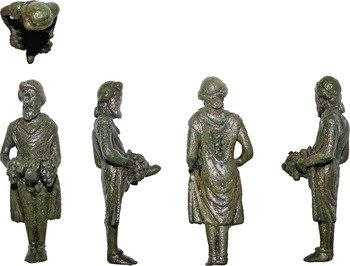
(20) Thorrington (ESS-E6F9E3) (fig. 21).Footnote 89 A copper-alloy figurine of Priapus. The figure stands looking slightly to the right, with legs straight and close together. Facial features are worn but the clipped beard might be said to be archaising. Priapus, depicted wearing a turban, hoists up his sleeveless garment, which hangs long at the back and sides, to reveal a massive erect phallus, on either side of which the god's hands hold large bunches of grapes. Where the legs taper at the ankles, there is a raised moulding, presumably representing footwear. The bottoms of the feet are flat. The figurine is 80.3 mm high, 23.3 mm wide at the shoulders, and 11.2 mm thick; it is 26.22 mm from the tip of the phallus to the back of the figure.
Thorrington, figurine of Priapus (No. 20). Scale 3:4.
(Photo: L. McLean; © L. McLean and Colchester and Ipswich Museum Service)

Images of Priapus are rare in Britain, and indeed in the North-Western provinces in general. A small cluster — including the Thorrington example, and a further example recorded by the PAS from Ingham, Suffolk (SF-177545) — can be identified in the south-eastern region of East Anglia.Footnote 90 The proximity of the colonia at Colchester, about seven miles north-west of the findspot, may provide a context for this unusual find, but it should be noted that phallic ornaments are also widely distributed in rural Suffolk.Footnote 91 Similar figurines of Priapus are documented in other provinces, though the Thorrington Priapus differs in some details, such as holding the fruit in his hands rather than in the fold of a cloak, and he lacks the basket on his head.Footnote 92 This mode of representing the god is more widely paralleled in other media.Footnote 93 This highly classical representation, with careful modelling of anatomy and clothing, sets it apart from most other images of deities from the province.
WILTSHIRE
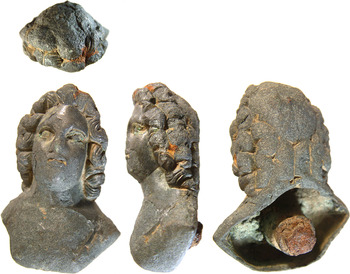
(21) Corsley (WILT-074FD1) (fig. 22).Footnote 94 A second-century a.d. hollow furniture mount in the form of the bust of a florid youth, perhaps to be identified as Bacchus. It is 82.3 mm high, 58.3 mm wide across the shoulders, and weighs 180 g. The face has heavy full cheeks and deep-set, almond-shaped eyes, one with a rib-defined upper lid, a very flat nose and a small straight mouth. There is an off-centre circular recessed hole towards the top of the left eye. The neck is broad and the full hair extends in tight waves to the top of the shoulders. Individual curving strands are separated within the clumps of hair, though at the flattened back of the head the coiffure is less well-defined. The chest is broad, but little detail of the musculature is rendered. The torso is hollow and open at the back, where part of a corroded iron rivet, 12 mm in diameter, meets a copper-alloy projection from the bust. The grey/silvery surface probably reflects a high lead content. There are patches of iron staining around the head, particularly on the hairline and at the ears. Busts of similar form and dimensions of Antinous and Bacchus, but more finely modelled, are recorded, for example from Littlecote.Footnote 95
Corsley, furniture mount in the form of a bust, perhaps Bacchus (No. 21). Scale 2:3.
(Photo: K. Hinds; © K. Hinds and Salisbury and South Wiltshire Museum)

HAMPSHIRE
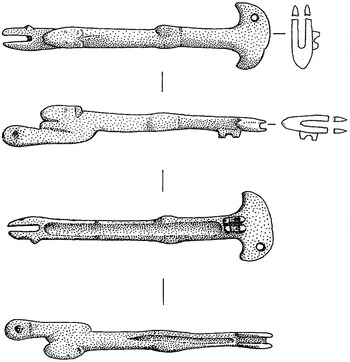
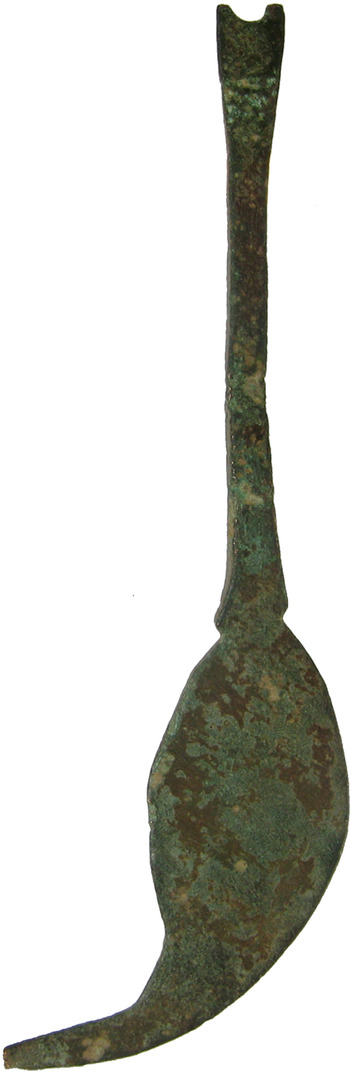
(22) Broughton (HAMP-BC38B6) (fig. 23).Footnote 96 A corroded copper-alloy multi-functional eating utensil, best described as a folding spoon of Sherlock's Type B, dating to the second to third century a.d.Footnote 97 It is 64.75 mm long, 12.3 mm high, 16.15 mm wide and weighs 11.16 g. The handle takes the form of an elongated, crouching animal (feline?), with front legs outstretched beyond the head, which has moulded ears, slight recesses for eyes and a groove indicating the mouth. The elongated body behind is U-shaped in section, the underside being recessed. A slight bulge on the creature's side represents its hind quarters. The other end of the handle terminates in a crescent which is perforated on one side. A groove runs along one side of the handle from the crescent. The perforation would have held a rivet for a hinged implement, possibly a spike for extracting flesh from crustaceans. This implement would have folded against the handle's side within the groove and have been retained within a notch in the paw. On the underside of the crescent is a perforated double lug, now broken. The hinge would almost certainly have held a blade which would have folded in the wide recessed groove on the underside of the handle. Within the lug are traces of the corroded iron rivets, and iron corrosion is also present in the side groove. Corrosion makes any decoration difficult to discern, but there are possible rouletted punch marks behind the animal's head and traces of white-metal coating on the underside of the crescentic terminal.
Broughton, copper-alloy folding spoon of Sherlock's Type B (No. 22). Scale 1:1.
(Drawn by A. Cracknell; © Winchester Museum Service)

The spoon bowl would have been held within the paws and folded up above the animal's head. Very few examples have been found with their bowls still attached (e.g. BM Registration No. 1856, 0701.1152), and all but one of these were ‘mandolin’-shaped. In the absence of bowls these pieces have often been misidentified as folding knives.Footnote 98 By 2007, Sherlock had catalogued eight handles and six separate bowls.Footnote 99 Along with this example, a further five handles have been recorded by the PAS from Campsey Ash, Suffolk (SF2196), Coberley, Glos. (GLO-C01E93), Ossington, Notts. (DENO-AEBF93), Wellingore, Lincs. (LIN-A68C52), and Ramsgate, Kent (KENT-DD9F73). Also recorded by PAS are a possible spoon bowl from Longbridge Deverill, Wilts. (HAMP-349434), and another seemingly related piece from Horncastle, Lincs. (NLM4722). To these can be added another utensil, which is of the same style but more complex, with extra lugs for a total of six implements.Footnote 100
(23) Cliddesden (HAMP-4669A5) (fig. 24).Footnote 101 A probable tooth pick in copper alloy; 66.5 mm long, 21.1 mm wide, 1.5 mm thick, and weighing 3.14 g. It has a comma-shaped, flat plain blade that curves round to one side as it tapers to the tip, which is slightly truncated and bent. The stem, which is rectangular in section and slightly buckled, expands slightly at the other end (width 4.4 mm) to receive a perforation, presumably for a suspension loop, but the terminal has broken at this point. The blade is of a common Late Roman form, with four silver examples known from the Hoxne hoard.Footnote 102 The presence of the broken hole suggests the existence of a loop for suspending the object, perhaps from a chatelaine.
Cliddesden, Late Roman copper-alloy tooth pick (No. 23). Scale 1:1.
(Photo: R. Webley; © R. Webley and Winchester Museum Service)

ISLE OF WIGHT
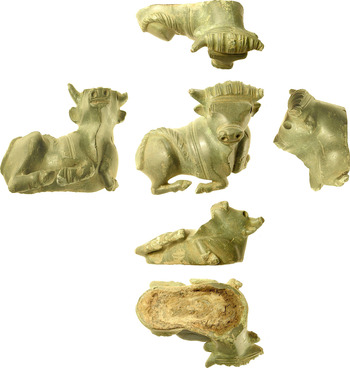
(24) Calbourne (IOW-2CA926) (fig. 25).Footnote 103 An almost complete copper-alloy hollow-cast figurine in the form of a recumbent bull. It is 58.3 mm high, 70.2 mm long, 36.7 mm thick, and weighs 245.1g. The angular head faces forward and is turned through 90 degrees to the body. The small, triangular ears project sideways and the horns curve upwards. A series of longitudinal grooves between the horns represent (?)hair. The eyes are formed by two circular recesses which are likely to have been filled with a decorative material, no trace of which survives. The top of the face is flat between the eyes. The nose is oval, but flattened at the front, where the nostrils are represented by two circular recesses. Below the nostrils there is a horizontal groove forming the mouth. Beneath the mouth is a prominent dewlap extending to the lower part of the chest. A band passes around the girth of the bull. A similar band, though decorated, is visible on a three-horned bull figurine reported to the PAS from Holbrook, Suffolk (SF-DCB627). Bands of this type, sometimes ending in tassels, occur regularly in scenes of sacrifice from the Late Republic through to Late Antiquity, for example on the ‘altar of Domitius Ahenobarbus’, Trajan's Column and the Decennial monument in the Forum.Footnote 104 The tail curves around the right rear leg, resting between the thigh and the grooved band. Both of the right legs are turned inwards with the hocks parallel to the body and the bottoms of the hooves facing each other. The left front leg is tucked beneath the body. Much of the interior of the body is filled with lead alloy. The body is truncated at the rear and is finished with a flat rim that would have abutted another object. The type of artefact to which it was attached is uncertain.
Calbourne, figurine in the form of a seated bull (No. 24). Scale 2:3.
(Photo: F. Basford; © F. Basford)

Very few other bronze bull figurines are known from Roman Britain and most represent standing figures.Footnote 105 A similar figurine was discovered in 1924 in the Lexden Tumulus near Colchester dating to c. 15–10 b.c.Footnote 106 The analogous, but less detailed, example in the Morel Collection, British Museum has a convex back, which may suggest that it fitted to the shoulder or rim of a vessel.Footnote 107 It may be significant that the horns of the Isle of Wight bull are without the knobbed terminals that the other examples possess.
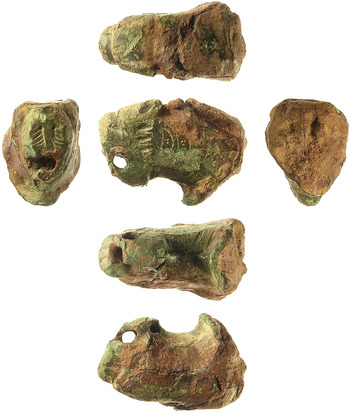
(25) Niton and Whitwell (IOW-F65D31) (fig. 26).Footnote 108 A copper-alloy knife-handle terminal in the form of a feline's head and neck, probably that of a lioness. The head is roughly triangular in cross-section; 36.2 mm long, 24.8 mm wide, 19.8 mm thick, and weighs 42 g. It is flat at the top with convex sides and a flattened snout. At the centre of the snout is a flat vertical area flanked on either side by a series of parallel oblique incised grooves forming whiskers. In the open mouth the surviving left canine connects the upper and lower jaw. The right canine is missing. On the left side of the head are three parallel grooves, one above the other, representing hair. A small swept-back oval ear is situated above them. The eyes are not apparent. On the opposite side of the head the ear is missing owing to a break or corrosion. Detail on this right side is largely obscured by a deposit of iron staining. The top and sides of the neck are flat and the underside is carinated. In side profile the underside of the neck is arched. Decoration on the flat side of the neck on the left side consists of three incised crescents with small punched dots within. At the outer end of the neck there are the remains of a corroded iron handle. A similar knife-handle terminal in the form of a feline head has been recorded by PAS from Fordingbridge, Hants. (WILT-F9BDC5). This head is closely paralleled by three feline protomes from Belgium which are clearly terminals for razor handles. In one case (Ourthe, Luxembourg) the triangular blade survives intact and in the other two enough remains to demonstrate the original nature of the object.Footnote 109
Niton and Whitwell, knife-handle terminal in the form of a feline's head and neck (No. 25). Scale 1:1.
(Photo: F. Basford; © F. Basford)

ROMAN COINS RECORDED WITH THE PORTABLE ANTIQUITIES SCHEME: A SUMMARY
THE DATASET
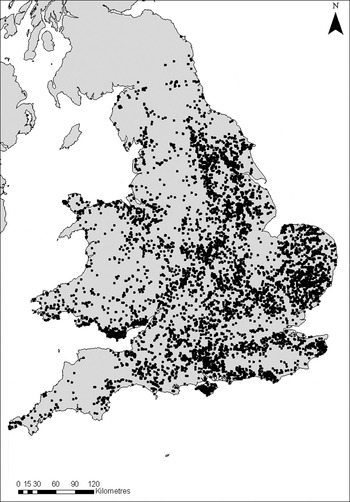
Between its inception in 1997 and the end of 2010, 108,621 Roman coins from England and Wales have been recorded by the Portable Antiquities Scheme (PAS). A further, 52,804 Roman coins from the Welsh corpus (which includes hoards and site finds), compiled by Peter Guest and Nick Wells, Cardiff University, have been added to the PAS database by Dan Pett, ICT Adviser for PAS.Footnote 110 The majority of the coins can be categorised as site or stray finds rather than being from hoards.Footnote 111 In recent years, there has been a major drive to encourage metal-detector users to record all coins, not just precious metal and better preserved pieces.Footnote 112 As a result over 50,000 Roman coins have been added to the database in the last three years.Footnote 113 fig. 27 illustrates the distribution of coins recorded between 1997 and 2011 in England and Wales.
The distribution of all coins recorded by the PAS between 1997 and 2011.

THE NATIONAL PICTURE
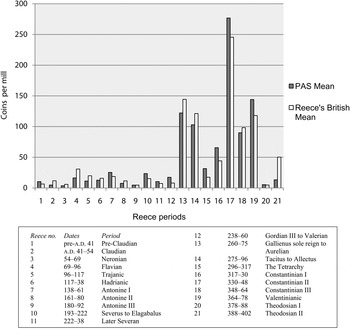
The coins recorded by the PAS offer an opportunity to study patterns of coin supply, circulation and loss at a truly national level, building on applied numismatic studies undertaken by scholars such as Richard Reece and John Casey.Footnote 114 For example, the mean values calculated using Roman coin data recorded by the PAS up until 2008 share a remarkable degree of similarity with Reece's British Mean as illustrated by fig. 28. However, there is some variation in values, particularly in the fourth century a.d. where the PAS Mean exhibits higher per mill values than Reece's British Mean. This probably reflects the rural nature of the PAS dataset, since later coins are proportionally more common on rural sites than urban or military ones.Footnote 115
A comparison of the PAS Mean (sample size: 38,167 coins) and Reece's British Mean (sample size: c. 100,000 coins).

The dataset also illustrates clearly how numismatic evidence can be used to investigate key research questions in the study of Roman Britain. Philippa Walton's doctoral thesis reassesses several key moments in the history of the province, including the Late Iron Age to early Roman transition, the late third century a.d. and the late fourth century, using PAS coin data as a starting point.Footnote 116 Studies have also been undertaken on Late Roman siliquae,Footnote 117 Roman gold coins found in Britain,Footnote 118 and Byzantine coins.Footnote 119 The PAS has also recorded numerous coins of importance to numismatic research and many of these have been published in the ‘Coin Register’ in the British Numismatic Journal.
THE REGIONAL PICTURE
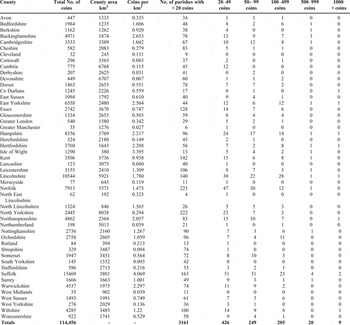
However, it is not just at a national level that PAS data can make an impact on research. It is increasingly clear that there were significant variations in the geographical distribution of particular types of material culture from Roman Britain, such as nail-cleaners and brooches. The PAS dataset shows that coinage also shares in this pattern of regionality, with the volume of coins recorded varying substantially from region to region. Table 2 summarises the total number of Roman coins recorded for each English county. It highlights the fact that the majority of coins are found to the south-east of the Fosse Way and in a few outlying regions, such as Warwickshire, the East Riding of Yorkshire and North Yorkshire.Footnote 120 The density of coin finds is greatest in the South-East, notably in Suffolk and on the Isle of Wight. The number of coins found per square kilometre for each county is also indicated, which provides a general overview of the density of coin finds. This is, of course, a crude tool and does not take land-use into account, but it does give an indication of which parts of the country are most productive. Table 2 also summarises the range in size of assemblages at a parish level within individual counties. It is notable that there are nine parishes with totals of more than 1,000 coins and a further 225 parishes with more than 100 coins. Many of these large assemblages come from sites previously unknown to archaeologists.
A SUMMARY OF ROMAN COINS RECORDED BY THE PAS FROM ENGLAND BY COUNTY AND PARISH

NB. Table 2 uses data as of 4 May 2011. There are some small hoards within the dataset which will be removed when more precise analysis is carried out; however, given the size of the dataset, they are unlikely to affect the overall picture presented significantly.
FUTURE RESEARCH
The PAS Roman coin dataset represents an extremely important resource for understanding the development, distribution and chronological range of Roman settlement in Britain.Footnote 121 We urge anyone who is studying a region of Roman Britain or is about to undertake archaeological fieldwork of a Romano-British site to consult the PAS database. The PAS Roman coin dataset, together with other Roman finds recorded, can often provide more nuanced contextual information than is available through Historic Environment Records. The number of Roman coins on the database will continue to grow and will provide an increasing amount of fresh information about Roman Britain in general. We hope that it is a resource which more scholars will wish to use in the future.
SUPPLEMENTARY MATERIAL
For supplementary material for this article please visit http://journals.cambridge.org/bri