Introduction
Postoperative hypertension is a known complication following paediatric cardiac surgery. Reference Appelbaum, Blackstone, Kouchoukos and Kirklin1–Reference Flynn, Kaelber and Baker-Smith3 The incidence of hypertension following coarctation of the aorta repair has been estimated to be between 37 and 100% and higher in younger patients with complex coarctation of the aorta. Reference Rocchini, Rosenthal, Barger, Castaneda and Nadas4–Reference Giordano, Chinali and Franceschini6 Common postoperative anti-hypertension pharmacotherapy includes beta-blockade, nitroprusside, calcium channel blockers, and angiotensin-converting enzyme inhibitors, with angiotensin-converting enzyme inhibitors used in 75% of paediatric patients as oral therapy. Reference Roeleveld and Zwijsen7 Angiotensin-converting enzyme inhibitors target the conversion of angiotensin I to angiotensin II, mitigating angiotensin II’s potent vasoconstriction effects. Although these agents have been established clinically for some time, information regarding their optimal utilisation dosage and titration, and safety is still an area of active research in paediatrics. Reference Snauwaert, Vande Walle and De Bruyne8–Reference Phelps, Eshelman, Cruz, Pan and Kaufman11
The use of angiotensin-converting enzyme inhibitors in paediatric patients is not without risk. Initiation often involves starting at low doses, then titrating up to effect. Premature neonatal populations are particularly vulnerable to angiotensin-converting enzyme inhibitor toxicities due to the immature nature of metabolism and altered pharmacokinetics, resulting in a prolonged elimination half-life. Enalapril has been reported to induce severe hypotension and renal failure when used in preterm infants when dosed on the higher end of the current starting dose spectrum. Reference Schilder and Van den Anker12 In infants cared for in neonatal ICUs, enalapril had an overall adverse effect incidence of 21% with the most common events being hyperkalemia, elevated serum creatinine, hypotension, and death. Reference Ku, Zimmerman, Benjamin, Clark, Hornik and Smith13 Enalapril and captopril have been noted to induce acute renal failure in neonates, with higher incidence in preterm neonates. Reference Dutta and Narang14,Reference Lindle, Dinh and Moffett15 Data on the use of lisinopril in patients <7 years of age are limited; however, referenced weight-based dosing is similar in these patients to their older counterparts.
Adult data have shown race to be a significant factor in angiotensin-converting enzyme inhibitor efficacy. Black patients with hypertension treated with angiotensin-converting enzyme inhibitors or angiotensin receptor blockers have been shown to be less responsive with worse cardiovascular outcomes such as acute myocardial infarction, stroke, and congestive heart failure. Reference Ogedegbe, Shah and Phillips16 There may be a decreased effect seen in this patient population due to low renin levels caused by possible genetic polymorphisms in the angiotensinogen gene, preventing the renin-angiotensin-aldosterone system from being effectively suppressed compared to patients of other races. Reference Woodiwiss, Nkeh and Samani17 Although data on the impact of race and angiotensin-converting enzyme inhibitor response in paediatrics is limited and primarily in patients >6 years old, the current literature reflects that this response discrepancy still applies to these paediatric patients. Reference Menon, Berezny and Kilaru18,Reference Li, Baker-Smith and Smith19
In this study, we evaluated the current practices on angiotensin-converting enzyme inhibitor titration in paediatric postoperative cardiac surgery patients at our centre. Our aims are to assess the change in mean arterial pressure for patients receiving angiotensin-converting enzyme inhibitor versus control, to assess the impact of angiotensin-converting enzyme inhibitor therapy on changes in mean arterial pressure by race and surgery type, and to evaluate the variation of mean arterial pressure change for patients who received low, medium, or high dose angiotensin-converting enzyme inhibitor therapy.
Materials and methods
Patients and population
We conducted a single-centre retrospective review of patients <24 months of age undergoing cardiac surgery for ventricular septal defect or coarctation of the aorta (with a surgical approach via thoracotomy) at our centre from January 1, 2017, to December 31, 2019. An internal surgical database was queried, and all eligible patients were identified. Patients with the following were excluded: chronic kidney disease prior to surgery, acute kidney disease during the perioperative period, prolonged postoperative intubation periods (>48 hours), incomplete chart data for collection parameters, non-isolated ventricular septal defect or coarctation of the aorta CHDs, coarctation of the aorta repaired by surgical approach via midline sternotomy, or documented syndromes or chromosomal abnormalities. Chronic kidney disease and acute kidney disease were defined by Kidney Disease Improving Global Outcomes criteria.
The primary endpoints were to assess the change in mean arterial pressure from baseline, assess an angiotensin-converting enzyme inhibitor dose response effect on mean arterial pressure, and assess mean arterial pressure response variation to angiotensin-converting enzyme inhibitor therapy by race and/or surgical type. Baseline mean arterial pressure (MAP) was defined as the mean MAP on postoperative day 1. Additionally, time 1, time 2, and time 3 were the mean MAP for postoperative day 1, day 2, and day 3, respectively. MAP was obtained from each patient at three separate times each day (i.e, morning at 8 am, 2:00 pm, and 8:00 pm). Data for the MAPs were obtained from arterial lines when available and from non-invasive blood pressure measurements. It is our centre’s guideline for the non-invasive blood pressure cuff to be of appropriate size per national standards. The reason why MAP was used, and not systolic blood pressure, is that when utilising Dinamap to measure blood pressure, MAP is what is actually measured, unlike systolic blood pressure, which is extrapolated using an algorithm. Patients were reviewed to assess the usage of angiotensin-converting enzyme inhibitor (captopril, enalapril, or lisinopril) postoperatively on days 1–5 and those without angiotensin-converting enzyme inhibitor administrations were identified as controls. Standard angiotensin-converting enzyme inhibitor administration times were every 8 hours for captopril (i.e. 0600, 1400, and 2200), every 12 hours for enalapril (i.e. 0800 and 2000), and daily for lisinopril (i.e. 0800); however, some variation may have occurred. Angiotensin-converting enzyme inhibitor initiation and titration were dictated by the bedside physician and clinical pharmacy specialist based on patient-specific parameters. This study was approved by the Children’s Healthcare of Atlanta IRB [IRB #00000458].
Angiotensin-converting enzyme inhibitor dosage classification
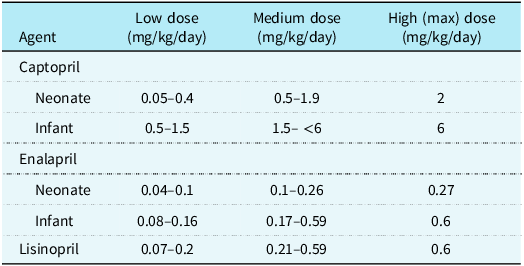
In an effort to standardise angiotensin-converting enzyme inhibitor utilisation, a dosage intensity scale for each angiotensin-converting enzyme inhibitor was formulated. Age categorisation was defined in accordance with the United States Food and Drug Administration for neonates and infants. 20 Using accepted dosing references as well as consensus from institutional critical care cardiologists and pharmacists, the following parameters outlined in Table 1 were assigned to each agent for the purposes of analysis. Reference Carol K.Taketomo21,Reference Mirkin and Newman22
Angiotensin converting enzyme inhibitor dosage intensity classification

Statistical analysis
Descriptive statistics and frequency distribution measures were run to characterise the demographic and clinical characteristics of the study participants. The primary statistical analysis involved the use of mixed-effects models to assess the impact of angiotensin-converting enzyme inhibitor therapy on blood pressure over time. Two models were run, treating time as a categorical and a continuous variable, and in both the models, the interaction between the medicine group and the time variable was included. The random intercept was also included in the model to account for patient-specific variability in the baseline mean arterial pressure percentage change. The unstructured covariance matrix was selected in order to model the correlation between the random intercepts. Several residual plots were obtained to visualise the change in mean arterial pressure with time. A three-way overall interaction analysis of variance (ANOVA) was utilised to assess angiotensin-converting enzyme inhibitor change in mean arterial pressure by race and surgery type. Statistical analysis was performed in SAS version 9.4 (Cary, N.C.).
Results
Patient demographics and clinical characteristics
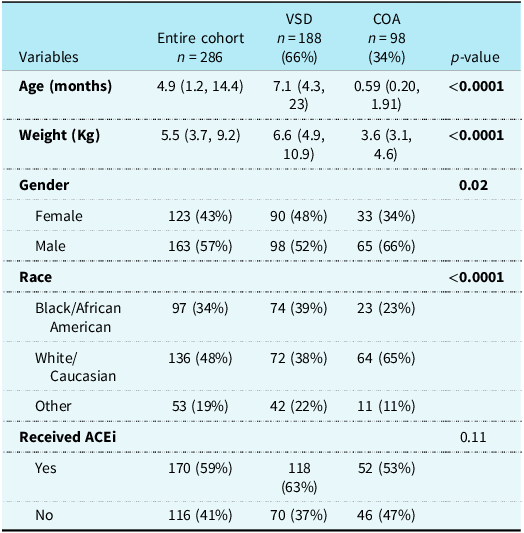
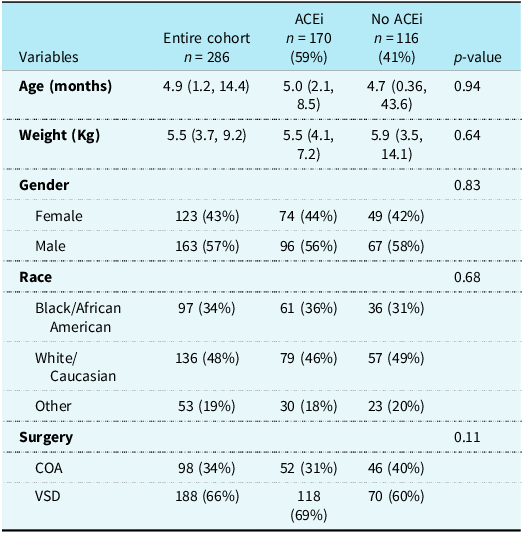
During the study period, there were 286 patients who met inclusion criteria, with 188 patients (66%) with a diagnosis of ventricular septal defect and 98 patients (34%) with a diagnosis of coarctation of the aorta. The median age of the entire cohort was 4.9 months (IQR 1.2–14.4), and median weight was 5.5 kg (3.7–9.2). There were 163 (57%) males, 136 patients (48%) White/Caucasian race, 97 patients (34%) Black/African American race, and 53 patients (19%) of other races. Of the study population, 170 patients (59%) received angiotensin-converting enzyme inhibitor and were considered the case group, while 116 patients (41%) did not receive angiotensin-converting enzyme inhibitor and were considered controls. The most common angiotensin-converting enzyme inhibitor was captopril on day 1 [n = 117 (69%)] and lisinopril at discharge [n = 86 (51%)]. When comparing the patients with the diagnosis of ventricular septal defect versus coarctation of the aorta, patients in the coarctation of the aorta group were younger (median age 0.59 months versus 7.1 months, p < 0.0001) and weighed less (median weight 3.6 kg versus 6.6 kg, p < 0.0001). There was no difference between the groups regarding angiotensin-converting enzyme inhibitor administration (Table 2). When comparing patients who received angiotensin-converting enzyme inhibitor (cases) versus those who did not receive angiotensin-converting enzyme inhibitor (controls), there was no difference in regard to weight, age, gender, race and diagnosis (Table 3).
Patient demographics by surgery type

Results depicted in n (percent), median (interquartile range/IQR). VSD = ventricular septal defect; COA = coarctation of the aorta; ACEi = angiotensin converting enzyme inhibitor.
Patient demographics for ACEi patients and controls

Results depicted in n (percent), median (interquartile range).
Comparison of change in mean arterial pressure for angiotensin-converting enzyme inhibitor patients versus control group
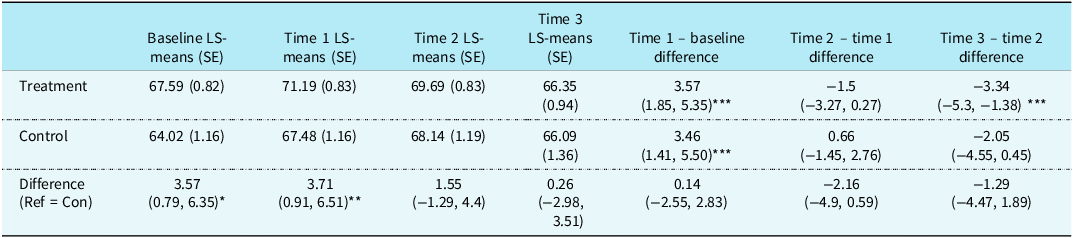
Patients in treatment group were shown to have higher median mean arterial pressure at baseline and at time 1, compared with patients in control group [mean difference 3.57 (95% CI: 1.85, 5.35) and 3.46 (95% CI: 1.41, 5.50)], respectively. However, the median mean arterial pressure became comparable and the difference between the two groups decreased at time 2 and at time 3, becoming statistically insignificant. We also found that median mean arterial pressure decreased significantly from time 2 to time 3 among patients in the treatment group. However, there is no significant difference found between groups at time 2 and time 3 (−1.29, 95% CI −4.47, 1.89) (Table 4, Figure 1). When time was analysed as a continuous variable, we found that the median mean arterial pressure among control group patients significantly increases over time with a slope of 0.97 (95% CI: 0.2, 1.74), while median mean arterial pressure among treatment group decreases with a slope of −0.31 (−0.93,0.31). The slopes were significantly different between two groups. Median mean arterial pressure among treatment patients was significantly higher than that of control patients at the first two timepoints. The difference decreases over time from 4.12 at the baseline to 0.29 at time 3 (Table 5, Figure 2).
Boxplot depicting the difference for median MAP between repeated patient follow-up and between treatment and control groups.

Trends depicting the change of median MAP over repeated patient follow-up between treatment and control groups.

Model-estimated least-squares means (LS-means) with standard error (SE), difference for median MAP between repeated patient follow-up and between treatment and control groups with 95% confidence interval (95% CI), and summary of model coefficients with 95% CI (Time as categorical variable)

Note: Four time points were treated as categorical variables.
* p-value < 0.05, **p-value < 0.01, ***p-value < 0.001.
Difference was presented as LS-means difference (95% CI) for the first four columns and difference in LS-Means difference (95% CI) for the last three columns.
Model-estimated least-squares means (LS-means) with standard error (SE), difference for median MAP over repeated patient follow-up between treatment and control groups with 95% confidence interval (95% CI), and summary of model coefficients with 95% CI (Time as continuous variable)

Note: Four time points were treated as a continuous variable. *p-value<0.05, **p-value<0.01, ***p-value < 0.001. The difference was presented as LS-means difference (95% CI). Trend indicated the increase of median MAP per day.
Impact of angiotensin-converting enzyme inhibitor on the change in mean arterial pressure varies by race and surgery type
A three-way overall interaction analysis did not give a statistically significant impact of angiotensin-converting enzyme inhibitor on the change in mean arterial pressure by race (p = 0.95) or surgery type (p = 0.89).
Dose-dependent response in angiotensin-converting enzyme inhibitor patients
Patients who received high and medium doses of angiotensin-converting enzyme inhibitor were shown with significantly decreasing median mean arterial pressure over time with a slope of −2.85 (−5.14, −0.56) and −1.25 (−2.4, −0.11), respectively, and are statistically significant. The median mean arterial pressure among patients receiving low dose of angiotensin-converting enzyme inhibitor slightly increased over time with a slope of 0.99 (−0.21, 2.2); however, the results were statistically insignificant. The trends of median mean arterial pressure among patients with high and medium doses of angiotensin-converting enzyme inhibitor were statistically different from the trend of median mean arterial pressure among patients with low doses of angiotensin-converting enzyme inhibitor. Overall, the findings suggest that high and medium dosage angiotensin-converting enzyme inhibitor patients exhibited a substantial reduction in mean arterial pressure over time compared to lower dosage patients (Table 6).
Discussion
Based on our findings, the use of angiotensin-converting enzyme inhibitor therapy for the management of hypertension after cardiac surgery for ventricular septal defect and coarctation of the aorta repair in patients <1 year of age is effective in decreasing mean arterial pressure. Furthermore, patients who were not treated with angiotensin-converting enzyme inhibitor therapy had an increase in mean arterial pressure over the study period despite a statistically lower mean baseline mean arterial pressure. There is likely a correlation between intensity of angiotensin-converting enzyme inhibitor dosing regimen as the high and medium dose groups had a significantly larger decrease in mean arterial pressure throughout the treatment period. Additionally, despite the association seen in adults, there was no correlation between angiotensin-converting enzyme inhibitor response and race.
Development and implementation of studies to evaluate efficacy and safety of angiotensin-converting enzyme inhibitors in paediatric patients are sparse and often have not included infants <1 year of age. Reference Flynn, Kaelber and Baker-Smith3,Reference Mirkin and Newman22,Reference Schaefer, Litwin and Zachwieja23 Available studies suggest, depending on the angiotensin-converting enzyme inhibitor utilised, adequate blood pressure management can be achieved in 60%–70% of patients. Reference Mirkin and Newman22,Reference Schaefer, Litwin and Zachwieja23 When evaluating our treatment cohort, we saw a significant reduction in mean arterial pressure at time 2, time 3, and overall from baseline, suggesting appropriate response to angiotensin-converting enzyme inhibitor therapy.
Treatment of postoperative hypertension after cardiothoracic surgery is important to maintain adequate end-organ perfusion pressure, maintain suture line integrity, and has been shown to improve overall outcomes. Reference Cheung24 Despite having a significantly lower mean arterial pressure in the control group at baseline and time 1, the mean arterial pressure at time 2 and time 3 were similar. The overall mean arterial pressure trends between the treatment cohort and control cohort were inverse, with the treatment cohort’s mean arterial pressure decreasing and the control cohort’s mean arterial pressure increasing over the study period. This would suggest that, regardless of initial mean arterial pressure postoperatively, infants <1 year of age recovering from ventricular septal defect or coarctation of the aorta repair may benefit from antihypertensive management with an angiotensin-converting enzyme inhibitor.
As previously mentioned, evidence for the safety and efficacy of angiotensin-converting enzyme inhibitors in patients <1 year of age is limited to include optimal dosing strategies. Reference Flynn, Kaelber and Baker-Smith3,Reference Mirkin and Newman22,Reference Schaefer, Litwin and Zachwieja23 Additionally, the approved dosing ranges for angiotensin-converting enzyme inhibitors in paediatric patients are large. Reference Carol K.Taketomo21 Our study utilised available dosing references and an expert opinion consensus to stratify dosing intensity for each angiotensin-converting enzyme inhibitor into three categories: low dose, medium dose, and high dose. Patients in the treatment cohort were then further stratified by which dose intensity they received and compared. We found that patients receiving high-dose and medium-dose angiotensin-converting enzyme inhibitor therapy had a significant reduction in mean arterial pressure over the treatment period with a negative mean arterial pressure trend, while patients receiving low-dose angiotensin-converting enzyme inhibitor therapy had similar mean arterial pressures over the treatment period with a positive MAP trend. Our findings suggest that medium and high-dose angiotensin-converting enzyme inhibitor therapy is required to adequately control mean arterial pressures in patients postoperatively. This is the first study to our knowledge to evaluate angiotensin-converting enzyme inhibitor dose intensity in patients <1 year of age post-cardiac surgery.
Adult data have shown race to be a significant factor in angiotensin-converting enzyme inhibitor efficacy, with reduced efficacy and worse outcomes seen in black patients compared to other races. Reference Ogedegbe, Shah and Phillips16 It is unclear if there is a similar response seen in paediatric patients. Reference Menon, Berezny and Kilaru18,Reference Li, Baker-Smith and Smith19 To further evaluate this, we separated the treatment cohort by race and performed a three-way overall interaction analysis, which did not show a difference in response between races. Our results would suggest there may not be a significant difference in response rate to angiotensin-converting enzyme inhibitor therapy by race in paediatric patients <1 year of age as seen in the adult population but should be evaluated more robustly.
Limitations of study
Our findings are subject to all limitations inherent to single-centre retrospective cohort studies. There may have been important clinical variables that could not be measured or obtained. Another important factor to consider is the inaccuracy of non-invasive blood pressure measurements in the paediatric population. All blood pressures in the ICU were collected non-invasively when clinical indications for arterial line were no longer present, which could lead to inaccuracy in the results. The decision to treat was based solely on physician discretion and was not standardised. Development of dosing cut-offs for angiotensin-converting enzyme inhibitor dosage intensity was guided by expert opinion and has not been validated. There was no standardised algorithm for initial angiotensin-converting enzyme inhibitor chosen, titration, or transition to a longer-acting agent; rather, this was performed at the discretion of the bedside physician and clinical pharmacy specialist.
Conclusion
Initiation of an angiotensin-converting enzyme inhibitor therapy significantly reduced mean arterial pressure after cardiac surgery. Additionally, efficacy of angiotensin-converting enzyme inhibitor therapy seemed to be dose-dependent, with the high-dose and medium-dose cohorts having improved mean arterial pressures compared to the low-dose cohort. Patients who were not treated with an ACEi after cardiac surgery had a significant increase in median mean arterial pressure over time, while patients treated with an angiotensin-converting enzyme inhibitor had a significant decrease in mean arterial pressure. There was no difference in response to angiotensin-converting enzyme inhibitor among different racial groups. Therefore, we conclude that angiotensin-converting enzyme inhibitor therapy may be both safe and effective at reducing mean arterial pressures after cardiac surgery for ventricular septal defect and coarctation of the aorta in infants <1 year of age. Further prospective studies should be done to confirm our findings.
Acknowledgements
None.
Competing interests
No authors have any disclosures, conflicts of interest, or sources of funding to report.
Ethical standard
The authors assert that all procedures contributing to this work comply with the ethical standards of the relevant national guidelines on human experimentation and have been approved by the appropriate committees at our institution.