Recent manifestations of world instability and uncertainty have renewed debates about the Liberal International Order, its character, and its lasting duration. There is a broad consensus that that order is under challenge from threats that are primarily internal to those that are considered its hard-core constituents: liberal industrial democracies. In these countries, populist forces built on deep-rooted racist and xenophobic sentiments to construct political discourses that are antagonistic to basic principles of equality. These discourses have also been attached to a return of overt power political discourse that de-emphasizes cooperation in exchange for political-institutional arrangements supposedly geared toward great powers' privilege. These threats have affected public confidence in core principles of twentieth-century international order, including that multilateral, rules-based international systems should serve as the foundation for world order. Disbelief in these foundations is itself a problem because it establishes new expectations of behavior that pull states away from cooperative, order-inducing behavior.
From an analytical standpoint, the severity of the perceived crisis of the contemporary order rests on the assumption that liberal industrial democracies are the creators, protagonists, and sustaining pillars of the world order. If these states, core to the system, are now actively working to undermine it, what can we expect from the future of international cooperation? This article seeks to destabilize this dominant assumption about the origins and character of the contemporary order by arguing that it is not the product of liberal hegemony per se but rather results as well from the influence of relatively weak actors through decentralized processes of contestation over core legal norms.
The idea of liberal international order as world order typically includes the notion that this order was constituted as a result of disproportional Anglo-American influences, most importantly after World War II. John Ikenberry relies on “constitutional moments” to describe the making of international political orders. For him, great powers designed all major modern international orders in high-level postwar peace conferences, and purposely restrained their own power to gain the acquiescence of weaker states. This reading lays the foundation for the characterization of a liberal international order from 1945, which he defines as “a hierarchical order with liberal characteristics.”Footnote 1 For Kupchan, “benign unipolarity” describes this system of rule, like empires in the centripetal force exerted by the core on the periphery, but unlike them in its emergence by acceptance rather than coercion.Footnote 2 Emphasizing the agency of the powerful, liberal internationalists describe that order as “open” and “user friendly,” a reflection of what they see as the West's unique societal and political features.
This approach is in line with much international relations (IR) scholarship, which characterizes the emergence of order as resulting from the diffusion or imposition of norms and institutions from the world's centers of power. Realists stress the epiphenomenal character of law in relation to power,Footnote 3 and liberal institutionalists emphasize the role of great powers and hegemons in designing stable (or unstable) orders.Footnote 4 Although neorealists and neoliberals differ on how said international order is to be maintained (hegemonic action versus international regimes), they agree that it is derived from a center of power (hegemons) and then spread globally.Footnote 5 Although constructivist scholars have been interested in nontraditional centers of power (for example, international organizations, activist groups, epistemic communities), they also emphasized the role of vanguards in shaping international norms by diffusion or socialization.Footnote 6 For the English School, international society is organized in concentric circles of power in which order expands from the core to the peripheries.Footnote 7 Postcolonial theorists often embraced narratives of European expansion to (rightfully) emphasize the intrusiveness, cultural violence, and brutality of colonial regimes. Coming from different ontologies, they often reaffirmed the view that empires shaped the modern world, including the postcolonial state itself.Footnote 8 Notwithstanding their meaningful contributions to international thought, these branches of theory rely on subtle variations of the same argument: rule makers conceive the rules and expand them to rule takers (through power politics, institutions, transnational networks, state socialization, or international law, depending on paradigmatic preferences). With few exceptions,Footnote 9 this results in understandings of the sources of order that leave undertheorized political interaction, normative resistance, and societal transformation.
The framing of world order as a liberal order overestimates the role of (Western) great powers in shaping it. By emphasizing the postwar settlement, it neglects a range of ordering (and disordering) initiatives that both preceded and followed it, co-constituting the international order. In postwar settlements, great powers influence outcomes disproportionally, while others seek more incremental forms of normative change. The literature correctly identifies a recurrent bargain between great powers and others: great powers are tied to (and constrained by) a shared normative system in exchange for the institutionalization and legalization of power political inequalities. This is not, however, a unilateral hegemonic move (that is, strategic restraint). It is a contested process in which weaker parties resisted hegemonic orders practically, legally, or diplomatically to increase the costs of such policies. Great powers engaged that resistance with concessions because they could not create a new, stable global order alone. In 1945, small powers were largely satisfied with the basic terms of the international order: war was prohibited, and sovereign equality and non-intervention prevailed in a context in which these normative developments were far from obvious. Where they were not favorable to small powers, notably in relation to self-determination and empire, weaker actors resisted and ultimately transformed that aspect of order facing the opposition of both Britain and the United States.
The world order is built on a system of sovereign equal, self-determining nation-states. To the extent that it is real, the “rules-based” and “open” character of the international order are not exclusively a result of Anglo-American traditions. Independent associations and relatively weak states, such as Latin American countries in the Pan-American system and African and Asian postcolonial states after 1945, pursued the legalization of order from a distinct perspective. Although those actors advocated for and praised aspects of the international order typically called “liberal” (such as institutions, the rule of law), they also rejected and resisted the hegemonic practices that have accompanied them. This produced new legal forms that would not have existed otherwise. Rather than being liberal by design, that order is a syncretic result of political contestation over core international norms.
Drawing on IR, history, and law, this article outlines a framework to interpret the actions and mechanisms by which supposedly weak actors shaped international order. It concisely traces the constitution of order as based on its fundamental norms, and assesses the implications of the argument for IR theory, laying out a research agenda for the future.
Counterhegemonic Power and the Constitution of Order
The idea that the international order was shaped primarily in and by the West is dominant in the study of IR. This view transcends the period of US ascendancy over world politics and is reminiscent of narratives first developed by legal scholars about what they saw as the global expansion of European order and civilization through trade, colonialism, and law.Footnote 10 This perspective became, typically in the form of assumption, foundational to the knowledge produced in the study of IR.
In practice, imperial power was immense but not unlimited.Footnote 11 Effective control was sparse in most territories nominally governed by Europeans. In the Americas, where legal territorial claims and colonial rule had been established centuries before, their presence continued to be based on coastal settlements until the nineteenth century.Footnote 12 This was also the case in Africa and Asia, where there were few and very limited areas of actual political domination. It was only very late in the colonial period that transportation technologies, malaria medications, and more destructive weaponry allowed empires to move inland to expand territorial and political domination.Footnote 13 Yet, even where control had been established, institutions imposed by imperial metropoles faced difficulties when confronting the complexity of local environments, institutions. and political resistance. This resulted in political orders in which the (colonial) state shared authority with other formal and informal institutional arrangements.Footnote 14 By the twentieth century, great powers were already encircled by a spreading culture of popular resistance against empire.Footnote 15 Complete global domination by imperial great powers might have been a project, but it was never a reality.
Transformations in the international order following World War II did not change that dynamic. The United States emerged (with the Soviet Union) as the prominent global power and had a disproportional role in designing international norms and institutions following the war, but could not shape international order alone. Although great powers had a commanding role in world affairs, this was within interactive relationships that involved decentralized processes of practical political contestation and normative change. As the next section outlines, critical principles of the legal order established in the United Nations Charter, such as sovereign equality and non-intervention, had first been conceived and negotiated in the Pan-American system, and were later redefined and reinforced by Afro-Asian anticolonial movements and postcolonial states. It was the locally driven process of decolonization, not desired or foreseen by those designing postwar institutions, that ultimately shaped the international order as one of sovereign equal nation-states.
Extraordinary inequalities in power and influence remained central to the international order. Formal and unstated hierarchies determined the character of that order, as great powers continuously recreated mechanisms to carve exceptions for themselves in international institutional and normative systems.Footnote 16 This does not mean that oligarchs or hegemons can shape the international order to fit their desires. The international order is constituted from political interaction, and is a result of constant change and power struggles involving the powerful and powerless alike.Footnote 17 In analyzing these political disputes, IR scholarship explored in depth the strategies and victories of the powerful, but understood comparatively little about the processes by which the weak sought (and at times succeeded) to shape the international order.
Existing analyses of the political strategies of the (relatively) weak in hierarchical orders are typically based on state actors, and are focused on their direct, often dyadic, relationships with the powerful.Footnote 18 Because weaker actors exercise power differently from the powerful, the emphasis here is distinct. To analyze the ways in which weak actors exert pressure to shape international order, one must look at indirect, rather than only direct, relationships. Nonetheless, to achieve their political-normative objectives, weak actors mobilize the same four tools of statecraft identified by Baldwin: symbolic, economic, military, and diplomatic means.Footnote 19 Furthermore, although states remain the principal actors in IR, others have also contributed to shaping international order by those means; in particular, prior to the universalization of the nation-state form. For example, the International Committee of the Red Cross (ICRC) was critical in determining the laws of armed conflict, and networks of African and Asian anticolonial leaders were instrumental in giving substance to the principle of self-determination.
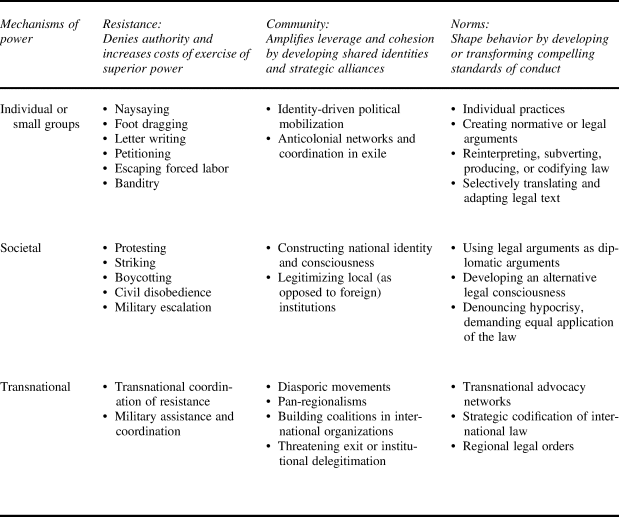
There is now a well-established recognition in the literature that international norms are often contested (in both law and political practice), and that weaker actors have some degree of agency in the norm life cycle. The argument presented here goes beyond the recognition of contestation to claim that the international order itself also results from the influence of those actors. To advance the still-incipient study of the influence of the weak, this section characterizes three mechanisms by which they shape the international order: (1) resistance, which denies authority and increases the costs of the exercise of power; (2) community, which amplifies leverage and cohesion by developing shared identities and strategic alliances; and (3) norms, which shape behavior by developing or transforming compelling standards of conduct.
These three mechanisms are not independent streams, but rather feed into each other and are often intertwined. Similarly, they might occur across different levels: individual, societal, or international. Although movements might begin at the individual/group level and grow to reach societal and then transnational levels, this linearity is not always present. As observed subsequently, the transnational sphere consistently produced and amplified the power of the weak and became itself a source of domestic influence. In what follows, these three mechanisms will be characterized and then applied to critical cases.
Resistance As Power
Resistance is a mechanism of power with potential for normative change. Beyond acting as a mere obstacle to superior power, it transforms norms, institutions, and political practices by raising the costs of hegemonic policies and constraining the options available to the most powerful. Resistance affects the broader international order in decentralized, but meaningful ways. Weak states and organized groups of individuals use it as a strategy in power political confrontation and to engage in the negotiation or renegotiation of international norms.
In practice, this process often involves popular rebellion; that is, the individual or collective refusal to accept or take orders in resistance to or disapproval of an authority. Rebellion may take many forms. From foot dragging and nay sayingFootnote 20 to letter writing and petitioning,Footnote 21 individual or small group rebellion rarely transforms international order directly, but increases the costs of dominant policies by questioning their morality or denying them efficiency.Footnote 22 Although no outcome is certain, when larger groups engage in coordinated action, consequences to challenged authorities may be severe.Footnote 23 Protests, strikes, and boycotts provoke instability on the societal level, causing uncertainty and fear that make domination more difficult. Large campaigns of civil disobedience, such as those that took place in India and South Africa, increased the costs of political domination and denied the exercise of political authority. Under oppression, subaltern actors read agency as actions that disrupt dominant political orders, which are understood as rebellious, irresponsible, or riotous by the dominant power.Footnote 24
By deliberately undermining stability, resistance provokes political failures, increases the costs of existing policies, and denies authority to others. For example, even at the peak of power disparity, empires struggled to firmly hold onto government when facing the combination of rebellion, dissidence, and domestic critiques of empire. By the early twentieth century, anticolonial movements in the Afro-Asian world had become mass movements able to exert substantial pressure on imperial powers. In the post-1945 period, popular rebellion constantly tested the resilience of colonial systems and raised the costs of their maintenance. Modern forms of political mobilization, including mass protests and strikes, were often responded to with great violence by colonial rulers, provoking a vicious cycle that increased the political and financial costs of empire and often escalated into large-scale conflict and the establishment of self-determination.Footnote 25
Community As Power
Weaker actors create coalitions, negotiate alliances, and act within international institution to influence international outcomes. By swarming, their dissatisfaction becomes more visible and the relative leverage of their positions in relation to great powers increases. As Wolfers explained, “the potential hostility of a large number of lesser countries, some of which may be allies or close friends, is a deprivation that any nation setting out to impose its will on a weaker country must take into consideration.”Footnote 26
Weaker powers mobilize mutual support within the peripheries and build community to increase political leverage and establish greater normative authority. The power of community entails a combination of building alliances in the classic sense with the construction of shared identities that can strengthen their bond and legitimize political claims. For example, it was to keep the European powers out of the continent that Monroeism became an accepted doctrine across the Americas.Footnote 27 Rejecting the European world order based on territorial stability, balance of power, dynastic legitimacy, and the repression of liberal values, the American republics offered an explicit normative alternative based on the possibility of popular sovereignty, self-determination, and non-intervention. Similarly, Pan-African movements engaged seriously with the cause of self-determination and helped to radically expand its scope beyond Woodrow Wilson's intentions. For example, the First Pan-African Congress organized by W.E.B. Du Bois and others was hosted in Paris and planned to coincide with the Versailles Peace Conference, an attempt to influence the colonial settlement. Marcus Garvey's Universal Negro Improvement Association (UNIA), represented by Haitian Elièzer Cadet, also went to Paris to speak up as the new international order was being designed.Footnote 28 Furthermore, for as long as the international order has been debated, pan-Islamic, pan-Asian, and pan-Arab political institutions have continued to offer influential visions for regional and international ordering that were critical parts of the global contestation to shape the world order.Footnote 29
Although such diplomatic strategies are typical of states, non-state actors may also engage in them, notably when political communities are not sufficiently autonomous to participate formally in political processes. For example, Pan-African participation in international conferences in the early twentieth century, a process driven by transnational activists and nongovernmental organizations in the continent and its diaspora, preceded modern African states.Footnote 30 These transnational networks laid the foundation for postcolonial cooperation among diverse groups in the United Nations and during the Cold War. In the United Nations, postcolonial states took advantage of their increasing numbers to build coalitions that could reshape international law and advance decolonization.Footnote 31 As postcolonial states started to play a more active role in international organizations, they worked to shift norms and working procedures to reflect their world view and interests. To that end, they typically specialized and focused on a few specific priorities in a strategy of niche diplomacy.
Norms As Power
Norms are, with institutions, pillars of international order, and as such have been widely debated in IR scholarship. For our purposes, it is enough to say they affect decision making regardless of one's power because actors are impelled to justify their actions on normative grounds that transcend their national interests.Footnote 32 This shapes arguments and debates,Footnote 33 and constrains actors to frame their behavior around international norms.Footnote 34 Once rules are established, the decision to break them, although possible, becomes politically costlier.
Weaker actors use normative and legal arguments as instruments of power to achieve individual political objectives such as constraining the most powerful, enhancing one's own status, or creating, adjusting, or completely transforming international norms. Although legal strategies were initially conceived to cope with a body of positive international law biased toward the powerful, they evolved to become versatile instruments used by many to shape the international order. The late nineteenth century saw the emergence of a transnational network of lawyers seeking to regulate power politics through the codification of an international law that was not just a reflection of diplomatic practice, but that also had its own distinct language, procedures, and moral values.Footnote 35 Once that technical language was established, it became easier for politicians, diplomats, and international lawyers in smaller states and outside of Europe to appropriate and transform that originally Eurocentric law. International legal texts were not just translated, but were also reinterpreted and adapted to suit those in the lower ranks of the world hierarchy.Footnote 36 Once their positions in global professional networks were established, peripheral diplomats and jurists were able to interpret, subvert, produce, and codify international law in ways that suited their perspectives and interests.Footnote 37
Weaker actors seek protection in international law and emphasize that it is to be applied to all regardless of rank and power. By denouncing the hypocrisy of universalist orders that differentiate among its subjects, norms-politics was central for weak actors to increase political autonomy and shape the international order. The formal and universal multilateral system, with its egalitarian procedural rules and environment conducive to coalition politics, became the ideal environment for the rule-making efforts of small and medium powers.
Table 1 synthesizes the mechanisms described and associates them with strategies used by weak actors to shape the international order at different levels of analysis and political engagement.
Mechanisms of counterhegemonic power by level of political engagement

Tracing the Co-Constitution of International Order
This article identifies and analyzes critical instances in which relatively weak actors unequivocally shaped core universal norms (the highest possible threshold of influence) in the so-called “Liberal International Order.” It explains their strategies and argues that those often considered “rule-takers” had a substantive role in shaping the contemporary world order. Relatively weak actors include individuals operating in transnational networks, nationalist movements, and small states, who developed strategies to participate, from their own standpoints and power, in shaping the ground rules of international relations. Their strategies involved mobilizing the alternative sources of power described—resistance, community, and norms—to withstand hierarchy, enhance their status, and transform international norms to fit their world views and interests.
This article analyzes four core international norms upon which the world order is based: (1) the universal right to self-determination, (2) the basic rule of non-intervention and peaceful settlement of disputes, (3) the prohibition and regulation of the use of military force, and (4) the sovereign equality of states. Together, they compose the normative infrastructure of international order; that is, the set of standards of conduct that serves as the foundation upon which other norms, institutions, and international relations are built upon. These norms are qualitatively different from others: they have an existential impact on all states and, considered together, determine the ground rules of international relations and the precise limits of sovereign statehood.Footnote 38
In their introduction to this special issue, the editors lay out important differences and tensions between liberal and Westphalian international orders.Footnote 39 The fundamental norms described previously are often associated with a “Westphalian” order, but this normative infrastructure was never really in place until after 1945, co-constituted with the Liberal International Order (and therefore also a part of it). Although arguments about sovereign equality and non-interference were made in early modern legal doctrine by international layers such as Vattel, these were not at all reflected in state practice, not even in Europe, and therefore did not exist outside of tentative legal discourse. Even then, sovereign equality and self-determination were conditional on great power balance and interests. International law provided little protection from intervention, as the system relied on it for enforcement and dispute settlement in a decentralized, self-help legal system that provoked the disappearance of numerous sovereign states well into the nineteenth century.Footnote 40 In contrast, the order of 1945 was founded on principles of universal, formally equal, participation under the rule of law. Although it did not immediately encompass the entire world, leaving aside colonized territories, the order was built on earlier efforts to establish objective criteria for statehood,Footnote 41 and on gradually constructed legal arguments around sovereignty and self-determination.
The cases that will be discussed demonstrate that the Liberal International Order is not a coherent set of norms developed by industrialized democratic states, and then adopted or resisted by others. In practice, the international order is continuously negotiated in a decentralized way, with various “liberal,” “Westphalian,” and other principles coexisting in permanent tension. These contradictions have long been present in both domestic politics and IR. The refusal of the United States to ratify the Convention on the Rights of the Child on sovereignty grounds, the ambiguous relationship that African states have with the International Criminal Court (ICC), and the political weaponization of the status of refugees worldwide are all reflections of tension between aspirational liberal standards and sovereignty that precede the current crisis. Embedded liberalism itself is a recognition of the need for an escape clause from the liberal order, and a prescription of caution regarding “Westphalian” principles in relation to liberal ones.Footnote 42
What follows also explains that although the actions of less powerful, developing states are often assumed to dilute liberal principles in favor of “Westphalian” ones, this has not actually been the case. In a mid-twentieth-century world in which liberalism was as democratic as it was imperial,Footnote 43 the contributions of postcolonial Latin American, African, and Asian states made the global order more, not less, liberal. These actors actively contributed to the establishment of a universal rule of international law, and of multilateralism, to the emergence of core aspects of international humanitarian and human rights law, including the fundamental equality of peoples, which are all foundational pillars of the Liberal International Order in its political dimension.Footnote 44 This section offers a necessarily concise characterization of these processes, which when they are combined, compose the anatomy of a co-constitution of international order, a process in which African, Asian, and Latin American actors contributed decisively to the outcome.
Norms and Community in the Principles of Non-Intervention and Peaceful Dispute Settlement
The use of armed intervention to settle disputes was central to international order until well into the twentieth century. In that self-help system, foreign coercive intervention to protect citizens or financial or commercial interests was legal and frequently invoked by great powers to maintain advantages abroad. It was a right codified in Eurocentric international law,Footnote 45 which enabled the repression of internal rebellion, the collection of public and private debt, and the forced opening of markets abroad.Footnote 46
The coercive collection of debt deeply affected nineteenth-century Latin American states because their postcolonial economies were dependent on foreign credit, and their societies were subject to political instability. Aware of that vulnerability, their jurists and diplomats coordinated a campaign, using the alternative powers of norms and community, to narrow the space for armed intervention in the international order during the 1907 Hague Conference. Building on the work of Carlos Calvo decades before, Argentine Foreign Minister Luis Drago led a group of small states in a movement to prohibit coercive intervention for the collection of debt and force great powers to engage in arbitration mechanisms. Drago emphasized the full sovereign authority of the weak to argue they had the right and autonomy to issue public debt and that its coercive collection was a violation of those rights. The risk to lenders, he claimed, had already been considered and calculated before the offering of credit, as a part of the determination of how onerous its conditions would be.Footnote 47
Their strategy in the Hague confronted capital importing with exporting countries. After much contestation, the dispute ended in what came to be known as the Drago-Porter compromise: an acceptance of Drago's principle that creditors renounce the use of force for debt collection, but imposing compulsory arbitration mechanisms as an alternative to resolve disputes. Intervention would be legal only if debtors refused arbitration or its results.
Universal non-intervention norms were developed in the Americas in the nineteenth and twentieth centuries as a response to first European and then US intrusion. Following decades of discussion, the 1933 Pan-American Convention in Montevideo codified the rule of non-intervention: “No state has the right to intervene in the internal or external affairs of another.” This simple formulation was influential in the compromise that allowed the creation of the United Nations and was reaffirmed in subsequent General Assembly resolutions. These decisions helped to delegitimize coercive intervention to settle international disputes, notably economic ones. The newly constituted norms narrowed the political options of great powers and fed into a broader movement for the peaceful settlement of disputes through arbitration and the prohibition of war.
Norms and Resistance in Restricting the Use of Force
Up until the late nineteenth century, the conduct of war was a legal instrument of policy, used to address international disputes. The delegitimization of war was a gradual and multifaceted process, and the advocacy of private organizations, the social traumas of major conflicts, the growing skepticism about the political benefits of war, and the desire to maintain the political status quo have all contributed to its regulation and later prohibition. Great powers contributed to this process: their desire to avoid the human and financial costs of war while maintaining power and political superiority has motivated collective security since the early twentieth century.
For small powers, the regulation of warfare can have existential motivations. Referring to crimes of aggression, Sellars explains that “the most consistent advocates of strong measures have been the small and insecure states, which, as well as looking to international law for protection against the vicissitudes of international life, have sought to wrest control over the determination of aggression from political institutions by proposing automatic methods for its identification.”Footnote 48 The prohibition of war enabled small and more vulnerable states to survive and prosper, often leading (because of their fragility) to persistent internal conflict.Footnote 49
Relatively weak actors helped to shape the laws of war that serve as a pillar of the international order. The movement spearheaded by the ICRC, which was initially a small private organization, advocated, designed, implemented, and monitored increasingly strict rules on the use of military force. Their role in international humanitarian law is almost indistinguishable from the law itself. Because of their relative size and fragility, small states have been early adopters and proponents of regulations regarding the use of force.
Although these norms were established to be universal, in practice there were two parallel legal standards: one applicable to wars between white, so-called “civilized” states, and another that applied to conflicts that involved other populations. A 1914 British manual of military law clarified that “the rules of international law apply only to warfare between civilized nations, where both parties undertake them and are prepared to carry them out. They do not apply in wars with uncivilized States and tribes.”Footnote 50 This distinction remained prevalent in practice for decades, and elements of it remain to the present day. Additionally, great powers also argued that armed repression in protectorates or colonies was outside of the domains of international law because they were internal, not external, disruptions of order.
The establishment of a universal law of armed conflict was a process in which small states and anticolonial movements were protagonists. During revolts, popular movements used the normative strategy of exposing the inconsistent application of law and gaps between imperial discourse and colonial practices to delegitimize empire. For example, rebels fighting Spanish and French forces in the Rif War (1920–27) formally requested the humanitarian support of the Red Cross.Footnote 51 These strategies were particularly relevant in the Algerian War of Independence (1954–62), when the National Liberation Front (FLN) sought to redefine both its own status and standards of behavior in warfare. The group, which saw itself as the vanguard of the global anticolonial struggle, strengthened its legitimacy by deliberately committing itself to laws of armed conflict that the French refused to abide to in the context of colonial wars.
The views of anticolonial movements were incorporated into international humanitarian law through the 1977 Additional Protocols to the Geneva Conventions. The law had to confront the context of colonial wars and was forced to reconsider its definitions of combatant and civilian, expanding the protection of those seeking self-determination. As a result of these interventions, the Additional Protocols incorporated elements that helped to create the actually universal jus in bello of today. For example, it formally recognized its applicability to conflicts “in which people are fighting against colonial domination and alien occupation and against racist regimes in the exercise of the right to self-determination,” argued to be a form of just war. The Protocols also codify the principle of distinction, seeking to protect civilians against hostilities more strictly and to incorporate into the law the forms of armed resistance typically used in anticolonial struggles.Footnote 52
Normative Strategies and the Principle of Sovereign Equality
Contending perspectives about the extent to which international power hierarchies were to be crystallized and legalized in institutions were already prevalent in the nineteenth century: European congresses were hierarchically organized (with formal status differentiation among parties) and those in the Americas were based on the formal equality of states. The 1907 Second Hague Conference, the first “global” conference of its kind, contrasted the two views during a dispute over the institutional design of a proposed mandatory Permanent Court of Justice. The positions of small and great powers were, respectively, that the composition of the court should be equal (as in reciprocal treaties), or unequal, to the benefit of the effectiveness produced and the special rights for great powers.Footnote 53 On that occasion, the fierce debate went unresolved and, as a result, the compulsory court was never established. This outcome was against the intentions of the United States, and the British delegate was so dissatisfied that he pondered a complete withdrawal from international institutions.Footnote 54
Because of their earlier decolonization, Latin American states were the first to use normative and legal strategies to address the issue of equal treatment under international law. As sovereigns frequently treated unequally, they emphasized the now prevailing logic of universal and equal participation in international rulemaking. For them, “universal participation was a logical corollary to sovereign equality … Sovereigns, recognizing no higher authority, are juridically equal under international law.”Footnote 55 Thus, the inter-American system, then still in the absence of a hegemon, was a fertile ground for the view that sovereign equality and perfect reciprocity must be the cornerstones of the international order.
Discussions over the role of sovereign equal statehood were systematically held in the inter-American system throughout the first decades of the twentieth century, and sovereign equal statehood was ultimately established as a principle in the 1933 Montevideo Convention on the Rights and Duties of States. The convention adopted a concept of statehood that excluded any qualifiers that could be used to limit sovereignty, such as race, form of government, or relationship to Western states. These ideas, which had emerged from postcolonial problems, sensibilities, and thinking, became recognizable legal arguments and gained strength with Latin American influence in international institutions.Footnote 56
The Montevideo Convention was a critical precedent to the United Nations Charter. Aware of the importance of these principles to his relationship with the region, President Franklin Delano Roosevelt and his close associates insisted in Dumbarton Oaks that the issue of equality was a central concern of the “American family of nations.”Footnote 57 They argued that the international order needed to balance hierarchy with elements of sovereign equality. The risk was losing support for the organization and, more concretely, failing to establish a new international organization at the conference in San Francisco.
However, the sovereign equality established in the charter referred only to recognized states and was, as such, applicable to only a portion of the world's polity. The trusteeship system established in the new organization, a continuation of colonial rule and the mandates system, implied a formal hierarchy of peoples: between those fit and those unfit for self-government and/or independence. In recognition of this fact, the General Assembly, under the leadership of postcolonial states, appropriated the principles and preamble of the charter to transform its practical meaning and undermine other forms of hierarchical differentiation, such as racial discrimination. Although other forms of hierarchy emerged over time, smaller and weaker parties delegitimized unequal arrangements for international legal relationships and political cooperation. Formal inequality still exists in various domains of international institutions and they are significant from the financial to the nuclear sectors. The exceptional (and still contested) rules of the United Nations Security Council are the most notable example. Yet, formal differentiation became rarer, and went from being an accepted legal norm to a highly exceptional arrangement. Although always in tension with the imperatives of power politics, sovereign equality became a cornerstone of the international legal order.
Community, Resistance, and Norms and the Right to Self-Determination
The right to self-determination is a central but complex organizing principle of international order. The term first entered mainstream international political discourse as a doctrine articulated by both Lenin and Wilson in the early twentieth century. Despite attempts by small powers in San Francisco, the United Nations Charter largely followed British plans to endorse the colonial system through a trusteeship system. It was only decades after San Francisco that self-determination was established as a right,Footnote 58 to a large extent against the preferences of dominant Western powers. One must recall that the United States (with colonial powers) did not vote in favor of the Declaration on the Granting of Independence to Colonial Countries and Peoples, critical to delegitimizing and dismantling the colonial order.Footnote 59 The establishment of a universal right to self-determination is closely associated with the process of decolonization, and involved all three strategies of the weak described previously.
First, the fabric of global anticolonial leadership was produced in the first half of the twentieth century, as a community forged in international conferences, as well as in prison and exile. One such instance was the 1927 gathering of leaders from thirty-seven colonies in Brussels, held to exchange strategies and debate the problems of the imperial order. These conferences included activists who would become influential in their national struggles, such as Sukarno (Indonesia), Nehru (India), Messali (Algeria), and Haya de la Torre (Peru)Footnote 60 and served a clear strategic purpose: to coordinate activities of resistance and increase public recognition to their causes.
Second, popular resistance forced empires to engage with self-determination demands. As rebellions, often coordinated transnationally, took place across the colonized world, great powers increased their use of violence. This produced a vicious cycle of revolt and repression that harmed the reputation of imperial projects in metropoles. To sustain colonial rule, imperial powers were caught in a difficult dilemma: every attempt in increasing governance on the annexed territories was interpreted as a form of control and a sign that occupation was not about to end, creating even greater opposition.Footnote 61 Although countries engaging in organized rebellion were not immediately successful, resistance raised the costs of, and gradually delegitimized, empire.
Third, recently decolonized states used their prerogatives as members of the United Nations to use legal norms to collectively undermine the remaining colonial institutions. As more postcolonial states joined the United Nations, the Trusteeship Council became a dedicated space to discuss (and demand) decolonization. The combination of international delegitimization with the practical difficulties of maintaining the colonial order locally increasingly weakened the colonial enterprise. This culminated in the approval in the General Assembly of the Declaration on the Granting of Independence of Colonial Countries and Peoples, a strong and influential resolution that sought to outlaw colonialism. By then, the pressure was so great that not even existing colonial empires at war to maintain their own colonies were able to vote against it. An internationally recognized right to self-determination drastically increased the political costs of empire, and introduced a drive for political change that deeply undermined the status quo. Liberation movements used it to legitimate their causes, increase the costs of foreign military occupation, and demand the participation of all racial groups in government.Footnote 62
Self-determination, a principle turned by anticolonial nationalists into a right and a program of political action, became an instigator for the broad objective of freedom from foreign domination. It was a profoundly destabilizing principle that could not be easily tamed.Footnote 63 By 1960, national self-determination became the only basis for legitimate political autonomy, and great powers lost much of their capacity to withhold recognition of undesired political units.
The normative transformations described were not the work of an enlightened hegemon. Some of their elements precede the emergence of the United States as a global superpower, and others emerged despite US preferences. Political thinkers and statespersons in great powers, notably the United States, often decided that their best self-interested strategy was to enhance the authority of international institutions; that is, to let themselves be tied to normative and institutional commitments. They did so because they believed that there were costs to governing foreign peoples and to having locals or smaller powers actively seeking to undermine their authority. Those costs are the result of policies intended to extract concessions from the most powerful and, on some occasions, simply to increase the costs of hegemony. To attribute the choice to avoid political resistance only to an enlightened hegemon, and not to those imposing costs on alternative hegemonic policies, is to tell only half the story.
The international order of today is very much a product of compromise and of negotiated and bargained solutions. Great powers were particularly effective in imposing their preferences on major postwar settlements, where hierarchies are more overt.Footnote 64 In these contexts, victors are clearly defined, and those who lost or did not contribute to wartime efforts inevitably became secondary players. In between these conflicts, however, small powers worked through incremental political influence to enhance their prerogatives and co-constitute global norms.
The centuries-long process of decolonization was the central engine behind the shape of the contemporary world order as one of sovereign equal nation-states. Postcolonial Latin American states played a critical role in establishing early norms about non-intervention and sovereign equality, and Afro-Asian anticolonial movements and postcolonial states were essential to norms about self-determination and to redefining sovereign equality and non-intervention in wider terms after 1950.
Weak powers are not inherently benign, and international order remains profoundly unequal, but if one considers the visions for order that great powers articulated as it was being constituted, it is clear that their desired norms would have been far more hierarchical than those currently in place. Specifically, self-determination would have been treated as a conditional principle, not a human right of all peoples under foreign domination. Although great powers do intervene against weak states today, this is exceptional and not understood to be a legitimate and legal mechanism to address disputes or to collect sovereign debt. Alternatively, armed interventions would be more frequent and violent if there were not such strong norms regarding their prohibition and regulation. Because there would be fewer boundaries to the exercise of power by the powerful, it would be more likely for weaker states to be under direct or indirect foreign domination. International institutions would be even more biased toward the powerful, as formal mechanisms of status differentiation would reflect power variation. In sum, the world order would not be composed of sovereign equal nation-states.
Considering the contemporary crisis of the Liberal International Order, these findings warrant a certain skepticism toward the prominence given to hegemony in the study of international relations. The general presumption that the powerful shape the order to their wishes, common to theories on hegemonic stability, liberal internationalism, and some of their postcolonial critiques, is not reflected in the process by which the most fundamental norms of the world order were established. The international order of today was not born out of hegemony, not because great powers did not want this to be so, but because they were unable to achieve it.
The Co-Constitution of Order and the Contemporary Crisis
Understanding international order as the syncretic product of a continuous political struggle involving great powers and weak actors alike has implications for our interpretation of the current crisis of the international liberal order. This article demonstrates that rather than being planned by “architects,” order is the result of innumerable instances of negotiation and contention among different actors, weak and strong, with their own visions of world order. Although it is tempting to see major movements such as the current crisis as decisive, the findings warrant caution on assumptions of their long-term impact.
From a global standpoint, the Liberal International Order was always filled with political tension and contradiction and the liberal promise limited by its association with empire and later with hegemony. Both empire and hegemony have been structurally in tension with liberal principles of equality and the rule of law, thereby making the Liberal International Order never fully in equilibrium.Footnote 65 As the editors stated in their introduction to this issue, scholars have neglected the biases and exclusive selectivity embedded in liberal hegemony.Footnote 66 Moreover, perceived exceptionalism and the imposition of liberal norms through illiberal means have repeatedly justified hegemonic abuse and violation of international norms.Footnote 67 Thus, it is concerning but unsurprising to observe hegemonic behavior that undermines or is destructive to core norms and institutions of the Liberal International Order today. Although earlier in this century the international order proved resilient to great power adventures, their recurrence and increasingly overt great power competition have gradually eroded the established legal order, and significantly damaged regional and global stability.
Understanding international order as being co-constituted normalizes the perceived disruption arising from the so-called “Global South” or “emerging powers.” Their views and acts of contestation have long been influential, as India, China, South Africa, and others have had an outsized impact on the international order. It is only recently, however, that their rise to quasi-great power status surfaced their policies within mainstream IR scholarship. The foundations of international order, embedded in the Unied Nations Charter and in international law, were developed in a decentralized way, meaning that its supporters have great reach and capillarity. Because it is founded on compromise, not imposition, the incentives are strong for various actors to maintain at least core elements of the current order. Although international order benefits from hegemonic investment in cooperation, its shape is not determined by the powerful. Furthermore, the cases mentioned previously show that hegemonic good citizenship lies not in a single-handed “sponsorship” of international order and public goods based on its own vision, and tied to domestic interests and volatility. Rather, it was most effective when it recognized diverging interests as legitimate and engaged in bargaining for imperfect arrangements that benefited peace and stability.
Although from an international standpoint the core of the international order remains relatively stable, if degraded, the same cannot be said about domestic liberal orders. What is truly novel in the contemporary crisis is the credible threat by authoritarian populists to domestic institutions within democracies worldwide. Extremist populisms damage international order by thriving on domestic instability, antagonizing foreigners and minorities, and driving countries away from well-established principles of international cooperation. As the editors pointed out in their introduction to this issue, the literature does not yet have the vocabulary and sufficient resources to interpret how fringe elements within societies may disproportionally influence the international order, or destabilize the social foundations upon which institutions rest.Footnote 68 Similarly, the varying capacities of democratic and law enforcement institutions across the world to effectively mediate internal conflict and address potential abuses of power will remain a critical open question about the future of the order that the scholarship is yet to systematically address.
Conclusion
Over the past decades, IR scholarship has been primarily concerned with the problems, strategies, and perspectives of the powerful. At least partially, this pattern is the result of a general conviction that international orders emerge from their actions and behavior. Although the most powerful, by definition, have more resources available to affect international outcomes, their capacity to actually do so is limited by other, often social, factors. The powerful never had a monopoly on power or control over international political outcomes. Because the discipline of IR was developed on the basis of an “anemic” understanding of power politics,Footnote 69 it has frequently underestimated the power of the weak in the inherently complex process of establishing global norms.
This article seeks primarily to destabilize these dominating premises. The hope is that demonstrating that nonpowerful actors were effective in shaping fundamental norms will enable new research on the extent to which “power” actually translates into rulemaking. A sharper understanding of counterhegemonic rulemaking has the potential to enhance the discipline's understanding of global norms, international regimes, and international order in general. Counterhegemonic forms of power and their strategic logic, tactical approaches, and ultimately effectiveness, are still unexplored areas in IR scholarship, and might unlock new avenues for understanding the world order. Inevitably, this project is also intended as a contribution to the reconstitution of IR as a more global discipline. Part of that process is to transcend disciplinary premises founded and disproportionally focused on the problems of the powerful. This approach opens important new avenues for research.
Although the United States has an outsized influence in world affairs, the literature has overestimated its role in shaping the international order. Domestic political debate about the ideal role of the United States in the world has, since the early twentieth century, permeated scholarly analyses on the Liberal International Order, helping to construct the assumption that order requires enlightened hegemons. These views have influenced policymakers, who work on the assumption that hegemons single-handedly shape order. As misguided uses of military force often remind us, the excess of self-confidence produced by the overestimation of one's own power can be highly destabilizing. Although great powers could always intervene, transform, and even destroy local and international orders, it has been far more difficult to reconstitute and shape those unilaterally, both domestically and internationally. As a discipline, we are yet to transcend the parochialism of hegemony.Footnote 70
A renewed understanding of the rulemaking potential of the relatively weak might help to interpret the making of international order as a global political process. The literature continues to be, with few exceptions, inattentive to contributions to global norms emerging from outside the centers of power, which have not halted. Although postcolonial states were particularly active in trying to shape order, major transformations are still ongoing. For example, Latin American states have continued to push the boundaries of international law when it comes to the trial of heads of states for crimes against humanity. The African Union, a pan-African organization, is at the vanguard of transformations in norms about the use of force and foreign intervention in relation to humanitarian crises and nonconstitutional changes of government.
Although norms have been a major preoccupation of the scholarship on IR and this journal, the literature is still lacking in its capacity to surface and interpret more complex, interactive forms of normative change. This article has shown that it was actually by appropriation, not diffusion, that the most substantive global expansion of rights took place. Rights to self-determination, racial equality, the peaceful settlement of disputes, and others, were established globally once they were demanded and obtained, often through the universalization of the nation-state. By insisting on their own inclusion in domains from which they were previously excluded, the powerless created those rights in their current and universal form.
Yet, attempts to reconstitute IR as a global discipline should be mindful of the risks associated with a single narrative of historical change. Weak actors are not inherently benign, and in many cases the same norms and legal arguments described are mobilized in ways that enable free riding or damage the order itself. “Non-Western” or “Global IR” theoretical approaches have been closely associated with the perspectives and potential of emerging powers in a renewed Asia-centric world. In many ways, it is still a story about the powerful shaping order, only in a new power dynamic. As this agenda evolves, critical scrutiny should ensure that we are not simply substituting the myth of Westphalia with the myth of Bandung and thereby creating as many analytical blind spots as Eurocentric visions of order have done in the past.
Interpreting international order as being co-constituted sheds light on the fact that normative contestation among diverging perspectives is not something to be feared, but a long-standing fact of world politics. Indeed, the fundamental norms of international order, including core human rights, have emerged because, not in spite, of it.
Acknowledgments
I thank David Lake, Lisa Martin, Thomas Risse, Erik Voeten, Tom Biersteker, the anonymous reviewers, and participants in the IO@75 workshops for the thoughtful engagement with this argument.