
I. INTRODUCTION
As an important part of microcircuits, the electronic packaging material mainly provides mechanical support for fine-scale electronic circuits, and is treated as a conductive connection medium, which plays a key role for the stability of devices. Reference Zhang, Wu, Jiang and Chen1–Reference Cai, Wang, Zhang, Peng, Feng and Wang3 Ideal thermal management materials usually possess a low coefficient of thermal expansion (CTE) of 7–9 × 10⁻⁶ K−1, a high thermal conductivity (TC) of >100 W/m·K, and a low density of <3 g·cm−3, which is of importance especially for transport applications. Reference Hogg, Lambourne, Ogilvy and Grant4,Reference Chien, Lee, Lin and Jahn5 It is well known that the densities of Al–Si binary alloys range from 2.3 to 2.7 g/cm3, depending on the Si content. Reference Jacobson, Ogilvy and Leatham6 In this binary-alloy system, Al possesses a high TC (238 W/m·K at room temperature) and Si exhibits a low CTE (2.6 × 10⁻⁶/K at room temperature). Therefore, an adjustment of the Si content in Si-rich Al–Si binary alloys (Siwt% ≥ 50%) to approach a high TC, and a low CTE that can be matched with GaAs alloy or Si is very attractive for thermal management applications. Reference Rao, Rao, Deshmukh, Shah and Kashyap7–Reference Li, Zuo, Zhang and Liu10
Previous studies have found that the microstructure of Si-rich Al–Si alloys prepared by conventional casting is mainly composed of a thick, irregular, and multi-faceted primary Si phase. Reference Cao, Jia, Ma, Prashanth, Liu, Scudino, Huang, Eckert and Sun11,Reference Zhang, Gan and Yang12 This primary Si phase has a size in the millimeter range, and exhibits a significant anisotropy. Such a microstructure can negatively influence the mechanical and physical properties, as well as the mechanical processing properties of the alloys. Reference Zhu, Wang, Peng, Liu and Peng13–Reference Yu, Feng, Li and Gong15 Furthermore, the sizes of the frameworks of electronic packaging components are already in the range of 1–5 mm. Due to the large size, the Si phase in the Si-rich Al–Si alloys prepared by casting methods would possibly precipitate, and may occupy the whole cross section of the components. This can result in an extreme difficulty for machining the surface of the components containing such large Si particles because the Si phase tends to crack along preferred crystallographic orientation. Reference Yu, Feng, Li and Gong15 Additionally, the CTE of the alloy is significantly deteriorated by the presence of large Si particles. Reference Chien, Lee, Lin and Jahn5 Accordingly, it is essential to modify the microstructure of Al–Si alloys to optimize the morphology and distribution of the primary Si phase.
A large amount of work on the modification of the primary Si phase has been performed for Al–Si alloys with high Si content (Siwt% ≥ 50%) by spray deposition and casting. Reference Hogg, Lambourne, Ogilvy and Grant4,Reference Wang, Xiong, Zhang, Zhu, Liu and We16–Reference Dai and Liu19 Hogg et al. Reference Hogg, Lambourne, Ogilvy and Grant4 reported that the morphology of the primary Si phase in the Si–30Al alloy could be modified from a coarse flake shape to a continuous network shape using spray deposition technology. Our previous work found that rapid quenching through spray deposition could cause the primary Si phase in the Al–50Si alloy to be modified from a coarse platelet morphology to a fine irregularly blocky shape, Reference Jia, Cao, Scudino, Ma, Li, Yu, Yu, Eckert and Sun18 which further causes a decrease of the CTE in the Al–50Si alloy. Liu at al. Reference Dai and Liu19 investigated the modification of cast Al–50Si alloys with a Si–20P master alloy, which led to the formation of the primary Si phase with a size of 30 μm. However, so far, little attention has been paid to the coupled effects of spray deposition and modifier additions on the primary Si phase formation in Al–Si alloys with high Si content.
Therefore, in this study, the effects of the cooling rate and a P modifier on the size and morphology of the primary Si phase obtained by spray deposition and casting for an Al–50Si alloy are investigated. The influences of the microstructure of the primary Si phase as well as the densification of the alloy on the TC behavior are studied.
II. EXPERIMENTAL PROCEDURES
Al–50Si and Al–50Si–0.5P alloys (wt%, nominal composition) were prepared using pure aluminum (99.95% purity), silicon (99.97% purity), and an Al–4.5 wt% P master alloy by casting and spray deposition, respectively. The as-cast alloy was melted in a MgO crucible using a 25 kW medium-frequency induction furnace at 1615 ± 20 K. The melt was degassed with high purity argon gas for 10 min using a graphite degasser before pouring. The permanent mold was preheated to 523 K before casting. The surface of the melt was skimmed, and then the melt was poured into a copper mold with dimensions 100 × 70 × 11 mm. The deposited alloy was atomized by nitrogen gas at 1573–1673 K, and then spray deposited on a cylindrical aluminum substrate. The distance between the atomizing nozzle and the substrate was kept constant at 500 mm. The atomization pressure was set at 1.5 MPa. After the spray deposition, the samples were hot isostatically pressed (HIP) for 6 h under an argon atmosphere at 843 K at a pressure of 120 MPa. The microstructure of the alloy was investigated by scanning electron microscopy (SEM) in a Gemini 1530 microscope equipped with an energy dispersive spectrometer (EDS). The SEM samples were mechanically ground to 1 μm diamond paper, and then etched in a 0.5% HF solution for 20–30 s. The samples used for deep corrosion were prepared with the same method, but etched in a 20% HF solution for 60–80 min. The phases were characterized using a Rigaku D/max-RB X-ray diffractometer (XRD; Rigaku Corporation, Tokyo, Japan) with monochromatic Co-Kα radiation.
The relationship between TC and thermal diffusivity, specific heat capacity, and density is given by the following equation Reference Sastry, Froyen, Vleugels, Bentefour and Glorieux20 :
 $$\lambda = \alpha {C_{\rm{p}}}\rho \quad ,$$
where λ is TC, α is the thermal diffusivity (mm2/s), C p is the specific heat capacity (J/g/K), and ρ is the density (g/cm3).
The thermal diffusivity (α) of the samples was measured at temperatures of 298, 373, 473, 573, and 673 K by a NETZSCH LFA 427 laser flash tester (NETZSCH Company, Selb, Germany) at a heating rate of 5 K/min under argon atmosphere; each sample was repetitively measured three times at each temperature to obtain average values. The specific heat capacity (C p) of the samples was measured by a Simultaneous Thermal Analysis system (Setsys Evolution). The density was calculated from the density measured at 298 K by weighing the sample in rectified and dried toluene and from respective values of thermal expansion data by the relation Reference Rudajevová21 :
 $$\rho = {\rho _0}{\left( {1 + {{\Delta l} \over {{l_0}}}} \right)^{ - 3}}\quad ,$$
where Δl/l 0 is the relative elongation of the alloy. The linear thermal expansion was measured in an Ar atmosphere using a NETZSCH DIL 402C dilatometer. Reference Rudajevová21
III. RESULTS AND DISCUSSION
A. Microstructural observation
Figure 1 shows the microstructure of the as-cast Al–50Si and Al–50Si–0.5P alloys. As illustrated in Fig. 1(a), the primary Si phase exhibits a plate-like morphology with an average length size of 223 ± 2.5 μm and an average width size of 46 ± 1.3 μm (aspect ratio of 4.8), which is heterogeneously distributed in the matrix of the Al–50Si alloy. The microstructure of the Al–50Si–0.5P alloy is shown in Fig. 1(b). The primary Si phase exhibits a blocky shape with an average length size of 37.5 ± 1.8 μm and an average width size of 25.0 ± 1.1 μm (aspect ratio of 1.5). In addition, the distribution of primary Si phase in the Al matrix is uniform. It is obvious that the addition of the P refiner into the Al–50Si melt can effectively refine the primary Si phase, and further improve the microstructural uniformity. An AlP phase can easily precipitate due to addition Al–4.5 wt% P master alloy in the melt. Both the crystal structure and lattice parameter of the AlP phase (cubic structure, a = 5.45 Å) are similar to those of the Si phase (cubic structure, a = 5.431 Å). The lattice disregistry between the primary Si phase and the AlP phase is calculated to be less than 0.4%. Reference Zhang, Liu and Dai23,Reference Zuo, Zhao, Teng, Geng and Zhang24 Therefore, the AlP phase can act as effective heterogeneous nucleation sites for the primary Si phase. The Si atoms can be included in the precipitation of the AlP phase due to the relatively smooth surfaces of the AlP phase. Reference Zuo, Zhao, Teng, Geng and Zhang24,Reference Kobayashi and Hogan25 In this case, crystal growth through the aggregation of the Si atoms on the surfaces of these pre-formed primary Si phase is avoided according to the twin plane reentrant edge (TPRE) mechanism during the growth stage. Reference Zuo, Zhao, Teng, Geng and Zhang24–Reference Wang, Lu and Hogan26 Hence, refinement of the primary Si phase in the Al–50Si alloy can be achieved. However, the AlP phase is difficult to be observed in the SEM because it dissolves into water when the SEM samples are prepared according to the reaction:
 $${\rm{AlP}} + 3{{\rm{H}}_2}{\rm{O}} \to {\rm{Al}}{\left( {{\rm{OH}}} \right)_3} + {\rm{P}}{{\rm{H}}_3} \uparrow \quad .$$
Microstructure of the hypereutectic Al-high Si alloys prepared by casting. (a) Al–50Si alloy, (b) Al–50Si–0.5P alloy.

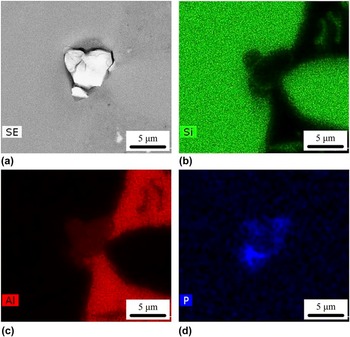
To observe the AlP phase, the refined alloy was processed with alcohol. The backscattered electron image, shown in Fig. 2, shows that the particle is rich in Al and P, which can be identified as the AlP phase according to the elemental scanning measurements presented in Figs. 2(b)–2(d).
(a) The backscattered electron image of refined alloy and the corresponding EDX images for (b) Si, (c) Al, and (d) P.

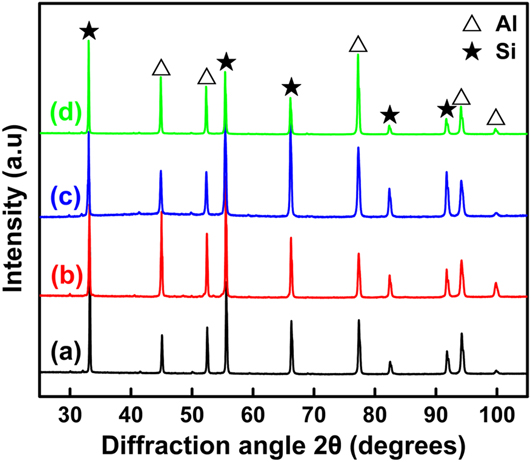
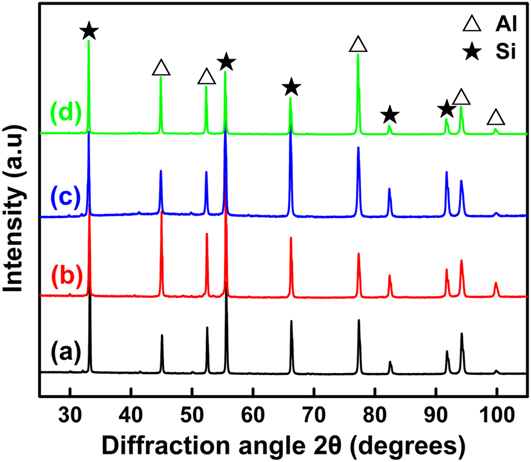
Curve (a) in Fig. 3 shows the XRD pattern of the as-cast Al–50Si alloy, in which all diffraction peaks are attributed to the α-Al or β-Si phases. Curve (b) in Fig. 2 shows the XRD pattern of the as-cast Al–50Si–0.5P alloy, which also exhibits the α-Al or β-Si phase without the P compound due to a relatively low content of P in the alloy.
XRD patterns of the hypereutectic Al-high Si alloys produced by different techniques: (a) cast Al–50Si alloy, (b) cast Al–50Si–0.5P alloy, (c) spray-deposited Al–50Si alloy, (d) spray-deposited Al–50Si–0.5P alloy.
The microstructures of the Al–50Si and Al–50Si–0.5P alloy manufactured by the spray deposition are shown in Fig. 4. The microstructure of the spray-deposited (SD) Al–50Si alloy [Fig. 4(a)] is composed of the primary Si phase and the Al matrix; no Al–Si eutectic is found. A large number of fine primary Si particles emerge in the semisolid droplets due to high cooling rate during atomization. Furthermore, a small amount of large size primary Si particles can also be observed, which undergo cracking and fracture during the deposited stage. The presence of such Si phase leads to an increase of the number density of nuclei in the SD material, which effectively inhibits the formation of eutectic Al–Si during deposition. Reference Dai and Liu22,Reference Grant27 In addition, a small amount of pores exists in the matrix, as marked by the arrows in Fig. 4(a), which has a negative effect on the TC. The presence of pores can be ascribed to the high solidification rate of the droplets, and the gas atomization. The shape of the primary Si phase is also irregular, and the size of the primary Si phase decreases to 12.5 ± 2.0 μm. Compared with that of the as-cast Al–50Si–0.5P alloy, the size of the primary Si for SD alloy is obviously refined due to the high cooling rate. Therefore, it can be inferred that the increase of the degree of undercooling causes the amount of favorable nucleation sites for the primary Si phase to be decreased, which is more dramatic than the AlP phase in providing nucleation sites. Meanwhile, the diffusion of the Si atom is restrained because of the short solidification time, which also results in the refinement of the primary Si phase.
Microstructure of the spray-deposited hypereutectic Al-high Si alloys. (a) and (b) Al–50Si alloy, (c) and (d) Al–50Si–0.5P alloy.

Figures 4(c) and 4(d) show the microstructure of the SD Al–50Si–0.5P alloy. A few Si particles precipitate in the matrix after the addition of the P refiner [Fig. 4(d)], which are believed to be associated with the Si atoms nucleating and growing from the AlP phase. The Si atoms are in the semisolid melt after the droplets have remelted. However, the primary Si phase is not coarsened due to the lack of Si atoms in the melt. The XRD patterns of the spray deposited Al–50Si and Al–50Si–0.5P alloys are given in Figs. 2(c) and 2(d). The structure of the deposited alloys also consists of Al and Si phases. There are no additional intermetallics or other compounds precipitating. However, the diffraction peaks from the Si phase in the deposited sample shift to lower angles as compared with those in the cast one, which suggests a supersaturation of Al in the Si lattice because a high degree of undercooling is achievable in the deposited alloy. Reference Dai and Liu22 Although the phase composition and the morphology of the primary Si phase are similar to those in the SD Al–50Si alloy, some fine Si particles can be found in the matrix, and the amount of the Si particles increases significantly from 103 ± 5 to 123 ± 8 per area, which cause the average size of the primary Si phase to decrease from 12.5 μm to 11.6 μm. Thus, the influence of the P refiner is indistinctive when the solidification is carried out at a high cooling rate.
Figure 5 shows the microstructures of the SD Al–50Si–0.5P alloy after HIP at 843 K. The phase composition after HIP is the same as in the SD alloy. The average size of the primary Si phase increases slightly from 11.6 μm to 13.0 μm, and the relative density increases after HIP. Furthermore, it can be seen that the sharp corners of the primary Si become rounded after HIP processing, which will be beneficial for improving the properties of the alloy.
Microstructure of the spray-deposited Al–50Si–0.5P alloy after HIP treatment at 843 K.

B. Thermal conductivity
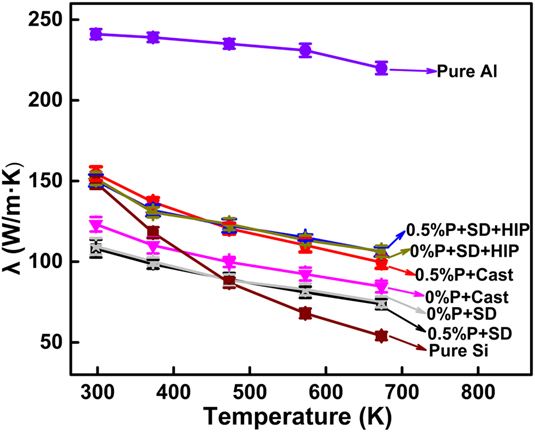
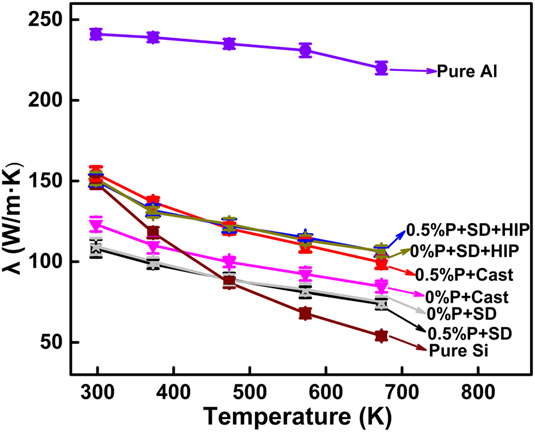
The TC of the Al–50Si alloy prepared by different methods as a function of temperature is shown in Fig. 6. The TC of the alloys decrease with increasing temperature. In a hypereutectic Al-high Si alloy, usually, the electronic heat transfer via the Al matrix and the phonon heat transfer via the Si phase are believed to dominate the TC of the alloy. Increasing temperature can improve the resistance of the alloy, and causes the electronic and phononic heat transfer to be hindered, which results in a TC decrease of the alloy. The TC of the P refined alloy is always higher than the values of the corresponding unrefined alloy. The TC value for the cast Al–50Si–0.5P alloy is 155 W/m·K, which is about 25.4% higher than the value of the cast Al–50Si alloy at room temperature. This is in contrast to previous reports that the refinement of the second phase particles leads to a decrease in TC. Reference Chien, Lee, Lin and Jahn5,Reference Okumus, Aslan, Karslioglu, Gultekin and Akbulut28 Previous work has reported that the volume fraction of the interfaces between the secondary phase and the matrix in the alloy increased with refining the primary Si phase, which could enhance the scattering of electrons and phonons during the heat transfer. Reference Chihiro29,Reference Molina, Narciso, Weber, Mortensen and Louis30 Therefore, the TCs of all alloys decrease with refining the primary Si phase. Figure 7 displays the morphologies of the as-cast Al–50Si and Al–50Si–0.5P alloys after a deep corrosion. As shown in Fig. 7(a), the Al matrix is divided into several discrete areas by the large plate-like primary Si phase. This separation can seriously hinder the electronic heat transfer in the Al matrix. Accordingly, the TC of the unrefined alloy is low. On the other hand, after the P refinement, the Al matrix becomes continuous, and the primary Si phase is uniformly distributed in the Al matrix, as illustrated in Fig. 7(b). Although the increase of the volume fraction of interfaces causes disadvantages in the improvement of the TC, the segmentation of the Al matrix more seriously influences the TC compared to the as-cast Al–50Si alloy. Therefore, the TC of the as-cast Al–50Si–0.5P alloy is higher.
TCs of the alloys prepared by different methods.
Morphologies of the as-cast alloys after deep corrosion. (a) Al–50Si alloy, (b) Al–50Si–0.5P alloy.

The TC values of the SD and HIP alloys are also shown in Fig. 6, which indicates that the TC value of the unrefined SD alloy are almost the same to the value of the refined SD alloy due to the similarity of microstructure. However, compared with the unrefined as-cast alloy, the TC value of the SD alloy obviously decreases. The decrease in the TC value can be ascribed to the presence of pores (Fig. 4) because the TC of the pores dramatically decreases to be zero. Reference Chien, Lee, Lin and Jahn5,Reference Sastry, Froyen, Vleugels, Bentefour and Glorieux20,Reference Abdullah, Daud, Harun and Shamsudin31 The pores can be treated as insulating particles. Therefore, the SD Al–50Si–0.5P alloy is believed to be composed of Al–50Si–0.5P and insulating particles. The effects of the porosity on the TC value of the SD Al–50Si–0.5P alloy can be quantitatively calculated by the following equation Reference Pitchumani, Liaw, Yao, Hsu and Jeong32,Reference Molina, Prieto, Narciso and Louis33 :
 $$\sum\limits_i {{{{\lambda _i} - \lambda } \over {{\lambda _i} + 2\lambda }}} {\theta _i} = 0\quad ,$$
where λ i is the TC value of the i phase, and θ i is the volume fraction of the i phase.
In the present study, the Al–50Si–0.5P alloy is considered as one phase (i = 1), and the pores as second phase (i = 2). Then, Eq. (4) can be rewritten as:
 $${{{\lambda _1} - \lambda } \over {{\lambda _1} + 2\lambda }}(1 - \theta ) + {{{\lambda _2} - \lambda } \over {{\lambda _2} + 2\lambda }}\theta = 0\quad .$$
Since the λ2 value approximately equals zero, Eq. (5) can be rewritten as:
 $$\lambda = {\lambda _1}\left( {1 - 1.5\theta } \right)\quad .$$
The porosity of the SD Al–50Si–0.5P alloy is about 9.9%, which indicates a 14.9% TC reduction according to Eq. (5). Furthermore, the presence of the insulating particles increases the number of interfacial barriers in the alloy, which renders scattering of electrons and phonons more serious compared to the as-cast alloy. As such, the TC value of the SD alloy is reduced. After the HIP treatment, the pores are virtually absent. In this case, the TC value of HIP treated alloy is higher than the value of the SD alloy. The TC values are similar between the unrefined HIP alloy and the refined HIP alloy.
It is interesting that the TC of the HIP alloys are lower at low temperatures and higher at high temperatures compared with the as-cast Al–50Si–0.5P alloy. At low temperatures, the average size of the primary Si phase in the HIP alloys are much smaller than that of the as-cast Al–50Si–0.5P alloy, which indicates that a larger volume fraction of interfaces is introduced into the HIP alloys, leading to strong scattering of electrons and phonons, as well as short electron mean free path. As a result, the TC value of the HIP alloys are lower than the value of the as-cast Al–50Si–0.5P alloy. The TC value of the HIP alloys show a sluggish declining trend with increasing temperature, as compared with the value of the as-cast Al–50Si–0.5P alloy. As shown in Fig. 6, it is found that the TC value of the Si phase is more sensitive to the temperature than that of the Al phase. The Al atoms can dissolve into the primary Si phase during the spray deposition due to the high cooling rate, Reference Jia, Cao, Scudino, Ma, Li, Yu, Yu, Eckert and Sun18 causing that the heat transfer medium of the Si phase is changed from phonons to a mixture of electronic and phononic contributions. The change of the heat transfer medium is the reason causing that the TC value for the HIP alloys decrease slowly with increasing temperature because the solid solubility of Al in Si is higher than in the as-cast Al–50Si–0.5P alloy.
IV. CONCLUSIONS
In the present study, the correlation between the microstructures and the TC of the hypereutectic Al-high Si alloy is investigated. The coarse Si phase, as a kind of harmful phase, in the Al–50Si alloy is successfully refined by the addition of the P refiner upon casting. The TC of the specimens after the addition of the P refiner is obviously enhanced in the Al–50Si alloy. However, the effect of the P refiner is not obvious at a high cooling rate based on the experimental results from the SD alloy. The TC value of the SD alloy is lower than the value of the corresponding cast alloy due to the presence of pores. Some Al atoms can dissolve in the primary Si phase during spray deposition, which causes that the TC value of the HIP alloys are higher at high temperatures, as compared with the value of the as-cast Al–50Si–0.5P alloy.
ACKNOWLEDGMENTS
This project was supported by the National Key Research and Development Program (2016YFB0700203), the Youth Teacher Development Program of Shanghai Universities (Grant No. ZZGCD15100), and the National Natural Science Foundation of China (Grant No. 51375110).