Introduction
The order Diptera comprises numerous families, such as Tephritidae, which includes economically important insect pests. Insects of the family Tephritidae are also known as fruit flies and include 4300 defined species from approximately 500 genera worldwide (White, Reference White2006). The damage caused by fruit flies is exacerbated by two major factors: wide host range and high fecundity rate (Clarke et al., Reference Clarke, Armstrong, Carmichael, Milne, Raghu, Roderick and Yeates2005; Rwomushana et al., Reference Rwomushana, Ekesi, Gordon and Ogol2008; Yee and Goughnour, Reference Yee and Goughnour2008; Schutze et al., Reference Schutze, Mahmood, Pavasovic, Bo, Newman, Clarke, Krosch and Cameron2015a). However, insect performance is influenced by a number of ecological factors, i.e., which plants are present in the environment, their accessibility and a plant's intrinsic value for insect development and survival (Fahrig and Paloheimo, Reference Fahrig and Paloheimo1988; Kuussaari et al., Reference Kuussaari, Singer and Hanski2000). The polyphagous species of tephritidae family offer different case histories of successful invasions; for example, Ceratitis catoirii, C. rosa and C. capitata, Bactrocera zonata and B. dorsalis can survive on a longer range of host plants than that of the oligophagous species, e.g., Zeugodacus cucurbitae, Dacus demmerezi and Neoceratitis cyanescens (Clarke et al., Reference Clarke, Armstrong, Carmichael, Milne, Raghu, Roderick and Yeates2005; Hafsi et al., Reference Hafsi, Facon, Ravigné, Chiroleu, Quilici, Chermiti and Duyck2016).
Tephritids span various continents, including South-East Asia, Indian subcontinent, China, southern Thailand (Aketarawong et al., Reference Aketarawong, Bonizzoni, Thanaphum, Gomulski, Gasperi, Malacrida and Gugliemino2007; Drew and Romig, Reference Drew and Romig2013), Nicobar and Andaman Islands (David and Ramani, Reference David and Ramani2011), Philippines (Drew and Hancock, Reference Drew and Hancock1994; Schutze et al., Reference Schutze, Krosch, Armstrong, Chapman, Englezou, Chomič, Cameron, Hailstones and Clarke2012), South Pacific Islands and Hawaii (Stephens et al., Reference Stephens, Kriticos and Leriche2007), America (Papadopoulos et al., Reference Papadopoulos, Plant and Carey2013; Suckling et al., Reference Suckling, Kean, Stringer, Cáceres-Barrios, Hendrichs, Reyes-Flores and Dominiak2016), New Guinea Island (Nair et al., Reference Nair, Thangjam, Bhattacharjee and Debnath2017) and Africa (Khamis et al., Reference Khamis, Karam, Ekesi, De Meyer, Bonomi, Gomulski, Scolari, Gabrieli, Siciliano and Masiga2009). This broad geographic distribution complicates the application of different control methods, quarantine, international trade and food security (Schutze et al., Reference Schutze, Aketarawong, Amornsak, Armstrong, Augustinos, Barr, Bo, Bourtzis, Boykin and Caceres2015b). In the past few decades, various pest-control tactics, such as insecticide spraying (Wang et al., Reference Wang, Wei, Dou, Hu, Liu and Wang2013), methyl eugenol and cue-lure traps, protein baiting (Vargas et al., Reference Vargas, Stark, Kido, Ketter and Whitehand2000), essential oils (Ling-Chang et al., Reference Ling-Chang, Kyu Cho and Li2009), biological control exploiting entomopathogens (Douglas, Reference Douglas2007), predators (Cao et al., Reference Cao, Zhou, Chen, Zeng and Xu2012), parasitoids (Bokonon-Ganta et al., Reference Bokonon-Ganta, McQuate, Messing and Jang2013) and sterile insect techniques (SITs) (Hendrichs et al., Reference Hendrichs, Robinson, Cayol and Enkerlin2002), have been used to control fruit flies. However, high adaptability, fecundity and resurgence can limit the effectiveness of such approaches, thus improvement of these techniques is needed.
SIT, an environmentally-friendly approach, is one of the most promising strategies for management of fruit flies (Hendrichs et al., Reference Hendrichs, Robinson, Cayol and Enkerlin2002). In this approach, mass-reared and radiation sterilized male fruit flies are released in the field where they compete with wild males for mating with wild females. When a sterile male mates with a wild female, no offspring is produced; thus, the population is significantly reduced (Ben-Ami et al., Reference Ben-Ami, Yuval and Jurkevitch2010). However, gamma-radiation can reduce male mating competitiveness, which is a limiting factor of this approach (McInnis et al., Reference McInnis, Lance and Jackson1996; Lance et al., Reference Lance, McInnis, Rendon and Jackson2000; Lux et al., Reference Lux, Vilardi, Liedo, Gaggl, Calcagno, Munyiri, Vera and Manso2002). Moreover, gamma-radiation damages the intestinal epithelium and other tissues that results in the reduction of gut microbial community (Lauzon and Potter, Reference Lauzon and Potter2012; Hamden et al., Reference Hamden, Guerfali, Fadhl, Saidi and Chevrier2013). Several issues are being faced for the implication of successful SIT strategy, including inappropriate cage design, oviposition substrates and contamination from human caregivers or damage caused during handling of eggs, mature larvae, pupation and adults (Estes et al., Reference Estes, Nestel, Belcari, Jessup, Rempoulakis and Economopoulos2011). Additionally, the difference between microbiota of wild and laboratory reared fruit flies is also concerning. For example, lower bacterial diversity in laboratory flies is most likely the result of laboratory environments and artificial diets that may contain antibiotics and antimicrobials (as described in Estes et al., Reference Estes, Nestel, Belcari, Jessup, Rempoulakis and Economopoulos2011) or opportunistic pathogens, e.g., Morganella morganii (Estes, Reference Estes2009a; Salas et al., Reference Salas, Conway, Schuenzel, Hopperstad, Vitek and Vacek2017), which could harm beneficial gut microbes. Hence, there is a need to enhance the competitiveness of mass reared sterile males to increase the efficiency of the SIT. Previous studies have suggested that for the maintenance of symbiotic microbiota, inoculation of gut bacteria prior to sterile male release may improve the effectiveness of SIT (Niyazi et al., Reference Niyazi, Lauzon and Shelly2004; Ben-Ami et al., Reference Ben-Ami, Yuval and Jurkevitch2010; Hamden et al., Reference Hamden, Guerfali, Fadhl, Saidi and Chevrier2013).
The gut of Metazoans harbours a complex microbial community that may include beneficial symbionts, non-symbionts and life-threatening pathogens (Dillon and Dillon, Reference Dillon and Dillon2004; Yao et al., Reference Yao, Wang, Li, Cai, Lemaitre and Zhang2015). The evolutionary success and diversification of insects are dependent in part on their association with beneficial microbes. Different beneficial gut–microbe interactions influencing the survival, nutrition, protection, communication, reproduction and various fitness aspects of insects have been reported (Petri, Reference Petri1909; Stammer, Reference Stammer1929; Lemaitre and Hoffmann, Reference Lemaitre and Hoffmann2007; Brune, Reference Brune2014). In addition, symbiotic microorganisms of insects contribute to intra- and inter-specific communication (Dillon et al., Reference Dillon, Vennard and Charnley2002), influence developmental time (Chouaia et al., Reference Chouaia, Rossi, Epis, Mosca, Ricci, Damiani, Ulissi, Crotti, Daffonchio and Bandi2012) and affect reproductive and mating systems, such as improved sterile male performance in copulation (Ben-Ami et al., Reference Ben-Ami, Yuval and Jurkevitch2010).
Knowledge about the structure of these gut communities is just beginning to develop. Earlier studies of the gut microbiota of various insects were summarized by Dillon and Dillon (Reference Dillon and Dillon2004) and Engel and Moran (Reference Engel and Moran2013). In this review, we consider what is known about the gut bacterial community of tephritids. We review new approaches to analyse the structure of the tephritid microbiome, consider the prospects of discovering additional microbiome functions and discuss the knowledge gaps for the use of gut symbionts as biocontrol agents.
Tephritidae microbiota structure
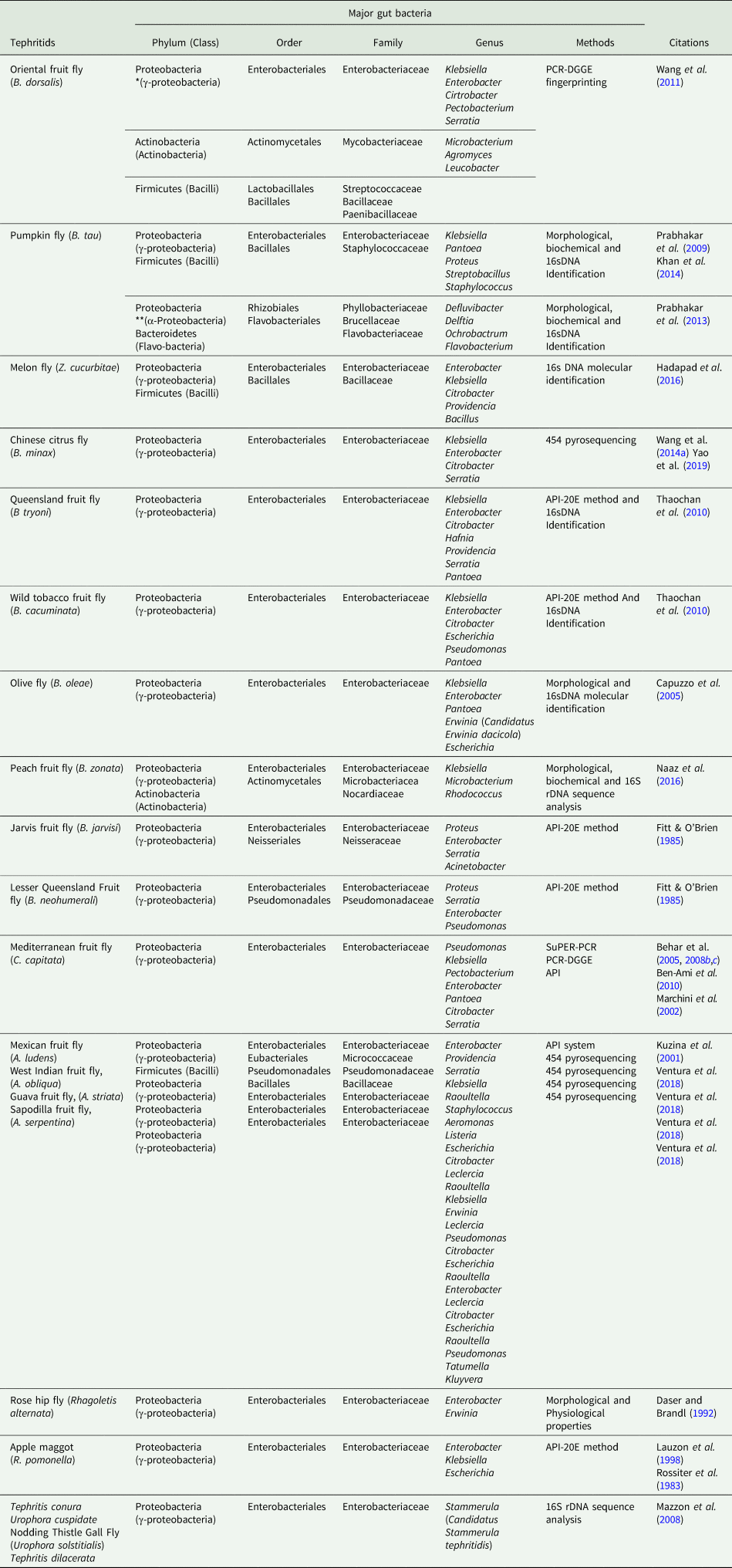
Classical and molecular methods have been used to determine the composition of symbiotic microbes associated with the gut (White, Reference White1988; Murphy et al., Reference Murphy, Teakle and MacRae1994; Marchini et al., Reference Marchini, Rosetto, Dallai and Marri2002; Thaochan et al., Reference Thaochan, Drew, Hughes, Vijaysegaran and Chinajariyawong2010) and oesophageal bulb (Marchini et al., Reference Marchini, Rosetto, Dallai and Marri2002). The oesophageal bulb (or diverticulum) is a unique organ found in the fly heads of many Tephritids, with some morphological differences (Girolami, Reference Girolami1973). From this organ, the obligate endosymbionts are multiplied and discharged into the oesophagus and intestine where they are eventually digested (Petri, Reference Petri1909; Mazzon et al., Reference Mazzon, Piscedda, Simonato, Martinez-Sanudo, Squartini and Girolami2008). Significant diverse bacterial components across the different life stages, such as eggs, larvae, pupae and adult fruit flies, have also been reported using classical and molecular methods (Fitt and O'Brien, Reference Fitt and O'Brien1985; Daser and Brandl, Reference Daser and Brandl1992; Zhao et al., Reference Zhao, Zhang, Chen, Wang, Lu and Cheng2018; Yao et al., Reference Yao, Ma, Cai, Raza, Bai, Wang, Zhang, Ma and Zhang2019). Initially, classical microbiological approaches, such as culture-dependent isolation (Marchini et al., Reference Marchini, Rosetto, Dallai and Marri2002), physiological and morphological characterization and analytical profile index (API) systems, were widely used to isolate and identify microbes associated with fruit flies (Fitt and O'Brien, Reference Fitt and O'Brien1985). However, these approaches can only account for a small proportion of the gut flora, i.e., 10–40% by some estimates (Macfarlane and Gibson, Reference Macfarlane, Gibson and Gibson1994; Langendijk et al., Reference Langendijk, Schut, Jansen, Raangs, Kamphuis, Wilkinson and Welling1995; Wilson and Blitchington, Reference Wilson and Blitchington1996). Currently, molecular approaches have been utilized to categorize both culturable and non-culturable bacteria (Mazzon et al., Reference Mazzon, Piscedda, Simonato, Martinez-Sanudo, Squartini and Girolami2008) mainly by polymerase chain reaction (PCR) amplification of the bacterial 16S rDNA and sequencing (Capuzzo et al., Reference Capuzzo, Firrao, Mazzon, Squartini and Girolami2005; Thaochan et al., Reference Thaochan, Drew, Hughes, Vijaysegaran and Chinajariyawong2010; Wang et al., Reference Wang, Jin and Zhang2011; Aharon et al., Reference Aharon, Pasternak, Yosef, Behar, Lauzon, Yuval and Jurkevitch2013; Wang et al., Reference Wang, Yao, Zheng and Zhang2014a,Reference Wang, Jin, Peng, Zhang, Chen and Huab; Andongma et al., Reference Andongma, Wan, Dong, Desneux, White and Niu2015; Ventura et al., Reference Ventura, Briones-Roblero, Hernández, Rivera-Orduña and Zúñiga2018). Major components of different genera microbiome associated with laboratory and wild tephritid populations are summarized in Table 1. Additional (major and minor) bacteria components according to the host species, locality and type of diet are listed in Table S1. Enterobacteriaceae (most common genera Klebsiella and Enterobacter) have been repeatedly shown to be the dominant gut bacteria family among fruit flies, including Bactrocera tryoni and B. cacuminata (Thaochan et al., Reference Thaochan, Drew, Hughes, Vijaysegaran and Chinajariyawong2010), B. jarvisi, B. neohumerali (Fitt and O'Brien, Reference Fitt and O'Brien1985), B. tau (Prabhakar et al., Reference Prabhakar, Sood, Kapoor, Kanwar, Mehta and Sharma2009, Reference Prabhakar, Sood, Kanwar, Sharma, Kumar and Mehta2013; Khan et al., Reference Khan, Mahin, Pramanik and Akter2014), B. zonata (Naaz et al., Reference Naaz, Choudhary, Prabhakar and Maurya2016), Z. cucurbitae (Hadapad et al., Reference Hadapad, Prabhakar, Chandekar, Tripathi and Hire2016), B. oleae (Sacchetti et al., Reference Sacchetti, Granchietti, Landini, Viti, Giovannetti and Belcari2008; Kounatidis et al., Reference Kounatidis, Crotti, Sapountzis, Sacchi, Rizzi, Chouaia, Bandi, Alma, Daffonchio and Mavragani-Tsipidou2009; Ben-Yosef et al., Reference Ben-Yosef, Pasternak, Jurkevitch and Yuval2015; Blow et al., Reference Blow, Gioti, Starns, Ben-Yosef, Pasternak, Jurkevitch, Vontas and Darby2016), B. dorsalis (Wang et al., Reference Wang, Yao, Zheng and Zhang2014a,Reference Wang, Jin, Peng, Zhang, Chen and Huab; Cai et al., Reference Cai, Yao, Li, Xi, Bourtzis, Zhao, Bai and Zhang2018), C. capitata (Behar et al., Reference Behar, Yuval and Jurkevitch2005, Reference Behar, Yuval and Jurkevitch2008a,Reference Behar, Yuval and Jurkevitchb,Reference Behar, Jurkevitch and Yuvalc, Reference Behar, Ben-Yosef, Lauzon, Yuval and Jurkevich2009), Anastrepha ludens (Kuzina et al., Reference Kuzina, Peloquin, Vacek and Miller2001; Ventura et al., Reference Ventura, Briones-Roblero, Hernández, Rivera-Orduña and Zúñiga2018), A. serpentina, A. obliqua, A. striata (Ventura et al., Reference Ventura, Briones-Roblero, Hernández, Rivera-Orduña and Zúñiga2018), Rhagoletis pomonella (Lauzon et al., Reference Lauzon, Sjogren, Wright and Prokopy1998) and Dacus (Drew and Lloyd, Reference Drew, Lloyd and Barbarosa1991) (Table 1). These studies have reported the most common gut bacterial genera associated with many tephritids, viz., Klebsiella, Citrobacter, Enterobacter, Providencia, Erwinia, Proteus and Bacillus. However, the gastrointestinal tract of some fruit flies also harbours Morganella (Salas et al., Reference Salas, Conway, Schuenzel, Hopperstad, Vitek and Vacek2017), Pseudomonas and Serratia spp., which are generally benign but can be opportunistic pathogens.
Major gut bacterial composition of Tephritid fruit flies.
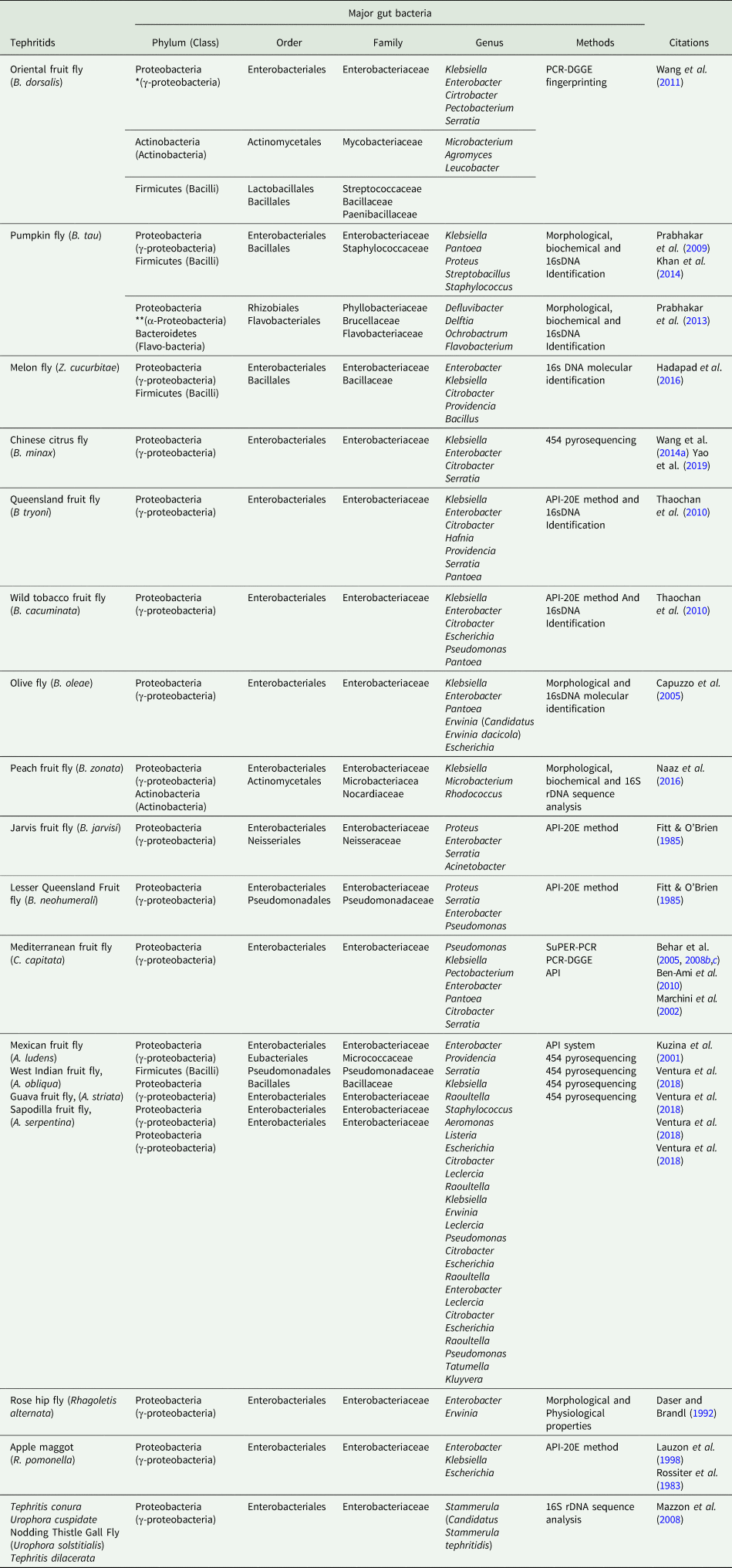
*γ, gamma, **α, alpha.
The latest calculation based on scaling law describes that a trillion microbe species are yet to be discovered (Locey and Lennon, Reference Locey and Lennon2016). There are many pros and cons of genomic analysis of gut microbial communities. Many recent studies document that gut communities are based on 16S rRNA gene profiles, but some of these do not provide sufficient information on bacterial cell numbers. For example, next-generation sequencing (NGS) only accounts for the relative abundance and composition of gut bacteria. Quantitative PCR is another quantitative molecular technique generally used to enumerate individual species as well as total bacteria using species-specific probes and can detect a broad linear range from 10 to more than 108 cells (Heid et al., Reference Heid, Stevens, Livak and Williams1996; Corless et al., Reference Corless, Guiver, Borrow, Edwards-Jones, Kaczmarski and Fox2000; Guiver et al., Reference Guiver, Borrow, Marsh, Gray, Kaczmarski, Howells, Boseley and Fox2000; Higgins et al., Reference Higgins, Hubalek, Halouzka, Elkins, Sjostedt, Shipley and Ibrahim2000). In the near future, some novel tools, such as meta-transcriptomics, gut microbiotassay (Hermann-Bank et al., Reference Hermann-Bank, Skovgaard, Stockmarr, Larsen and Mølbak2013), metagenomics and functional genomic assessment, could be addressed to develop our awareness about gut microbial communities of unreported genera of fruit flies.
Factors influencing gut microbial diversity
Gut bacterial communities may be influenced by host factors (transmission modes, species, tissue environment, developmental stage and genetics), environmental factors, sterilizing radiation, diet and immunity. Below, we document the reported evidence that may demonstrate a link with each aspect that influences gut microbial diversity.
A key parameter defining symbiosis is the transmission efficiency of microbial symbionts between host individuals and generations (Bateman, Reference Bateman1972). The mode of bacteria transmission from one generation to the next varies with the host. Mammals have an established social communication that enables the direct transmission of microorganisms in the form of parent–child contact. Conversely, insects in general lack consistent mechanisms for direct transmission of gut bacteria to the next progeny. However, social insects, such as ants, bees and termites, are exceptions; they transfer bacteria from one individual to another via social interactions (Benemann, Reference Benemann1973; Ohkuma et al., Reference Ohkuma, Noda and Kudo1999). Most tephritids have developed mechanisms for vertical transmission of bacteria to progeny via smearing the egg surface with bacteria during oviposition, which is subsequently consumed by offspring (Marchini et al., Reference Marchini, Rosetto, Dallai and Marri2002; Mazzon et al., Reference Mazzon, Piscedda, Simonato, Martinez-Sanudo, Squartini and Girolami2008; Estes et al., Reference Estes, Hearn, Bronstein and Pierson2009b; Hamden et al., Reference Hamden, Guerfali, Fadhl, Saidi and Chevrier2013; Wang et al., Reference Wang, Wei, Dou, Hu, Liu and Wang2013). Another example of maternal transmission in adult female B. oleae has been demonstrated by Petri (Reference Petri1909). He found that the dorsal wall of the rectum is thrown up into a complex series of tubules or rectal crypts, which are filled with bacteria. Eggs passing down the oviduct are pressed against the open mouths of these crypts and smeared with bacteria immediately before they are injected into the fruit. Subsequently, bacteria enter the egg through the micropile and multiply in the developing larvae in gastric caeca. A few bacteria remain throughout pupal development and induce infestation in the adult oesophageal bulb, and these symbionts spread through the alimentary canal of the adult (Petri, Reference Petri1909). Later, Capuzzo and his colleagues (Reference Capuzzo, Firrao, Mazzon, Squartini and Girolami2005) confirmed that once B. oleae embryo development is completed in the egg, the unhatched larva already contain the bacterial symbiont within its blind sacs even before it has a chance to start feeding on the olive pulp (Capuzzo et al., Reference Capuzzo, Firrao, Mazzon, Squartini and Girolami2005). However, decaying fruit also plays a vital role in the transmission of bacterial symbionts to fruit fly offspring and as a source of nutrition for developing larvae (Behar et al., Reference Behar, Jurkevitch and Yuval2008c).
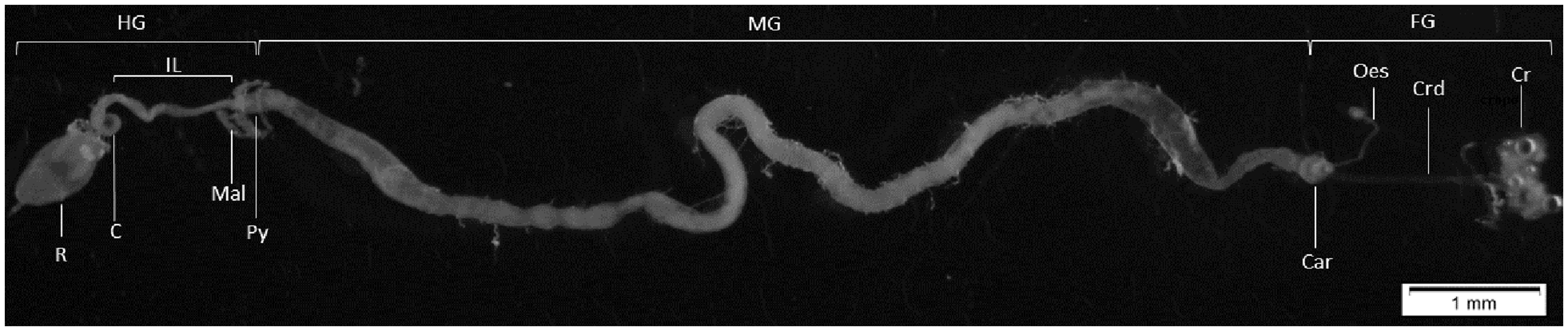
Gut structure plays a vital role for the development of bacterial community, and insect gut structure (Fig. 1) is simpler and offers less ecological niches than that of the mammalian gut. As mentioned by Colman et al. (Reference Colman, Toolson and Takacs-Vesbach2012), the complexity of the insect microbiome is considerably reduced compared with mammals (tens to hundreds vs. thousands bacterial species) (Dethlefsen et al., Reference Dethlefsen, Huse, Sogin and Relman2008; Ley et al., Reference Ley, Lozupone, Hamady, Knight and Gordon2008; Robinson et al., Reference Robinson, Bohannan and Young2010; Broderick and Lemaitre, Reference Broderick and Lemaitre2012). Moreover, the average retention time of gut bacterial communities is shorter in insects than that of the gut of higher organisms (Chapman et al., Reference Chapman, Douglas, Simpson and Simpson2013). Another reason for reduced microbial niches could be that foregut and hindgut regions are shed during moulting. In addition, during metamorphosis, the whole larval gut is substituted by a new adult gut. Hence, the transitory gut nature of tephritid flies may be incompatible with the development of a diverse bacterial community (Robinson et al., Reference Robinson, Bohannan and Young2010).
Dissected gut structure of B. dorsalis. FG, foregut; Car, cardia; Crd, cardial duct; Oes, oesophagus; Cr, crop; MG, midgut; HG, hindgut; py, pylorus, Mal, malpighian tubules; IL, ileum; C, colon; R, rectum.

Various physicochemical conditions, such as pH and the redox potential of different gut compartments, determine the composition of the bacterial community along the gut. Most bacteria prefer pH ranging from 6 to 7 (Dillon and Dillon, Reference Dillon and Dillon2004). Bacteria may also populate gut compartments displaying extreme pH; for example, the midgut of Dacus (Bactrocera) larvae has a strong acidic pH ranging from 1.4 to 2.0 that supports the growth of lactic acid bacteria (Fitt and O'Brien, Reference Fitt and O'Brien1985; Dillon and Dillon, Reference Dillon and Dillon2004). Acid-metabolizing bacteria of the genera Leuconostoc and Lactobacillus were also found in the crop of adult tephritids. An acidic pH in the crop of some Bactrocera spp. has been reported by Drew et al. (Reference Drew, Courtice and Teakle1983) and can hold acid-metabolizing bacteria (Thaochan et al., Reference Thaochan, Drew, Chinajariyawong, Sunpapao and Pornsuriya2015). However, it is possible that the acidity of crop in insects gut is partly related to the characteristics of the ingested diet (Thaochan et al., Reference Thaochan, Drew, Chinajariyawong, Sunpapao and Pornsuriya2015). For example, a substantial difference of bacterial representation between gut and crop of both B. tryoni and B. cacuminata was observed and was attributed to dissimilar pH values of these parts, which is possibly due to the different types of diets (Thaochan et al., Reference Thaochan, Drew, Hughes, Vijaysegaran and Chinajariyawong2010). However, lactic acid bacteria can produce their own low pH environment in the gut by secreting acids (Kodama and Nakasuji, Reference Kodama and Nakasuji1971). Similarly, Acetobacteraceae likely can create acidic micro-niches in an otherwise alkaline or neutral gut (Kounatidis et al., Reference Kounatidis, Crotti, Sapountzis, Sacchi, Rizzi, Chouaia, Bandi, Alma, Daffonchio and Mavragani-Tsipidou2009). This may explain why Acetobacteraceae bacteria are found in two members of Acalyptratae, Bactrocera and Drosophila.
A diet also plays a key role in structuring gut microbial diversity. Effects on the microbiome structure have been observed in comparisons between artificial and natural diets (Table S1), as well as between diets in which main nutritional classes (protein and sugar) are different (Capuzzo et al., Reference Capuzzo, Firrao, Mazzon, Squartini and Girolami2005). Previously, Wang et al. (Reference Wang, Jin and Zhang2011) explored whether different types of diets could significantly influence the gut bacteria community of B. dorsalis (Wang et al., Reference Wang, Jin and Zhang2011). The field-collected flies have more diverse gut flora compared with laboratory-reared flies. A possible reason for the gut community variations could be that the field-collected flies had more opportunities to feed on uncontrolled natural diets, while laboratory reared flies were fed with sterile sucrose solution under sanitary and controlled conditions (Wang et al., Reference Wang, Jin and Zhang2011).
Sterilizing irradiation procedures used for SIT affects the gut microbiome structure of mass-rearing strains of tephritids. The level of dominant gut bacteria (e.g., Klebsiella spp.) decreases after sterilization, whereas potentially pathogenic species, such as Pseudomonas, which is known to harm insects, increase in industrial strains (Ben-Ami et al., Reference Ben-Ami, Yuval and Jurkevitch2010). Optimization of mass-rearing conditions is an important goal in SIT programmes. For example, irradiation used in mass rearing of tephritids can also have substantial negative effects on insect performance, e.g., reduced flight capacity, female attraction, mating competitiveness and longevity (Ben-Ami et al., Reference Ben-Ami, Yuval and Jurkevitch2010; Cai et al., Reference Cai, Yao, Li, Xi, Bourtzis, Zhao, Bai and Zhang2018).
The dysbiosis of physiological processes and chronic inflammation in the intestinal tract of insects are resulted by the deregulation alterations of the gut microbiota (Round and Mazmanian, Reference Round and Mazmanian2009; Nyholm and Graf, Reference Nyholm and Graf2012). Therefore, the host maintains suitable microbiota homoeostasis for beneficial host–microbe interactions. The gut epithelium is commonly exposed to harmful pathogens; therefore, an efficient immune system is required for protection (Kuraishi et al., Reference Kuraishi, Hori and Kurata2013). The roles of antimicrobial peptides and reactive oxygen species in the gut immune response are well documented in B. dorsalis, Aedes aegypti and Drosophila melanogaster (Fig. S1), but the molecular mechanisms underlying the associations between insect gut immunity and its resident micro-organisms is still poorly understood. Future studies are needed to explore how the host distinguishes beneficial bacteria from pathogens and whether the host determines gut homoeostasis or pathogenesis through bacterial metabolites or other factors. Besides providing immunity, gut microbiota might also be useful for efficient parasitoid rearing, i.e., high quality and cost-effective. Host C. capitata larvae are commonly subjected to irradiation before exposing them to parasitoids (Cancino et al., Reference Cancino, Ruiz, Viscarret, Sivinski and Hendrichs2012; Yokoyama et al., Reference Yokoyama, Wang, Aldana, Caceres and Yokoyama-Hatch2012). Both X-ray and gamma irradiation do not seem to have negative influences on C. capitata (Cancino et al., Reference Cancino, Ruiz, Viscarret, Sivinski and Hendrichs2012) and Anastrepha fraterculus (Bachmann et al., Reference Bachmann, Carabajal-Paladino, Conte, Devescovi and Milla2015) quality for use in rearing of Diachasmimorpha longicaudata; however, the effect of larval irradiation on the immune response remains poorly understood. Numerous other functions of gut microbiota may affect parasitoid biology. For example, it would be interesting to explore whether bacteria help developing parasitoids by avoiding or overcoming the host immune system in the same way as viruses (Lawrence, Reference Lawrence2004). Additionally, successful development of endoparasitoid wasps in the larval bodies of A. obliqua depends on the ability to avoid encapsulation by the host immune system (Silva et al., Reference Silva, Boleli and Simões2002). Haemocytes are responsible for making the cellular components of the capsules that surrounds the parasitoids in larval hosts (Ratcliffe, Reference Ratcliffe, Beckage, Thompson and Federici1993). As the haemocytes are involved in defence reactions in insects, they could be very useful to understand host–parasite interactions in the future. The immune system is an important feature that regulates microbiota homoeostasis in the insect gut, but we will not discuss the details of immunity in this review.
Gut microbe functions for the fitness improvement of host fruit flies
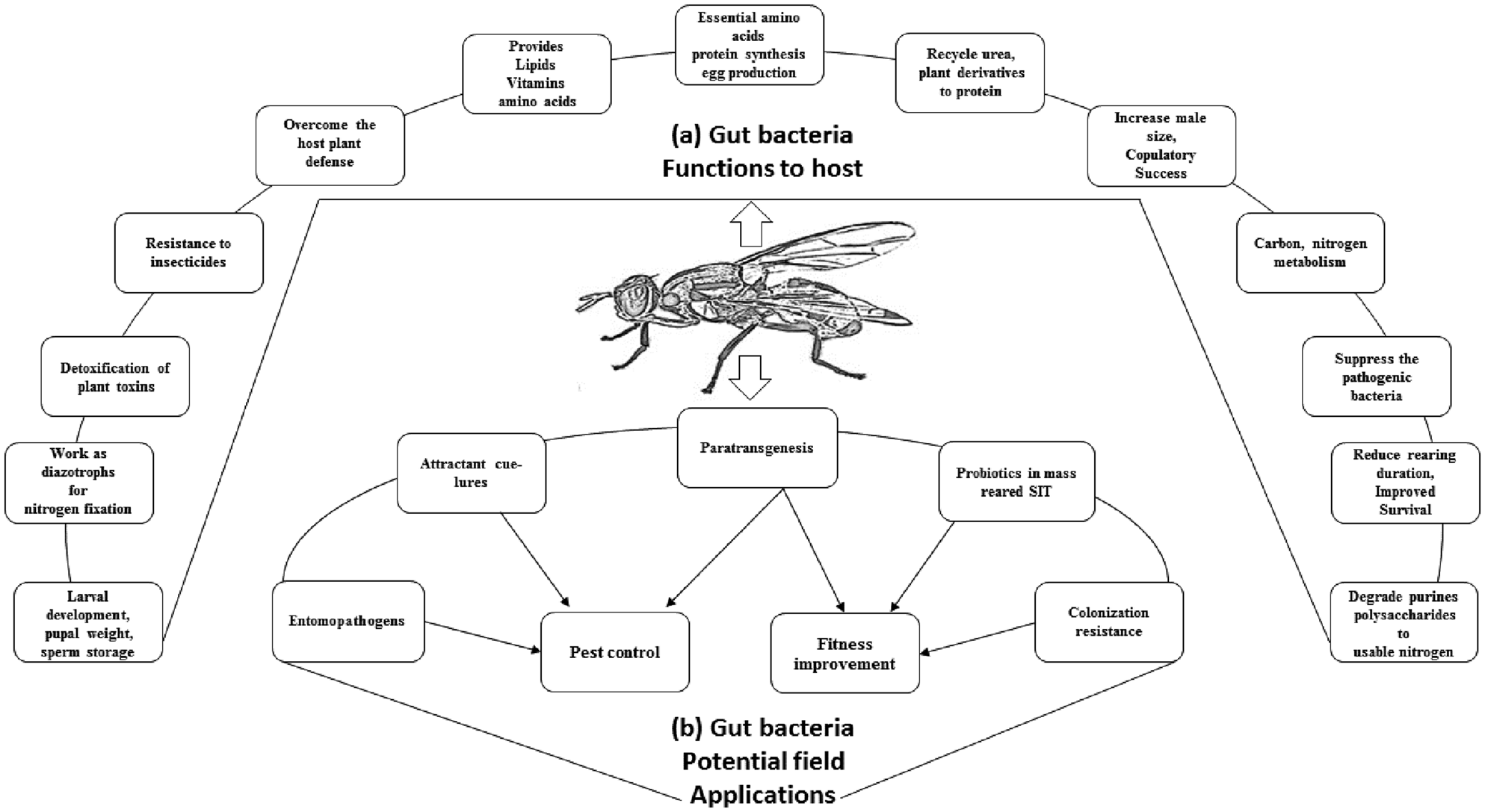
The gut microbial community of tephritid flies govern a massive array of functions contributing to host nutrition, development, physiological resistance to pathogens and insecticides and insect immune system modulation. However, our recent information about microbiota functions in host flies remains inadequate. In the following section, we review some important findings (Fig. 2) that emphasize the practical roles of gut microbiota to economically important tephritid flies.
Different roles of gut bacteria in Tephritidae fruit flies. (a) Functions contributing to host nutrition, development, physiology and resistance to pathogens and insecticides. (b) Potential for field applications, viz., insecticidal potential of entomopathogenic gut bacteria can be used to control pests. In paratransgenesis, bacteria can be used as sources to express molecules in the gut that positively or negatively affect the health of the host. In colonization resistance, gut bacteria that inhibit parasite colonization naturally could be dispersed in insect populations to promote host fitness, gut bacteria can be used as cue-lure-kill strategies of pests, probiotics used in SIT could enhance the fitness of mass reared flies.

Gut bacteria provide nutrients to the host
In the early 20th century, Metchnikoff embarked upon a series of experiments to investigate the positive role of gut microbes in the nutrition and development of host. He found that trypsin-producing bacteria were necessary for nutrition and normal development in the D. melanogaster maggot, while a lack of microbial flora in axenic flies resulted in stunted growth (Metchnikoff, Reference Metchnikoff1901). More recently, a study investigated the nutritional role of gut microbes on the host revealed that the intestinal bacteria of C. capitata provides significantly higher amount of lipids and proteins to the host compared with that of antibiotic-treated flies (Ben-Yosef et al., Reference Ben-Yosef, Jurkevitch and Yuval2008a). This finding may be attributed to the fact that gut bacteria affect lipid and carbohydrate metabolism in an unknown manner (Ben-Yosef et al., Reference Ben-Yosef, Jurkevitch and Yuval2008a). As reported in B. tryoni, another reason may be that adult gut acidity is adequate to autolyse the ingested bacteria and release of their cell contents in the form of vitamins, amino acids and other nutrients (Drew et al., Reference Drew, Courtice and Teakle1983). A major role of the acetic acid bacterium Acetobacter tropicalis in the nutrition, development and physiology of R. pomonella has also been reported (Dean and Chapman, Reference Dean and Chapman1973).
Insect food contains numerous polysaccharides that are generally difficult to digest. Many insect endosymbiotic bacterial communities have the potential to digest different polymeric carbohydrate molecules (Prem Anand et al., Reference Prem Anand, Vennison, Sankar, Gilwax Prabhu, Vasan, Raghuraman, Jerome Geoffrey and Vendan2010; Dey et al., Reference Dey, Karmakar and Ray2011). Saha and Ray (Reference Saha and Ray2015) demonstrated that B. dorsalis gut bacteria might produce enzymes that help in the digestion of polysaccharides, including xylan, pectin, cellulose and starch. Similarly, R. pomonella creates a facultative symbiotic relationship with Enterobacter and Klebsiella, which degrade purines and purine derivatives and provide usable nitrogen for the insect (Lauzon et al., Reference Lauzon, Sjogren and Prokopy2000).
Many tephritid flies rely on poor diet sources that have variable amino acid composition. For instance, adult B. oleae feed on nectar, honeydew, fruit and plant exudates, and pollen (Chrlstenson and Foote, Reference Chrlstenson and Foote1960; Drew and Yuval, Reference Drew, Yuval, Aluja and Norrbom2000). The nutritional significance of these foodstuffs may fluctuate greatly; for example, plant-derived exudates, nectar and honeydew are typically rich in carbohydrates but poor in amino acids (Wäckers, Reference Wäckers, Wäckers, van Rijn and Bruin2005; Lundgren, Reference Lundgren2009). Ben-Yosef et al. (Reference Ben-Yosef, Aharon, Jurkevitch and Yuval2010) demonstrated that the gut microbiota of B. oleae flies that survive primarily on a nitrogen-poor diet such, as honeydew, are able to compensate skewed amino acid composition (Ben-Yosef et al., Reference Ben-Yosef, Aharon, Jurkevitch and Yuval2010). Similarly, in vitro studies showed that gut bacteria can recycle uric acid, urea and plant derivatives into protein via mechanisms that contribute to the host nitrogen levels (Hellmuth, Reference Hellmuth1956; Lauzon et al., Reference Lauzon, Sjogren and Prokopy2000; Robacker and Lauzon, Reference Robacker and Lauzon2002).
Different authors reported the association of Candidatus Erwinia dacicola as the main symbiont of wild B. oleae. Ca. E. dacicola is maintained extracellularly in both adults and larvae; however, it also resides intracellularly in the gastric caeca of the larval midgut (Estes et al., Reference Estes, Hearn, Bronstein and Pierson2009b, Reference Estes, Hearn, Burrack, Rempoulakis and Pierson2012; Ben-Yosef et al., Reference Ben-Yosef, Pasternak, Jurkevitch and Yuval2014). This bacterium can utilize urea as a nitrogen source and can use essential amino acids for protein synthesis and egg production. This type of symbiosis enables adult flies to exploit low or imbalanced food substrates and thus to overcome nitrogen limitations in their natural diet (Ben-Yosef et al., Reference Ben-Yosef, Pasternak, Jurkevitch and Yuval2014).
In insects, including tephritids, male and female development and reproductive potential depend on the acquisition of nitrogenous compounds (Drew and Yuval, Reference Drew, Yuval, Aluja and Norrbom2000; Du et al., Reference Du, Li, Wang, Peng, Hong and Yang2012). Termites are the prominent insects that harbour diazotrophic bacterial communities, such as Citrobacter freundii, Enterobacter agglomerans and Desulfovibrio spp., as shown by phylogenetic analysis of both dinitrogenase reductase (nifH) genes and 16S rRNA (Benemann, Reference Benemann1973; Ohkuma et al., Reference Ohkuma, Noda and Kudo1999). Behar et al. (Reference Behar, Yuval and Jurkevitch2005) reported that natural populations of C. capitata harbour large diazotrophic populations of Enterobacteriaceae that express dinitrogen reductase (nifH) genes in the gut (Behar et al., Reference Behar, Yuval and Jurkevitch2005). The diazotrophic bacterial species retrieved from the C. capitata gut were also reported in other tephritid guts, viz., Rhagoletis completa (Peloquin et al., Reference Peloquin, Kuzina, Lauzon and Miller2000), B. tryoni (Murphy et al., Reference Murphy, Teakle and MacRae1994), R. pomonella (Rossiter et al., Reference Rossiter, Howard, Bush and Cavolloro1983; Lauzon et al., Reference Lauzon, Sjogren and Prokopy2000) and A. ludens (Kuzina et al., Reference Kuzina, Peloquin, Vacek and Miller2001). On the basis of acetylene reduction assay (ARA), laboratory-reared B. tryoni fed dinitrogen-fixing strains of Klebsiella oxytoca and Enterobacter spp. revealed nitrogenase activity (Murphy et al., Reference Murphy, Mac Rae and Teakle1988, Reference Murphy, Teakle and MacRae1994). However, it is noteworthy that ARAs were associated with fruit flies, and nifH genes were detected in bacteria isolated from their guts. Thus, the nutritional contributions of gut bacteria to the host due to nitrogen fixation must be further explored. Additionally, it is premature to conclude that the availability of atmospheric nitrogen to diazotrophs' gut bacteria favours the activation of nitrogen fixation mechanism. The natural diet of wild flies is poor in organic nitrogen but does contain amino acids, uric acids and proteins. Thus, a contribution of fixed nitrogen to the host may be very small and has minimal fitness consequences (Wackers, Reference Wäckers, Wäckers, van Rijn and Bruin2005; Lundgren, Reference Lundgren2009).
Development and reproduction
Primarily, Petri postulated that bacteria are present at every stage of the B. oleae life and play a significant role for successful growth and development (Petri, Reference Petri1906, Reference Petri1909). Probiotics added to the adult fruit flies diet may provide essential nutrients for fecundity and increase the longevity compared with those fed a conventional diet (Drew et al., Reference Drew, Courtice and Teakle1983; Halder et al., Reference Halder, Khan, Al-Mahin and Howlader2013). Bacterial association significantly increased survival and reproductive success of C. capitata males when well-nourished on a sugar diet (Hamden et al., Reference Hamden, Guerfali, Fadhl, Saidi and Chevrier2013). Ben-Yosef et al. (Reference Ben-Yosef, Behar, Jurkevitch and Yuval2008b) investigated the reproductive potential and longevity of C. capitata males and females after removing gut bacteria using antibiotics. They found that intestinal bacteria affect the life span in a diet-dependent fashion (Ben-Yosef et al., Reference Ben-Yosef, Behar, Jurkevitch and Yuval2008b). Similarly, the addition of probiotics in the diet increased pupal weight, male matting success, longevity and male size and improved sperm storage in the females' spermathecae (Hamden et al., Reference Hamden, Guerfali, Fadhl, Saidi and Chevrier2013). Damodaram and his colleagues found that male B. dorsalis flies are attracted to and ejaculated more sperm into females harbouring the microbiota, but this attraction was eliminated when female flies were fed antibiotics (Damodaram et al., Reference Damodaram, Ayyasamy and Kempraj2016), which suggests that the gut microbiota mediates mate selection. Sacchetti et al. (Reference Sacchetti, Ghiardi, Granchietti, Stefanini and Belcari2014) isolated Pseudomonas putida from the oesophageal bulb of wild B. oleae; they found that its probiotics diet increased the egg production and reduced the longevity of B. oleae. A possible reason could be that it took longer for colonization in the oesophageal bulb of the B. oleae adults (Sacchetti et al., Reference Sacchetti, Ghiardi, Granchietti, Stefanini and Belcari2014). These results provide several important clues about the beneficial role of gut microbiota in reproduction and development of the flies; while these explanations are possible, we feel that a more comprehensive view of these interactions need to be worked out in further experiments, regardless of diet type or gut bacterial strains.
Conversely, some authors disagree with the above findings. Bacteria added to the diet of female B. tryoni and B. tau did not affect fecundity (Meats et al., Reference Meats, Streamer and Gilchrist2009; Khan et al., Reference Khan, Mahin, Pramanik and Akter2014). Another study also showed that gut bacteria did not enhance reproductive success or the nutritional status of poorly fed C. capitata. The possible reason of bacteria inefficiencies could be due to the co-existence of mutualistic and pathogenic microorganisms in the fly gut or poor nutritional conditions (Drew et al., Reference Drew, Courtice and Teakle1983). Such complications have been revealed in other insect–gut bacteria associations, especially the thrips–Erwinia relationship (De Vries et al., Reference De Vries, Jacobs, Sabelis, Menken and Breeuwer2004). Khan et al. found that the isolated gut bacterial species Proteus rettgeri and K. oxytoca supplemented with a protein and sugar diet has no significant influence on egg production and ovariole number compared with an exclusively protein diet (Khan et al., Reference Khan, Mahin, Pramanik and Akter2014). Similarly, Ben-Yosef et al. (Reference Ben-Yosef, Aharon, Jurkevitch and Yuval2010) also examined that gut symbionts supplemented with a protein-rich diet or nutritionally poor sucrose diet did not affect the fecundity of B. oleae (Ben-Yosef et al., Reference Ben-Yosef, Aharon, Jurkevitch and Yuval2010). The results of the above studies showed that gut bacteria did not improve host reproduction quality, which could be due to the nutritionally poor diet used in those studies and/or the co-existence of pathogenic and mutualistic microbes in the fly gut. Additionally, other laboratory environmental conditions, such as housing conditions, sex, age and contamination from human caregivers could also reduce the competitiveness of fruit flies.
Gut symbionts assist to overcome host plant defences
Unripe fruits generally endure less loss from pathogens and herbivores due to less nutritional value and high levels of secondary metabolites with antimicrobial, anti-nutritive and toxic effects (Prokopy and Roitberg, Reference Prokopy and Roitberg1984). In contrast to other frugivorous Tephritids, such as B. dorsalis and C. capitata, which feed upon hydrolysed compounds of ripe fruits, B. oleae larvae have the unique ability to feed upon olive proteins and other nutrients of unripe olives as well as cope with high levels of phenolic compounds (Ben-Yosef et al., Reference Ben-Yosef, Pasternak, Jurkevitch and Yuval2015; Pavlidi et al., Reference Pavlidi, Gioti, Wybouw, Dermauw, Ben-Yosef, Yuval, Jurkevich, Kampouraki, Van Leeuwen and Vontas2017). A major symbiont ‘Ca. E. dacicola’ contributes to larval development by aiding its host B. oleae to overcome the unripe fruit chemical defence (Ben-Yosef et al., Reference Ben-Yosef, Pasternak, Jurkevitch and Yuval2015). It was hypothesized that B. oleae gut bacteria might be responsible for disabling the hindrance effect of a bitter taste phenolic glycoside ‘oleuropein’ in unripe fruits (Ben-Yosef et al., Reference Ben-Yosef, Pasternak, Jurkevitch and Yuval2015). Recently, Pavlidi et al. (Reference Pavlidi, Gioti, Wybouw, Dermauw, Ben-Yosef, Yuval, Jurkevich, Kampouraki, Van Leeuwen and Vontas2017) reported transcriptomic responses of B. oleae and its gut obligate symbiotic bacterium Ca. E. dacicola to olive feeding. A number of genes were overexpressed in the B. oleae larvae when feeding in green olives that encode digestive and detoxification enzymes, such as uridine-glucuronosyltransferase (Pavlidi et al., Reference Pavlidi, Gioti, Wybouw, Dermauw, Ben-Yosef, Yuval, Jurkevich, Kampouraki, Van Leeuwen and Vontas2017). Additionally, a number of biological processes seem to be activated in Ca. E. dacicola during larval development in olives, and the most notable is the stimulation of amino-acid metabolism (Pavlidi et al., Reference Pavlidi, Gioti, Wybouw, Dermauw, Ben-Yosef, Yuval, Jurkevich, Kampouraki, Van Leeuwen and Vontas2017). These observations indicate a possible host–microbe association in B. oleae to cope with green olives. However, it is difficult to say whether degradation of oleuropein occurs with symbiont or insect enzymes or their cooperation; thus, further studies are still required to identify the functional contributions of this unique symbiont to its host.
Resistance to pathogens
It was previously noted that the presence of a dominant bacterial community in the D. melanogaster gut is sufficient to suppress the establishment of pathogenic bacteria (Ryu et al., Reference Ryu, Kim, Lee, Bai, Nam, Bae, Lee, Shin, Ha and Lee2008). A minor but stable community of a known pathogen Pseudomonas spp. in the C. capitata gut was also reported by Behar et al. (Reference Behar, Yuval and Jurkevitch2008b). They found that Enterobacteriaceae added to the C. capitata diet not only supports the fly's development, carbon and nitrogen metabolism, copulatory success and longevity, but also may suppress the proliferation of pathogenic bacterium Pseudomonas spp. (Behar et al., Reference Behar, Yuval and Jurkevitch2008b). The addition of K. oxytoca to the post-irradiation diet of C. capitata aided in the restoration of beneficial bacteria in the gut and decreased the levels of potential pathogenic Pseudomonas species (Ben-Ami et al., Reference Ben-Ami, Yuval and Jurkevitch2010). Another study also showed that C. capitata fly larvae fed with Klebsiella pneumonia, Enterobacter spp. and C. freundii increased Enterobacteriaceae and decreased Pseudomonas spp. in the larval stage (Hamden et al., Reference Hamden, Guerfali, Fadhl, Saidi and Chevrier2013).
Symbiont-mediated insecticide resistance
Recently, research on the largely untapped resource of ‘detoxifying-symbionts’ has revealed that gut microbial symbionts may have a role in the detoxification of plant toxins and insecticides. The ability of various bacteria to degrade organophosphate pesticides has been described in recent years (Prabhakar et al., Reference Prabhakar, Sood and Mehta2008; Zhang et al., Reference Zhang, Xu, Liu and Zhao2014; Akbar et al., Reference Akbar, Sultan and Kertesz2015; Siripattanakul-Ratpukdi et al., Reference Siripattanakul-Ratpukdi, Vangnai, Sangthean and Singkibut2015). Phenol and myo-inositol hexakisphosphate (InsP6) degradation by numerous Citrobacter species has been documented, and their degradation pathways are generally well known (Pontoppidan et al., Reference Pontoppidan, Glitsoe, Guggenbuhl, Quintana, Nunes, Pettersson and Sandberg2012; Ma et al., Reference Ma, Wang, Liu and Zhang2015). A novel insecticide resistance mechanism has been reported by Cheng and his colleagues, in which a bacterium C. freundii isolated from B. dorsalis gut increases the host resistance against Trichlorphon (Cheng et al., Reference Cheng, Guo, Riegler, Xi, Liang and Xu2017). The inoculation of isolated Citrobacter species to B. dorsalis resulted in higher trichlorphon resistance, whereas antibiotic-treated flies were less resistant. Comparative genomic analysis with other Citrobacter species revealed 55 phosphatase hydrolase (OPH)-like genes and five new genes that were unique to gut symbiont C. freundii from B. dorsalis. In the presence of trichlorphon, the expression of the five OPH-like genes was activated. Gas chromatography-mass spectrometry showed that C. freundii degrades ‘trichlorphon’ into less toxic products, e.g., chloral hydrate and dimethyl-phosphite (Cheng et al., Reference Cheng, Guo, Riegler, Xi, Liang and Xu2017). Metabolite characteristics of those less toxic products were similar to the results obtained with Citrobacter braakii (Pontoppidan et al., Reference Pontoppidan, Glitsoe, Guggenbuhl, Quintana, Nunes, Pettersson and Sandberg2012), but further evidence is required to determine whether phosphatase is the critical enzyme in degradation pathway used by C. freundii and whether this pathway is same as that used by C. braakii.
Practical applications of gut microbiota in tephritidae fruit flies
The resident microbiota of tephritids has great potential in promoting practical management of pests, e.g., gut symbiont-based probiotics can be used to improve larval and adult ecological fitness parameters, including morphological properties and mating competitiveness of sterile males used in SIT or using gut bacteria as attractant cue-lures of fruit flies.
Probiotics used in mass-reared SIT
Due to several attractive features, including environmental friendliness and species-specificity, SIT has been used for decades to control tephritids insect pests of agricultural importance (Lance et al., Reference Lance, McInnis, Rendon and Jackson2000; Hendrichs et al., Reference Hendrichs, Robinson, Cayol and Enkerlin2002; Lux et al., Reference Lux, Vilardi, Liedo, Gaggl, Calcagno, Munyiri, Vera and Manso2002). Several studies have addressed the need of defining an optimal dose range of radiations at which reasonable results of both performance and sterility of released males are achieved (Hooper, Reference Hooper1971; Zumreoglu et al., Reference Zumreoglu, Ohinata, Fujimoto, Higa and Harris1979; Rendon et al., Reference Rendon, Franz and Wood1996). To produce >97% sterility in tephritid males, e.g., A. obliqua, sufficient gamma radiation doses ranging from 60 to 70 Gy have been recently reported (Gallardo-Ortiz et al., Reference Gallardo-Ortiz, Pérez-Staples, Liedo and Toledo2018). Lauzon and Potter compared midgut tissues and microflora from irradiated and non-irradiated mass-reared adult fruit flies through scanning and transmission electron microscopy. They found that cellular damage of midgut tissues included small, distorted nuclei that lacked nuclear material and mitochondria that were dilated or vacuolated (Lauzon and Potter, Reference Lauzon and Potter2012). In addition, radiation exposure reduced peritrophic matrix (PM) (microorganisms are generally confined in it) formation in the midguts of newly emerged and 2-day-old adult flies of C. capitata and A. ludens, and bacterial abundance was subsequently decreased (Lauzon and Potter, Reference Lauzon and Potter2012). However, replenishment of gut symbionts may help restore the impaired gut to a pre-irradiated state. The use of gut symbionts to cope with disruption of morphologic mucosal integrity and normal microbiota populations for human cancer patients receiving radiotherapy treatments has shown potential for developing enteritis and related malnutrition (Demirer et al., Reference Demirer, Aydintug, Aslim, Kepenekci, Sengul, Evirgen, Gerceker, Andriew, Ulusoy and Karahiiseyinoglu2006). Probiotics for tephritid fruit flies may also exhibit similar effects on the ultrastructure, histology and physiology of sterile insects gut tissues (Lauzon, Reference Lauzon, Bourtzis and Miller2003; Lauzon and Potter, Reference Lauzon and Potter2012). Thus, harnessing gut microbiota could be an alternative approach to enhance the quality of sterile males used in SIT.
Symbiont bacteria contribute to host fitness in a systemic manner that is not essentially specific to one of the components of host physiology or behaviour. Niyazi et al. (Reference Niyazi, Lauzon and Shelly2004) described that probiotic post-teneral diets of E. agglomerans and K. pneumoniae (isolated from wild C. capitata gut) have positive effects on the behavioural ecology of sterile C. capitata (Niyazi et al., Reference Niyazi, Lauzon and Shelly2004). A significant increase in calling activity or life expectancy and mating performance of probiotic-treated males were observed in laboratory cages (Niyazi et al., Reference Niyazi, Lauzon and Shelly2004). Post-irradiation diet of K. oxytoca derived from wild medflies resulted in the restoration of these bacteria in the gut. Moreover, male sexual performance was significantly enhanced, while the mating latency of sterile males was reduced (Ben-Ami et al., Reference Ben-Ami, Yuval and Jurkevitch2010). Similarly, larval diets enriched with Klebsiella, Enterobacter and Citrobacter spp. improved morphometric qualities and the mating competitiveness of C. capitata males (Hamden et al., Reference Hamden, Guerfali, Fadhl, Saidi and Chevrier2013). Lauzon et al. (Reference Lauzon, McCombs, Potter and Peabody2009) demonstrated that vertical transmission of microorganisms from larval to adult stages could be the reason for improved quality and sexual performance of C. capitata adults (Lauzon et al., Reference Lauzon, McCombs, Potter and Peabody2009). In the laboratory and field cages, a diet supplemented with K. oxytoca improves the survival, mating ability and courtship of mass-reared C. capitata sterile males with wild females under starvation (Gavriel et al., Reference Gavriel, Jurkevitch, Gazit and Yuval2011). Enterobacter spp. used as live or dead probiotic supplemented the larval diet of Z. cucurbitae improved morphological properties, including pupal weight and survival compared with the non-probiotic irradiated group (Yao et al., Reference Yao, Zhang, Cai, Gu, Wang and Ji2017). Interestingly, sterile flies could be used as vectors of virulent fungus, e.g., Beauveria bassiana via mating or contact during courtship (Toledo et al., Reference Toledo, Campos, Flores, Liedo, Barrera, Villaseñor and Montoya2007). If mating does not occur, there might be horizontal transmission that could result in the mortality of the wild population, and fungal infection might prevent a wild female from re-mating with a wild male (Toledo et al., Reference Toledo, Flores, Campos, Villaseñor, Enkerlin, Liedo, Valle and Montoya2017). Thus, sterile flies used as fungus vectors in SITs may also represent a new control method for area-wide integrated management of tephritid flies; however, the shortcomings and potential benefits of this technique require further investigation.
Other important issues for the mass-rearing conditions for SIT, i.e., the effects of laboratory-rearing environment on fruit flies symbionts, are also concerning. Laboratory-reared flies maintained on artificial diet have a lower diversity in their gut bacterial community compared with their counterparts, the wild flies (Konstantopoulou et al., Reference Konstantopoulou, Raptopoulos and Economopoulos1999; Wang et al., Reference Wang, Jin and Zhang2011). In B. oleae laboratory rearing, antimicrobial agents are used to prevent the growth of pathogenic bacteria or fungi. For example, washing eggs with a 2% Clorox solution may prevent the vertical transmission of the naturally associated bacterial layer that is deposited on the eggs. In addition, the larval medium contains antimicrobial agents, e.g., nipagin, which have been shown to cause changes in the microbiota community structure in B. oleae (Konstantopoulou et al., Reference Konstantopoulou, Raptopoulos and Economopoulos1999). There are several options to promote symbiont survival in the host, such as modification of larval diet, especially during domestication, which is selective for beneficial bacteria and against pathogens in larvae (Cohen, Reference Cohen2003). Another option is to add symbiotic bacteria to the diet as probiotic supplements, which have been successfully used in other fruit flies, such as Bactrocera species (Drew et al., Reference Drew, Courtice and Teakle1983; Meats et al., Reference Meats, Streamer and Gilchrist2009; Yao et al., Reference Yao, Zhang, Cai, Gu, Wang and Ji2017; Cai et al., Reference Cai, Yao, Li, Xi, Bourtzis, Zhao, Bai and Zhang2018) or C. capitata (Niyazi et al., Reference Niyazi, Lauzon and Shelly2004; Ben-Ami et al., Reference Ben-Ami, Yuval and Jurkevitch2010; Gavriel et al., Reference Gavriel, Jurkevitch, Gazit and Yuval2011; Hamden et al., Reference Hamden, Guerfali, Fadhl, Saidi and Chevrier2013; Augustinos et al., Reference Augustinos, Kyritsis, Papadopoulos, Abd-Alla, Cáceres and Bourtzis2015). Importantly, for effective probiotic supplementations, the target bacterial symbionts should be easy to culture and add to the diet. Generally, transiently associated facultative bacterial species should be considered as probiotics due to their ease of cultivation (Estes et al., Reference Estes, Nestel, Belcari, Jessup, Rempoulakis and Economopoulos2011).
Attractant cue-lures
Semio-chemically mediated interactions between insects and gut bacteria particularly from the families Enterobacteriaceae, Pseudomonadaceae and Bacillaceae (Leroy et al., Reference Leroy, Sabri, Verheggen, Francis, Thonart and Haubruge2011) highlight the significance of bacterial cue-lures against tephritids (Robacker and Lauzon, Reference Robacker and Lauzon2002; Drew and Fay, Reference Drew and Fay1988; Robacker and Bartelt, Reference Robacker and Bartelt1997). Despite knowing that fruit flies are attracted to gut bacteria isolates, relatively few studies have been evaluated in this aspect. One possible reason could be that recognition of attractant chemicals produced by bacteria has been nearly as challenging as identifying the nature of associations between bacteria and host fly; it may also attract beneficial insects (Robacker, Reference Robacker2007; Leroy et al., Reference Leroy, Sabri, Verheggen, Francis, Thonart and Haubruge2011).
However, this finding raised a question as to why tephritid fruit flies searched or are attracted to bacteria. Various possible reasons could include the search for bacteria as food (Drew and Fay, Reference Drew and Fay1988), replenishing gut microbiota, detoxifying allelo-chemicals in the diet (Lauzon, Reference Lauzon, Bourtzis and Miller2003), or as indicators of food (Robacker and Moreno, Reference Robacker and Moreno1995). In the last century, it was hypothesized that ammonia produced by bacteria was the reason of attractiveness to fruit flies (Jarvis, Reference Jarvis1931; Gow Reference Gow1954). These studies have provided fruitful information for the development of food-odour A. ludens (Robacker and Warfield, Reference Robacker and Warfield1993) and C. capitata lures (Heath et al., Reference Heath, Epsky, Guzman, Dueben, Manukian and Meyer1995). Field trials of bacteria cues prepared from P. putida (isolated from foregut of B. oleae adults) exhibited more attractive potential to B. oleae adults compared with the commercial baits, e.g., Elkofon-type and nitrogen based traps baited with protein compounds and hydrolysed protein (Buminal®), respectively. Both male and female adults were attracted to bacterial cue traps (Sacchetti et al., Reference Sacchetti, Landini, Granchietti, Camèra, Rosi and Belcari2007).
Robacker and Bartelt identified volatile chemicals produced by K. pneumoniae and C. freundii cultures, which attract A. ludens (Robacker and Bartelt, Reference Robacker and Bartelt1997). Wang et al. (Reference Wang, Jin, Peng, Zhang, Chen and Hua2014b) described the attraction potential of cultivable gut bacterial communities to B. dorsalis. However, autoclaved supernatants revealed more attraction to B. dorsalis compared to whole LB broth or filtered supernatants (Wang et al., Reference Wang, Yao, Zheng and Zhang2014a,Reference Wang, Jin, Peng, Zhang, Chen and Huab). This finding might be attributed to the formation of attractive or heat-stable chemicals during autoclaving, and one or more of the chemicals seemed to be an amine as previously reported (Kai et al., Reference Kai, Haustein, Molina, Petri, Scholz and Piechulla2009; Robacker and Flath, Reference Robacker and Flath1995). Among various bacterial isolates from laboratory and field-collected B. zonata, only Enterobacter cloacae and K. pneumoniae showed the maximum attraction across different age groups of flies (Reddy et al., Reference Reddy, Sharma and Singh2014). Gut microbiota can also be involved in the production of certain signalling compounds, such as cuticle hydrocarbons that work as pheromones; for example, in D. melanogaster, gut microbes affect the mate choice and flies are attracted to mates with conspecifics that have a similar gut microbiota (Sharon et al., Reference Sharon, Segal, Ringo, Hefetz, Zilber-Rosenberg and Rosenberg2010). The interesting results of above studies however lack definitive evidence and represent a priority for future research or may be implied for the development of biocontrol agents or cue-lure baiting from gut bacterial isolates as proven in economically important tephritid flies (Gow, Reference Gow1954; Robacker and Bartelt, Reference Robacker and Bartelt1997; Robacker and Lauzon, Reference Robacker and Lauzon2002).
Knowledge gaps
Many of the factors that potentially influence the host–microbiome interactions via antagonistic or synergistic mechanism remain incompletely characterized. Underpinning the knowledge gaps may lead to more sustainable and durable solutions to tephritid-associated crop damage, worldwide. The high priority knowledge gaps are outlined below.
Combination of incompatible insect technique (IIT) and SIT
Gamma-radiation damages the host intestinal floral community and reduces the efficiency of mass-reared sterile males used in SIT. To overcome this problem, the combination of IIT with SIT in addition to more favourable lower radiation doses could be used in the future (Bourtzis and Robinson, Reference Bourtzis and Robinson2006). In IIT, the outcome achieved is the crossing sterility between infected males with females that are either infected or uninfected with a different and incompatible Wolbachia strain (candidate bacterium for IIT) (Riegler and Stauffer, Reference Riegler and Stauffer2002). This facultative symbiont Wolbachia strain, which is commonly known to influence the host reproduction by cytoplasmic incompatibility (CI), has captivated the attention of many researchers. CI is a phenomenon of reproductive incompatibility that results in eggs and sperm being unable to form viable offspring caused by intracellular bacteria, such as Wolbachia, that resides in the cytoplasm (Yen and Barr, Reference Yen and Barr1971). The first implication of IIT for naturally infected Rhagoletis cerasi in the field was tested as a substitute to radiation-based SIT (Riegler and Stauffer, Reference Riegler and Stauffer2002). A study reported that trans-infection of Aedes albopictus with Wolbachia strains wPip generated from Culex pipiens resulted in the significant reduction of hatching rates (Fu et al., Reference Fu, Gavotte, Mercer and Dobson2010; Atyame et al., Reference Atyame, Duron, Tortosa, Pasteur, Fort and Weill2011). Similarly, CI was associated with the spread of Wolbachia variant wRi in Drosophila simulans in California via a bistable wave, in which infection tend to increase only once the infection becomes sufficiently common to offset defective maternal transmission and infection costs (Kriesner et al., Reference Kriesner, Hoffmann, Lee, Turelli and Andrew2013). Currently, Wolbachia infections have been introduced into populations of mosquitoes and other insects for disease suppression (Kriesner et al., Reference Kriesner, Hoffmann, Lee, Turelli and Andrew2013). Depending on the rapidity with which Wolbachia adapt to novel hosts, its spread after artificial introduction to target tephritid species may be greatly enhanced in future.
Harnessing gut bacteria to promote the efficiency of mass-reared flies
Previous studies have reported that sterilized males are less competitive in mating with wild females and thus have disadvantages compared with natural wild male population. To date, limited research has suggested that probiotics or bacterial inoculations at the larval or adult stage could enhance the mass-rearing efficiency of sterile males (Niyazi et al., Reference Niyazi, Lauzon and Shelly2004; Ben-Ami et al., Reference Ben-Ami, Yuval and Jurkevitch2010). We have summarized some interesting examples of fitness improvement of irradiated sterile males achieved by feeding gut-symbionts enriched diet (for details see ‘Probiotics used in mass-reared SIT’ section). Future strategies based on harnessing commensal gut bacteria inoculations to sterilized insects should be considered to sustain and promote the effectiveness of tephritids pest control.
Symbiont-mediated stress resistance
Although we have reviewed some important findings of gut microbiota functions to their host fitness and performance, our recent information in this regard remain inadequate. For instance, stress affects various biochemical regulatory systems and is considered as the non-specific response of organism to varying environmental demands. Insects are regularly exposed to unfavourable environments, including cold, heat, ultra-violet stress, lack of food resources, insecticides exposure, parasites and infectious diseases or pathogens. In particular, gut microbiota could provide a wide range of beneficial effects on many systems of the host, including survival, development, reproduction, energy metabolism and immune function. It has been previously reported that the gut bacterial association can improve the different fitness parameters of host via providing essential nutrients and/or by maintaining the host energy metabolism under normal environmental conditions (Ben-Yosef et al., Reference Ben-Yosef, Aharon, Jurkevitch and Yuval2010; Du et al., Reference Du, Li, Wang, Peng, Hong and Yang2012; Hamden et al., Reference Hamden, Guerfali, Fadhl, Saidi and Chevrier2013). However, we pose some questions. Do gut symbionts have the potential to improve host fitness under environmental stress conditions? What is the impact of gut microbes on the cellular mechanisms and biosynthetic pathways of host? Are gut microbes capable of producing major metabolites/essential nutrients in stressed environments in the presence of gut microbes to improve host fitness? Combining some novel tools, including NGS, transcriptomics and/or metabolomics analysis, future experimental work is needed to explore the mechanisms underlying the symbiont-mediated resistance to environmental stress conditions.
Possible applications of gut bacteria for the management of fruit flies
Paratransgenesis
Gut symbionts could help to overcome some of the transgenesis limitations. The vast diversity of gut bacteria associated with tephritids represents a valuable source to recognize activities that could be harnessed for pest control strategy. Genetically modified symbionts can be used as vehicles to specifically express foreign traits, which interfere with pathogen development and attempts to eliminate it from vector populations. This type of pest control technique is termed as paratransgenesis. For example, midgut bacterial species, e.g., Sodalis glossinidius, Asaia sp. and Pantoea agglomerans in mosquitoes and tsetse flies, have been considered as suitable in vivo drug delivery vehicles to control vector borne diseases (Favia et al., Reference Favia, Ricci and Damiani2007; Aksoy et al., Reference Aksoy, Weiss and Attardo2008; Bisi and Lampe, Reference Bisi and Lampe2011).
Despite this limited progress in other insects, no transformed symbionts have yet been implied in tephritid pest control, and the efficiency of paratransgenic methods in the environment also remains questionable. However, evaluation of environmental effects and risk assessment are intrinsic challenges associated with the release of genetically modified organisms. To date, it is uncertain whether transformed symbionts can substitute non-transformed symbionts in natural field populations; however, no fitness deficits due to genetically modified symbionts have been reported in the literature. Other demanding challenges include species-specific approaches to ensure the compatibility between bacterial delivery vehicles and host insect.
Entomopathogenic gut bacteria
Entomopathogenic gut bacteria have insecticidal potential and thus can be used to control pest species. Currently, the release of entomopathogenic bacteria producing insecticidal toxins is a common method in various agricultural pest control systems (excluding tephritid flies), such as Bacillus thuringiensis, Photorhabdus luminescens and Xenorhabdus nematophilus (Becker, Reference Becker, JF, Delécluse and Nielsen-Roux2000; Christou et al., Reference Christou, Capell, Kohli, Gatehouse and Gatehouse2006). An interesting example is Pseudomonas spp. isolated from the gut of C. capitata and reported as potential pathogenic species for the host (Ben-Ami et al., Reference Ben-Ami, Yuval and Jurkevitch2010). We have summarized earlier work of spore-forming gut bacterial entomopathogens, such as Bacillus spp. and Paenibacillus spp., and non-spore forming bacteria that belong to the genera Pseudomonas and Serratia sp. reported from different tephritids guts (Table S1). However, future research is needed to explore the pathogenic roles or insecticidal toxin complexes produced by these entomopathogenic gut bacteria in their hosts. Using entomopathogens as biopesticides could play a critical role in IPM against several tephritid pests.
Conclusions
The microbiome is ubiquitous in tephritid fly guts and has pervasive impacts on multiple characteristics of host biology. Consequently, gut bacteria should be included as candidate factors affecting many aspects of host fly biology. Luckily, the tools to study these associations are gradually becoming accessible, including methods to quantify and identify gut microbiome, their functions and their interactions with physiological systems of host. A few aspects of fly–microbe association have stable experimental foundations, but others are still contentious. Of particular interest for future research are the mechanisms by which gut bacteria influence the insect resistance to environmental stress, pathogens, phytotoxins and insecticides. New developments in symbiont-based pest control techniques are on-going, such as paratransgenesis (Wang and Jacobs-Lorena Reference Wang and Jacobs-Lorena2017), which requires genetic modifications. Applied motivations are required for the manipulations of gut microbes to improve higher quality production of mass-reared sterile insects for SIT applications in an economical manner and the development of attractants for baiting or lure-and-kill strategies.
Supplementary material
The supplementary material for this article can be found at https://doi.org/10.1017/S0007485319000853
Data
All data included in this study are publicly available because it is a review paper, in which data have been published already.
Author contributions
HZ conceived idea of compiling review and MFR and ZY completed first draft. SB and ZC prepared table and helped in writing. Finally, HZ reviewed the manuscript and critically revised it as per the current scenario. All authors read and approved the final manuscript.
Financial support
This work was supported by the National Natural Science Foundation of China (Nos. 31872931 and 31572008), National Key R&D Program of China (No. 2017YFD0202000), the earmarked fund for the China Agricultural Research System (No. CARS-26), International Atomic Energy Agency's Coordinated Research Project (No. D42016) and Fundamental Research Funds for the Central Universities (Nos. 2662019PY055 and 2662015PY129).
Conflict of interest
The authors declare that they have no competing interests.