





Introduction
The Age of Trade happened simultaneously with the Age of Missions.Footnote 1 The early modern period represents not only the first instance in which European vessels reached beyond the Mediterranean and the Baltic seas, but also – with the brief exception of the Franciscan mission in Yuan China – the first time that Latin Christianity expanded its missionary activity beyond Europe and the Mediterranean. Research has consistently noted the complementarity of these dual developments. Luke Clossey studied the use of growing mercantile networks in the organisation of missionary efforts for the Jesuit order.Footnote 2 Eugenio Menegon similarly highlighted the role of the Canton trade system in enabling the logistical support of the Propaganda Fide establishment in China.Footnote 3 Starting in the late fifteenth century, the papacy had already enlisted the support of governments through legitimising grants of power. The Portuguese padroado and the Spanish real patronato, which handed extensive control of missionary activities to the kings of Portugal and Spain, respectively, in exchange for organising the conversion of the populations under their control, prepared the ground for other forms of economic patronage, exhaustively investigated by Dauril Alden for the Portuguese Assistancy of the Society of Jesus.Footnote 4 The complementarity of the “early globalisation” not only affected logistics through physical trade or through extended imperial patronage; a less studied aspect of it was the internationalisation of finance, which simultaneously affected the way in which missions capitalised their efforts.
Following a recent emphasis on studying religious organisations in conversation with the broader economic, political, and cultural contexts in which they developed,Footnote 5 and on highlighting their role in the financial system of the Hispanic world,Footnote 6 this article examines how religious orders and missions took advantage of the capital market of the city of Manila to invest their funds and mobilise resources to finance the missions. For over two hundred years (1571–1821), Manila was the Asian terminal of the trans-Pacific trade, one of the main long-distance routes of the global silver trade. The large amount of liquidity available in Manila resulted in the emergence of a sophisticated capital market built on the use of endowment funds (obras pías) as vehicles to invest silver specie, which worked simultaneously as investable funds and working capital for trade. Multi-layered jurisdictional overlaps within the fabric of Spanish imperial governance in Manila and the capacity of obras pías as charitable foundations to play civil and canonical jurisdictions against one another created a system able to foster the collaboration between religious orders and merchants, which guaranteed the mobilisation of resources for the missions as proceeds from investments made by the obras pías, as well as their independence from episcopal supervision which in turn helped bypass any suspicions on clergymen benefitting from financial investments. Lay organisations played a fundamental – yet often overlooked – role in the expansion of Catholicism, acting as the link between the missions and the increasingly dense commercial and financial networks that contributed to the extension of the evangelising efforts to distant locations.
But this relationship could not be sustained without constant financial communication between lay brotherhoods that pooled capital and the missions that (partly) benefited from them. In turn, the sharing of information and crafting of account books in itself was a heavily regulated activity in which religious norms and commercial strategy intersected. The crafting and circulation of accounting records reflected this negotiation between religious guidelines and lay involvement. This article argues that the role of lay organisations as managers of legacy funds, together with the capacity of the religious orders to offer them a platform from which to operate between jurisdictional boundaries, is reflected in the account-keeping strategies of both missionaries and obras pías in a system that was fragmentary by design. It uses the account books of the Spanish Franciscan mission in China and of twenty-three legacy funds under the management of the Dominican order in Manila alongside the foundational documents of several religious funds. This combination is not ideal and is a reflection of the state of the sources. Although the account books of legacy funds managed by the Third Order of Saint Francis in Manila have not been found, the use of the Dominican obras pías can help mitigate this lack and offer a complete reconstruction of accounting practices between the originators of capital for the missionary effort (the obras pías) and the beneficiaries (the missions). This reconstruction suggests that the multiplicity of financing from both royal and lay sources influenced the accounting practices of the Franciscan mission in China. It can be specifically seen in the missions’ practice of keeping separate accounts depending on the source of funding, as well as the simplified use of charge and discharge accounts that prioritised reporting of expenses to economic patrons over complete overviews of the economic activities of the mission. Therefore, overlapping interests of religious orders, lay merchants, and royal officials, operating in a context of high liquidity, resulted in a granular structure in which a variety of actors, each distinct and with their own priorities, could find avenues of cooperation that enabled the smooth functioning of the system despite the lack of integration.
The article is divided into three sections. The first section outlines the Pacific silver trade and the role of Manila as a commercial hub that connected the wealth of Spanish American mines with Asian markets. It highlights the importance of liquidity for Asian trade and the relative ease with which remittance networks emerged across the South China sea. The second section explores the Catholic institutions of Manila, particularly the endowment funds – obras pías – and how they financed the Pacific and intra-Asian trade of Manileños. The concomitant influence that lay members of religious orders and brotherhoods were capable of exerting similarly led to frictions with the episcopal authority, worsened by the fragmentary jurisdictional nature of the Hispanic Monarchy. Following this, the third section analyses how the multiplicity of the sources of patronage and the opportunities offered by legislative fragmentation reflected in the cash flows between Manila and the missions, and therefore in the accounting practices of the priests deployed in China, using the case of the Franciscan accounts in Canton and Macao.
The Global and the Local: The Silver Trade and Manila’s Obras Pías
The discovery of the largest silver deposits at the time in Spanish America during the sixteenth century led to one of the most consistent features of global trade during the entire early modern period: the shipment of silver from America, across Europe, the Levant, and the Cape of Good Hope, to Asia, especially China. The drivers of this trade were macroeconomic. Asia, a vastly populated continent with advanced commodity currency systems, lacked any meaningful sources of silver by the end of the fifteenth century, while Spanish America produced an average of 345 annual tons between 1570 and 1810.Footnote 7 For a period between the late sixteenth century and the mid-seventeenth century, Japanese silver mining became important, but its production, which peaked at an average 200 annual tons, was not large enough to displace American silver, and it had petered out by the 1680s.Footnote 8 Asian demand for silver, thus, created the global silver trade of the early modern period.Footnote 9 This meant that silver acquired its highest price in Asia, especially China, the largest country in the continent, and it also meant that European merchants and companies trading with the East needed to settle their accounts with silver specie.
Only one trade route connected Spanish American silver production directly to Chinese demand, and that was the Pacific route of the Manila Galleons. Between 1571 and 1815, the Manila Galleons carried an average two to four million pesos (50 to 100 annual tons of silver) to the Asian continent.Footnote 10 Manila, therefore, was not like any other commercial entrepôt in the East. It was the easternmost hub of the American silver trade, and the source – within Asian waters – of the most demanded good among Asian merchants. As a result, large annual fleets from China, mostly coming from Fujian but also from Taiwan, Macao, and the Yangtse Delta, arrived annually in Manila.Footnote 11 Vessels from India and Batavia regularly called in the harbour, and Manila was irregularly also the terminal of other junk trading routes including Cambodia, Sulu, Borneo, Japan, and Siam.Footnote 12 The Chinese were by far the largest resident community in Manila and the main commercial partners of the city for the entire period.
From the early days of the Pacific trade, the wealth of the Manileños was built on financing commerce. Maritime trade was financed by individuals through the use of sea loans, while religious and municipal institutions invested in real estate – both agricultural and urban – through the use of censos, Spanish contracts similar to the English lease,Footnote 13 which were subject to usury laws, remaining capped in their interest rates at an annual 5% return during the eighteenth century in Manila.Footnote 14 Paramount amongst these institutions was the Casa de la Misericordia, or the Brotherhood of Mercy, a type of lay institution of charity that had originated in medieval Florence and which became fundamental in the process of imperial expansion in Portugal.Footnote 15 The Brotherhood of Mercy was dedicated to performing charitable activities, and its membership soon attracted the wealthiest citizens in Manila. This blend of religious financing and welfare was not unique to Manila but was a shared feature of the Catholic world. The uniqueness of Manila – and neighbouring MacaoFootnote 16 – was that after 1668, citizens started investing directly in maritime trade through the establishment of endowment funds administered by these lay confraternities, the famous obras pías of Manila.
The reason behind this switch is complex, but it could have been a reaction to a series of disasters affecting the land economy during the seventeenth century that severely damaged the urban properties of the orders and the Misericordia in Manila.Footnote 17 The Misericordia was forced to disburse 80% of its portfolio to cope with the consequences of the 1645 earthquake.Footnote 18 Under these circumstances, Manileños were hard-pressed to find opportunities to invest their capital. The solution came in 1668, when the merchant Diego Martínez Castellanos left a legacy in cash to the Misericordia, with instructions that the fund was to be invested in the trade through sea loans, and that the proceeds go to pay for charity.Footnote 19
Obras pías were primarily charitable vehicles for investment that could be opened by any individual through a deposit of silver in cash. As legacy funds akin to trusts, ownership remained in the immortal soul of the founder whose stipulations at the time of opening the fund were binding for trustees managing its capital. Most of Manila’s obras pías were placed under the management of brotherhoods or third orders, lay organisations tasked with investing the capital of the original endowment until it reached a pre-specified threshold, after which moment administrators were instructed to start paying dividends to the charitable endeavours outlined by the founders. This often included masses for the soul of the founder, money for the celebration of specific festivals, the provision of medicine and beds in the hospitals of Manila, or funding for scholars and students in the universities of the city.Footnote 20 Among the charitable purposes was also the funding of missions for the conversion of China and Vietnam in particular.Footnote 21 Once this capital was attained, fund administrators were to pay charity according to the instructions laid out in the foundational charters out of net trading profits per season.Footnote 22 At 20 to 50% premiums per voyage for the Pacific trade during the eighteenth century,Footnote 23 sea loans offered obras pías high potential for profits.
Brotherhoods and tertiary orders were governed by their constitutions, which specified the election process for their ruling boards of managers, known as mesas. Mesas were elected annually from the membership of the lay organisations and included the list of officials charged with running the day-to-day affairs of the organisations, including the management of the obras pías. Mesas often comprised the wealthiest members of the city. The Misericordia, particularly, attracted the most important merchants in the city, including the Memije family, and the Marquis of Montecastro, one of the most important freighters in the trade, together with the Marquis of Las Salinas, both serving in the mesa in 1739. Amongst the members of the Dominican tertiary order were important galleon traders like Francisco David and Juan Infante de Sotomayor. Essentially, lay, mercantile interests controlled the governance of the obras pías and were instrumental in the operation of the financial market. As institutions under the fold of canonical jurisdiction but for all effects shielded from the visitations of the archbishops, governance of lay institutions offered the wealthy in the city a platform from which they could control the flow of investment capital without outside influences. The foundation holding this coalition of interests together was the charitable purposes of the obras pías: for the religious orders and missions that benefitted from them, in enabled them to participate – albeit indirectly – on the potential profits from trade, while the public goods distributed by the obras pías guaranteed their centrality in the life of the city and beyond, functioning as a source of power and influence that could be wielded in the benefit of wealthy merchants to prevent inquiries.
Obras pías spread quickly. By the turn of the century, the Misericordia managed only eight funds,Footnote 24 yet by 1816, these had multiplied to 58, holding a little less than a million pesos.Footnote 25 The number of institutions managing sea loan funds also expanded. Up to their expulsion in 1769, the Jesuit province of the Philippines managed 45 sea loan funds,Footnote 26 while the Third Order of Saint Francis managed 83 funds in 1833,Footnote 27 and the Third Order of Saint Dominic administered another 46 by the late 1820s.Footnote 28 Altogether, there is evidence of at least 264 individual legacy funds that operated in Manila between 1668 and 1833. It is difficult to estimate the exact volume of Manila’s capital market due to the lack of statistical sources. Nevertheless, the evidence suggests that it was large. In 1809, after four years without galleons to America, Tomás de Comín estimated that the obras pías collectively managed 3 million pesos (78 tons of silver), while private individuals held 2.5 million more (a combined total of 143 tons).Footnote 29 The Misericordia, the largest manager of funds in Manila, gives an indication of the market’s size. By 1707, it held 81,587 pesos in obras pías,Footnote 30 which had increased to 577,738 pesos in 1755,Footnote 31 and to 1,037,449 pesos by 1783.Footnote 32 Much of this liquidity was then offered as working capital for trade through sea loans, as mentioned before.
In short, Manila was the home of a large capital market that redistributed the silver specie, partly as returns on earnings, but also as direct investment. The abundance of liquidity in Manila was a consequence of its commercial position, and in turn this caused the prosperity of its capital market, which was both broad in scope and depth. These global characteristics impacted the organisation of enterprises on the local level. Citizens, corporations, and religious orders found it more advantageous to invest their funds in commerce through the obras pías, linking their fortunes to that of the trade. This gave the lay organisations that managed the endowments considerable influence in the local dynamics of Manila.
Financing the Conversion of China
Manila was a tight-knit community in which citizens actively participated in communal expressions of devotion.Footnote 33 Many Manileños were members of a Third Order or the brotherhood of their local parish, and – if they were affluent enough – even of the Misericordia itself. Urban networks were therefore quite dense and linked lay citizens to religious orders. And in a city where most citizens were, in one capacity or another, involved in trade, this density meant that merchants, financiers, and ship captains were an integral part of the devotional community of Manila. Financing the conversion of Asia ranked highly in the list of charitable endeavours of the citizens that opened obras pías. An examination of the surviving information reveals that four out of the 46 obras pías managed by the Third Order of Saint Dominic,Footnote 34 three out of the 53 obras pías of the Misericordia,Footnote 35 and twelve out of the 45 funds managed by the Jesuits prior to their expulsion in 1769,Footnote 36 dictated that part of their proceeds were to be paid for the financing of missions in China, Japan, the Philippines, or elsewhere in Asia. At first glance such numbers do not appear to be much, but we have to consider that some of the funds alone were meant to disburse up to 3,800 pesos annually, a significant amount.Footnote 37 Other obras pías were created for the purpose of financing specific institutions abroad. The Jesuits managed an obra pía dedicated exclusively to finance a seminary in Macao that remitted a total of 6,123 pesos to the city between its foundation in 1737 and 1769 (almost 200 pesos annually).Footnote 38The obra pía named “of the Orient and China” dedicated among other things to the rescuing of orphaned children in China, disbursed around 500 pesos annually from its creation in 1764.Footnote 39 Obras pías dedicated explicitly to the financing of missions in Asia may not have been many in number, but they represented an important addition to the income of the missionary orders and highlights the importance of lay networks in mobilising resources for the missions.
This urban tightness is reflected in the identity of the individuals who opened obras pías in Manila. Funds were opened by bishops and ecclesiastics like Fray Andrés González, bishop of Nueva Cáceres,Footnote 40 as well as governors like Fernando Valdez Tamón, whose descendants opened a fund in the Third Order of Saint Dominic in 1761.Footnote 41 Wealthy merchants opened a large percentage of the identifiable funds. These included successful trans-Pacific merchants of different generations, from Tomás de Endaya in the early eighteenth century,Footnote 42 to the aforementioned Blanco Vermúdez and the Marquises of Montecastro and Las Salinas in the 1730s and 1750s,Footnote 43 to Francisco David in the late eighteenth century.Footnote 44 There were, however, a large number of funds similarly opened by women, professionals, and even foreigners. Of the forty-six obras pías opened in the Third Order of Saint Dominic between 1721 and 1829, twelve belonged to women.Footnote 45 Among foreigners, there is evidence that at least two Armenian merchants resident in Manila, Joannes de Zena and Juan de Santa Cruz Cachic, established obras pías with the Society of Jesus.Footnote 46 The diversity amongst founders thus replicates the social composition of the city, in which trade was central and attracted the savings of individuals, powerful and humble alike, to be invested in the trade through the management of religious brotherhoods.
The capital market also proved attractive for missionaries and clergymen posted in Asia who sought to establish a regular source of income or to put their savings to work for the further evangelisation of the continent. Among the missionaries were Giovanni Battista Sidoti, an Italian priest who had accompanied Cardinal Tournon to China. Sidoti opened a fund in the Misericordia in 1705 while awaiting passage to Macao, which he endowed with 8,000 pesos.Footnote 47 Sidoti’s obra pía caused controversy because its proceeds were originally destined to pay for the eventual establishment of a Propaganda Fide mission in the Philippines, which trespassed on the patronato of the king of Spain.Footnote 48 Yet, despite never fulfilling this requirement, Sidoti’s obra pía operated throughout the century, and parts of its proceeds were earmarked for missionary efforts. More revealing is the obra pía that Sabino Mariani, another Italian priest of Tournon’s mission, opened in the Misericordia in 1718 with 2,000 pesos through his attorney in Manila, Francisco Rayo Doria.Footnote 49 The proceeds of Mariani’s fund were destined for the Congregazione della Dottrina Cristiana in Monticelli, Rome, which clashed with the existing legislation forbidding the payment of proceeds outside of the Spanish empire.Footnote 50 More astonishing is the widespread circulation of information regarding such funds. The congregation in Monticelli was aware of the existence of Mariani’s obras pías, and in 1737 it petitioned the king of Spain for the repatriation of the funds.Footnote 51 Mariani’s obras pías were eventually closed, but these two cases reveal that, for missionaries travelling to China, opening legacy funds in Manila was an option to not only invest their capital, but also to ensure the financing of missionary activities.
This was well understood by contemporaries, and more attempts to finance religious institutions through Manila’s capital market took place over time. In 1735, the French Jesuit mission in Madura, India, sought to invest 20,000 pesos in censos in Manila through the Misericordia, but the brotherhood declined due to the lack of investment opportunities in the land market.Footnote 52 Missionaries and priests from the Hispanic Monarchy also made use of these vehicles to generate revenue that could cover their missionary expenses. Fr. Santiago Fernández, of the Dominican Order and apostolic vicar for Eastern Tonkin, opened an obra pía in the Third Order of Saint Dominic in 1775 a principal of 10,000 pesos in a censo expected to produce a revenue of 500 pesos per year. Fernández instructed his attorneys to transfer the revenues to Tonkin in order to finance the missions that he was to take care of. Instead – and perhaps as a result of the persecutions of 1773 - the censo was redeemed and placed as an obra pía under the management of the Third Order. The proceeds of the newly established fund were to be paid to the next apostolic vicars of Eastern Tonkin, as long as they were Spaniards of the Dominican Order, otherwise the funds would be paid to the missions in Vietnam.Footnote 53
Lay individuals also opened funds with the goal of financing the conversion of Asia. For example, Francisco de Echeveste, a successful galleon trader, opened two funds, one to finance the missions in Vietnam, and another for the conversion of Ity and Paniqui, in the Philippines.Footnote 54 Individual obras pías may have represented instances of private initiative in helping with missionary efforts, but they certainly were complementary with the broader and more institutionalised process of patronage and financing that religious orders deployed with governments and wealthy patrons in order to obtain resources through charity. The Society of Jesus was especially adept at channelling resources from devout sympathisers into the missions, as evidenced by the case of the Marianas islands. In the late seventeenth century, María Guadalupe of Lecanstre, Duchess of Aveiro, made substantial donations to the Society of Jesus for the purpose of evangelising the archipelago, comprising sizeable funds that were still managed by the Jesuits by the time of their expulsion in 1769.Footnote 55
Due to the abundant liquidity available in the city, the capital market of Manila offered opportunities for individuals and institutions to structure their finances. Through the obras pías, Manila offered the necessary institutional infrastructure to protect investments just as the silver trade and its intra-Asian ramifications offered the necessary commercial opportunities to generate profits. The result was a dynamic relationship between orders and laypeople within the islands. Obras pías, and their charitable dispositions, offered individuals a vehicle through which to pool their capital under canonical jurisdiction. On the other hand, through the obras pías, merchants had ready access to liquidity to finance their trades. Additionally, missionary efforts were considered urgent and necessary, which was of great help in circumventing the suspicions about illegal activity cast on religious orders originating capital for trade. This can be seen in a declaration by Fr. Juan de Arrechederra in 1741 that the Dominican province of the Philippines could (and had the duty to) accept obras pías destined for financing the missions from secular or ecclesiastical individuals, regardless of the prohibitions made by Pope Clement IX against clergymen trading in the East.Footnote 56 For both the lay and ecclesiastical interests, the obras pías provided advantages that allowed them to expand their activities, as vehicles for investment for the former, and as sources of income for the latter. But this in turn meant that obras pías – and the lay organisations that managed them – became patrons and financiers of the missions alongside the religious province and the king.
In fact, this symbiotic relationship between the mercantile sphere and the canonical world betrays one of the fundamental characteristics of Manila, namely, the capacity of religious orders to remain outside the metropolitan control of the archbishops. When it came to the governance of the institutions, the multiple overlapping jurisdictions that coexisted in the Hispanic Monarchy enabled the obras pías to place themselves beyond the supervision of diocesan authorities. The foremost example was that of the Misericordia of Manila. It was founded in the last years of the sixteenth century with the statutes of the Misericordia of Lisbon during the Iberian Union, although there was ample ambiguity regarding whether it was included within the Tridentine exception that placed all Portuguese Misericordias under the patronage of the king instead of the local bishops. Following this exemption, the Misericordia resisted the episcopal right of visit of the archbishops of Manila, until in 1733 it petitioned to be placed under the king’s protection.Footnote 57 The jurisdictional fragmentation characteristic of the Hispanic Monarchy also allowed the Misericordia to resist the authority of diocesan judges by jumping between canonical and civil jurisdictions, requesting trials and legal consultations with Dominican theologians of the University of Santo Tomás and the civil authorities of the local Audiencia, and even obtaining canonical exemption from the jurisdiction of the ecclesiastical judges from the former.Footnote 58
The religious orders also sought to prevent episcopal visitations, alleging privileges that exempted them from control.Footnote 59 As late as 1806, after several reforms and heated debates, archbishop Juan Antonio Zulaibar complained to the king that ecclesiastical judges should audit the accounts of the obras pías, since the provincial priors simply signed whatever accounts the lay members presented to them and had no effective control over their Third Orders.Footnote 60 While the relationship between Third and First orders varied, this jurisdictional decentralisation demonstrates the influence that lay associations held as managers of endowment funds and necessary intermediaries between the missionary effort and the commercial world of Southeast Asia, and the incentives for co-operation between lay confraternities and religious orders. Furthermore, the ambiguous legal boundaries between jurisdictions presented crevices that stakeholders like Third Orders and brotherhoods could exploit to gain independence and exemptions from diocesan control.
In a way, this system worked on bargaining at a local level through institutional hierarchies that resembled the broader political economy of the Hispanic Monarchy.Footnote 61 The peculiarity of the Manila case, where the close relationship between the global silver trade and the institutional use of canonical jurisdiction to structure trade finance increased the power of lay associations, highlights the layered nature of the Catholic missionary ventures as explained by Christian Windler’s concept of “composite Catholicism.”Footnote 62 This negotiation between local circumstances and empire-wide jurisdictional fragmentation was also reflected in the financing of missionary activity in China.
Accounting Practices across Fragmented Spaces
Missionaries could use the capital market and the trading networks of Manila to their advantage, but this raises the question of how fundamental they were for their operations. This question is not easy to answer given the fragmentary evidence that has survived of Manila’s capital market, which precludes any kind of statistical analysis. Yet recent studies on Manila allow for a partial reconstruction of these links. This section is based on the account books of the Franciscan mission in China between 1707 and 1798.Footnote 63 To understand how the circumstances in Manila may have impacted the recordkeeping of missions in Asia, it is important to first understand how the Franciscan mission was organised and financed.
The Franciscan province of the Philippines was tasked with propagating Catholicism in Asia, which they did after Pope Urban VIII rescinded the privilege that granted the conversion of China and Japan to the Portuguese Jesuits in 1633.Footnote 64 Since its earliest days, the Franciscans focused their efforts on Guangdong, where the missionaries acquired a monastery that served as the headquarters of their religious activity throughout the period.Footnote 65 The China mission remained dependent on the Philippines’ province, from whence came the missionaries assigned to Asia and the stipend allocated by the king for the promotion of the faith. The mission was similarly subject to periodic episodes of prosecution and hostility from local authorities, which forced it to permanently relocate from Canton to Macao in 1733. By the eighteenth century, the accounts forwarded to Manila and the correspondence collected in the Sinica Franciscana reveal that the Franciscans were a truly preaching order.Footnote 66 The core of the mission remained headquartered in Canton/Macao, where the procurador and a number of priests maintained the convent and the link with the Philippines – and therefore, the Spanish empire. But a varying number of up to eleven priests roamed across China in individual missions, accompanied only by Chinese catechists and converts.Footnote 67 Another group of priests was active in Tonkin. From an accounting perspective, it seems that the Tonkin mission kept its own records and remained in direct contact with the procurador in Canton, who received their stipends from Manila and remitted correspondence between Manila and Vietnam.
The Franciscan mission in China and Tonkin never seems to have exceeded twenty-five active missionaries, most of whom toured the country at regular intervals. Repression in China starting in the 1730s and in Vietnam during the 1770s, however, constrained the evolution of the mission, which shrunk during the century. The overall picture is that of a preaching mission, focused on the dissemination of the Christian gospel with little local investment. In organisational terms, the procurador and the headquarters was the nexus that connected the wandering friars across China and Tonkin with their main sources of income, and that acted as the primary point of contact for the transfer of information between China and Manila, including the reporting of accounts. The accounts, simplified reports of the expenses and income of the mission crafted by the comisario provincial in China (first in Canton until 1733, then in Macao), signed together with the procurador, were sent to the provincial priors in the Philippines for approval. The mission in Canton received the annual stipends for the missionaries in China and Cochinchina, which were later distributed to the priests in the interior provinces of the Middle Kingdom and of Vietnam once the money reached the procurador and the comisario provincial. However, the counterpart flow of accounts regarding expenses was not systematic. In some years, the account balances sent to Manila did include the expenses of the Tonkin mission, but this was apparently done ad hoc.Footnote 68 The accounting reports were but annual balances in charge and discharge accounting, designed to convey detailed information on how the money that had been received was spent.Footnote 69 In fact, much more detail was given to reporting expenses than incomes, which in some years were glossed over.
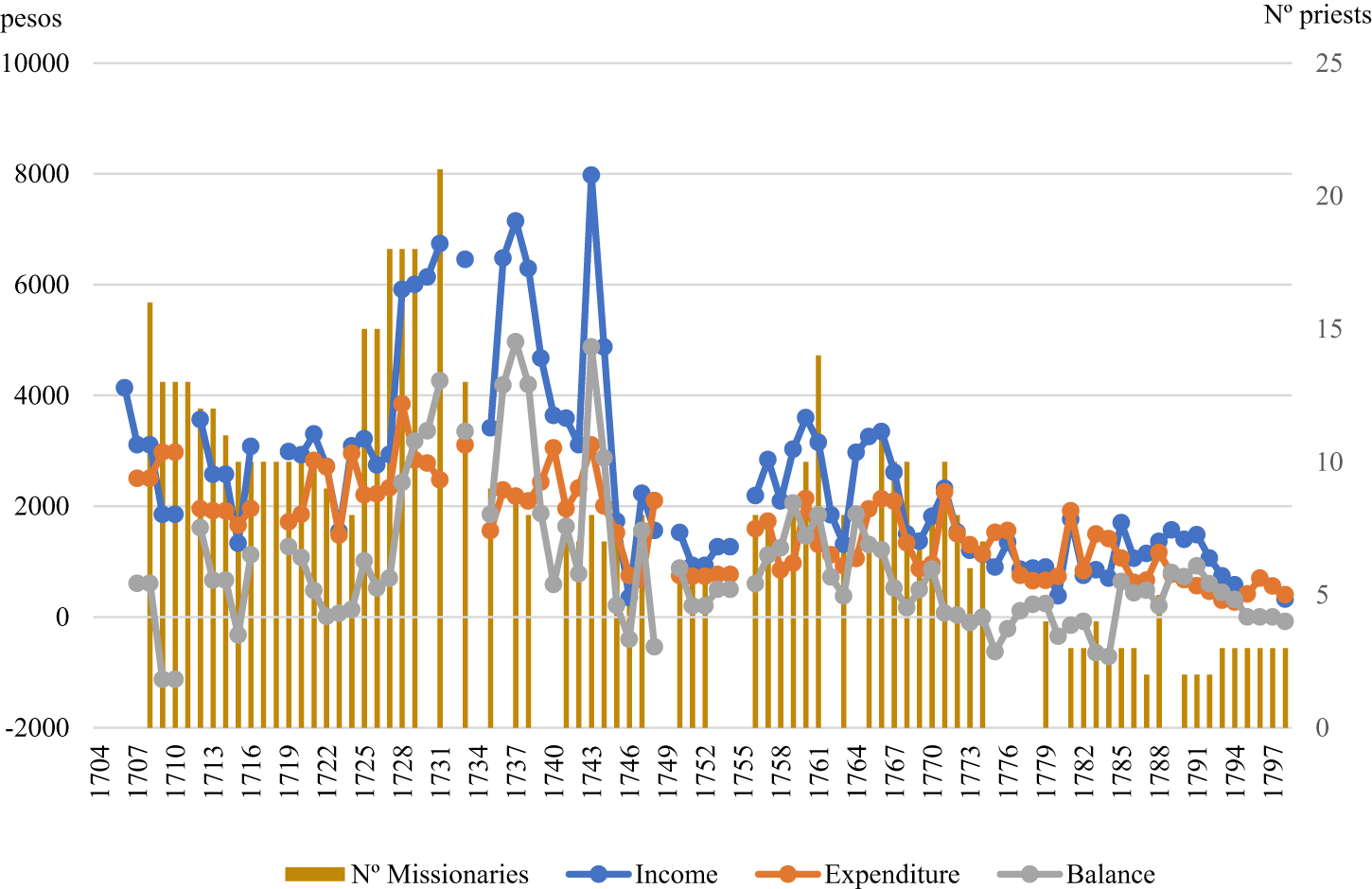
Figure 1 shows the accounting indicators of the missions relative to the number of priests posted in China. The chart uses the accounting reports of the mission but has been modified to address several deficiencies. Since the documents sent to Manila were balance reports rather than true account books, the information contained presents accounting problems that need to be addressed. For example, many of the first reports were sent biannually, combining the incomes and expenditures of two years. Similarly, until the 1740s, the start and end of the accounting year differed with each exercise. Some years are missing as well – data which cannot be filled in. The comisarios’ practice of not disaggregating the annual income means that often this figure included the previous year’s balance carried over, making it necessary to separate the two numbers manually. On the other hand, the number of missionaries was not always reported in a clear fashion. Overall, however, the chart paints a picture of the Spanish Franciscan mission in China during the eighteenth century. The figure shows that the income was dependent on the number of missionaries employed in China, which is expected given the reliance of the missions on the stipends paid by the king from the New Spanish treasury as part of the patronato.Footnote 70
Accounts of Spanish Franciscan Mission in China, 1707-1798. Sources: Archivo Franciscano Ibero-Oriental (AFIO), Cuentas de la Misión de China: AFIO 29-19, 29-20, 29-22, 29-26, 29-28, 29-29, 29-31, 29-32.

Figure 1 Long description
The graph displays data from 1704 to 1798, with the horizontal axis representing years and the vertical axis showing pesos and number of priests. The graph includes four data series: number of missionaries, income, expenditure and balance. The number of missionaries is depicted by vertical bars, ranging from 0 to 25. The income, expenditure and balance are represented by lines, with values ranging from negative 2000 to 10000 pesos. The income line shows fluctuations, peaking around 1740 and 1760. Expenditure follows a similar pattern, with notable peaks and troughs. The balance line remains relatively stable, with minor variations. The number of missionaries shows significant changes over the years, with peaks around 1740 and 1760. The legend identifies each data series with distinct labels.
The accounts sent to Manila state that, between 1707 and 1798, the Franciscan mission received approximately 133,813 pesos (an average of 1,470 pesos annually).Footnote 71 Most of this income was royal stipends coming from Acapulco via Manila, which is consistent with the findings of Junyang and Ollé.Footnote 72 Since 1689, the annual stipend stood at 140 pesos per missionary posted in China.Footnote 73 This stipend was then renewed in 1724, 1731, and at least also in 1736, and together with the number of priests active in China, Cochinchina, Tonkin, and Cambodia, formed the basis for calculating the annual remittances, which were sent from the royal treasury in Mexico through the Manila Galleons.Footnote 74 The shipwreck of a galleon or its failure to sail meant that the royal stipend might not arrive on time or would have to be sent by the province from Manila. Such eventualities did take place, although they were not common: the mission did not receive any stipends for the years 1744 to 1747,Footnote 75 after the capture of the Covadonga in 1743, the failure of the Nuestra Señora del Rosario to arrive to Acapulco in 1744, and the lack of galleons in 1745 dented the returns to Manila.Footnote 76 The same applied to the years 1762–1764, when the English capture of Manila and the disruption of the Pacific trade made it impossible to send the stipends from Acapulco.Footnote 77
Beyond the royal stipends, the mission also supplemented its income through the celebration of masses, alms, the occasional sale of produce consigned to them from merchants, and rarely, through donations from the Propaganda Fide or the Jesuits in China.Footnote 78 These amounts, however, were irregular and the backbone of the financing of the mission remained the patronato throughout this period. In fact, contrary to the previous period examined by Junyang and Ollé, the regularity with which the stipends were sent during the eighteenth century (except for those instances of force majeure mentioned above) is surprising.Footnote 79 Despite this regularity, there were occasions on which the mission was forced to take on debt. The creditors of the mission are not recorded systematically, but the reports mention Manila merchants, the Jesuit bishop in Beijing, and sometimes local Chinese lenders.Footnote 80 Even then, the secular decline in the volume of the mission’s cash flows reflects the declining number of active priests (and therefore, the smaller stipend remittances), most likely caused by intermittent persecution in the provinces. By the end of the period, in fact, the mission was confined to its outpost in Macao.
The account reports do not mention any real estate or local investments beyond the monastery that housed the mission. All the income of the mission was liquid, mimicking the economic circumstances of the Spanish presence in Asia and the abundance of silver specie. This provided flexibility for the activities of the mission, allowing priests to travel inland or facilitating the eventual move from Canton to Macao, but at the expense of making the mission vulnerable to maritime risk. This also further enhanced the role of the mercantile networks of lay citizens in Manila, who managed the endowment funds and invested in the trade with China. The reliance on silver shipments from America may be a reflection of the sources that have survived. The possibility that the Franciscan mission kept other separate account books cannot be discarded, given the tendency of the missionaries to report differentiated accounts to their patrons. But there is also no other indication to suggest that there was a sustained investment in local real estate or markets. The Franciscan missionaries seem to have followed a hectic programme of missionary activity that required constant travelling, and in which the majority of their members were engaged in wandering preaching. On the other hand, the overall regularity of cash stipends in coined silver may simply indicate that the needs of the mission were mostly covered with intercontinental shipments, and that the missionaries did not need to search for alternative sources of income except in those instances in which shipwrecks or war disrupted these transfers, forcing them into debt. This illustrates the peculiarities of the China mission financed from Manila, and contrasts sharply with other contemporary missionary strategies. In the case of the Philippines-based missions, “glocal” meant very literally a dependence on intercontinental cash flows.
Funding from the Misericordia or the Manila obras pías was generally not included in the reports. The impression is that no financing came from the legacy funds, except for in rare instances. In 1792, for example, the mission received 117 pesos from the Misericordia.Footnote 81 However, there were funds in Manila established with the explicit purpose of financing the missionary efforts. Combining the instructed charitable payments of the legacy funds of the Misericordia that have survived indicates that, on paper, 4,400 pesos should have annually accrued to the missionary efforts in China,Footnote 82 and it is most likely that some of the funds of the Third Order of Saint Francis would have also been earmarked for this purpose. A possible explanation is that proceeds of the funds were conflated with alms given by individuals from Manila. These occurrences were relatively common during the first half of the eighteenth century. In 1731, four individuals offered 300 pesos to the Franciscan mission in China.Footnote 83 The paucity of data regarding income and the emphasis on reporting expenses means that there is no definitive way of knowing the ultimate source of income in many cases. A different explanation is that the income from the obras pías was not recorded in the accounting reports sent to the provincials. An entry for the year 1742 shows that 500 pesos received from the Misericordia were recorded in a separate account,Footnote 84 with other entries peppered throughout the years. The entry referred to the fund established for rescuing orphaned children in China to send them to Manila, highlighting the existence of parallel account books for different purposes.
The Franciscans in Macao organised the rescuing of orphans and the baptism of children in articulo mortis, which was entirely paid for by the Misericordia.Footnote 85 This fund for orphans indeed had separate accounts, and the records for the years between 1741 and 1780 have survived.Footnote 86 Furthermore, they showed that during these thirty-nine years, the Franciscans received 8,808 pesos (an annual average of a little over 225 pesos) to run the orphanage and the baptisms.Footnote 87 This venture was interrupted by the English capture of Manila in 1762 and the looting of the Misericordia.Footnote 88 Payments only resumed in 1772 with 100 pesos sent by private individuals.Footnote 89 Indeed, the period of 1762 to 1780 saw only 500 pesos moving from Manila to Macao for this purpose, as opposed to 8,308 for the twenty years prior. It is therefore likely that the Misericordia may have disbursed a similar or even higher amount of funds in previous years, especially given the challenging circumstances of the 1740s and the 1750s for the galleon trade and the Manila obras pías.
The account book of the orphans, as it was called by the missionaries, was essentially an unbound diary in which the missionaries recorded the children who had been baptised, those living in the monastery, and the donations received from the Misericordia. However, the journal was not kept in any recognisable accounting practice; a collection was instead formed of annotations of expenses, donations, and explanations of the activities of the priests. There was seemingly a separation of accounts based on the origin of the income. As a result the Franciscan missionaries did not present a holistic report of their entire finances, but rather, a rendition of accounts to different patrons, explaining their use of the royal stipend and of the obras pías’ donations separately. The intended audience of this notebook is difficult to discern, but the separation of accounts may indicate that it could have been used by the provincial prior to report to the Misericordia, the financiers of this charity.
A first examination therefore reveals that while the obras pías may not have been as fundamental for the running of the missionary efforts of the Franciscans, they were still instrumental in supporting specific aspects of it. Examining the account books of the endowment funds themselves can help bridge that gap. The lack of account books for Manila’s obras pías has been an obstacle for researchers, and unfortunately, the account books of the Third Order of Saint Francis have not been found; however, the accounts of twenty-three legacy funds under the management of the Third Order of Saint Dominic have survived.Footnote 90 Four of these twenty-three legacy funds were established to finance Dominican missionary efforts in Tonkin, China, and the Philippines. Since the funds were earmarked for Dominican missions, it is not possible to cross-check the accounts with those of the Franciscan mission in China and Cochinchina, but the account books of the Dominican obras pías help us to cross-examine accounting practices between the legacy funds (as the originators of the financing) and the missions (as the recipients).
Of the four obras pías under the management of the Dominican third order, two were established in 1754,Footnote 91 one in 1761,Footnote 92 and another in 1775.Footnote 93 Thus, three out of the four suffered the English looting of Manila shortly after their creation, and the books of one of them (Tamón’s fund opened in 1761) were burnt in 1794, so the accounts only start after that date. None of the funds started paying out their proceeds until 1786 at the earliest. From that date until the end of the Manila Galleons in 1815, the four funds paid out a combined total of 8,353 pesos for their specified charitable destinations (an annual average of 288 pesos).Footnote 94 However, while the account books of two of the funds finish in 1797,Footnote 95 it is likely that these funds continued paying out proceeds after that date.
The sum of 8,353 pesos may not seem to be very much, but it still represents a respectable amount given the volume of the stipends and of the expenses of the Franciscan mission in Macao. The late date at which the funds started paying proceeds is not unusual. Most funds were established with a clause that all proceeds were to be reinvested in the trade until the principal reached a certain amount, when proceeds would start to be paid out.Footnote 96 Of the four funds under consideration, the funds of Echeveste only reached the established principal in 1781,Footnote 97 while the fund of Santiago Fernández did so only in 1804.Footnote 98 Similarly, proceeds would not be paid out in those years in which the funds incurred losses. This applied to most of the period of the funds’ recorded activities, due to the intermittent disruption of the trans-Pacific trade from 1762 to 1764 and from 1792 to 1815. As the Third Order of Saint Dominic, unlike the Franciscans or the Misericordia, did not have long-drawn-out conflicts with its provincial priors, its superiors would have known whether the mesas were withholding payments. It is more likely, in fact, that payments were made when it was possible to do so, and that the lack of continuity in remitting funds to the missions reflects the volatility of trade in the late eighteenth century.
The account books of the Dominican obras pías present an interesting contrast with the reports sent back to Manila by the Franciscan mission. Fragmented accounting remained the rule. Each fund had a separate account book with an appointed accountant. However, the funds’ accounts were not consolidated, and the brotherhood or Third Order tasked with their management had separate books for the accounts of their organisations.Footnote 99 The only instance in which the financial information of the funds managed by an institution was presented in its totality was in the “balances.” These were charts, functioning as balance sheets, which represented the individual accounts for a specific year of all funds side by side.Footnote 100 Balances enabled administrators to simultaneously understand the situation of specific funds as well as the overall assets under the management of the obras pías of an institution. The purpose behind their crafting is difficult to discern, since only a handful have survived for different years. Nevertheless, the fact that a balance of the obras pías managed by the Misericordia was found in the Franciscan archive signals that this was probably a document created by the mesas of managing institutions, intended to report on the health of their obras pías to stakeholders – and perhaps even to the general public.
However, there were several differences between the account books of the obras pías and the reports of the Franciscan mission in China. There was a great variety of methods and in levels of detail. Some accountants simply recorded transactions entered on an ad hoc basis, providing a balance sheet at the end of several years to keep track of the situation of the fund entrusted to them.Footnote 101 Others, like the fund of Francisco de Echeveste in Cavite, presented detailed charge and discharge accounts in which income, investments, and cash flows were presented clearly, including the payments of dividends in the form of charity.Footnote 102 Despite the diversity of detail, all account books allowed the members of the mesa to understand the situation of each fund, spot losses, and identify non-performing investments, as well as offering a balance of the funds’ performance through the years. Account keeping for the obras pías was more professionalised, betraying the internal use of the account books to track the situation of the funds. These documents were clearly created by the members of the mesas for their own consumption, even when the accounts were presented to the priors of the religious province for approval. However, there is no indication that episcopal authorities had access to the account books until late in the eighteenth century. The Franciscan reports, in contrast, seem to have functioned more as a report of expenses incurred in the undertaking of missionary activities. The differences highlight the contrasting nature of the income and use of resources between the missions and the obras pías, and therefore, the different meanings attached to account keeping.
In summary, while the overall monetary dependence of missions on the financing of the obras pías is unclear, their importance for financing specific activities was fundamental. The lack of a central repository which prevents the reconstruction of the flow of resources from the funds to the missions similarly highlights the decentralisation of the system, and the peculiar circumstances of the Spanish missions in the South China sea. The lay confraternities that managed funds enjoyed a high degree of independence from the archbishopric and their religious orders (a reflection of their fundamental role in the flow of cash), while the missionaries in China were not directly in contact with their benefactors, including the king and the royal officials in either Manila or Acapulco. Petitions would reach the Council of the Indies, the ultimate instance of appeal due to the patronato, but these, as with most other issues, had to go through provincial hierarchies, the real intermediaries sitting between donors and missionaries. The separation of accounts within the order based on the origin of the income reveals that, at least for the Franciscans in Asia, accountability to donors was a higher priority than accounting for income and expenses.
Conclusions
Conditions in Manila affected the organisation of the missions elsewhere in Asia. In the highly commercialised environment of Europeans operating in Southeast Asia, this meant that the financing of the missions, whether through royal patronage or through private donations, was reliant on the fortunes of the trade. At the same time, this trading world enhanced the influence of lay organisations that combined commercial financing and religious piety. The result of the combination of these two spheres of legal activity was the creation of ambiguous jurisdictions that enabled moral justifications for the investment of capital to the benefit of both the Manila merchant community and the religious orders, including their missionary efforts. It also produced a decentralised system of financing and remittance which reflected in the account keeping for both the missions and the obras pías. Subject to two distinct levels of compliance even if linked together through capital flows, the results were the keeping of separate accounts based on the precedence of funds and different priorities in account-keeping.
The independence of these lay organisations and the disintegrated nature of the system is evidenced precisely by the difficulty of reconstructing the entire chain of financing, from the source of the income to its expenditure on the ground. The account books of the Third Order of Saint Francis or the brotherhood of the Misericordia remained with these two institutions, and the only reason the accounts of legacy funds from the Third Order of Saint Dominic are available is due to the uniqueness of its obedience to its prior, not shared with the other lay organisations. On the other hand, the missionary accounts, created in the context of dependence on the financial authority of the provincial priors in Manila, amount to little more than annual reports, which fail to convey fundamental information regarding the nature of the income they received. This fragmentation illustrates the decentralisation in the management of funds. Nothing was integrated, and accounting entries cannot be followed from the obras pías, which needed only to record the dividends paid out, to the missions, which in turn reported the balances of expenses and incomes with exclusive detail on the former. From an accounting perspective, it is obvious that the decision-making centre was not on the ground in China, but elsewhere, primarily in Manila and in Spain. Yet, however decentralised, this system worked. The missions of the Franciscans and the Dominicans at times were capable of sustaining several transient missionaries, and even their decline as the century progressed has to be understood in the context of the increased persecution in China and the disruptions caused by the Napoleonic Wars, rather than as an inherent lack of this decentralised system.
Acknowledgements
Special thanks are due to the organizers of this special edition, Felicita Tramontana, Christian Windler, and Hélène Vu Thahn for their work and feedback, as well as to the participants of the ERC Conference “Accounting Practices and Religious Orders in Missionary Territories” and the members of the HOLYLAB Project for their questions and insightful comments.

 Open access

