Introduction
Horseweed is a self-pollinating, winter or summer annual weed that is also referred to as mare's-tail or Canada fleabane (Weaver Reference Weaver2001). Horseweed can emerge in the late summer or early fall and overwinter as a small rosette, followed by rapid vegetative growth the following spring (Buhler and Owen Reference Buhler and Owen1997; Weaver Reference Weaver2001). Horseweed is a prolific seed producer, dispersing seed by wind. The first report of glyphosate-resistant (GR) horseweed in Canada was made by Byker et al. (Reference Byker, Soltani, Robinson, Tardif, Lawton and Sikkema2013a, Reference Byker, Soltani, Robinson, Tardif, Lawton and Sikkema2013b, Reference Byker, Soltani, Robinson, Tardif, Lawton and Sikkema2013c) from seed collected in 2010 in Essex County, Ontario. Since then, GR horseweed has been reported in 30 Ontario counties across Ontario (Budd et al. Reference Budd, Soltani, Robinson, Hooker, Miller and Sikkema2018; Byker et al. Reference Byker, Soltani, Robinson, Tardif, Lawton and Sikkema2013b).
Giant ragweed is an annual dicot plant with early-spring emergence that is native to North America (Bassett and Crompton Reference Bassett and Crompton1982; Johnson et al. Reference Johnson, Loux, Nordby, Sprague, Nice, Westhoven and Stachler2007). Giant ragweed flowers between July and September in Ontario and has the potential to produce 10 million pollen grains per day, leading to a high level of genetic diversity through cross pollination (Bassett and Crompton Reference Bassett and Crompton1982; Johnson et al. Reference Johnson, Loux, Nordby, Sprague, Nice, Westhoven and Stachler2007). Giant ragweed is found in a wide range of environments such as riverbanks, ditches, and agricultural fields. The first report of GR giant ragweed in Canada was from seeds collected in 2008 near Windsor, Ontario (Vink et al. Reference Vink, Soltani, Robinson, Tardif, Lawton and Sikkema2012). In 2010, 47 sites in southwestern Ontario were confirmed to have GR giant ragweed. By 2013, 34 additional sites in southwestern Ontario were confirmed to be resistant to glyphosate (Follings Reference Follings2013). GR giant ragweed biotypes have been confirmed in Chatham-Kent, Elgin, Essex, Huron, Lambton, Lennox and Addington, and Middlesex counties (Follings Reference Follings2013; Vink et al. Reference Vink, Soltani, Robinson, Tardif, Lawton and Sikkema2012).
Wheat is the leading crop globally, based on the number of hectares grown. Wheat is commonly used in Ontario crop rotations. Wheat can suppress weeds, but if emergence is delayed or a competitive species is present, yield can be negatively affected (Worthington et al. Reference Worthington, Reberg-Horton, Brown-Guedira, Jordan, Weisz and Murphya2015). Although there are limited reports on winter wheat yield loss due to the presence of GR horseweed and GR giant ragweed, weeds can host insects and disease pathogens, contaminate the grain, reduce straw yield, and complicate harvest; all of these factors can lead to economic loss for the producer (Klein Reference Klein2019).
It has previously been suggested that an integrated weed management (IWM) system is required to control GR weed biotypes (Beckie Reference Beckie2006; Mortensen et al. Reference Mortensen, Egan, Maxwell, Ryan and Smith2012). Davis et al. (Reference Davis, Gibson, Bauman, Weller and Johnson2009) explored whether the inclusion of winter wheat in a crop rotation could affect the prevalence of GR horseweed; in a long-term rotation, positive effects were reported. However, previous literature reported that herbicide rotation, predominantly herbicides other than glyphosate, is the key driver in an IWM system to reduce GR biotypes in a field (Davis et al. Reference Davis, Gibson, Bauman, Weller and Johnson2009; Swanton et al. Reference Swanton, Booth, Chandler, Clements and Shrestha2006). Only limited effective POST herbicide treatments are available for winter wheat when GR horseweed or GR giant ragweed is present (OMAFRA 2018). Halauxifen-methyl is a new arylpicolinate (WSSA Group 4) herbicide. Known as Arylex™, halauxifen-methyl is a selective broadleaf herbicide that can be applied POST in wheat at 5 g ai ha–1 (Dow AgroSciences 2017). Halauxifen-methyl is registered to provide control of a wide range of annual broadleaf weed species and suppression of some perennial broadleaf species, including herbicide-resistant biotypes (Dow AgroSciences 2017). Introducing wheat into a rotation of GR corn (Zea mays L.) and/or soybean (Glycine max L.) may provide growers with an integrated approach to control GR horseweed and GR giant ragweed, and halauxifen may be a useful tool for the management of these weeds in winter wheat.
Halauxifen-methyl/fluroxypyr is currently registered for use in winter wheat, although more research is required to better understand the most effective way to manage GR horseweed and giant ragweed with halauxifen-methyl. The hypothesis of these studies was that halauxifen-methyl (5 g ai ha–1), combined with currently registered wheat herbicides, will improve the control of GR horseweed and GR giant ragweed compared to industry standards. The objective of these studies was to determine the efficacy of halauxifen-methyl applied alone, and in combination, for the control of GR horseweed and GR giant ragweed in winter wheat.
Materials and Methods
Experimental Methods
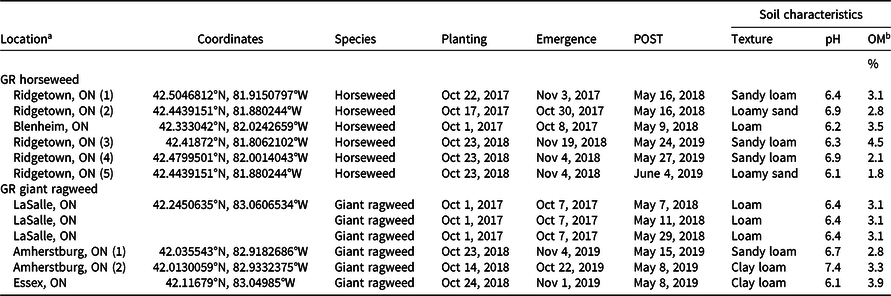
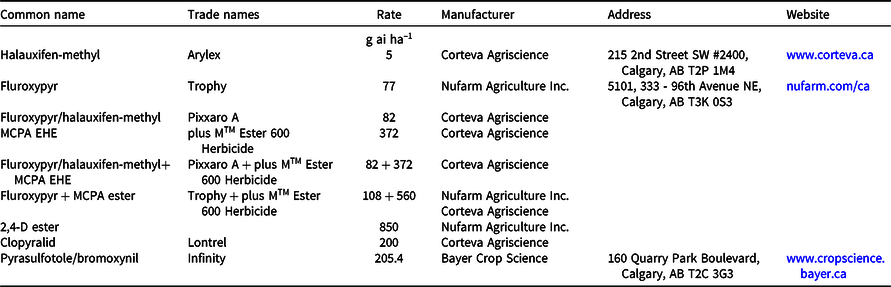
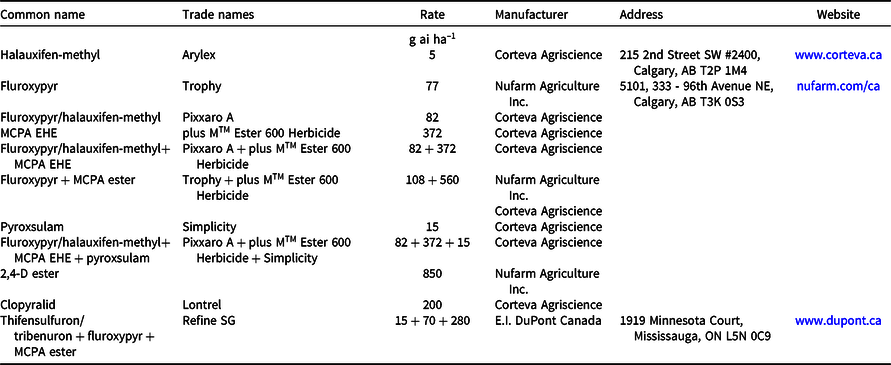
Two studies, each consisting of six field trials, were conducted during 2018 and 2019 (Table 1). One study investigated the control of GR horseweed, and the other investigated the control of GR giant ragweed. GR horseweed and GR giant ragweed control were evaluated at six and four field sites, respectively, across southwestern Ontario. When trials were located at the same site, they were separated in time and location in the field. Wheat was planted at a rate of 152 kg ha–1, at a depth of 2.5 cm with 19-cm row spacing. Cultivars used were ‘Pioneer 25R40’, ‘Pioneer 25R74’, and ‘Pioneer 25R46’ (Pioneer Hi Bred International, Johnston, IA). Fertilizer was applied when required according to OMAFRA recommendations (OMAFRA 2017). Treatments within each trial were arranged in a randomized complete block design consisting of 4 blocks with 9 treatments in the GR horseweed study, and 4 blocks with 11 treatments in the GR giant ragweed study, plus the weedy and weed-free controls. The treatments are presented in Tables 2 and 3. Plots were 2 m wide by 8 m long. Treatments were applied POST to winter wheat when the majority of weeds were <10 cm in height. The weed-free control in the GR horseweed study was maintained weed-free with pyrasulfotole/bromoxynil (205.4 g ai ha–1) + ammonium sulfate (1.0 L ha–1) applied POST, followed by hand-weeding as required. Similarly, the weed-free control in the GR giant ragweed study was maintained weed-free with 2,4-D ester (850 g ae ha–1) applied POST followed by hand-weeding as required. Herbicide applications were made with a CO2-pressurized backpack sprayer calibrated to deliver spray solution at 200 L ha–1. The sprayer was equipped with a 1.5-m-wide handheld boom with four ULD nozzles (Hypro, New Brighton, MN), producing a spray width of 2.0 m.
Planting and emergence dates of winter wheat, and application dates and soil characteristics for the studies on POST control of glyphosate-resistant horseweed and giant ragweed in Ontario in 2018 and 2019.

a Locations from the same town followed by a different number are located at different locations.
b Abbreviation: OM, organic matter.
Glyphosate-resistant (GR) horseweed herbicide treatments applied POST across six experiments conducted in Ontario, Canada during 2018 and 2019.

Glyphosate-resistant (GR) giant ragweed herbicide treatments applied POST across six experiments conducted in Ontario, Canada during 2018 and 2019.

Crop injury was assessed at 1, 2, and 4 WAA on a scale of 0 to 100, with 0 indicating no visible injury and 100 indicating total plant death. GR horseweed and GR giant ragweed control were assessed 2, 4, and 8 WAA. Weed control ratings were assessed using a 0-to-100 scale, with 0 indicating no weed control and 100 indicating complete weed control. GR horseweed and GR giant ragweed density and biomass assessments were made 4 WAA. Weed density and biomass were determined by counting and harvesting plants in two 0.25-m2 quadrats in separate areas of each plot. Weed biomass was measured in each plot by harvesting the plants at the soil surface, placing them in a paper bag, drying them in a kiln at 60 C for 3 wk, and recording the weight. Winter wheat was harvested at maturity with a small-plot combine (area harvested 1.45 m × 8 m); grain moisture content and weight were recorded. Yield data were adjusted to 14% moisture content.
Statistical Analysis
PROC GLIMMIX was used in SAS v. 9.4 (SAS Institute Inc., Cary, NC) for data analysis. The model fixed effect was the herbicide treatment, and the random effects were block and site (year by site). PROC UNIVARIATE was used to test for normality. GR horseweed control data at 2, 4, and 8 WAA were fit to a beta distribution and logit link. The data were then back-transformed using the ilink option in SAS. GR giant ragweed control data for 2, 4, and 8 WAA were fit to a normal distribution and the corresponding identity link. The untreated and weed-free controls were not included in the weed control analysis for either GR horseweed or GR giant ragweed. Density and biomass data were fit to a log-normal distribution with the identity link. All means were back-transformed within SAS. A normal distribution was used to analyze yield data. A multiple-comparison Fisher protected LSD and Tukey-Kramer adjustment (α = 0.05) were used for treatment separation. Means were independently compared to zero.
Results and Discussion
There were significant interactions between herbicide treatment and site (year by site) for 4 and 8 WAA assessments, density, and biomass. These significant interactions are attributed to varying weed pressure and precipitation. Weed pressure among site-by-year combinations was variable. Additionally, season-long rainfall and rainfall immediately following application varied among site-by-year combinations. To better understand the best herbicide option across differing Ontario environments, sites were combined for analysis.
GR Horseweed
Weed Control
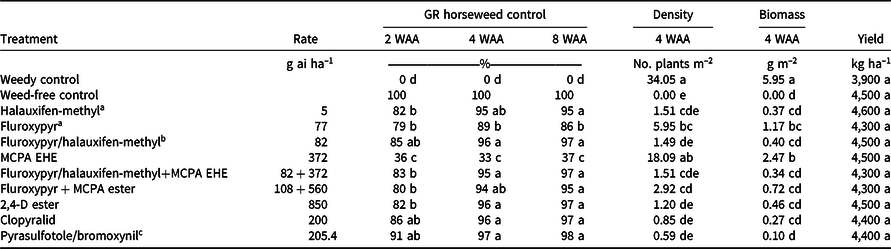
At 2 WAA, halauxifen-methyl alone provided good control of GR horseweed (82%) (Table 4). Similarly, fluroxypyr, fluroxypyr + MCPA ester, 2,4-D ester, and fluroxypyr/halauxifen-methyl + MCPA EHE controlled GR horseweed 79% to 83%. MCPA EHE provided poor control of GR horseweed (36%). Fluroxypyr/halauxifen-methyl, clopyralid, and pyrasulfotole/bromoxynil were the most efficacious treatments, providing 85% to 91% control of GR horseweed, respectively.
Glyphosate-resistant (GR) horseweed control 2, 4, and 8 wk after application (WAA), density and biomass 4 WAA, and winter wheat yield with herbicides applied POST across six experiments conducted in Ontario, Canada during 2018 and 2019.a

a Values followed by the same lowercase letter within column were not statistically different (P < 0.05).
b Tank mix included methylated seed oil at a rate of 1% v/v.
c Tank mix included ammonium sulfate at 1 L ha–1.
At 4 and 8 WAA, MCPA EHE provided poor control of GR horseweed (33% to 37%), whereas fluroxypyr provided good control (86% to 89%) (Table 4). All remaining herbicide treatments evaluated (halauxifen-methyl, fluroxypyr/halauxifen-methyl, fluroxypyr/halauxifen-methyl + MCPA EHE, fluroxypyr + MCPA ester, 2,4-D ester, clopyralid, and pyrasulfotole/bromoxynil) controlled GR horseweed similarly at 94% to 98%. At 4 WAA, there was no benefit from adding MCPA ester to fluroxypyr or MCPA EHE to fluroxypyr/halauxifen-methyl. At 8 WAA, the addition of MCPA ester to fluroxypyr improved GR horseweed control, but adding MCPA EHE to fluroxypyr/halauxifen-methyl did not increase control. Mahoney et al. (Reference Mahoney, McNaughton and Sikkema2016) reported that MCPA (630 g ai ha–1), 2,4-D (528 g ai ha–1), fluroxypyr +MCPA (108 + 560 g ai ha–1), clopyralid (200 g ai ha–1), and pyrasulfotole + bromoxynil (31.1 + 174.3 g ai ha–1) controlled GR horseweed 58%, 78%, 82%, 86%, and 95% in winter wheat 4 WAA, respectively. At 8 WAA, Mahoney et al. (Reference Mahoney, McNaughton and Sikkema2016) reported that MCPA, clopyralid, 2,4-D, fluroxypyr + MCPA, and pyrasulfotole/bromoxynil provided 67%, 87%, 89%, 96%, and 97% control of GR horseweed in winter wheat, respectively. In this study, the lower GR horseweed control with MCPA can be attributed to the lower use rate, whereas the improved control with 2,4-D can be attributed to the higher use rate. Furthermore, Kumar et al. (Reference Kumar, Jha and Jhala2017) observed that fluroxypyr provided 83% to 88% control of GR horseweed 31 d after treatment (DAT), similar to the 89% control in this study. Previous research conducted by Zimmer et al. (Reference Zimmer, Young and Johnson2018a, Reference Zimmer, Young and Johnson2018b) also found that halauxifen-methyl (5 g ai ha–1) provided 90% control of GR horseweed in soybean 35 DAT, comparable to the control observed in this study. In contrast, McCauley et al. (Reference McCauley, Johnson and Young2018) reported that halauxifen-methyl (5 g ha–1) provided 65% to 80% control of GR horseweed 28 DAT; their study was in a no-crop system, and plants ranged from 5 to 30 cm at application, whereas in this study all weeds were <10 cm tall, with crop competition, which may explain the lower control in that study.
Density and Biomass
At 4 WAA, halauxifen-methyl, fluroxypyr/halauxifen-methyl, and fluroxypyr/halauxifen-methyl + MCPA EHE significantly reduced GR horseweed density, similar to other industry standards (Table 4). Fluroxypyr reduced GR horseweed density 82%, whereas MCPA EHE did not reduce GR density relative to the weedy control. There was no benefit with the addition of MCPA EHE to fluroxypyr/halauxifen-methyl to reduce GR horseweed density. Similar to this study, Mahoney et al. (Reference Mahoney, McNaughton and Sikkema2016) reported that 2,4-D, clopyralid, fluroxypyr + MCPA, and pyrasulfotole/bromoxynil reduced GR horseweed density by 94% to 99%. In contrast, Zimmer et al. (Reference Zimmer, Young and Johnson2018a) reported that halauxifen-methyl applied in soybean reduced GR horseweed density by 76%.
At 4 WAA, biomass reduction followed a trend similar to density reduction (Table 4). All halauxifen-methyl treatments greatly reduced GR horseweed biomass, similar to the weed-free check. This biomass reduction was comparable to current industry standards. MCPA EHE and fluroxypyr reduced GR horseweed biomass by 58% and 82%, respectively. Mahoney et al. (Reference Mahoney, McNaughton and Sikkema2016) reported similar GR horseweed biomass reductions for 2,4-D, clopyralid, fluroxypyr + MCPA, and pyrasulfotole/bromoxynil. There was no impact of GR horseweed interference on winter wheat yield in this study, which was similar to studies completed by McNaughton et al. (Reference McNaughton, Brown and Sikkema2014) and Robinson et al. (Reference Robinson, Letarte, Cowbrough, Sikkema and Tardif2015). Winter wheat injury was ≤10% at all site-years at 1, 2, and 4 WAA; data are not presented.
Giant Ragweed
Weed Control
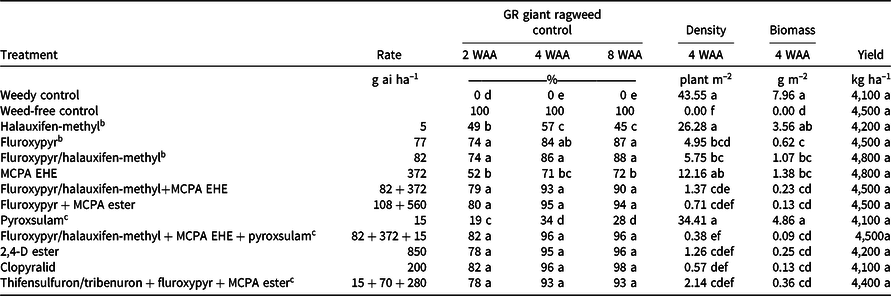
At 2 WAA, halauxifen-methyl alone did not control GR giant ragweed but did provide 49% suppression (Table 5). Pyroxsulam and MCPA EHE suppressed GR giant ragweed by 19% and 52%, respectively. All other treatments (fluroxypyr, fluroxypyr/halauxifen-methyl, fluroxypyr/halauxifen-methyl + MCPA EHE, fluroxypyr + MCPA ester, fluroxypyr/halauxifen-methyl + MCPA EHE + pyroxsulam, 2,4-D ester, clopyralid, and thifensulfuron/tribenuron + fluroxypyr + MCPA ester) controlled GR giant ragweed similarly between 74% and 82%.
Glyphosate-resistant (GR) giant ragweed control 2, 4, and 8 wk after application (WAA), density and biomass 4 WAA, and winter wheat yield with herbicides applied POST from six experiments conducted in Ontario, Canada in 2018 and 2019.a

a Values followed by the same lowercase letter(s) within a column were not statistically different (P < 0.05).
b Tank mix included methylated seed oil at a rate of 1% v/v.
c Tank mix included Agral 90 (nonionic spreading and wetting agent; Syngenta Canada Inc., 140 Research Lane, Research Park, Guelph, ON N1G 4Z3) at a rate of 0.25% v/v.
At 4 and 8 WAA, pyroxsulam, halauxifen-methyl, and MCPA EHE did not provide adequate control of GR giant ragweed (Table 5). At 4 and 8 WAA, all other herbicide treatments (fluroxypyr, fluroxypyr/halauxifen-methyl, fluroxypyr/halauxifen-methyl + MCPA EHE, fluroxypyr + MCPA ester, fluroxypyr/halauxifen-methyl + MCPA EHE + pyroxsulam, 2,4-D ester, clopyralid, and thifensulfuron/tribenuron + fluroxypyr + MCPA ester) provided good to excellent control of GR giant ragweed, ranging from 84% to 98%. At 4 and 8 WAA, there was no benefit of the addition of MCPA ester to fluroxypyr. Furthermore, there was no benefit of the addition of MCPA EHE or MCPA EHE + pyroxsulam to fluroxypyr/halauxifen-methyl. Mahoney et al. (Reference Mahoney, McNaughton and Sikkema2016) reported similar GR giant ragweed control with MCPA (69%), fluroxypyr + MCPA (89%), and 2,4-D (88%), although they reported lower control with clopyralid (76%) and thifensulfuron/tribenuron + MCPA (58%) at 4 WAA. The treatment of thifensulfuron/tribenuron + MCPA did not contain fluroxypyr in their study, highlighting the value of fluroxypyr in the mix. Similar to this study, Zimmer et al. (Reference Zimmer, Young and Johnson2018a) observed 65% control of GR giant ragweed 35 DAT when halauxifen-methyl was applied as a burndown in soybean. Mahoney et al. (Reference Mahoney, McNaughton and Sikkema2016) reported similar GR giant ragweed control at 8 WAA; MCPA, clopyralid, 2,4-D, and fluroxypyr + MCPA controlled GR giant ragweed 83%, 92%, 95%, and 97%, respectively. The slightly lower control in this study with MCPA can be due to the lower rate of MCPA. In contrast, thifensulfuron/tribenuron + MCPA in the Mahoney et al. (Reference Mahoney, McNaughton and Sikkema2016) study provided only 78% control of GR giant ragweed; the same treatment with the addition of fluroxypyr in this study provided 93% control.
Density and Biomass
At 4 WAA, fluroxypyr/halauxifen-methyl + MCPA EHE and fluroxypyr/halauxifen-methyl + MCPA EHE + pyroxsulam significantly reduced GR giant ragweed density by 95% to 100% (Table 5). This reduction was similar to fluroxypyr + MCPA ester, 2,4-D, clopyralid, and thifensulfuron/tribenuron + fluroxypyr + MCPA ester. Fluroxypyr and fluroxypyr/halauxifen-methyl decreased GR giant ragweed density by 89% and 86%, respectively. Halauxifen-methyl alone did not adequately reduce GR giant ragweed density. MCPA EHE and pyroxsulam did not reduce GR giant ragweed density relative to the weedy control. Similar to this study, Mahoney et al. (Reference Mahoney, McNaughton and Sikkema2016) reported that fluroxypyr + MCPA, 2,4-D ester, clopyralid, and thifensulfuron/tribenuron + MCPA reduced GR giant ragweed density by 89% to 100%.
At 4 WAA, all treatments including halauxifen-methyl tank mixes (fluroxypyr, fluroxypyr/halauxifen-methyl, MCPA EHE, fluroxypyr/halauxifen-methyl + MCPA EHE, fluroxypyr + MCPA ester, fluroxypyr/halauxifen-methyl + MCPA EHE + pyroxsulam, 2,4-D, clopyralid, and thifensulfuron/tribenuron + fluroxypyr + MCPA ester) significantly reduced GR giant ragweed biomass 83% to 99%. Halauxifen-methyl and pyroxsulam alone did not reduce GR giant ragweed biomass. Mahoney et al. (Reference Mahoney, McNaughton and Sikkema2016) reported similar findings for biomass reduction of GR giant ragweed in winter wheat. GR giant ragweed interference had no impact on winter wheat yield in this study. Winter wheat injury was ≤10% at all site-years at 1, 2, and 4 WAA; data are not presented.
Halauxifen-methyl applied alone, in combination with fluroxypyr, or in combination with fluroxypyr + MCPA EHE provided excellent control of GR horseweed in winter wheat. The observed control was equivalent to 2,4-D, clopyralid, and pyrasulfotole/bromoxynil. Halauxifen-methyl applied alone did not adequately control GR giant ragweed, although when in combination with fluroxypyr + MCPA EHE or fluroxypyr + MCPA EHE + pyroxsulam, excellent control was observed. The observed control was similar to 2,4-D ester, clopyralid, and thifensulfuron/tribenuron + fluroxypyr + MCPA ester. Although there was no significant difference in yield between treatments with either weed species, season-long control of GR horseweed and giant ragweed in winter wheat is imperative to reduce pest pressure in an IWM system. Overall, this study demonstrated the efficacy of halauxifen-methyl when used in a mix for the control of GR horseweed and giant ragweed. The availability of products containing halauxifen-methyl will provide producers with additional effective herbicide options, specifically when designing an IWM system to manage herbicide-resistant weed populations. The addition of halauxifen-methyl to a mix while also incorporating other weed control strategies may help reduce the selection pressure for herbicide resistance and preserve the use of herbicides for weed control.
Acknowledgments
Funding for this project was provided by Corteva Agriscience Inc. No other conflicts of interest have been declared.