Introduction
Schizophrenia is a relatively common (~0.6%), multifactorial neuropsychiatric syndrome that typically shows familial clustering. The risk of developing schizophrenia is considerably greater among the first-degree biological relatives of affected persons (~10-fold) than in the general population, and both certain personality disorders and non-schizophrenic psychotic disorders (i.e. schizophrenia spectrum disorders) are also known to aggregate in the families of probands (Kendler and Diehl, Reference Kendler and Diehl1993). Decades of family, twin and adoption studies indicate a substantial genetic component to risk with a modest contribution of environmental influences, but the mode of transmission is complex, and convergent evidence supports a highly polygenic architecture. The multifactorial origins of schizophrenia, taken together with its extensive clinical heterogeneity, have hindered efforts to delineate its neurobiological underpinnings.
Given these inherent complexities, the study of schizophrenia endophenotypes has gained significant traction as an alternative research strategy to simply studying schizophrenic symptoms to elucidate the neurobiological underpinnings of this disorder. Endophenotypes are heritable, disease state independent (i.e. stable), and quantitative trait-related measures posited to be more proximal to underlying disease processes than a schizophrenia diagnosis (Shields and Gottesman, Reference Shields and Gottesman1972; Gottesman and Gould, Reference Gottesman and Gould2003). Neurocognitive measures of working memory, verbal declarative memory, and sustained attention are particularly salient endophenotypes for schizophrenia, given the prominent deficits in these cognitive domains observed in patients and, to a lesser extent, their unaffected relatives (Gur et al., Reference Gur, Calkins, Gur, Horan, Nuechterlein, Seidman and Stone2007). That particular domains of cognition are known to involve specific brain regions further highlights the advantages of examining neurocognitive endophenotypes in schizophrenia.
We sought to replicate previous reports demonstrating significant familial transmission (or ‘familiality’), involving shared familial-environmental factors, in select neurocognitive domains. Using empirically derived factor scores representing attention, working memory, verbal learning, verbal retention, and memory for faces, we obtained estimates of familial transmission in independent cohorts of childhood- and adult-onset schizophrenia, and community control families. We compare these estimates to those reported previously by Greenwood and colleagues (Greenwood et al., Reference Greenwood, Braff, Light, Cadenhead, Calkins, Dobie, Freedman, Green, Gur, Gur, Mintz, Nuechterlein, Olincy, Radant, Seidman, Siever, Silverman, Stone, Swerdlow, Tsuang, Tsuang, Turetsky and Schork2007; Greenwood et al., Reference Greenwood, Swerdlow, Gur, Cadenhead, Calkins, Dobie, Freedman, Green, Gur, Lazzeroni, Nuechterlein, Olincy, Radant, Ray, Schork, Seidman, Siever, Silverman, Stone, Sugar, Tsuang, Tsuang, Turetsky, Light and Braff2013). Of particular interest was whether analyses of the familial transmission of neurocognitive functioning in families with a childhood-onset schizophrenia patient would more-or-less recapitulate those in families with the more typical, adult-onset schizophrenia patient, or yield preliminary evidence of potentially divergent genetic architectures.
Methods
Ascertainment and diagnosis
Probands and relatives for childhood- and adult-onset schizophrenia and community control cohorts were ascertained as part of the UCLA Family Study (Asarnow et al., Reference Asarnow, Nuechterlein, Fogelson, Subotnik, Payne, Russell, Asamen, Kuppinger and Kendler2001; Nuechterlein et al., Reference Nuechterlein, Asarnow, Subotnik, Fogelson, Payne, Kendler, Neale, Jacobson and Mintz2002). The current study combines data for child and adult probands with DSM-IV diagnoses of schizophrenia or schizoaffective disorder, depressed type, age-matched non-psychotic community control probands, and first-degree relatives of probands (i.e. parents, full- and half-siblings), all of whom were at least 7 years of age and had valid data from neurocognitive assessments (described below). Probands with neurological disorders, substance abuse that obscured the source of psychotic symptoms, or full-scale IQ less than 70 were excluded. In addition, community control probands could not have DSM-IV diagnoses in the schizophrenia spectrum, but could have any other psychiatric diagnoses. All participants in this study provided either informed consent or if the participant was a minor parental consent and minor assent.
Details regarding proband recruitment strategy are detailed elsewhere and reviewed only briefly here (Nuechterlein et al., Reference Nuechterlein, Dawson, Gitlin, Ventura, Goldstein, Snyder, Yee and Mintz1992; Subotnik et al., Reference Subotnik, Nuechterlein, Asarnow, Fogelson, Goldstein and Talovic1997; Asarnow et al., Reference Asarnow, Nuechterlein, Fogelson, Subotnik, Payne, Russell, Asamen, Kuppinger and Kendler2001). Childhood-onset probands were children with consensus diagnoses of DSM-IV schizophrenia with first onset of psychosis before 13 years of age (American Psychiatric Association. and American Psychiatric Association. Work Group to Revise DSM-III., 1987). Probands were identified by screening 9 Los Angeles County facilities that treated appreciable numbers of childhood-onset schizophrenia patients, and through the Resnick Neuropsychiatric Hospital at UCLA and school-based programs for seriously emotionally disturbed children in the Los Angeles County Department of Mental Health and the Los Angeles Unified School District. Adult-onset probands were recruited from a study of schizophrenia patients with a recent adult onset of psychosis, Developmental Processes in Schizophrenic Disorders (Nuechterlein et al., Reference Nuechterlein, Dawson, Gitlin, Ventura, Goldstein, Snyder, Yee and Mintz1992), which drew its sample from consecutive admissions to four large public hospitals in Los Angeles and from outpatient referrals to the Aftercare Research Program of the UCLA Neuropsychiatric Institute.
A scientific survey research firm (Survey Sampling Inc., Fairfield, Conn) provided lists of potential community controls living in the same ZIP codes as probands. Prospective community control probands or their parents, as applicable, were contacted by telephone to explain the purpose of the study, as well as to screen probands for schizophrenia or placement in special classes for gifted or learning-disabled children.
Neurocognitive assessment
Probands and their relatives were administered the Degraded Stimulus version of the Continuous Performance Task (DS-CPT) (Nuechterlein et al., Reference Nuechterlein, Parasuraman and Jiang1983), 3-7 CPT (Nuechterlein et al., Reference Nuechterlein, Edell, Norris and Dawson1986), Forced-Choice Span of Apprehension Task (SPAN) (Asarnow and MacCrimmon, Reference Asarnow and MacCrimmon1978), Trail Making Test (TMT) (Army Individual Test Battery, 1944), and Maintenance and Manipulation Test (MNM) (Kim et al., Reference Kim, Glahn, Nuechterlein and Cannon2004). Participants 17 years old or older were administered the California Verbal Learning Test (CVLT-II) (Delis et al., Reference Delis, Kramer, Kaplan and Ober2000) and the Wechsler Memory Scale – III (WMS-III): Digit Span (WMS-III DS), Memory for Faces (WMS-III Faces), and Logical Memory (WMS-III LM) (Tulsky et al., Reference Tulsky, Zhu and Lebetter1997). Participants 16 years old or younger were administered the CVLT for Children (CVLT-C), and the Test of Memory and Learning (TOMAL), 2nd Ed.: Digits Forward and Digits Backward (TOMAL Digits), Memory for Stories (C) (TOMAL MS), and Facial Memory (TOMAL Faces) (Ramsay and Reynolds, Reference Ramsay and Reynolds1995).
Derivation of cognitive dimensions
The UCLA Family Study employed a broad battery of cognitive tests found in prior research to show impairment in both schizophrenia patients and their unaffected first-degree relatives. A parsimonious set of composite scores was created for use in relational analyses with other data domains including clinical, genetics, and neuroimaging variables. Briefly, a specialized approach to norming was used to account for the wide age range in the sample and the corresponding use of multiple versions for some tests. A combination of factor analytic and clustering techniques was then applied to the resulting standardized scores to identify subgroups of measures with shared variance. The final composites were created by averaging the resultant sets of scores using unit weights. The result was five composite scores that measure attention, working memory, verbal learning, verbal retention, and memory for faces. The specific assessments comprising each of the five composite scores are displayed in Table 3.
Variance component analyses
We used the variance component approach implemented in the SOLAR-Eclipse software (version 7.6.4) (Blangero and Almasy, Reference Blangero and Almasy1996) to obtain estimates of the phenotypic variance explained by shared familial-environmental factors. Using maximum likelihood, this method compares models in which some fraction or none of the variation in a trait is explained by relationships among pedigree members. It is important to note that in settings where only first-degree relatives (i.e. parent-offspring and sibling-sibling pairs) were assessed, the contributions of shared genetic and shared environmental factors are confounded (Kendler and Neale, Reference Kendler and Neale2009). Since this is largely true of the three cohorts considered here, resultant estimates of ‘heritability’ are more accurately interpreted as representing familial rather than specifically genetic transmission.
Prior evidence suggests that particular neurocognitive measures may be influenced by sex, low education, and socioeconomically disadvantaged minority background (Stone et al., Reference Stone, Giuliano, Tsuang, Braff, Cadenhead, Calkins, Dobie, Faraone, Freedman, Green, Greenwood, Gur, Gur, Light, Mintz, Nuechterlein, Olincy, Radant, Roe, Schork, Siever, Silverman, Swerdlow, Thomas, Tsuang, Turetsky and Seidman2011). We adjusted the factors used here for sex effects and excluded subjects with fewer than 6 years of formal education. We also examined relationships with a binary variable indicating socioeconomically disadvantaged minority status for each factor using the polygenic –screen routine in SOLAR-Eclipse. Subsequent ‘heritability’ analyses controlled for socioeconomically disadvantaged minority status if it was associated with a given neurocognitive factor. We also controlled for ascertainment bias. Briefly, because affected probands were ascertained specifically for schizophrenia, the families studied here are non-representative of the population at large. This is true of the control pedigrees because these ‘probands’ were age-matched to affected counterparts, and especially true of childhood-onset schizophrenia proband cases given the low prevalence of this disorder. As implemented in SOLAR-Eclipse, correction for extreme ascertainment is achieved by conditioning on the probands' phenotypic values (Beaty and Liang, Reference Beaty and Liang1987).
For each factor and neurocognitive assessment, we compared estimates of familiality between childhood- and adult-onset cohorts via a simple test of inequality. Briefly, we specified a combined model inclusive of both cohorts using the polyclass – intrait – comb – max routine in SOLAR-Eclipse, which allows for different mean effects and variances in each cohort but a single ‘heritability’ term. The resultant log-likelihood estimate was then compared to the sum of log-likelihoods for models in which each cohort was separately estimated; twice the difference in log-likelihoods is distributed as a χ2 with one degree of freedom.
For exploratory, bivariate analyses of pairs of measures, we considered only factors that yielded nominally significant estimates of familial transmission in a given cohort (i.e. p < 0.05). We included socioeconomically disadvantaged minority status as a covariate if it was associated with both traits; if associated with a single trait, we specified this as being applicable to only that trait. In instances where standard errors were not computable by SOLAR Eclipse due to model instability, we constrained the parameter estimate (p g) to ‘nearby’ values and re-estimated the log-likelihood difference.
Results
Demographic characteristics
Table 1 summarizes relevant demographic information for the three cohorts, separately for probands and their relatives. Comparisons of probands across cohorts failed to identify any significant differences with respect to gender [χ2(2, N = 390) = 1.90, p = 0.386] or proportion of socioeconomically disadvantaged minority subjects [χ2(2, N = 390) = 0.090, p = 0.956]. Similarly, probands' relatives did not differ with respect to gender [χ2(2, N = 390) = 1.06, p = 0.589] or proportion of socioeconomically disadvantaged minority subjects [χ2(2, N = 390) = 0.83, p = 0.660].
Demographic characteristics of probands and relatives in three studied cohorts

Available sample size (N), number and fraction of Male subjects, mean Age (s.d.), number and fraction of socioeconomically Disadvantaged minority subjects, and average years of Education (s.d.) are displayed for community control, adult-onset schizophrenia (AOS), and childhood-onset schizophrenia (COS) cohorts.
As expected, age was significantly lower among childhood-onset subjects compared to their adult-onset counterparts, both for probands (t (77.5) = −10.06, p = 1.02 × 10⁻¹⁵) and their relatives (t (185.7) = 3.33, p = 0.0011). Because control probands were matched either to adult- or childhood-onset probands, we compared age between matched subsets. Average ages of childhood-onset and matched control subjects were not significantly different for probands (t (54.9) = 0.71, p = 0.484) or their relatives (t (131.5) = 0.96, p = 0.337). In contrast, adult-onset probands and relatives were slightly older on average than matched controls, based on comparisons of both probands (t (70.9) = 2.20, p = 0.0308) and their relatives (t (185.7) = 3.33, p = 0.00105).
Socioeconomically disadvantaged minority status was a significant covariate for attention, working memory, and verbal learning in the adult-onset and community control cohorts, whereas this was true only of verbal learning and memory for faces in the childhood-onset cohort.
Familial transmission of derived factors
Estimates of familial transmission for the five neurocognitive factors, as assessed in schizophrenia and community control pedigrees, are displayed in Table 2, and reflect the variance in each trait resulting from familial sources of resemblance (i.e. as inferred from pedigree structure). Only verbal learning and memory for faces yielded significant (p < 0.05) estimates in the childhood-onset cohort, while attention and working memory were found to be significantly transmissible among adult-onset families. Attention, working memory, and verbal learning were significant (p < 0.05) among community control pedigrees, with estimates of familial transmission nearly identical to those reported previously for analogous endophenotypic measures (Greenwood et al., Reference Greenwood, Braff, Light, Cadenhead, Calkins, Dobie, Freedman, Green, Gur, Gur, Mintz, Nuechterlein, Olincy, Radant, Seidman, Siever, Silverman, Stone, Swerdlow, Tsuang, Tsuang, Turetsky and Schork2007).
Estimates of familial transmission for five neurocognitive factors

N is the number of subjects with non-missing phenotypes; f 2 and p-value are the familiality estimate and its significance, as estimated by SOLAR-Eclipse. p model is the significance of a test of inequality for f 2 in adult-onset schizophrenia (AOS) and childhood-onset schizophrenia (COS) cohorts. Missing values indicate that an estimate was not computable.
* Finding remains significant (p < 0.05) following Bonferroni adjustment for 5 variables tested in 3 cohorts.
† Finding remains significant (p < 0.05) following Bonferroni adjustment for 5 pairwise comparisons.
We compared the evidence of familial transmission for adult- and childhood-onset schizophrenia pedigrees via a model-fitting procedure (see Methods). Significant evidence for group differences was observed for attention (p model < 0.005), working memory (p model < 0.01), and verbal learning (p model < 0.05).
We found that excluding community control pedigrees in which the proband had a psychiatric diagnosis outside of the schizophrenia spectrum did not meaningfully change the resulting estimates of familial transmission (results not shown).
Familial transmission of neurocognitive variables
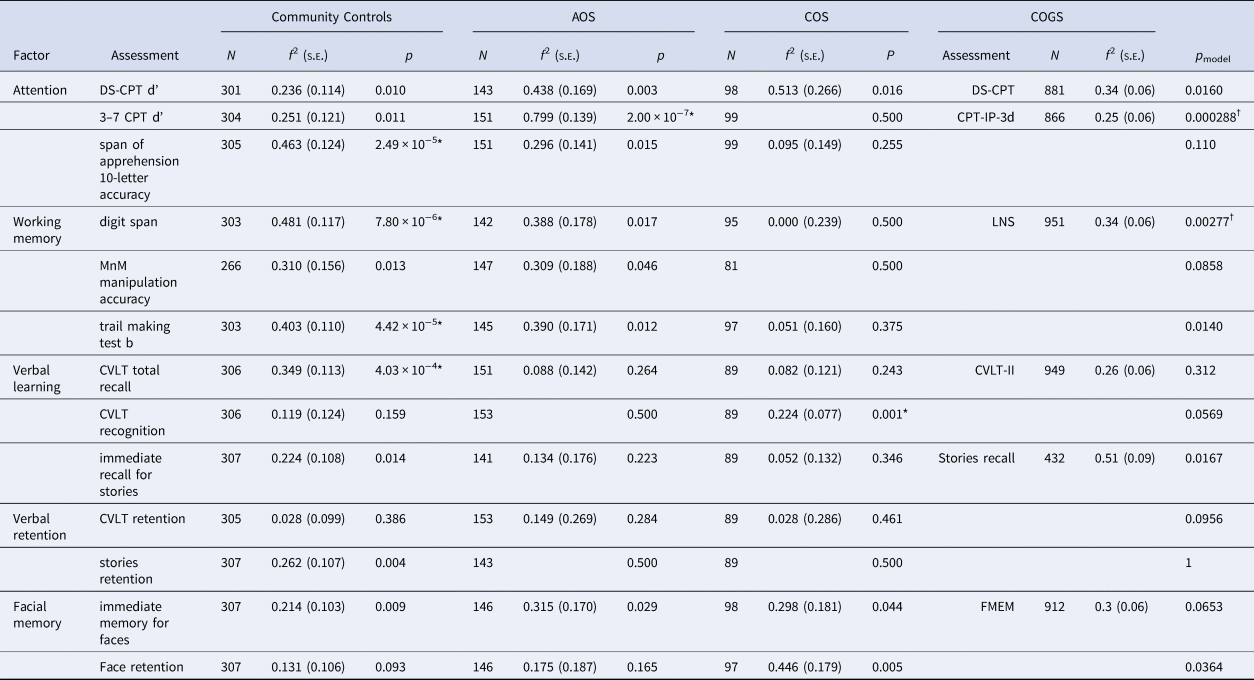
We sought to parse the observed differences between adult- and childhood-onset cohorts by evaluating the constituent neurocognitive measures used to derive these factors. Estimates of familial transmission for residualized variables are given in Table 3.
Estimates of familial transmission for neurocognitive assessments

N is the number of subjects with non-missing phenotypes; f 2 and p-value are the familiality estimate and its significance. p model is the significance of a test of inequality for f 2 in adult-onset schizophrenia (AOS) and childhood-onset schizophrenia (COS) cohorts. Missing values indicate that an estimate was not computable.
* Finding remains significant (p < 0.05) following Bonferroni adjustment for 13 variables tested in 3 cohorts.
† Finding remains significant (p < 0.05) following Bonferroni adjustment for 13 pairwise comparisons.
For attention, only degraded stimulus demonstrated significant familial transmission in the childhood-onset cohort; whereas in the adult-onset and community control pedigrees, all three constituent measures were found to be significantly familial. Model-fitting comparison revealed significant differences between adult- and childhood-onset schizophrenia for both 3-7 CPD d’ (p model < 0.0005) and, to a lesser extent, degraded stimulus (p model < 0.05). Notably, estimates for 3-7 CPT d’ were markedly higher in adult-onset pedigrees than in community controls, or previously reported estimates with conceptually related measures (Greenwood et al., Reference Greenwood, Braff, Light, Cadenhead, Calkins, Dobie, Freedman, Green, Gur, Gur, Mintz, Nuechterlein, Olincy, Radant, Seidman, Siever, Silverman, Stone, Swerdlow, Tsuang, Tsuang, Turetsky and Schork2007). The significant familial transmission of span of apprehension performance in community controls and adult-onset families is consistent with its high heritability (0.65) in a study (Bartfai et al., Reference Bartfai, Pedersen, Asarnow and Schalling1991) of normal adult monozygotic twins.
For working memory, significant familial transmission was observed for digit span, manipulation accuracy, and trails B (adolescent version) time in both adult-onset and community control pedigrees, with no evidence of familial effects in the childhood-onset cohort. Comparable estimates were observed for adult-onset and community control pedigrees, as well as between individual measures within each group. Tests of inequality indicated nominally significant differences between adult- and childhood-onset schizophrenia for digit span and trails B (p model < 0.05).
For verbal learning, no individual measure yielded a significant estimate of familial transmission in the adult-onset cohort; among childhood-onset pedigrees, only CVLT recognition was significant. By contrast, CVLT total recall and immediate story recall were significantly familial among community control pedigrees. Recalling that estimates for the verbal learning factor were comparable for childhood-onset and community control pedigrees, the observed pattern of results would suggest that its constituent measures are differentially informative in unaffected persons compared to childhood-onset schizophrenia probands and their relatives.
For verbal retention, no significant familial effects were observed for either measure in adult- and childhood-onset pedigrees. By contrast, story retention was significantly familial in community controls.
For facial memory, immediate recall was found to be significantly familial in both adult- and childhood-onset cohorts and community controls. Face retention was only significant in childhood-onset pedigrees; a test of inequality indicated a nominally significant difference between adult- and childhood-onset schizophrenia (p model < 0.05).
Familial correlations between neurocognitive factors
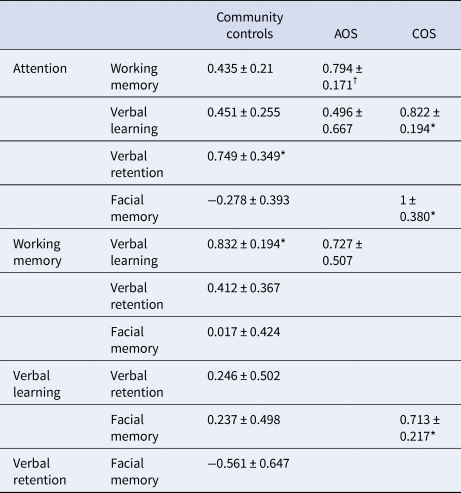
Bivariate familial correlations for selected pairs of neurocognitive factors, representing the strength of the component of trait correlation attributable to familial sources of resemblance, are displayed in Table 4. We compared our estimates to those previously reported for analogous neurocognitive measures in affected pedigrees (Greenwood et al., Reference Greenwood, Braff, Light, Cadenhead, Calkins, Dobie, Freedman, Green, Gur, Gur, Mintz, Nuechterlein, Olincy, Radant, Seidman, Siever, Silverman, Stone, Swerdlow, Tsuang, Tsuang, Turetsky and Schork2007).
Familial correlations between neurocognitive factors

For selected pairs of neurocognitive factors (see Methods), estimates of familial correlation are displayed for community control, adult-onset schizophrenia (AOS), and childhood-onset schizophrenia (COS) cohorts.
* Indicates a nominally significant finding (p < 0.05).
† Finding remains significant (p < 0.05) following Bonferroni adjustment for 16 tests.
Among community control pedigrees, we observed significant, positive familial correlations only between attention and verbal retention, and between verbal learning and working memory. In adult-onset schizophrenia pedigrees, attention and working memory were significantly and positively correlated, while in the childhood-onset cohort, we significant positive correlations were observed between attention and facial memory, and between verbal learning and the attention and facial memory factors. By comparison, Greenwood and colleagues demonstrated significant, positive correlations between analogous measures of attention and working memory (DS-CPT and Letter-number Span, respectively), working memory and verbal learning (California Verbal Learning Test), and verbal learning and facial memory (Greenwood et al., Reference Greenwood, Braff, Light, Cadenhead, Calkins, Dobie, Freedman, Green, Gur, Gur, Mintz, Nuechterlein, Olincy, Radant, Seidman, Siever, Silverman, Stone, Swerdlow, Tsuang, Tsuang, Turetsky and Schork2007).
Discussion
Shared familial factors explain significant variability in community controls and among the first-degree relatives of schizophrenia probands in several key domains of neurocognitive functioning that in prior studies are impaired in patients with schizophrenia and their first degree relatives. Taken together with prior reports based on specific neurocognitive assessments (Bertisch et al., Reference Bertisch, Li, Hoptman and DeLisi2010), our findings support the use of empirically derived factors as endophenotypes for schizophrenia. Of particular interest is the first systematic comparison of neurocognitive endophenotypes in adult- and childhood-onset schizophrenia.
Overall, factors representing attention and working memory were influenced by shared familial effects in adult-onset schizophrenia pedigrees, with community control pedigrees yielding comparable estimates of familial transmission for these scores. In contrast, in childhood-onset schizophrenia pedigrees there were significant familial effects on the verbal learning and facial memory factors. No evidence for significant familial transmission of verbal retention was found in any cohort.
Whereas the attention factor yielded similar estimates for community control and adult-onset pedigrees, we observed significantly greater familial transmission for 3-7 CPT d’ in the adult-onset group than in the childhood-onset group. The DS-CPT d’ index was the only test for which there was a significant familial effect in both adult- and childhood-onset schizophrenia families. Considering that only DS-CPT d’ was demonstrably familial in childhood-onset pedigrees, this pattern of results suggests that the particular attention assessments used here may be differentially informative. This may be related to the memory load required by the 3-7 CPT but not the DS-CPT.
Examination of specific measures for verbal learning revealed significant familial transmission of CVLT total recall and immediate recall for stories only in community controls. Notably, familial transmission was not evident in adult-onset pedigrees for either test. This may be due to the significant association of socioeconomically disadvantaged minority status with both measures in the adult-onset group; in the presence of real group differences, the familiality of verbal learning measures may be obscured. In contrast, CVLT recognition demonstrated significant familial transmission in childhood-onset pedigrees while yielding null results for both adult-onset and community control pedigrees, suggesting that transmission of this less effortful form of verbal memory may be especially salient for childhood-onset schizophrenia.
Consideration of specific neurocognitive measures facilitated more direct comparison to prior reports by Greenwood and colleagues from the Consortium on the Genetics of Schizophrenia (COGS) (Greenwood et al., Reference Greenwood, Swerdlow, Gur, Cadenhead, Calkins, Dobie, Freedman, Green, Gur, Lazzeroni, Nuechterlein, Olincy, Radant, Ray, Schork, Seidman, Siever, Silverman, Stone, Sugar, Tsuang, Tsuang, Turetsky, Light and Braff2013; Greenwood et al., Reference Greenwood, Light, Swerdlow, Calkins, Green, Gur, Gur, Lazzeroni, Nuechterlein, Olincy, Radant, Seidman, Siever, Silverman, Stone, Sugar, Tsuang, Tsuang, Turetsky, Freedman and Braff2016b). We successfully replicate a previous finding of significant familial transmission for DS-CPT d’ (Greenwood et al., Reference Greenwood, Swerdlow, Gur, Cadenhead, Calkins, Dobie, Freedman, Green, Gur, Lazzeroni, Nuechterlein, Olincy, Radant, Ray, Schork, Seidman, Siever, Silverman, Stone, Sugar, Tsuang, Tsuang, Turetsky, Light and Braff2013); our results for 3-7 CPT d’ are a tentative replication of a prior finding for CPT-IP-3digit, another memory-load CPT version (Greenwood et al., Reference Greenwood, Light, Swerdlow, Calkins, Green, Gur, Gur, Lazzeroni, Nuechterlein, Olincy, Radant, Seidman, Siever, Silverman, Stone, Sugar, Tsuang, Tsuang, Turetsky, Freedman and Braff2016b). The significant findings for digit span replicate a previous finding for working memory based on letter-number span(Greenwood et al., Reference Greenwood, Swerdlow, Gur, Cadenhead, Calkins, Dobie, Freedman, Green, Gur, Lazzeroni, Nuechterlein, Olincy, Radant, Ray, Schork, Seidman, Siever, Silverman, Stone, Sugar, Tsuang, Tsuang, Turetsky, Light and Braff2013). In contrast, estimates based on childhood-onset pedigrees were null. The significant familial transmission of immediate memory for faces in all three cohorts replicates a prior finding by Greenwood and colleagues (Greenwood et al., Reference Greenwood, Swerdlow, Gur, Cadenhead, Calkins, Dobie, Freedman, Green, Gur, Lazzeroni, Nuechterlein, Olincy, Radant, Ray, Schork, Seidman, Siever, Silverman, Stone, Sugar, Tsuang, Tsuang, Turetsky, Light and Braff2013).
Intriguingly, the smaller childhood-onset cohort yielded a significantly greater estimate of familial transmission for the memory for faces factor than was observed for the adult-onset cohort (p < 0.04); significant familial transmission was observed in childhood-onset pedigrees for both face retention and immediate memory for faces. Beyond being well documented in schizophrenia (Calkins et al., Reference Calkins, Gur, Ragland and Gur2005), deficits in face memory also feature prominently in childhood disorders with putative etiological links to schizophrenia, namely 22q11.2 microdeletion syndrome and autism spectrum disorder (ASD) (Weigelt et al., Reference Weigelt, Koldewyn and Kanwisher2012; McCabe et al., Reference McCabe, Marlin, Cooper, Morris, Schall, Murphy, Murphy and Campbell2016). Furthermore, neuroimaging studies of both disorders report abnormalities of the fusiform gyrus, a brain region linked to facial processing (Andersson et al., Reference Andersson, Glaser, Spiridon, Debbane, Vuilleumier and Eliez2008; Dougherty et al., Reference Dougherty, Evans, Katuwal and Michael2016; Patriquin et al., Reference Patriquin, DeRamus, Libero, Laird and Kana2016). Using brain imaging and genetics to study face memory may yield insights into the underlying pathophysiology of some childhood neuropsychiatric onset illnesses.
The familial architecture of neurocognitive functions appears to be different in childhood-onset schizophrenia nuclear families than in adult-onset schizophrenia families. At the level of neurocognitive factors, in adult-onset families there are significant shared familial effects on attention and working memory but not on verbal learning and memory for faces. By contrast, in childhood-onset families there are significant shared familial effects on verbal learning and memory for faces but not on attention and working memory. At the level of individual assessments, there were significant familial effects in childhood-onset schizophrenia families on CVLT recognition, DS-CPT, immediate memory for faces and face retention. In contrast, in adult-onset schizophrenia families there were significant familial effects on digit span, MnM manipulation accuracy, Trail Making-B, 10-letter Span of Apprehension accuracy, DS-CPT d’ and 3-7 CPT d’.
Limitations
An important limitation of the present study is our inability to unambiguously attribute shared familial influences to genetic or familial environmental effects. As previously clarified by our colleagues (Kendler and Neale, Reference Kendler and Neale2009), the approach utilized here cannot disentangle the shared environmental and genetic correlations among first-degree relative pairs. However, classical twin-studies and results based on established molecular approaches to estimating heritability support an additive genetic component for several neurocognitive domains (Kremen et al., Reference Kremen, Panizzon, Franz, Spoon, Vuoksimaa, Jacobson, Vasilopoulos, Xian, McCaffery, Rana, Toomey, McKenzie and Lyons2014).
A second limitation is the limited sample size of the three cohorts. Childhood-onset schizophrenia represents a rare subtype of a disorder with lifetime prevalence much lower than in adult-onset schizophrenia, limiting sample size. More generally, the challenges posed by ascertainment and comprehensive assessment of multiple relative pairs put considerable constraints on the scale of family-based studies of schizophrenia.
Finally, because the neurocognitive variables considered herein are not independent, the true number of independent statistical tests performed and appropriate correction for multiple tests are not easily known. Within a given set of analyses, we have highlighted those comparisons that remain significant following Bonferroni adjustment but emphasize that this approach is almost certainly overly conservative in this context.
Conclusions
We propose the following framework for interpreting these results: significant familial transmission in community control pedigrees and either schizophrenia cohort validates a given factor as a potential endophenotype, and is taken as broad replication of findings based on analogous measures (Greenwood et al., Reference Greenwood, Braff, Light, Cadenhead, Calkins, Dobie, Freedman, Green, Gur, Gur, Mintz, Nuechterlein, Olincy, Radant, Seidman, Siever, Silverman, Stone, Swerdlow, Tsuang, Tsuang, Turetsky and Schork2007; Greenwood et al., Reference Greenwood, Swerdlow, Gur, Cadenhead, Calkins, Dobie, Freedman, Green, Gur, Lazzeroni, Nuechterlein, Olincy, Radant, Ray, Schork, Seidman, Siever, Silverman, Stone, Sugar, Tsuang, Tsuang, Turetsky, Light and Braff2013; Greenwood et al., Reference Greenwood, Lazzeroni, Calkins, Freedman, Green, Gur, Gur, Light, Nuechterlein, Olincy, Radant, Seidman, Siever, Silverman, Stone, Sugar, Swerdlow, Tsuang, Tsuang, Turetsky and Braff2016a). Formal replication of prior reports is based on corresponding estimates for specific neurocognitive assessments in the current and prior studies. Observed group differences between the level of familial transmission in adult-onset schizophrenia v. childhood-onset schizophrenia pedigrees support actual differences with respect to trait architecture of these endophenotypes in these two forms of schizophrenia.
Acknowledgements
We would like to thank Charles Peterson of the Texas Biomedical Research Institute, John Blangero of the University of Texas Rio Grande Valley School of Medicine, and Peter Kochunov of the Maryland Psychiatric Research Center for advice on SOLAR-Eclipse commands and interpretation of output. Financial support was provided by the Della Martin Foundation and NIMH grants MH72697, MH045112, MH49716, MH37705, and MH066286, and NCRR grant RR013642.