Introduction
The consistent observation of an increased incidence of non-affective psychotic disorder (NAPD) among immigrants (Cantor-Graae & Selten, Reference Cantor-Graae and Selten2005; Bourque et al. Reference Bourque, van der Ven and Malla2011) has been attributed to the stress of adaptation to a new environment precipitating the disorder in those who are genetically at risk (van Os et al. Reference van Os, Kenis and Rutten2010). Ødegaard proposed an alternative explanation (Reference Ødegaard1932) based on his findings of an increased risk for schizophrenia among Norwegian-born immigrants in Minnesota. He suggested that this phenomenon was caused by negative selection, i.e. their disturbed personalities prevented them from efficiently integrating in their native country and encouraged them to emigrate.
However, Rosenthal et al. (Reference Rosenthal, Goldberg, Jacobsen, Wender, Kety, Schulsinger and Eldred1974) showed that adoptees born to a biological parent with a schizophrenia spectrum disorder were less likely to emigrate than adoptees without such a genetic predisposition. Using data from Danish national registries, Pedersen et al. (Reference Pedersen, Mortensen and Cantor-Graae2011) found that a parental history of bipolar disorder (BD) was positively associated with a risk of future emigration from Denmark, whereas a parental history of schizophrenia or a personal history of mental illness was not. They further reported an association between emigration and the degree of urbanization of the place of birth, but this did not apply to Danes aged 17–26 years, the most relevant group for the selection hypothesis.
Another study demonstrated that the increased rates of schizophrenia among Surinamese immigrants in The Netherlands could not solely be explained by selective migration, considering that their relative risk remained increased compared to native Dutch presuming that the entire Surinamese population had emigrated, while in fact only one third did (Selten et al. Reference Selten, Cantor-Graae, Slaets and Kahn2002). Furthermore, a study in Uganda showed that aspirations regarding emigration, not active planning to emigrate, were associated with increased delusional ideation (Lundberg et al. Reference Lundberg, Cantor-Graae, Kahima and Ostergren2007).
None of the above studies included information on an array of important factors associated with increased risk for NAPD, such as impaired social adjustment, low intellectual ability or cannabis use. We tested the hypothesis of selective migration by examining whether previously identified risk factors for psychotic disorders are more prevalent among Swedish men who emigrate later in life. Previous studies have found twofold increased risks for schizophrenia in Swedish immigrants in New York State (Malzberg, Reference Malzberg1962) and in Scandinavian migrants, including Swedes, in Denmark (Cantor-Graae et al. Reference Cantor-Graae, Pedersen, McNeil and Mortensen2003).
Since emigrants are lost to follow-up, we also estimated their hypothetical relative risk for developing NAPD after emigration.
Method
Subjects
The study population consisted of 49 321 Swedish males conscripted nationwide during 1 year, 1969–1970, for compulsory military training. Over 98% of the cohort was aged between 18 and 20 years. Two to three percent of the men were excused conscription owing to a severe physical or mental handicap. During this conscription year the conscripts completed questionnaires on sociodemographic background, upbringing, school and work adjustment, psychiatric history, and on the use of alcohol, tobacco and drugs. Trained psychologists conducted structured interviews with all conscripts, and referred those suspected of a psychiatric disorder to a psychiatrist for diagnostic evaluation. Psychiatric diagnoses were coded according to the Nordic version of the International Classification of Diseases – 8 (ICD-8; WHO, 1967). Thirty-two (0.1%) subjects with a diagnosis of a psychotic disorder at conscription and 677 (1.4%) foreign-born subjects were excluded from this study. Permission to perform the study was granted by the Stockholm Regional Ethical Review Board and the Swedish Data Inspection Board.
Exposures
First, we selected six exposures that have been reported to increase the risk for NAPD among members of this cohort: low IQ (David et al. Reference David, Malmberg, Brandt, Allebeck and Lewis1997); ‘poor social adjustment’ (Malmberg et al. Reference Malmberg, Lewis, David and Allebeck1998); ‘disturbed behaviour’ (Zammit et al. Reference Zammit, Lewis, Dalman and Allebeck2010); cannabis use (Andreasson et al. Reference Andreasson, Allebeck, Engstrom and Rydberg1987; Zammit et al. Reference Zammit, Allebeck, Andreasson, Lundberg and Lewis2002); non-psychotic psychiatric diagnosis at conscription (Lewis et al. Reference Lewis, David, Malmberg and Allebeck2000); and urban upbringing (Lewis et al. Reference Lewis, David, Andreasson and Allebeck1992). Second, since exposure to a trauma may be a cause of both emigration and psychotic symptomatology (Bhui et al. Reference Bhui, Abdi, Abdi, Pereira, Dualeh, Robertson, Sathyamoorthy and Ismail2003), we added parental death and history of physical abuse to the list of exposures. We included parental history of a NAPD as well as BD as proxies of genetic liability, because of the partially shared genetic aetiology of these disorders (Lichtenstein et al. Reference Lichtenstein, Yip, Bjork, Pawitan, Cannon, Sullivan and Hultman2009) and for comparability with results presented by Pedersen et al. (Reference Pedersen, Mortensen and Cantor-Graae2011).
IQ was measured using verbal, visuo-spatial, general knowledge and mechanical reasoning tests. Total sum scores were set off against the scores of a conscript cohort of the previous year and standardized into a normal distribution with nine bands (<74, 75–81, 82–89, 90–95, 96–104, 105–110, 111–118, 119–126, >126). Social adjustment was measured using four Likert-type questions inquiring about friendships, presence of a steady girlfriend and sensitivity to others. There were four or five possible answers to each question. For example, answers to the question ‘Do you think you are more sensitive than other people?’ included ‘yes, much more’, ‘yes, somewhat more’, ‘about average’, ‘no, somewhat less’ or ‘no, much less’. The first two answers were considered as presence of a symptom, i.e. ‘more sensitive than other people’ (Malmberg et al. Reference Malmberg, Lewis, David and Allebeck1998). A composite score of social adjustment was calculated as the sum of the quantified variables (range 0–11). ‘Disturbed behaviour’ was measured using items on running away from home, misconduct at school, truancy and contact with police or social services. The selection of these items was based on a previously conducted factor analysis (Zammit et al. Reference Zammit, Lewis, Dalman and Allebeck2010). A composite score of ‘disturbed behaviour’ was similarly derived from the sum of the variables (range 0–9).
Information on cannabis use was based on replies to questions about the most commonly used drug and the frequency of use, recorded as: once, 2–4 times, 5–10 times, 11–50 times or >50 times. The psychiatric diagnoses recorded at conscription, which included personality and psychosomatic disorder, neurosis, alcohol and substance misuse, were subsumed under the heading of non-psychotic psychiatric disorder at conscription. Replies to the question ‘Where did you live mostly while you were growing up?’ were used to define the level of urbanicity of the place of upbringing. Possible responses included ‘Greater Stockholm, Göteborg, Malmö’, ‘another town with more than 50 000 inhabitants’, ‘another town with less than 50 000 inhabitants’, ‘in the country’ and ‘abroad’ (Lewis et al. Reference Lewis, David, Andreasson and Allebeck1992). Childhood trauma was considered present in case of death of a parent before conscription or if the conscript reported physical abuse to have occurred sometimes or often. Links to the parents were obtained via the Multigenerational Register (Statistics Sweden, 2010) and information on the presence of a parental history of NAPD or BD was retrieved from the Swedish National Patient Register (Ludvigsson et al. Reference Ludvigsson, Andersson, Ekbom, Feychting, Kim, Reuterwall, Heurgren and Olausson2011).
This register stores information on virtually all psychiatric admissions between 1973 and 2007. Diagnoses were coded according to the Swedish version of the ICD: ICD-8 between 1973 and 1986, ICD-9 between 1987 and 1996, and ICD-10 between 1997 and 2007. NAPD was defined as schizophrenia or other non-affective psychoses (ICD-8: 295, 297, 298.20-298.99; ICD-9: 295, 297, 298C-298X; ICD-10: F20-F29). Parental family history was classified as presence of schizophrenia or other non-affective psychoses (NAPD as described above) or bipolar disorders (ICD-8: 296.10-296.30; ICD-9: 296A, 296C-296E; ICD-10: F30-F31). Diagnoses of schizophrenia (Kristjansson et al. Reference Kristjansson, Allebeck and Wistedt1987; Dalman et al. Reference Dalman, Broms, Cullberg and Allebeck2002; Ekholm et al. Reference Ekholm, Ekholm, Adolfsson, Vares, Osby, Sedvall and Jonsson2005) and BD (Sellgren et al. Reference Sellgren, Landen, Lichtenstein, Hultman and Langstrom2011) in the national patient register have shown to be of satisfactory validity for epidemiological studies.
Outcome
The main outcome was emigration. Statistics Sweden stores data on emigration and immigration from 1968. We had access to dates of emigration and immigration for each individual until the end of 2003 (Statistics Sweden, 2006). Emigration was a priori defined in two ways. The narrow definition included subjects who left the country after conscription and lived abroad for a period of at least 2 years before the age of 25 years. Since some men develop NAPD at a later age, we also included a broad definition referring to all individuals who lived abroad for at least 2 years during the period between conscription and the age of 40 years. Information about loss to follow-up due to death was obtained via the Cause of Death Register.
Statistical methods
We first calculated odds ratios (ORs) and their 95% confidence intervals (CIs) to measure the association between each exposure and future emigration. For ordinal exposures with more than two levels (IQ, urbanicity of place of upbringing, cannabis use) we examined dose–response relationships by calculating χ 2 statistics for linear-by-linear associations and corresponding p values for trend. We conducted multivariate logistic regression to test whether variables were independently related to later emigration at 5% significance level. Given the large number of exposures and the skewed distribution of ordinal data, we dichotomized exposures for the purpose of multivariate logistic regression analyses, adopting the same cut-off scores as used in previous studies (Zammit et al. Reference Zammit, Lewis, Dalman and Allebeck2010). Low IQ was defined as the lowest 33% of scores v. the rest, cannabis use as ever v. never used cannabis, urban upbringing as growing up in any of the three largest cities v. the rest of the country, ‘poor social adjustment’ as the lowest 30% of scores and ‘disturbed behaviour’ as the highest 20% of scores on the composite variable (Zammit et al. Reference Zammit, Lewis, Dalman and Allebeck2010).
Hypothetical risk model
In order to estimate the hypothetical relative risk for NAPD among emigrants, it is necessary to calculate the strength of the association between each exposure and the secondary outcome, i.e. risk of NAPD in non-emigrants. Presence of NAPD among conscripts was retrieved from the Swedish National Patient Register as described earlier. Using a multivariable logistic regression model we calculated the predictive value (β) of each variable with the maximum likelihood method for developing NAPD. The final set of risk factors was selected based on backward elimination (p < 0.05 to retain) and verified using forward selection (p < 0.05 to enter). Next, we composed a regression formula for emigrants and non-emigrants. According to this formula the β-weights are multiplied with the mean group prevalence of each exposure and the products added. To calculate a hypothetical relative risk for developing the disease among emigrants, the mean outcome (Y) was transformed from the logit scale by using the formula: p = eY/(1+eY) and divided by the risk estimate (p) for non-emigrants, i.e. the reference group. CIs were calculated based on the sample sizes in each group. All analyses were performed in IBM SPSS version 20 (SPSS Inc., USA).
Results
Cohort description
Sixty-nine (0.1%) of 48 612 individuals emigrated before the age of 25 years and stayed abroad for at least 2 years (narrow definition of emigration). Four hundred and seventy-two (1.0%) individuals emigrated before their 40th birthday and did not return within the next 2 years (broad definition). In total, 1998 (4.1%) individuals were lost to follow-up due to death.
Risk factors for emigration
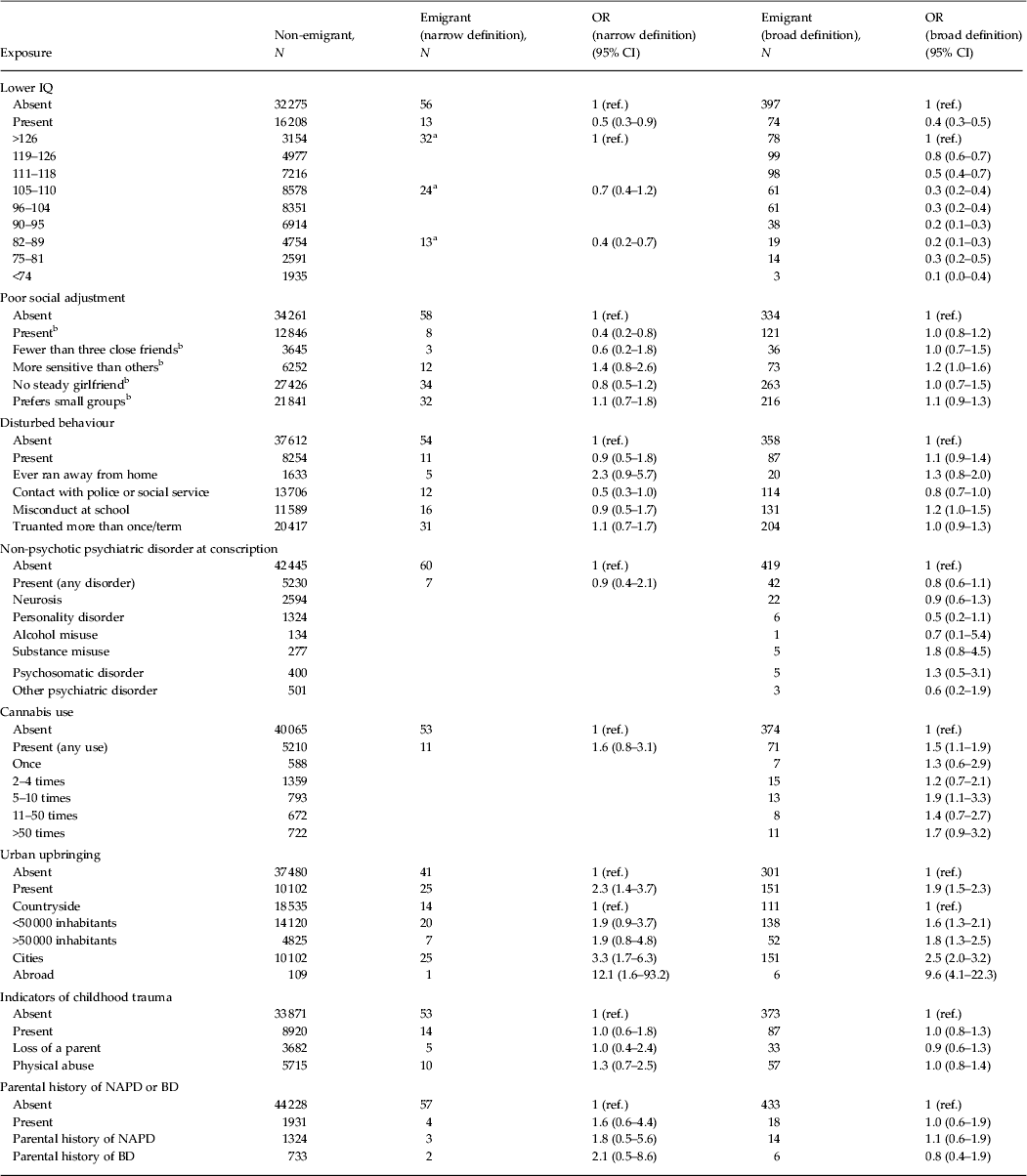
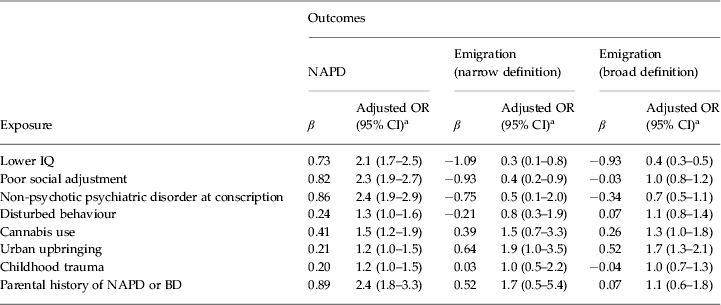
The frequencies of each exposure and the corresponding ORs for emigration are presented in Table 1. IQ was negatively associated with emigration, whether narrowly or broadly defined. When categorized in three IQ bands for the narrow definition and in nine IQ bands for the broad definition, significant linear trends emerged between IQ and emigration (χ 2 = 11.043, p < 0.01 and χ 2 = 155.4, p < 0.001, respectively). In addition, ‘poor social adjustment’ was less prevalent in the group of narrowly defined emigrants (OR 0.4, 95% CI 0.2–0.8), but not in the broadly defined group. There were no significant group differences on any of the individual social adjustment variables or in frequencies of reported ‘disturbed behaviour’. The prevalence of non-psychotic psychiatric disorder at the time of conscription was also similar in both groups. By contrast, emigrants were more likely to have been brought up in a city (OR 2.3, 95% CI 1.4–3.7) with an increasing odds contingent on an increasing level of urbanicity of the main residence during upbringing (χ 2 = 13.9, p < 0.001). This association held when using the broad definition of emigration. Cannabis use was significantly increased among individuals emigrating before age 40 years, but not among those emigrating before age 25 years, with a significant p value for linear trend (χ 2 = 7.7, p < 0.01). There were no significant group differences in the occurrence of parental death or physical abuse. Conscripts that emigrated were not significantly more likely to have been born to a parent with a NAPD or BD. Multivariate analysis (see Table 2) revealed that lower IQ was the strongest negative predictor for future emigration, broadly (p < 0.001) or narrowly (p < 0.05) defined.
Prevalence of risk factors for non-affective psychotic disorder (NAPD) according to emigrant status, narrow and broad definition, corresponding crude odds ratios (ORs) and their 95% confidence intervals (CIs)

Ref., Reference; NAPD, non-affective psychotic disorder; BD, bipolar disorder.
a Due to small sample size in the group of narrowly-defined emigrants, IQ was collapsed into three bands: <90, 90–110, >110.
b Discrepant results between the composite score of social adjustment and individual items are due to differences in the definitions (see Method section).
Associations between exposures at conscription and prospective risk of treatment for non-affective psychotic disorder, emigration out of Sweden before age 25 years (narrow definition) and before age 40 years (broad definition)

NAPD, Non-affective psychotic disorder; BD, bipolar disorder; OR, odds ratio; CI, confidence interval; β, standardized regression coeffcient.
a Adjusted for all other exposures in the regression model.
Hypothetical risk for developing NAPD
Standardized β-weights for each exposure and the concurrent OR for NAPD are depicted in Table 2. The final equation was [−5.317 + (0.728 × lower IQ) + (0.820 × poor social adjustment) + (0.872 × non-psychotic psychiatric disorder at conscription) + (0.235 × disturbed behaviour) + (0.411 × cannabis use) + (0.213 × urban upbringing) + (0.895 × parental history of NAPD or BD) + (0.212 × childhood trauma)]. Compared to non-emigrants, this regression formula yielded relative risks for developing NAPD of 0.7 (95% CI 0.4–1.2) and 0.8 (95% CI 0.7–1.0), respectively, for emigrants narrowly and broadly defined.
Discussion
We tested the hypothesis that risk factors for NAPD are more prevalent among young Swedish males who emigrated. The results showed that a history of urban upbringing and cannabis use were more common. Although this may lend some support for the selection hypothesis, these findings were counterbalanced by the decreased prevalence of low IQ and ‘poor social adjustment’. There were no major differences in the prevalence of other studied risk factors. The hypothetical risks for developing NAPD did not differ significantly between emigrants and non-emigrants.
There are some limitations that need to be addressed. First, our estimation of a hypothetical risk was restrained by the assumption that exposures remain stable over time, which in case of cannabis use and social adjustment may well be untrue. Nonetheless, IQ is considered to be relatively stable over time and emerged as the strongest predictor of emigrant status. Second, the selection mechanisms for emigration out of Sweden may differ from those related to migration from countries afflicted by poverty, unemployment, or political turmoil. Moeover, emigration rates and selection mechanisms may change over time. However, attachment to people in one's country of birth is a universal phenomenon and the present study does not support the hypothesis that emigration is prompted by an inability to establish social relationships. Third, it is impossible to examine all psychosis risk factors for their potential to stimulate migration and we cannot rule out that other mechanisms operate before migration. Last, this study relied on self-report questionnaires for most exposures, which may have introduced errors that could result in bias, if differential.
In accordance with the study by Pedersen et al. (Reference Pedersen, Mortensen and Cantor-Graae2011), we found that a personal history of mental illness does not predict emigration. Conversely, their finding of a parental history of BD as risk factor for emigration, is not supported by this study. Also contrary to their results, we observed that Swedes who had been brought up in the city were more likely to emigrate before their mid-twenties (Pedersen et al. Reference Pedersen, Mortensen and Cantor-Graae2011). This is not surprising given that individuals in urban areas are more likely to be internationally oriented and may encounter more possibilities to move abroad, especially those with a higher IQ and level of education.
On the whole, in keeping with previous studies (Rosenthal et al. Reference Rosenthal, Goldberg, Jacobsen, Wender, Kety, Schulsinger and Eldred1974; Selten et al. Reference Selten, Cantor-Graae, Slaets and Kahn2002; Lundberg et al. Reference Lundberg, Cantor-Graae, Kahima and Ostergren2007) our findings do not support the selection hypothesis. Rosenthal et al. (Reference Rosenthal, Goldberg, Jacobsen, Wender, Kety, Schulsinger and Eldred1974) noted that the process of emigration involves a high level of mental perseverance and planning skills. The cognitive profile required for successful emigration seems inconsistent with premorbid cognitive deficits found in some individuals developing psychosis later in life (Cannon et al. Reference Cannon, Bearden, Hollister, Rosso, Sanchez and Hadley2000). In fact, our findings of a higher IQ among emigrants and a higher level of social adjustment among those emigrating before age 25 years support the notion that the process of emigrating requires favourable environmental circumstances and certain individual qualities. In particular, our results are inconsistent with Ødegaard's characterization of most emigrants as socially maladjusted ‘loners’.
Acknowledgements
This work was supported by the European Community's Seventh Framework Program under grant agreement no. HEALTH-F2-2009-241909 (Project EU-GEI). The authors thank Sofia Löving for preparing and matching the databases. Dr Stanley Zammit has been an invaluable help in advising on definitions and categorizations of variables in the conscript database. We also thank Dr Nan van Geloven for providing statistical guidance. Dr Clifford Cassidy gave very useful comments to a preliminary version of this manuscript.
Declaration of Interest
None.