Introduction
Despite evidence of substantial disease burden of eating disorders (EDs) (Mathers et al. Reference Mathers, Vos and Stevenson1999), few studies have examined health services use among individuals with anorexia nervosa (AN), bulimia nervosa (BN) or eating disorders not otherwise specified (EDNOS). A comprehensive review (Simon et al. Reference Simon, Schmidt and Pilling2005) identified only six studies worldwide with data on health services use and cost among individuals with an ED. The review noted that despite indications of significantly elevated health services use among individuals with an ED, results in most studies probably reflect gross underestimates of the full magnitude of the economic burden because only in-patient costs were captured (e.g. Krauth et al. Reference Krauth, Buser and Vogel2002) or results were based on a limited set of cost data (Striegel-Moore et al. Reference Striegel-Moore, Leslie, Petrill, Garvin and Rosenheck2000). Moreover, only one study (Striegel-Moore et al. Reference Striegel-Moore, Leslie, Petrill, Garvin and Rosenheck2000) reported specific information on service use associated with EDNOS, the diagnosis most commonly encountered in clinical practice (Fairburn & Bohn, Reference Fairburn and Bohn2005). A recent evidence report commissioned by the Agency for Healthcare Research and Quality (Berkman et al. Reference Berkman, Bulik, Brownley, Lohr, Sedway, Rooks and Gartlehner2006) issued a call for more detailed information on the treatment of EDs, noting in particular the dearth of data concerning the treatment of individuals with EDNOS. Questions remain about the types of health services utilized by individuals with an ED and the frequency of their use of such services.
The present study sought to answer several questions about health services use among insured individuals with an ED. First, what is the number of individuals who experience an ED ‘new care episode’ in this population and where in the healthcare system are such cases typically diagnosed? Second, how does health services use associated with EDs compare with services use among demographically similar plan members without an ED the year prior to ‘detection’ (diagnosis) and in the 12 months following diagnosis? And, related, if there is elevated services use among the ED patients, does it vary by type of ED (AN, BN, EDNOS)? Finally, how does services use change from the pre-detection year to the post-detection year among patients with an ED?
To answer these questions, the study utilized the institutional database of a large health maintenance organization offering comprehensive health, mental health, and health education services. Specifically, services use for ED cases and comparison plan members was captured at three time points: at the visit when the ED was first diagnosed (‘index visit’); the 12-month period leading up to the index visit; and the 12-month period following the index visit. By focusing on these three time points, the study examined where services were being provided at the time of first diagnosis (‘index visit’); whether health services use among ED cases already differed from that of the comparison group in the year leading up to the index visit (‘prior year’); whether there was differential health services use once a provider had diagnosed the ED (‘post-year’); whether any excess services use among plan members with an ED varied by type of ED (AN, BN, EDNOS); and, for ED cases, how services use changed once the disorder was diagnosed.
Method
Data source
Data were obtained from a large healthcare organization in the northwestern United States. Comprehensive membership surveys indicate that members of the health plan are representative of the Portland, Oregon Metropolitan area, the geographic region served by the plan (Freeborn & Pope, Reference Freeborn and Pope1994). To be included in the sample, at the index visit participants had to be between the ages of 18 and 55 years, the population most likely to experience an ED (Hudson et al. Reference Hudson, Hiripi, Pope and Kessler2007). Participants also had to be health plan members for the duration of the observation period of this study (24 months); plan members on Medicaid or Medicare were excluded because their benefits package was substantially less comprehensive than that of regular health plan members.
Definition of ‘cases’
ED diagnoses were based on the diagnostic code entered by the healthcare provider in the patient's record. Patients were considered new care episodes (i.e. ‘cases’) if they received an ED diagnosis for the first time after a period of 12 months during which no diagnosis of an ED was identified in the medical record. The ED diagnosis at this ‘index visit’ was noted and patients could fall into one of three mutually exclusive diagnostic categories: AN, BN, and EDNOS. When more than one ED diagnosis was noted in the index visit record (3% of the cases), the following hierarchy was used for classification: any combination including AN was coded as AN; any remaining cases with a combination of BN and EDNOS were coded as BN. Thus any patient coded as EDNOS had only EDNOS as a diagnosis. To ensure that these diagnoses were meaningful characterizations, we also examined ED diagnoses over the subsequent year. More than 90% of participants did not shift diagnostic categories (e.g. EDNOS to AN or BN) in the subsequent year, increasing our confidence that these were reliable diagnostic classifications.
Definition of the comparison group
For each ED case, five comparison health plan members were randomly selected from among those members who had a health plan office visit within 3 months of the index visit date of the ED case for which he/she served as the match (to adjust for potential seasonal effects on health services use) and who matched the case on gender and age (within 3 months of date of birth) to adjust for the well-established effects of gender and age on health services use (Kessler et al. Reference Kessler, Demler, Frank, Olfson, Pincus, Walters, Wang, Wells and Zaslavsky2005) but who did not have any ED diagnosis within the 12 months prior to the index visit. We considered, but rejected, matching comparison plan members solely on the basis of gender and age. We were concerned that without the requirement of an office visit we might have identified a comparison sample of ‘super-healthy’ individuals, thus artificially magnifying possible differences in health services use between ED and non-ED health plan members.
Health services use categories
Health services use was coded into one of seven mutually exclusive categories, each reflecting number of days of service: primary care (including internal medicine, family medicine, and obstetric/gynaecological care); emergency or urgent care; mental health services; addiction medicine; out-patient specialty care (this category included all out-patient care not captured in the other service use categories; examples include ophthalmology, foot clinic); telephone consultations; and in-patient care. In addition, use of specific pharmacological treatments was coded as the percentage of patients who had received antidepressants and the percentage of patients who had received anxiolytics. On a given day, patients may have used more than one health service category (e.g. seen their family doctor for a primary-care consultation and received a prescription).
Health services use was examined at three time periods: the index visit (by inclusion criteria, all participants in this study had a service use in at least one of the first six of the above categories), the 12 months leading up to (but excluding) the index visit, and the 12 months following (but excluding) the index visit.
Demographic information
Information about patients' age (coded as age at the time of the index visit) and gender was extracted from electronic patient records.
Co-morbid diagnoses
The percentage of patients with the following diagnoses at the index visit was examined among both the cases and the comparison group: major depressive disorder, bipolar disorder, post-traumatic stress disorder (PTSD), anxiety disorders (excluding PTSD), alcohol-related disorders, drug dependence and/or abuse, tobacco dependence, adjustment disorder, and attention deficit disorder (ADD).
Data analyses
Because the controls were individually matched to the cases, a case response was compared with the median of the matched controls using a paired-sample t test. The median, rather than the mean, was used in these analyses because the health services use variables were not normally distributed. For this reason, the analyses were also repeated using Wilcoxon signed rank tests. With few exceptions (footnoted in the tables), the two tests yielded similar results, therefore only the paired-sample t tests will be reported here. The effect size reported was ‘number needed to take’ (NNT), which indicates how many cases you have to see to find one more ‘failure’ than if you had observed their matched controls, where ‘failure’ means having more health services or a greater frequency of co-morbid diagnoses. This effect-size statistic is strongly recommended for its clinical interpretability and independence from limiting assumptions about the distributions of responses in the groups being compared (Kraemer & Kupfer, Reference Kraemer and Kupfer2006). The larger the NNT, the weaker the difference between cases and matched controls, with NNT=1 indicating that every single case failed and every matched control did not. While the relationship between clinical significance and the size of the NNT is not well established, for the purpose of this discussion, NNT <4 is considered ‘strong’, NNT >9 is considered ‘weak’, and NNT values between 4 and 9 are considered ‘moderate’. If the responses were normally distributed, a ‘strong’ effect (NNT <4) would correspond to the more familiar standardized mean difference greater than 0.5 and a ‘weak’ effect (NNT >9) to one less than 0.2 (Kraemer & Kupfer, Reference Kraemer and Kupfer2006).
Post hoc analyses were conducted to test for the possible effect of ED diagnosis on elevated health services use. Because service use is known to vary with age (Kessler et al. Reference Kessler, Demler, Frank, Olfson, Pincus, Walters, Wang, Wells and Zaslavsky2005), an age term was also included in these analyses. For each category of service use, ‘excess’ utilization (defined as the difference between the case and the median of the comparison group) was entered into separate 3 (diagnosis: AN, BN, EDNOS)×3 (age group: 18–24, 25–34, 35–55 years) analyses of variance. These analyses were conducted for both the year prior to diagnosis and the year following diagnosis.
Results
Incidence of new care episodes of eating disorders
Among the 104 130 female and 93 628 male plan members aged 18–55 years, 332 (0.319%) women and 19 (0.0203%) men were found to have received an ED diagnosis at least once during the 2003 calendar year. The present sample contained too few men to be able to adequately examine gender-related service use patterns. Therefore, the remaining analyses were limited to data from female health plan members.
Of the 332 women identified, 204 had not been diagnosed with an ED in 2002 (satisfying the definition of ‘case’). The cases represent 0.1959% of the total number of female health plan members between the ages of 18 and 55 years with full membership during 2003 and no ED diagnosis in 2002 (n=104 130). Among the 204 cases, 28 (13.73% of cases; 0.0269% of female health plan members) were diagnosed with AN at the index visit, 77 (37.75% of cases; 0.0739% of female health plan members) were diagnosed with BN, and 99 (48.53% of cases; 0.0951% of female health plan members) were diagnosed with EDNOS. Mean ages of cases (comparison members were age matched within 3 months) were as follows: AN, mean age 28.11, standard deviation s.d.=8.54 years; BN, mean age 31.52, s.d.=9.8 years; EDNOS, mean age 30.65, s.d.=11.02 years.
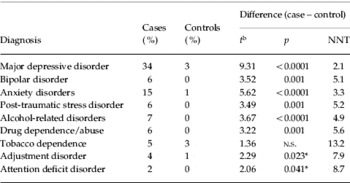
Group differences in psychiatric co-morbidity at the index visit are shown in Table 1. Psychiatric co-morbidity was noted significantly more often for ED cases than controls for major depression, bipolar disorder, anxiety disorders, PTSD, alcohol disorders, drug dependence or abuse, ADD, and adjustment disorder. The NNT estimates indicate that these differences are strong (NNT <4) for major depression and anxiety disorders, and moderate (4 <NNT <9) for bipolar disorder, PTSD, alcohol disorders, drug dependence/abuse, adjustment disorder, and ADD. The two groups did not differ significantly in the prevalence of tobacco dependence (NNT >9). By far the most common co-morbid psychiatric disorder noted among the ED cases was major depression, which was noted in one-third of the cases; anxiety disorders were the second most common co-morbid condition noted in 15% of cases. Co-morbidity was also examined for pre-year and post-year data and was found to have a similar pattern to that identified at the index visit (results not shown, but available upon request).
Co-morbid diagnoses at index date among eating disorder cases and their matched controlsFootnote a

NNT, Number needed to take; n.s., non-significant.
a Comparison plan members were matched to cases on gender, age (within 3 months), and date of index visit (within 3 months). Paired-sample t tests and the Wilcoxon signed rank test yield similar results, except as noted.
b Degrees of freedom=203.
* p>0.05 (Wilcoxon signed rank test).
To address the question of where EDs are first diagnosed within the healthcare system, we examined the frequency of service use categories on the index date for the ED cases. Of the seven possible health services categories, ED cases were identified in only one of three categories: most cases were diagnosed during a primary-care (n=102, 50%) or mental health (n=89, 43.63%) visit. A few cases (n=13, 6.37%) were identified during a specialty care visit.
Health services use of female plan members with versus without an eating disorder
Pre-index visit year
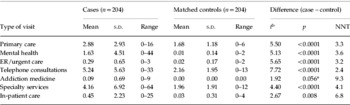
Group differences in services use during the 12 months leading up to the index visit are shown in Table 2. ED cases had more visits to the primary-care, mental health, and emergency/urgent-care departments as well as a greater number of telephone consultations than comparison patients. These differences were statistically significant and strong. ED cases also had significantly more specialty service visits, were hospitalized for a greater number of days, and had somewhat more addiction medicine visits, differences of only moderate to small effect size. Finally, ED cases were more likely than comparison patients to have received prescriptions for antidepressants [50% v. 22%, t(203)=7.81, p<0.0001, NNT=2.4], a strong effect, and anxiolytics [16% v. 7%, t(203)=3.36, p<0.002, NNT=5.4], a moderate effect.
Health services use among women with an eating disorder (cases) and women without an eating disorder (controls) in the 12 months prior to the index visitFootnote a

s.d., Standard deviation; NNT, number needed to take; ER, emergency room.
a Comparison plan members were matched to cases on gender, age (within 3 months), and date of index visit (within 3 months). Paired-sample t tests and the Wilcoxon signed rank test yield similar results, except as noted.
b Degrees of freedom=203.
* p<0.01 (Wilcoxon signed rank test).
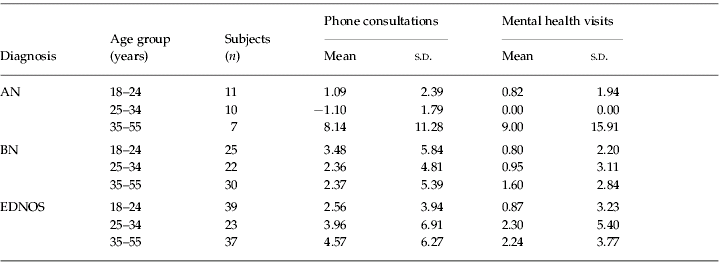
Planned post hoc tests compared services use among patients with AN, BN, and EDNOS (each category classed further into one of three age groups: 18–24, 25–34, 35–55 years). A statistically significant main effect of ED diagnosis was found for prescription of anxiolytics [F(2, 195)=3.33, p<0.04]. More patients with AN (26.3%) were prescribed anxiolytic medication than patients with BN (7.2%) or EDNOS (5.6%). The analyses yielded a significant main effect of age for prescription of antidepressants [F(2, 195)=4.37, p<0.02], with 49% of patients aged ⩾35 years having been prescribed antidepressants, compared with 28% of patients aged 25–34 years and 20% of patients younger than 25 years. There also were significant main effects of age group for phone consultations [F(2, 195)=4.5, p<0.02] and for mental health visits [F(2, 195)=9.29, p<0.0002]; however, these main effects were qualified by significant ED diagnosis by age group interactions [F(4, 195)=3.02, 4.10, p values <0.02]. The relevant means for these interactions are reported in Table 3. Examining these means, women in the 35–55 years age group with a diagnosis of AN showed very high usage for these two categories of use. These analyses should be interpreted with caution given the very small sample sizes for the AN group (e.g. there were only seven AN patients aged ⩾35 years), the unequal variances between groups, and the fact that the distributions, especially for AN, appear non-normal. No other significant main effects or interaction effects were found.
Average excess utilization in year prior to index visit in women with AN, BN and EDNOS, by age group, for phone consultations and mental health visits
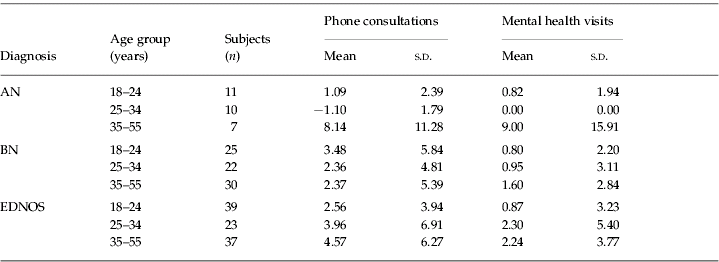
AN, Anorexia nervosa; BN, bulimia nervosa; EDNOS, eating disorders not otherwise specified; s.d., standard deviation.
Post-index visit year
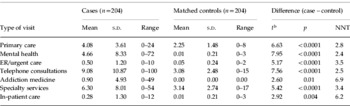
Group differences in services use during the 12 months following the index visit are shown in Table 4. ED cases had more visits to the primary-care, mental health, and emergency and urgent-care departments as well as a greater number of telephone consultations and specialty service visits than did comparison patients. These differences were statistically reliable and strong. Though ED cases also had significantly more mean days of hospitalization and more addiction medicine visits, the size of these effects was only moderate. ED cases were significantly more likely than comparison patients to have received prescriptions for antidepressants [68% v. 26%, t(203)=12.03, p<0.0001, NNT=1.7] and anxiolytics [22% v. 8%, t(203)=4.77, p<0.0001, NNT=3.8], both strong effects.
Health services use among women with an eating disorder (cases) and women without an eating disorder (controls) in the 12 months following the index visitFootnote a

s.d., Standard deviation; NNT, number needed to take; ER, emergency room.
a Comparison plan members were matched to cases by gender, age (within 3 months) and date of index visit (within 3 months).
b Degrees of freedom=203.
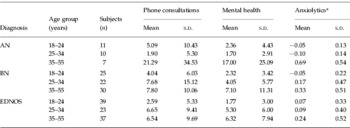
Planned post hoc tests comparing elevated health services use among patients with AN, BN and EDNOS in the 12 months post-diagnosis revealed no significant main effects of diagnostic group. There was a significant main effect of age group for specialty care visits [F(2, 195)=3.78, p<0.03], with the oldest patient group (mean=6.29) using specialty services significantly more often than either of the two youngest groups (means=2.32, 2.08, p values <0.05, respectively). There also were significant main effects of age group for mental health visits [F(2, 195)=13.80, p<0.0001], telephone consultations [F(2, 195)=7.10, p<0.002] and prescription of anxiolytics [F(2, 195)=15.39, p<0.0001], but these effects were qualified by significant ED by age group interactions [F(4, 195)=2.80, 2.81, and 2.90, respectively, p values <0.03). As shown in Table 5, consistent age group effects were evident among the AN group. Specifically, among patients with AN, 25- to 34-year-olds showed relatively low levels of mental health visits and telephone encounters whereas utilization for these categories was markedly high among those aged ⩾35 years. Similarly, the proportion of AN participants receiving prescriptions for anxiolytics was much higher than among those with BN and EDNOS for the 35–55 years age group, but there were very small differences between those with the different ED diagnoses for the younger age groups. In contrast, for participants with diagnoses of BN or EDNOS, service use did not vary consistently as a function of age for these three categories of use, though the lowest utilization appeared to occur among the 18- to 24-year-olds. No other significant main effects or interaction effects were found.
Average excess utilization in the 12 months following the index visit in women with AN, BN and EDNOS, by age group, for phone consultations, mental health visits, and prescription of anxiolytics

AN, Anorexia nervosa; BN, bulimia nervosa; EDNOS, eating disorders not otherwise specified; s.d., standard deviation.
a Means here represent average differences in proportion of participants receiving prescriptions for anxiolytics.
Change in health services use among eating disorder cases from pre-diagnosis year to post-diagnosis year
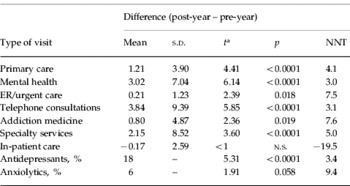
The average differences in utilization between the pre-diagnosis year and the post-diagnosis year among the ED cases are presented in Table 6. Health services use increased in the year following diagnosis, compared with the year prior to diagnosis, for all categories of service use measured with the exception of in-patient care which did not change significantly. The increases in services use were both statistically significant and strong for mental health visits and telephone consultations. Though group differences were statistically significant, the effect sizes were only moderate for primary care, emergency/urgent care, specialty service, and addiction medicine visits. There was a marked increase in prescriptions for antidepressants from 50% in the year prior to diagnosis to 68% in the year following diagnosis; in contrast, the percentage of cases receiving prescriptions for anxiolytics increased only slightly, from 16% to 22%.
Change in health services use among eating disorder cases from pre-year to post-year

s.d., Standard deviation; NNT, number needed to take; ER, emergency room; n.s., non-significant.
a Degrees of freedom=203.
Discussion
This study examined health services use among adult members of a large health maintenance organization who had been diagnosed with an ED in 2003. Overall, about 2/1000 female, and fewer than 2/10 000 male, health plan members received a diagnosis of AN, BN, or EDNOS in 2003 who had not yet been diagnosed with an ED in 2002. EDs are far less common among males than females (Hudson et al. Reference Hudson, Hiripi, Pope and Kessler2007) and the proportion of men who were found to have been diagnosed with an ED in the target year of the present study is consistent with findings based on a national insurance database (Striegel-Moore et al. Reference Striegel-Moore, Leslie, Petrill, Garvin and Rosenheck2000). Moreover, the 12-month ‘prevalence’ estimates (i.e. the number of individuals diagnosed with an ED, regardless of whether they had received an ED diagnosis in the prior year) and the ‘incidence’ estimate (i.e. the number of individuals who received an ED diagnosis for the first time in the target year) observed in the present study are far lower than prevalence estimates of EDs in community samples (there are no published estimates of the incidence of EDs based on US populations). This is consistent with findings from previous studies suggesting that many individuals do not access or receive treatment specifically for an ED (Garvin & Striegel-Moore, Reference Garvin, Striegel-Moore, Striegel-Moore and Smolak2001; Striegel-Moore, Reference Striegel-Moore2005).
The examination of health services use data of female health plan members yielded four major findings. One, 50% of the ED cases were first diagnosed during a primary-care visit, pointing to the critical importance of primary-care providers in identifying EDs, even in a health plan where members have direct access to specialty care including mental health services. Although several screening instruments have been developed to identify those experiencing an ED (e.g. Spitzer et al. Reference Spitzer, Kroenke and Williams1999; Stice et al. Reference Stice, Telch and Rizvi2000), they have not yet been tested in large, unselected populations of primary-care patients against reliable structured interviews nor do they seem to be used in routine clinical practice.
Two, health services use was significantly elevated in all service sectors among those with an ED compared with a randomly selected sample of women who did not have an ED diagnosis, both in the 12 months leading up to, and in the 12 months following, the index visit. The present study cannot disentangle whether the elevated services use reflects the considerable co-morbidity among individuals with an ED or an attempt by the patient to receive care without acknowledging the ED to herself or the healthcare provider. The high levels of co-morbidity observed in this study may in part be due to the fact that the more distressed and more highly co-morbid patients are more likely to have their ED diagnosed. Indeed, epidemiological studies have found an ED is almost never identified without a psychiatric co-morbid disorder having first been recognized but those studies also report that most ED cases meet criteria for another psychiatric disorder even among individuals whose ED has not been treated (Kendler et al. Reference Kendler, MacLean, Neale, Kessler, Heath and Eaves1991; Lewinsohn et al. Reference Lewinsohn, Hops, Roberts, Seeley and Andrews1993; Walters & Kendler, Reference Walters and Kendler1995; Hudson et al. Reference Hudson, Hiripi, Pope and Kessler2007). Major depression was the most common co-morbid mental disorder among women with an ED, probably reflecting both the large number of women with depression as well as ‘true’ co-morbidity (Kraemer, Reference Kraemer1995; Kraemer et al. Reference Kraemer, Wilson and Hayward2006). Co-morbid anxiety disorders were also noted in 15% of women with an ED diagnosis at the index visit. In light of the considerable number of women with co-morbid depression and anxiety disorder diagnoses, it is not surprising that many were prescribed antidepressant and/or anxiolytic medication in the year prior to diagnosis.
Beyond reflecting clinical need arising from co-morbid symptoms, the elevated services use in the year prior to diagnosis also may reflect patients' efforts to receive help specifically for ED symptoms without acknowledging the symptoms clearly. Denial is a hallmark of AN (Bruch, Reference Bruch1978) but is also common among individuals with BN, and ED symptoms are often ego-syntonic in the early stages of the disorder. Patients may not attribute their distress to, or acknowledge, body image concerns or disordered eating behavior, making it difficult for the care provider to detect an ED. An additional barrier to detecting EDs may be patients' shame about their disorder, which may make patients reluctant to give an unambiguous account of their problems; in turn, providers may not be sufficiently familiar with the signs or symptoms of EDs and miss patients' ‘hints’ that they suffer from disordered eating (Cachelin & Striegel-Moore, Reference Cachelin and Striegel-Moore2006). Our results suggest that physicians screen women for an ED, particularly those who are being treated for an anxiety disorder or for major depression.
Both prior to diagnosis and thereafter, patients with an ED are being treated not only in primary care or mental health care but also receive more services than non-ED patients in the form of telephone consultations, specialty care, and emergency/urgent care. This spectrum of services probably reflects the broad range of physical and psychiatric symptoms associated with EDs (Wonderlich & Mitchell, Reference Wonderlich and Mitchell1997). Following diagnosis, service use increases in particular in terms of prescription of antidepressants, telephone consultations, and visits to both mental health and primary-care departments.
Consistent with a previous report based on a national insurance consortium database (Striegel-Moore et al. Reference Striegel-Moore, Leslie, Petrill, Garvin and Rosenheck2000), in-patient treatment was uncommon. Focusing specifically on privately insured adolescent patients, Martin & Leslie (Reference Martin and Leslie2003) showed that from 1997 to 2000, psychiatric in-patient and out-patient treatment declined 20% and 11.3% respectively. They also noted a shift toward increased use of medication compared with ‘talking’ therapies. This trend is of particular concern in EDs where, to date, no specific medication has been identified for the treatment of AN, and where medication is less effective than cognitive behavioral therapy in the treatment of BN and binge eating disorder (Wilson & Shafran, Reference Wilson and Shafran2005).
Three, with the possible exception of older women with AN, elevated service use did not appear to vary significantly by type of ED. Of particular note is the finding that the group of patients with EDNOS did not have lower use of health services than those with AN or BN. This result is consistent with several studies suggesting that patients with EDNOS do not appear to represent individuals with a ‘less severe’ type of ED (Fairburn & Bohn, Reference Fairburn and Bohn2005). Our results underscore the importance of the EDNOS population both in terms of the absolute numbers of individuals who are being treated as well as their impact on the healthcare system in terms of greater service utilization.
Finally, although service use was elevated for those with an ED diagnosis compared with the controls, and increased significantly among the women with an ED in the year following diagnosis, inspection of average service use estimates suggests that this population is being under-treated. Specifically, the average number of mental health visits was well below the number of sessions of evidence-based psychotherapy (16–20) provided in randomized clinical trials of cognitive behavior therapy or interpersonal psychotherapy (Wilson & Shafran, Reference Wilson and Shafran2005). It is important to note that the relatively modest number of mental health visits was observed in a health plan that provides such services without restricting the number of sessions. Our data do not permit us to ascertain the reasons for the under-treatment of EDs in this population. Other studies have shown that under-utilization of mental health services is common among patients with mental health disorders in general (Wang et al. Reference Wang, Lane, Olfson, Pincus, Wells and Kessler2005; Alonso et al. Reference Alonso, Codony, Kovess, Angermeyer, Katz, Haro, De Girolamo, De Graaf, Demyttenaere, Vilagut, Almansa, Lepine and Brugha2007) and that the under-utilization is the result of a complex interplay of external (e.g. insurance plan restrictions) and internal (e.g. reluctance to seek care) factors. Both patients and providers should be encouraged to engage in a more sustained treatment effort than is reflected in the average number of mental health sessions (4–5) received by the individuals whose data were examined in this study.
Several limitations of the study need to be considered. Men comprise a minority of individuals who develop an ED (Hudson et al. Reference Hudson, Hiripi, Pope and Kessler2007) and are especially unlikely to receive treatment for an ED (Striegel-Moore et al. Reference Striegel-Moore, Leslie, Petrill, Garvin and Rosenheck2000). In the present study, only 19 men were found to have received health services for an ED during the calendar year of 2003; therefore, our sample was too small for further analyses concerning health services use among men. Only a small number of women with AN were identified. That individuals with AN comprise a minority among the population of individuals with EDs has been repeatedly documented in epidemiological and clinical studies (Hoek, Reference Hoek2006; Hudson et al. Reference Hudson, Hiripi, Pope and Kessler2007). The large heterogeneity in health services use in women with AN, especially among those aged >35 years where one individual accounted for much of the significantly elevated health services use, raises questions of how best to test hypotheses about differential health services use. We considered but rejected censoring health services use or omitting from analysis the one case with particularly high service use because the small number of women with AN aged >35 years in our sample made it impossible to determine with conviction what values, if any, represent true outliers. Nonetheless, we caution that our finding that AN disproportionately contributed to elevated services use observed among women with an ED needs to be replicated in unrelated samples.
Institutional data are limited by the fact that diagnoses cannot be verified. Cases might have been treated for an ED for some time before providers finally entered the diagnosis into the patient record. Because providers may not apply diagnostic criteria with the rigor typically employed in research, each of the ED groups may have included cases experiencing a different ED and this lack of precision may have obscured differences among ED groups in health services use. The comparison sample may include some individuals whose ED had not yet been detected or labelled. As has been found in previous studies, health services use varied considerably among individuals with an ED. It is unclear to what extent this variability reflects true differences in clinical need versus lack of consistency in the provision of care for EDs. Finally, we caution that our findings may not generalize to individuals with more restrictive or no health insurance plans.
The study's limitations are offset by several strengths, including the availability of objectively measured service use data that are probably more comprehensive and accurate than data that are based on self-reported service use (Garvin & Striegel-Moore, Reference Garvin, Striegel-Moore, Striegel-Moore and Smolak2001; Marshall et al. Reference Marshall, Grayson, Jorm and O'Toole2001), the inclusion of a very large sample, and the availability of health services data over multiple years rather than the shorter time period of 12 months or less used in previous studies.
Acknowledgements
This publication was supported by National Institutes of Health (NIH) research grant no. MH066966 (principal investigator: R. S. M., Wesleyan University) funded by the National Institute of Mental Health (NIMH) and the National Institute of Diabetes and Digestive and Kidney Diseases (NIDDK), awarded to the Kaiser Foundation Research Institute. Its contents are solely the responsibility of the authors and do not necessarily represent the official view of the NIH, NIMH, NIDDK or the Kaiser Foundation Research Institute.
Declaration of Interest
None.