INTRODUCTION
Most tree species in tropical forests are self-incompatible (Kress & Beach Reference KRESS, BEACH, McDade, Bawa, Hespenheide and Hartshorn1994), and almost all of them rely on animals for pollination (Bawa Reference BAWA1990). For plants, temporal variation in flowering time may be considered as a strategy to avoid interference or competition for pollinators among co-occurring flowering species (Baker Reference BAKER1960). Nocturnal pollination in plants has been suggested as an adaptation to escape competition for pollinators with diurnal flowering plants. Most tropical species in a Venezuelan plain are pollinated during the day; only about 10% are night-pollinated (Ramirez Reference RAMIREZ2004). In species-rich tropical ecosystems where pollinators are numerous and diverse and many animal-pollinated plants flower synchronously, it has been proposed that pollination of a given plant species by only a few animal species is likely to be advantageous (Richards Reference RICHARDS1996). In contrast to this speculation, most plant species are visited by many pollinator species, which has been interpreted to mean that pollination generalization is the rule rather than the exception (Waser et al. Reference WASER, CHITTIKA, PRICE, WILLIAMS and OLLERTON1996). However, using the same dataset as Waser et al. (Reference WASER, CHITTIKA, PRICE, WILLIAMS and OLLERTON1996), Fenster et al. (Reference FENSTER, ARMBRUSTER, WILSON, DUDASH and THOMSON2004) concluded that approximately 75% of flowering plant species exhibit pollination specialization to functional groups of animals (e.g. long-tongued bees, short-tongued bees, etc.). A similar figure was also obtained in the study of the tropical Venezuelan plain (Ramirez Reference RAMIREZ2004). At the finer scale, although it was suggested to occur rarely, plants that rely on only one species of pollinator are increasingly being described (Johnson & Steiner Reference JOHNSON and STEINER2000, Somanathan & Borges Reference SOMANATHAN and BORGES2001).
With approximately 800 species, the Bignoniaceae show great diversity in pollination mechanisms. In addition to the majority which are pollinated by medium to large bees, some are pollinated by hawkmoths, birds, bats and lemurs (Machado & Vogel Reference MACHADO and VOGEL2004). Oroxylum indicum Vent. is a small, deciduous/evergreen tree which is frequently found in forest edges and in secondary forest. Flowers of this tree have been recognized to conform to the bat pollination syndrome (van der Pijl Reference VAN DER PIJL1934). Anthesis occurs at night and the opened flower lasts for only a few hours (Gould Reference GOULD1978, Start Reference START1974). The precise morphological fit between this flower and the nectarivorous bat, Eonycteris spelaea, has been previously reported (Gould Reference GOULD1978), and faecal analysis carried out in Malaysia and southern Thailand confirmed that E. spelaea visits this plant (Bumrungsri unpubl. data, Start & Marshall Reference START, MARSHALL, Burley and Styles1976). Gould (Reference GOULD1978) demonstrated by various techniques that only E. spelaea visits flowers of this particular plant although a number of other fruit-eating bats were found feeding nearby, and only mature E. spelaea were heavy enough to bend corolla tubes to an appropriate angle in order to obtain nectar. This observation led to the hypothesis that O. indicum depends solely on E. spelaea for its pollination. Excellent photographs of E. spelaea visiting flowers of O. indicum have been published (Marshall Reference MARSHALL1983). However, morphological fit is rarely a sufficiently strong constraint to ensure pollination specialization (Waser et al. Reference WASER, CHITTIKA, PRICE, WILLIAMS and OLLERTON1996), and visitation by bats does not mean that plants are necessarily primarily pollinated by them (Start & Marshall Reference START, MARSHALL, Burley and Styles1976). Although it has been shown that the pollination syndrome suggested by the floral attributes of a species can reliably predict its pollinator (Muchhala Reference MUCHHALA2006), the pollination syndrome is sometimes misleading (Heithaus Reference HEITHAUS and Kunz1982, Marshall Reference MARSHALL1983, Ollerton Reference OLLERTON1998), thus, empirical evidence based on pollination experiments on each species is necessary before a conclusion is possible. The present study aims to determine the breeding system of O. indicum and to examine the hypothesis that E. spelaea is the sole pollinator of this plant.
METHODS
Study site
The study was conducted in Songkla (6° 7′N–7° 56′N, 100° 01′E–101° 06′E) and Phattalung (7° 6′N–7° 53′N, 99° 44′E–100° 26′E) Provinces (in southern Thailand) from June–October 2005, when O. indicum is in flower. The sampled trees occur in a mixed-fruit orchard (one tree), along a highway (two isolated trees), and on the campus (four isolated trees) of Prince of Songkla University (PSU) in Songkla Province (07° 00.4′N, 100° 30.7′E). The campus is at the edge of Hat Yai City, and at the base of Kor Hong Hill, which is about 6 km long and 1 km wide with an elevation between 30–140 m asl. The vegetation of the surrounding area is predominately characterized by old growth mixed with secondary forest and rubber plantation. The trees sampled at PSU were distributed in open areas around PSU office buildings. The climate of the past 10 y has been hot, with a mean temperature of 28.3 °C, relatively humid (average 72%), and mean annual rainfall was 2118 mm (Bumrungsri et al. Reference BUMRUNGSRI, SRIPAORAYA and LEELATIWONG2006).
Study species
Oroxylum indicum Vent. (Bignoniaceae) is a small, evergreen or deciduous tree growing up to 20 m tall. The genus is monotypic and is widely distributed from India, Bhutan, Nepal, southern China, and Indochina to Malaysia, Indonesia and the Philippines. The tree is often found in young secondary forest, forest edges, along streams or in highly sunlit areas such as roadside, villages, rice fields (Start Reference START1974, Zhang & Santisuk Reference ZHANG and SANTISUK1998). The seeds are large flat discs (1.5 cm across) surrounded by a large papery wing that promotes wind or water dispersal (Corner Reference CORNER1988).
Floral biology
A total of 35 flowers were sampled from two trees to analyse floral characteristics. The 20 flowers from the first tree were sampled from 20 June 2005 to 15 July 2005. The other 15 flowers from another tree were sampled from 31 July 2005 to 10 August 2005. Flower morphology and floral biology were examined, including the sizes of the corolla tube, anthers and stigmas, the lengths of the styles and stamens, scent, colour, time of nectar secretion and anthesis in total of 30–35 flowers. Pollen viability was estimated by germination tests. Eight flowers were cut from the trees at 20h00 on each night and kept in a humid atmosphere. Pollen was removed from the anthers and placed in a 15% sucrose solution for 30 min every 2 h. Germinated pollen was fixed with Formalin Acetic Acid (FAA) II and examined under a microscope. Stigma receptivity was determined by applying 3% hydrogen peroxide to stigmas. The presence of bubbling on the stigma indicated that it was receptive (Dafni Reference DAFNI1992). The number of pollen grains and ovules were counted from a total of 25 flowers from two trees. Five anthers from each sampled flower were kept in 1.25 ml of water in eppendorf tubes, and were pressed gently to release pollen, mixed well, and one drop of solution was placed on each of three slides. The number of pollen grains was counted over half of the slide grid, and the total number of pollen per flower was then calculated (Faegri & van der Pijl Reference FAEGRI and VAN DER PIJL1979). Ovules in an ovary were also counted under microscope. The pollen:ovule ratio was calculated for each flower.
Nectar production
Nectar production was determined from a total of 15 flowers from three trees. Nectar was collected with a 1-ml syringe every hour from 19h00 until nectar production had ceased or corolla drop between 01h30–02h00. Flower were bagged before nectar was collected, and after each hourly collection. Nectar concentration was measured with a pocket refractometer.
The minimum number of pollen grains for initiating fruit set
The minimum number of pollen grains for initiating fruit set was determined. Three amounts of pollen (c. 300, 600 and 900 grains) from freshly dehisced anthers were collected with cotton wool and transferred to stigma for cross-pollination. These flowers were bagged before anthesis and after subjected to experiment. A total of 12 flowers from six trees were subjected to each amount of pollen. Fruit set was checked 10 d after the experiment.
Pollination experiments
Breeding systems and the contribution of animal visitors to pollination success were assessed with five pollination treatments. These are (1) open pollination: flowers were left open permitting unhindered animal visitation, (2) automatic autogamy: flowers were bagged before they opened but left untouched, (3) facilitated autogamy: flowers were bagged before opening and were hand-pollinated with pollen from the same flower at 21h00 – 22h00, (4) hand-crossed pollination: flowers were bagged and emasculated before opening (17h00–18h00) and were hand-pollinated with pollen from freshly dehised anthers from different trees at 21h00–22h00, and (5) insect pollination: closed flowers were enclosed within plastic nets 15 cm diameter by 25 cm long (4 cm mesh size), allowing only insects to visit flowers. Hand pollination was performed by transferring pollen on the tips of cotton wool onto the stigmas. These experimental treatments were carried out on seven trees. In the first year (July–August 2005), the treatments were conducted on six trees. Five flowers per treatment in each tree were used, with a total of 34 and 33 flowers subjected to hand-crossed pollination and open pollination. Most of these flowers were in the same inflorescence. Fruits were checked 10–20 d after the experiments. Additional experimental treatments were conducted on one more tree in September 2006, and ten flowers were subjected to each of three treatments including open pollination, self-induced pollination and hand-crossed pollination. Flowers from the same trees were nested when ANOVA was applied to determine the variation in pollination success between treatments. All statistical analyses were undertaken with SPSS 11.0. The index of self-incompatibility (ISI) was calculated as the fruit:flower ratio in the self-pollination treatment divided by the fruit:flower ratio in the cross-pollination treatment (Bullock Reference BULLOCK1985).
Visitor observation
Flower visitors were observed using a night-shot video (SONY 740E, Sony Corp. Japan) set on towers c. 3 m from flowers and the observer sitting there. Visual observations of bat visits to flowers were also made by the aid of available light or seen against the sky. Visitation rates were determined by counting the number of insects and bats visiting flowers for 10 min h−1 from 19h00–02h00 for 15 flowers on seven trees, observed over 15 nights. The interval observation started from 19h00 until 02h00 in each night. Initially, direct capture of fruit bats with mist-nets set at flowering trees was undertaken, no bats were captured. Subsequently, bats were identified visually by photography at the peak activity. A Nikon SLR camera (FE2) with 70–210 mm lens and flash (Nikon SB 24), and later a digital camera (Nikon D70 with SB 600 flash) were used to take photographs from six trees. Two bat species were common in the study area; Eonycteris spelaea and Cynopterus sphinx. Eonycteris spelaea is the larger species (body mass 60–70 g and forearm length 65–80 mm) and feeds mainly on nectar. It has short chocolate brown hair, a long slender snout and neck hairs that are often tinged yellow (Lekagul & McNeely Reference LEKAGUL and MCNEELY1988). This bat often produces high-pitched ‘tseet’ calls when flying. Cynopterus sphinx (body mass 40–50 g and forearm length 65–70 mm) feeds mainly on fruits. It has a cinnamon-brown to red-brown and thicker hair than E. spelaea, and can also be distinguished by its typical white-rimmed ear and white wing bone (Lekagul & McNeely Reference LEKAGUL and MCNEELY1988). A reference collection of bat photographs was also made. Insects were identified when they visited flowers from pictures.
The number of pollen grains deposited after the first visit by bat and after corolla drop
To determine the number of pollen grains deposited after the first visit by bat, the stigmas of eight flowers from two trees were rapidly removed after the observer saw the first bat visiting recently opened flowers. Since bats arrive early at the time of flower opening, and also flowers were carefully and continuously observed since opening, other visitors that could have deposited pollen onto the stigma could be ignored. The stigmas were immediately put onto the slide prepared with melted Fuchsin jelly. The number of pollen grains on the stigma was counted under a microscope. To verify that stigma were solely closed by bats, the numbers of pollen grains deposited on the stigma after the corolla dropped in the early morning were also counted from a total of 30 stigmas of six trees. The stigmas were removed and deposited pollen grains were counted in the same way as the first-visit pollen load. The pollen grains of other species found deposited on the stigma were also determined.
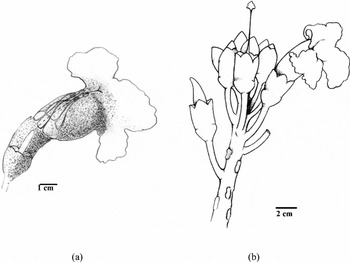
A bell-shaped flower and bilobed stigma (a) and the racemous inflorescence (b) of Oroxylum indicum. Scale bar = 1 cm for (a) and 2 cm for (b).

RESULTS
Floral biology
In each tree, up to 15 terminal racemes were present. The number of flowers per inflorescence varied between 30 and 62 (mean ± SD = 51 ± 2.3, n = 15). Only one or two flowers per inflorescence were open each night, and each inflorescence generally flowered for 10 wk. The corolla was strong, infundibuliform, five-lobed, 80.3 ± 13.2 mm in length, and 65.9 ± 15.8 mm wide at the lip. The corolla tube was purple-red externally, and creamy white on the inner surface. There was a light purple hairy patch at the middle of each corolla lobe. There were five fertile stamens. Anthers contained two elliptic cells, basifixed. The style terminated in a bilabiate stigma which was highly sensitive and closed within about 10 s after it was touched (Figure 1). The style was 47.4 ± 15.4 mm long and was exserted 12–25 mm beyond the anthers. The superior ovary was on the top of a nectariferous disc. The number of ovules and pollen grains in each flower was 306 ± 20.8 and 269 600 ± 750, respectively. The pollen:ovule ratio was 884:1 (n = 25). There were 2–16 pods per inflorescence (mean 5.6 ± 4.0, n = 16).
Flowers opened from 19h00 to 20h30, earlier in wet weather. Flower opening was quite rapid, taking c. 5 min. The flower had a strong musty odour. The corolla dropped at c. 02h00 on the night of opening. All flowers dropped at nearly the same time. Unpollinated flowers were shed within 3 d. The stigma was receptive during the period of flower opening. Stigmas (n = 5) were also tested for their receptivity before the flowers open, but none of them was found to be receptive. Anthesis occurred between 19h00–20h40 which was the time of flower opening or slightly thereafter. Pollen grains were ovoid (like a rugby-ball) and tri-colpate with reticulate sculpture. More than half of pollen grains remained viable throughout the night and decreased to about 30% 24 h after anthesis (Figure 2). Pollen was easily shed when the anthers are touched, and appeared to be released shortly after the flowers open. Nectar was secreted earlier, before the flowers open. Nectar secretion was 3.37 ± 0.12 (SD) ml per flower (range = 2.7−3.9, n = 15) with the concentration of 13–22% sucrose by weight. The nectar secretion rate was highest at 20h00 to 22h00. At least 900 pollen grains were needed to initiate fruit set in cross pollination. Seven out of 12 flowers in treatment with that amount of pollen grains set fruit, while other treatments set no fruit.
Average germination percentage (+ SD) of pollen of Oroxylum indicum in 15% sucrose solution (n = 3 flowers). In each time interval, a mean of 460 ± 229 pollen grains were germinated (range 180–937). Standard deviation is shown.

Pollination experiments
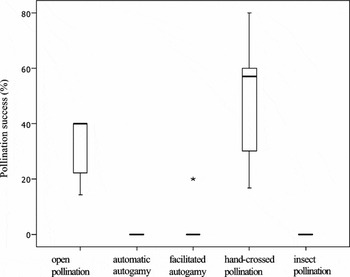
Following hand-crossed pollination, 16–80% of flowers in each tree set fruit (average = 47.7%, median = 57.1%, n = 7 trees, 44 flowers) while 14–40% of the flowers in each tree in open pollination set fruit (average = 31.2%, median = 40%, n = 7 trees, 43 flowers) (Figure 3). In contrast, spontaneous selfing and insect pollination set no fruit. Only a single flower from one tree in self-induced pollination treatment set fruit (n = 7 trees, 40 flowers). There was a significant difference between treatments (nested ANOVA, F = 14.1, P < 0.001). The difference between hand-crossed pollination and open-pollination was statistically significant (F = 31.37, P = 0.001). The self–incompatibility index was 0.06.
Pollination success in experiments carried out in seven Oroxylum indicum trees in Songkla and Satun Provinces during July 2005−September 2006. The box represents lower quartile, median, and upper quartile. The whiskers and star represent minimum and maximum, and extreme outlier values.

Visitor observation
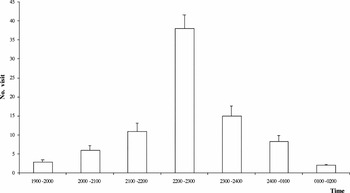
Fruit bats were the main visitors to O. indicum. From 47 still pictures of foraging bats, all were identified as Eonycteris spelaea. The first bats arrived at the flowers at 19h30, the peak of visiting time was 22h00–23h00; visitation steadily decreased after that time (Figure 4). Bats, either a single or a small group of them, made several visits intermittently for a few minutes and disappeared in pulse fashion throughout the night till the corolla dropped. On average, nectarivorous bats visited each flower 65 ± 3.5 times per night. Bats usually landed on the flowers using their feet and claws to grab the corolla tube, and then inserted their snout into the corolla tube to feed on the nectar and consequently, dusted the forehead with pollen. Each visit lasted for only 1–2 s. A single sphingid moth was observed to visit a flower, but it did not come into contact with the stigma or stamens.
Mean number of visits (+ SD) by Eonycteris spelaea to Oroxylum indicum. The observations covered 15 flowers from 15 nights in August–November 2005.

Number of pollen grains deposited on the stigma after the first visit by bat and after corolla drop
The mean (± SD) number of pollen grains deposited on the stigma after the first visit of E. spelaea was 1655 (± 1796, range = 120–4105, n = 8). The same figure for the number of conspecific pollen grains deposited on closed stigmas observed after corolla drop in the morning was 1615 (± 1114, range = 543–5002, n = 30) which was not significantly different from the former (Mann–Whitney test, Z = −0.72, df = 38, P = 0.474). Pollen grains of three other species were found deposited on the stigma observed in the morning including Musa spp., Parkia spp. and an unknown taxon. The pollen grains of each of them contributed (mean ± SD) 5.8% ± 3.9% (range = 0.7–13.3%), 3.7% ± 2.6% (range = 0.7–10%) and 1.8% ± 1.1% (range = 0.4–4%) of the total pollen grains deposited on the stigma (n = 30 stigmas), respectively.
DISCUSSION
Breeding system and effective pollinators
Oroxylum indicum is highly self-incompatible; cross pollination is vital for pollination success, while selfing is very rare. The breeding system in this plant also supports the prediction based on its pollen:ovule ratio (Cruden Reference CRUDEN2000). Such a breeding system appears to be typical of the Bignoniaceae. Of the 38 species (out of 800 species total) of Bignoniaceae in which the breeding system has been examined, self incompatibility has been found in 31 species. Further studies indicated that all examined species are characterized by late-acting self incompatibility (Bittencourt & Semir Reference BITTENCOURT and SEMIR2006).
With its self-incompatible breeding system, Oroxylum indicum is pollinator-dependent. The results of this study support the hypothesis that O. indicum is solely dependent on the nectarivorous bat, Eonycteris spelaea for pollination, and pollen load from only one visit by the bat is generally sufficient to initiate fruit set of O. indicum. Pollen counted after the corolla dropped confirmed that bats are responsible for all pollen load. Eonycteris spelaea is regarded as a legitimate and effective pollinator since it made frequent visits, depositing pollen onto the stigma and causing nearly all of the fruit set in O. indicum. On the other hand, moths can be regarded as nectar robbers. Although only a few flowers of O. indicum open each night, E. spelaea was observed to visit intermittently throughout the night until corolla drop which supports the previous suggestion that this bat uses a trap-line foraging strategy when feeding on this steady-state plant (Gould Reference GOULD1978). Nectarivorous bats are often effective pollinators (i.e. they successfully transfer pollen to conspecific flowers), however they are not efficient pollinators, since most of the transported pollen is wasted through interspecific pollination or removed by grooming (Fleming & Sosa Reference FLEMING and SOSA1994). Oroxylum indicum has a touch-sensitive stigma, a character common within the Bignoniaceae. The stigma of O. indicum takes a few seconds to close fully after touching, and closes permanently if it receives intraspecific pollen (Srithongchuay unpubl. data). Thus, the first visit appears to be the most important for female reproductive success. On average, sufficient pollen grains were deposited on the stigma in the first visit of E. spelaea, however, 40% of these stigmas received less pollen than the minimum number of pollen grains (900 pollen grains) required for fruit setting. Moreover, pollen grains from other chiropterophilous species were also found deposited on the stigma of O. indicum.
Advantage of pollination specialization
Competition for pollinators is a potentially very strong selection pressure within populations of flowering plants. The combination of steady-state flowering (in which few flowers open per night over relatively long periods) and the reliance on a trap-line pollinator species is one way to achieve an advantage since plants receive higher visit frequency per energy expended and cross-pollination is assured when the flowering trees are incorporated into the foraging routes of such pollinators (Gentry Reference GENTRY1974). In addition, the trap-lining pollinator is maintained when nectar is predictable (Fleming Reference FLEMING and Kunz1982). When relatively few flowers per inflorescence are available each night, as in steady-state flowering, outcrossing is promoted (Barrett & Harder Reference BARRETT and Harder1996, Harder & Barrett Reference HARDER and BARRETT1995, Thomson & Plowright Reference THOMSON and PLOWRIGHT1980). With its large foraging range, up to 38 km (Start Reference START1974, Start & Marshall Reference START, MARSHALL, Burley and Styles1976), E. spelaea is capable of maintaining gene flow of O. indicum over a large area. Both the foraging range of its pollinator and its breeding system could explain the surprisingly high genetic diversity of this species observed in the newly colonized Krakatau Islands (Parrish Reference PARRISH2002) which is at least 30 km from the mainland. Although pollination specialization is quite rare in tropical forests, it is suggested to be more common in species-rich communities, and when the pollinator is predictable (Johnson & Steiner Reference JOHNSON and STEINER2000, Ramirez Reference RAMIREZ2004).
Conservation
Due to its self-incompatibility and reliance on Eonycteris spelaea for pollination, the future survival of Oroxylum indicum appears to depend on the survival of this nectarivorous bat. Serious declines in populations of E. spelaea from hunting in some areas including Thailand have been reported (Mickleburgh et al. Reference MICKLEBURGH, HUTSON and RACEY1992, S. Bumrungsri, pers. obs.). As a consequence, the likelihood of pollination failure in O. indicum may increase. The rapid stigma closure of O. indicum flowers also reduces the probability that other generalized nectarivorous animals will replace E. spelaea as effective pollinators. Thus, declines in pollinator populations may affect O. indicum more than other plant species that are pollinator generalists. The nectarivorous cave-dwelling bat, E. spelaea, which roosts mainly in large caves (Bumrungsri unpubl. data, Start Reference START1974), is also known as the major pollinator of other economically and ecologically important plants including durian (Durio zibethinus), petai (Parkia speciosa), P. timoriana, Sonneratia spp., and Duabanga grandiflora (Bumrungsri et al. unpubl. data, Hopkins Reference HOPKINS1994, Soepadmo & Eow Reference SOEPADMO and EOW1976, Start & Marshall Reference START, MARSHALL, Burley and Styles1976). Thus, protecting bat populations and their roosts is necessary for maintaining crop yields and ecological complexity.
ACKNOWLEDGEMENTS
This study was funded by Department of Biology, Prince of Songkla University. We wish to thank Booppha Pongsri, Khwansuthorn Pathompark, Niwat Sritongchuay, Pannawadee Poonsuk, Phutharate Pornprasit, Yoawadee Rungreang, and Soawaluck Buain for field assistance. Pipat Soisook and Sunate Karapan assisted with photographs. The authors are very grateful to S. Mazer, A. Brooke and P. A. Racey for constructive comments and correction. Three anonymous reviewers significantly improved the manuscript.